Lead Generation for Recruitment Agencies: 2026 Playbook
Most recruitment agencies confuse candidate sourcing with client acquisition. Here is the channel-by-channel playbook for filling your client pipeline in 2026 — with real numbers, costs, and timelines.
TL;DR
- Recruitment agencies have two funnels, not one. Candidate sourcing is a supply problem; client acquisition is a sales problem. Most agencies staff the first and improvise the second.
- The highest-yield signal in 2026 is still the job posting. A company that posted a role 14 days ago and hasn't closed it is a warm lead with a budget already approved.
- Outbound to hiring managers beats outbound to HR for contingency and exec search; HR wins for RPO and high-volume staffing. Match the persona to the deal type.
- Expect 8–14 weeks from first touch to signed terms in contingency search. Anything promising 7-day client acquisition is selling you a course.
- Build the list from hiring signals, verify before you send, and keep send volume under 40/day per mailbox. Deliverability kills more agency pipelines than bad copy does.
Why is lead generation for recruitment agencies different from normal B2B?#
Because you are selling a service that your buyer only wants when something has already gone wrong.
Think of it like being a plumber. Nobody browses plumbers on a Tuesday afternoon. They call when water is coming through the ceiling. Your job is not to convince a VP of Engineering that recruiters are valuable in the abstract — it is to be the name in their inbox on the day their internal TA team misses a deadline on a Staff Engineer req that's been open 62 days.
That changes the mechanics in three ways:
- Timing beats targeting. A perfect-fit account with no open roles is worth less than a mediocre-fit account with three stale reqs. Intent is the primary sort key.
- The buyer is fragmented. Depending on the deal, your economic buyer is a hiring manager, a Head of Talent, a COO, or a procurement lead. Each needs a different message.
- Your proof is inventory. Unlike a SaaS pitch, you can lead with something concrete: "I have three placed-elsewhere finalists from a similar search who'd take your call." That is a fundamentally stronger opener than a value prop.
The second mistake is structural. Agencies build sophisticated candidate-sourcing machines — Boolean strings, ATS hygiene, outreach sequences — and then run client acquisition off the founder's LinkedIn and whoever the billing consultants happen to know. The tooling that finds candidates is not the tooling that finds clients, and the two funnels should not share a headcount.

What are the actual lead sources that produce client meetings?#
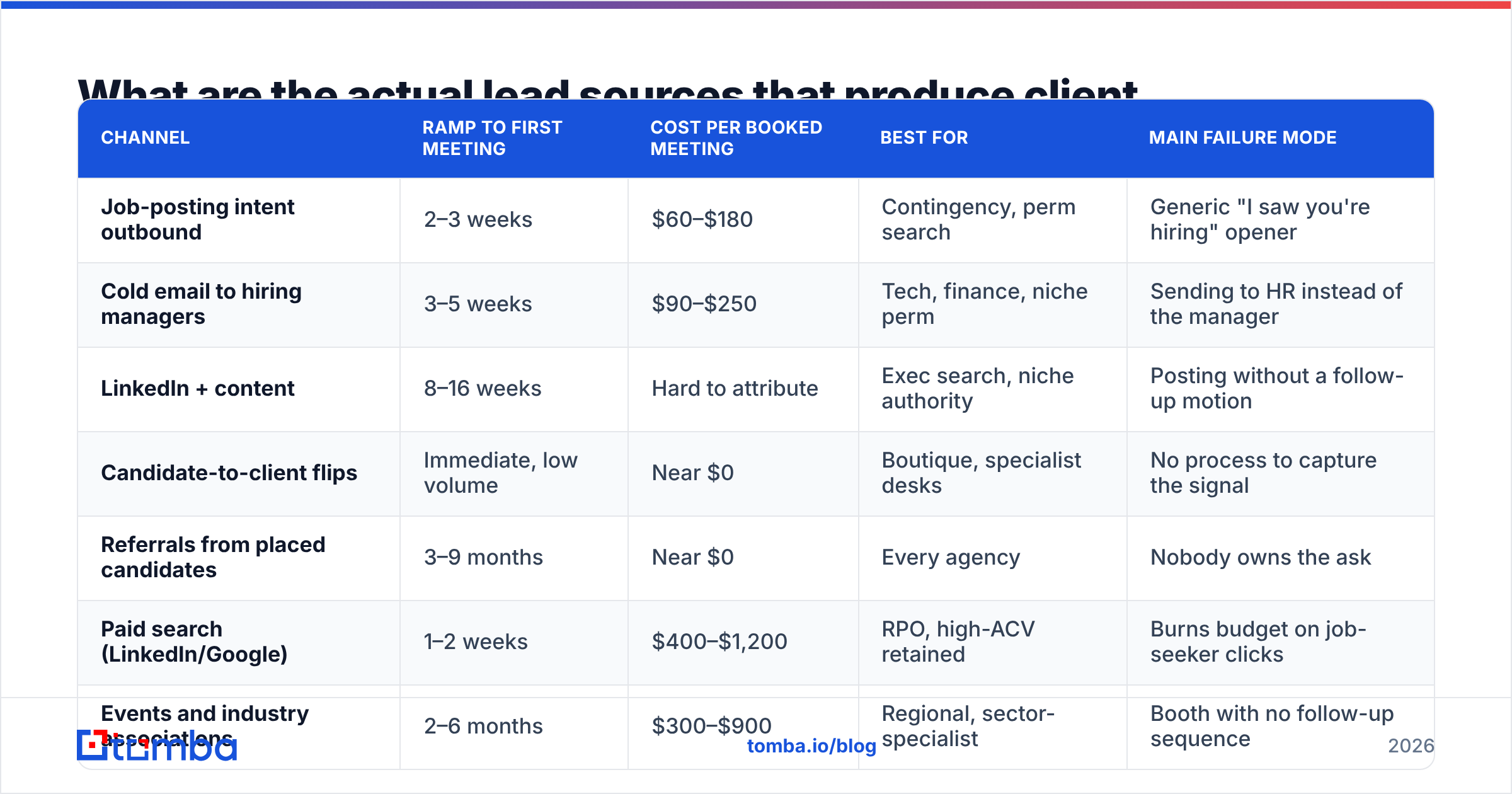
Here is what the channels look like when you strip out the agency-marketing hype and compare them on cost, ramp time, and what they realistically produce.
| Channel | Ramp to first meeting | Cost per booked meeting | Best for | Main failure mode |
|---|---|---|---|---|
| Job-posting intent outbound | 2–3 weeks | $60–$180 | Contingency, perm search | Generic "I saw you're hiring" opener |
| Cold email to hiring managers | 3–5 weeks | $90–$250 | Tech, finance, niche perm | Sending to HR instead of the manager |
| LinkedIn + content | 8–16 weeks | Hard to attribute | Exec search, niche authority | Posting without a follow-up motion |
| Candidate-to-client flips | Immediate, low volume | Near $0 | Boutique, specialist desks | No process to capture the signal |
| Referrals from placed candidates | 3–9 months | Near $0 | Every agency | Nobody owns the ask |
| Paid search (LinkedIn/Google) | 1–2 weeks | $400–$1,200 | RPO, high-ACV retained | Burns budget on job-seeker clicks |
| Events and industry associations | 2–6 months | $300–$900 | Regional, sector-specialist | Booth with no follow-up sequence |
| Funding-round triggers | 2–4 weeks | $80–$200 | Startup/scale-up desks | Everyone else emails them too |
Two things stand out. First, the cheapest channels — candidate flips and referrals — have the lowest ceiling and the least control. They are a floor, not a strategy. Second, the channels with the best economics all depend on the same underlying asset: a clean, well-timed list of the right people at the right companies.
That's the part most agencies skip, and it's why their cold email numbers look like a rounding error.
How do you build a client list from hiring signals?#
Work backwards from the trigger. Five signals, ranked by how reliably they convert:
- Stale job posting (14–45 days old). The sweet spot. Budget approved, internal team struggling, no incumbent agency locked in yet. Under 14 days is too early — they're still optimistic. Over 60 days often means the req is frozen.
- Reposted role. A company that reposts the same title within 90 days is publicly admitting the first attempt failed. This is the single strongest buying signal in the category.
- Funding announcement (Series A–C). Headcount plans follow within 30–60 days. High competition — every agency has a Crunchbase alert — so you need a differentiated angle, not just congratulations.
- New VP/Director hire in a function you staff. New leaders build teams. A new VP Sales will open 4–8 reqs inside two quarters.
- Competitor agency churn. Harder to detect, but a company that has cycled through two agencies on one req is ready for a specialist.
Once you have the trigger, you need the person. This is where the operational work lives. A job posting gives you a company and a title, not a contact. You need to resolve "Series B fintech, hiring a Head of Risk" into "Marta Oduya, VP People, marta@company.com, direct line."
That resolution step is where most in-house processes break down. Scraping a careers page is easy; getting a deliverable address for the right decision-maker is not. A domain search pulls the full contact map for a target company so you can see who actually owns hiring for that function, and an email finder resolves a specific name-plus-company into a verified address. For desks that work off LinkedIn lists of hiring managers, a LinkedIn finder closes the same gap from the other direction.
Then verify. Recruitment lists decay faster than average B2B data because TA teams themselves churn heavily — HR functions routinely see 20%+ annual turnover, which means a six-month-old talent-acquisition list is meaningfully stale. Running the list through an email verifier before the first send is not optional; it's the difference between a 2% bounce rate and a burned domain.
Should you target HR or hiring managers?#
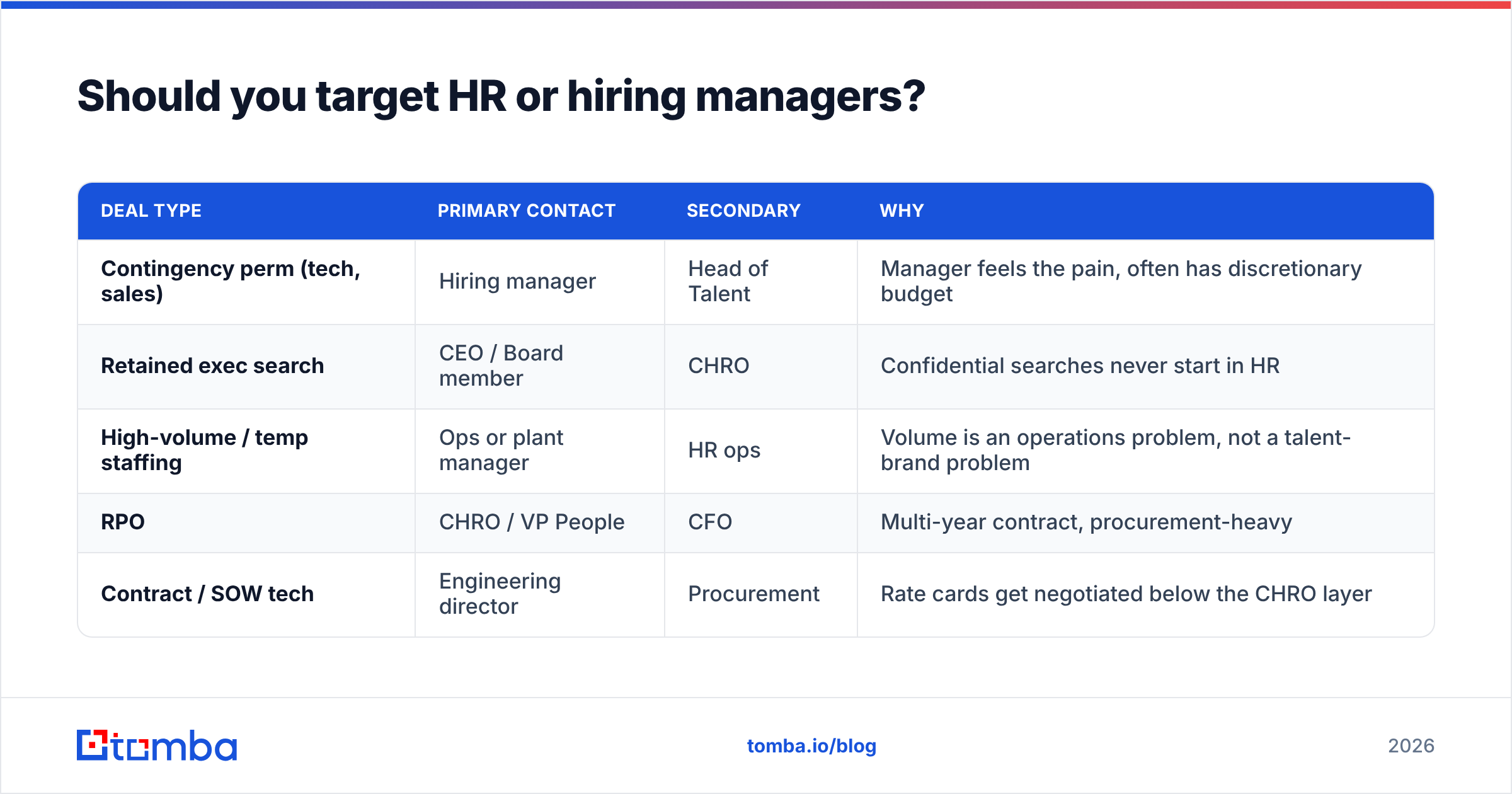
Depends on what you sell. This is the single most common targeting error in agency outbound, and it's fixable in an afternoon.
| Deal type | Primary contact | Secondary | Why |
|---|---|---|---|
| Contingency perm (tech, sales) | Hiring manager | Head of Talent | Manager feels the pain, often has discretionary budget |
| Retained exec search | CEO / Board member | CHRO | Confidential searches never start in HR |
| High-volume / temp staffing | Ops or plant manager | HR ops | Volume is an operations problem, not a talent-brand problem |
| RPO | CHRO / VP People | CFO | Multi-year contract, procurement-heavy |
| Contract / SOW tech | Engineering director | Procurement | Rate cards get negotiated below the CHRO layer |
The nuance: hiring managers reply faster but can't always sign. HR signs but is structurally incentivised to say "we have a PSL and it's closed." The workable play for contingency is to win the manager's enthusiasm first, then let them pull you through the HR gate. Going HR-first on a contingency pitch means competing on the one axis where you have no advantage — vendor list politics.
For manager-level outreach you'll also need direct dials more often than you'd like, because engineering and ops leaders ignore email at a much higher rate than HR does. A phone finder paired with your email sequence lifts connect rates on that persona specifically; for HR personas, skip the calls and put the effort into email.
What does a cold email that books recruitment meetings look like?#
Short, specific, and built around inventory rather than credentials.
The failing pattern, which you have received a hundred times:
"Hi Sarah, I'm a specialist recruiter with 12 years in the fintech space. We've helped companies like X and Y build world-class teams. Would you be open to a quick 15-minute call to discuss your hiring needs?"
Nothing here is false. Nothing here is a reason to reply. It's credential-led, asks for time before giving value, and could have been sent to 4,000 people.
The pattern that works:
"Sarah — saw the Senior Backend Engineer req went back up on your careers page on the 3rd. Second posting since June, if I'm reading it right.
I placed two engineers out of [specific competitor] last quarter on near-identical specs. Both had Go + payments infra, both moved for scope rather than comp.
I have one similar profile currently in play. Worth a 10-minute call before I take him elsewhere?"
Four things it does: names the trigger, proves domain specificity, offers inventory rather than a meeting, and creates real urgency rather than manufactured urgency. The "before I take him elsewhere" line only works if it's true — and that's the point. Recruitment outbound has an honesty advantage most industries don't: you genuinely do have scarce inventory.
On volume: keep it under 40 sends per day per mailbox, use 2–3 dedicated sending domains rather than your primary, and warm each mailbox for at least three weeks. Google and Yahoo's bulk-sender requirements, in force since 2024 and tightened since, mean a spam-complaint rate above 0.3% gets you throttled regardless of how good your copy is. Google's own sender guidelines are the authoritative reference here, and they're short enough to read in full.
Follow-up cadence for this category: day 1 email, day 4 LinkedIn view + connect, day 7 email 2 (new angle, not a bump), day 12 call, day 20 email 3 (break-up with a resource). Four to five touches across three weeks. Agencies that stop at two touches leave roughly half their meetings on the table.

Which tools do recruitment agencies actually need for this?#
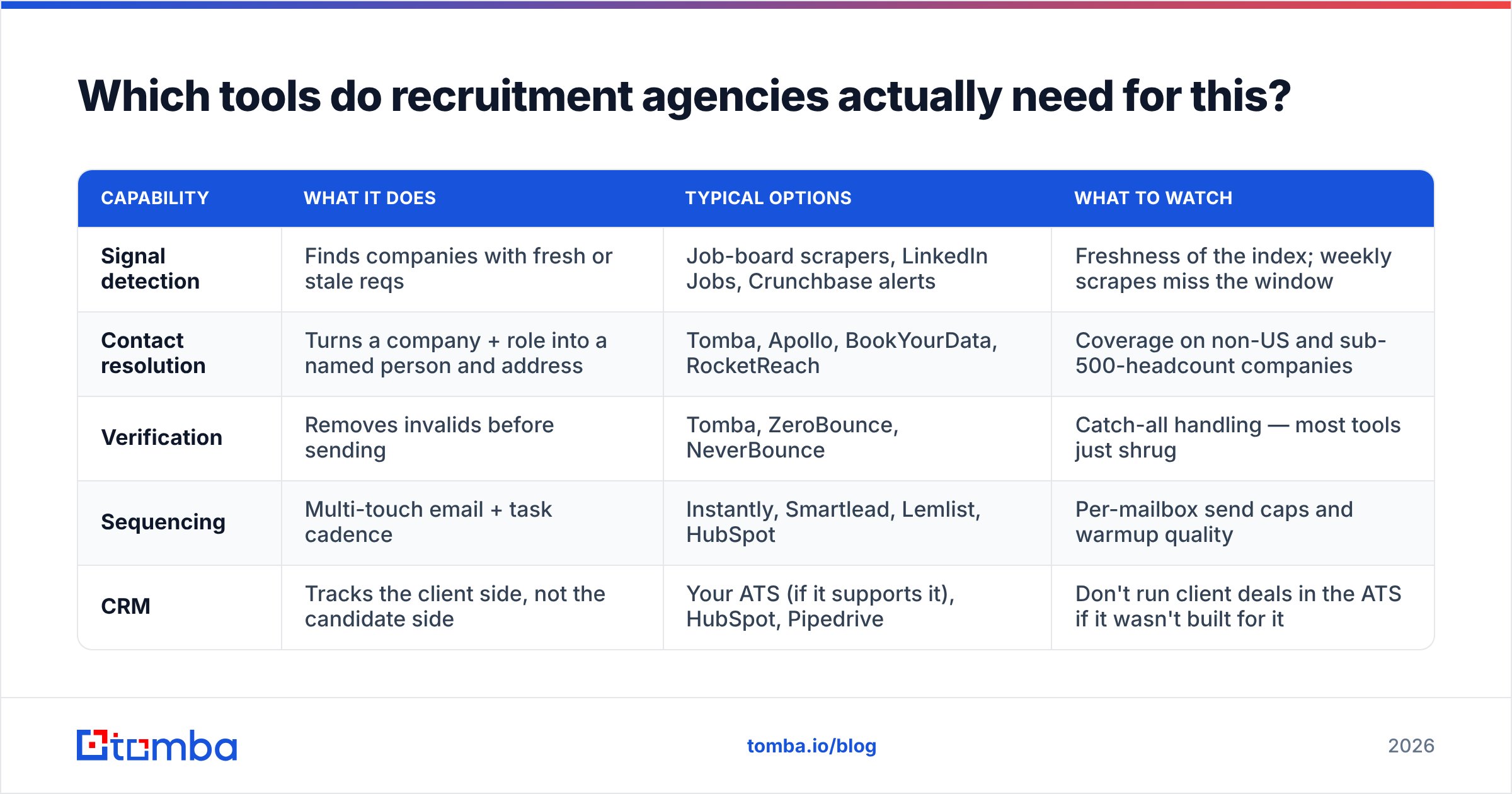
You need four capabilities, and you can cover them with fewer tools than most stacks assume: signal detection, contact resolution, verification, and sequencing. Adding a fifth tool usually adds a sync problem, not a result.
| Capability | What it does | Typical options | What to watch |
|---|---|---|---|
| Signal detection | Finds companies with fresh or stale reqs | Job-board scrapers, LinkedIn Jobs, Crunchbase alerts | Freshness of the index; weekly scrapes miss the window |
| Contact resolution | Turns a company + role into a named person and address | Tomba, Apollo, BookYourData, RocketReach | Coverage on non-US and sub-500-headcount companies |
| Verification | Removes invalids before sending | Tomba, ZeroBounce, NeverBounce | Catch-all handling — most tools just shrug |
| Sequencing | Multi-touch email + task cadence | Instantly, Smartlead, Lemlist, HubSpot | Per-mailbox send caps and warmup quality |
| CRM | Tracks the client side, not the candidate side | Your ATS (if it supports it), HubSpot, Pipedrive | Don't run client deals in the ATS if it wasn't built for it |
A note on the contact-resolution layer, since it's where budget gets wasted. The pricing models differ more than the products do. Credit-based platforms like Tomba start at $49/mo for Starter with a free tier of 25 searches for testing coverage before you commit, then $99/mo for Growth and $249/mo for Pro. Prepaid database providers like BookYourData sell verified contacts by the record, which suits agencies that want a one-off list for a specific vertical rather than an always-on API. Seat-based platforms like Apollo bundle sequencing in, which is convenient until you have four consultants and the seat math turns ugly.
The honest framing: if you're pulling 200–2,000 contacts a month against a rolling list of hiring signals, a credit-based finder plus a separate sequencer is cheaper and more accurate than an all-in-one. If you're buying a static list of 5,000 HR directors in one region once a quarter, a per-record database is the better fit. If you're running a 12-seat desk with heavy SDR activity, the all-in-one's bundled sequencing may justify the seat cost.
For agencies with a technical resource, the Tomba API lets you wire the resolution step directly into a job-scraping script, so a new stale req produces a verified contact row automatically. That's the version of this process that scales without adding headcount — and it's what separates an agency doing 15 client meetings a month from one doing 60.
How do you measure whether any of this is working?#
Track four numbers, weekly, and ignore the rest until these are healthy:
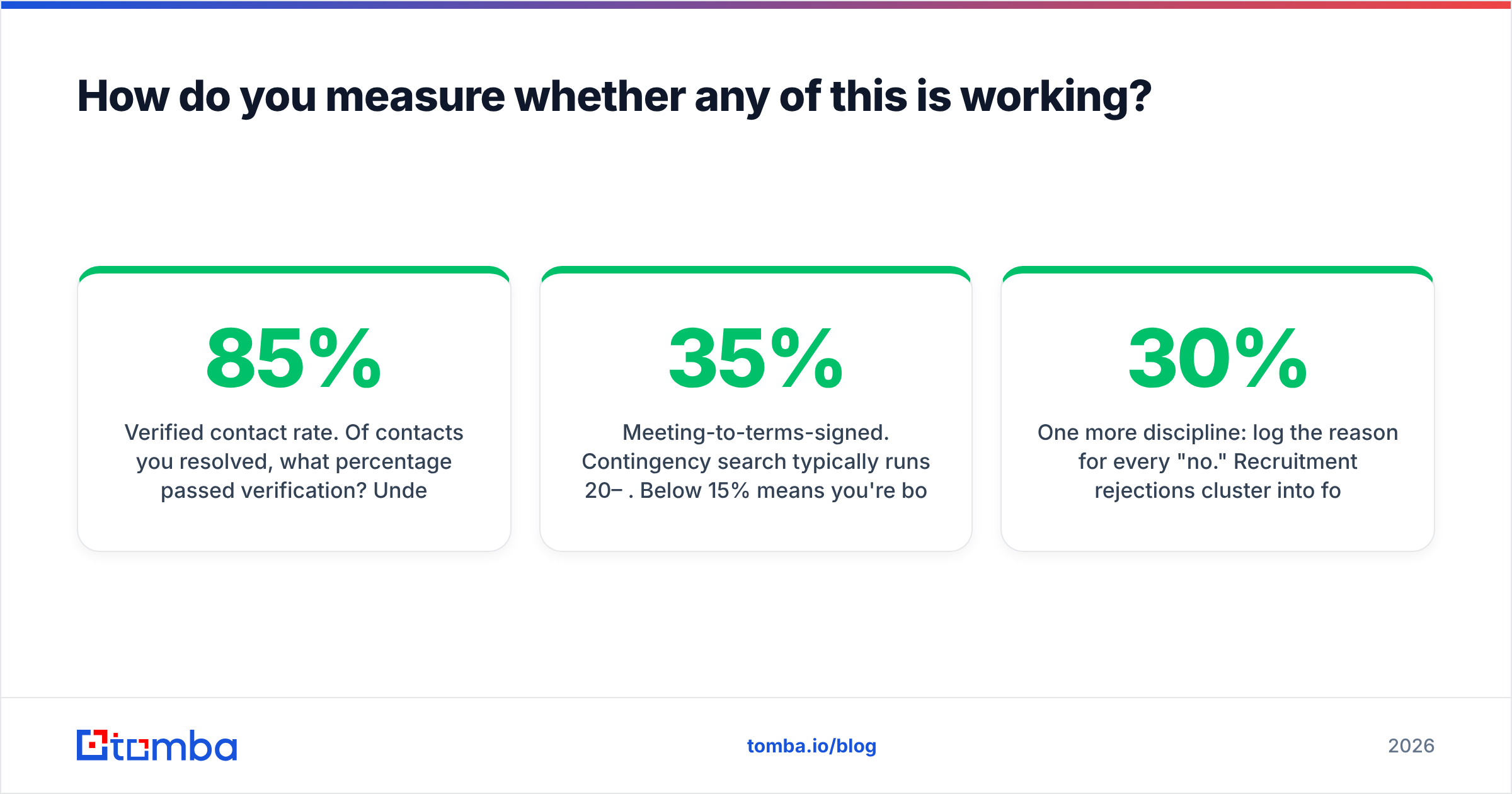
- Verified contact rate. Of contacts you resolved, what percentage passed verification? Under 85% means your source data is weak. Over 95% is achievable on standard corporate domains.
- Reply rate per persona. Segment hiring managers from HR. If they're the same number, your copy isn't actually differentiated.
- Meetings per 100 verified sends. Healthy for recruitment outbound: 1.5–3. Below 1, your trigger selection is wrong, not your copy.
- Meeting-to-terms-signed. Contingency search typically runs 20–35%. Below 15% means you're booking meetings with people who can't sign.
Watch the lag. First touch to signed terms averages 8–14 weeks in contingency, longer in retained. If you judge a channel at week four, you will kill things that were about to work. Set the review gate at week ten, and until then only optimise the leading indicators — deliverability, reply rate, meeting rate.
One more discipline: log the reason for every "no." Recruitment rejections cluster into four buckets — PSL is closed, no budget this quarter, using internal TA only, bad timing. Three of those four are "not now," not "never." Route them into a 90-day nurture and re-approach on the next hiring signal. Agencies that do this well generate 20–30% of new client wins from accounts that said no the first time. G2's staffing software category is a reasonable place to sanity-check whichever CRM you use to hold that nurture list.
What should you do in the next 30 days?#
A concrete sequence, not a framework:
- Week 1 — Pick one vertical and one signal. Not three. One. For example: Series A–C fintech companies with an engineering req older than 21 days.
- Week 1 — Build a 200-account list. Scrape or manually collect the companies matching that signal. Resolve decision-maker contacts with a bulk email finder, then verify the full list before it goes near a sequencer.
- Week 2 — Warm two sending domains. Do not send from your primary. Three weeks of warmup minimum; start the clock now so you're ready when the list is.
- Week 3 — Write three openers, all trigger-led. Test the trigger phrasing, not the sign-off. Send 40/day/mailbox.
- Week 4 — Add the call layer. Any contact that opened twice but didn't reply gets a dial. This is where the meeting rate roughly doubles.
- Week 6 — Review leading indicators only. Bounce rate under 2%, reply rate above 4%, meetings booked above 3. Fix whichever is worst; don't touch the others.
The agencies that win this are not the ones with the best copy. They're the ones whose list is built on a real trigger and whose contact data is clean enough that the copy ever gets read.
Start with the list. If your client pipeline is thin, the fix almost always sits upstream of your messaging. Pull a target vertical, find the hiring managers behind the reqs, and verify before you send — the Tomba Email Finder covers the resolution and verification steps in one pass, with a free tier of 25 searches so you can test coverage on your own vertical before paying anything. Build the list properly, and the rest of the playbook above actually has something to run on.
Related guides#
// get started
Find, verify and enrich your first contacts today
Start on the free plan with 25 searches a month, then scale when your team is ready.
Free plan · No credit card required · GDPR & CCPA
// about the author