Lead Generation for SaaS: The 2026 Playbook That Works
Most SaaS lead gen advice is recycled 2019 content. Here is what actually fills pipeline in 2026: channel benchmarks, real CAC math, and the data layer that decides whether any of it works.
TL;DR
- Lead generation for SaaS in 2026 is a portfolio problem, not a channel problem. Companies growing above 40% YoY run three to four sourcing motions at once, not one "winning" channel.
- Paid search CAC for B2B SaaS keeps climbing — expect $180–$600 per qualified demo in crowded categories. Outbound and product-led motions are the pressure valve.
- The MQL-to-pipeline handoff is where most SaaS teams leak money. Fixing routing and qualification usually beats adding a new channel.
- Your data layer decides everything downstream. A 70% deliverable list turns a great sequence into a mediocre one before a single word is read.
- Start with one repeatable motion, instrument it properly, and only add a second channel when the first one has a known cost per opportunity.
What does lead generation for SaaS actually mean in 2026?#
Lead generation for SaaS means building a repeatable system that turns strangers into accounts with a real evaluation intent — not collecting form fills. That distinction matters more now than it did five years ago, because buying committees got bigger and attention got cheaper to buy but harder to convert.
Three structural things changed between 2021 and 2026:
- Buying committees expanded. Gartner has tracked B2B buying groups at six to ten stakeholders for years, and in software purchases above $25K it is now normal to see security, finance, and a data governance reviewer in the thread. One champion is not a deal.
- Self-serve became the default first touch. Buyers do 70%+ of evaluation before talking to anyone. If your product has no free tier, trial, or interactive demo, you are paying a tax on every other channel.
- Email volume exploded, and inbox providers responded. Google and Yahoo's bulk-sender enforcement pushed the floor higher on authentication and complaint rates. Sloppy senders do not get throttled anymore — they get filtered silently.
The practical consequence: a "lead" is no longer a useful unit. Track accounts showing evaluation behavior and qualified opportunities created, and let the lead count be a diagnostic metric rather than a target.

Which lead generation channels work best for SaaS?#
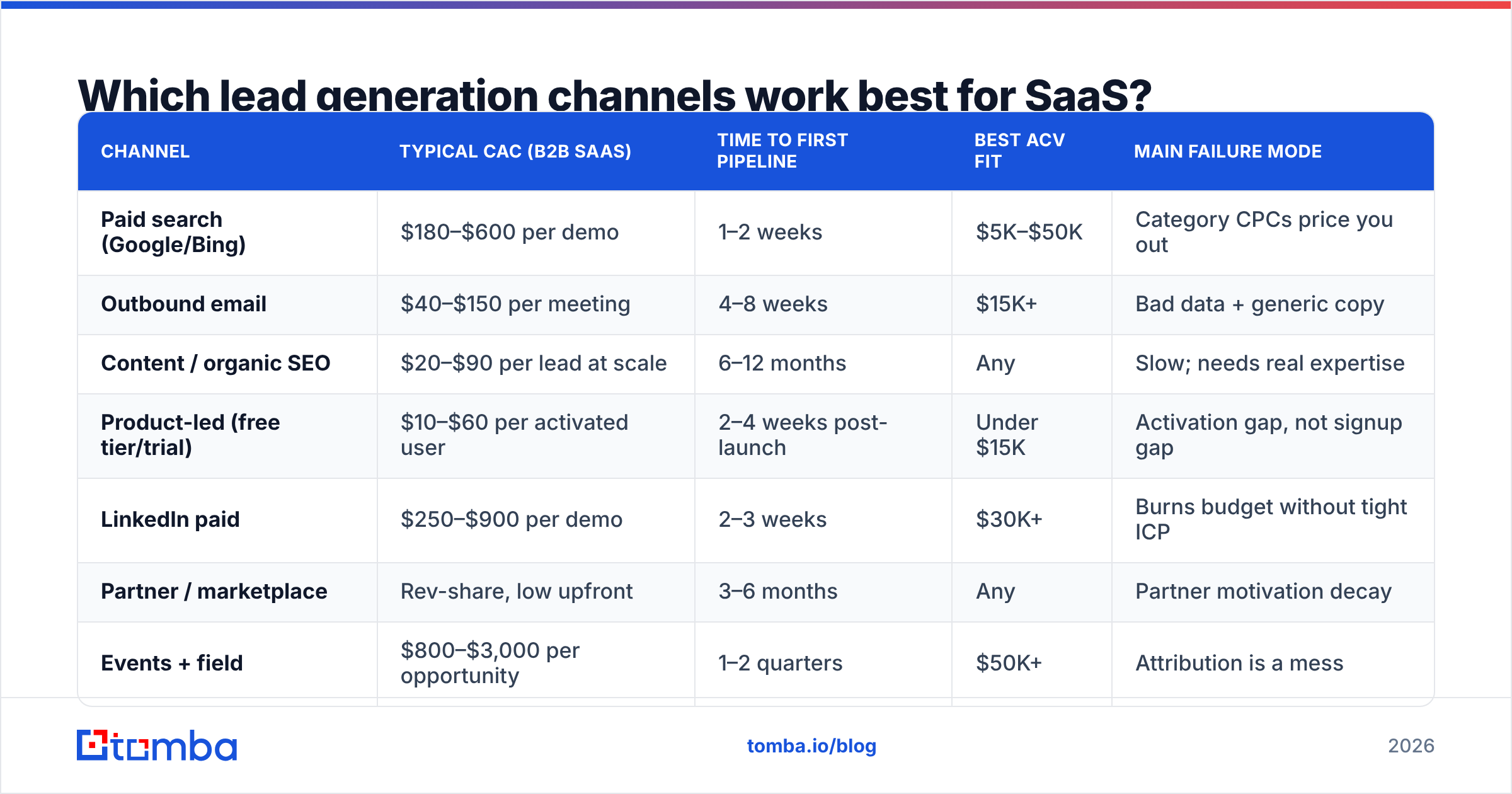
There is no single best channel — there is a best channel for your ACV, sales motion, and category maturity. Here is how the main options compare on the numbers that actually determine whether they'll work for you.
| Channel | Typical CAC (B2B SaaS) | Time to first pipeline | Best ACV fit | Main failure mode |
|---|---|---|---|---|
| Paid search (Google/Bing) | $180–$600 per demo | 1–2 weeks | $5K–$50K | Category CPCs price you out |
| Outbound email | $40–$150 per meeting | 4–8 weeks | $15K+ | Bad data + generic copy |
| Content / organic SEO | $20–$90 per lead at scale | 6–12 months | Any | Slow; needs real expertise |
| Product-led (free tier/trial) | $10–$60 per activated user | 2–4 weeks post-launch | Under $15K | Activation gap, not signup gap |
| LinkedIn paid | $250–$900 per demo | 2–3 weeks | $30K+ | Burns budget without tight ICP |
| Partner / marketplace | Rev-share, low upfront | 3–6 months | Any | Partner motivation decay |
| Events + field | $800–$3,000 per opportunity | 1–2 quarters | $50K+ | Attribution is a mess |
Read that table as ranges, not gospel — your category and geography move every number. But the shape holds: paid gets you speed and costs the most per unit, content costs patience, outbound sits in the middle and scales linearly with data quality, and product-led has the best unit economics if your product can sell itself without a human.
How do you pick among them?#
Use ACV as the first filter. Under about $10K ACV, a human-led sales motion usually cannot pay for itself — you need product-led growth with outbound layered on for the larger accounts that self-serve surfaces. Between $15K and $75K, outbound plus paid search is the workhorse combination. Above $75K, field, partner, and highly targeted account-based motions take over because you only need dozens of deals, not thousands.
Second filter: category maturity. If buyers already search for what you do ("email verification tool"), capture the demand with search and SEO. If they don't know your category exists, you have to create demand, and that means outbound, content, and community — nobody is going to search for a solution to a problem they haven't named.
Why do most SaaS lead generation programs stall?#
They stall for four reasons, and only one of them is "we picked the wrong channel."
- Data decay. B2B contact data degrades roughly 2–3% per month through job changes alone. A list built in January is meaningfully wrong by June. Teams blame copy when the real issue is that a third of their sends never reached a human.
- The qualification handoff. Marketing ships an MQL, sales ignores it, nobody agrees on why. If your MQL-to-SQL conversion is under 15%, the definition is broken, not the volume.
- No channel gets to maturity. Six weeks of outbound, declare failure, pivot to LinkedIn ads, six weeks, pivot again. Each channel needs two full sales cycles before you have a signal.
- Attribution theater. Teams optimize toward the metric their dashboard can measure — form fills — instead of the one the board cares about, which is pipeline created per dollar spent.
The fix for the first one is structural, and it is worth spending a section on because it silently sets the ceiling on every other channel you run.
How much does your data layer really matter?#
More than your copy. Here is the arithmetic that most teams never run.
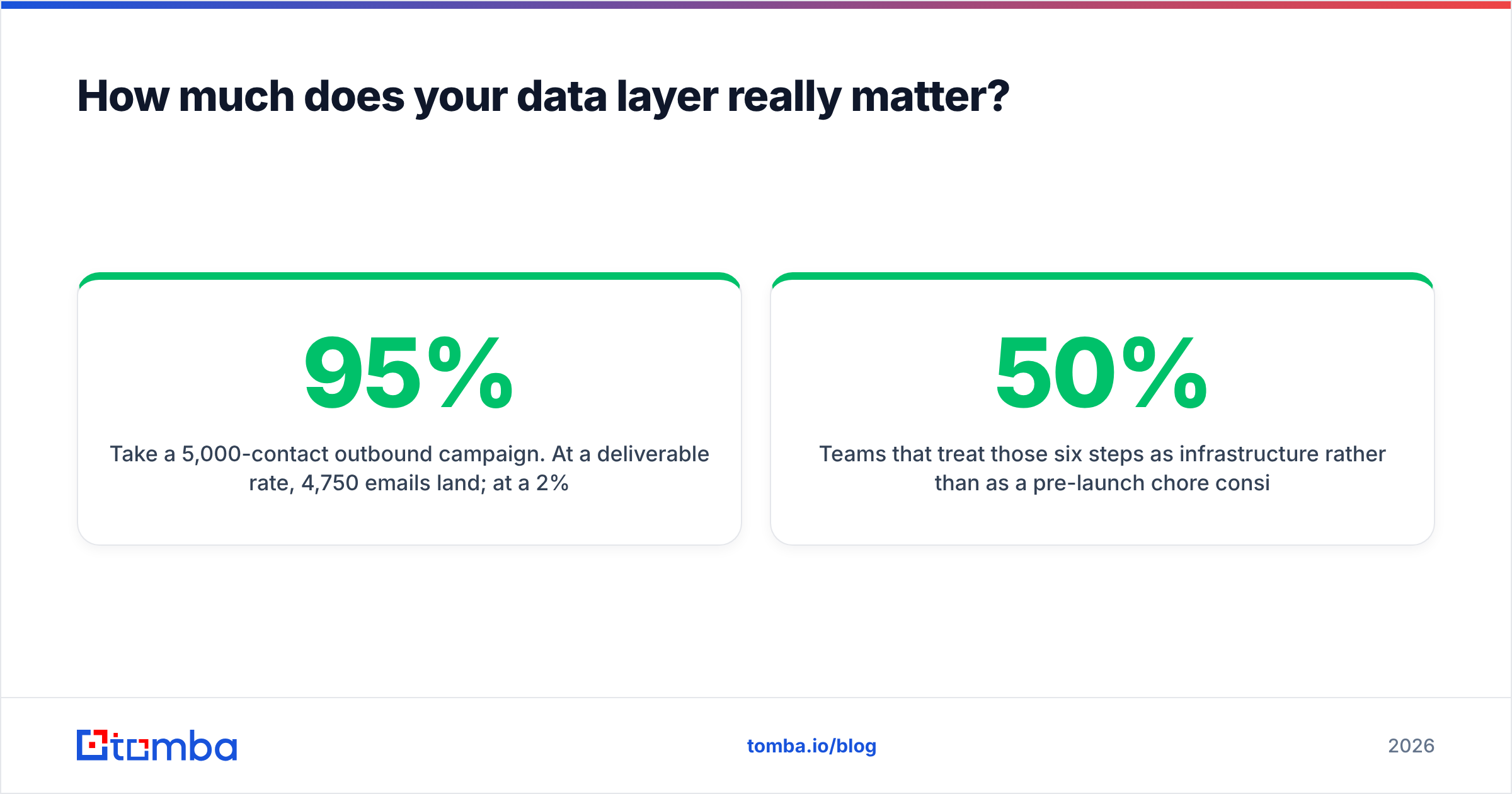
Take a 5,000-contact outbound campaign. At a 95% deliverable rate, 4,750 emails land; at a 2% reply rate you get 95 replies. Drop the data quality to 75% deliverable and you get 3,750 landed emails — but the real damage is worse than the 1,000 lost sends. High bounce rates degrade your sender reputation, which suppresses the deliverability of the sends that were valid. You end up somewhere near 55 replies, not 75. The loss compounds.
That is why the sequencing matters: source, verify, enrich, then write. A good email verifier run before any campaign costs a fraction of what a burned sending domain costs to repair.
Practical data-layer checklist:
- Source from the domain, not a static list. Domain search pulls current, pattern-derived addresses for a company instead of relying on a snapshot someone scraped 18 months ago.
- Verify before every send, not once at import. Contacts you verified in Q1 are not verified in Q3.
- Handle catch-all domains explicitly. A large share of enterprise domains accept everything at the SMTP layer. Treat "catch-all" as its own bucket with its own send strategy, not as valid.
- Enrich for routing, not vanity. Headcount, funding stage, and tech stack should change which sequence a contact enters. If enrichment fields don't change behavior, stop paying for them.
- Deduplicate at the account level. Three reps emailing three people at one company in the same week is the fastest way to get blocked.
- Suppress aggressively. Current customers, open opportunities, competitors, and anyone who replied "no" in the last 180 days.
Teams that treat those six steps as infrastructure rather than as a pre-launch chore consistently see 30–50% better reply rates on identical copy. It is the least glamorous lever and the highest-leverage one.

Is product-led growth better than outbound for SaaS?#
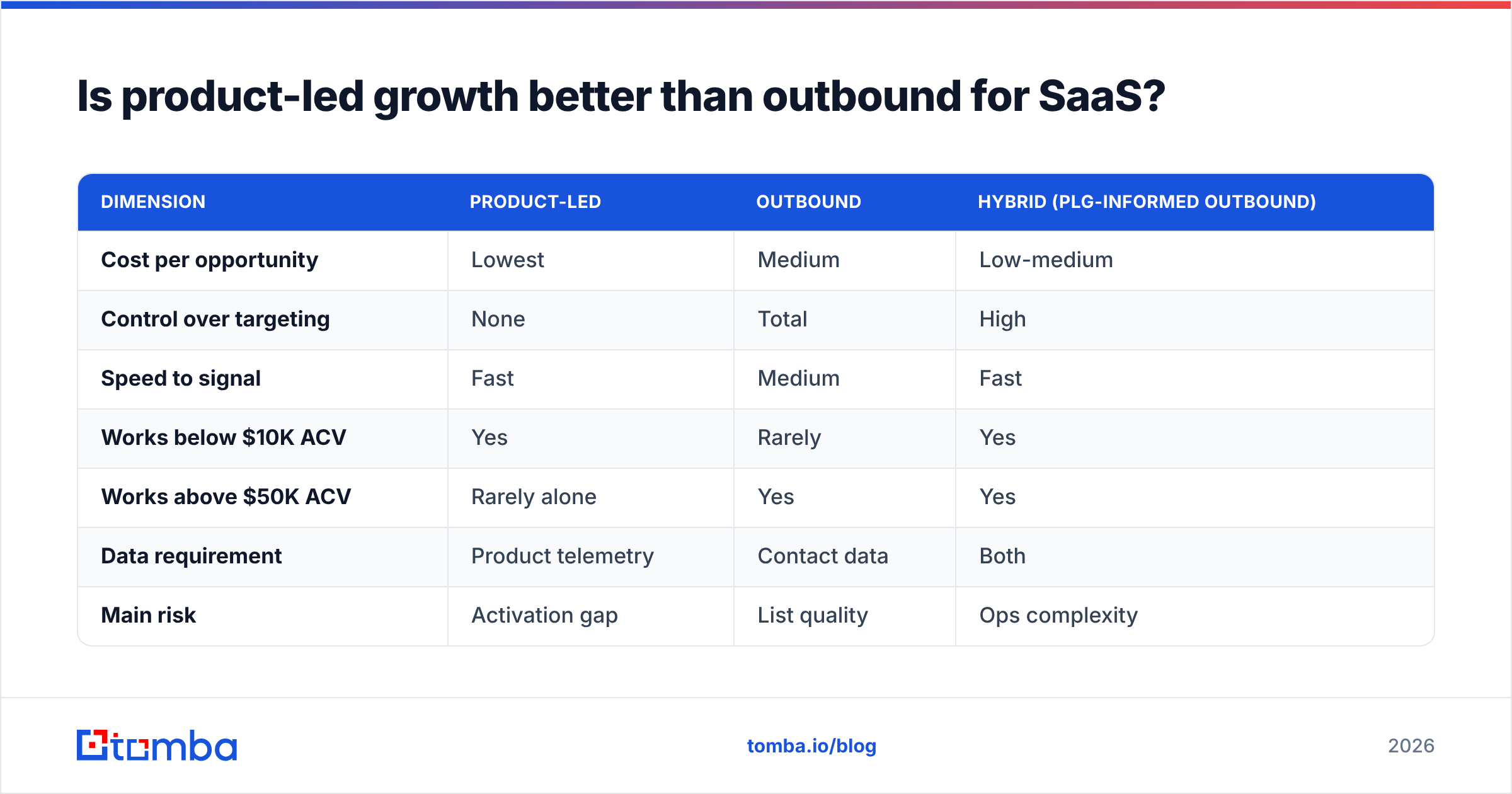
Neither is better — they answer different questions. PLG answers "how do I acquire cheaply at volume," outbound answers "how do I reach the 200 accounts I actually want."
The strongest 2026 SaaS motion is the hybrid: run a free tier to generate signal, then use that signal to prioritize outbound. When someone from a 400-person company signs up for your free plan, that is not a self-serve user — that is an inbound account signal, and a rep should be on it within the hour.
| Dimension | Product-led | Outbound | Hybrid (PLG-informed outbound) |
|---|---|---|---|
| Cost per opportunity | Lowest | Medium | Low-medium |
| Control over targeting | None | Total | High |
| Speed to signal | Fast | Medium | Fast |
| Works below $10K ACV | Yes | Rarely | Yes |
| Works above $50K ACV | Rarely alone | Yes | Yes |
| Data requirement | Product telemetry | Contact data | Both |
| Main risk | Activation gap | List quality | Ops complexity |
The hybrid's cost is operational complexity — you need product events flowing into your CRM and a routing rule that distinguishes a solo consultant from a director at a target account. That is a real engineering lift. But the payoff is that your outbound stops being cold: you are contacting people who already touched the product.
For teams that want outbound scale without building all of that, BookYourData and similar verified-data providers give you a solid starting list to work from, which pairs well with in-house verification on top.
What does a realistic SaaS lead generation funnel look like?#
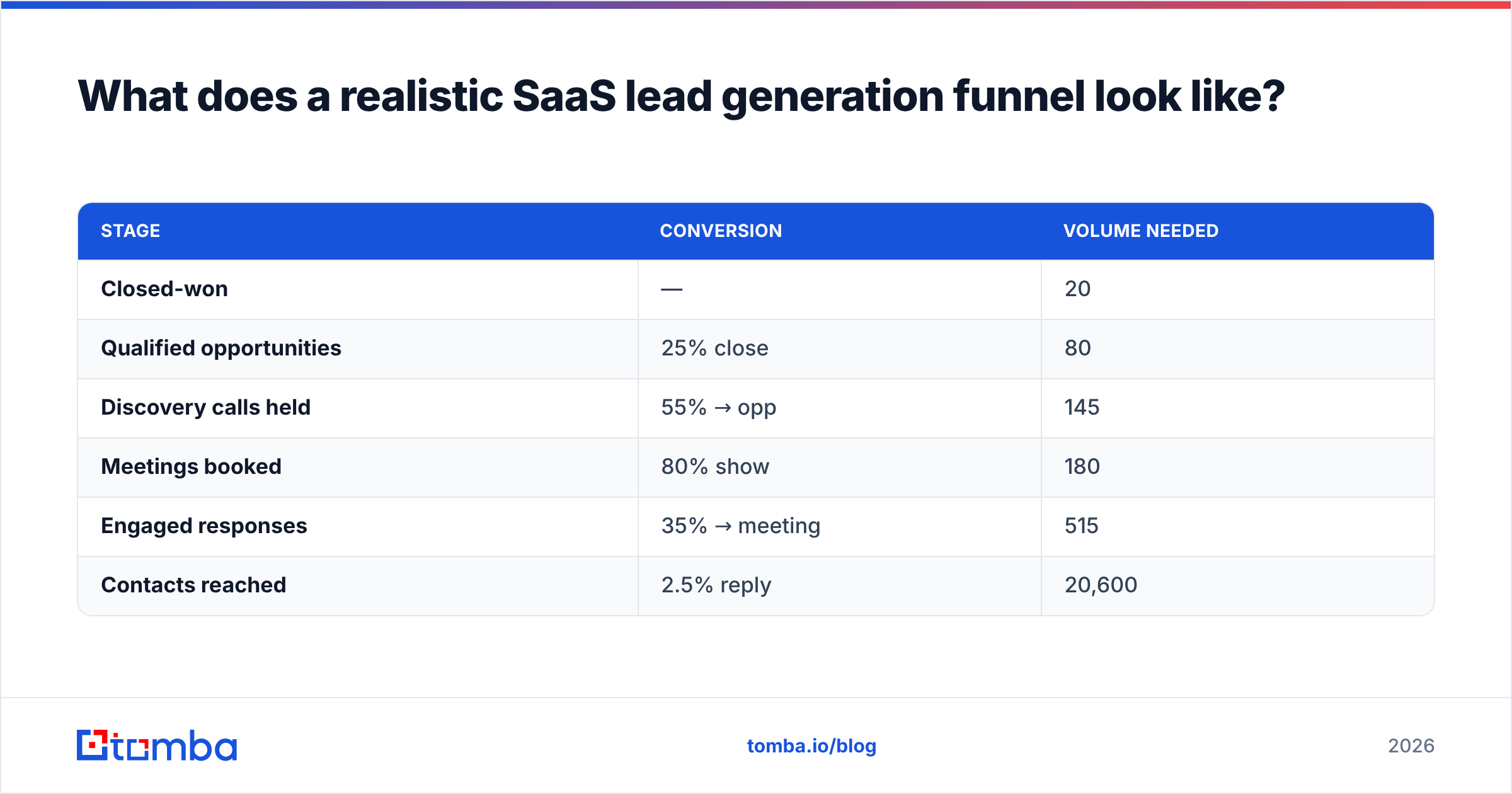
Here is a funnel model for a $25K ACV SaaS targeting 20 new customers per quarter. Work backwards from the number, not forwards from activity.
| Stage | Conversion | Volume needed |
|---|---|---|
| Closed-won | — | 20 |
| Qualified opportunities | 25% close | 80 |
| Discovery calls held | 55% → opp | 145 |
| Meetings booked | 80% show | 180 |
| Engaged responses | 35% → meeting | 515 |
| Contacts reached | 2.5% reply | 20,600 |
Twenty thousand verified, ICP-matched contacts per quarter is a real data operation, not a side project. This is exactly why teams run bulk email finder workflows rather than manual research — at manual speed, a rep sourcing 40 contacts a day gets you nowhere near 20,600.
Two caveats on that table. First, those conversion rates are a healthy mid-market benchmark; if yours are materially worse, the funnel volume requirement explodes and the motion may not be viable. Second, this assumes outbound carries the whole load. Blend in inbound and PLG and every row shrinks.
How should you measure SaaS lead generation?#
Measure four things and ignore most of the rest:
- Cost per qualified opportunity, by channel. Not cost per lead. Opportunity is the first metric with a real dollar attached to it.
- Pipeline coverage. Open pipeline divided by quota. Below 3x and you are already behind; 3.5–4x is the working target for most SaaS teams.
- Channel-level time to revenue. A channel with a 90-day lag needs different budgeting than one with a 14-day lag. Both can be good.
- Reply-to-meeting rate on outbound. This isolates message quality from data quality. If replies are high but meetings are low, your copy is getting attention for the wrong reason.
G2 and Capterra both publish category-level buyer behavior data that's useful for sanity-checking your own conversion assumptions against category norms — worth a quarterly look at G2's research if you sell into a crowded category.
What should you build first?#
If you are starting from zero, this is the order that gets to predictable pipeline fastest:
- Define the ICP narrowly enough to be wrong quickly. "B2B SaaS companies" is not an ICP. "Series A–B SaaS companies, 50–250 employees, in the US, with an existing sales team of 5+" is testable.
- Build the data pipeline before the campaign. Sourcing, verification, enrichment, suppression. Two weeks of setup saves two quarters of bad results.
- Run one motion for two full sales cycles. Resist the urge to add a channel until you know the first one's cost per opportunity.
- Instrument the handoff. Agree in writing on what qualifies a lead and what happens within how many minutes. Most response rate problems are really speed-to-lead problems.
- Add the second channel only when the first plateaus. Plateau means CAC rising while volume is flat — not "results were slow for a month."
There is a version of this advice that says "do everything at once, omnichannel wins." That works at 50 people and destroys you at 8. Sequence matters more than coverage when the team is small.
Where does Tomba fit?#
If outbound or PLG-informed outbound is part of your plan, the bottleneck is almost always finding and validating the right contacts at the right companies — fast enough to keep the funnel fed.
Tomba Email Finder handles that layer: find professional email addresses by domain, name, or company, verify them before they enter a sequence, and push the results into your CRM or sequencer through the API. The free tier gives you 25 searches a month to test the data quality against accounts you already know, and paid plans start at $49/mo on Starter, $99/mo on Growth, and $249/mo on Pro — see the full Tomba pricing breakdown for credit allocations.
Start by running 50 known contacts through it. If the accuracy holds on accounts you can verify yourself, it will hold on the 20,000 you can't.
Related guides#
// get started
Find, verify and enrich your first contacts today
Start on the free plan with 25 searches a month, then scale when your team is ready.
Free plan · No credit card required · GDPR & CCPA
// about the author