Lead Generation for SEO Agencies: The 2026 Playbook
Referrals dried up and cold outreach is harder than it was in 2022. Here is the channel-by-channel math on what actually books SEO agency calls in 2026 — with costs, close rates, and the stack that runs it.
TL;DR
- Referral volume for SEO agencies has flattened because fewer clients are switching agencies — the average retainer relationship now outlasts the average marketing director's tenure. You need a manufactured pipeline, not a hopeful one.
- The three channels that still produce booked calls at defensible cost in 2026: targeted outbound off technical triggers, productized audits as a paid front-end offer, and partner/white-label deal flow.
- Content marketing for your own agency still works, but the payback window is 9-14 months. Budget it as an asset, not a pipeline source for this quarter.
- The trigger beats the list. "You just migrated to Shopify and lost 40% of your category pages" outperforms "we do SEO" by roughly an order of magnitude in reply rate.
- Your cost per booked call is the only number that matters. Track it per channel, monthly, or you're guessing.
Why is lead generation for SEO agencies harder in 2026?#
Because you are selling a service whose value proposition got publicly complicated.
Between AI Overviews compressing click-through on informational queries, LLM-driven answer engines absorbing a chunk of the discovery journey, and every founder having watched at least one "SEO is dead" video, the buyer you're calling in 2026 arrives with more skepticism than the buyer you called in 2021. That's the demand-side problem.
The supply-side problem is worse: there are more agencies, more freelancers, and more AI-assisted one-person shops undercutting your retainer. Gartner's research on marketing budgets has tracked flat-to-declining discretionary spend as a percentage of revenue for several cycles running, which means you're competing for a smaller pot with more competitors.
None of that makes lead generation for SEO agencies impossible. It makes untargeted lead generation impossible. The agencies still growing are the ones who replaced "we're an SEO agency, want to chat?" with a specific, evidenced, time-sensitive reason to talk.
Wait — that placeholder belongs to the meme system. Here it is properly:

What are the actual lead generation channels available to an SEO agency?#
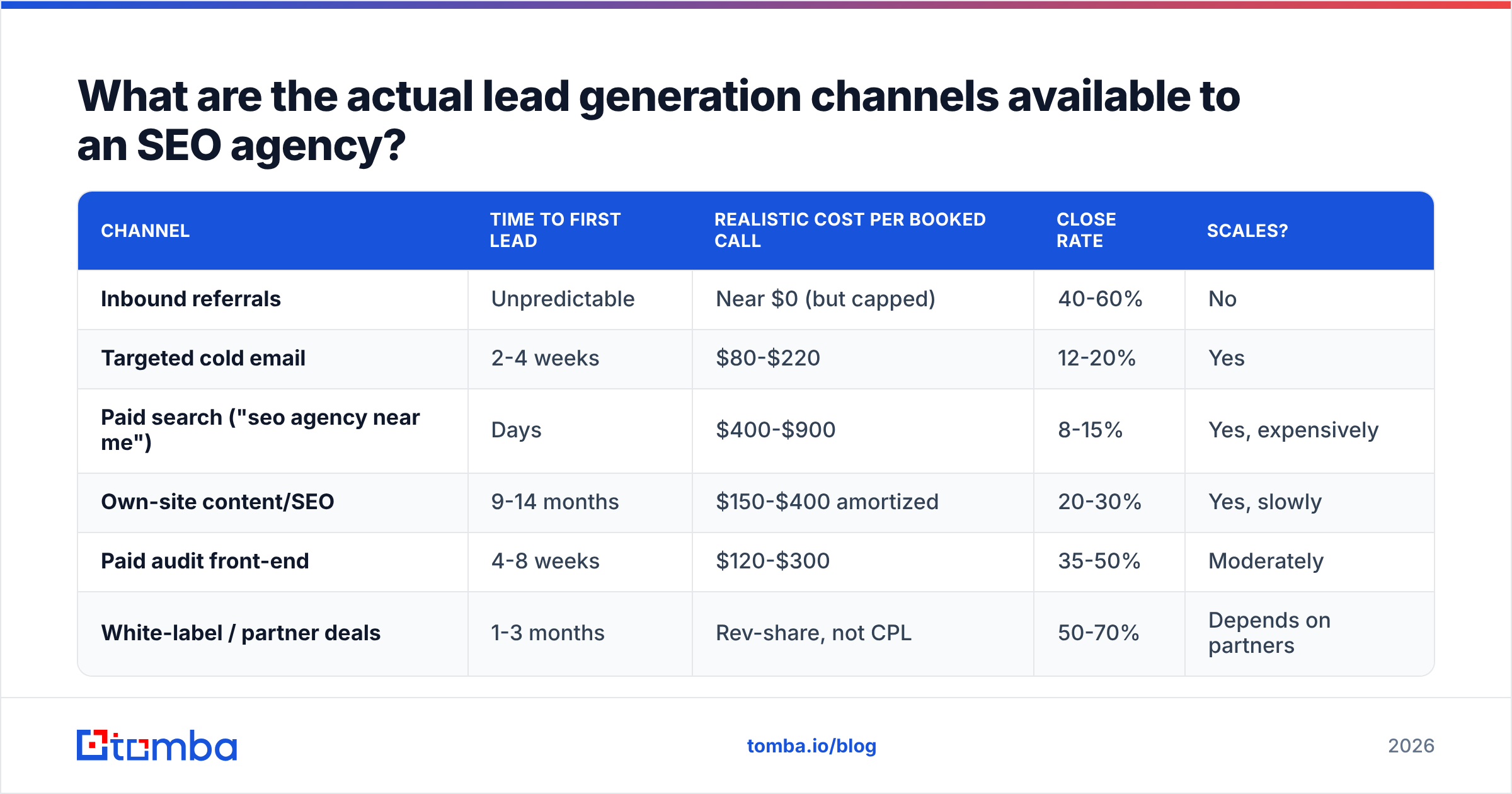
There are six that consistently show up in agency pipelines. They are not equal, and most agencies over-invest in the two cheapest-feeling ones.
| Channel | Time to first lead | Realistic cost per booked call | Close rate | Scales? |
|---|---|---|---|---|
| Inbound referrals | Unpredictable | Near $0 (but capped) | 40-60% | No |
| Targeted cold email | 2-4 weeks | $80-$220 | 12-20% | Yes |
| Paid search ("seo agency near me") | Days | $400-$900 | 8-15% | Yes, expensively |
| Own-site content/SEO | 9-14 months | $150-$400 amortized | 20-30% | Yes, slowly |
| Paid audit front-end | 4-8 weeks | $120-$300 | 35-50% | Moderately |
| White-label / partner deals | 1-3 months | Rev-share, not CPL | 50-70% | Depends on partners |
Read that table as a portfolio, not a ranking. Referrals and partner deals close best but you cannot turn a dial to get more of them tomorrow. Cold email and paid search scale on demand but close worse. The paid audit sits in the middle and is, for most agencies under $2M in revenue, the single most underused play on the list.
The six channels, ranked by how much control you have#
- Targeted outbound — full control over volume, timing, and targeting. Your quality ceiling is set entirely by your data and your trigger.
- Paid audits — you control the offer and the ad spend driving it; demand is elastic to price.
- Paid search and paid social — full control over spend, zero control over the fact that competitors bid the same keywords and CPCs only ever go up.
- Partner and white-label — high leverage, slow to build, and dependent on other people's growth.
- Own-site content — total control over production, no control over the timeline or the algorithm.
- Referrals — zero control. You can influence them with systematic asks and a referral fee, but you cannot forecast them.
If your pipeline depends on items 5 and 6 alone, you don't have a lead generation system. You have weather.
How do you build an outbound list that doesn't look like every other agency's?#
Start from the trigger, not the ICP.
Every SEO agency in your market has the same ICP definition: "B2B SaaS, 20-200 employees, US/UK, has a blog." That definition produces the same 4,000 companies for everyone, which is why those companies get 11 identical pitches a week. The list is commoditized. The trigger isn't.
Triggers that actually predict SEO budget:
- Recent site migration or replatform. Detectable via tech-stack changes on the domain. A migration nearly always means lost rankings and an internal panic.
- A new Head of Growth / VP Marketing in seat under 90 days. New leaders buy. They need a visible win in their first two quarters.
- Ranking drop on a commercial term you can evidence. Not "your traffic is down" — "your /pricing page fell from 4 to 19 for [term] after the August update."
- Recently raised funding with a stated go-to-market motion. Money plus a mandate.
- Competitors publishing aggressively while they aren't. Content velocity gaps are measurable and embarrassing in a good way.
- Broken technical fundamentals you can screenshot. Orphaned pages, indexation bloat, a robots.txt that's blocking the blog.
Once you have the trigger, you need the person. This is where most agency outbound quietly fails — the trigger research is excellent and the email goes to info@.
Build the contact layer in this order: identify the company from the trigger, identify the role that owns the problem (usually Head of Marketing, Head of Growth, or a founder at sub-50 headcount), then resolve that person to a verified work address. A domain search pulls the full set of addresses and the email pattern for a company in one call, so you can stop guessing between first.last@ and flast@. For a named person you already identified on LinkedIn, a direct email finder lookup is faster.
Then verify before you send. This is not optional in 2026. Mailbox providers treat bounce rate as a primary reputation signal, and a 5% bounce on a cold domain will get you filtered for months. Run every address through an email verifier and drop anything that doesn't come back deliverable. Catch-all domains — extremely common in enterprise — need their own handling; a catch-all verifier tells you whether the mailbox is genuinely routable or whether the server accepts everything and drops it.
The workflow costs you maybe 40 minutes a week once it's built. Agencies that skip it spend that time wondering why their reply rate is 0.4%.
What does a good SEO agency cold email actually look like?#
Short, evidenced, and about one thing.
The structural rule: your first line must prove you looked at their site. Not "I was browsing your website" — actual evidence. A URL, a keyword, a number, a screenshot reference.
Here's the shape that works:
Subject: /integrations pages dropped to page 3
Hi Dana — your /integrations subfolder was ranking 4-7 for 31 comparison terms in June, and it's sitting at 22-40 now. Looks like the migration in July dropped the internal links from the product nav.
We fixed the same pattern for [similar company] and recovered 80% of the positions in 11 weeks.
Worth 15 minutes to walk you through what we'd check first? I can send the list either way.
— Alex
What makes that work: it's specific enough that it could only have been written for Dana, it names a mechanism (internal links from the product nav) rather than a vague promise, it has social proof that matches their situation, and the CTA offers value whether or not they take the call.
What kills agency cold email, in order of frequency:
- Leading with your credentials. Nobody cares that you're a Semrush partner. They care that their category pages are gone.
- The "quick question" subject line. Burned. Filtered. Dead.
- Pitching the retainer in email one. The goal of the first email is a reply, not a contract.
- Sending to unverified addresses. See above. It poisons the domain for everything else.
- Following up four times with "just bumping this." One good follow-up with new information beats four empty bumps.
If you want a starting library rather than a blank page, our cold email templates cover the trigger-based structures; adapt them, don't ship them verbatim.

Is a paid SEO audit a better front-end offer than a free one?#
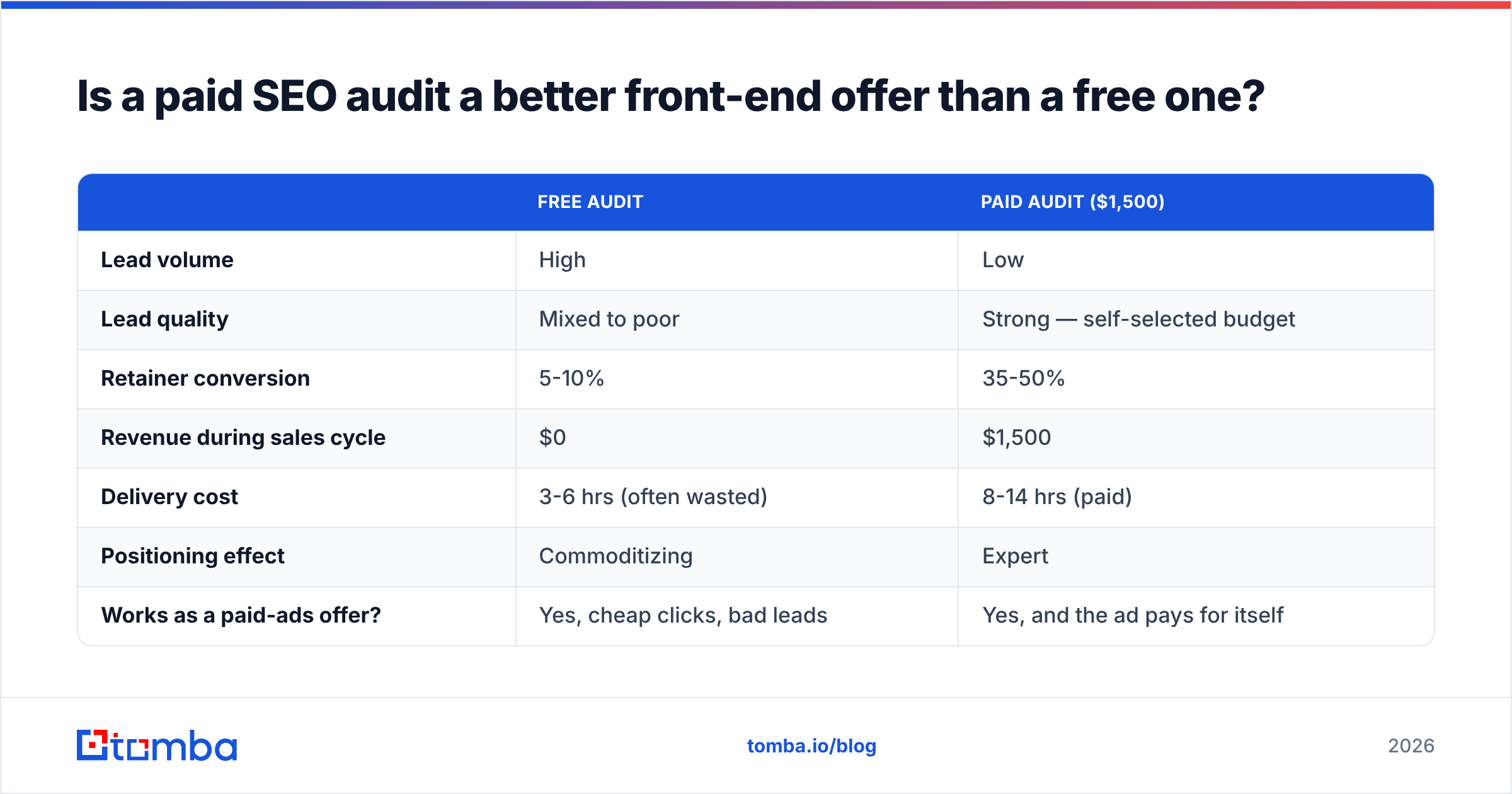
Yes, for almost every agency above the freelancer tier. The paid audit is the highest-converting front end in agency lead generation and it's still underused because it feels counterintuitive.
The logic: a free audit attracts people who want a free audit. A $750-$2,500 paid audit attracts people with a budget and a problem, and it converts to retainer at 35-50% instead of the 5-10% you'll see from free PDF downloads. You also get paid to do sales work, which changes the unit economics of the entire channel.
| Free audit | Paid audit ($1,500) | |
|---|---|---|
| Lead volume | High | Low |
| Lead quality | Mixed to poor | Strong — self-selected budget |
| Retainer conversion | 5-10% | 35-50% |
| Revenue during sales cycle | $0 | $1,500 |
| Delivery cost | 3-6 hrs (often wasted) | 8-14 hrs (paid) |
| Positioning effect | Commoditizing | Expert |
| Works as a paid-ads offer? | Yes, cheap clicks, bad leads | Yes, and the ad pays for itself |
The operational trick is to make the audit genuinely standalone-valuable — deliverable they could hand to an in-house team or another agency — and then include a scoped implementation proposal as the last section. About half will hand it back to you and ask you to run it.
A second trick: credit the audit fee against the first month of retainer. It removes the "am I paying twice" objection without discounting your actual work.
How should SEO agencies use their own content for lead generation?#
Rank for buying-intent terms, not for traffic. And accept the timeline.
The mistake agencies make is running their own site like a client's content program — volume, informational keywords, topic clusters. That's a traffic strategy. For agency lead gen you want a much smaller set of pages that catch people already in market:
[service] agency for [vertical]— "SEO agency for SaaS", "SEO agency for ecommerce"[competitor] alternativeand[competitor] review— people evaluating other agencieshow much does [service] cost— pricing pages rank and convert- Case studies with the client's vertical and the metric in the title
- Tool-adjacent pages where your buyer already searches
Ten pages like that outperform 200 blog posts about "what is a meta description." The payback is still 9-14 months, which is why content funds next year's pipeline while outbound funds this quarter's.
One thing worth doing in 2026: make sure your pages are structured to be cited by answer engines, not just ranked. Clear question headings, direct answers in the first two sentences under each heading, tables with real comparative data, and named entities. HubSpot's research on AI search behavior and the broader industry data both point the same direction — citation share is becoming a distinct acquisition channel from blue-link ranking.
Outreach and content overlap in one useful place: author-level outreach. When you find a journalist, analyst, or industry blogger writing about your clients' space, an author finder resolves the byline to a contact address so you can pitch data or commentary. That's how agency link building and agency PR stop being separate budgets.
How do you measure whether your lead generation is working?#
One metric governs everything: cost per booked call, by channel, monthly.
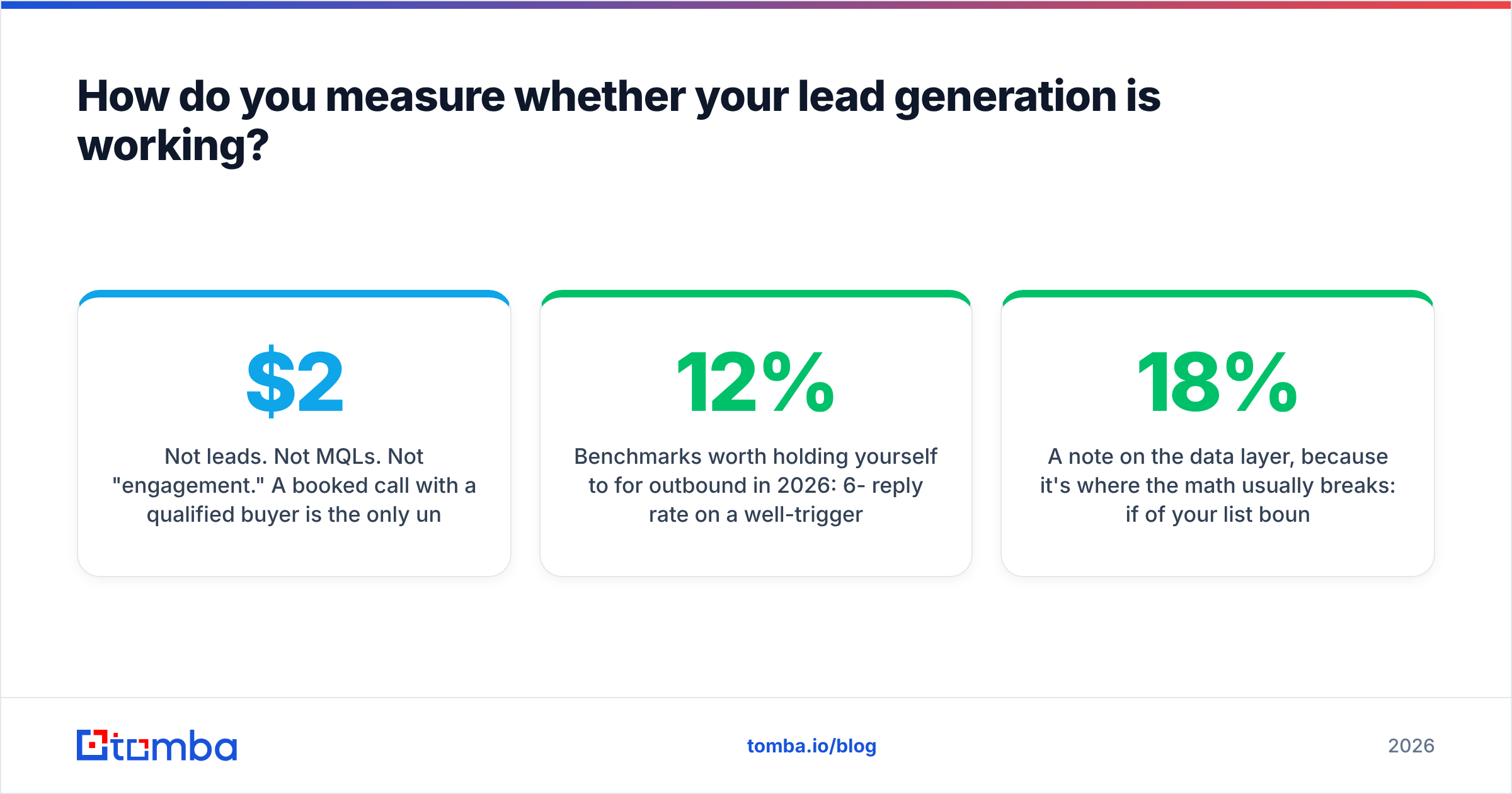
Not leads. Not MQLs. Not "engagement." A booked call with a qualified buyer is the only unit that predicts revenue for a service business, and it's the only one that lets you compare a $2,000/mo outbound program against a $6,000/mo Google Ads budget honestly.
Track these five, and only these five, per channel:
- Contacts touched — how many real humans received the message
- Reply rate — total replies / contacts touched (positive and negative both count here)
- Booked call rate — calls booked / contacts touched
- Cost per booked call — all-in channel cost / calls booked
- Call-to-close rate — signed retainers / calls held
Benchmarks worth holding yourself to for outbound in 2026: 6-12% reply rate on a well-triggered sequence, 1.5-3% of contacts booking a call, and a cost per booked call under $250. If your reply rate is under 3%, your problem is targeting or data quality, not copy. If your reply rate is healthy but booking rate is low, your CTA or your offer is wrong.
A note on the data layer, because it's where the math usually breaks: if 18% of your list bounces, your reply-rate denominator is lying to you and your sender reputation is degrading in the background. Verified data doesn't just improve deliverability — it makes every other number in the table trustworthy. That's why the bulk workflow matters: running lists through a bulk email finder and verifier before import keeps your CRM clean and your metrics real.
For agencies running this at volume, wiring it into the stack directly via the Tomba API or a HubSpot integration removes the CSV shuffle entirely — the trigger fires, the contact resolves, the record lands enriched.
Which channel mix should your agency actually run?#
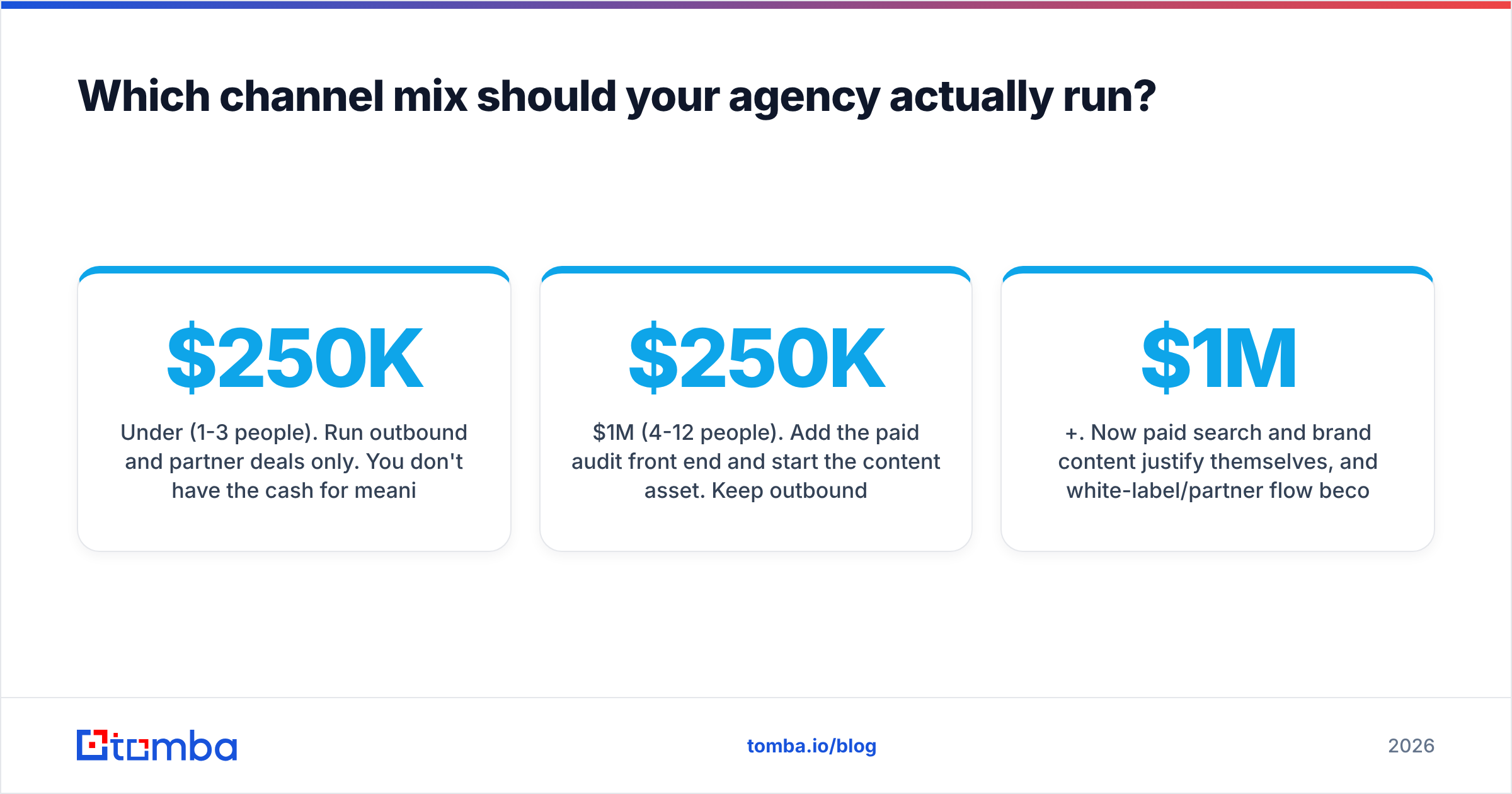
Depends on where you are. Three honest profiles:
Under $250K/year (1-3 people). Run outbound and partner deals only. You don't have the cash for meaningful paid search and you don't have the production capacity for a content program that pays back in a year. Target 200-300 verified, well-triggered contacts a month. That's enough for 4-8 calls and 1-2 signings, which is all you need at this size.
$250K-$1M (4-12 people). Add the paid audit front end and start the content asset. Keep outbound running — it's still your primary. Begin systematizing referrals with an actual referral fee and a quarterly ask cadence. This is also where a real CRM discipline starts mattering; loose pipeline tracking costs you deals you already earned.
$1M+. Now paid search and brand content justify themselves, and white-label/partner flow becomes a genuine revenue line. Outbound shifts from founder-led to a dedicated SDR function, which means your data quality standard has to get stricter, not looser — an SDR sending to bad addresses burns a domain much faster than a founder sending 30 a day.
Across all three, the same constraint applies: your pipeline is downstream of your list, and your list is downstream of your data. Agencies that treat contact data as a commodity line item end up paying for it in deliverability, in wasted SDR hours, and in a reply rate that never explains itself. Compare providers on verified-deliverable rate rather than headline database size — where the data comes from tells you more about what you'll actually reach than a claim of 700 million records.
What should you do this week?#
Pick one trigger. Build a list of 50 companies that match it. Resolve and verify the decision-maker at each. Write one email that could only have been sent to those 50 people. Send it Tuesday.
That's a testable unit. If it produces two replies and a call, you have a channel. If it produces nothing, you change the trigger — not the subject line — and run it again. Most agencies never get to this loop because they're stuck deciding between "should we do LinkedIn or email" instead of shipping 50 well-researched sends.
The research is the work. The sending is trivial.
Start with clean contact data. Everything in this playbook — the trigger outbound, the audit offer, the author outreach for link building — collapses if the emails bounce. Tomba's Email Finder resolves decision-makers by name and domain with built-in verification, so the 50 companies on your trigger list turn into 50 reachable people rather than 30 reachable people and a damaged sender score. Start free with 25 searches a month, or move to Starter at $49/mo when your outbound volume justifies it; full Tomba pricing runs through Growth at $99/mo and Pro at $249/mo for agencies running multi-client prospecting. Build the list, verify it, and send something worth replying to.
Related guides#
// get started
Find, verify and enrich your first contacts today
Start on the free plan with 25 searches a month, then scale when your team is ready.
Free plan · No credit card required · GDPR & CCPA
// about the author