Lead Generation for Small Business: A 2026 Playbook
Most small-business lead gen advice assumes a marketing team you don't have. Here's what actually fills a pipeline when you're the founder, the SDR, and the support desk — with real costs and channel math.
TL;DR
- Small businesses do not fail at lead generation because they pick the wrong channel. They fail because they run five channels at 20% effort instead of one at 100%.
- Outbound email plus a clean contact list is still the cheapest way to get from zero to a first repeatable pipeline — roughly $50–$300/month all-in versus $3,000+/month for paid acquisition.
- Inbound (SEO, content) compounds but takes 6–12 months. Budget for it as a second channel, not a first one.
- Your list quality matters more than your copy. A 22% bounce rate kills a domain faster than a bad subject line ever will.
- Track one number per channel: cost per qualified conversation. Everything else is vanity.
What does lead generation for small business actually mean in 2026?#
It means getting a specific human who has a specific problem to agree to a specific conversation. That's it. Not "brand awareness," not "top-of-funnel engagement" — a conversation with someone who could plausibly pay you.
The reason this definition matters is that most lead-gen advice written for VC-backed SaaS companies is actively harmful to a 6-person agency or a 30-person manufacturer. Those companies optimise for volume because they have a sales team to absorb it. You don't. You need 8–15 good conversations a month, not 400 MQLs that nobody follows up on.
So the constraint set is different:
- Budget is real money. A $4,000 monthly ad test is somebody's salary, not a line item.
- Time is the scarcest input. The founder is usually the closer, the demo-giver, and the person writing the follow-ups.
- You can't wait 9 months. Cash flow decides which experiments you're allowed to run.
- There is no marketing ops person. Whatever you build has to survive being ignored for two weeks during a busy period.
Every recommendation below is filtered through those four constraints. If a tactic needs a full-time operator to work, it's not on the list.

Which lead generation channels are worth it for a small business?#
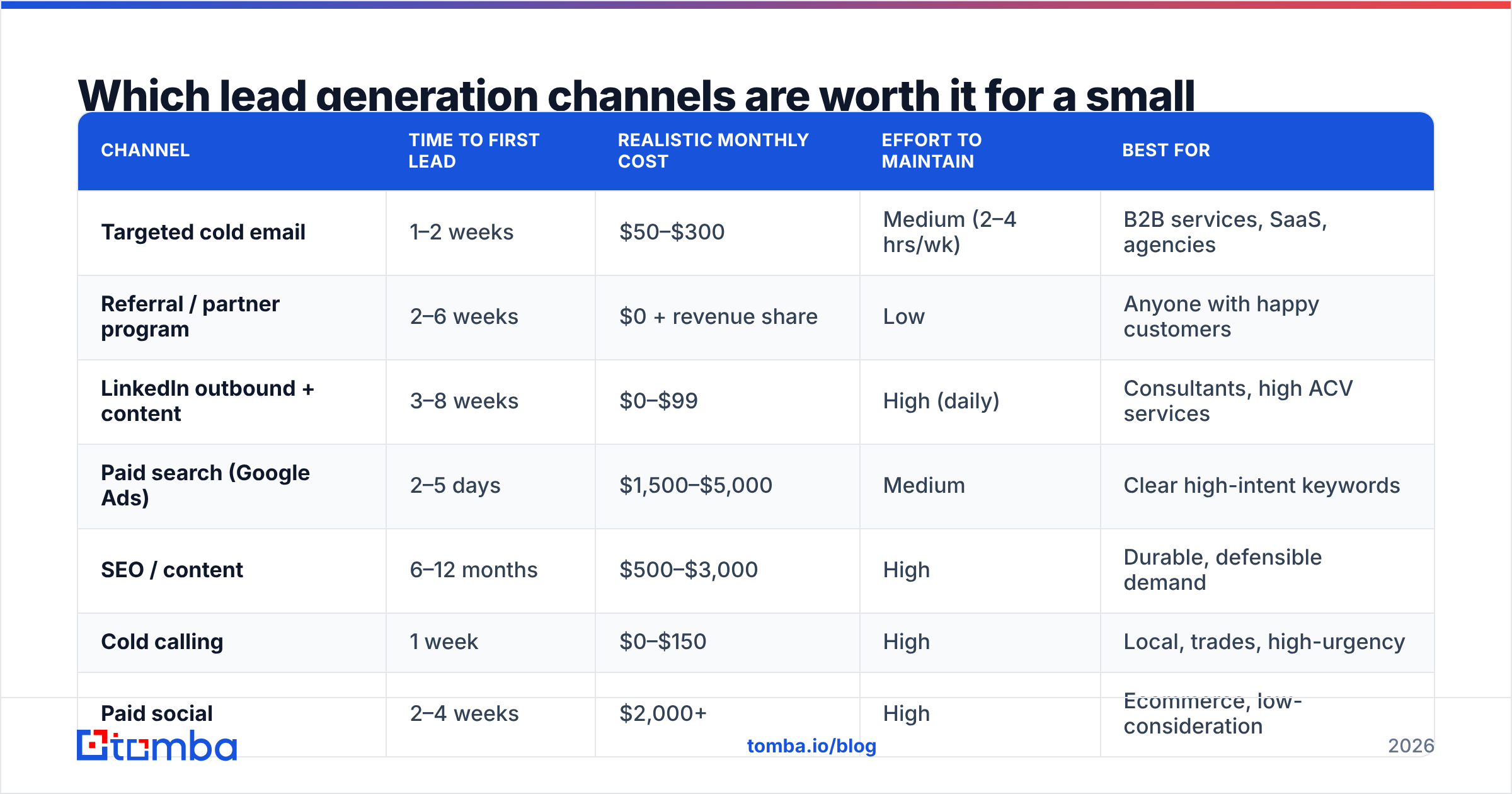
Here's the honest ranking by payback speed, not by how exciting the channel sounds on LinkedIn.
| Channel | Time to first lead | Realistic monthly cost | Effort to maintain | Best for |
|---|---|---|---|---|
| Targeted cold email | 1–2 weeks | $50–$300 | Medium (2–4 hrs/wk) | B2B services, SaaS, agencies |
| Referral / partner program | 2–6 weeks | $0 + revenue share | Low | Anyone with happy customers |
| LinkedIn outbound + content | 3–8 weeks | $0–$99 | High (daily) | Consultants, high ACV services |
| Paid search (Google Ads) | 2–5 days | $1,500–$5,000 | Medium | Clear high-intent keywords |
| SEO / content | 6–12 months | $500–$3,000 | High | Durable, defensible demand |
| Cold calling | 1 week | $0–$150 | High | Local, trades, high-urgency |
| Paid social | 2–4 weeks | $2,000+ | High | Ecommerce, low-consideration |
| Events / local networking | 4–12 weeks | $200–$2,000 | Medium | Regional, relationship-led |
Two things jump out. First, the fast channels are the cheap ones — cold email, referrals, calling. Second, the expensive channels (paid social, events) are also the ones with the longest feedback loops, which is the worst possible combination when you're testing with limited cash.
The sequencing most small businesses should follow:
- Months 1–2: Referrals and outbound. Mine your existing customer base for introductions, then build a targeted outbound motion. Near-zero cost, fastest signal on whether your offer resonates.
- Months 2–4: Double down on whichever one worked. Resist adding a third channel. Depth beats breadth at your scale.
- Months 4–8: Add one compounding channel. Usually SEO or a content-led LinkedIn presence, funded by revenue from step 1–2.
- Months 8+: Consider paid. Paid acquisition works best when you already know your conversion rates, your messaging, and your actual customer profile. Running ads before that is paying to learn things outbound would have taught you for free.
- Ongoing: Kill anything that hasn't produced a qualified conversation in 60 days. No exceptions, no "it's building brand."
Why does cold outbound still work for small teams?#
Because it's the only channel where you control the input volume directly. With SEO you wait. With ads you bid. With outbound, if you need more conversations next week, you send more emails next week.
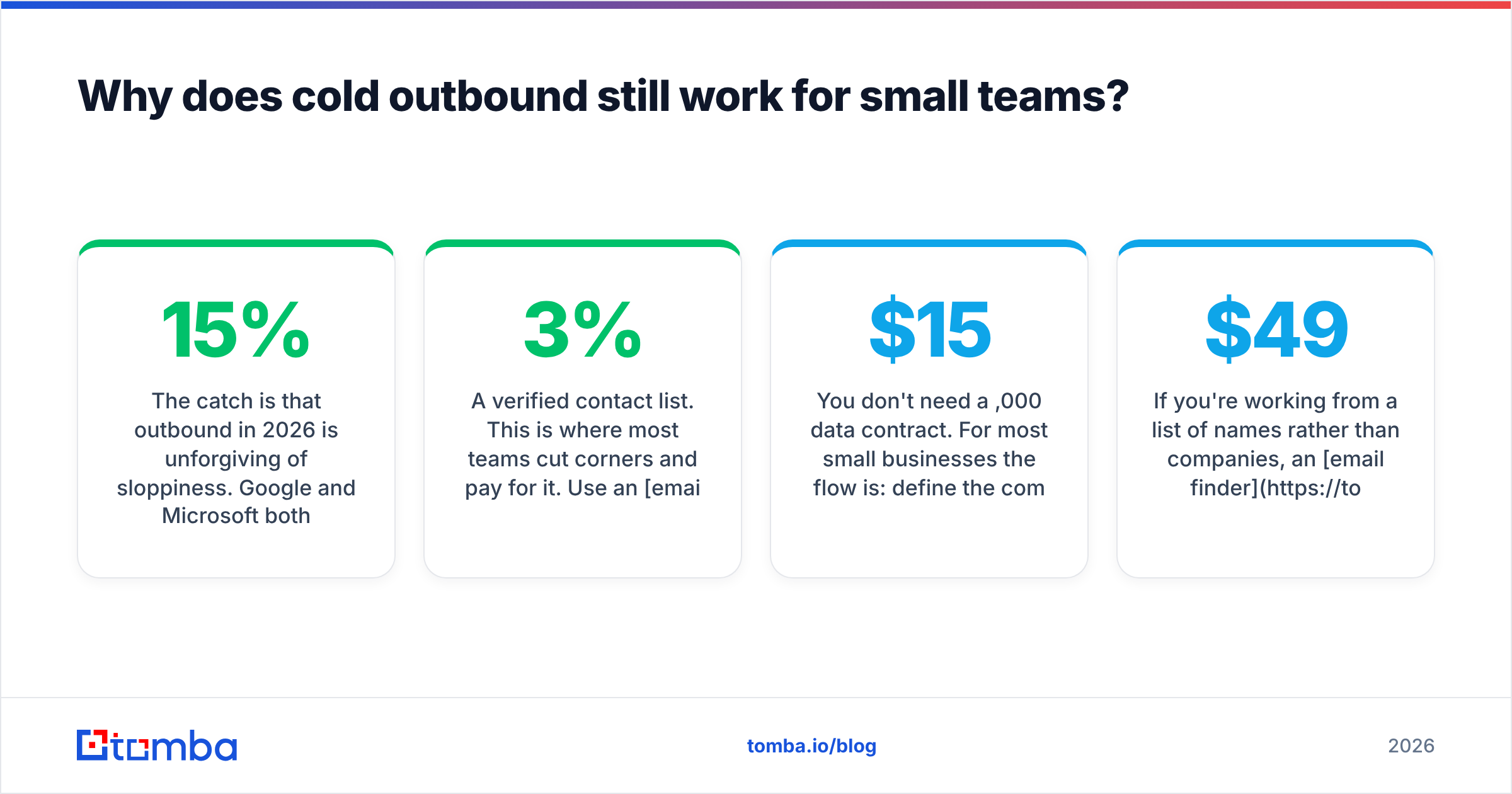
The catch is that outbound in 2026 is unforgiving of sloppiness. Google and Microsoft both tightened bulk-sender requirements, and the practical effect is that a list with 15%+ invalid addresses will get your domain throttled before your offer ever gets read. Google's own sender guidelines spell out the spam-rate thresholds — stay under 0.3% complaints or you're throttled.
What a working small-business outbound stack looks like:
- A narrow ICP. Not "B2B companies" — "dental practices in Texas with 3+ locations that just hired a practice manager." Narrow lets you write specifics, and specifics get replies.
- A verified contact list. This is where most teams cut corners and pay for it. Use an email verifier before every send, not just at list-build time; B2B data decays roughly 2–3% a month as people change jobs.
- A secondary sending domain. Never send cold volume from your primary domain. Buy a lookalike, warm it for 3 weeks, and keep your main domain clean for transactional and customer mail.
- 50–80 emails a day, max, per inbox. Slower than you want. Also the reason your deliverability survives past month two.
- A 4-touch sequence, not 12. Follow up three times, then move on. The marginal reply rate after touch four is not worth the unsubscribe and complaint cost.
How do you build the list without a data budget?#
You don't need a $15,000/year data contract. For most small businesses the flow is: define the company list first, then find the people.
Start with a source of companies that already signals fit — a directory, an industry association member list, a conference attendee page, a set of job postings mentioning a tool you integrate with. Then run domain search against those domains to pull the contacts and email patterns for each one, and verify before you import anything into your sending tool.
If you're working from a list of names rather than companies, an email finder resolves name + domain into a deliverable address. Either way, the discipline is the same: verify, then send. Tools like Tomba start at a free tier of 25 searches/month, which is genuinely enough to validate whether a segment replies before you commit budget. Paid plans run $49/mo (Starter), $99/mo (Growth), and $249/mo (Pro) — see Tomba pricing for credit allocations per tier. If you need pre-built, human-verified lists rather than building your own, BookYourData is a solid option for teams that would rather buy the list than assemble it.
How much should a small business spend on lead generation?#
The usual benchmark is 5–10% of revenue on marketing for established B2B companies, higher if you're growing fast. But percentages are a bad planning tool when your revenue is lumpy. Work backwards from deals instead.
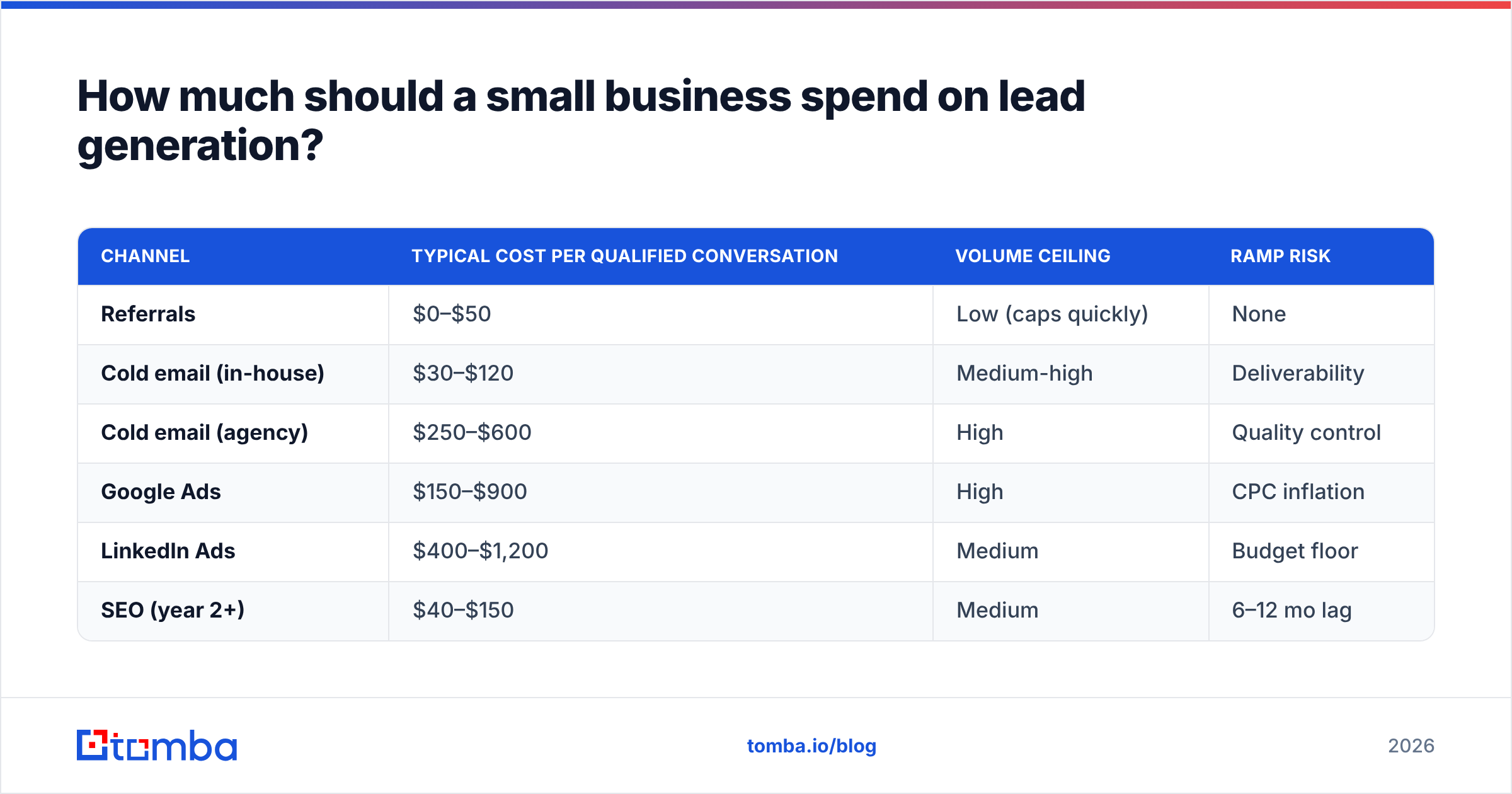
Say your average deal is $6,000 and you close 25% of qualified conversations. Each conversation is worth $1,500 in expected revenue. If you're comfortable spending 15% of that to acquire it, your ceiling is $225 per qualified conversation. Now compare:
| Channel | Typical cost per qualified conversation | Volume ceiling | Ramp risk |
|---|---|---|---|
| Referrals | $0–$50 | Low (caps quickly) | None |
| Cold email (in-house) | $30–$120 | Medium-high | Deliverability |
| Cold email (agency) | $250–$600 | High | Quality control |
| Google Ads | $150–$900 | High | CPC inflation |
| LinkedIn Ads | $400–$1,200 | Medium | Budget floor |
| SEO (year 2+) | $40–$150 | Medium | 6–12 mo lag |
In-house outbound wins on cost per conversation for almost every small business under $5M revenue. That's not a Tomba talking point — it's arithmetic. A $49/month data tool plus $30/month in inbox costs plus four hours of your week produces conversations at a fraction of what a $3,000/month ad budget does, assuming your targeting is tight.
Where paid acquisition genuinely beats outbound: when there's obvious high-intent search demand ("emergency plumber near me," "QuickBooks bookkeeper"), or when your buyer is genuinely unreachable by email. Otherwise, paid is the channel you graduate into, not the one you start with.
What should you measure, and what should you ignore?#
Measure exactly three things per channel:
- Cost per qualified conversation. Total channel spend (including your own time at a reasonable hourly rate) divided by conversations with someone who fits your ICP and agreed to talk.
- Conversation-to-close rate. If this drops when a channel scales, the channel is producing worse-fit leads, not more leads.
- Time to first response. For inbound especially. Response within five minutes versus within an hour is a well-documented difference in connect rates, and it's the single cheapest fix most small businesses have available.
Ignore: impressions, open rates (Apple Mail Privacy Protection made them close to meaningless), follower counts, and "engagement." None of them predict revenue at your scale.
One caveat on response rate tracking: measure replies per contacted person, not per email sent. A 4-touch sequence inflates the per-send denominator and makes a bad campaign look acceptable.
What are the most common small-business lead gen mistakes?#
Targeting too broadly. The instinct when leads are slow is to widen the net. It's almost always wrong — widening makes your message generic, which lowers reply rates, which makes leads slower. Narrow instead. A list of 200 perfect-fit companies beats 5,000 maybes.
Buying a list and blasting it. Purchased lists that haven't been re-verified are the fastest route to a burned domain. If you buy, verify on arrival and again before each send.
Abandoning a channel at week three. Outbound needs 4–6 weeks to produce interpretable data. If you rewrite your sequence every 10 days, you never learn anything — you just generate noise.
No follow-up system. The most expensive leak in small-business lead gen isn't the top of funnel, it's the 40 interested-but-not-now conversations sitting in an inbox with no reminder attached. Even a spreadsheet with a "follow up on" date column beats what most small businesses do.
Confusing activity with pipeline. Sending 2,000 emails is activity. Eleven booked calls is pipeline. Report the second number to yourself, weekly, in writing.
Treating data quality as a one-time task. Contacts go stale continuously. Re-verification should be a recurring calendar item, not something you did once when you built the list. For teams running larger lists, bulk verification handles this in a single pass rather than record by record.
How do you build a repeatable system instead of a scramble?#
The difference between a small business with predictable leads and one without is almost never talent. It's whether the process survives a busy week.
A minimum viable system, in five recurring blocks:
- Monday, 45 minutes — list building. Add 100–150 new ICP-fit contacts. Verify them. Load them into the sequence.
- Tuesday/Thursday, 30 minutes — reply handling. Answer everything within the day. Book calls directly in the reply; don't send people to a form.
- Wednesday, 30 minutes — referral asks. Two asks a week to happy customers or partners. This is the highest-ROI half hour in the entire system and the one most often skipped.
- Friday, 20 minutes — the numbers. Contacts added, replies received, calls booked, deals closed. Four rows in a sheet. Takes twenty minutes and makes every other decision easier.
- Monthly, 90 minutes — the review. Which segment replied best? Which message? Kill the bottom third of your targeting and replace it.
That's about four hours a week. It is not glamorous, and it will outperform an unfocused $4,000/month ad spend for most businesses under $5M in revenue. Third-party reviews on G2 and Capterra are useful for shortlisting tools once you know which step you're actually trying to speed up — but pick the process first, then the tool.
If you're running this with a CRM, connect the data flow so verified contacts land in your pipeline automatically. Most small teams use a HubSpot integration or Google Sheets, and either is fine. The tool is not the bottleneck; the weekly discipline is.
Where should you start this week?#
Pick one segment. Build a list of 150 companies in it. Find and verify the decision-maker contacts. Write four emails that reference something specific about that segment. Send 50 a day for two weeks and count the replies.
If it works, you have a channel. If it doesn't, you've spent about $50 and eight hours to learn something that would have cost $3,000 to learn from ads.
Ready to build that first list? Tomba Email Finder gets you from a company domain to verified, deliverable contacts without a data contract or a minimum commitment. Start on the free tier (25 searches/month) to test a segment, then move to Starter at $49/month once you know which one replies. Your pipeline problem is usually a list problem first.
Related guides#
// get started
Find, verify and enrich your first contacts today
Start on the free plan with 25 searches a month, then scale when your team is ready.
Free plan · No credit card required · GDPR & CCPA
// about the author