Lead Generation Funnel: How to Build One That Converts
Most lead generation funnels leak at the same three joints. Here is the stage-by-stage blueprint, the benchmark conversion rates to beat, and how to tell a broken funnel from a broken offer.
TL;DR
- A lead generation funnel is a staged model of how a stranger becomes a qualified buyer — awareness, capture, nurture, qualification, handoff. Each stage has its own conversion math and its own failure mode.
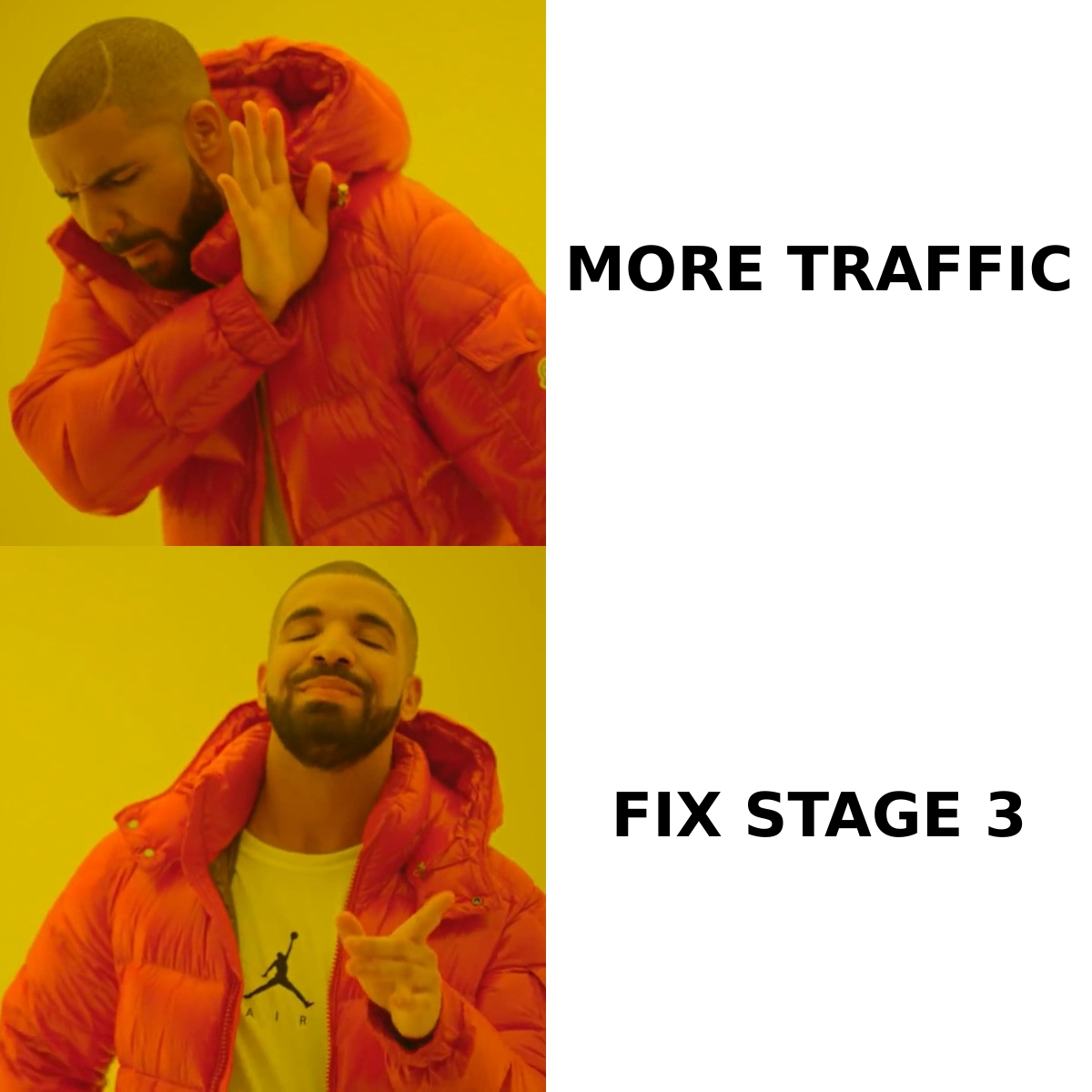
- Most B2B funnels do not have a traffic problem. They have a stage-3 problem: leads get captured, then sit in a nurture sequence nobody owns.
- Track four numbers per stage: entry volume, conversion rate to the next stage, time-in-stage, and cost per conversion. If you cannot produce those four for every stage, you have a report, not a funnel.
- Benchmark reality check: visitor→lead of 2-5%, lead→MQL of 25-35%, MQL→SQL of 13-20%, SQL→customer of 20-30%. Anything wildly above those is usually a definition problem, not a performance win.
- Contact data quality silently caps everything downstream. A 30% bounce rate on your captured emails means a third of your funnel never existed.
What is a lead generation funnel?#
A lead generation funnel is the sequence of steps a person moves through between "never heard of you" and "sales-ready conversation." Think of it like airport security: a wide entrance, a series of narrowing checkpoints, and a small number of people who actually make it to the gate. Each checkpoint has a throughput rate and a queue time — and if one checkpoint is slow, the ones behind it back up no matter how many people walk in the front door.
Technically, it is a measurement framework layered on top of your marketing and sales motion. The funnel does not create demand. It tells you where demand is dying.
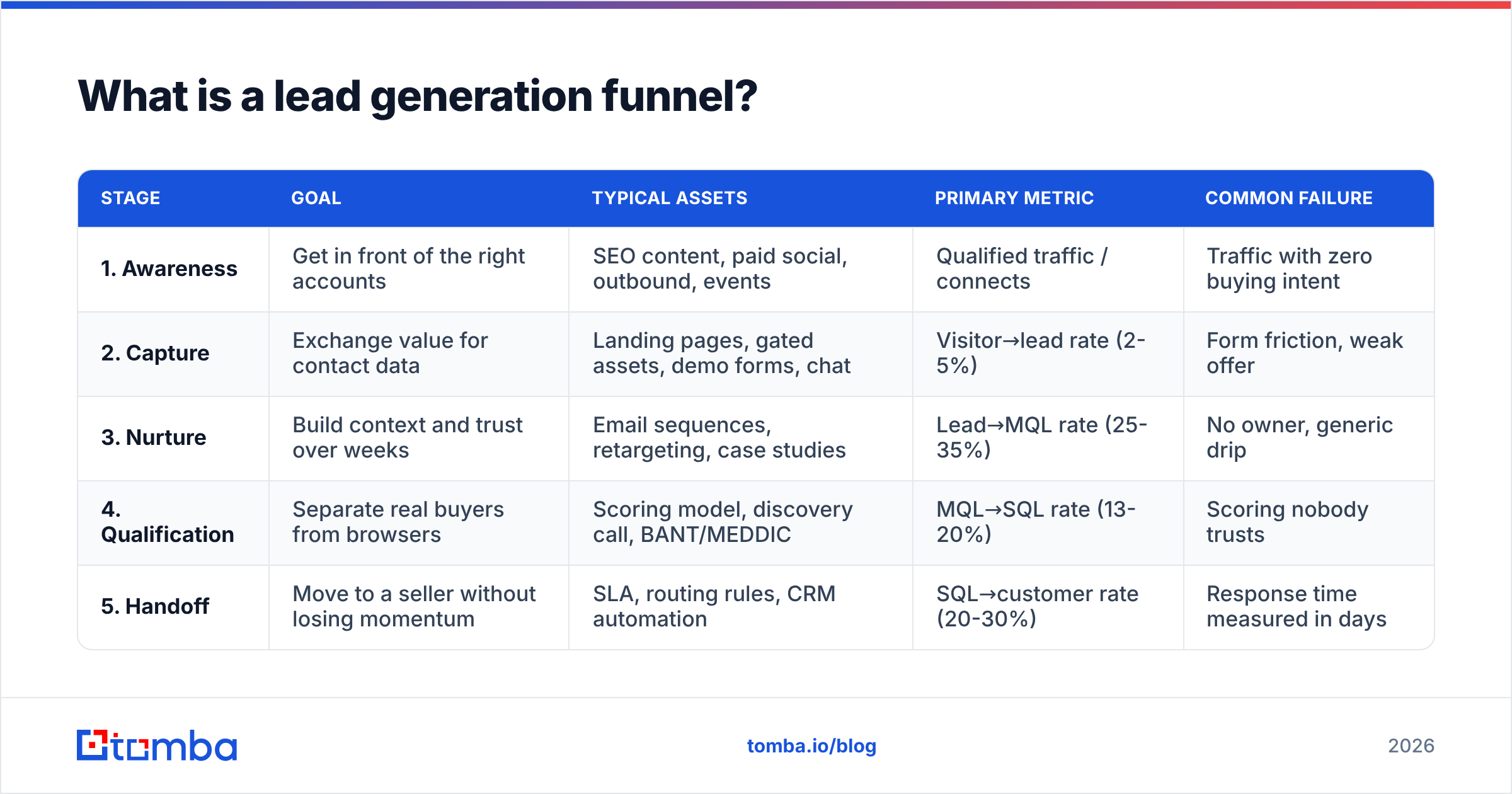
Here is the canonical five-stage structure and what each stage actually owns:
| Stage | Goal | Typical assets | Primary metric | Common failure |
|---|---|---|---|---|
| 1. Awareness | Get in front of the right accounts | SEO content, paid social, outbound, events | Qualified traffic / connects | Traffic with zero buying intent |
| 2. Capture | Exchange value for contact data | Landing pages, gated assets, demo forms, chat | Visitor→lead rate (2-5%) | Form friction, weak offer |
| 3. Nurture | Build context and trust over weeks | Email sequences, retargeting, case studies | Lead→MQL rate (25-35%) | No owner, generic drip |
| 4. Qualification | Separate real buyers from browsers | Scoring model, discovery call, BANT/MEDDIC | MQL→SQL rate (13-20%) | Scoring nobody trusts |
| 5. Handoff | Move to a seller without losing momentum | SLA, routing rules, CRM automation | SQL→customer rate (20-30%) | Response time measured in days |
Read that table as a diagnostic, not a description. Most teams can tell you their stage-2 number and have no idea about stages 3 and 4.
Why do most lead generation funnels leak?#
Because the leaks happen where ownership is ambiguous. Marketing owns stages 1-2. Sales owns stage 5. Stages 3 and 4 belong to whoever complains loudest in the weekly meeting, which means they belong to nobody.
Three leaks account for most of the loss:
- The definition leak. "Lead" means eight different things in eight different dashboards. A newsletter signup and a pricing-page demo request land in the same bucket, so your lead→MQL rate is mathematically meaningless. Fix: write down a one-sentence definition per stage, get sales to sign it, and enforce it in the CRM with required fields.
- The data-quality leak. You captured the email, but it bounces, or it is a shared inbox, or the person left the company six months ago. This leak is invisible because bounced contacts still count as "leads" in most attribution reports. Fix: verify at the point of capture, not at the point of send.
- The latency leak. A Harvard Business Review study on lead response found firms that responded within an hour were nearly seven times more likely to have a meaningful conversation than those who waited two hours. Most B2B teams average over 40 hours. Fix: routing automation and a hard SLA with a visible breach report.
None of these are creative problems. They are plumbing problems, which is good news — plumbing is fixable in a sprint.
How do you build a lead generation funnel from scratch?#
Start at the bottom and work up. If you build top-down you will generate volume you cannot process, which produces the worst possible outcome: sellers who stop trusting inbound.
Step 1 — Define the qualified lead first. Write the profile of someone your best reps would drop everything to call. Firmographics (industry, headcount, tech stack), role (title and seniority), and trigger (hiring, funding, a competitor's product sunset). This is your target, and every stage above it inherits it.
Step 2 — Pick one capture mechanism and make it excellent. Not five. One. A single high-intent offer — a live teardown, a benchmark report, a free tool — converts better than a content library of gated PDFs nobody reads. Measure visitor→lead for four weeks before adding a second.
Step 3 — Build contact data on top of capture, not instead of it. Inbound capture alone will never fill a B2B funnel, because 95% of your addressable market is not in-market this quarter. That is what outbound sourcing is for. A domain search across your target account list produces the named contacts that inbound will never surface, and an email verifier pass before the first send keeps your sender reputation intact.
Step 4 — Write the nurture sequence as a narrative, not a newsletter. Five to seven emails, each answering one objection in order: why change, why now, why you, what it costs, what breaks if you do nothing. Assign an owner with a name.
Step 5 — Score, don't guess. A simple additive model beats a black box: +15 for target title, +10 for target industry, +20 for pricing page visit, +25 for demo request, -20 for free-email domain, -30 for competitor domain. Publish the model so sellers can argue with it. An argued-about model gets used; a mysterious one gets ignored.
Step 6 — Instrument the handoff. Round-robin routing, a 15-minute first-touch SLA on high scores, and a rejection reason field that is required when a seller bounces an MQL back. The rejection reasons are the single most valuable dataset in your funnel.
What are realistic lead generation funnel benchmarks?#
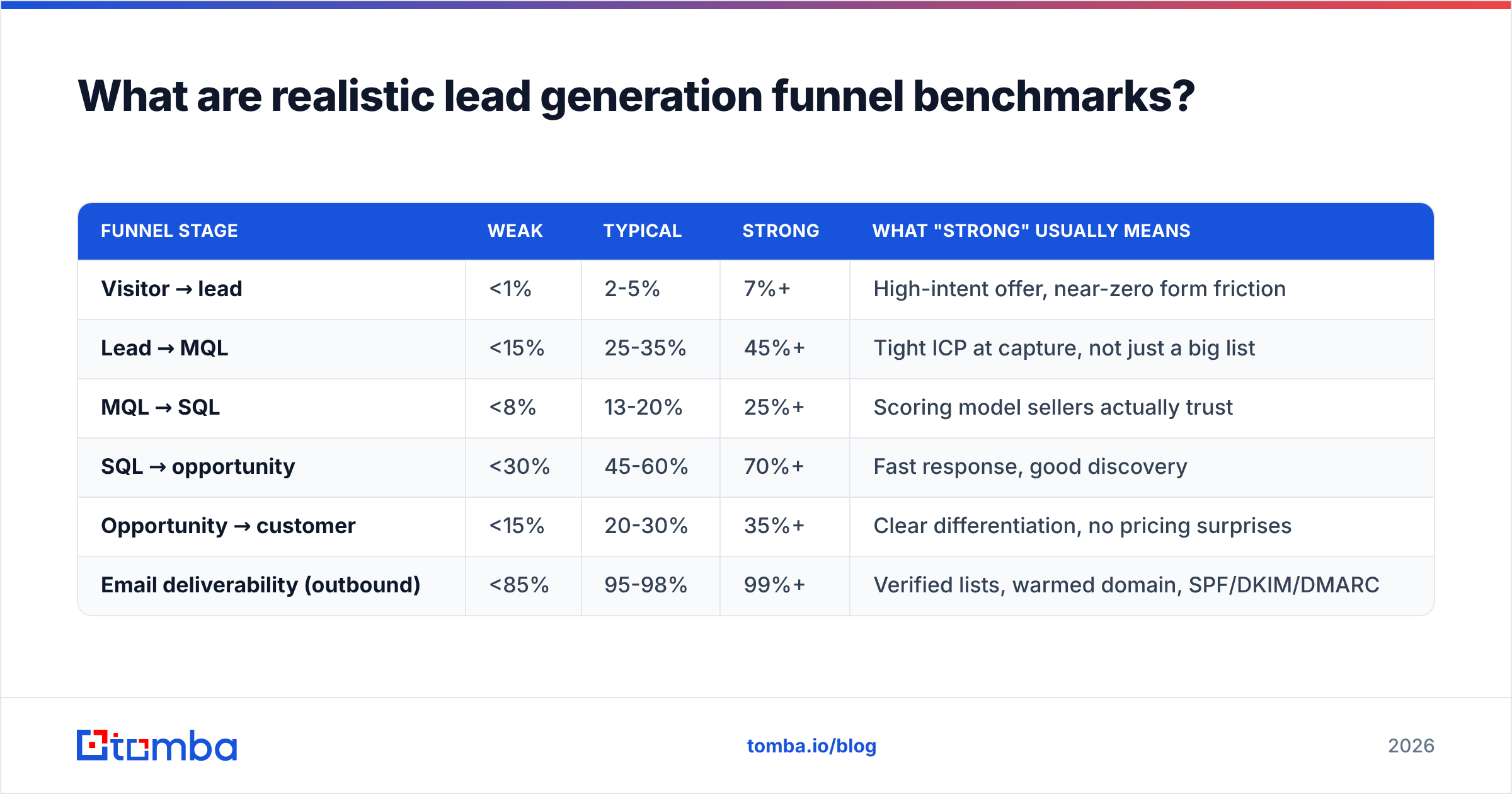
Benchmarks are useful as sanity checks, not targets. Your absolute numbers depend on ACV, sales cycle, and channel mix. Use these to spot the outlier stage:
| Funnel stage | Weak | Typical | Strong | What "strong" usually means |
|---|---|---|---|---|
| Visitor → lead | <1% | 2-5% | 7%+ | High-intent offer, near-zero form friction |
| Lead → MQL | <15% | 25-35% | 45%+ | Tight ICP at capture, not just a big list |
| MQL → SQL | <8% | 13-20% | 25%+ | Scoring model sellers actually trust |
| SQL → opportunity | <30% | 45-60% | 70%+ | Fast response, good discovery |
| Opportunity → customer | <15% | 20-30% | 35%+ | Clear differentiation, no pricing surprises |
| Email deliverability (outbound) | <85% | 95-98% | 99%+ | Verified lists, warmed domain, SPF/DKIM/DMARC |
A stage that is dramatically above "strong" is a red flag, not a trophy. A 60% MQL→SQL rate almost always means your MQL bar is set so high that marketing is hiding volume, or your SQL definition is so loose that sellers accept everything.
Two nuances worth internalizing. First, win rate compounds backwards — a 5-point improvement at stage 4 is worth more than doubling stage-1 traffic, because it costs nothing in media spend. Second, time-in-stage matters as much as conversion rate. A funnel with great rates and a 180-day average cycle will still miss the quarter.
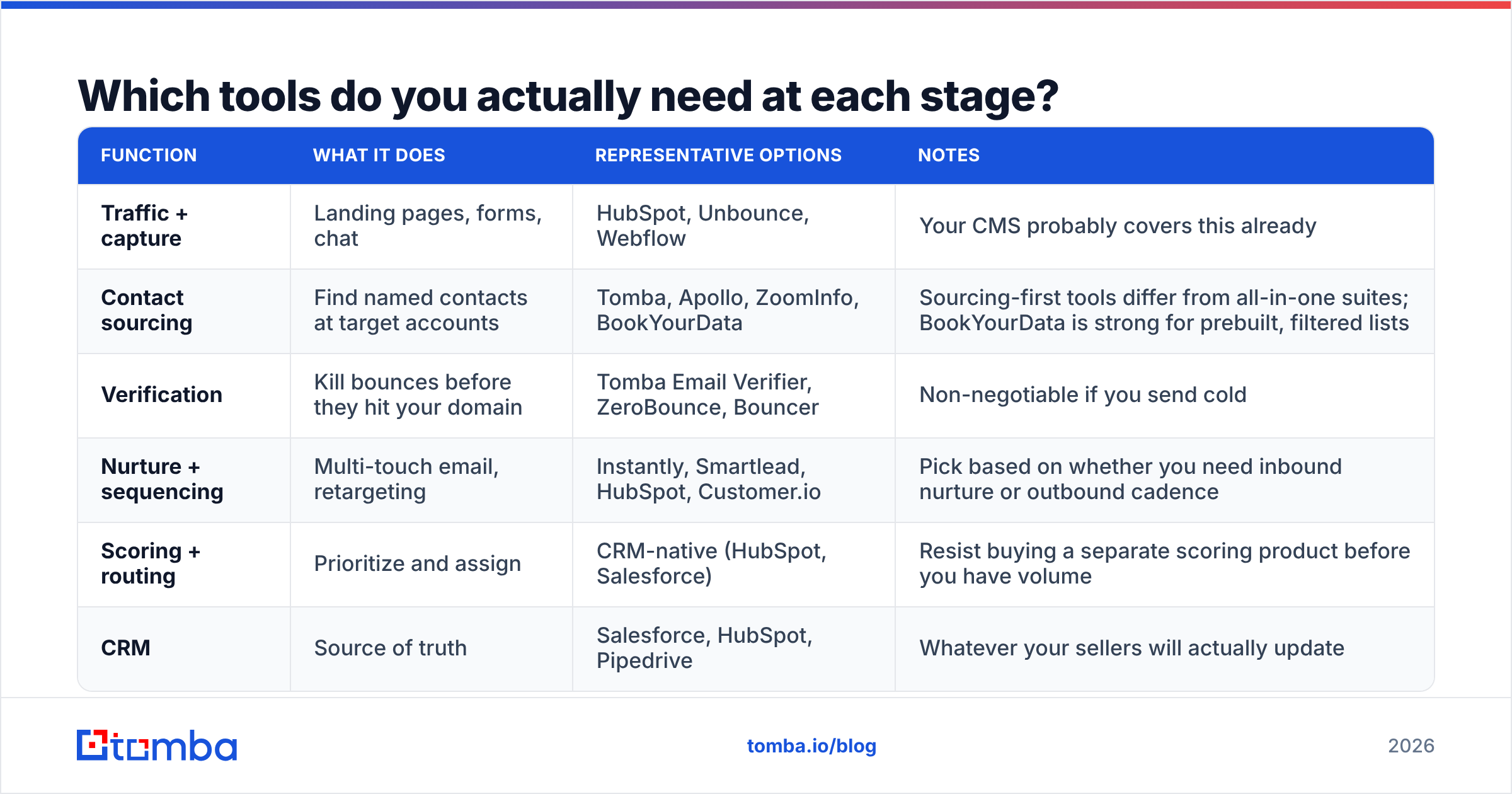
Which tools do you actually need at each stage?#
You need fewer than the vendor category maps suggest. Here is an honest split by function, with the trade-offs stated:
| Function | What it does | Representative options | Notes |
|---|---|---|---|
| Traffic + capture | Landing pages, forms, chat | HubSpot, Unbounce, Webflow | Your CMS probably covers this already |
| Contact sourcing | Find named contacts at target accounts | Tomba, Apollo, ZoomInfo, BookYourData | Sourcing-first tools differ from all-in-one suites; BookYourData is strong for prebuilt, filtered lists |
| Verification | Kill bounces before they hit your domain | Tomba Email Verifier, ZeroBounce, Bouncer | Non-negotiable if you send cold |
| Nurture + sequencing | Multi-touch email, retargeting | Instantly, Smartlead, HubSpot, Customer.io | Pick based on whether you need inbound nurture or outbound cadence |
| Scoring + routing | Prioritize and assign | CRM-native (HubSpot, Salesforce) | Resist buying a separate scoring product before you have volume |
| CRM | Source of truth | Salesforce, HubSpot, Pipedrive | Whatever your sellers will actually update |
The classic mistake is buying the scoring and orchestration layer first. Scoring a hundred leads a month is a spreadsheet problem. Buy in order of where your funnel is actually leaking, and check vendor reviews on G2 against your own segment, not the aggregate score.
How do you fix a funnel that is already broken?#
Diagnose in this order, because each step invalidates the next if you skip it.
Audit the data before the tactics. Pull last quarter's captured contacts and run a bulk verify. If more than 10% are invalid or catch-all-unknown, your funnel metrics have been lying to you and every optimization you ran was tuned on noise. Fix the input first.
Find the single worst stage by absolute loss, not by percentage. A stage converting at 20% that receives 5,000 leads loses 4,000 people. A stage converting at 5% that receives 100 loses 95. Optimize the first one.
Interview ten rejected MQLs. Not survey — call. Ask what they were actually trying to do when they filled the form. You will usually discover your capture offer attracts a job function that cannot buy. That is a stage-2 targeting fix disguised as a stage-4 quality complaint.
Cut the weakest channel entirely for 30 days. Reallocate the budget to the strongest. Most teams discover that two of their six channels produce 80% of qualified pipeline, and that the other four survived on institutional habit.
Shorten one thing. Fewer form fields, fewer nurture emails before the first CTA, fewer days between MQL and first call. Funnel improvements from removal are cheaper and more durable than improvements from addition.
What does a healthy funnel review look like?#
Monthly, one hour, four questions:
- Where did volume enter and where did it die? One chart, absolute numbers, no percentages until question 3.
- What changed versus last month, and what did we deliberately change? Separate drift from intervention. If you cannot name the intervention, you got lucky or unlucky, not better or worse.
- Which stage has the worst rate-times-volume loss? That is next month's only project.
- What did sellers reject and why? Read the rejection reasons out loud. They are uncomfortable and they are correct.
Keep a running log of interventions with dates. Six months in, that log is the most useful document in your revenue operations stack, because it is the only record of what actually moved numbers versus what merely felt productive.
One more discipline: attach a cost to every stage. Cost per lead is easy and misleading. Cost per SQL and cost per customer, by channel, is where budget decisions get made. If a channel produces cheap leads and expensive customers, it is an expensive channel wearing a disguise.
Where should you start this week?#
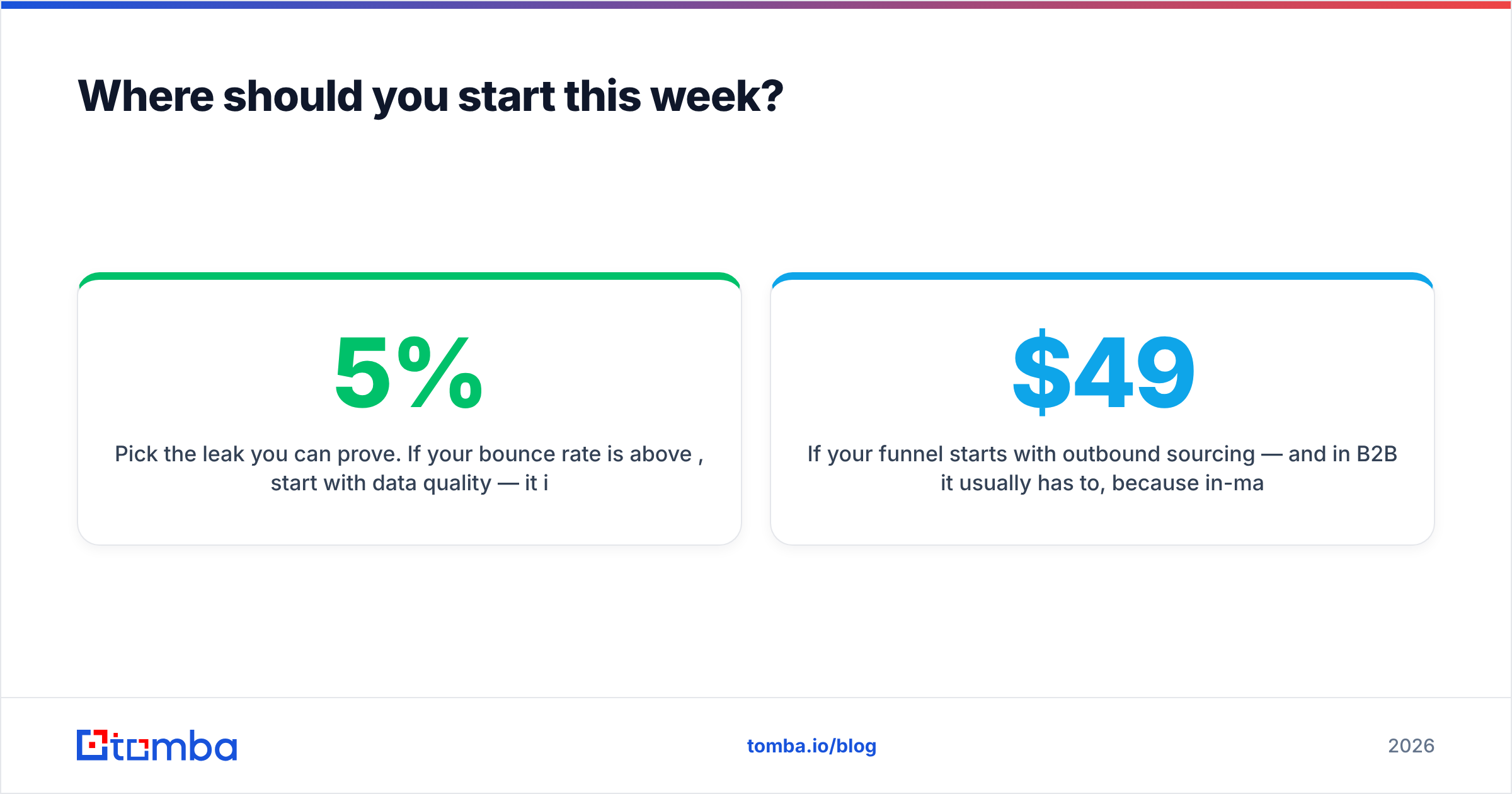
Pick the leak you can prove. If your bounce rate is above 5%, start with data quality — it is the fastest fix with the widest downstream effect. If your bounces are clean but MQL→SQL is under 10%, your capture offer is attracting the wrong job function and no amount of nurture copy will repair it. If both look fine and the cycle is just long, you have a handoff and follow-up problem, which is an SLA fix, not a marketing fix.
The funnel is not a growth strategy. It is a measurement instrument that tells you which growth strategy is failing and where. Build it small, instrument all five stages, and resist adding channels until the existing ones are legible.
If your funnel starts with outbound sourcing — and in B2B it usually has to, because in-market buyers are a rounding error of your addressable market — the top of the funnel is only as good as the contact data feeding it. The Tomba Email Finder gives you verified, named contacts at your target accounts by domain, name, or company, with verification built into the same workflow so bounces never reach your sending domain. The free tier covers 25 searches a month to test your ICP hypothesis, and paid plans start at $49/mo when you are ready to build volume — full details on Tomba pricing. Fix the input, and every stage below it gets easier to read.
Related guides#
// get started
Find, verify and enrich your first contacts today
Start on the free plan with 25 searches a month, then scale when your team is ready.
Free plan · No credit card required · GDPR & CCPA
Get the Tomba newsletter
Product and data updates
// about the author