The B2B Lead Generation Funnel: A 2026 Stage-by-Stage Guide
Most B2B funnels don't fail at the top — they leak in the middle, where bad data and slow follow-up quietly kill deals. Here's how each stage should actually work, what to measure, and where to fix the leaks first.
TL;DR
- A B2B lead generation funnel is not a marketing diagram — it's a measurement system. If you can't name the conversion rate between two adjacent stages, that stage doesn't exist operationally.
- Most funnels don't fail at the top. They fail between MQL and SQL, where handoff delays, unverified contact data, and vague qualification criteria destroy 60-80% of the volume marketing worked to create.
- The three metrics that predict pipeline health earliest: stage-to-stage conversion rate, time-in-stage, and contactability (what share of leads have a reachable, verified email or phone).
- Buying committees now average 6-10 people. A funnel built around one contact per account is structurally broken regardless of how good your content is.
- Fixing data quality at the top is usually cheaper than fixing conversion at the bottom. Verified emails and enriched records raise every downstream rate at once.
What is a B2B lead generation funnel?#
A B2B lead generation funnel is the ordered set of stages a company passes through from first anonymous touch to closed revenue, with a defined entry criterion, owner, and conversion metric at each stage.
Think of it like an airport. Every traveler passes through check-in, security, gate, and boarding. Nobody skips security because they're in a hurry. The airport doesn't measure "how many people came to the airport" — it measures how many cleared each checkpoint and how long each one took. When a flight is delayed, you can point at the checkpoint that caused it.
Most B2B teams treat their funnel like a mood board instead. They know roughly how many leads came in and roughly how many deals closed, and everything between those two numbers is folklore. Then a quarter misses and nobody can say which checkpoint jammed.
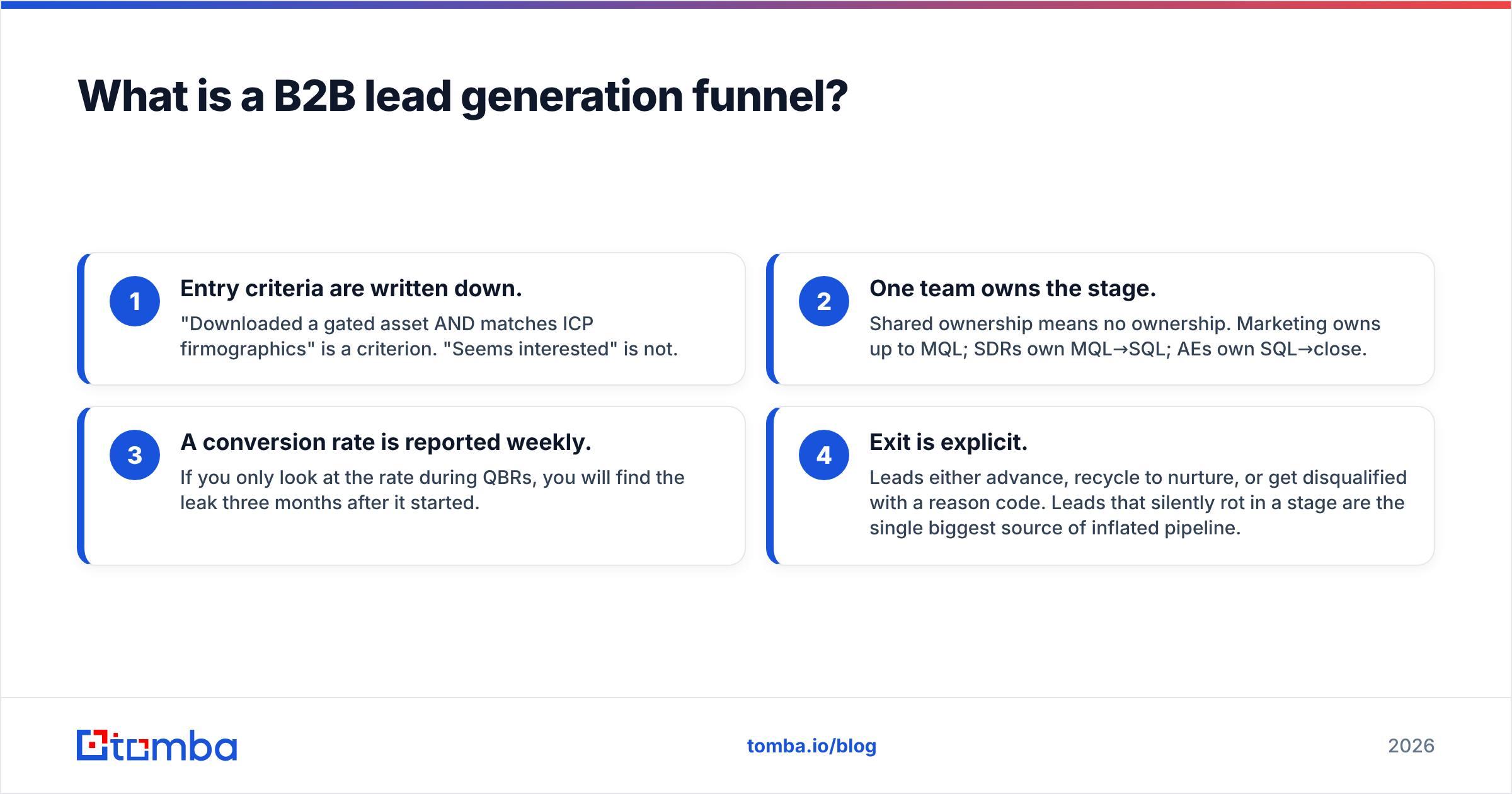
The technical definition matters here. A funnel stage is real only if three things are true:
- Entry criteria are written down. "Downloaded a gated asset AND matches ICP firmographics" is a criterion. "Seems interested" is not.
- One team owns the stage. Shared ownership means no ownership. Marketing owns up to MQL; SDRs own MQL→SQL; AEs own SQL→close.
- A conversion rate is reported weekly. If you only look at the rate during QBRs, you will find the leak three months after it started.
- Exit is explicit. Leads either advance, recycle to nurture, or get disqualified with a reason code. Leads that silently rot in a stage are the single biggest source of inflated pipeline.
Everything else in this guide is downstream of those four rules.
Why do B2B funnels leak between stages?#
Because the handoffs are where ownership changes, and ownership changes are where accountability evaporates.
Here's the pattern almost every leaking funnel shares. Marketing generates 1,000 raw leads in a month. Around 300 meet the marketing qualified lead bar. SDRs work those 300 and book 25 meetings. AEs hold 18 of them. Four become opportunities. One closes.
Everyone stares at the 1-in-1,000 and concludes they need more traffic. The actual story is in the 300→25 step, where 92% of qualified demand died — and a large chunk of it died for mechanical reasons, not because the prospects weren't interested.
The mechanical causes, in rough order of frequency:
- Unreachable contacts. A meaningful share of any list has stale, guessed, or catch-all addresses. If 22% of your MQLs have an email that bounces or never lands, you didn't lose those leads to competitors — you lost them to your CRM.
- Response latency. Research consistently shows response-time decay is brutal: contact attempts within the first hour convert dramatically better than attempts the next day. A nightly sync between your forms and your sequencing tool is a conversion tax.
- Single-threading. Gartner's B2B buying research puts the typical buying group at six to ten stakeholders. Your one champion cannot carry a deal through procurement, security review, and finance alone.
- Criteria drift. Marketing's MQL definition was set 18 months ago against a different ICP. SDRs quietly stopped trusting it and started cherry-picking. Now the stage measures nothing.
- No recycle path. "Not now" is not "no," but without a nurture loop, every "not now" is treated as a loss and the demand is spent permanently.
Notice that only one of those five is about messaging. The rest are data, routing, and process problems — which is good news, because those are fixable in weeks rather than quarters.
What does each funnel stage actually do?#
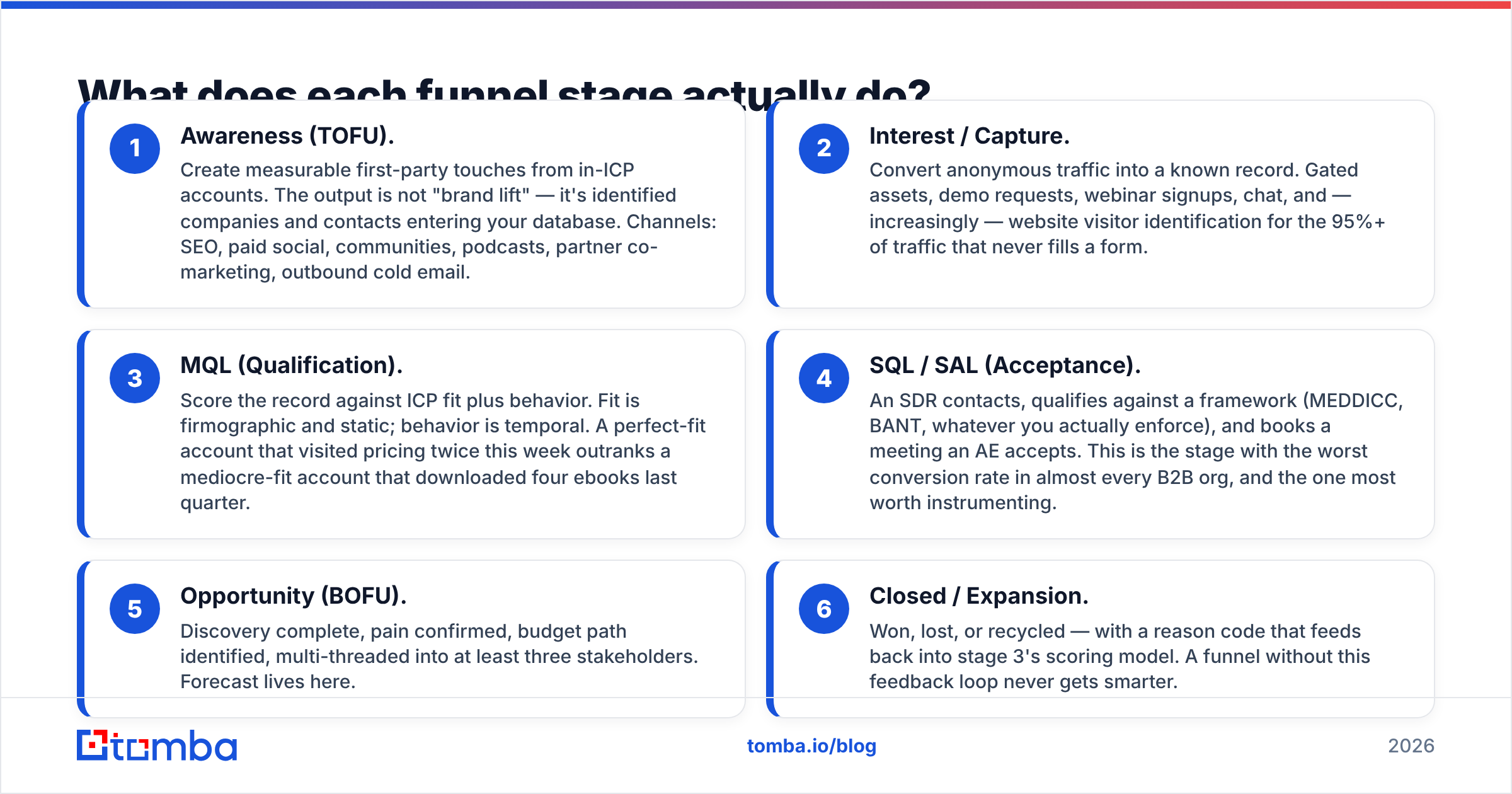
Six stages, each with one job. Anything more granular is reporting theater; anything less and you can't localize a leak.
- Awareness (TOFU). Create measurable first-party touches from in-ICP accounts. The output is not "brand lift" — it's identified companies and contacts entering your database. Channels: SEO, paid social, communities, podcasts, partner co-marketing, outbound cold email.
- Interest / Capture. Convert anonymous traffic into a known record. Gated assets, demo requests, webinar signups, chat, and — increasingly — website visitor identification for the 95%+ of traffic that never fills a form.
- MQL (Qualification). Score the record against ICP fit plus behavior. Fit is firmographic and static; behavior is temporal. A perfect-fit account that visited pricing twice this week outranks a mediocre-fit account that downloaded four ebooks last quarter.
- SQL / SAL (Acceptance). An SDR contacts, qualifies against a framework (MEDDICC, BANT, whatever you actually enforce), and books a meeting an AE accepts. This is the stage with the worst conversion rate in almost every B2B org, and the one most worth instrumenting.
- Opportunity (BOFU). Discovery complete, pain confirmed, budget path identified, multi-threaded into at least three stakeholders. Forecast lives here.
- Closed / Expansion. Won, lost, or recycled — with a reason code that feeds back into stage 3's scoring model. A funnel without this feedback loop never gets smarter.
The stages are sequential, but the work isn't. You should be enriching, verifying, and multi-threading continuously, not only at the moment a lead crosses a threshold.
What metrics should you track at each stage?#
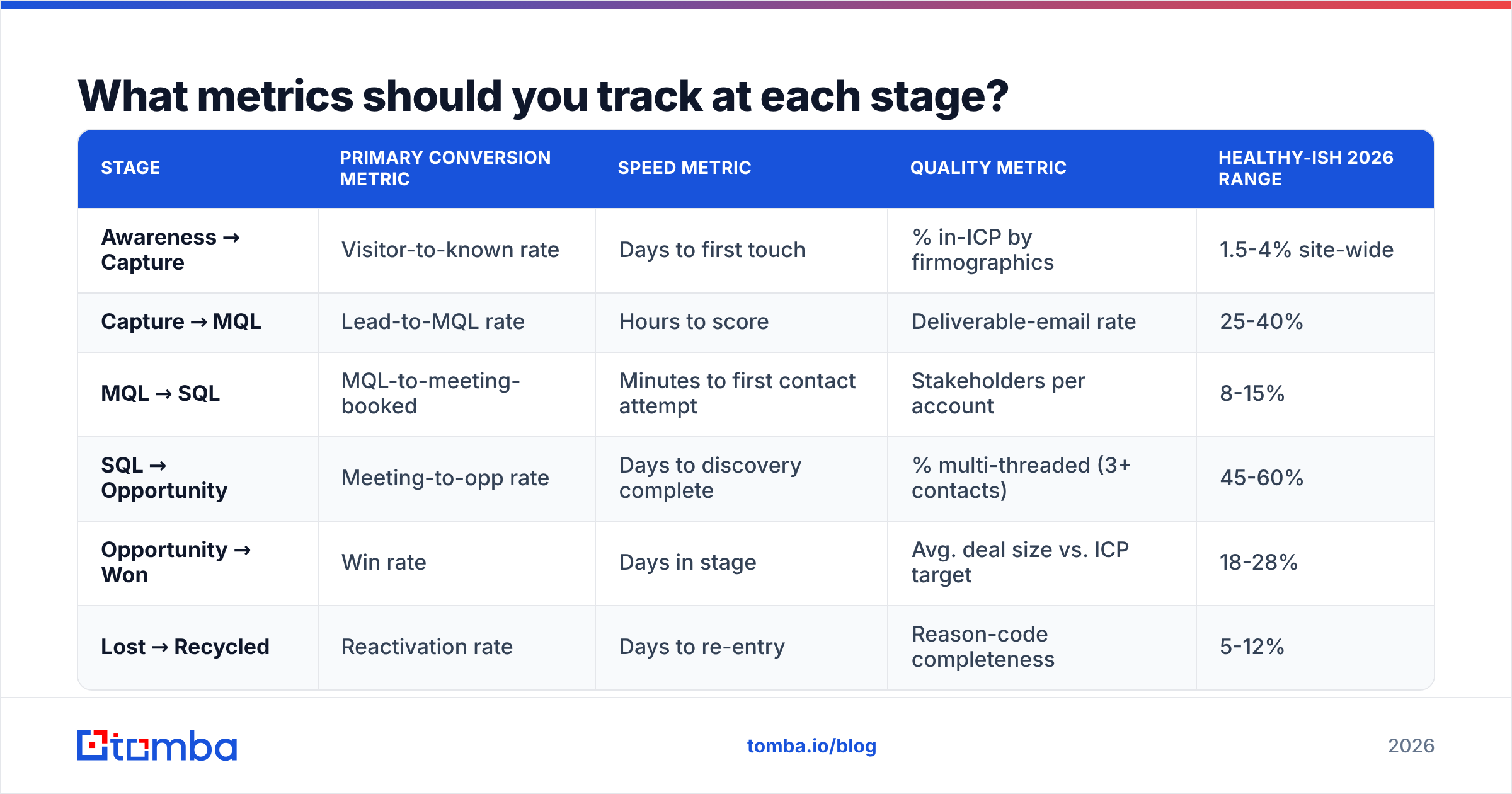
One primary rate, one speed metric, one quality metric per stage. That's it. Dashboards with 40 tiles get ignored.
| Stage | Primary conversion metric | Speed metric | Quality metric | Healthy-ish 2026 range |
|---|---|---|---|---|
| Awareness → Capture | Visitor-to-known rate | Days to first touch | % in-ICP by firmographics | 1.5-4% site-wide |
| Capture → MQL | Lead-to-MQL rate | Hours to score | Deliverable-email rate | 25-40% |
| MQL → SQL | MQL-to-meeting-booked | Minutes to first contact attempt | Stakeholders per account | 8-15% |
| SQL → Opportunity | Meeting-to-opp rate | Days to discovery complete | % multi-threaded (3+ contacts) | 45-60% |
| Opportunity → Won | Win rate | Days in stage | Avg. deal size vs. ICP target | 18-28% |
| Lost → Recycled | Reactivation rate | Days to re-entry | Reason-code completeness | 5-12% |
Treat those ranges as calibration, not gospel — they shift hard by ACV, motion, and category. A $200k enterprise ACV funnel with 40 opportunities a year has entirely different math from a $6k self-serve motion. What matters is that you can compute every cell for your own funnel and watch the direction of travel week over week.
The metric teams most often skip is the quality column in row two: deliverable-email rate. It's the cheapest one to fix and it multiplies through every stage below it. If you raise deliverability from 78% to 95%, you didn't gain 17 percentage points — you gained 17 points on the top of a chain where each subsequent stage multiplies it.
How do you fill the top of the funnel without burning your domain?#
Volume is easy. Volume that doesn't destroy your sender reputation is the actual skill.
The failure mode is familiar: a team buys or scrapes 50,000 contacts, loads them into a sequencer, and sends. Bounce rate hits 9%, spam complaints spike, sender reputation collapses, and now even the warm inbound replies land in Promotions. The list wasn't the problem — sending to a list nobody validated was.
The disciplined version:
- Build narrow, not wide. 500 accounts that match your top three closed-won patterns beat 50,000 that match "software, US, 50-200 employees."
- Find contacts per account, not per list. Start from the account, then use a domain search to pull the actual people in the relevant functions — champion, economic buyer, technical evaluator — instead of whoever happened to be in a purchased CSV.
- Verify before you send, every time. Run every address through an email verifier and remove the unknowns and catch-alls you can't confirm. Keep bounce rate under 2%.
- Enrich before you write. Titles, headcount, tech stack, and funding stage turn a generic sequence into a relevant one. Contact enrichment is what makes personalization scalable rather than artisanal.
- Warm and ramp. New sending domains need weeks, not days. Ramp volume gradually and monitor placement, not just opens.
- Keep channels independent. LinkedIn, phone, and email should reinforce each other, not fire simultaneously on day one. Sequenced multi-channel beats simultaneous multi-channel.
Which tools fit which funnel stage?#
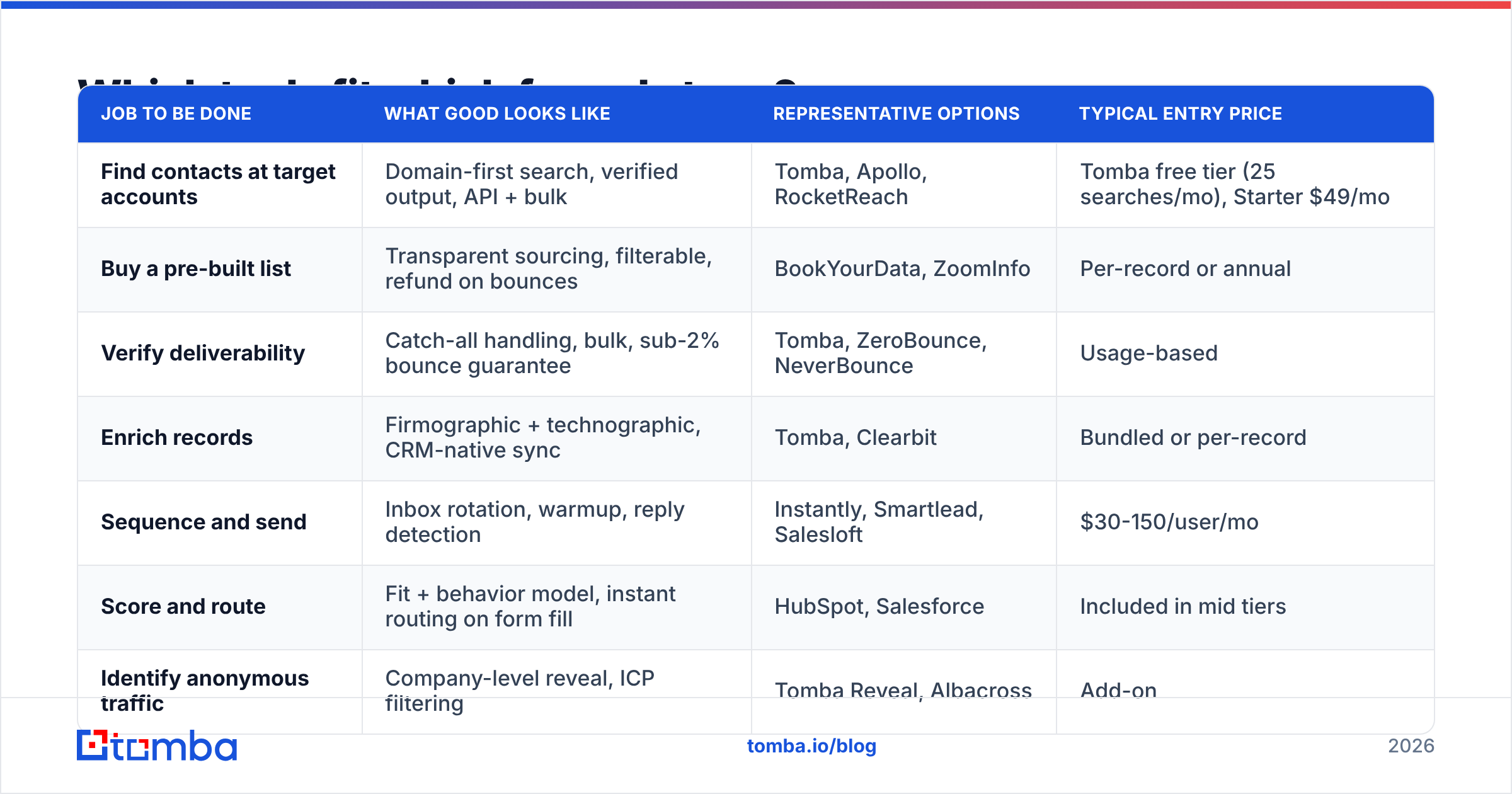
You do not need a 14-tool stack. You need one dependable option per job, and the jobs at the top of the funnel have the most leverage.
| Job to be done | What good looks like | Representative options | Typical entry price |
|---|---|---|---|
| Find contacts at target accounts | Domain-first search, verified output, API + bulk | Tomba, Apollo, RocketReach | Tomba free tier (25 searches/mo), Starter $49/mo |
| Buy a pre-built list | Transparent sourcing, filterable, refund on bounces | BookYourData, ZoomInfo | Per-record or annual |
| Verify deliverability | Catch-all handling, bulk, sub-2% bounce guarantee | Tomba, ZeroBounce, NeverBounce | Usage-based |
| Enrich records | Firmographic + technographic, CRM-native sync | Tomba, Clearbit | Bundled or per-record |
| Sequence and send | Inbox rotation, warmup, reply detection | Instantly, Smartlead, Salesloft | $30-150/user/mo |
| Score and route | Fit + behavior model, instant routing on form fill | HubSpot, Salesforce | Included in mid tiers |
| Identify anonymous traffic | Company-level reveal, ICP filtering | Tomba Reveal, Albacross | Add-on |
A note on the buy-vs-find question, since it drives a lot of budget arguments: pre-built list providers like BookYourData are genuinely good when you need a defined slice of a market fast and you're comfortable with a per-record model — their pay-as-you-go structure suits one-off campaigns well. Search-and-verify tools suit continuous prospecting, where you're generating fresh contacts against accounts your team picked this week and you want API access to automate it. Plenty of teams run both. Compare Tomba pricing against per-record economics using your actual monthly contact volume rather than list price — the crossover point is usually around a few thousand contacts a month.
For a broader vendor landscape, G2's lead capture and intelligence categories are a reasonable starting filter, though read the reviews by company size rather than the aggregate score.
How do you fix a leaking middle funnel?#
Fix in this order, because each step makes the next one measurable.
Week 1 — Instrument the handoff. Add timestamps at MQL creation and first contact attempt. Report median minutes between them. Most teams discover a number they didn't believe was possible, usually measured in days.
Week 2 — Clean the contactability problem. Run your existing MQL backlog through verification. Segment into valid, catch-all, and invalid. For invalid records at accounts you care about, re-find the contact rather than deleting the account — the company is still in-ICP, you just had the wrong person.
Week 3 — Rewrite the MQL definition with SDRs in the room. If SDRs are ignoring 40% of what marketing sends, the definition is wrong, not the SDRs. Agree on a fit score floor and at least one behavioral trigger.
Week 4 — Add the second and third contact per account. For every account that reaches MQL, automatically find two additional stakeholders in adjacent functions using an email finder and add them to the account record. Multi-threading at MQL rather than at opportunity is the single highest-ROI process change most B2B teams can make.
Ongoing — Build the recycle loop. Every disqualified lead gets a reason code and a re-entry date. "No budget this quarter" re-enters in 90 days. "No champion identified" re-enters when a relevant title changes at the account.
HubSpot's ongoing research on inbound and sales alignment covers the qualification-definition piece in more depth if you want a second reference point — their marketing research library is a useful counterweight to vendor claims, including ours.
What does a working funnel look like end to end in 2026?#
Concretely, for a mid-market SaaS team with a $25k ACV:
Marketing publishes for a narrow set of bottom-funnel queries and runs paid retargeting against a 1,200-account target list. Anonymous traffic from those accounts is identified at the company level and pushed to a daily queue. A form fill or a pricing-page visit from an in-ICP account triggers enrichment and contact discovery within minutes — three stakeholders per account, all verified, all written to the CRM before an SDR ever opens the record.
The SDR sees a routed lead with the account's tech stack, headcount, funding stage, and three reachable humans. First touch happens inside 30 minutes during business hours. Email, LinkedIn, and phone run in a sequenced cadence over 14 days. Non-responders recycle to nurture with a dated re-entry, not a deletion.
Meetings land with the AE already multi-threaded. Discovery confirms pain against a written qualification framework. Lost deals write a reason code that adjusts next quarter's scoring weights.
None of that requires a new category of software. It requires the data at the top to be accurate and the handoff at the middle to be fast. Everything else is execution you already know how to do.
Start where the leverage is. The fastest measurable improvement in most B2B lead generation funnels isn't a new channel — it's making sure the contacts already in your funnel are real, complete, and multi-threaded. Tomba's Email Finder does exactly that job: give it a company domain and a name, or just a domain, and get back verified, deliverable contacts you can route to an SDR the same hour. The free tier covers 25 searches a month so you can test it against a segment of your own MQL backlog before committing to anything — run 25 of your worst-performing records through it and see how many were simply unreachable.
Related guides#
// get started
Find, verify and enrich your first contacts today
Start on the free plan with 25 searches a month, then scale when your team is ready.
Free plan · No credit card required · GDPR & CCPA
Get the Tomba newsletter
Product and data updates
// about the author