Lead Generation Funnels: How to Build One That Converts
Most lead generation funnels leak at the same three joints. Here's the stage-by-stage teardown, real conversion benchmarks, and the tooling choices that actually move pipeline in 2026.
TL;DR
- A lead generation funnel is not a page — it's a measured sequence of stages (attract → capture → qualify → nurture → convert) where each stage has its own conversion rate and its own failure mode.
- Most funnels don't fail at the top. They fail at capture-to-qualify, where 40-60% of collected contacts are unreachable, mistyped, or role accounts.
- Inbound and outbound funnels use the same skeleton but different fuel: inbound trades content for contact data, outbound trades research for contact data.
- Benchmarks worth holding yourself to in 2026: 2-5% visitor-to-lead on a content page, 20-35% MQL-to-SQL, 15-25% SQL-to-opportunity.
- The cheapest fix in the whole system is contact data hygiene — verified emails before send, not after bounces.
What Is a Lead Generation Funnel?#
A lead generation funnel is the ordered set of steps a stranger moves through before they become a qualified sales conversation, plus the measurement that tells you where they drop.
Think of it like a municipal water system. Water enters the reservoir (traffic), passes through intake screens (capture forms), gets treated (qualification), sits in the tank (nurture), and finally reaches taps (sales conversations). Nobody judges a water system by how much rain fell. They judge it by how much clean water reaches the tap. Your funnel works the same way — top-of-funnel volume is weather, not performance.
The technical version: a funnel is a state machine over contact records. Each contact occupies exactly one stage, transitions are event-driven (form submit, email reply, demo booked), and every transition has a measurable rate. If you can't name the event that moves a contact from stage 3 to stage 4, you don't have a funnel — you have a mailing list with optimism attached.
The five stages, and what each one actually owns#
- Attract — Owns traffic quality, not traffic volume. A blog post ranking for "best CRM for agencies" is worth 10x one ranking for "what is CRM."
- Capture — Owns the exchange. Something of value goes out (guide, calculator, audit, trial), a contact record comes in. This is where data quality is won or lost permanently.
- Qualify — Owns the filter. Firmographic fit, role fit, and intent signals decide who gets human attention and who gets automation.
- Nurture — Owns time. Most qualified leads are not ready now. Nurture exists to stay useful until the trigger event fires.
- Convert — Owns the handoff. A booked meeting, a trial-to-paid upgrade, a signed contract. The only stage finance cares about.
Skipping a stage doesn't speed the funnel up. It just moves the leak somewhere you're not instrumented to see it.
Why Do Most Lead Generation Funnels Leak?#
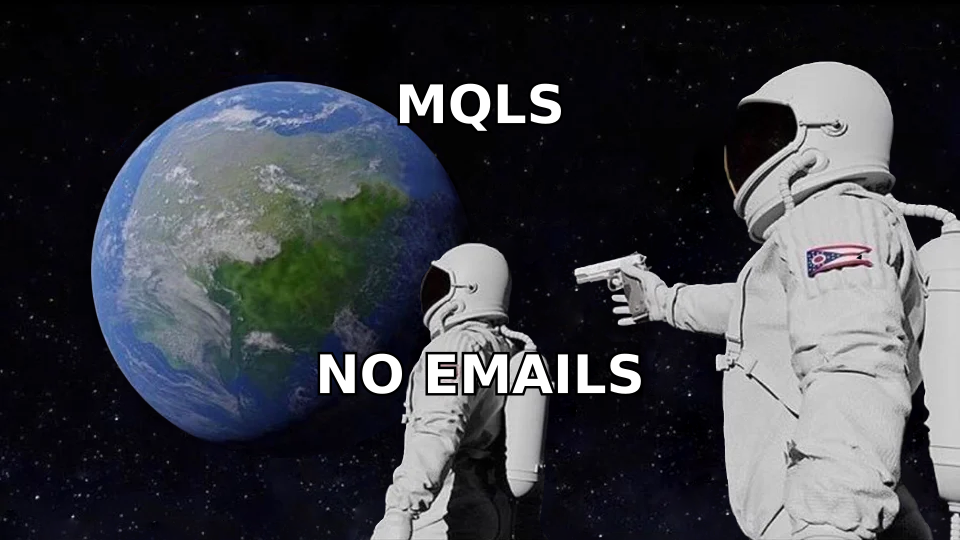
Three leaks account for the overwhelming majority of wasted pipeline, and they're all in the middle.
Leak 1: The contact data is wrong. You captured john@ a typo'd domain, a role account like info@, or a personal Gmail that nobody checks for work. Nothing downstream can save this. Your nurture sequence sends to a dead address, your CRM counts it as a lead, and your reporting shows a healthy MQL number that converts to zero. HubSpot's research on database decay has long pegged B2B contact databases at roughly 22-30% annual decay — people change jobs, domains get retired, mailboxes get deprovisioned. Without periodic re-verification, a two-year-old list is closer to a fiction than a funnel.
Leak 2: Qualification happens too late. Teams route everything to sales, sales ignores 70% of it, and marketing concludes "sales doesn't follow up." Both are right. The fix is a scoring gate that runs before routing, not after. If your definition of a marketing qualified lead is "filled out a form," you have no qualification stage at all.
Leak 3: Nurture is a newsletter. A broadcast email to everyone at stage 4 is not nurture. Nurture is segment-specific, trigger-aware, and has an exit condition. If a contact can sit in your nurture track for nine months without either converting or being archived, that track is a storage unit.
There's a fourth leak that's less common but more expensive: sending to unverified addresses at volume, tanking your sender reputation, and quietly losing inbox placement for the contacts who were real. A 6% bounce rate doesn't just waste 6% of sends — it degrades the other 94%.
What Are Realistic Conversion Benchmarks at Each Stage?#
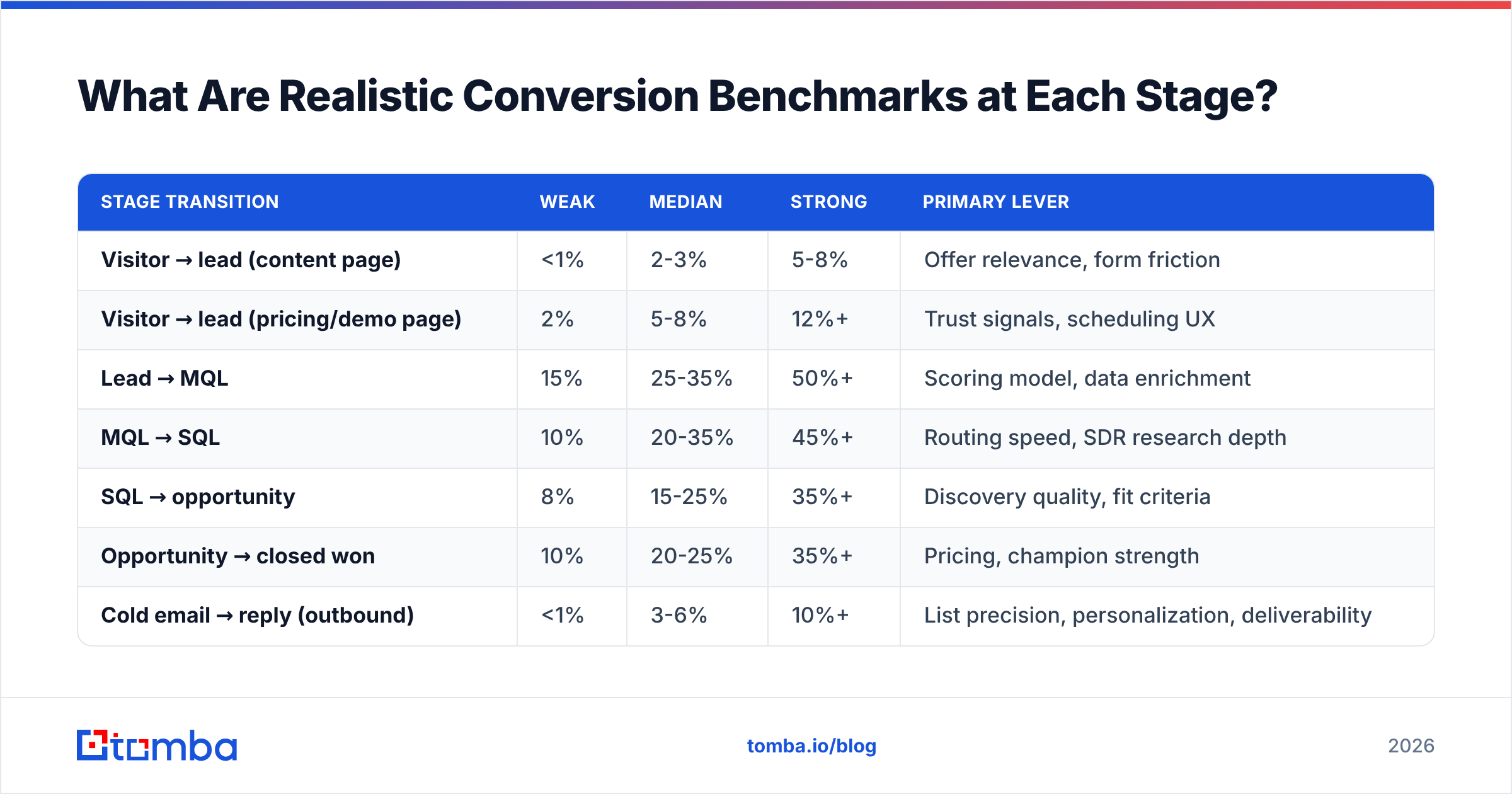
Benchmarks vary wildly by ACV, motion, and category. These ranges reflect what mid-market B2B SaaS teams typically report; treat them as a sanity check, not a target to game.
| Stage transition | Weak | Median | Strong | Primary lever |
|---|---|---|---|---|
| Visitor → lead (content page) | <1% | 2-3% | 5-8% | Offer relevance, form friction |
| Visitor → lead (pricing/demo page) | 2% | 5-8% | 12%+ | Trust signals, scheduling UX |
| Lead → MQL | 15% | 25-35% | 50%+ | Scoring model, data enrichment |
| MQL → SQL | 10% | 20-35% | 45%+ | Routing speed, SDR research depth |
| SQL → opportunity | 8% | 15-25% | 35%+ | Discovery quality, fit criteria |
| Opportunity → closed won | 10% | 20-25% | 35%+ | Pricing, champion strength |
| Cold email → reply (outbound) | <1% | 3-6% | 10%+ | List precision, personalization, deliverability |
Two things stand out when you look at this as a system. First, compounding is brutal: a funnel at median on every line converts roughly 0.1% of visitors to closed-won. Second, the biggest single-stage swings are lead→MQL and cold-email reply rate — and both are dominated by data quality rather than creative. Better copy on a bad list is a rounding error. A better list with mediocre copy is a step change.
Inbound vs Outbound Funnels: Which Should You Build First?#
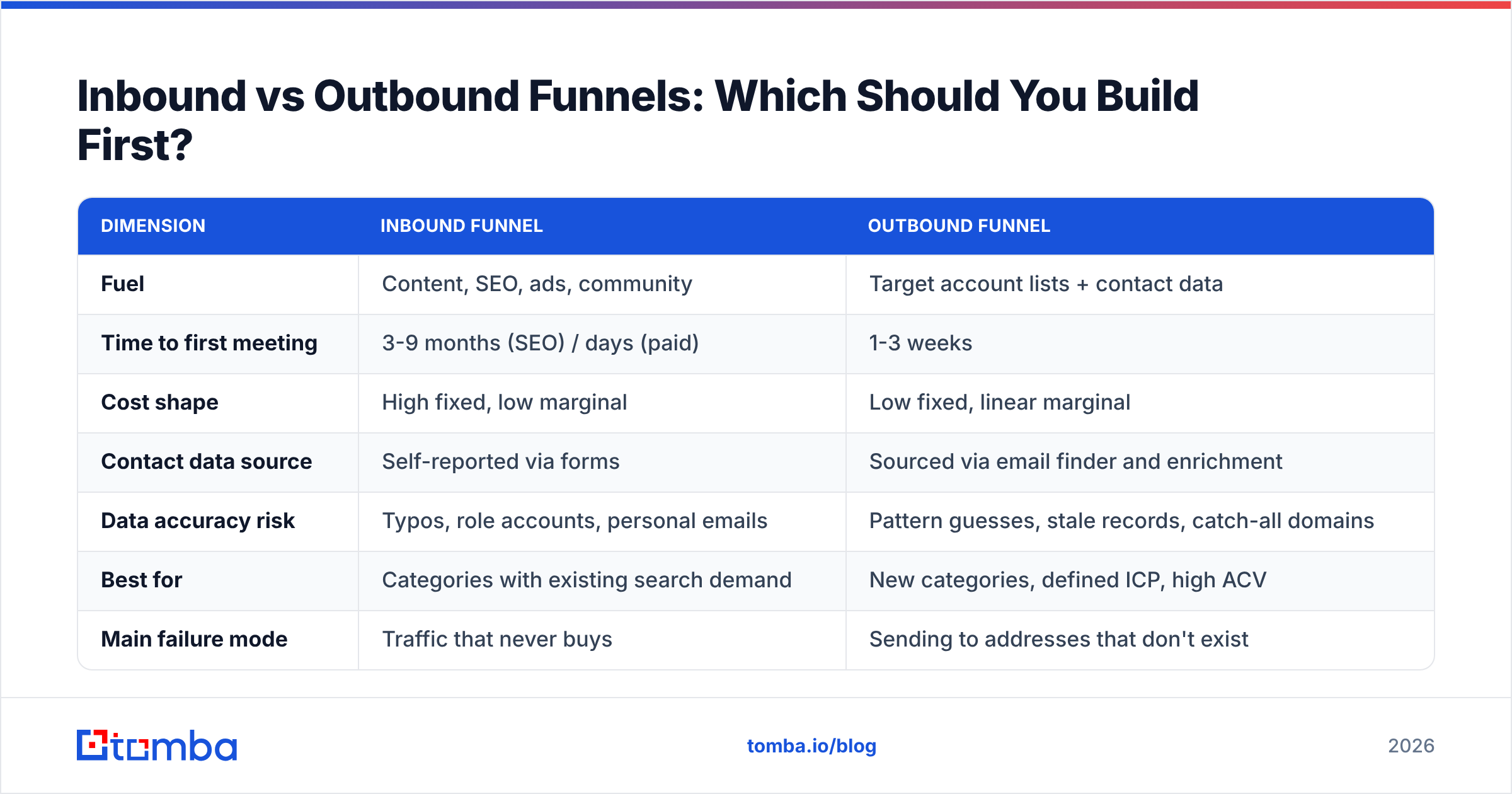
They're the same skeleton with different fuel, different cost curves, and very different time-to-first-meeting.
| Dimension | Inbound funnel | Outbound funnel |
|---|---|---|
| Fuel | Content, SEO, ads, community | Target account lists + contact data |
| Time to first meeting | 3-9 months (SEO) / days (paid) | 1-3 weeks |
| Cost shape | High fixed, low marginal | Low fixed, linear marginal |
| Contact data source | Self-reported via forms | Sourced via email finder and enrichment |
| Data accuracy risk | Typos, role accounts, personal emails | Pattern guesses, stale records, catch-all domains |
| Best for | Categories with existing search demand | New categories, defined ICP, high ACV |
| Main failure mode | Traffic that never buys | Sending to addresses that don't exist |
| Scales by | Publishing velocity + domain authority | Rep capacity + list quality |
The honest answer for most teams under $5M ARR: build outbound first, inbound in parallel, and let inbound take over as the cost-efficient channel around month 12. Outbound gives you conversations this quarter and — more importantly — tells you what messaging works. Inbound without that feedback loop is guessing in public for three quarters.
If you're running outbound, the list-building step deserves more engineering than it usually gets. Sourcing decision-maker contacts at target accounts via domain search beats scraping a general database, because you start from the account list your GTM team actually agreed on rather than whatever filter combination produced the most rows.
How Do You Fix the Capture-to-Qualify Leak?#
Fix it in three passes: verify, enrich, then score. In that order, because enriching a bad record produces a confidently wrong record, and scoring a confidently wrong record routes it to a human.
Pass 1 — Verify at the point of capture. Run syntax, MX, and mailbox checks before the record is written, not in a nightly batch. Real-time email verification on the form catches typos while the user is still on the page and can correct them. For sourced outbound lists, verify before the first send — catch-all domains in particular need their own handling, since a standard SMTP check returns "accept" for every address. A dedicated catch-all verifier is the difference between a 2% and a 9% bounce rate on enterprise domains.
Pass 2 — Enrich to fill the gaps you didn't ask for. Every form field you remove raises conversion and lowers data completeness. The resolution is to ask for email only, then append company size, industry, tech stack, and seniority server-side. Contact enrichment turns a three-field form into a fifteen-field record without touching conversion rate.
Pass 3 — Score against fit and intent separately. Fit is static (company size, industry, role). Intent is dynamic (pricing page visits, doc views, repeat sessions). A high-fit/low-intent lead goes to nurture. A low-fit/high-intent lead goes to self-serve. Only high-fit/high-intent earns an SDR. Collapsing both into one 0-100 score destroys the routing logic that made scoring worth doing.
One operational note: log the verification result on the contact record and keep it. When a campaign underperforms, the first question should be "what percentage of this segment was verified deliverable?" If you didn't store it, you'll spend two weeks blaming the subject line.
What Tools Do You Actually Need at Each Stage?#
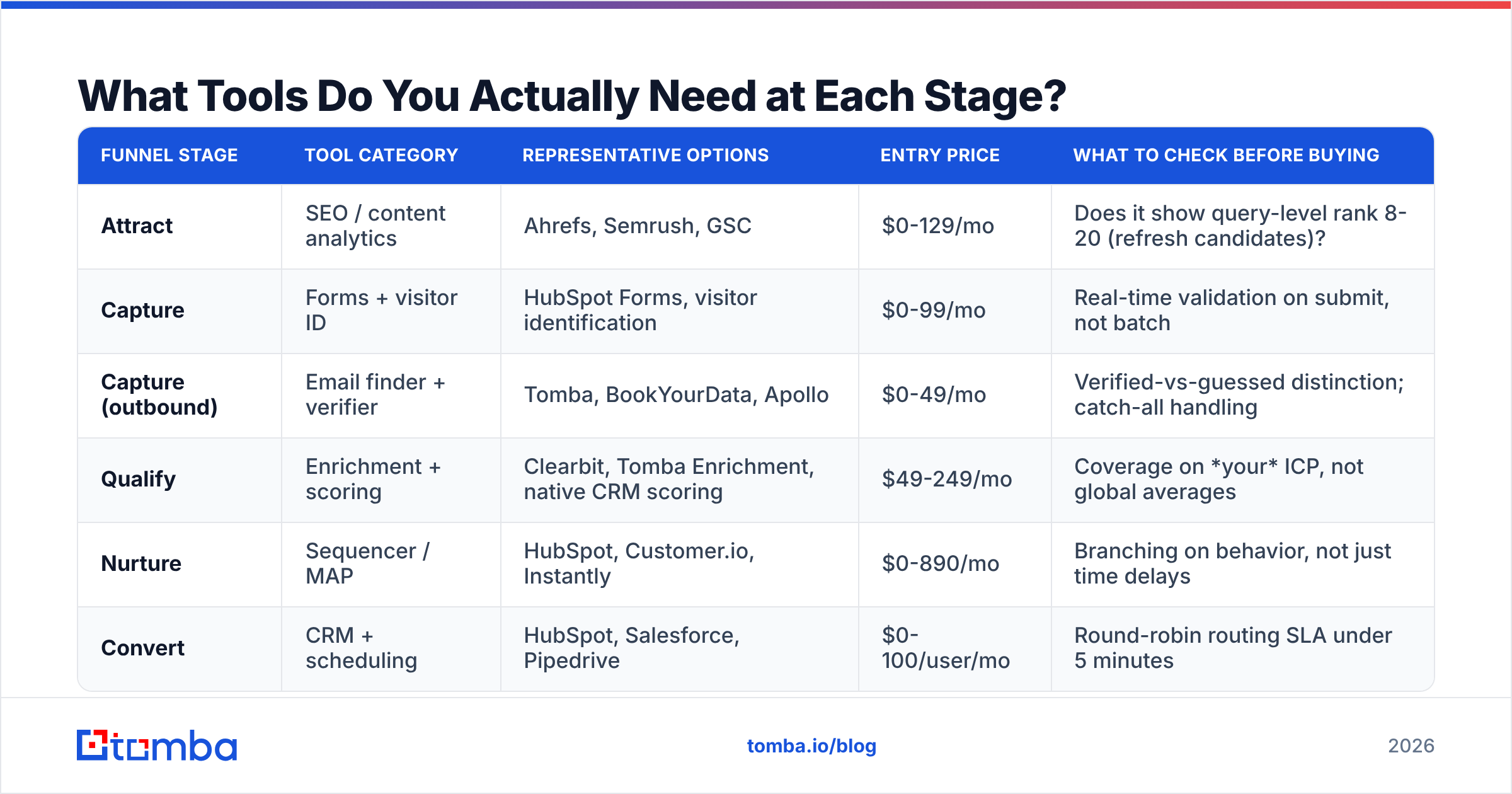
You need fewer than the vendor landscape implies. Here's a comparison of the categories that matter, with representative pricing as of 2026.
| Funnel stage | Tool category | Representative options | Entry price | What to check before buying |
|---|---|---|---|---|
| Attract | SEO / content analytics | Ahrefs, Semrush, GSC | $0-129/mo | Does it show query-level rank 8-20 (refresh candidates)? |
| Capture | Forms + visitor ID | HubSpot Forms, visitor identification | $0-99/mo | Real-time validation on submit, not batch |
| Capture (outbound) | Email finder + verifier | Tomba, BookYourData, Apollo | $0-49/mo | Verified-vs-guessed distinction; catch-all handling |
| Qualify | Enrichment + scoring | Clearbit, Tomba Enrichment, native CRM scoring | $49-249/mo | Coverage on your ICP, not global averages |
| Nurture | Sequencer / MAP | HubSpot, Customer.io, Instantly | $0-890/mo | Branching on behavior, not just time delays |
| Convert | CRM + scheduling | HubSpot, Salesforce, Pipedrive | $0-100/user/mo | Round-robin routing SLA under 5 minutes |
A note on the capture-for-outbound row, since that's where most budget gets misallocated. BookYourData is a strong fit if you want a pre-built, pay-as-you-go list with verified B2B contacts and no subscription commitment — genuinely useful when you need 5,000 contacts in an afternoon for a defined segment. Tomba fits a different shape: you already know the accounts, you want to find and verify contacts at those specific domains on an ongoing basis, and you want it wired into your stack via API. Both approaches are legitimate; they're answers to different questions. Buy the list when your ICP is broad and stable. Build the list when your ICP is narrow and your account list changes quarterly.
For reference pricing: Tomba runs a free tier at 25 searches/month, Starter at $49/mo, Growth at $99/mo, Pro at $249/mo, and custom Enterprise. The Tomba pricing page breaks down credit allocation per tier, which matters more than headline price if you're doing bulk work.
Independent review data on any of these is worth checking on G2 before committing — specifically the "ease of setup" and "data accuracy" sub-scores, which diverge from overall ratings more than you'd expect.
How Do You Instrument a Funnel So You Can Actually Debug It?#
Instrument transitions, not stages. A dashboard showing 4,000 MQLs tells you nothing. A dashboard showing "lead→MQL fell from 31% to 19% over six weeks, concentrated in paid social" tells you where to go.
Minimum viable instrumentation:
- Stage entry timestamp on every contact. Without it you can't compute velocity, and velocity degradation precedes conversion degradation by weeks.
- Source attribution that survives the handoff. First-touch and last-touch both, stored as separate fields. Arguing about which is "correct" is less useful than having both.
- Deliverability status as a first-class field. Verified / risky / catch-all / undeliverable, with a re-check date. This one field explains more variance in outbound performance than any other.
- Rejection reason on every disqualification. "Not a fit" is not a reason. "Company under 20 employees" is. After 200 records, your rejection reasons are your ICP definition.
- Cohort by entry month, not by report month. Reporting on "leads that converted in September" mixes cohorts and hides trend changes for a full quarter.
Forrester and Gartner both publish periodic B2B buying-process research worth reading against your own funnel shape — Gartner's B2B buying research in particular documents how much of the buying journey now happens before any vendor contact, which reframes what "top of funnel" should even be measured against.
Set a review cadence: weekly on transition rates, monthly on cohort velocity, quarterly on ICP definition. Anything more frequent is noise-chasing; anything less and you'll find out about a broken stage a full sales cycle late.
What Does a Working Funnel Look Like End to End?#
Concrete example — a 12-person B2B SaaS selling a $12k ACV product to operations leads at 200-2000 employee companies:
Attract: 8,000 monthly organic sessions, of which 1,900 land on bottom-funnel comparison and alternative pages. Capture: a ROI calculator and a template library convert 4.1% of those 1,900 into contacts — 78 leads. Forms ask for work email only; everything else is enriched server-side. Every submission is verified in real time; 6 are caught as typos and corrected on the spot.
In parallel, outbound: a 400-account target list, 3 contacts sourced per account via domain search, verified, and deduped against existing CRM records. 1,100 usable contacts after verification removes 9% as undeliverable or catch-all-risky. At a 5% reply rate that's 55 conversations per cycle.
Qualify: 78 inbound leads score to 24 MQLs (31%); the 55 outbound replies score to 31 SQLs directly since they self-identified. Convert: 24 MQLs → 7 SQLs → 2 opportunities; 31 outbound SQLs → 7 opportunities. Nine opportunities at 22% close rate is roughly 2 closed-won per cycle, or $24k new ARR monthly from a system that costs well under $1k/mo in tooling.
Nothing in that example is clever. It's just a funnel where every transition is measured and the contact data is verified before it's used. That's the whole trick.
Build the List Your Funnel Deserves#
Every leak described above compounds downstream, but only one of them is fixable in an afternoon: the quality of the contact data entering your funnel. Verified addresses mean your nurture reaches inboxes, your reply rates reflect your messaging rather than your bounce rate, and your MQL count means something to the person reading the dashboard.
Start with the Tomba Email Finder — find and verify decision-maker emails at the accounts on your target list, on the free tier at 25 searches/month before you commit to anything. If it works on your ICP, Starter at $49/mo covers most early outbound programs, and the API drops into whatever you've already built.
Related guides#
// get started
Find, verify and enrich your first contacts today
Start on the free plan with 25 searches a month, then scale when your team is ready.
Free plan · No credit card required · GDPR & CCPA
// about the author