Lead Generation Goals: How to Set Targets That Actually Hold
Most lead generation goals are just last quarter's number plus 20%. Here's how to back-solve targets from revenue, pick the right metrics, and avoid the MQL trap.
TL;DR
- Lead generation goals fail when they start from last quarter's number. Back-solve instead: revenue target → average deal size → win rate → SQLs → MQLs → top-of-funnel volume.
- Volume goals without a quality gate produce inflated dashboards and angry sales reps. Pair every volume target with an acceptance-rate or data-accuracy target.
- Pick three to five metrics maximum. A goal sheet with fourteen KPIs is a goal sheet with zero priorities.
- Set goals per channel, not just per team. Outbound, inbound, partner, and events have wildly different conversion math and shouldn't share one number.
- Review monthly, re-baseline quarterly. Annual goals set in January and never touched are decoration.
What are lead generation goals, really?#
Lead generation goals are the measurable commitments your marketing and sales development functions make about how much qualified demand they will create in a given period — and at what cost and quality.
That definition is doing more work than it looks. Three clauses matter:
- Measurable commitments. "Grow the pipeline" is an aspiration. "Deliver 340 sales-accepted leads at or below $180 blended cost per lead by Q2 close" is a goal.
- Qualified demand. Not form fills. Not webinar registrations. Demand that sales has agreed, in writing, counts as real.
- Cost and quality constraints. A goal without a denominator invites gaming. You can always hit a volume number by lowering the bar.
Most teams get clause 1 right and skip 2 and 3 entirely. That's why the average quarterly business review contains a green lead-gen dashboard sitting directly above a red pipeline number.
Why do most lead generation goals fail?#
Because they're set by arithmetic on the wrong starting point. The default process looks like this: open last quarter's report, take the MQL count, add 15–25%, socialize it, done.
Here's what goes wrong with that.
Failure 1 — The goal is untethered from revenue. If your MQL target doesn't reverse-engineer from a revenue number, it's a vanity metric with a budget attached. You can hit 120% of your MQL goal and miss pipeline by 40% simultaneously. Both facts can be true, and both usually are.
Failure 2 — Quality is nobody's number. Marketing is measured on leads delivered. Sales is measured on revenue closed. The gap between those two — acceptance, contactability, data accuracy — belongs to nobody. So it rots. HubSpot's research on sales and marketing alignment consistently finds lead quality, not lead volume, as the top-cited friction point between the two functions.
Failure 3 — One goal for every channel. Outbound cold email converts differently than a demo request from organic search. If you average them into a single MQL target, you lose the ability to diagnose anything. When the number misses, you have no idea which lever broke.
Failure 4 — Set once, never revisited. A goal you set in January using Q4's win rate is already wrong by March if your ACV moved, your ICP shifted, or a competitor cut prices.
How do you back-solve lead generation goals from revenue?#
Start at the money and walk backward. This is the only sequence that produces a defensible number.
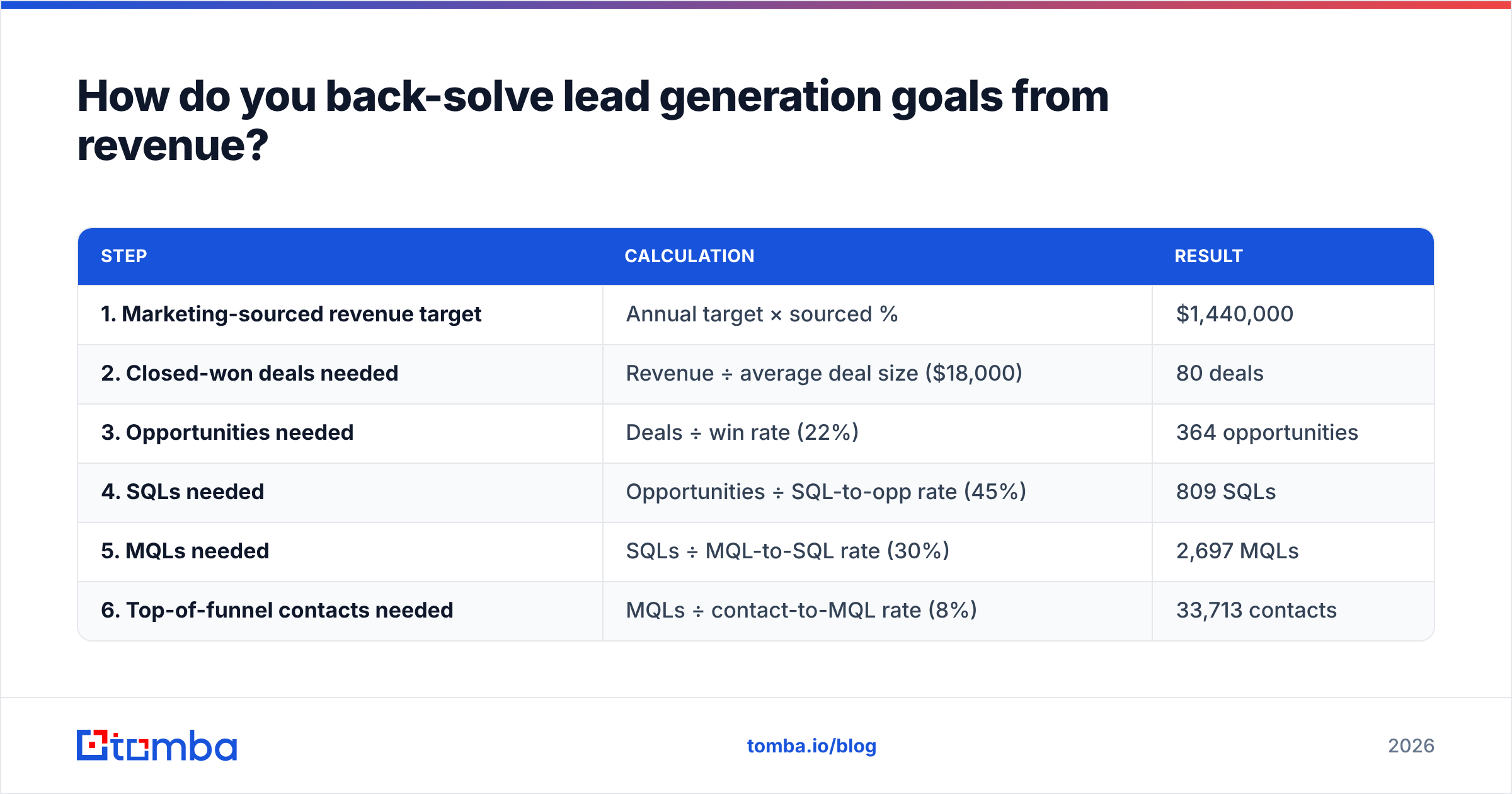
Say your team owns $2.4M in new-business revenue for the year, and marketing sources 60% of it — $1.44M.
| Step | Calculation | Result |
|---|---|---|
| 1. Marketing-sourced revenue target | Annual target × sourced % | $1,440,000 |
| 2. Closed-won deals needed | Revenue ÷ average deal size ($18,000) | 80 deals |
| 3. Opportunities needed | Deals ÷ win rate (22%) | 364 opportunities |
| 4. SQLs needed | Opportunities ÷ SQL-to-opp rate (45%) | 809 SQLs |
| 5. MQLs needed | SQLs ÷ MQL-to-SQL rate (30%) | 2,697 MQLs |
| 6. Top-of-funnel contacts needed | MQLs ÷ contact-to-MQL rate (8%) | 33,713 contacts |
Now you have a real annual goal: roughly 2,700 marketing qualified leads and about 33,700 quality top-of-funnel contacts. Divide by four for quarterly targets, adjusting for seasonality if your business has any.
The exercise is valuable even when the output is uncomfortable. If step 6 says you need 33,700 contacts and your total addressable market is 12,000 companies, the model just told you something important: you cannot hit this number with volume. You need a better win rate or a bigger deal size, and those are different projects entirely.
Two rules for making this work:
- Use trailing 12-month conversion rates, not best-ever rates. Optimism at step 3 compounds into fantasy at step 6.
- Rebuild the model quarterly. Conversion rates drift. A model built on stale rates produces goals that miss for reasons nobody can explain.
Which lead generation metrics should you actually set goals on?#
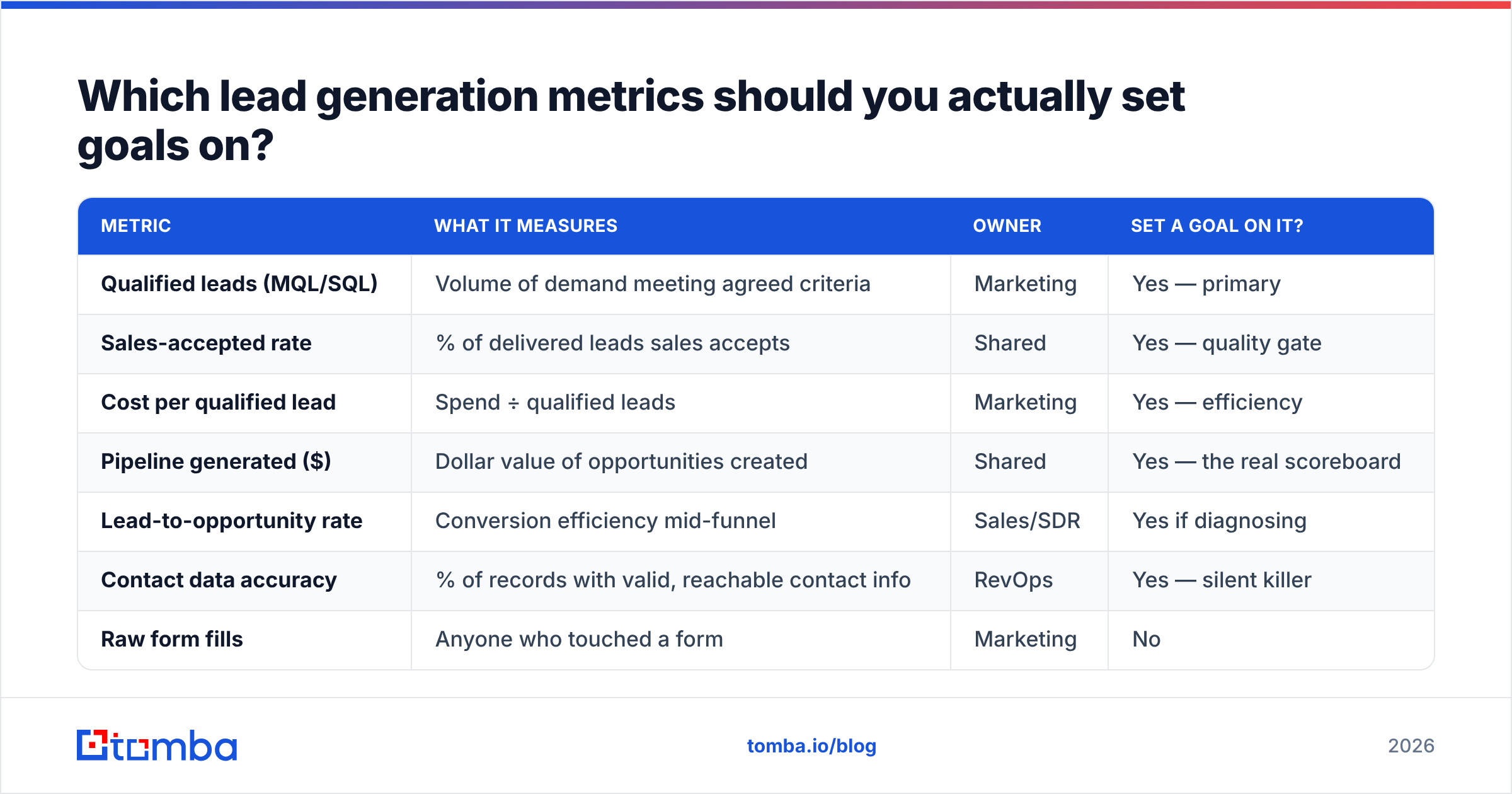
Fewer than you think. Here's the practical hierarchy, with which team owns each.
| Metric | What it measures | Owner | Set a goal on it? |
|---|---|---|---|
| Qualified leads (MQL/SQL) | Volume of demand meeting agreed criteria | Marketing | Yes — primary |
| Sales-accepted rate | % of delivered leads sales accepts | Shared | Yes — quality gate |
| Cost per qualified lead | Spend ÷ qualified leads | Marketing | Yes — efficiency |
| Pipeline generated ($) | Dollar value of opportunities created | Shared | Yes — the real scoreboard |
| Lead-to-opportunity rate | Conversion efficiency mid-funnel | Sales/SDR | Yes if diagnosing |
| Contact data accuracy | % of records with valid, reachable contact info | RevOps | Yes — silent killer |
| Raw form fills | Anyone who touched a form | Marketing | No |
| Website traffic | Sessions | Marketing | No — leading indicator only |
| Email open rate | Opens | SDR | No — unreliable since MPP |
The last three belong on dashboards, not goal sheets. They're diagnostic, not directional.
The one most teams miss is contact data accuracy. If 30% of your list bounces or routes to a person who left two years ago, your entire funnel math is built on sand. Setting an explicit goal — say, ≥95% deliverable contacts at handoff — forces someone to own list hygiene. Running lists through an email verifier before they hit the sequencing tool turns that from an aspiration into a checkbox.
How should lead generation goals differ by channel?#
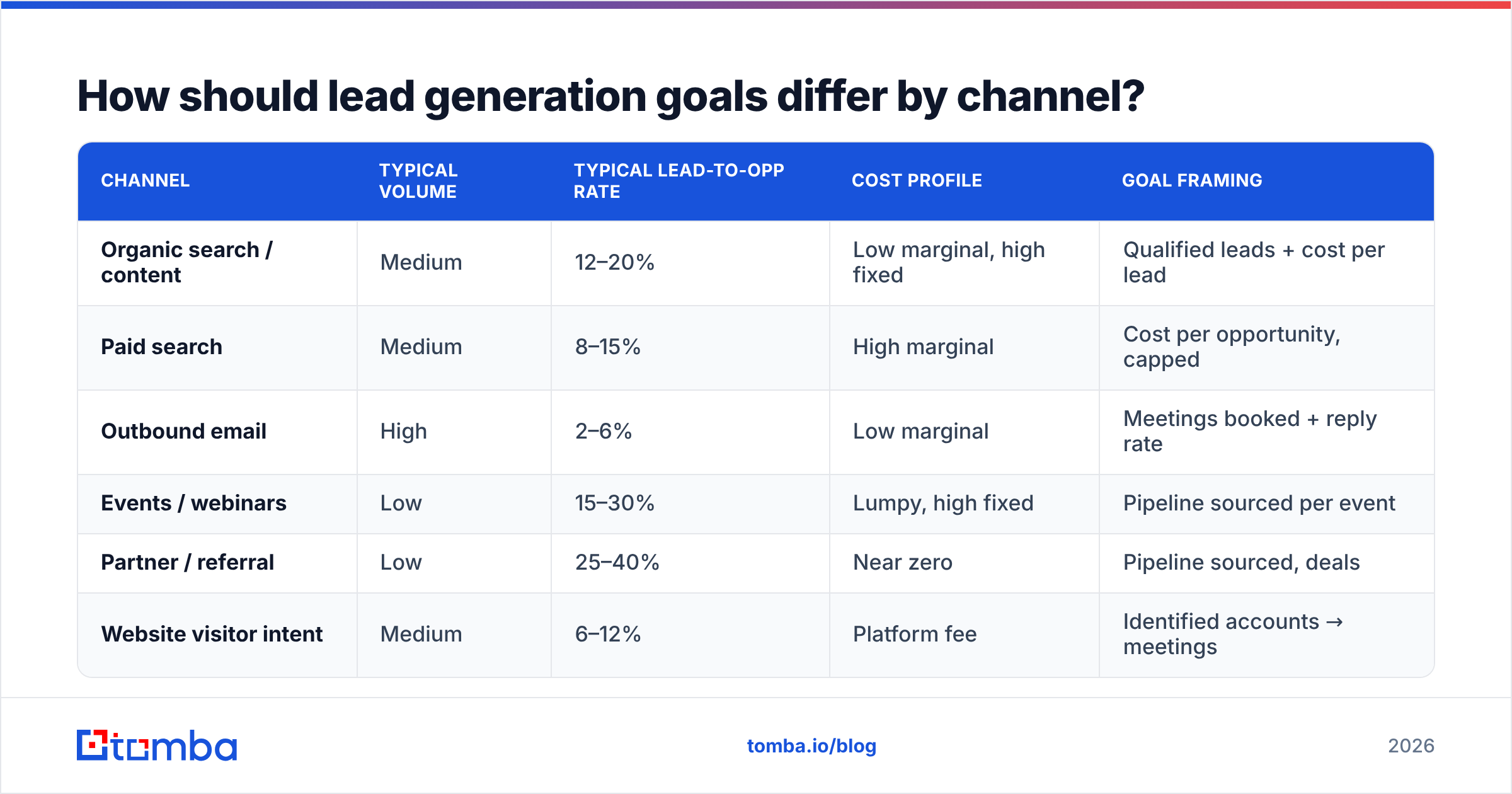
Wildly. Blending channels into one target is the single most common way teams lose diagnostic power.
| Channel | Typical volume | Typical lead-to-opp rate | Cost profile | Goal framing |
|---|---|---|---|---|
| Organic search / content | Medium | 12–20% | Low marginal, high fixed | Qualified leads + cost per lead |
| Paid search | Medium | 8–15% | High marginal | Cost per opportunity, capped |
| Outbound email | High | 2–6% | Low marginal | Meetings booked + reply rate |
| Events / webinars | Low | 15–30% | Lumpy, high fixed | Pipeline sourced per event |
| Partner / referral | Low | 25–40% | Near zero | Pipeline sourced, deals |
| Website visitor intent | Medium | 6–12% | Platform fee | Identified accounts → meetings |
Read that table sideways and the point becomes obvious: a partner referral at 30% lead-to-opp and an outbound email lead at 4% should never be counted as the same unit. If you must have one blended number for the board, keep the channel-level targets underneath it for operational use.
A few channel-specific notes worth internalizing:
- Outbound goals should be activity-and-outcome paired. "800 verified contacts sequenced, 24 meetings booked" tells you whether a miss was a volume problem or a messaging problem. "24 meetings booked" alone does not.
- Content goals lag by 60–120 days. Setting a monthly organic lead goal for a program that's eight weeks old guarantees a red month that means nothing.
- Event goals should be pipeline-denominated, not lead-denominated. Nobody cares about 400 badge scans. They care about the six opportunities.
How do you keep lead quality from collapsing under a volume goal?#
Attach a quality constraint to every volume number. Volume goals without quality gates are an instruction to lower the bar, and teams follow instructions.
Four gates that actually work:
- Sales-accepted lead (SAL) rate floor. Marketing hits its number only when ≥80% of delivered leads are accepted by sales. Rejected leads don't count toward the goal. This single rule ends most volume-gaming overnight.
- Data deliverability floor. Every contact handed to sales must have a verified, deliverable email. Bounces from a handoff list should be subtracted from the delivered count, not shrugged off. A bulk email finder workflow that verifies at enrichment time keeps this cheap.
- ICP-fit scoring threshold. Define firmographic fit as a score; leads below the threshold don't count. Nothing stops a target-account motion faster than a quarter's worth of 4-person companies in the MQL column.
- Speed-to-contact SLA. A lead nobody touched in 48 hours is not a lead — it's a receipt. Make the SLA part of the SDR goal, not a nice-to-have.
- Recycled-lead cap. Limit how many previously-rejected contacts can be re-submitted in a period. Otherwise the same 200 contacts circulate forever and inflate every report.
The SAL rate floor is the highest-leverage of the five. It converts lead quality from a complaint into a number with a name attached.

What does a good lead generation goal actually look like?#
Concrete, time-bound, and constrained. Compare:
Weak: "Increase qualified leads by 20% in Q3."
Strong: "Deliver 675 sales-accepted leads in Q3 — 280 inbound, 310 outbound, 85 partner — at ≤$190 blended cost per SAL, with ≥95% email deliverability at handoff and a ≥78% sales acceptance rate. Target: $1.4M in sourced pipeline."
The strong version does four things the weak one can't:
- It's decomposable. When you miss, you know which channel.
- It's falsifiable. Every clause can be checked against a system of record.
- It constrains quality and cost, so hitting it is unambiguously good.
- It names the pipeline number, which is what the CFO actually asked about.
Write goals in that shape and QBRs get shorter.
How often should you review and reset lead generation goals?#
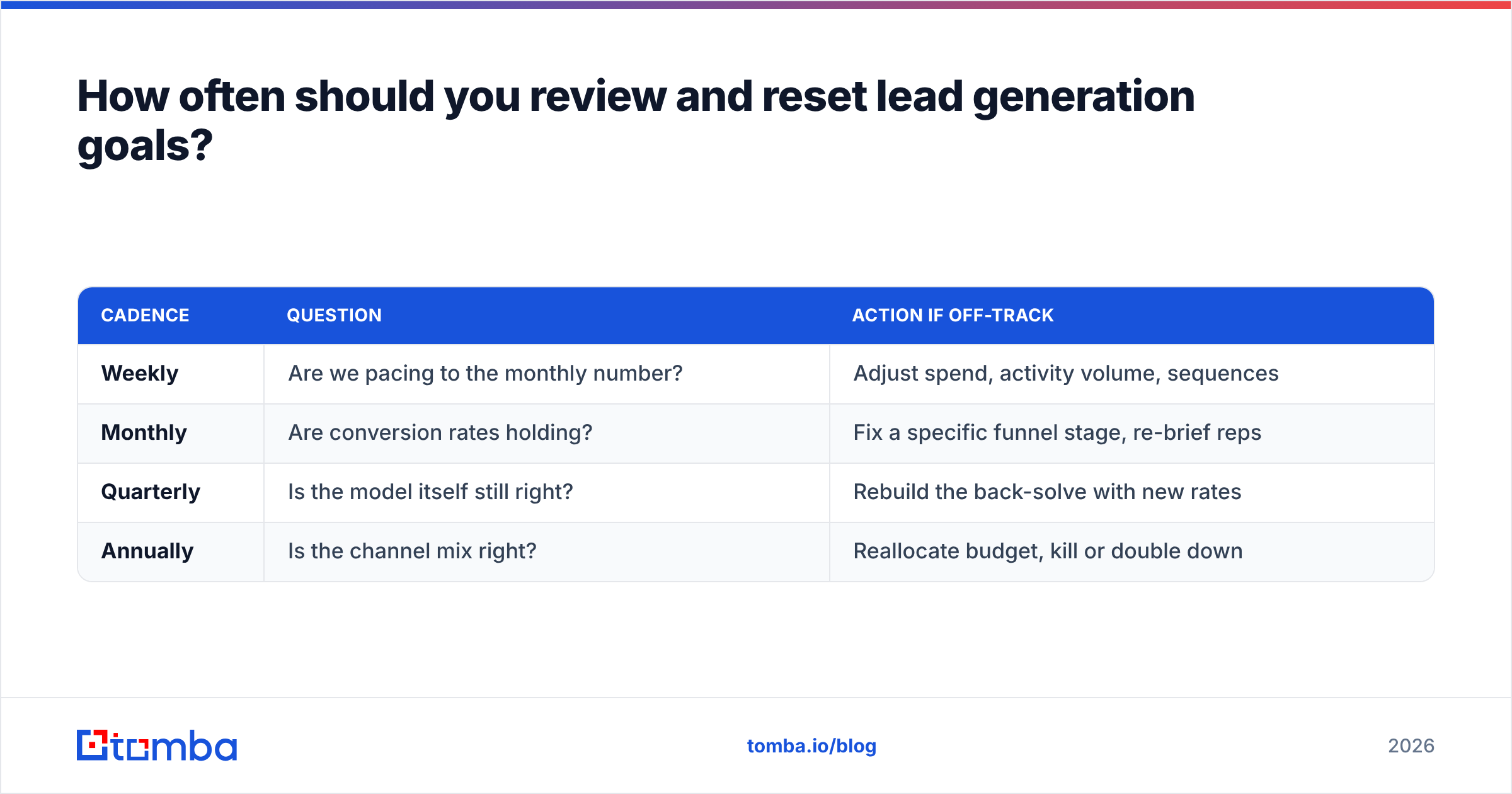
Three cadences, three different questions.
| Cadence | Question | Action if off-track |
|---|---|---|
| Weekly | Are we pacing to the monthly number? | Adjust spend, activity volume, sequences |
| Monthly | Are conversion rates holding? | Fix a specific funnel stage, re-brief reps |
| Quarterly | Is the model itself still right? | Rebuild the back-solve with new rates |
| Annually | Is the channel mix right? | Reallocate budget, kill or double down |
The quarterly rebuild is the one teams skip and the one that matters most. Win rates move. Average deal size moves. If your Q1 model assumed a 22% win rate and you're now closing at 17%, your MQL goal is understated by about 29% and no amount of effort at the top of the funnel will fix a target that was wrong on arrival.
Vendor-neutral benchmarking helps here. Review categories on G2 or Capterra to sanity-check which tools your peers use for each channel before you reallocate budget on gut feel — and remember that benchmark conversion rates published by vendors skew optimistic.
What tooling do lead generation goals actually require?#
Less than the average martech stack diagram suggests. You need four capabilities:
- A source of contact data that's accurate enough to trust in your funnel math. Sourcing with an email finder and running domain search against target accounts is the practical floor for outbound goals.
- A verification layer so deliverability floors are enforceable rather than aspirational.
- A CRM with clean stage definitions, because every conversion rate in your back-solve model comes from it. Ambiguous stage criteria produce conversion rates that are fiction. Salesforce's own opportunity stage guidance is a reasonable starting template if yours is a mess.
- A reporting view that maps channel → lead → opportunity → closed-won, with attribution rules everyone has agreed to in advance.
Peers worth evaluating depend on your motion. If your goals lean toward purchased list volume for a defined ICP, a curated database provider like BookYourData fits that shape well. If your goals lean toward find-and-verify against specific target accounts, a search-and-verify platform fits better. Most teams running both inbound and outbound end up with one of each rather than forcing a single tool to do both jobs badly.
On budget: Tomba pricing starts with a free tier at 25 searches/month for testing the workflow, then $49/mo Starter, $99/mo Growth, and $249/mo Pro as volume scales — which makes the cost-per-qualified-lead line in your goal model straightforward to forecast rather than a variable you discover at renewal.
Where do teams go from here?#
Do this in order, this week:
- Pull trailing-12-month conversion rates for every funnel stage. Not best-ever. Trailing.
- Build the back-solve table from revenue down to contacts. Share it with sales before you socialize the number.
- Split the top-of-funnel target by channel using each channel's own conversion math.
- Attach the quality gates — SAL rate, deliverability, ICP fit, speed-to-contact.
- Put the quarterly rebuild on the calendar now, not in week 11.
Goals built this way survive scrutiny because every number traces back to a revenue commitment someone already signed up for.
If step 6 of your model says you need thousands of verified, reachable contacts to hit the number, that's the part worth solving first — no amount of clever sequencing rescues a list that bounces. Tomba Email Finder finds professional email addresses by domain, name, or company, with verification built into the same workflow, so the contact count in your goal model is a count of people you can actually reach. Start on the free tier, run your next target-account list through it, and see what your real deliverability rate is before you commit to a quarterly number.
Related guides#
// get started
Find, verify and enrich your first contacts today
Start on the free plan with 25 searches a month, then scale when your team is ready.
Free plan · No credit card required · GDPR & CCPA
// about the author