37 Lead Generation Ideas That Still Work in 2026
Most lead generation ideas lists are recycled fluff. This one ranks 37 tactics by cost, time-to-first-lead, and realistic conversion rate — plus what to stop doing in 2026.
TL;DR
- Most "lead generation ideas" posts list 50 tactics with no cost, no effort estimate, and no honest conversion rate. This one ranks each idea by time-to-first-lead, monthly cost, and realistic response rate.
- The three ideas producing the best returns in 2026: website visitor identification, founder-led LinkedIn content paired with manual outreach, and intent-triggered cold email built on verified contact data.
- Gated PDF ebooks, generic webinars, and purchased bulk lists have collapsed in performance — they still show up on every listicle and they still mostly waste budget.
- Channel choice matters less than data quality. A mediocre offer sent to 200 verified, well-researched contacts beats a brilliant offer sent to 5,000 scraped guesses.
- Pick two ideas, not twelve. Run each for 90 days with a fixed weekly volume before judging it.
What Counts as a Lead Generation Idea in 2026?#
A lead generation idea is any repeatable system that turns a stranger into a contactable, interested prospect. That definition rules out a lot of what gets published under this headline — brand awareness stunts, "post more on social," vague advice about "adding value." If it does not end with a name, a verified email or phone number, and a reason to talk, it is not lead generation. It is marketing.
The economics changed in a specific way over the last three years. Form-fill volume dropped as buyers learned that downloading a PDF means six months of drip emails. Cold email inbox placement got harder after Google and Yahoo tightened bulk sender requirements in 2024, and enforcement kept ratcheting through 2026. Paid search CPCs in B2B categories keep climbing. What survived is anything that identifies buying signals early and reaches a real human with a relevant message.
Here is the practical framework we use to sort ideas:
- Time-to-first-lead — how many days between starting and a real conversation. Outbound email: 3-10 days. SEO: 90-180 days. Both are valid; they solve different quarters.
- Cost per qualified conversation — not cost per lead. A $12 MQL that never books a meeting costs more than a $180 conversation with a qualified buyer.
- Data dependency — how badly the tactic fails when your contact data is stale. Cold email fails catastrophically. Content marketing fails gently.
- Repeatability — can a new hire run it from a document, or does it depend on one person's network?
- Compounding vs. linear — SEO, community, and referrals compound. Ads and outbound stay linear: stop paying, stop leading.
- Channel saturation — how many competitors already hit the same inbox or feed this week.
Score every idea below against those six before you commit a quarter to it.

Which Lead Generation Ideas Are Worth Your Time?#
Below is the honest ranking. The numbers are ranges drawn from B2B teams in the 5-200 employee band — your mileage varies by ACV and category, but the relative ordering holds up.
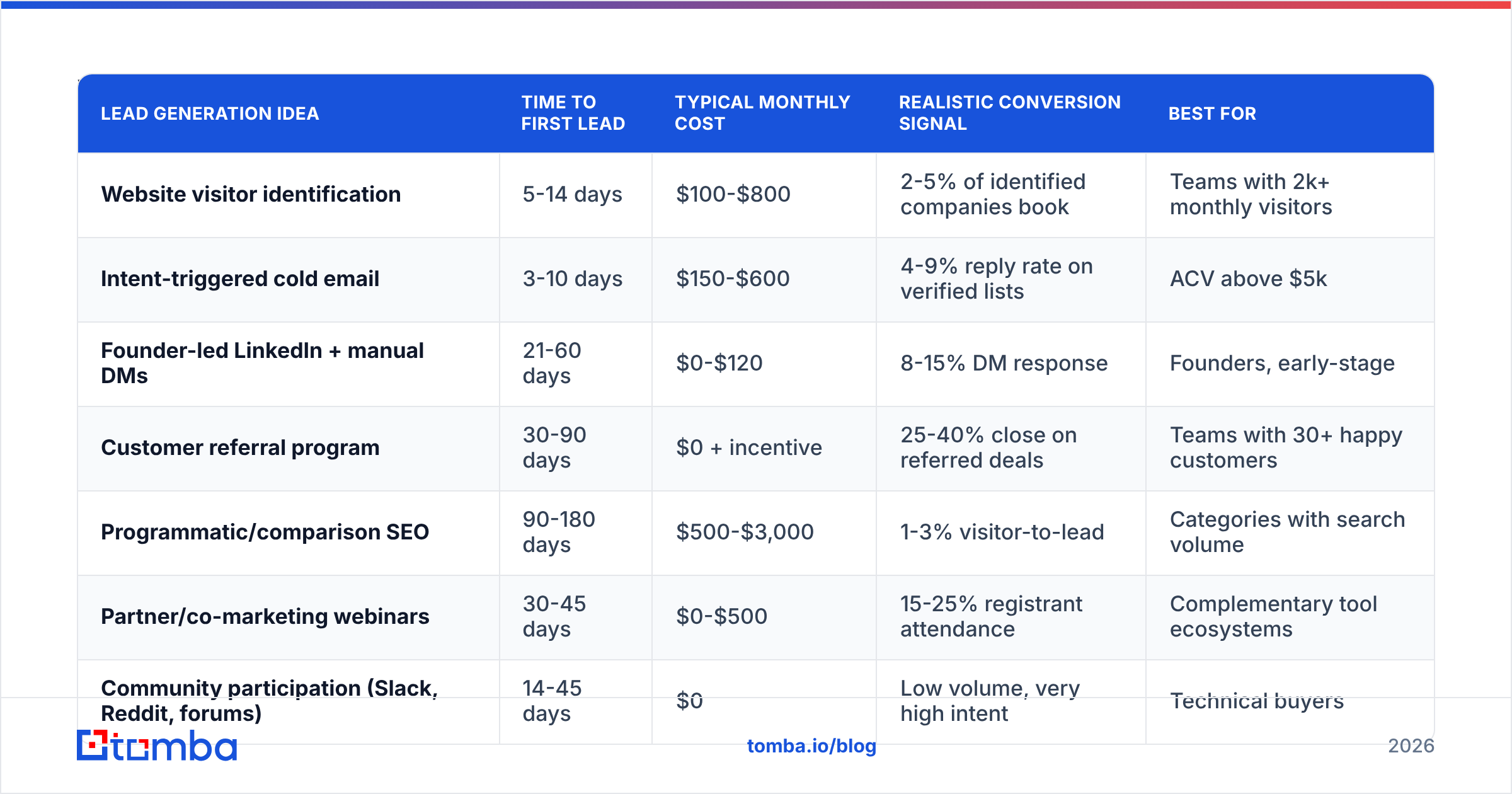
| Lead generation idea | Time to first lead | Typical monthly cost | Realistic conversion signal | Best for |
|---|---|---|---|---|
| Website visitor identification | 5-14 days | $100-$800 | 2-5% of identified companies book | Teams with 2k+ monthly visitors |
| Intent-triggered cold email | 3-10 days | $150-$600 | 4-9% reply rate on verified lists | ACV above $5k |
| Founder-led LinkedIn + manual DMs | 21-60 days | $0-$120 | 8-15% DM response | Founders, early-stage |
| Customer referral program | 30-90 days | $0 + incentive | 25-40% close on referred deals | Teams with 30+ happy customers |
| Programmatic/comparison SEO | 90-180 days | $500-$3,000 | 1-3% visitor-to-lead | Categories with search volume |
| Partner/co-marketing webinars | 30-45 days | $0-$500 | 15-25% registrant attendance | Complementary tool ecosystems |
| Community participation (Slack, Reddit, forums) | 14-45 days | $0 | Low volume, very high intent | Technical buyers |
| Cold calling with verified direct dials | 1-5 days | $200-$700 | 5-8% connect-to-meeting | ACV above $15k |
| Paid search on bottom-funnel terms | 7-14 days | $1,500+ | 3-8% click-to-lead | Proven unit economics only |
| Gated ebook / generic PDF | 14-30 days | $300-$1,500 | Under 1% lead-to-meeting | Almost nobody, in 2026 |
Three patterns fall out of that table. First, the fastest ideas are all outbound and all depend on contact data quality. Second, the cheapest ideas — referrals, community, founder content — are the ones nobody wants to do because they are unglamorous and hard to delegate. Third, the tactic that dominates most listicles, the gated PDF, sits at the bottom.
The 12 ideas worth starting this quarter#
- Identify anonymous website traffic. Somewhere between 96% and 98% of your visitors never fill in a form. Reverse-IP and firmographic matching turns a slice of that back into named companies. Pair it with a website visitor reveal workflow so the pricing-page visitors from last Tuesday become a call list on Wednesday.
- Build trigger lists, not persona lists. Stop exporting "all VP Marketing in SaaS." Build lists from events: new funding, a job posting for a role your product replaces, a tech-stack change, a leadership hire. Trigger-based outreach consistently doubles reply rates over static persona pulls.
- Run "closed-lost revival" campaigns. Every deal lost in the past 18 months to budget, timing, or a competitor is a warm lead with a known pain. Re-contact them when the original blocker plausibly changed.
- Mine your churned accounts. Same logic, better context. You already know what broke.
- Track competitor job postings. A company hiring three SDRs is a company about to buy sales tooling. A company hiring a first RevOps lead is about to buy data infrastructure.
- Use author outreach for content partnerships. Journalists and bloggers covering your category are both a distribution channel and a lead source. An author finder turns a byline into a contactable person in seconds.
- Ship a genuinely free tool. Not a gated calculator — a real utility that works without an email. Capture happens on the second interaction, when someone wants to save results.
- Run small, specific webinars with a partner. "How to run RevOps at a 40-person company" with a complementary vendor beats "The Future of Sales" with a keynote speaker.
- Ask for referrals at the value moment. Not at renewal. At the point where a customer just got a measurable result. Systematize the trigger.
- Publish comparison and alternative pages. Buyers searching "X vs Y" are 60-90 days from a decision. These pages convert at multiples of blog traffic.
- Work your existing CRM contacts who changed jobs. A champion who moved to a new company is your single highest-converting lead source. Data enrichment run monthly against your CRM surfaces these automatically.
- Dial the direct line. Cold calling did not die; cold calling with bad numbers died. With verified direct dials, connect rates in 2026 remain well above what most teams assume.
How Do You Pick Between Inbound and Outbound Ideas?#
Pick based on your ACV and your patience, not on ideology.
If your average contract value is below $3,000 and your sales cycle is under 30 days, outbound math rarely works — the cost of human touches exceeds the margin. Lean into self-serve funnels, SEO, product-led growth, and free tools. If your ACV is above $10,000, outbound is almost always positive-ROI as long as your data is clean, because one meeting can pay for a quarter of tooling.
The mistake is running both at half effort. A team doing two blog posts a month and 40 cold emails a week has no channel at meaningful volume and will conclude that "nothing works."
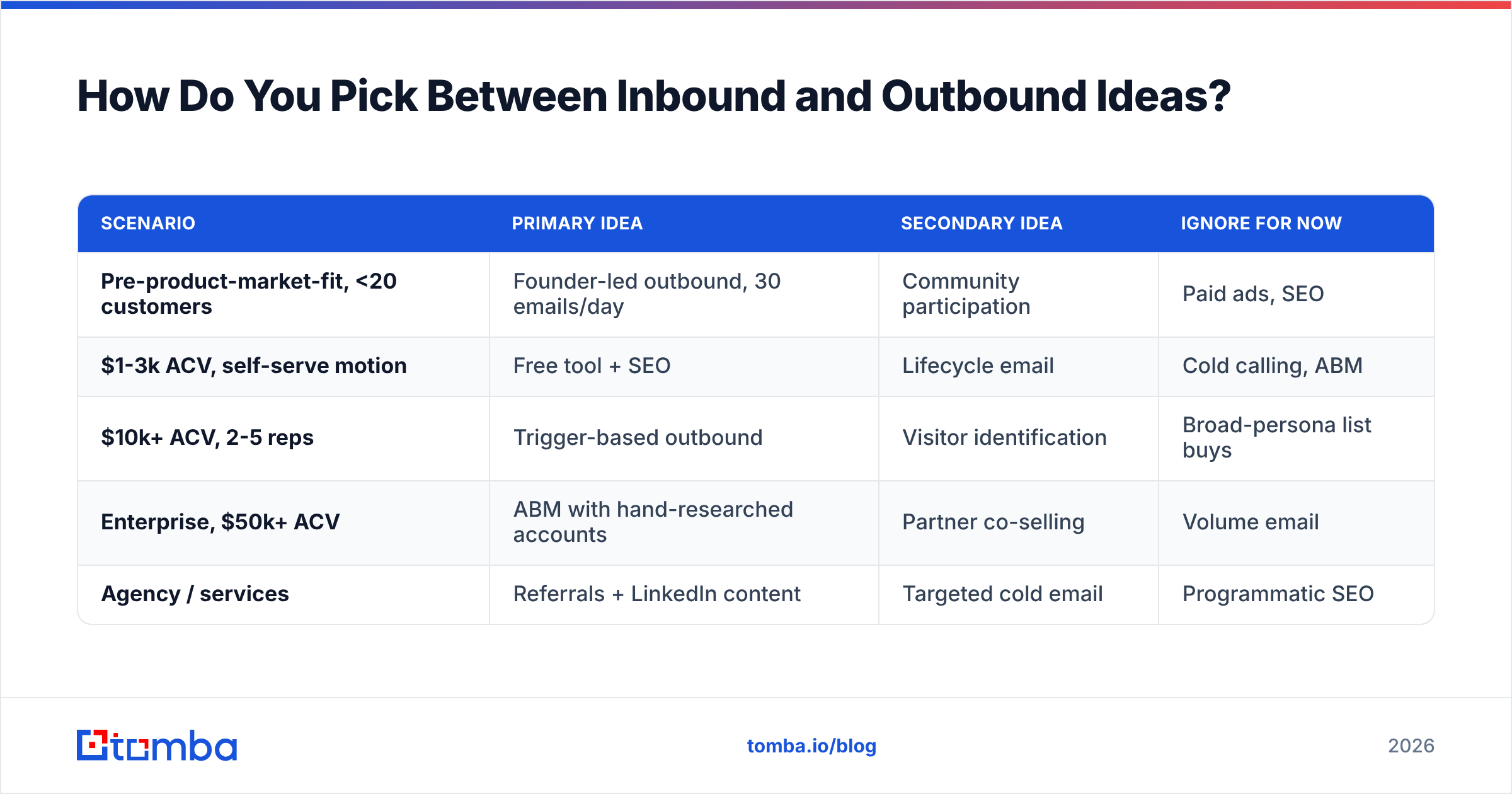
Here is the split most teams should use:
| Scenario | Primary idea | Secondary idea | Ignore for now |
|---|---|---|---|
| Pre-product-market-fit, <20 customers | Founder-led outbound, 30 emails/day | Community participation | Paid ads, SEO |
| $1-3k ACV, self-serve motion | Free tool + SEO | Lifecycle email | Cold calling, ABM |
| $10k+ ACV, 2-5 reps | Trigger-based outbound | Visitor identification | Broad-persona list buys |
| Enterprise, $50k+ ACV | ABM with hand-researched accounts | Partner co-selling | Volume email |
| Agency / services | Referrals + LinkedIn content | Targeted cold email | Programmatic SEO |
Two things to note. Enterprise teams should treat account count as a feature, not a bug — 150 well-researched accounts outperform 5,000 shallow ones. And every row assumes your contact data is verified. Which brings us to the part most lead generation guides skip entirely.
Why Does Data Quality Beat Tactic Selection?#
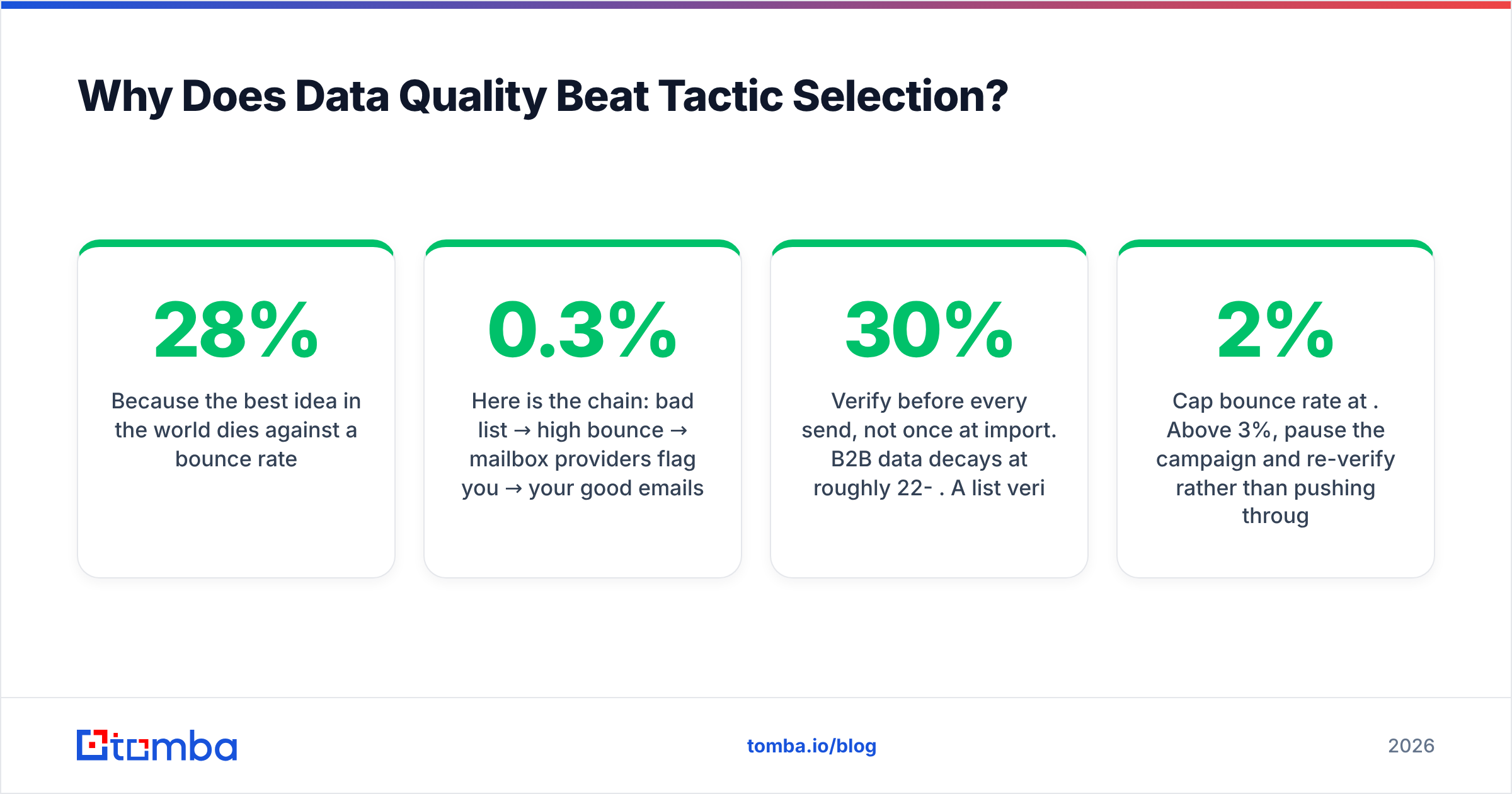
Because the best idea in the world dies against a 28% bounce rate.
Here is the chain: bad list → high bounce → mailbox providers flag you → your good emails land in spam → your reply rate collapses → you blame the tactic. Teams abandon cold email every week because of a data problem they diagnosed as a channel problem. Google's bulk sender rules require you to keep spam complaints under 0.3%, and a list full of dead addresses is the fastest way past that line.
Practical hygiene rules that cost almost nothing:
- Verify before every send, not once at import. B2B data decays at roughly 22-30% per year. A list verified in January is meaningfully wrong by July. Run it through an email verifier as a pre-send step.
- Treat catch-all domains separately. They accept everything at the SMTP layer, so standard verification returns "unknown." Send to them in a separate, lower-volume segment or run a catch-all verifier first.
- Cap bounce rate at 2%. Above 3%, pause the campaign and re-verify rather than pushing through.
- Deduplicate across sources. Contacting the same person from two sequences is the fastest way to a complaint.
- Keep a suppression list that outlives your tools. Unsubscribes must persist when you switch sending platforms.
The deliverability side matters just as much. Authenticate with SPF, DKIM, and DMARC before your first send — Google's own sender guidelines spell out the requirements, and they are not optional at any volume. Warm new domains for at least three weeks. Keep per-mailbox volume under 50 sends a day.
What Should You Stop Doing in 2026?#
Five ideas that still appear on every list and no longer earn their slot:
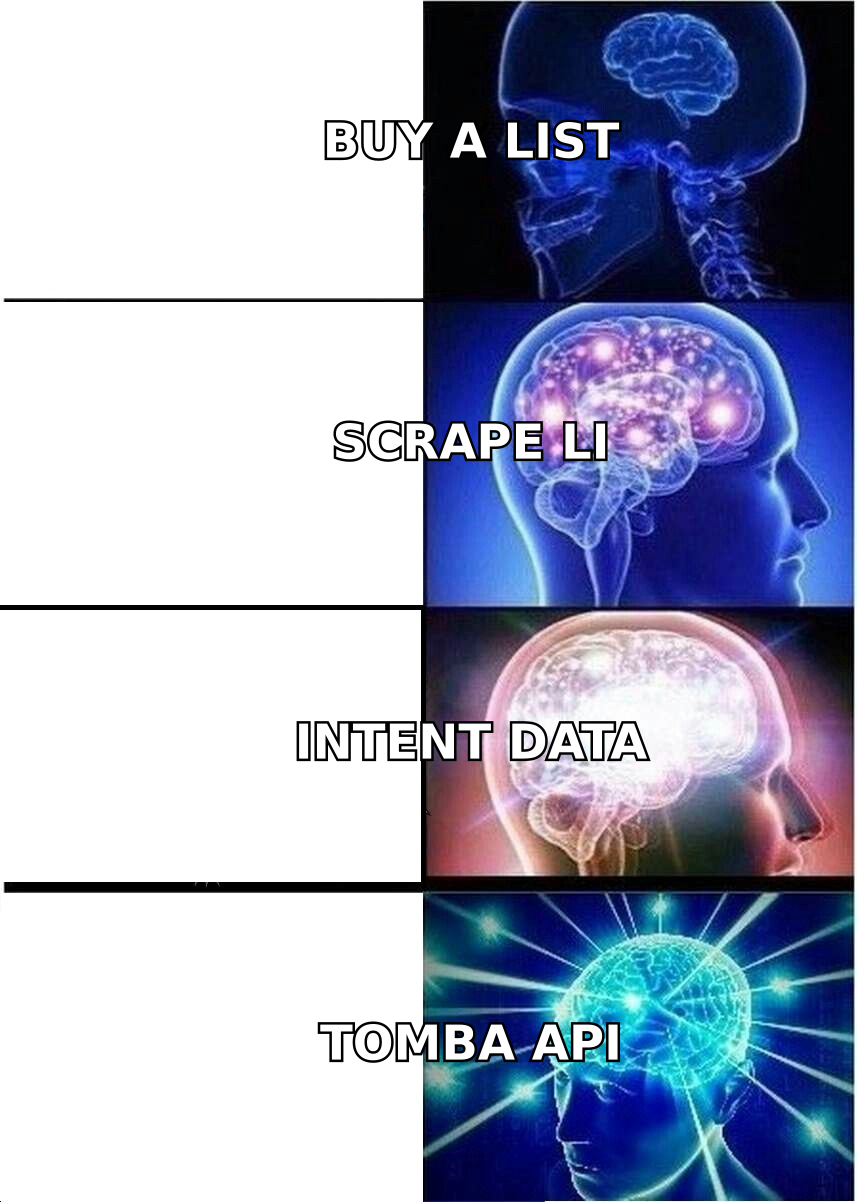
Buying generic bulk contact lists. Not to be confused with quality curated databases — vendors like BookYourData and other reputable providers do real verification work and sell accountable data. The problem is the low-end market: $99 for 50,000 "verified" records, resold across hundreds of buyers, already burned out by the time you get it. If the price per record is under a cent, someone else already emailed everyone on it.
Gating everything. Gating a 40-page report behind a form in 2026 produces a list of people who wanted the report, not the product. Ungate the content, track who reads it, and use behavior as the signal instead.
Generic "Book a Demo" CTAs on cold outreach. Asking a stranger for 30 minutes on call one is a 2015 ask. Interest-based CTAs ("worth a look?") consistently outperform calendar links in first touches.
Spray-and-pray LinkedIn connection requests. Acceptance rates have fallen, LinkedIn's automation enforcement has tightened, and the channel now rewards fewer, better-researched touches. If you use it, use it with research — see how teams structure LinkedIn outreach that does not get flagged.
Chasing MQL volume as a north-star metric. G2's buyer behavior research keeps pointing the same direction: buyers self-educate through most of the cycle and appear late. Counting form fills measures how many people wanted your PDF. Count qualified conversations instead.
How Do You Actually Execute Two Ideas Well?#
A 90-day operating plan beats a 37-item list. Here is the version we would run for a 10-person B2B team with a $15k ACV.
Days 1-14: foundation. Define your ICP tightly enough that a new hire could disqualify an account in 15 seconds. Set up domain authentication. Buy or build one trigger source (funding, hiring, tech-stack change). Assemble a 300-account list.
Days 15-30: data build. Find and verify contacts at those 300 accounts. Two to three people per account — the economic buyer, the user, and one influencer. Use domain search to map who works where, then verify everything before it touches a sequence. Expect to end with 600-900 usable contacts.
Days 31-60: first channel at volume. Run one channel hard. If outbound: 40-60 emails a day across two warmed mailboxes, four-touch sequence, one clear trigger reference per email. Track reply rate, positive reply rate, and meetings booked — not opens, which became unreliable after Apple's privacy changes.
Days 61-90: layer the second channel. Add visitor identification or founder-led content on top of the working outbound base. Do not swap channels; stack them. Review the full funnel monthly and cut anything below a 3% positive reply rate after you have fixed the data and the offer.
The measurable output at day 90 should be 15-30 qualified conversations, a documented list-building process, and a verified contact base you own rather than rent. That is a lead generation engine. Everything else on the internet's lead generation ideas lists is a tactic looking for a system.
Where Should You Start?#
Start with the data layer, because every idea above depends on it and none of them work without it.
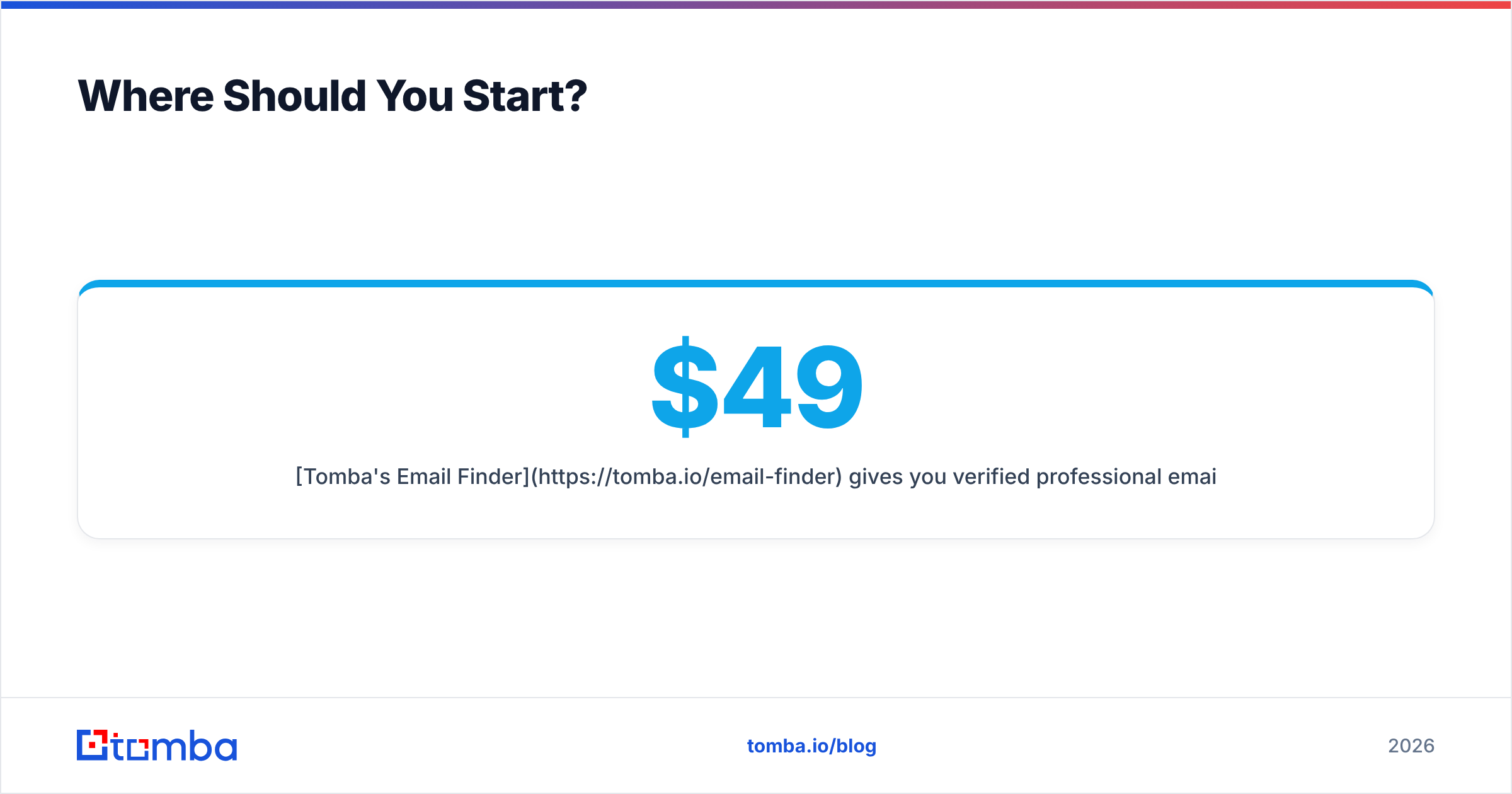
Tomba's Email Finder gives you verified professional email addresses by domain, name, or company, with the verification, catch-all handling, and enrichment sitting alongside it in the same account — so the list you build on Monday is still accurate when you send on Thursday. The free tier covers 25 searches a month if you want to test the accuracy on your own ICP first; paid plans start at $49/mo for Starter, $99/mo for Growth, and $249/mo for Pro, with full Tomba pricing published rather than gated behind a sales call. If you are wiring lead generation into an existing stack, the Tomba API and the HubSpot integration handle the plumbing.
Pick two ideas from the table. Build the list properly. Run them for 90 days before you judge them.
Related guides#
// get started
Find, verify and enrich your first contacts today
Start on the free plan with 25 searches a month, then scale when your team is ready.
Free plan · No credit card required · GDPR & CCPA
// about the author