Lead Generation in Digital Marketing: A 2026 Playbook
Most lead generation advice stops at "create great content." This guide breaks down the channels, costs, and conversion math behind digital lead gen in 2026 — with real CPL benchmarks.
TL;DR
- Lead generation in digital marketing is the process of turning anonymous traffic and intent signals into identified, contactable people — and the "contactable" part is where most programs quietly fail.
- Paid search still has the highest intent but the worst unit economics in crowded B2B categories: $180–$450 per MQL in software, versus $45–$120 for organic content.
- Inbound and outbound are not opposing religions. The highest-performing 2026 programs run both against the same ICP list and share one enrichment layer.
- Form-fill volume is a vanity metric. Track cost per qualified lead, contact-data accuracy, and speed-to-first-touch instead.
- Your database decays at roughly 22–30% per year. Without routine verification and enrichment, a good lead-gen engine still produces a bad pipeline.
What is lead generation in digital marketing?#
Lead generation in digital marketing is the set of channels, offers, and systems that convert online attention into a record you can contact: a name, a company, a work email, ideally a phone number and a reason to reach out.
Think of it like a restaurant. Marketing is the sign on the street and the smell coming out the door. Lead generation is the host who gets a name and a phone number before the party leaves. Sales is dinner. Plenty of restaurants nail the smell and lose the reservation.
Technically, a "lead" is any identified individual who has entered your funnel through a measurable digital touchpoint — a gated asset, a demo request, a webinar registration, a chatbot conversation, a reply to an outbound sequence, or an enriched website visit. The definition matters because the word gets stretched to cover wildly different things. A trade-show badge scan and a pricing-page visitor who booked a call are both "leads" in most CRMs. They convert at rates that differ by an order of magnitude.
Three components make up every digital lead-gen motion:
- The traffic source — where attention comes from (search, social, ads, referral, direct outbound, partner co-marketing).
- The conversion mechanism — what turns attention into an identity (form, calendar link, chat, reply, or a reverse-lookup on anonymous traffic).
- The data layer — what makes the identity actionable (verified email, phone, firmographics, job title, tech stack).
Most teams obsess over #1, tolerate #2, and completely neglect #3. Then they wonder why 38% of their outbound bounces.

Which digital lead generation channels actually work in 2026?#
There is no universally best channel — there is a best channel for your ACV, sales cycle, and category maturity. A $600 ACV self-serve tool and a $180k enterprise platform should not run the same playbook.
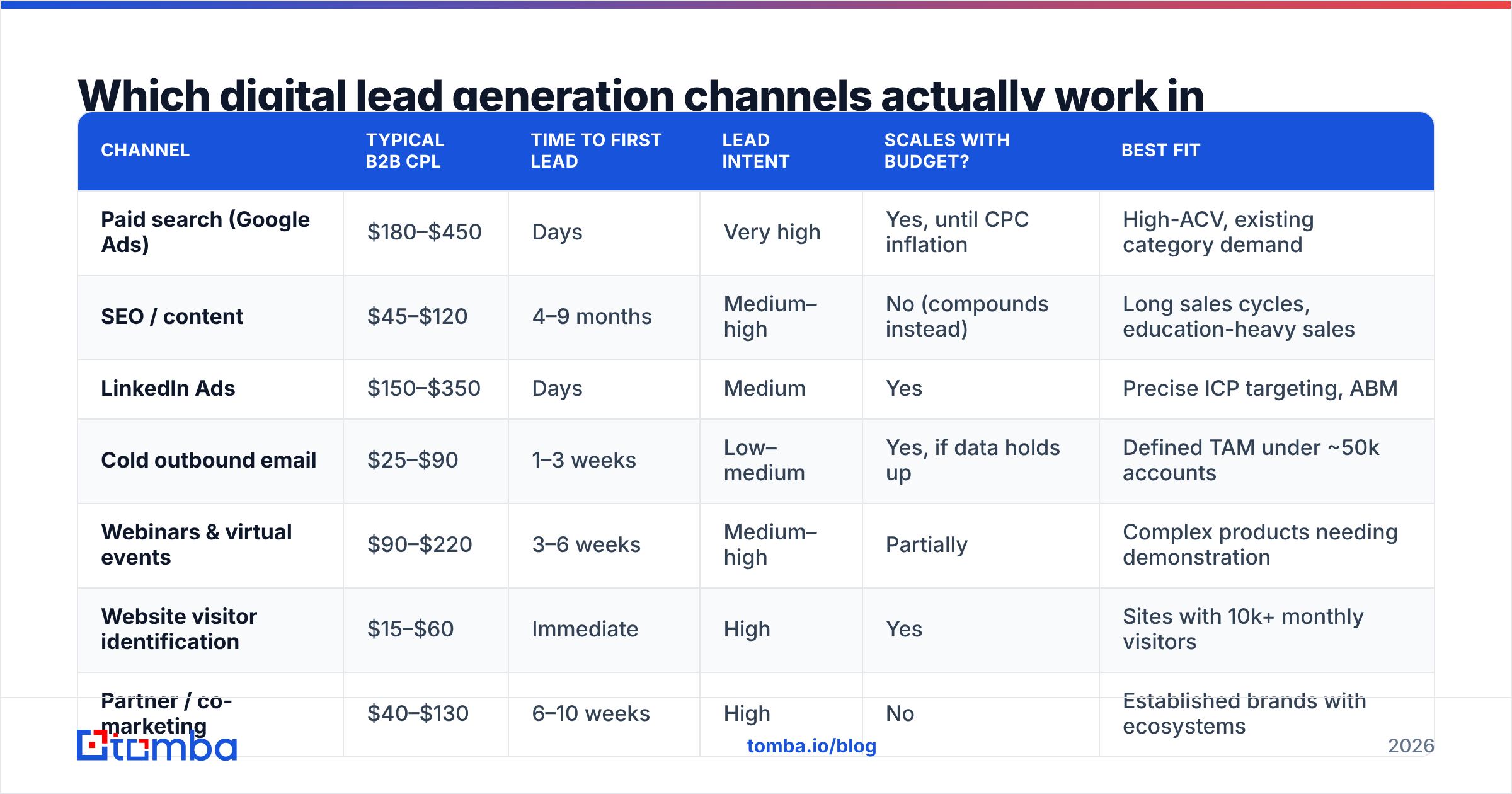
Here is how the major channels compare on the metrics that matter:
| Channel | Typical B2B CPL | Time to first lead | Lead intent | Scales with budget? | Best fit |
|---|---|---|---|---|---|
| Paid search (Google Ads) | $180–$450 | Days | Very high | Yes, until CPC inflation | High-ACV, existing category demand |
| SEO / content | $45–$120 | 4–9 months | Medium–high | No (compounds instead) | Long sales cycles, education-heavy sales |
| LinkedIn Ads | $150–$350 | Days | Medium | Yes | Precise ICP targeting, ABM |
| Cold outbound email | $25–$90 | 1–3 weeks | Low–medium | Yes, if data holds up | Defined TAM under ~50k accounts |
| Webinars & virtual events | $90–$220 | 3–6 weeks | Medium–high | Partially | Complex products needing demonstration |
| Website visitor identification | $15–$60 | Immediate | High | Yes | Sites with 10k+ monthly visitors |
| Partner / co-marketing | $40–$130 | 6–10 weeks | High | No | Established brands with ecosystems |
A few notes on reading that table honestly.
Paid search CPLs look terrible until you segment by keyword intent. A "best [category] software" query converts to pipeline at 4–7x the rate of a top-of-funnel informational query, even though both are counted as one lead. If your blended paid CPL is $380, the bottom-funnel slice is probably $140 and the top-funnel slice is $900. Kill the second one.
SEO's CPL only looks cheap after the fact. The $45–$120 number amortizes content investment across leads generated over 24+ months. In month three, your effective CPL is infinite. Budget accordingly, and don't let a CFO compare a nine-month-old content program to a two-week-old ads test.
Cold outbound's economics live or die on data quality. At a 3% reply rate with 95% deliverable contacts, outbound is one of the cheapest channels in B2B. At a 3% reply rate with 70% deliverable contacts, you're burning domain reputation to buy the same leads at triple the cost. This is the single most common failure point, and it's fixable with a verification step that costs pennies per record.
Is inbound or outbound better for lead generation?#
Neither. The framing is a leftover from a 2012 blog war, and it costs teams pipeline.
The useful distinction is demand capture versus demand creation. Inbound channels mostly capture existing demand — someone already knows they have the problem and is searching. Outbound mostly creates it — you're telling someone the problem is worth solving now. Almost every category needs both, in a ratio determined by how aware your market already is.
Here's the practical split by market maturity:
- New category, low awareness: 70% outbound / 30% inbound. Nobody is searching for a term that doesn't exist yet. You go find the accounts with the symptom.
- Emerging category, growing awareness: 50/50. Search volume exists but is thin; outbound gives you volume control while content compounds.
- Mature, crowded category: 30% outbound / 70% inbound plus brand. CPCs are brutal and everyone's inbox is saturated, so differentiated content and product-led motions win.
The operational unlock is running both against one ICP definition and one enrichment layer. When your content team targets "RevOps leaders at 200–2000 employee SaaS companies" and your SDRs prospect "anyone with 'Operations' in the title," you get two disconnected funnels and no compounding learning.
A shared data layer means: inbound form fills get enriched with firmographics before routing, and outbound lists get built from the same ICP filters. A data enrichment step on every inbound lead lets you route a Fortune 500 form fill to an AE in under five minutes instead of letting it sit in a nurture drip for three weeks.
How do you build a digital lead generation funnel that converts?#
Work backwards from revenue, not forwards from traffic. Here's the sequence that survives contact with a real quarter.
1. Define the qualified lead before you generate any. Write down, in one sentence, what makes a lead worth an AE's time: company size, role, trigger event, and budget signal. If marketing and sales can't recite the same sentence, your marketing qualified lead definition is decorative.
2. Size the TAM and pick a coverage strategy. If your ICP contains 3,000 accounts, outbound can cover all of them in a quarter and SEO is a brand play. If it contains 400,000, you need inbound leverage and paid efficiency, because you'll never manually touch the list.
3. Build the conversion mechanism with the least friction that still qualifies. Every form field costs you roughly 5–11% of completions, according to conversion research published by HubSpot. Ask for email and company domain; enrich the rest. A three-field form with enrichment beats an eight-field form with manual review every time.
4. Enrich and verify at the point of capture. The moment an email hits your CRM, verify it's deliverable and append firmographics. Doing this in real time — rather than in a monthly batch — is what lets you route by fit instead of by arrival order.
5. Route on fit and speed. The research on speed-to-lead is unambiguous and unchanged for a decade: responding within five minutes dramatically outperforms responding within an hour. Build the routing rules before you turn on the ad spend.
6. Measure cost per qualified lead, then cost per opportunity. CPL alone will push you toward the cheapest, worst traffic available. Add the qualification filter and the channel rankings often invert.
What data quality problems kill lead generation programs?#
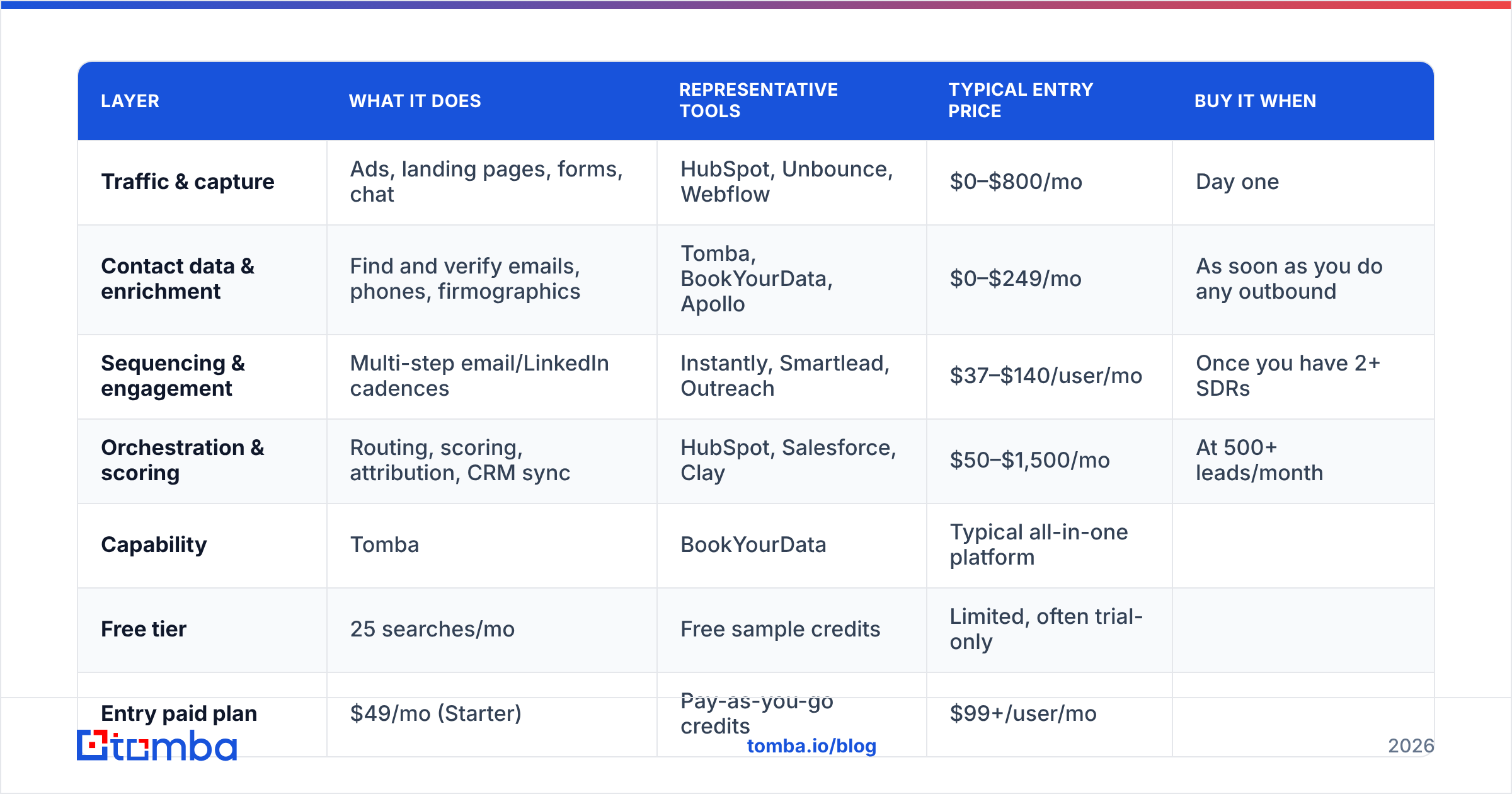
Data decay is the silent killer. B2B contact databases degrade at roughly 22–30% per year through job changes, company moves, domain changes, and acquisitions. That means a list you built in January is meaningfully wrong by December — without anyone touching it.
The downstream damage compounds:
- Deliverability collapse. Bounce rates above 3–5% signal to mailbox providers that you're sending to stale lists. Your sender reputation drops, and your good emails stop landing too. One bad list poisons the whole domain.
- Wasted SDR hours. An SDR working a list with 25% bad contacts spends a quarter of their week on dead records. At a $70k fully-loaded cost, that's $17,500 a year of pure waste per rep.
- Broken attribution. When leads bounce or route incorrectly, channel performance data becomes noise. You'll optimize toward the wrong channel with total confidence.
- CRM rot. Duplicate and dead records inflate your database, skew forecasting, and make every downstream report slightly wrong in a way nobody can trace.
The fix is boring and works: verify at capture, re-verify on a schedule, and enrich continuously. Run new inbound leads through an email verifier before they enter a sequence, and re-verify any record older than six months before it goes into an active campaign. For domains that accept everything, a dedicated catch-all verifier tells you whether the mailbox genuinely exists rather than just returning "unknown."

How do the main lead generation tool categories compare?#
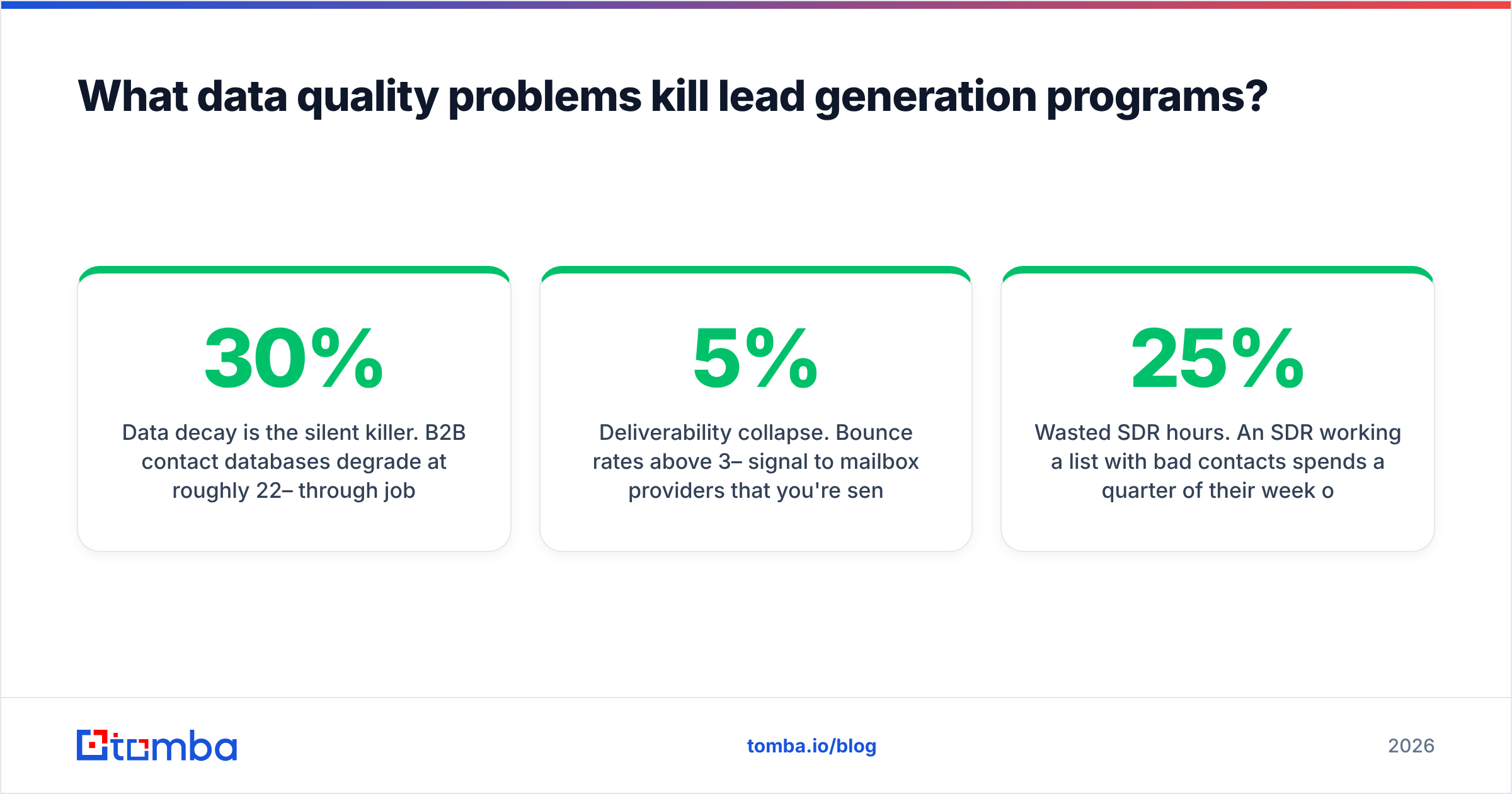
Tooling splits into four functional layers, and teams frequently buy three products that all do the same thing while leaving a genuine gap unfilled.
| Layer | What it does | Representative tools | Typical entry price | Buy it when |
|---|---|---|---|---|
| Traffic & capture | Ads, landing pages, forms, chat | HubSpot, Unbounce, Webflow | $0–$800/mo | Day one |
| Contact data & enrichment | Find and verify emails, phones, firmographics | Tomba, BookYourData, Apollo | $0–$249/mo | As soon as you do any outbound |
| Sequencing & engagement | Multi-step email/LinkedIn cadences | Instantly, Smartlead, Outreach | $37–$140/user/mo | Once you have 2+ SDRs |
| Orchestration & scoring | Routing, scoring, attribution, CRM sync | HubSpot, Salesforce, Clay | $50–$1,500/mo | At 500+ leads/month |
On the contact-data layer specifically — the one most directly tied to whether your generated leads are reachable — the differences are less about "who has more records" and more about accuracy, verification depth, and cost per usable contact:
| Capability | Tomba | BookYourData | Typical all-in-one platform |
|---|---|---|---|
| Free tier | 25 searches/mo | Free sample credits | Limited, often trial-only |
| Entry paid plan | $49/mo (Starter) | Pay-as-you-go credits | $99+/user/mo |
| Mid tier | $99/mo (Growth) | Volume packages | $149–$499/user/mo |
| Catch-all verification | Yes, dedicated tool | Included in validation | Often flagged "unknown" |
| Phone data | Yes | Yes | Varies by tier |
| API access | Yes, all paid plans | Yes | Usually top tier only |
| Bulk processing | Yes | Yes | Yes |
BookYourData is a genuinely strong option if you prefer buying pre-built, pre-verified lists by filter rather than searching per-company — its pay-as-you-go model suits teams with spiky, campaign-driven needs. Tomba fits better when you want a searchable finder plus verification as an always-on layer inside your workflow, with a predictable monthly cost. Check current Tomba pricing against your monthly contact volume before committing; the break-even between credit packs and subscriptions usually sits somewhere around 2,000 lookups a month.
The all-in-one platforms are convenient but expensive per seat, and their data layer is frequently the weakest part of the bundle. Independent reviews on G2 consistently show data accuracy as the top complaint category for bundled sales platforms — you're paying for sequencing and getting the database thrown in.
How do you measure lead generation performance correctly?#
Replace your dashboard's top metric. If "leads generated" is the headline number, every optimization decision downstream will be slightly wrong.
Track these five instead:
- Cost per qualified lead (CPQL) — total channel spend divided by leads that pass your ICP filter, not total form fills. This one number reorders your channel rankings more than any other change.
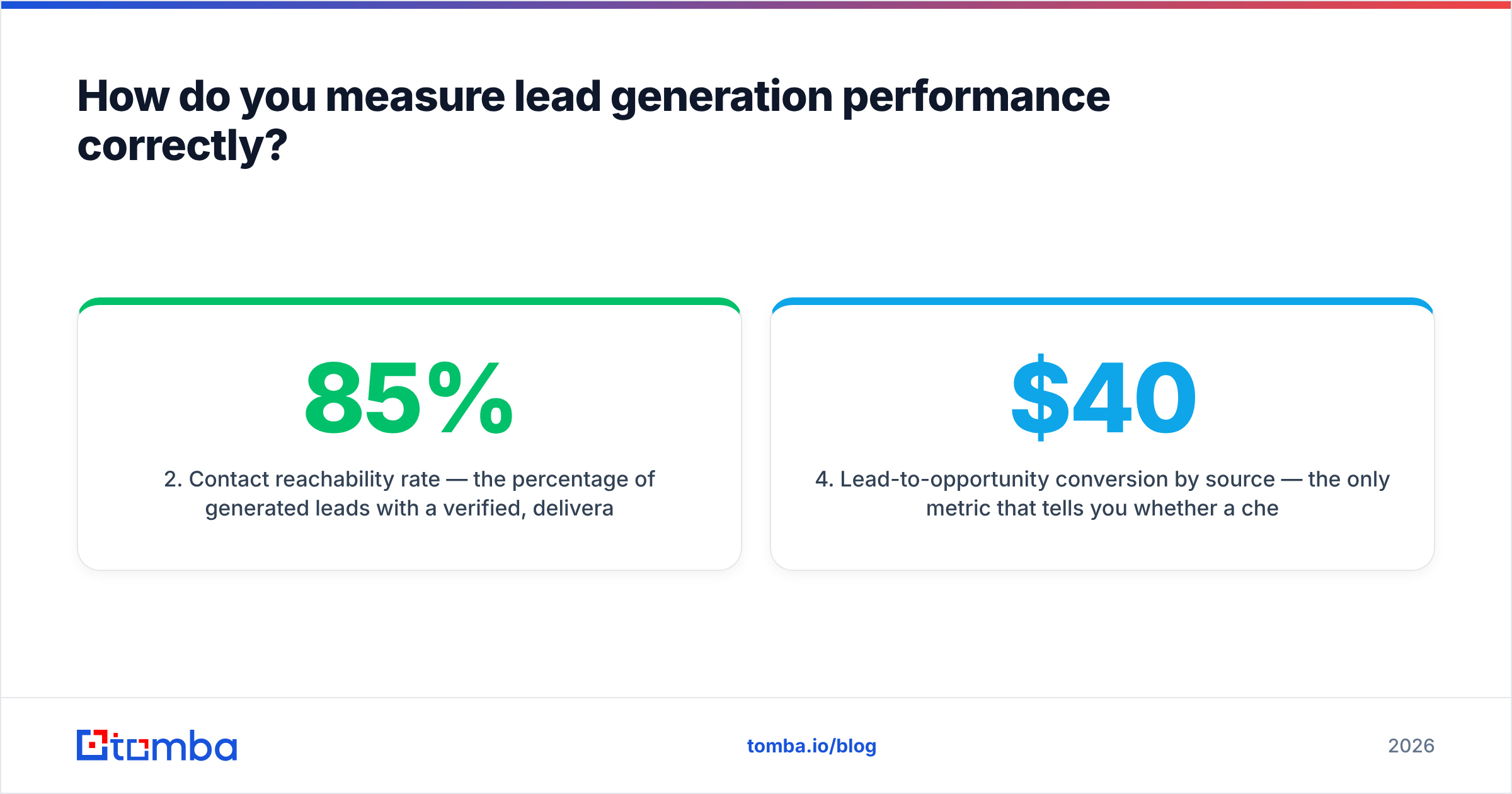
- Contact reachability rate — the percentage of generated leads with a verified, deliverable email or phone. Below 85%, fix your data layer before you spend another dollar on traffic.
- Speed to first touch — median minutes from capture to first human or automated contact. Measure the median, not the average; one outlier at 72 hours hides behind a good average.
- Lead-to-opportunity conversion by source — the only metric that tells you whether a cheap channel is actually cheap. A $40 CPL channel converting at 1% is worse than a $200 CPL channel converting at 12%.
- Pipeline velocity by entry channel — how fast deals from each source move. Some channels produce leads that convert but take twice as long to close, which changes their real cost materially.
A practical cadence: review CPQL and reachability weekly, conversion-by-source monthly, and velocity quarterly. Weekly reviews of conversion data on low-volume B2B channels produce noise, not insight — you need enough sample size for the number to mean anything.
For teams reporting to a board, Gartner research on B2B buying behavior is worth citing internally: buyers now spend the majority of their journey in independent research before ever contacting a vendor. That reframes lead gen as "be findable and be enrichable" rather than "capture early and nurture long."
What does a realistic 90-day lead generation plan look like?#
Days 1–30 — Foundation. Write the ICP sentence. Audit your existing database for reachability and deduplicate it. Set up verification at the point of capture. Pick one capture mechanism and one channel to run properly rather than five channels run badly. Establish your CPQL baseline, even if the baseline is embarrassing.
Days 31–60 — Volume. Turn on the second channel. If your first was inbound, make the second outbound against a list built from the same ICP filters — use a domain search to map contacts at your target accounts rather than buying a generic list. Start measuring lead-to-opportunity by source. Expect the first month's conversion data to be directionally useful at best.
Days 61–90 — Compounding. Kill the worst-performing segment, not the worst-performing channel — most channels have one bad slice dragging the average. Double budget on the best segment. Add enrichment to routing so high-fit leads skip the nurture queue. Re-verify anything captured in month one.
That's the whole thing. It is not exciting, and it works better than the alternative, which is running six channels simultaneously with unverified data and declaring the whole program "a branding investment" in month four.
Where should you start?#
Start with the data layer, because it's the cheapest fix with the largest downstream effect. Every other improvement — better ads, better content, better sequences — multiplies against a reachability rate you control today for a fraction of your ad budget.
Tomba's Email Finder gives you verified professional emails by domain, name, or company, with a free tier of 25 searches a month to test accuracy against your own known-good contacts before you commit. Run 50 records you already know the answers to, measure the hit rate, and decide from evidence instead of a vendor's landing page. Paid plans start at $49/mo, and the API is available on every paid tier if you want verification running automatically at the point of capture rather than as a monthly cleanup chore.
Related guides#
// get started
Find, verify and enrich your first contacts today
Start on the free plan with 25 searches a month, then scale when your team is ready.
Free plan · No credit card required · GDPR & CCPA
Get the Tomba newsletter
Product and data updates
// about the author