Local Lead Generation in 2026: The Complete Playbook
Local lead generation is not national demand gen with a zip code filter. Here is how ranking, review velocity, radius targeting, and contact data actually combine into booked jobs in 2026.
TL;DR
- Local lead generation is a different sport from national demand gen: the buying radius is 5–40 miles, the search intent is "near me," and your competitors are three other businesses, not three hundred.
- Google Business Profile plus review velocity is still the highest-ROI local channel in 2026 — but it caps out. Once you own the map pack, growth comes from outbound to nearby businesses, not more SEO.
- Paid local channels (LSA, Google Ads radius, Meta) cost $45–$310 per lead depending on vertical. Organic map-pack leads cost effectively nothing after month six.
- For B2B local (agencies, MSPs, commercial services, wholesalers), the real bottleneck isn't traffic — it's clean contact data for the 400 businesses inside your service area.
- Build the list from a geographic filter, verify every address before sending, and treat the local outbound motion as a standing list you re-work quarterly.
What Is Local Lead Generation, Really?#
Local lead generation is the process of getting inquiries from prospects inside a defined geographic service area — a city, metro, county, or drive-time radius — rather than from anyone on the internet who matches your ICP.
Think of it like a pizza shop versus a frozen-pizza brand. The frozen-pizza brand wants everyone in the country to recognize the box. The pizza shop only cares about the 22,000 households that will actually wait 25 minutes for delivery. Both are marketing. Only one of them should be buying national keyword ads.
That distinction changes almost every tactical decision:
- Intent beats volume. A keyword with 90 monthly searches in your city outperforms one with 40,000 nationally, because the 90 are people who can actually buy from you.
- Proximity is a ranking factor you cannot buy. Google weighs the searcher's distance from your listed address in the map pack. No amount of content fixes being 30 miles out.
- Your total addressable market is finite and knowable. There are exactly N dental practices in Phoenix. You can list all of them. That is not true of "SaaS companies."
- Reputation compounds locally. Word of mouth, referral partners, chamber networks, and reviews all reinforce each other inside a small geography in a way they never do nationally.
- The list is reusable. A national prospect list decays as companies grow out of your ICP. A local list of 600 businesses within 25 miles is roughly the same list next year, minus churn.
If you sell B2B locally — commercial cleaning, managed IT, a regional staffing firm, a marketing agency that only takes clients it can meet in person — you're running two motions at once: inbound local SEO, and outbound to a bounded, mappable universe of accounts.
Which Local Lead Generation Channels Actually Work in 2026?#
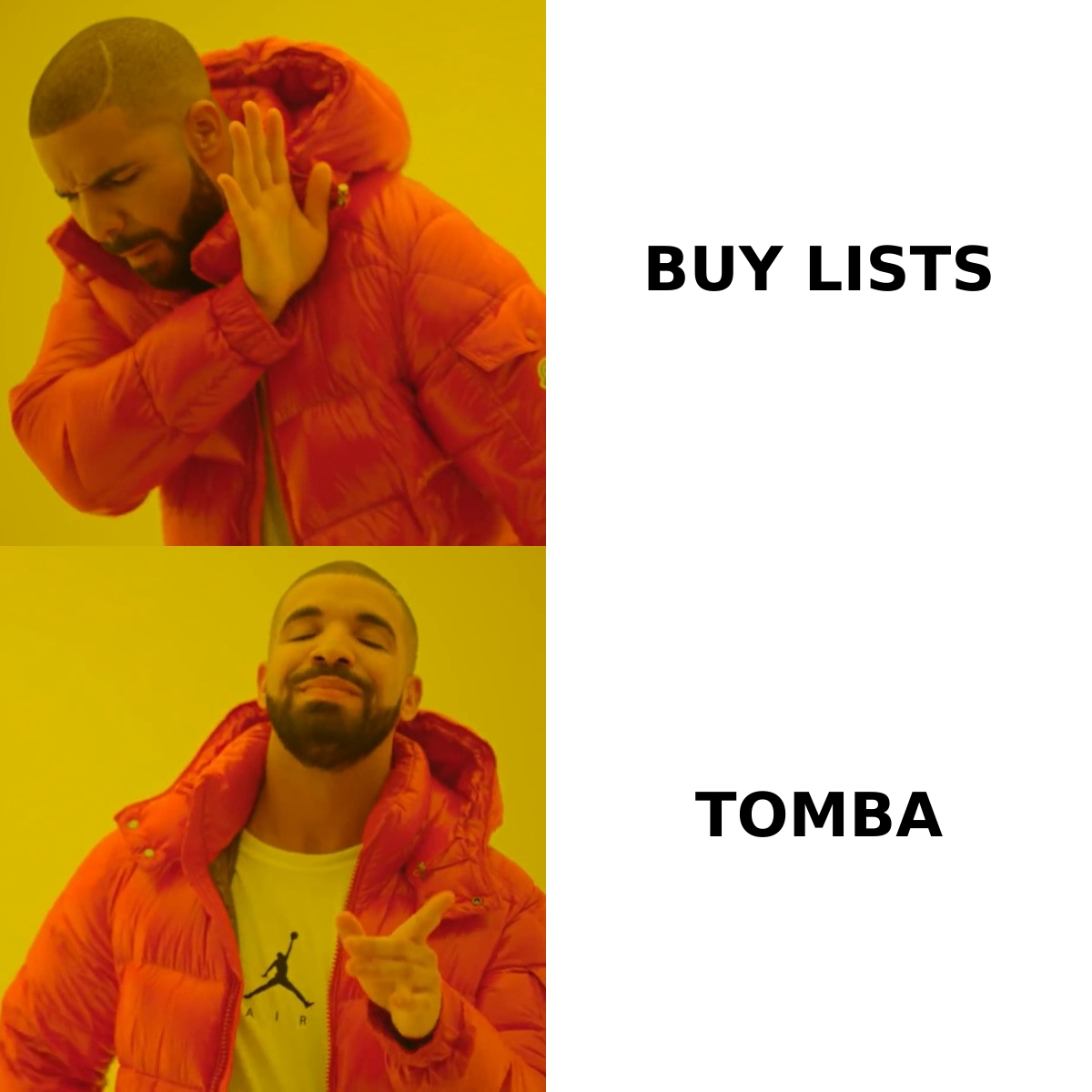
Here's where the money goes and what comes back. Cost-per-lead figures below are directional ranges drawn from commonly reported home-services, professional-services, and local-B2B benchmarks — your vertical will shift them, sometimes hard.
| Channel | Typical cost/lead | Time to first lead | Lead intent | Best for |
|---|---|---|---|---|
| Google Business Profile + map pack | ~$0 after setup | 4–12 weeks | Very high | Any business with a physical address or service area |
| Google Local Services Ads (LSA) | $45–$130 | 2–5 days | Very high | Licensed trades, legal, real estate, home services |
| Google Ads (radius-targeted search) | $80–$310 | 1–3 days | High | High-ticket services, competitive metros |
| Local SEO content (city pages) | ~$0 marginal | 3–6 months | Medium-high | Multi-location, multi-service-area businesses |
| Meta / Instagram radius ads | $25–$90 | 1–3 days | Low-medium | Consumer-facing, visual, impulse-adjacent offers |
| Outbound email to local businesses | $8–$40 | 1–2 weeks | Medium | B2B local: agencies, MSPs, commercial services |
| Referral / partner network | ~$0 + rev share | 1–6 months | Very high | Everyone, and it's still underbuilt at most firms |
| Directory listings (Yelp, industry) | $30–$200 | Immediate | Medium | Verticals where the directory owns the category |
Two things fall out of that table immediately.
First, the map pack is the best deal in local marketing and it is not close. Google's own Business Profile documentation lays out the three ranking inputs — relevance, distance, prominence — and two of the three are things you control. Complete every field, choose the narrowest accurate primary category, post weekly, and answer every review. Businesses that do all four consistently tend to outrank identical competitors who do none of them.
Second, outbound is the cheapest scalable channel for local B2B — but only if your data is clean. That "$8–$40" range assumes you're not burning 40% of sends on dead mailboxes. Miss that and the real cost triples, because bounces don't just waste sends, they damage the domain you need for every future campaign.
(Screenshot placeholder: Google map pack SERP for a local B2B query, showing review counts and proximity ordering.)
How Do You Build a Local Prospect List That Isn't Garbage?#
Start from geography, not from a keyword. That inversion is the whole trick.
The national playbook says: define ICP → find companies matching ICP → filter by location. The local playbook says: define radius → enumerate every business inside it → filter down to ICP. The second approach gets you a complete universe instead of whatever a database happened to index.
A workable sequence:
1. Draw the boundary honestly. Not "the tri-state area" if your techs won't drive past 45 minutes. Use drive time, not radius miles — 20 miles across a river is a different business than 20 miles down an interstate.
2. Enumerate the businesses. Chamber of commerce directories, county business registries, Google Maps exports, trade association member lists, and permit databases are all public and all under-mined. For a mid-size metro you'll typically land on 300–2,000 names in a given vertical.
3. Get to a decision-maker, not an info@ address. This is where most local outbound dies. You have a company name and a website, and you need a person. A domain search turns a company URL into the list of professional email addresses associated with it, along with the detected pattern (first.last, finitial.last, etc.). From there, an email finder resolves a specific named person — the owner, the ops manager, the facilities director — into a deliverable address.
4. Verify before you send. Local lists are worse than national ones for staleness: small businesses change owners, rebrand, and switch mail providers constantly. Run everything through an email verifier and quarantine the catch-all domains for separate handling rather than blasting them.
5. Enrich with the one field that matters locally: the phone number. Local B2B closes on the phone far more often than national SaaS does. A phone finder pass on your top 100 accounts is usually worth more than 400 extra emails.
6. Store it as a living asset. Re-verify quarterly. Tag by sub-vertical and by distance band. The list is the durable thing; campaigns are disposable.
If you're pulling contacts straight off LinkedIn company pages for local firms, the LinkedIn finder shortcut works well for the 10–200 employee businesses that dominate most metro B2B markets.
Is Local SEO Still Worth It When Everyone Has a Google Profile?#
Yes, because "everyone has one" and "everyone maintains one" are wildly different populations.
Walk any local category in your metro and you will find that roughly half the listings have stale hours, a generic primary category, no photos added in two years, and unanswered reviews. That's not a saturated channel. That's a channel where the bar is on the floor.
What still moves the needle in 2026:
- Review velocity over review count. Thirty reviews collected over the last six months outperforms 180 reviews that stopped in 2023. Build the ask into your job-completion or invoice workflow.
- Primary category precision. "Commercial cleaning service" and "janitorial service" are different categories that surface on different queries. Pick the one matching your highest-margin service, not the broadest one.
- Service-area pages with actual local substance. A page about "IT support in Tempe" that mentions Tempe once in an H1 and nothing else is a doorway page. One that references specific business districts, local compliance requirements, and named case studies is a ranking asset.
- NAP consistency across citations. Boring, unglamorous, still correlated with rank. Your name, address, and phone should be byte-identical everywhere.
- Proximity-adjusted expectations. If your office is on the edge of the metro, you will not rank in the map pack downtown. That's not an SEO failure; it's geometry. Budget paid coverage for the parts of your service area where proximity works against you.
Worth reading alongside this: BrightLocal's annual local consumer review survey is the most-cited dataset on how buyers actually use reviews, and it consistently shows recency mattering more than raw volume.
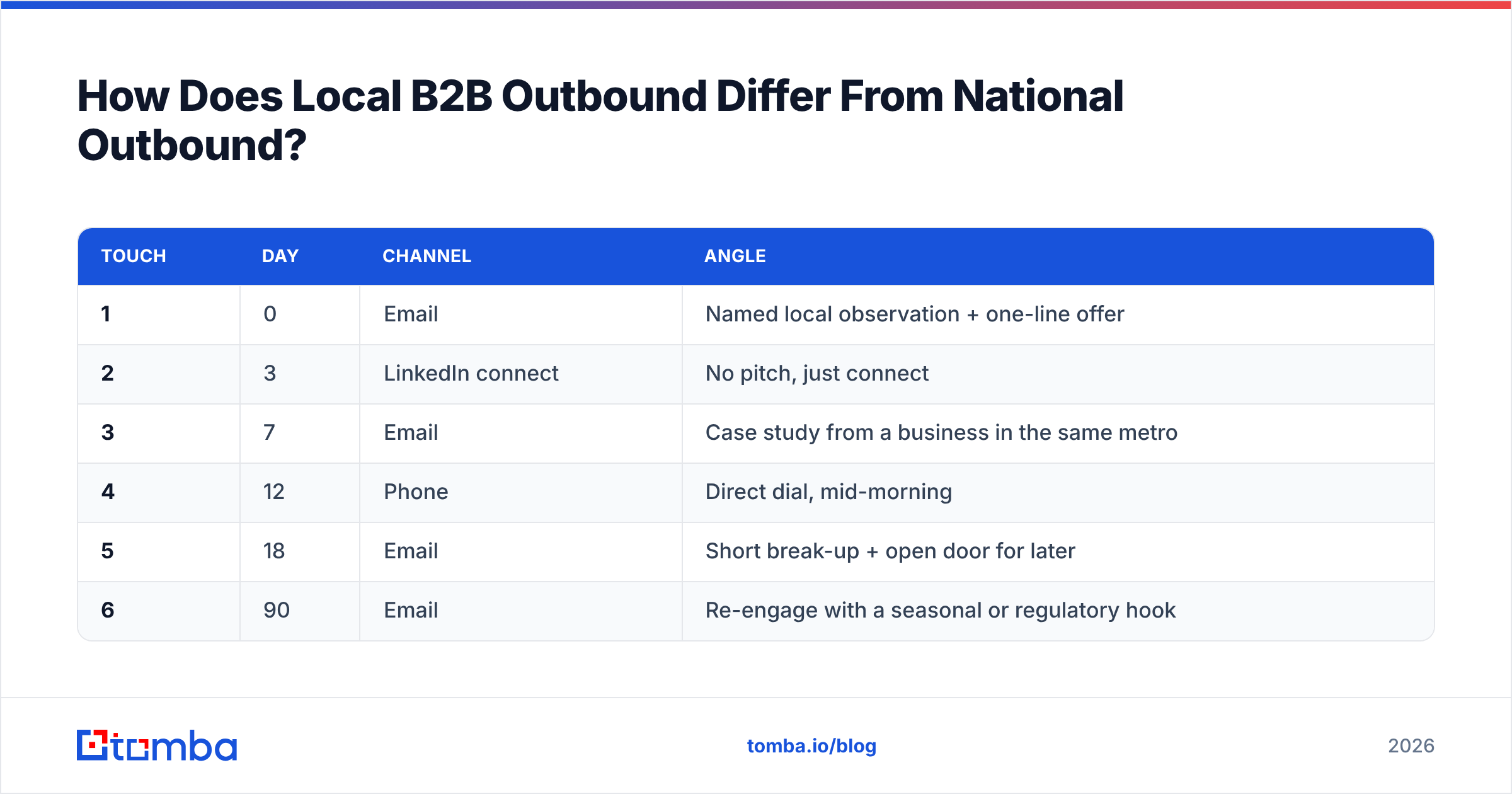
How Does Local B2B Outbound Differ From National Outbound?#
Four ways, and each one changes the copy.
You can name the neighborhood. "I noticed you just opened the second location on Mill Ave" is a personalization that no national SDR can write. Local specificity is the highest-converting personalization variable available, and it's free.
Your list is small, so volume discipline flips. With 600 total accounts, you cannot run 3,000 sends a month. You run 60 highly-researched sends a week, across five touches, and you accept that this campaign is a six-month program rather than a six-week sprint. That also means email deliverability discipline matters more, not less — you cannot afford to burn a domain when your total universe is finite.
Multi-channel is genuinely easy. You can drop by. You can show up at the same chamber breakfast. You can send physical mail that costs $1.20 and actually gets opened because it's from someone eight miles away. National teams fantasize about this; local teams can just do it.
Referral loops close faster. Every closed local account knows four other businesses in your radius. Ask at the 90-day mark, not at the end of the contract.
Practically, the sequence I'd run for a local B2B service business:
| Touch | Day | Channel | Angle |
|---|---|---|---|
| 1 | 0 | Named local observation + one-line offer | |
| 2 | 3 | LinkedIn connect | No pitch, just connect |
| 3 | 7 | Case study from a business in the same metro | |
| 4 | 12 | Phone | Direct dial, mid-morning |
| 5 | 18 | Short break-up + open door for later | |
| 6 | 90 | Re-engage with a seasonal or regulatory hook |
Note touch 6. Local lists get re-worked, not discarded. A "no" from a 40-person manufacturer in March is a live opportunity in November when their contract renews.
What Does Local Lead Generation Actually Cost?#
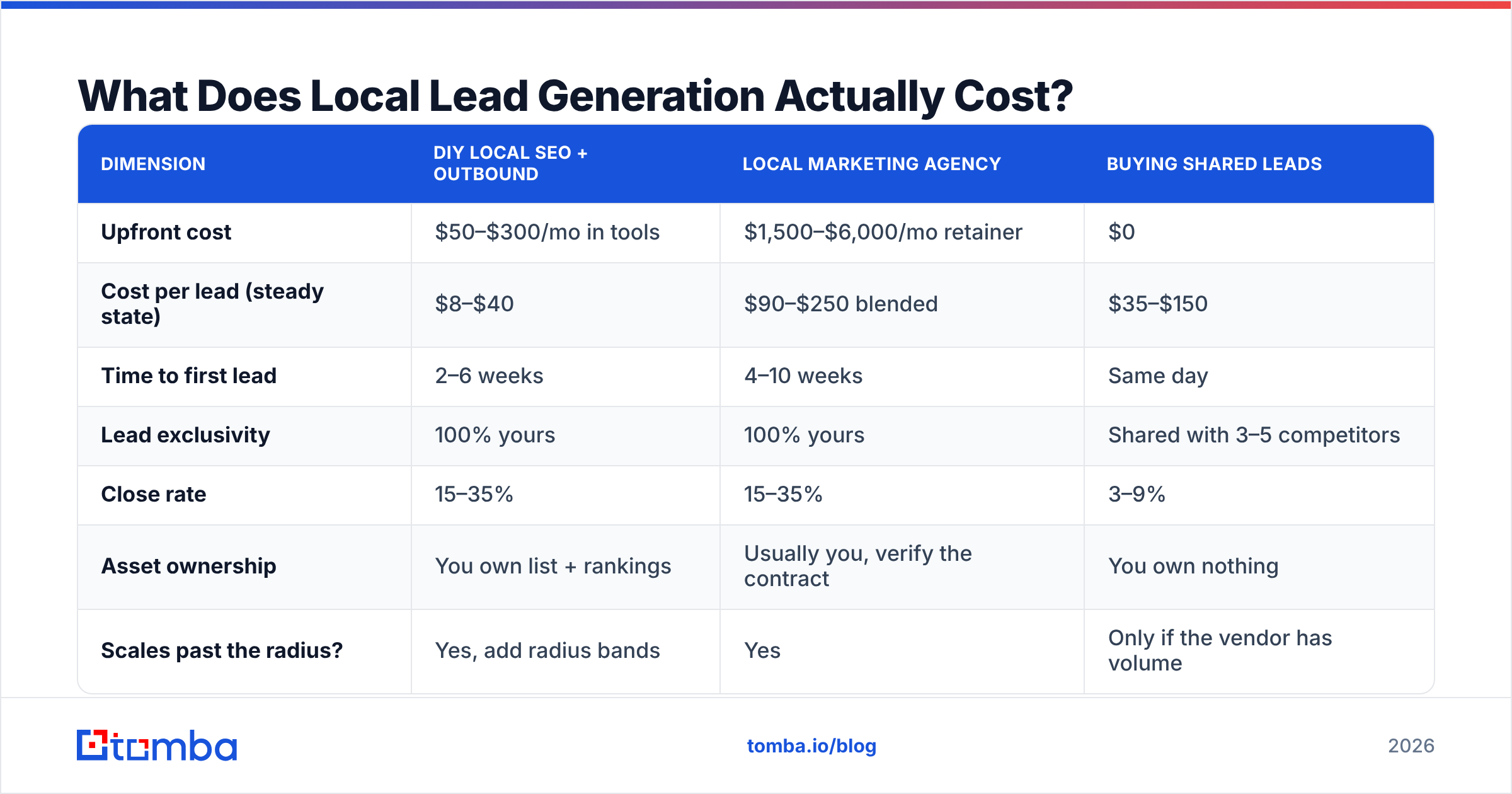
Here's the honest comparison most agency pitches skip — the three ways a local business can build pipeline, side by side.
| Dimension | DIY local SEO + outbound | Local marketing agency | Buying shared leads |
|---|---|---|---|
| Upfront cost | $50–$300/mo in tools | $1,500–$6,000/mo retainer | $0 |
| Cost per lead (steady state) | $8–$40 | $90–$250 blended | $35–$150 |
| Time to first lead | 2–6 weeks | 4–10 weeks | Same day |
| Lead exclusivity | 100% yours | 100% yours | Shared with 3–5 competitors |
| Close rate | 15–35% | 15–35% | 3–9% |
| Asset ownership | You own list + rankings | Usually you, verify the contract | You own nothing |
| Scales past the radius? | Yes, add radius bands | Yes | Only if the vendor has volume |
| Main failure mode | Nobody runs it consistently | Retainer outlives the results | Racing four rivals to the phone |
Shared-lead marketplaces look cheap per lead and are almost always the most expensive channel once you divide by closed deals. When four contractors get the same homeowner's number, you're paying for a footrace.
The DIY column only works if someone actually owns it. That's the real variable. A local business with one person spending six focused hours a week on profile maintenance, review collection, and 60 outbound touches will beat a $4,000/month retainer in most metros. A local business that "will get to it" beats nothing.
On the data side, tooling cost is genuinely small at local scale. If your universe is 600 accounts, you need a few hundred lookups a month, not a hundred thousand. Tomba pricing starts with a free tier at 25 searches a month for testing the workflow, and the $49/mo Starter plan covers most single-metro operations comfortably. Compare that against the $90–$250 blended CPL of the agency column and the math resolves quickly.
If you'd rather stay in a spreadsheet than learn another dashboard, the Google Sheets add-on lets you run finds and verifications in the same sheet where your local list already lives — which, for most small local teams, is the difference between a process that gets used and one that doesn't.
What Should You Track?#
Five numbers. Not fifty.
- Map pack impressions by query — pulled from your Business Profile insights. This is your organic local ceiling.
- Calls and form fills by source — tag everything. If you can't attribute it, you'll over-fund the loudest channel rather than the best one.
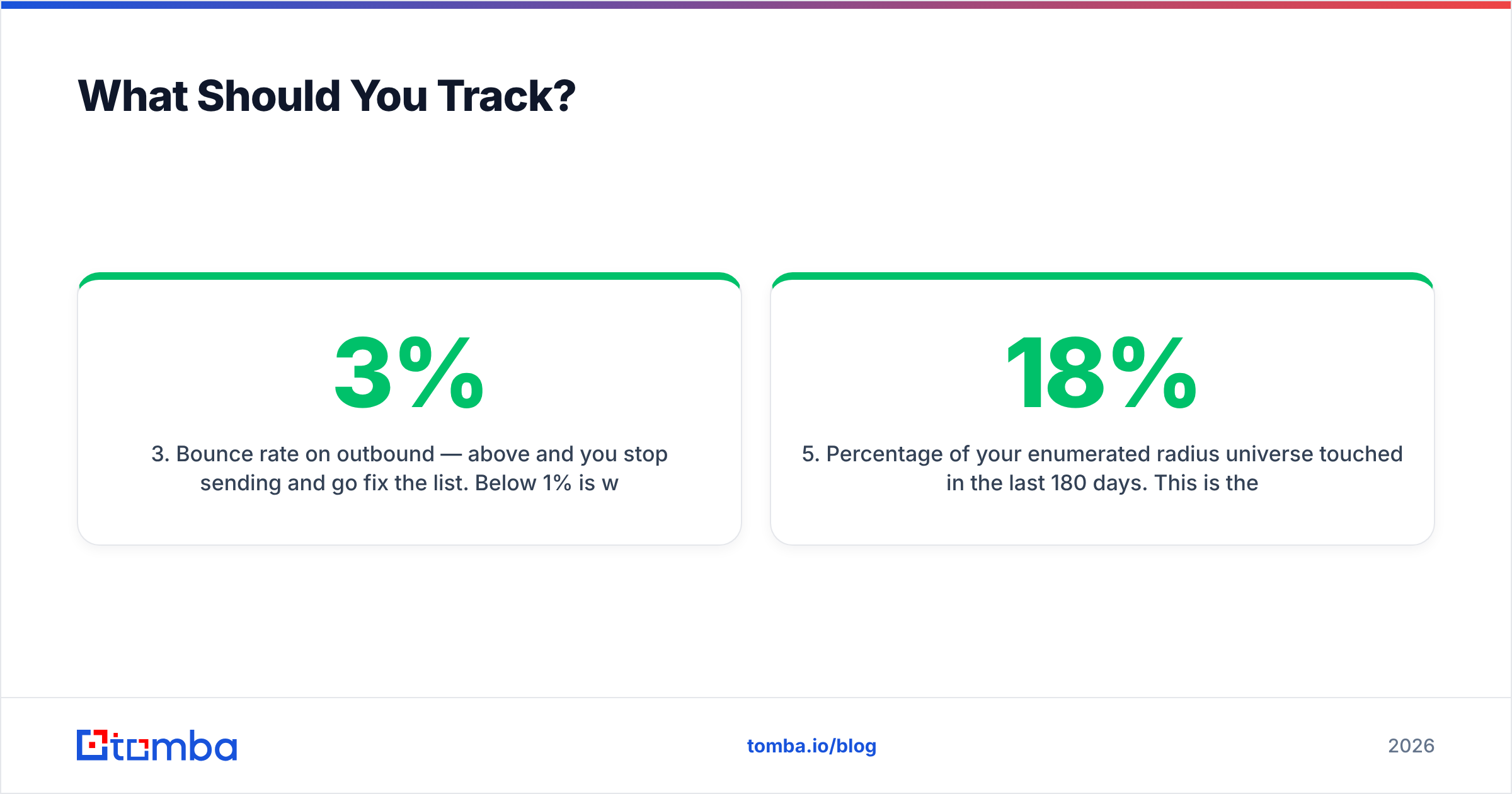
- Bounce rate on outbound — above 3% and you stop sending and go fix the list. Below 1% is where a verified local list should sit.
- Cost per booked appointment, not cost per lead. Local verticals have wildly different lead-to-appointment ratios, and CPL hides that.
- Percentage of your enumerated radius universe touched in the last 180 days. This is the metric almost nobody tracks and it's the one that tells you whether you have a lead generation problem or a coverage problem. If you've touched 18% of the businesses in your service area, you do not need a new channel. You need to finish the list.
That last number is why the enumeration step matters so much. Once you know the denominator, "we need more leads" becomes a specific, solvable task instead of a vague anxiety.
Where Do You Start This Week?#
Compressed version, in order:
- Day 1: Claim and fully complete your Google Business Profile. Every field, ten photos, correct primary category, real hours.
- Day 2: Build the review-request step into whatever workflow touches a finished customer. Automate the ask.
- Day 3–4: Enumerate your radius. Chamber lists, Maps exports, trade directories. Get to a raw list of business names and domains.
- Day 5: Run domain search and email finder against that list, then verify. You should end with a few hundred named, deliverable contacts.
- Week 2: Start the six-touch sequence at 60 accounts per week. Do not scale it until touch 4 has data.
- Week 6: Review the five metrics. Decide whether to add paid coverage for the parts of your radius where proximity works against you.
None of this is clever. It's just rarely done end to end, which is exactly why it still works.
Ready to turn your service-area map into a contact list? Start with Tomba's Email Finder — feed it the business names and domains you enumerated inside your radius, and get verified, deliverable decision-maker addresses back. The free tier gives you 25 searches to test the workflow on your own metro before committing to anything; Starter at $49/mo covers most single-city outbound programs. Build the list once, verify it quarterly, and stop guessing at info@.
Related guides#
// get started
Find, verify and enrich your first contacts today
Start on the free plan with 25 searches a month, then scale when your team is ready.
Free plan · No credit card required · GDPR & CCPA
Get the Tomba newsletter
Product and data updates
// about the author