Lead Generation Marketing Strategy: A 2026 Playbook That Converts
Most lead gen plans are a channel list with a budget attached. Here's how to build a lead generation marketing strategy in 2026 — channel mix, data layer, 90-day rollout, and the four metrics that actually predict pipeline.
TL;DR
- A lead generation marketing strategy is not a channel list. It's a documented decision about who you target, what you offer them, how you capture and verify their contact data, and what you do in the first 10 minutes after they raise a hand.
- The biggest failure point in 2026 isn't creative or channel choice — it's the data layer. Forms half-filled, enrichment guessed, emails unverified, and 30-40% of the "leads" you paid for never reach a human inbox.
- Inbound builds compounding demand but takes 6-9 months. Outbound produces pipeline in weeks but decays without fresh, accurate contact data. Almost every team that hits target runs both.
- Track four things: cost per qualified lead, lead-to-opportunity rate, speed-to-lead, and data decay rate. Everything else is a vanity chart.
- Budget rule of thumb that survives most board reviews: 50% to what's already working, 30% to scaling the second-best channel, 20% to experiments you're willing to kill.
What is a lead generation marketing strategy?#
A lead generation marketing strategy is the documented system that turns strangers into identified, contactable, qualified buyers — and the reasoning behind every choice in that system.
Think of it like a municipal water system rather than a bucket brigade. Anybody can carry a bucket (run a campaign). A system decides where the reservoir is, what pipes carry the water, where the filters sit, and what pressure gets it to the tap before anybody goes thirsty. Most "strategies" are a bucket schedule.
A real one answers five questions in writing:
- Who exactly — the ICP defined by firmographics, technographics, and a triggering event, not "mid-market SaaS."
- What they trade contact details for — the offer, and whether it's genuinely worth an email address.
- Where you meet them — the channel mix and the rationale for each channel's share of budget.
- How the data gets clean — capture, enrichment, verification, deduplication, and routing.
- What happens in the first 10 minutes — routing rules, SLA, and the first touch.
Skip question four and the other four stop mattering. You can run a flawless campaign into a database that quietly destroys 35% of what it touches.
Why do most lead generation strategies stall in 2026?#
They stall because acquisition got cheaper to start and much harder to sustain. Three forces compounded:
Form fatigue. Buyers have learned that an 11-field form means seven sales calls. Completion rates on long gated forms have collapsed, and the people who do complete them increasingly type junk. Shortening the form fixes conversion and breaks your data — unless you enrich the missing fields afterward.
Inbox gatekeeping. Google and Yahoo's bulk-sender requirements pushed spam complaint thresholds and authentication from "best practice" to "mandatory." A list with a 5% bounce rate no longer just wastes sends; it degrades your sender reputation for every subsequent campaign, including the ones to your best accounts.
AI-generated sameness. When everyone can produce a competent blog post in four minutes, competent blog posts stop being a moat. The differentiator moved from volume to specificity — original data, real customer detail, and offers that only your company could make.

None of these are creative problems. They're plumbing problems dressed as creative problems.
What channels belong in your lead generation mix?#
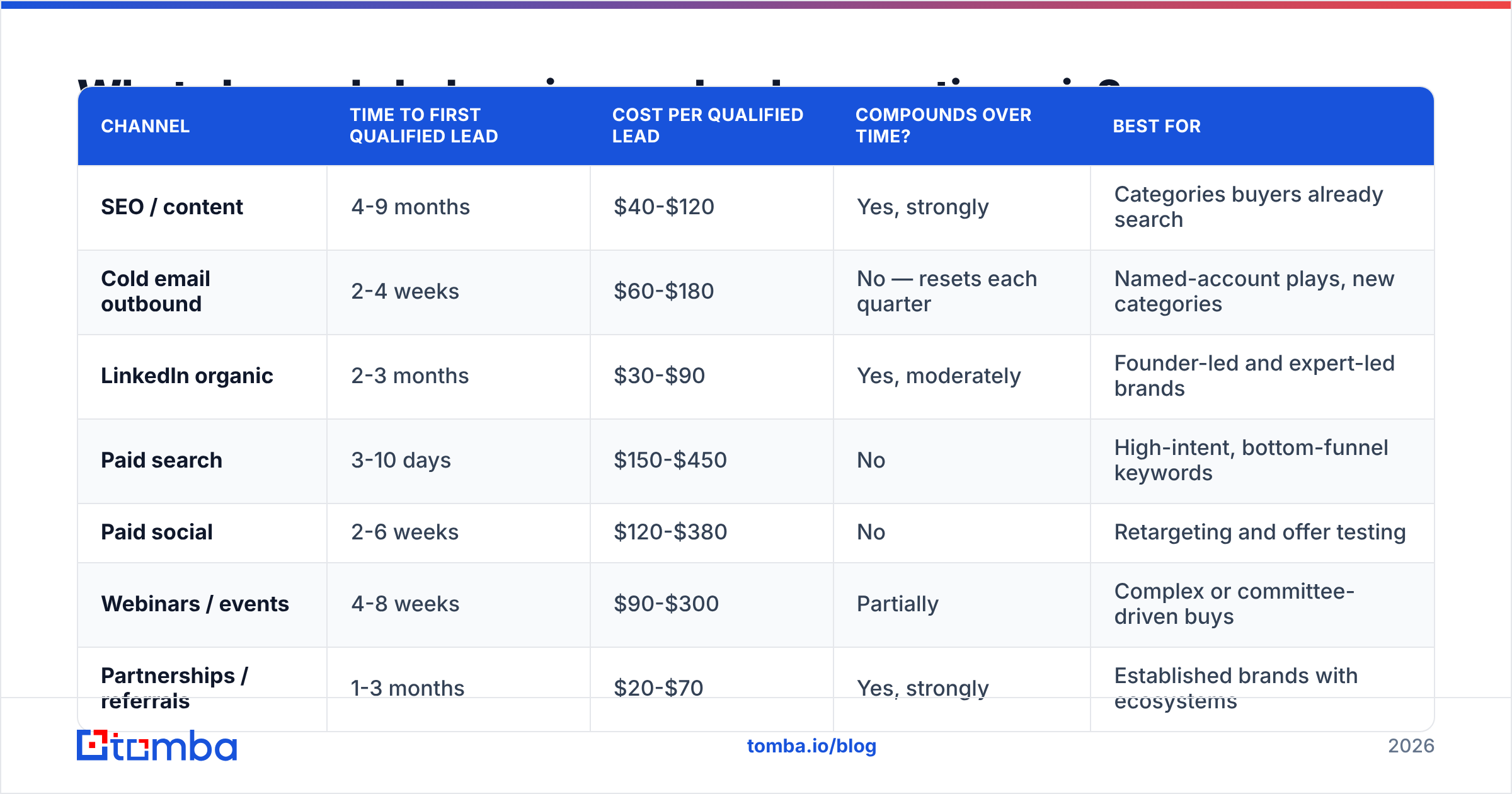
There is no universally correct mix, but there is a correct method: rank channels by how fast they produce a qualified conversation and how well they compound. Here's how the main options compare for a B2B team with a $15k-$60k average contract value.
| Channel | Time to first qualified lead | Cost per qualified lead | Compounds over time? | Best for |
|---|---|---|---|---|
| SEO / content | 4-9 months | $40-$120 | Yes, strongly | Categories buyers already search |
| Cold email outbound | 2-4 weeks | $60-$180 | No — resets each quarter | Named-account plays, new categories |
| LinkedIn organic | 2-3 months | $30-$90 | Yes, moderately | Founder-led and expert-led brands |
| Paid search | 3-10 days | $150-$450 | No | High-intent, bottom-funnel keywords |
| Paid social | 2-6 weeks | $120-$380 | No | Retargeting and offer testing |
| Webinars / events | 4-8 weeks | $90-$300 | Partially | Complex or committee-driven buys |
| Partnerships / referrals | 1-3 months | $20-$70 | Yes, strongly | Established brands with ecosystems |
Two readings of that table matter more than the numbers themselves.
First, the cheapest channels are the slowest. If you need pipeline this quarter, you will pay a premium for speed — that's not a failure of execution, it's the price of time.
Second, only three rows compound. A lead generation marketing strategy built entirely on paid channels is a treadmill: your cost per lead rises every year as auction competition increases, and it drops to zero the day you pause spend. Most durable programs pair one compounding channel with one fast channel and accept that both are permanent line items.
Is inbound better than outbound for lead generation?#
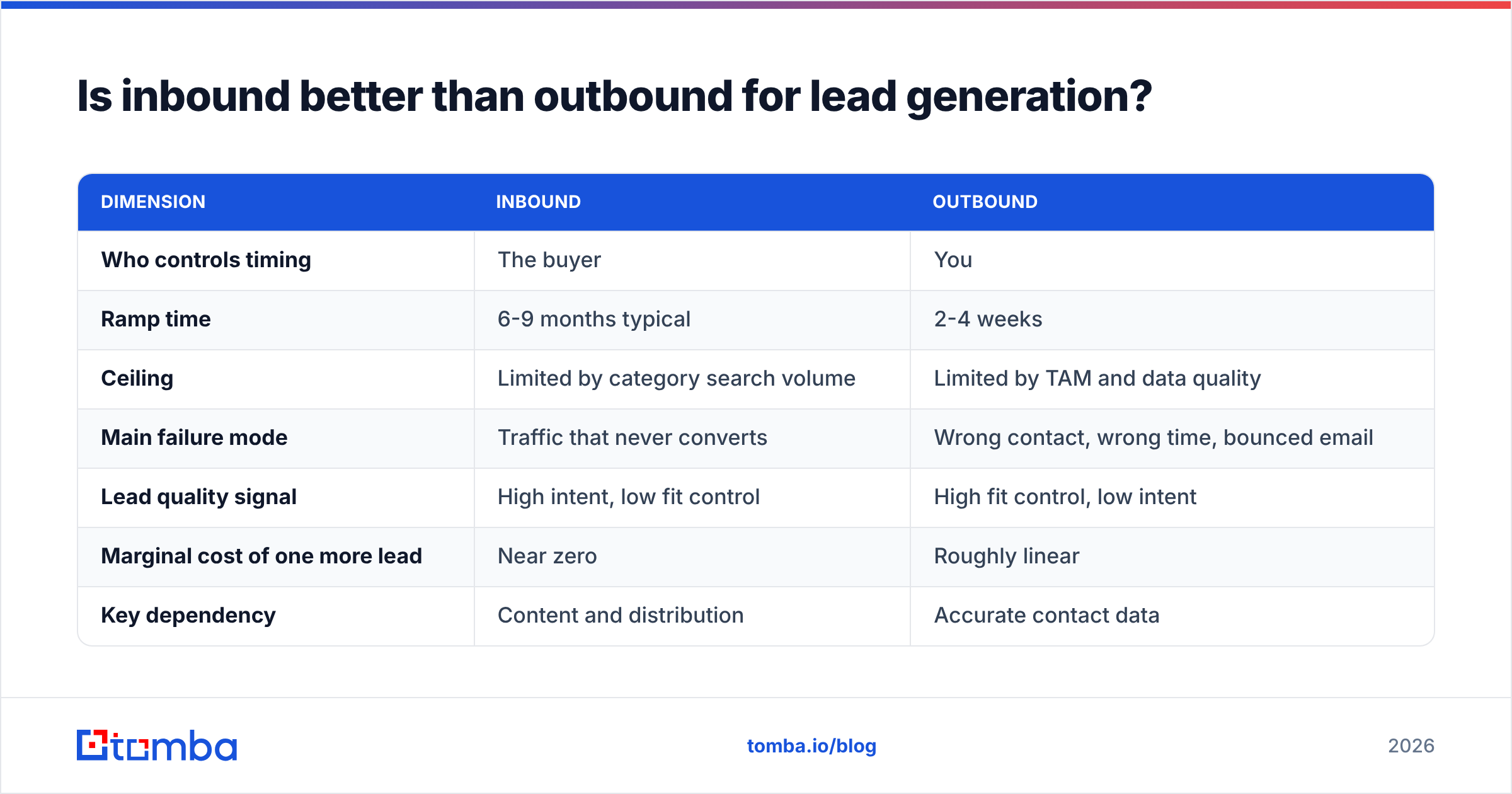
Neither wins outright. They fail differently, and that's the useful distinction.
| Dimension | Inbound | Outbound |
|---|---|---|
| Who controls timing | The buyer | You |
| Ramp time | 6-9 months typical | 2-4 weeks |
| Ceiling | Limited by category search volume | Limited by TAM and data quality |
| Main failure mode | Traffic that never converts | Wrong contact, wrong time, bounced email |
| Lead quality signal | High intent, low fit control | High fit control, low intent |
| Marginal cost of one more lead | Near zero | Roughly linear |
| Key dependency | Content and distribution | Accurate contact data |
Inbound gives you intent but not fit — anyone can download your guide, including students and competitors. Outbound gives you fit but not intent — you picked the account, so the firmographics are perfect, but nobody asked you to call.
The hybrid play that outperforms both: use inbound signals to prioritize outbound targets. Someone from an ICP account read three pricing-adjacent pages but never filled a form. You already know the company. You need the person and their verified address. That's a domain search plus a verification step, and it converts several times better than a cold list because the intent is real even though the hand never went up.
For a more formal read on how buying committees behave across these paths, Gartner's marketing research is the standard reference, and HubSpot's marketing statistics is a decent free benchmark set for conversion rates by channel.
How do you build the data layer under the strategy?#
This is the part nobody puts in the deck and everybody pays for later. Your lead generation marketing strategy needs five explicit steps between "a lead exists somewhere" and "a rep is talking to them."
- Capture minimally. Ask for work email and company only. Every additional required field costs roughly 3-7% completion. You will fill the rest in step two.
- Enrich immediately. Push the captured domain through data enrichment to append company size, industry, tech stack, and role. Now your routing rules and scoring model have something to work with, and the buyer typed two fields instead of nine.
- Verify before anything sends. Run every address through an email verifier at the moment of capture, not once a quarter. Catch-all domains need their own handling — a catch-all accepts everything at the SMTP layer and tells you nothing, so route those to a catch-all verifier rather than assuming they're valid.
- Deduplicate and merge. The same human will enter your database as
j.smith@,john.smith@, and a LinkedIn form-fill with a personal Gmail. Three records means three sequences and one very annoyed prospect. - Route within minutes. Speed-to-lead is the single most under-invested variable in B2B. Response inside five minutes versus an hour is a step-change in connect rate, and no amount of clever copy compensates for arriving on day three.
Run these five and your marketing qualified lead definition starts meaning something, because the record behind it is complete and reachable.

What does a 90-day lead generation rollout look like?#
If you're rebuilding from scratch, resist the urge to launch six channels in week one. A staged rollout tells you what's working; a simultaneous launch tells you nothing.
Days 1-30 — Define and instrument. Write the ICP with three disqualifiers, not just qualifiers. Pick one compounding channel and one fast channel. Set up tracking so every lead carries its source, campaign, and first-touch content through to closed-won. Fix the data layer above before spending a dollar on traffic. Build a baseline list of 300-500 verified target contacts so outbound isn't blocked on data in week five.
Days 31-60 — Launch narrow and instrument harder. Run one outbound sequence to one segment with one offer. Publish against 8-12 keywords where you can plausibly rank, not the head term you'd like to own. Start measuring reply rate, bounce rate, and meeting rate separately — they fail for completely different reasons and averaging them hides both.
Days 61-90 — Kill, double, and systematize. Anything below half the median performance gets cut without sentiment. Anything above median gets twice the budget. Document the winning sequence and the winning content format so a new hire can run it in week one instead of week six.
Ongoing — Refresh the data. B2B contact data decays roughly 2-2.5% per month through job changes, domain migrations, and restructures. That compounds to about a quarter of your database per year. A quarterly re-verification pass on active segments is the cheapest pipeline insurance you can buy, and a bulk email finder run makes it a batch job rather than a project.
Which metrics prove the strategy is working?#
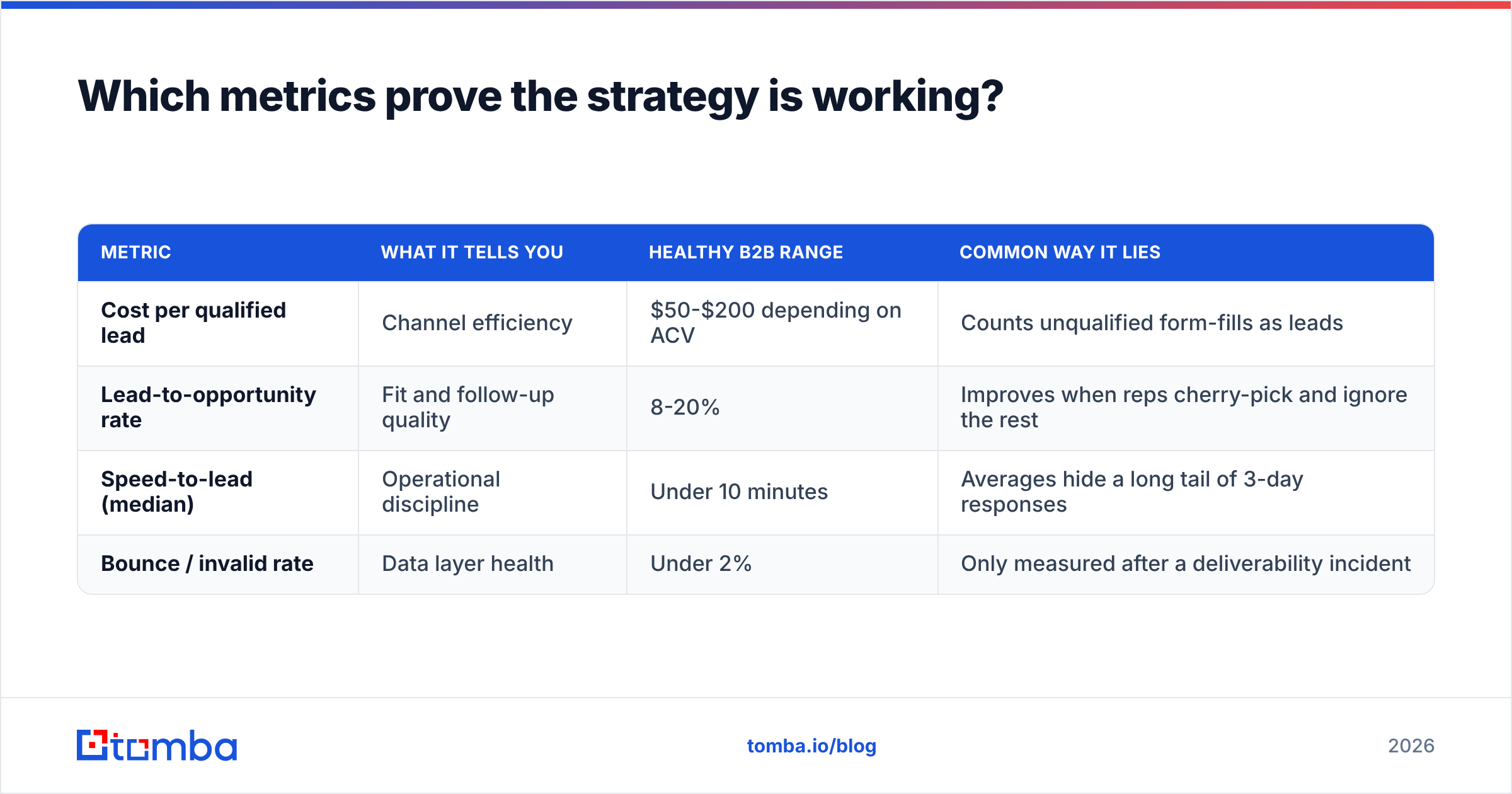
Four numbers, reviewed monthly. Everything else is diagnostic detail underneath them.
| Metric | What it tells you | Healthy B2B range | Common way it lies |
|---|---|---|---|
| Cost per qualified lead | Channel efficiency | $50-$200 depending on ACV | Counts unqualified form-fills as leads |
| Lead-to-opportunity rate | Fit and follow-up quality | 8-20% | Improves when reps cherry-pick and ignore the rest |
| Speed-to-lead (median) | Operational discipline | Under 10 minutes | Averages hide a long tail of 3-day responses |
| Bounce / invalid rate | Data layer health | Under 2% | Only measured after a deliverability incident |
Note what isn't on that list: MQL volume, traffic, and impressions. They're useful for debugging a drop, but optimizing for them directly produces exactly what you'd expect — more leads, worse leads. If your MQL count doubled and your opportunity count didn't move, you didn't improve the strategy; you lowered the bar. Peer reviews on G2's lead capture category are a reasonable sanity check on what tooling teams at your stage actually keep versus churn out of.
How much should you budget, and where?#
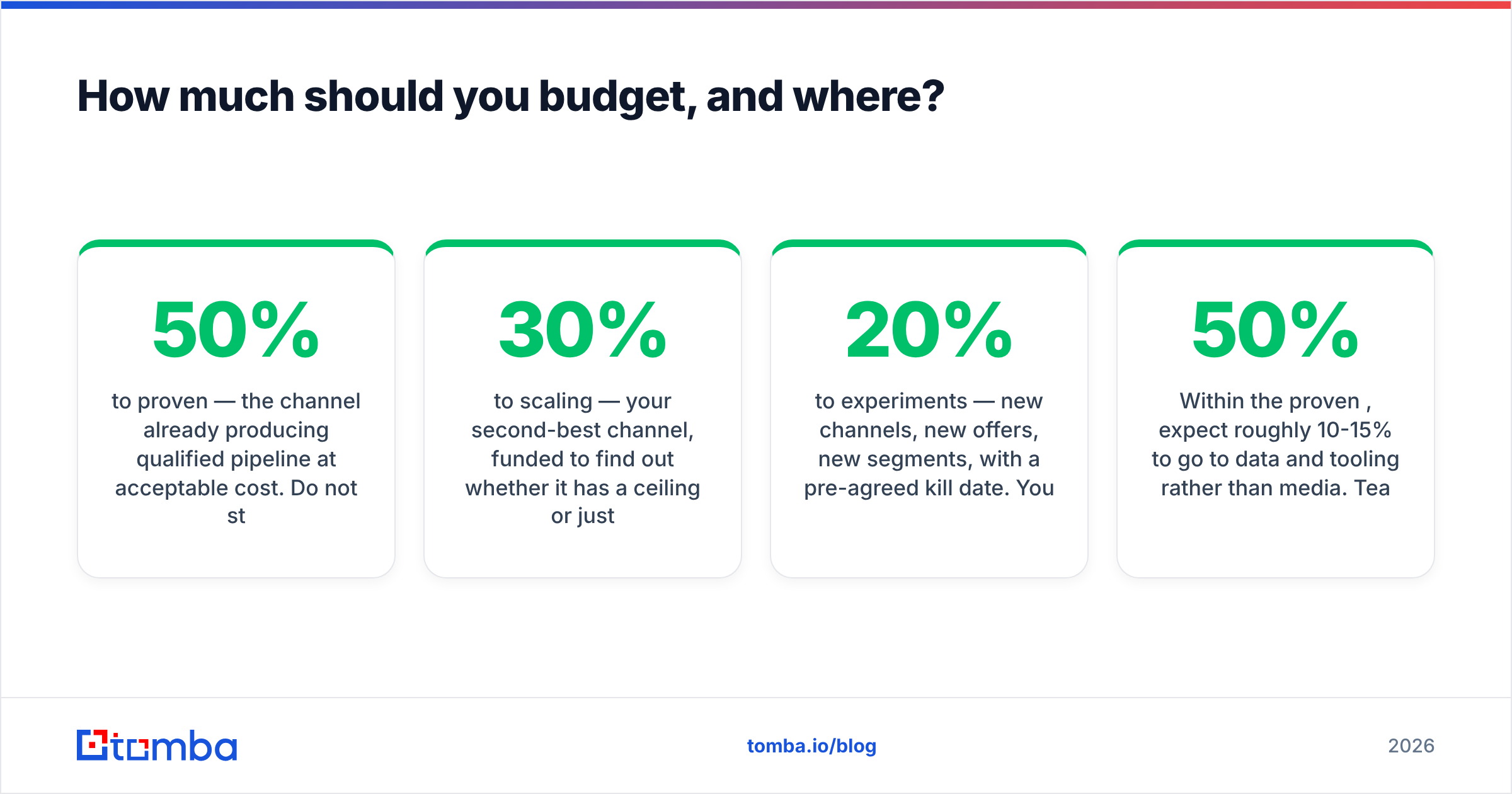
The split that survives scrutiny is 50/30/20.
- 50% to proven — the channel already producing qualified pipeline at acceptable cost. Do not starve it to fund novelty.
- 30% to scaling — your second-best channel, funded to find out whether it has a ceiling or just needed budget.
- 20% to experiments — new channels, new offers, new segments, with a pre-agreed kill date. You should expect most of this to fail. That's the point; it's the price of finding the next 50%.
Within the proven 50%, expect roughly 10-15% to go to data and tooling rather than media. Teams consistently underweight this and then wonder why a well-funded campaign produced a 6% bounce rate. Compared to a single month of paid search, a Tomba plan that keeps your entire contact database verified is a rounding error — the Free tier covers 25 searches a month for testing, Starter is $49/mo, Growth $99/mo, and Pro $249/mo for teams running real volume.
Where should you start this week?#
Pick the smallest broken link. For most teams reading this, that's not the creative and it's not the channel mix — it's that a meaningful slice of the contacts in your CRM can't actually receive an email, and nobody has checked in a year.
Start there: export one active segment, verify it, and measure how much of it comes back invalid. That number will tell you more about your lead generation marketing strategy than the next three campaign reports combined.
When you're ready to fill the gaps that enrichment and verification expose, the Tomba Email Finder finds verified professional addresses by domain, name, or company — so the accounts your strategy already identified as worth pursuing become accounts you can actually reach. Run a free search against your current target list and see how much of your pipeline was sitting one verified address away.
Related guides#
// get started
Find, verify and enrich your first contacts today
Start on the free plan with 25 searches a month, then scale when your team is ready.
Free plan · No credit card required · GDPR & CCPA
Get the Tomba newsletter
Product and data updates
// about the author