9 Lead Generation Mistakes That Quietly Kill Your Pipeline
Most lead generation mistakes don't look like mistakes. They look like a busy team, a full CRM, and a quiet pipeline. Here are the nine that cost the most, with the numbers behind each one and a fix you can ship this month.
TL;DR
- The most expensive lead generation mistakes are invisible on a dashboard: bad data, undefined ICP, and volume targets that reward activity over fit.
- A 41% bounce rate doesn't just waste sends — it damages the sending domain you'll need for the next six months of outbound.
- Buying a list isn't automatically wrong. Buying an unvetted list and skipping verification is.
- Most teams run five channels badly instead of two well. Depth beats breadth until you hit repeatable conversion.
- Fix order matters: ICP → data quality → channel focus → follow-up cadence → measurement. Fixing measurement first just gives you accurate reports about a broken process.
What actually counts as a lead generation mistake?#
A lead generation mistake is any repeatable step in your pipeline that consumes budget or rep hours without moving a qualified buyer forward. That definition matters because it excludes a lot of things people beat themselves up over (a bad subject line, a slow week) and includes a lot of things nobody flags (a CRM full of contacts nobody will ever call).
The tell is always the same: activity metrics look healthy, outcome metrics don't. Emails sent are up. Connects are up. Meetings booked are flat. When that gap persists for more than a quarter, the problem isn't effort — it's one of the nine below.
Here's the uncomfortable framing: lead generation is a data problem wearing a sales costume. Most of what breaks happens before anyone writes a single line of copy.
Which lead generation mistakes cost the most money?#
Ranked by what they actually drain, not by how often people complain about them:
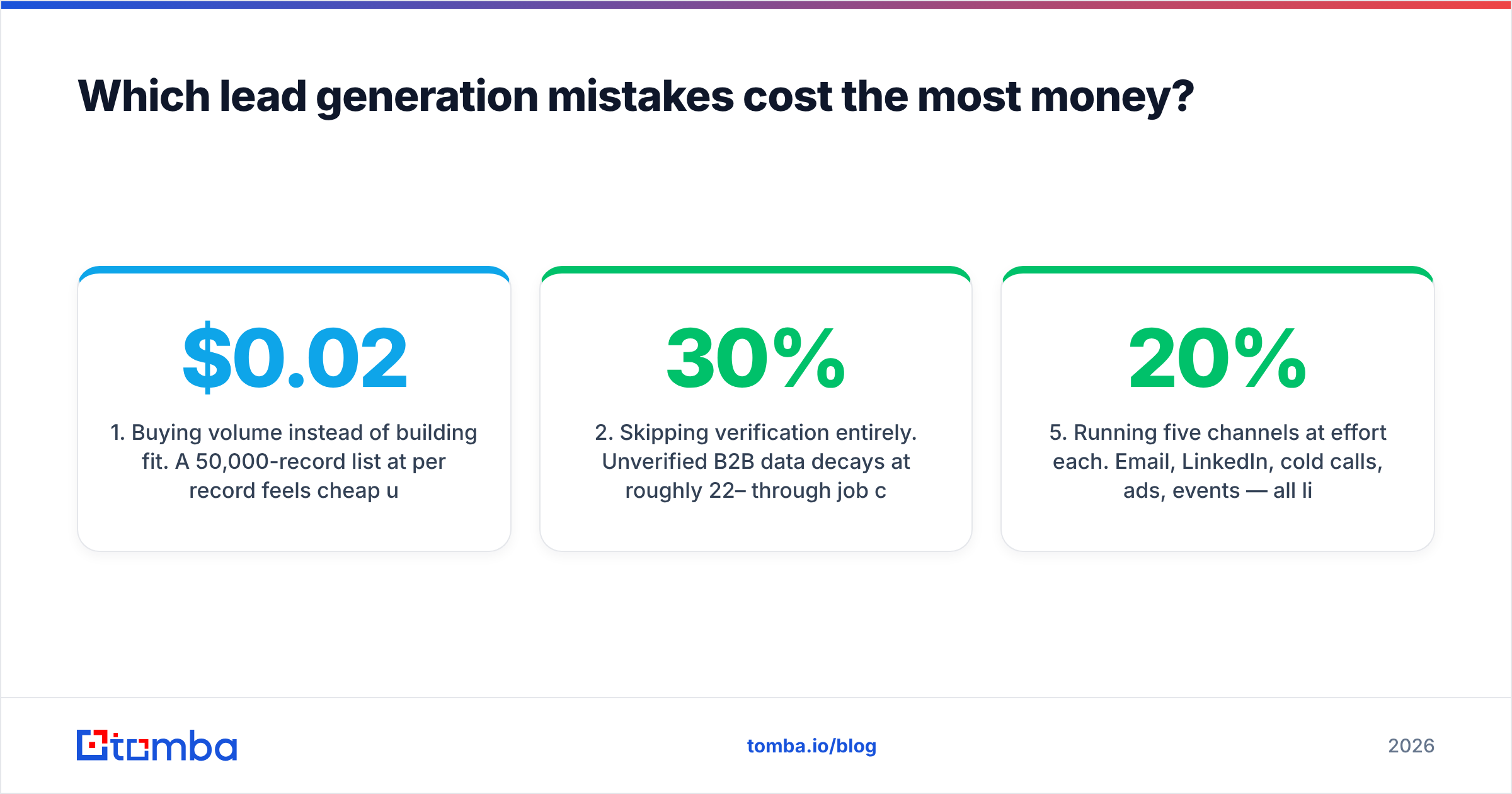
- Buying volume instead of building fit. A 50,000-record list at $0.02 per record feels cheap until you calculate cost per meeting. If 3% match your ICP, you paid $1,000 for 1,500 usable records and burned rep time sorting the rest.
- Skipping verification entirely. Unverified B2B data decays at roughly 22–30% per year through job changes alone. A list that was clean in January is measurably not clean in September.
- Defining ICP by firmographics only. "SaaS, 50–200 employees, US" describes 40,000 companies. It doesn't describe a buyer. Add a trigger (hiring for the role, new funding, using a competing tool) and the list shrinks to something a human can actually work.
- Treating MQLs as a finish line. A marketing qualified lead that gets a one-touch follow-up and a "not interested" tag was never qualified in any useful sense.
- Running five channels at 20% effort each. Email, LinkedIn, cold calls, ads, events — all live, none owned, none measured properly.
- Stopping outreach at touch two. The majority of booked meetings in B2B outbound come from touches 3–7. Teams that stop at two are paying full price for half the sequence.

Is buying a lead list always a mistake?#
No — and this is where a lot of advice gets lazy. Bought data and built data both work. Scraped data usually doesn't.
The distinction is provenance and freshness, not whether money changed hands. A vetted provider that documents its sources, offers bounce guarantees, and refreshes records on a known cadence is a legitimate input. A CSV from a marketplace with no source documentation is a liability you pay to host in your CRM.
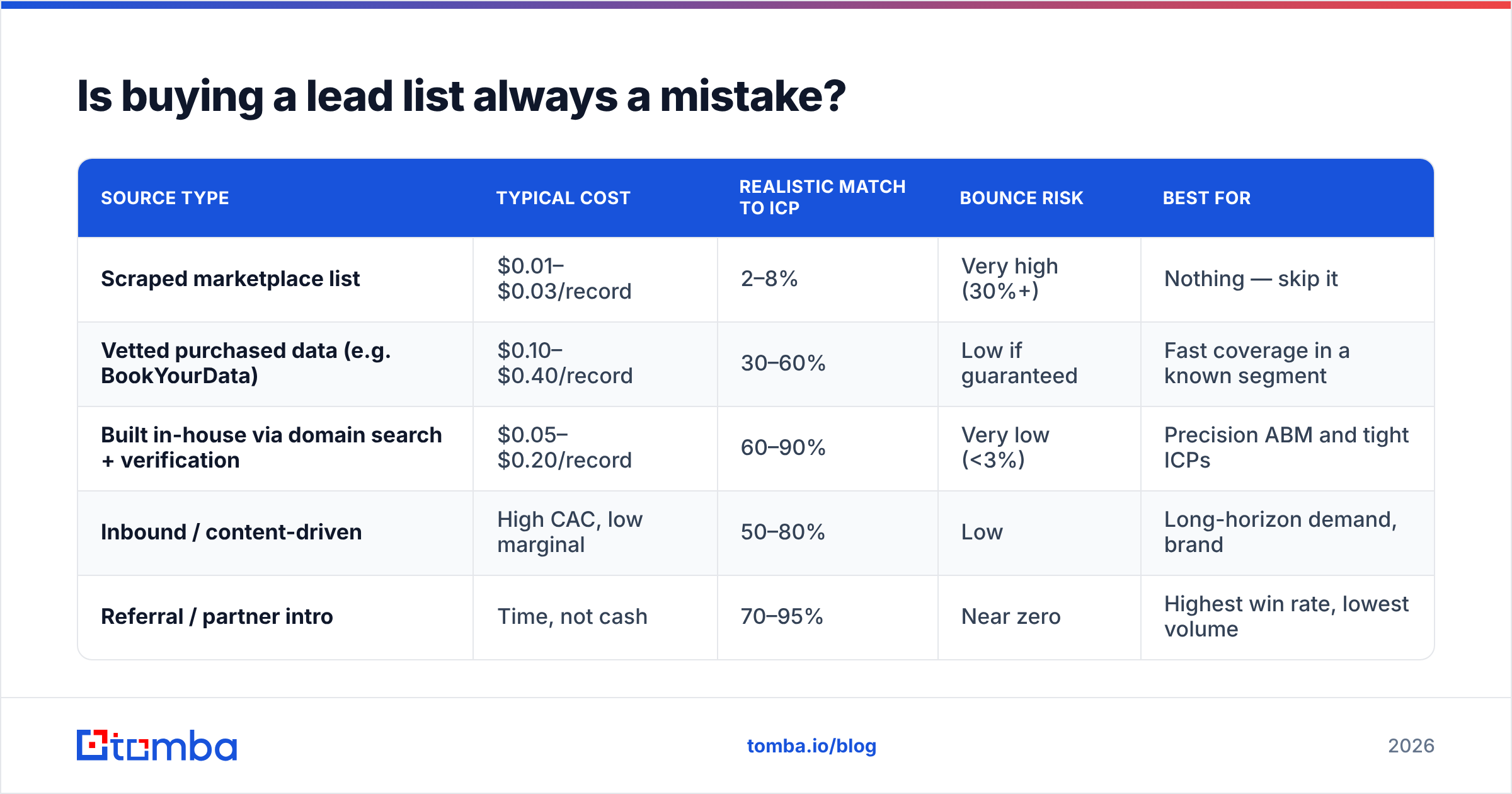
| Source type | Typical cost | Realistic match to ICP | Bounce risk | Best for |
|---|---|---|---|---|
| Scraped marketplace list | $0.01–$0.03/record | 2–8% | Very high (30%+) | Nothing — skip it |
| Vetted purchased data (e.g. BookYourData) | $0.10–$0.40/record | 30–60% | Low if guaranteed | Fast coverage in a known segment |
| Built in-house via domain search + verification | $0.05–$0.20/record | 60–90% | Very low (<3%) | Precision ABM and tight ICPs |
| Inbound / content-driven | High CAC, low marginal | 50–80% | Low | Long-horizon demand, brand |
| Referral / partner intro | Time, not cash | 70–95% | Near zero | Highest win rate, lowest volume |
The honest read: most teams should run a mix. Use a vetted provider for breadth when you enter a new segment, and build your own records for the accounts you actually care about. BookYourData and similar vetted vendors solve a different problem than a self-serve email finder — one gives you a segment, the other gives you a specific person at a specific account.
What you should never do is treat either source as final. Run everything through an email verifier before it touches a sending domain. That single step is the difference between a 2% bounce rate and a 20% one.
Why does bad data break everything downstream?#
Because deliverability is a compounding system, and bad data is the input that poisons it.
Here's the chain. You send to a list with 18% invalid addresses. Mailbox providers register the hard bounces. Your domain reputation drops. Your valid recipients start landing in spam. Reply rate falls. Someone on the team concludes the messaging is wrong and rewrites the sequence. The new sequence also underperforms, because the problem was never the copy.
Three months later you're on your fourth message test with a domain that needs a full warmup cycle to recover. The original mistake cost you one list. The compounding cost you a quarter.

Some practical guardrails:
- Verify before every send, not once at import. A record verified six months ago is an assumption, not a fact.
- Segment catch-all domains separately. They're not invalid, they're unknown. Run them through a catch-all verifier and treat the results as a distinct risk tier rather than mixing them into your main send.
- Cap bounce rate at 3% per campaign. If a batch exceeds it, stop the send and re-verify rather than pushing through.
- Enrich, don't just find. Title, seniority, and company size turn a valid address into a targetable one. Data enrichment is what makes segmentation possible at all.
Is more channels better than more depth?#
More depth, almost always — until you have one channel converting predictably.
The multi-channel argument is real: buyers respond on different surfaces, and a LinkedIn view before an email lifts reply rates. But that argument assumes each channel is executed competently. In practice, a five-channel program run by a three-person team means five channels run at the level of a distracted intern.
The sequencing that works:
- Pick the channel where your buyer already is. For most B2B software, that's email plus LinkedIn. For field-heavy or trades-adjacent markets, it's phone first.
- Run it until you have a baseline. You need at least 500 contacts through a full sequence to distinguish signal from noise.
- Optimize one variable at a time. List, then offer, then copy. In that order — list quality swamps copy quality every time.
- Only then add a second channel, layered onto the same list rather than running in parallel to a different one.
- Keep the channel count at two or three permanently. A fourth channel rarely pays for the coordination overhead it introduces.
Gartner's research on B2B buying behavior makes the same point from the buyer's side: buyers spend most of their journey independent of any vendor, so the goal isn't omnipresence — it's being findable and credible at the two or three moments they're actually looking.
What do these mistakes cost in real numbers?#
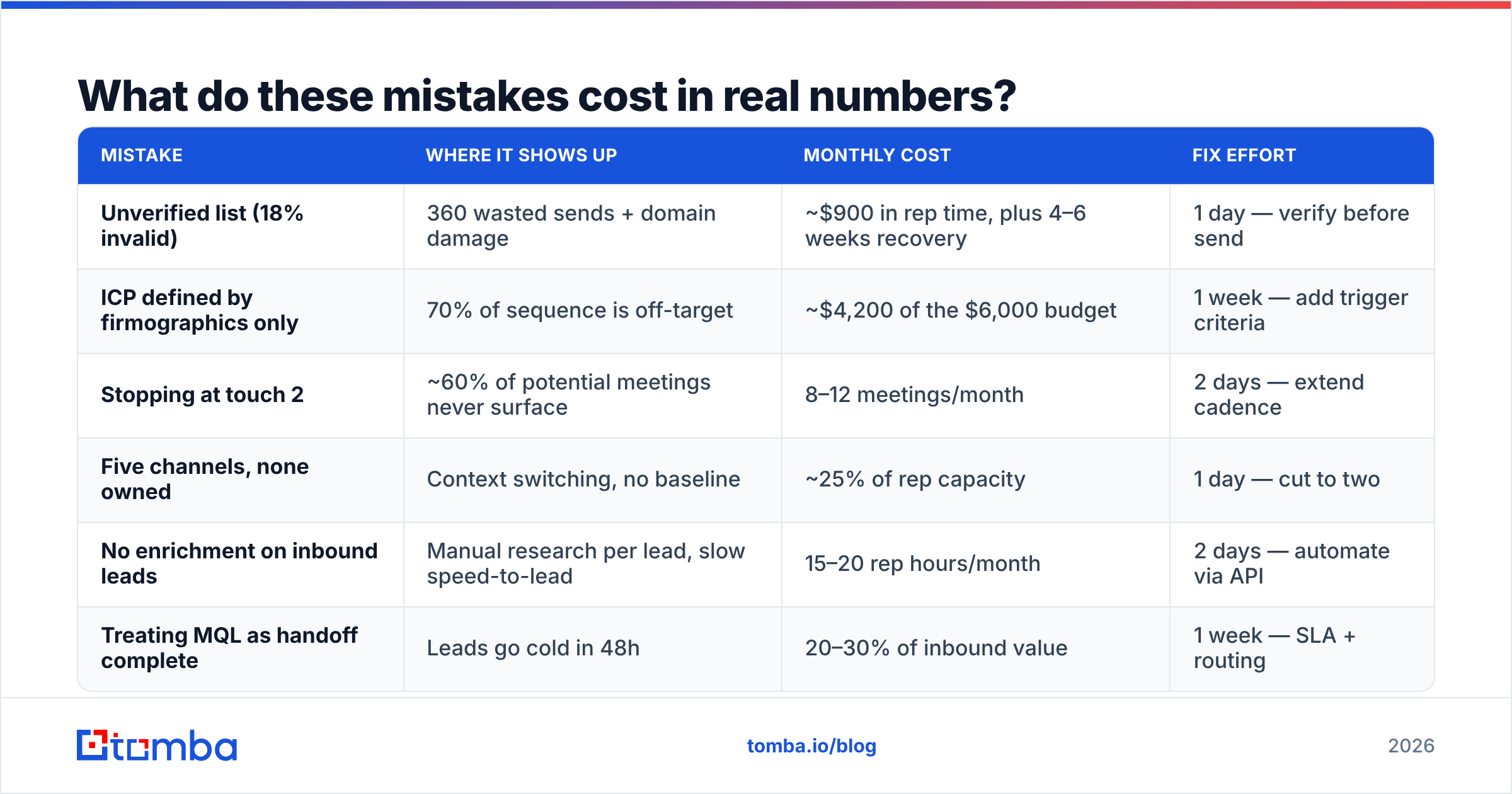
Model it with a team of three SDRs, a $6,000/month tooling and data budget, and a 2,000-contact monthly send volume.
| Mistake | Where it shows up | Monthly cost | Fix effort |
|---|---|---|---|
| Unverified list (18% invalid) | 360 wasted sends + domain damage | ~$900 in rep time, plus 4–6 weeks recovery | 1 day — verify before send |
| ICP defined by firmographics only | 70% of sequence is off-target | ~$4,200 of the $6,000 budget | 1 week — add trigger criteria |
| Stopping at touch 2 | ~60% of potential meetings never surface | 8–12 meetings/month | 2 days — extend cadence |
| Five channels, none owned | Context switching, no baseline | ~25% of rep capacity | 1 day — cut to two |
| No enrichment on inbound leads | Manual research per lead, slow speed-to-lead | 15–20 rep hours/month | 2 days — automate via API |
| Treating MQL as handoff complete | Leads go cold in 48h | 20–30% of inbound value | 1 week — SLA + routing |
The pattern in that table is the actionable part: the cheapest fixes (verification, cadence length, channel count) recover the most value. The expensive fixes are organizational, not technical.
How do you fix your lead gen process in 30 days?#
Week 1 — Audit the data, not the copy. Export your last 2,000 contacted records. Run them through verification and check what percentage was invalid at send time. If it's above 5%, you have a data problem, and nothing else you change this month will matter more.
Week 2 — Rewrite the ICP with a trigger. Take your current ICP definition and add one behavioral or timing signal. Hiring for a role your product supports. Recent funding. A specific technology in their stack. Rebuild your target list against the new definition using domain search to pull the right contacts at the accounts that qualify, rather than pulling everyone at accounts that vaguely fit.
Week 3 — Fix the cadence, not the message. Extend every sequence to at least six touches across two channels. Change nothing about the copy. Measure the delta. Most teams find that cadence length alone moves meetings booked more than three rounds of copy testing did.
Week 4 — Instrument one number per stage. Not a dashboard. One number: valid-send rate, reply rate, meeting-held rate, and opportunity rate. If you can't name all four from memory next Monday, you have too many metrics.
HubSpot's ongoing lead generation benchmarks are useful here as a sanity check — not because your numbers should match theirs, but because a metric that's off by an order of magnitude usually indicates a measurement bug rather than a performance gap.
What separates teams that fix this from teams that don't?#
The teams that fix it stop treating lead generation as a creative discipline and start treating it as an operations one.
That sounds deflating. It isn't. Creativity still matters enormously — in the offer, in the positioning, in the one line that makes a busy VP reply. But creativity applied to a list of 1,800 people who will never buy is expensive theater. Get the list right and average copy converts. Get the list wrong and excellent copy doesn't.
Practically, that means three standing habits:
- Verification is a pipeline step, not a cleanup task. It runs automatically, before every send, with no human deciding whether it's worth it this time.
- The ICP document gets revised quarterly based on closed-won data, not on what the founder believed 18 months ago.
- Every new channel earns its place by beating the baseline of the channel you already run, on the same list.
None of these require new headcount. All three are a decision plus an afternoon of setup.
Where should you start?#
Start with the addresses, because that's the one input every other fix depends on. An ICP you can't reach is a document. A sequence sent to invalid addresses is a domain-reputation problem in slow motion.
The Tomba Email Finder covers that layer directly: find professional email addresses by domain, name, or company, verify them before they enter your sequence, and enrich the record so your segmentation is based on something real. The free tier gives you 25 searches a month to test your own list quality before committing, and paid plans start at $49/month — full Tomba pricing is public, with Growth at $99/month and Pro at $249/month for teams running higher volume.
Run your last 500 contacted records through it this week. Whatever percentage comes back invalid is the size of the problem you've been calling a copy problem.
Related guides#
// get started
Find, verify and enrich your first contacts today
Start on the free plan with 25 searches a month, then scale when your team is ready.
Free plan · No credit card required · GDPR & CCPA
// about the author