Lead Generation Offers: 9 That Convert and 4 That Don't
Most lead generation offers collect email addresses nobody on your sales team wants to call. Here are the nine offer types that still produce pipeline in 2026, the four to retire, and how to price and test each one.
TL;DR
- A lead generation offer is the specific thing someone gets in exchange for their contact details. The offer — not the form, not the landing page copy — decides both your opt-in rate and your lead quality.
- High opt-in and high quality rarely come from the same offer. Checklists and templates convert at 30-50% but produce weak leads; audits, assessments, and pilots convert at 3-8% and produce leads a rep will actually call.
- Four offer types are effectively dead weight in 2026: the generic ebook, the "subscribe to our newsletter" CTA with no promise, the recorded-webinar replay wall, and the gated trend report.
- Gate based on effort-to-produce and buying intent, not on word count. If the asset took you two hours to make, it should not cost a prospect their email address.
- An offer only pays off if the data behind it survives contact. Verify, dedupe, and enrich every submission before it reaches a sequence.
What is a lead generation offer?#
A lead generation offer is the value exchange at the top of your funnel: you give something concrete, the prospect gives contact information and permission to follow up. Think of it like the sample counter at a grocery store. Nobody hands over their name for a stale cracker. They will for a taste of something they were already considering buying.
The mechanics are boring — a landing page, a form, a thank-you email. The offer itself is where all the leverage sits. Two teams running identical landing page tech, identical ad spend, and identical follow-up sequences can see a 10x difference in booked meetings purely because one offered a "2026 Industry Trends Report" and the other offered "We'll audit your checkout flow and send you a 6-minute Loom."
Three things separate an offer that produces pipeline from one that produces a list:
- Specificity. "Improve your marketing" is not an offer. "The exact 11-step onboarding sequence we use to cut day-30 churn" is.
- Proximity to the purchase decision. The closer the offer sits to the problem your product solves, the more qualified the person who raises their hand.
- Cost to fulfil. Offers that cost you something — time, analysis, a human — self-select for serious buyers. Offers that cost you nothing attract people who are paying you nothing back.
If you want the formal background on how this fits into demand generation as a discipline, Wikipedia's lead generation entry is a reasonable neutral primer, and HubSpot maintains a long-running practitioner guide at blog.hubspot.com/marketing/lead-generation.
Why do most lead generation offers fail?#
They optimise for the wrong number. Marketing gets measured on leads, so marketing builds the offer that produces the most leads. Sales gets measured on meetings, so sales ignores those leads. Six months later everyone is arguing about lead quality and nobody has changed the offer.
The failure pattern is consistent:
- The offer answers a question nobody urgent is asking. Trend reports are read by analysts and competitors, not buyers with a budget cycle.
- The offer has no natural next step. If the logical thing to do after reading your asset is "nothing," your follow-up email has to invent a reason to exist.
- The offer is gated at the wrong depth. Gating a 400-word checklist annoys people. Publishing your entire pricing methodology ungated gives away the reason to talk to you.
- The offer collects junk data. A form that accepts
a@a.comproduces a CRM full of bounces, which then destroys the sender reputation of the domain you use for every other campaign.
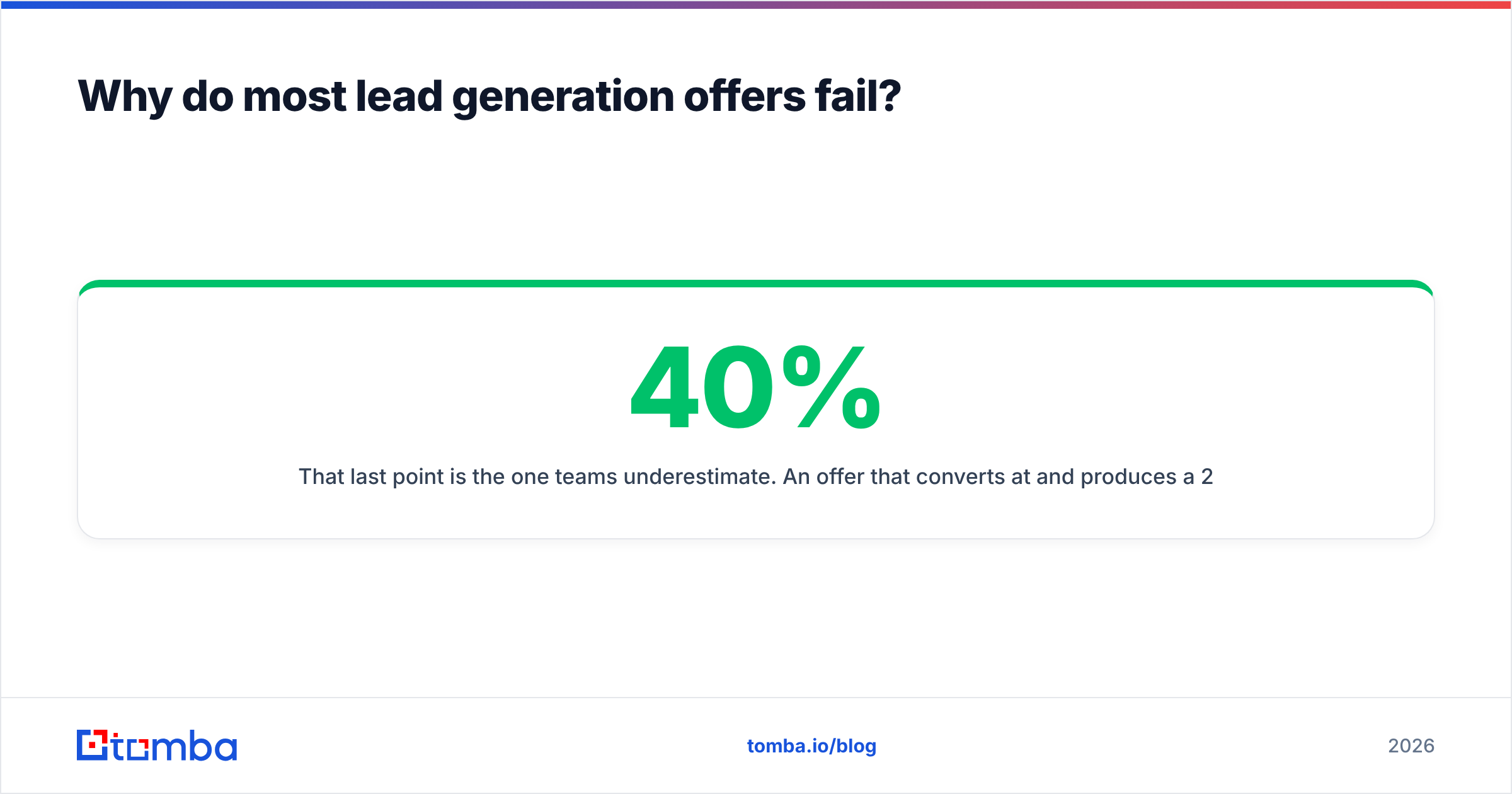
That last point is the one teams underestimate. An offer that converts at 40% and produces a 22% bounce rate is worse than an offer that converts at 6% and produces clean, reachable contacts — because the first one costs you deliverability across the whole domain.
Which lead generation offers convert best in 2026?#
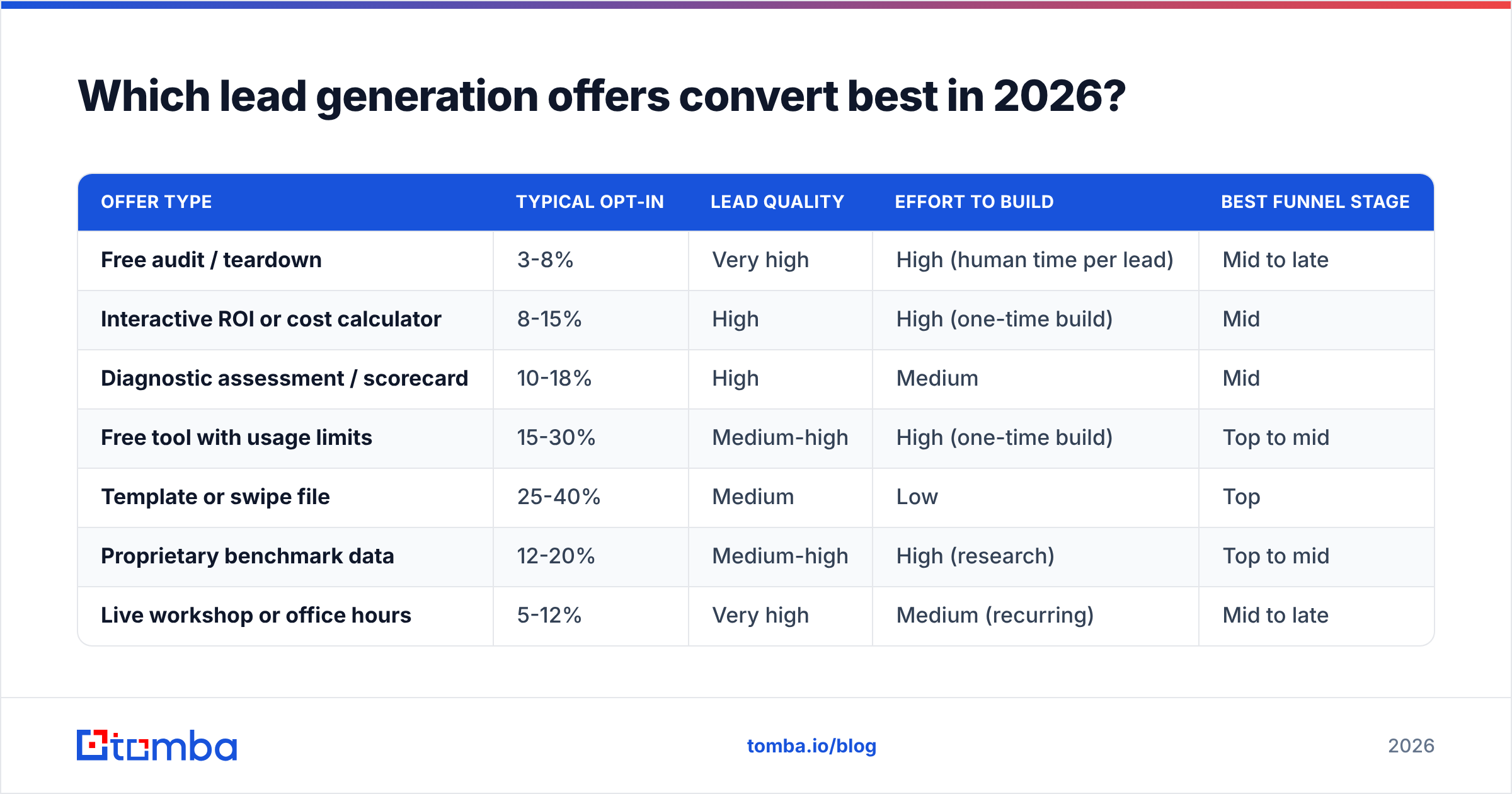
Here is the honest trade-off table. Opt-in ranges below reflect what teams typically report for cold-traffic landing pages; your numbers will move with traffic source and audience temperature, but the relative ordering holds almost everywhere.
| Offer type | Typical opt-in | Lead quality | Effort to build | Best funnel stage |
|---|---|---|---|---|
| Free audit / teardown | 3-8% | Very high | High (human time per lead) | Mid to late |
| Interactive ROI or cost calculator | 8-15% | High | High (one-time build) | Mid |
| Diagnostic assessment / scorecard | 10-18% | High | Medium | Mid |
| Free tool with usage limits | 15-30% | Medium-high | High (one-time build) | Top to mid |
| Template or swipe file | 25-40% | Medium | Low | Top |
| Proprietary benchmark data | 12-20% | Medium-high | High (research) | Top to mid |
| Live workshop or office hours | 5-12% | Very high | Medium (recurring) | Mid to late |
| Checklist or cheat sheet | 30-50% | Low-medium | Very low | Top |
| Curated database or list | 10-20% | Medium | Medium | Top to mid |
Read that table as two clusters rather than a ranking. The top cluster — audits, calculators, assessments, workshops — converts less traffic but converts it into people a rep can call today. The bottom cluster — checklists, templates, curated lists — fills the list fast and feeds nurture, not sales.
The best-performing programmes run one offer from each cluster simultaneously and route them differently. A checklist submission goes into a newsletter and a 90-day nurture. An audit request goes to a rep within the hour.
How do you match the offer to the funnel stage?#
Use effort symmetry: the amount of effort you ask the prospect to invest should rise as they move down the funnel, and so should the amount you invest back.
- Top of funnel — ask for an email, give a shortcut. Templates, checklists, swipe files, free micro-tools. The prospect spends 20 seconds. You spend nothing per lead. Judge these on volume and list growth, never on meetings.
- Early-mid funnel — ask for context, give a diagnosis. Assessments and scorecards that ask 6-10 questions before showing results. The extra friction filters out the merely curious and hands your reps a completed qualification form disguised as a quiz.
- Mid funnel — ask for their numbers, give an economic case. ROI and cost calculators. Anyone who types in their real headcount, deal size, or ad spend is modelling a purchase. Route these to sales even if they never request contact.
- Late funnel — ask for access, give human expertise. Audits, teardowns, architecture reviews, live office hours. Expensive to deliver, which is exactly why they work: the cost is the qualifier. Cap them at a number your team can actually fulfil without slipping past 48 hours.
- Post-demo — ask for a decision, give risk removal. Pilot programmes, migration assistance, sandbox environments with your data pre-loaded. Technically still an offer, and often the one that closes the deal.
A marketing qualified lead that came from step 1 and an MQL that came from step 3 should never be scored the same way. If your scoring model treats them identically, the model is the problem, not the offer.
Which lead generation offers should you retire?#
Four offer types have degraded to the point where they cost more than they return for most B2B teams:
- The generic ebook. A 30-page PDF assembled from blog posts. Download rates still look fine; read rates are in the single digits and meeting rates are near zero. If it can be summarised in a 600-word post, publish the post ungated and get the SEO instead.
- The bare newsletter CTA. "Subscribe for updates" promises nothing. Newsletters work — but only when the offer is a specific recurring thing ("one teardown of a real B2B checkout flow, every Tuesday"). The promise is the offer, not the newsletter.
- The gated webinar replay. Live attendance has real value because live attendance costs the prospect time. A recording behind a form is an ebook with worse UX. Publish the replay, gate the slides plus the Q&A transcript if you must gate something.
- The gated trend report. Unless the data is genuinely proprietary — your own platform's aggregate numbers, a survey you funded — a trend report is a summary of things your prospect already read on LinkedIn.
Notice what all four share: zero marginal cost to deliver, zero personalisation, and no natural reason for a follow-up conversation. That combination is what separates a dud from a workhorse.
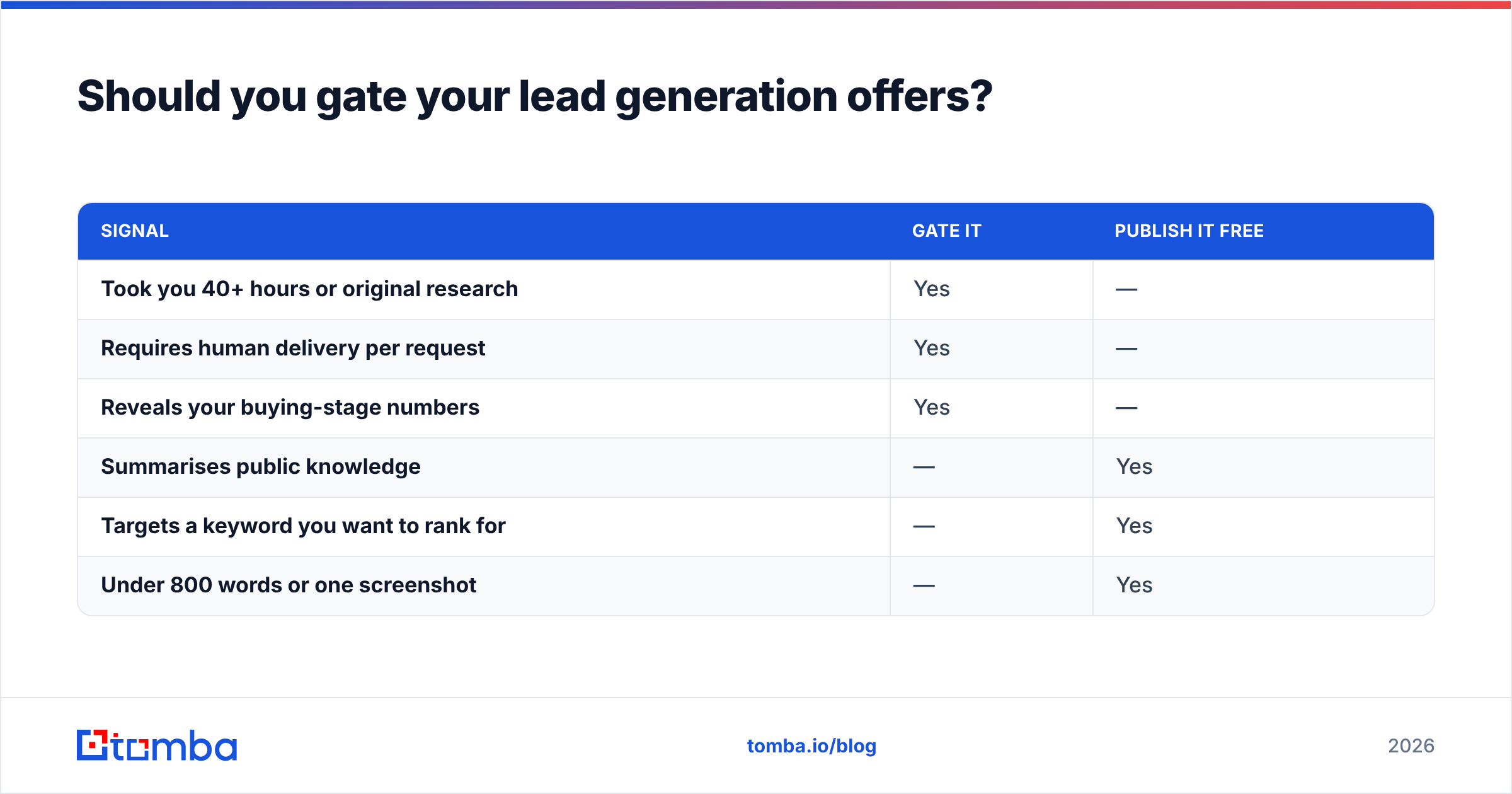
Should you gate your lead generation offers?#
Gate on production cost and intent signal, not on length.
| Signal | Gate it | Publish it free |
|---|---|---|
| Took you 40+ hours or original research | Yes | — |
| Requires human delivery per request | Yes | — |
| Reveals your buying-stage numbers | Yes | — |
| Summarises public knowledge | — | Yes |
| Targets a keyword you want to rank for | — | Yes |
| Under 800 words or one screenshot | — | Yes |
The hybrid pattern beats both extremes: publish the asset openly, then gate the operational layer — the editable spreadsheet, the Notion template, the raw dataset, the calculator that runs your numbers. You capture the SEO value and the leads, and the people who convert are the ones who intend to act.
One caveat worth stating plainly: ungating lowers lead volume immediately and raises organic traffic slowly. If your board reviews MQL counts monthly, make the change at the start of a quarter and set expectations first.
How do you keep the leads an offer collects usable?#
An offer is only as good as the data it deposits in your CRM. Three habits separate teams whose offers compound from teams whose lists rot:
- Verify at the point of capture. Reject role addresses, disposable domains, and syntax failures before the record is created. A real-time email verifier check on form submit costs milliseconds and saves months of deliverability damage.
- Enrich immediately, not at campaign time. Company size, industry, tech stack, and seniority determine routing. Running data enrichment at submission means your routing rules fire while the prospect still remembers who you are.
- Close the gap when the form lies. A meaningful share of B2B form fills use personal addresses. If the record includes a company domain or a LinkedIn URL, an email finder can resolve the work address so the follow-up lands in the inbox the buying decision actually happens in.
G2's lead capture category is a useful place to compare the form and capture layer itself; the verification and enrichment layer behind it is what most teams skip, and it is where the measurable losses occur.
How do you test a new lead generation offer in 30 days?#
Do not build the calculator first. Test the promise before you build the thing.
Week 1 — Fake the door. Put up a landing page describing the offer, drive 300-500 clicks from an existing channel, and measure opt-in. If nobody converts on the promise, the asset would not have saved it.
Week 2 — Deliver manually. Fulfil the first 20 signups by hand, even if the "product" is you in a spreadsheet for two hours per lead. You will learn what people actually want from the offer, which is never what you assumed.
Week 3 — Measure the right metric. Not downloads. Track: opt-in rate, verified-contact rate, reply rate to the follow-up email, and meetings booked per 100 submissions. That last number is the only one that matters at review time.
Week 4 — Decide. Under 1 meeting per 100 submissions at the top of funnel, or under 5 per 100 at the mid funnel, and the offer is a nurture asset, not a pipeline asset. Keep it, but stop reporting it as demand generation.
Run this loop on two offers at once — one high-volume, one high-intent — and you will have a defensible offer stack in a quarter instead of a year.
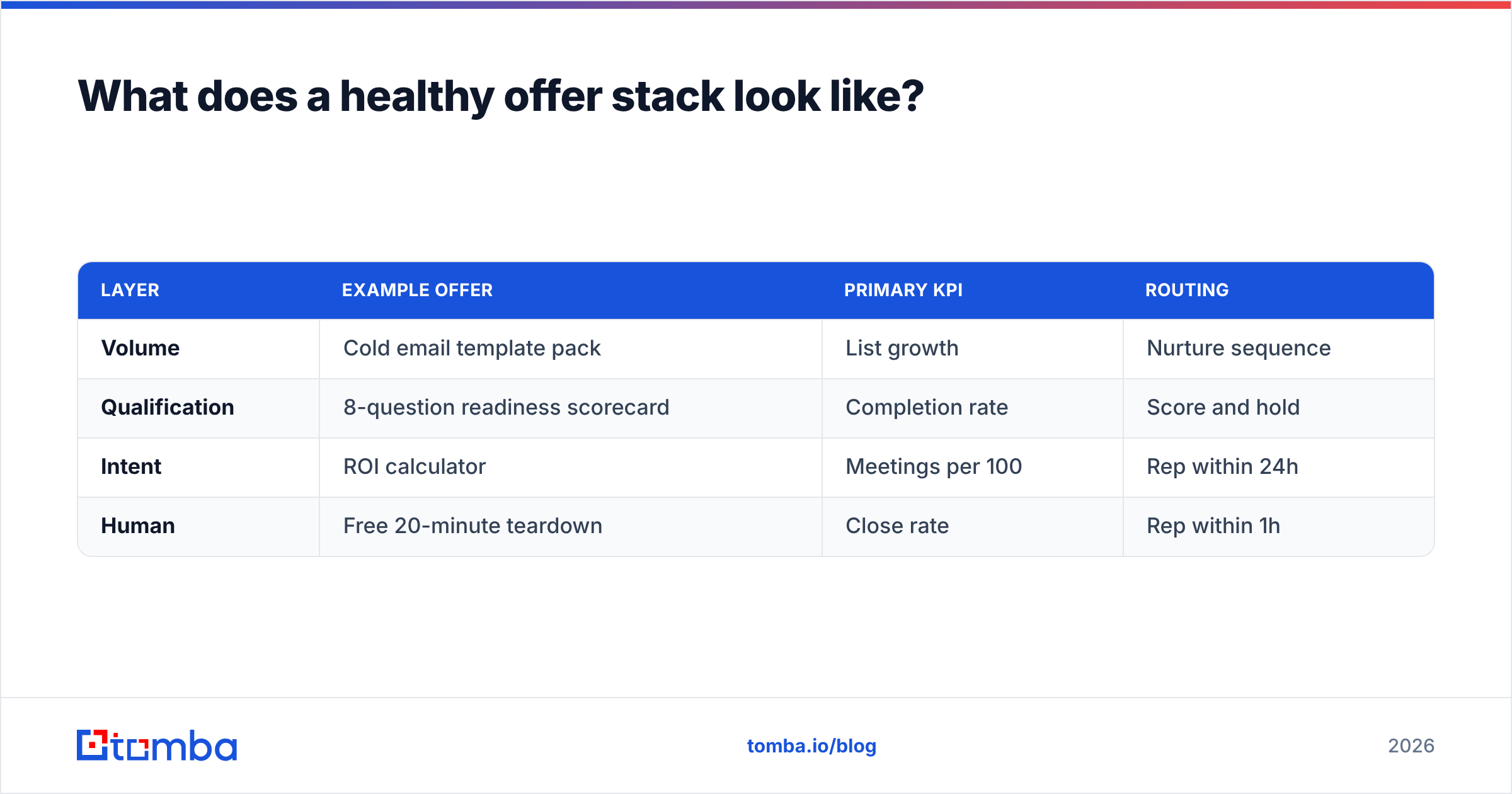
What does a healthy offer stack look like?#
| Layer | Example offer | Primary KPI | Routing |
|---|---|---|---|
| Volume | Cold email template pack | List growth | Nurture sequence |
| Qualification | 8-question readiness scorecard | Completion rate | Score and hold |
| Intent | ROI calculator | Meetings per 100 | Rep within 24h |
| Human | Free 20-minute teardown | Close rate | Rep within 1h |
Four offers. One per layer. Each one measured on its own KPI instead of a shared "leads" number that flatters the weakest asset and punishes the strongest.
Where to start#
Pick the highest-intent offer you can staff this month — usually an audit or a calculator — and put it behind a form that verifies and enriches every submission before a rep sees it. That single change tends to move meetings-per-100 more than any landing page redesign will.
When those forms come back with a personal Gmail address instead of a work one, or with a company name and no contact at all, the Tomba Email Finder resolves the professional address so your follow-up reaches the inbox where the decision gets made. Start on the free tier with 25 searches a month, and check Tomba pricing when your offer starts producing more leads than your list can keep clean.
Related guides#
// get started
Find, verify and enrich your first contacts today
Start on the free plan with 25 searches a month, then scale when your team is ready.
Free plan · No credit card required · GDPR & CCPA
// about the author