Lead Generation Outsourcing: Costs, Risks, and When It Works
Outsourced SDRs can cut your cost per meeting in half — or quietly burn $60k on a shared list nobody verified. Here is the real 2026 pricing, the contract traps, and the break-even math that tells you whether to rent or build.
TL;DR
- Lead generation outsourcing works when you have a proven ICP, a closer with capacity, and a repeatable offer. It fails when you outsource discovery — no agency can find your market for you.
- Realistic 2026 pricing: $3,000–$8,000/mo retainer for appointment setting, $150–$500 per qualified meeting on pay-per-lead, $6,000–$15,000/mo for a full managed outbound pod.
- The hidden cost is data. Most agencies resell the same scraped lists to three clients in your category. Owning your own verified contact layer is cheaper than any agency's "data included" line item.
- Break-even usually lands around 8–12 qualified meetings per month. Below that, an agency is cheaper than a hire. Above that, in-house plus tooling wins on cost and on learning.
- The hybrid model beats both extremes: outsource the labor, keep the data, the domains, the messaging, and the CRM.
What Is Lead Generation Outsourcing, Exactly?#
Lead generation outsourcing means paying an external team to do some or all of the work that fills your pipeline — list building, cold email, cold calling, LinkedIn outreach, booking meetings — instead of hiring internal SDRs.
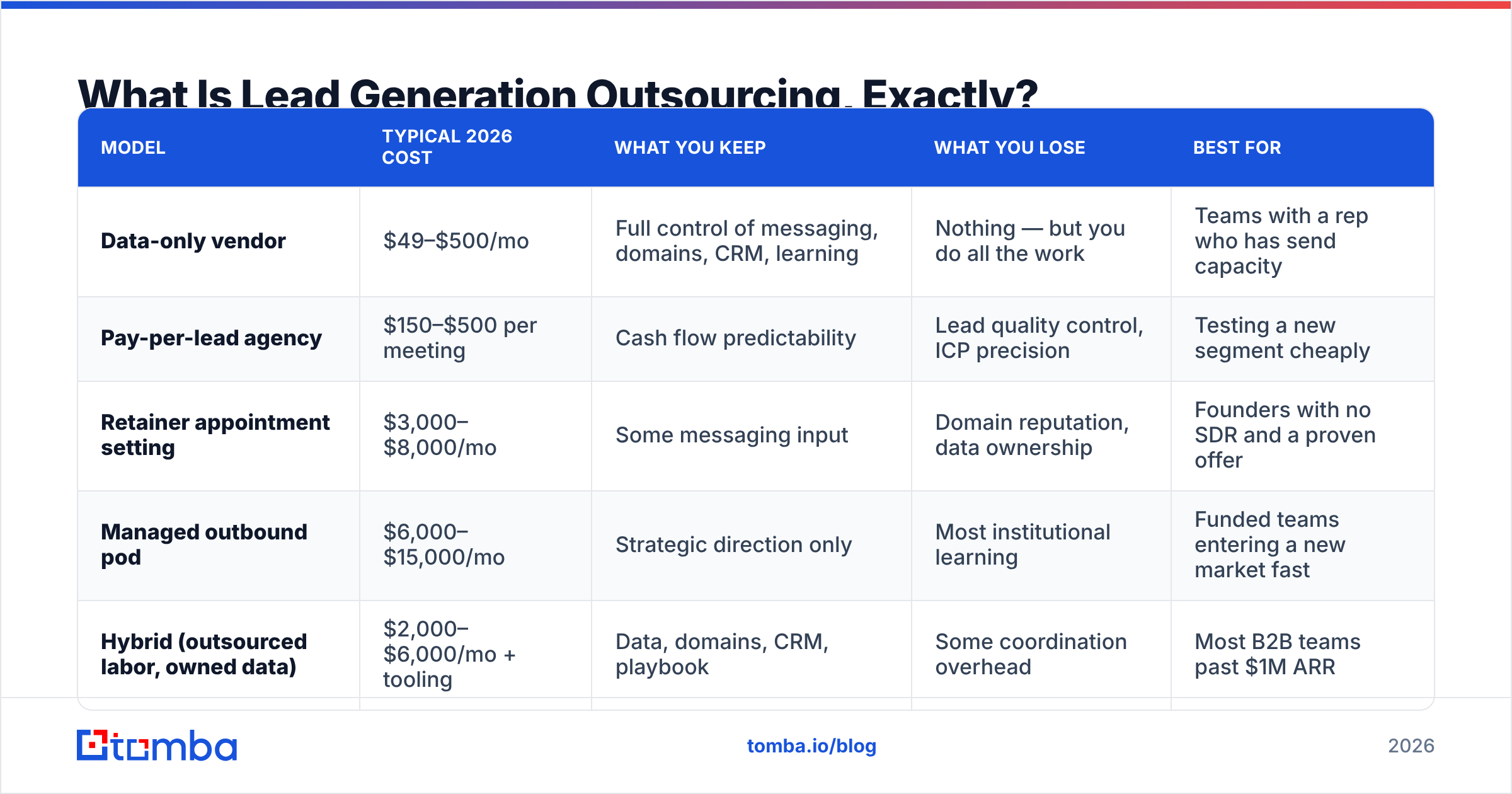
The confusion starts because "outsourcing" covers four very different products sold under one label. A $4,000/mo appointment-setting retainer and a $40,000/mo managed revenue pod are not the same purchase, and the failure modes are completely different.
Think of it like a restaurant kitchen. You can hire line cooks (in-house SDRs), order prepped ingredients (data vendors), bring in a catering company for one event (project-based agency), or franchise the whole kitchen to someone else (managed outbound). Each one trades control for speed at a different exchange rate.
Here's how the four models actually compare:
| Model | Typical 2026 cost | What you keep | What you lose | Best for |
|---|---|---|---|---|
| Data-only vendor | $49–$500/mo | Full control of messaging, domains, CRM, learning | Nothing — but you do all the work | Teams with a rep who has send capacity |
| Pay-per-lead agency | $150–$500 per meeting | Cash flow predictability | Lead quality control, ICP precision | Testing a new segment cheaply |
| Retainer appointment setting | $3,000–$8,000/mo | Some messaging input | Domain reputation, data ownership | Founders with no SDR and a proven offer |
| Managed outbound pod | $6,000–$15,000/mo | Strategic direction only | Most institutional learning | Funded teams entering a new market fast |
| Hybrid (outsourced labor, owned data) | $2,000–$6,000/mo + tooling | Data, domains, CRM, playbook | Some coordination overhead | Most B2B teams past $1M ARR |
Notice the pattern. Cost scales with how much thinking you hand over — and thinking is exactly the part you should keep.
Why Do Most Companies Outsource Lead Generation?#
Four honest reasons, in the order people actually say them out loud:
- Speed. Hiring an SDR takes 6–10 weeks to source and another 8–12 weeks to ramp. An agency is sending in 14 days. When you have a board meeting in a quarter, that gap is the whole argument.
- Fixed cost instead of headcount risk. A US SDR at $65k base plus $25k variable plus tooling and management overhead lands near $110k fully loaded. A $5k/mo retainer is $60k a year and cancellable in 30 days.
- Nobody in-house knows how to do outbound anymore. Deliverability rules tightened hard after Google and Yahoo's bulk sender requirements, and a lot of marketing teams quietly stopped sending cold. Agencies kept the muscle.
- The founder is doing it and hates it. This is the real reason more often than anyone admits.
All four are legitimate. None of them survive if your ICP is fuzzy. An agency will happily book meetings with anyone who says yes, and "anyone who says yes" is a very expensive definition of a lead.

What Does Lead Generation Outsourcing Actually Cost in 2026?#
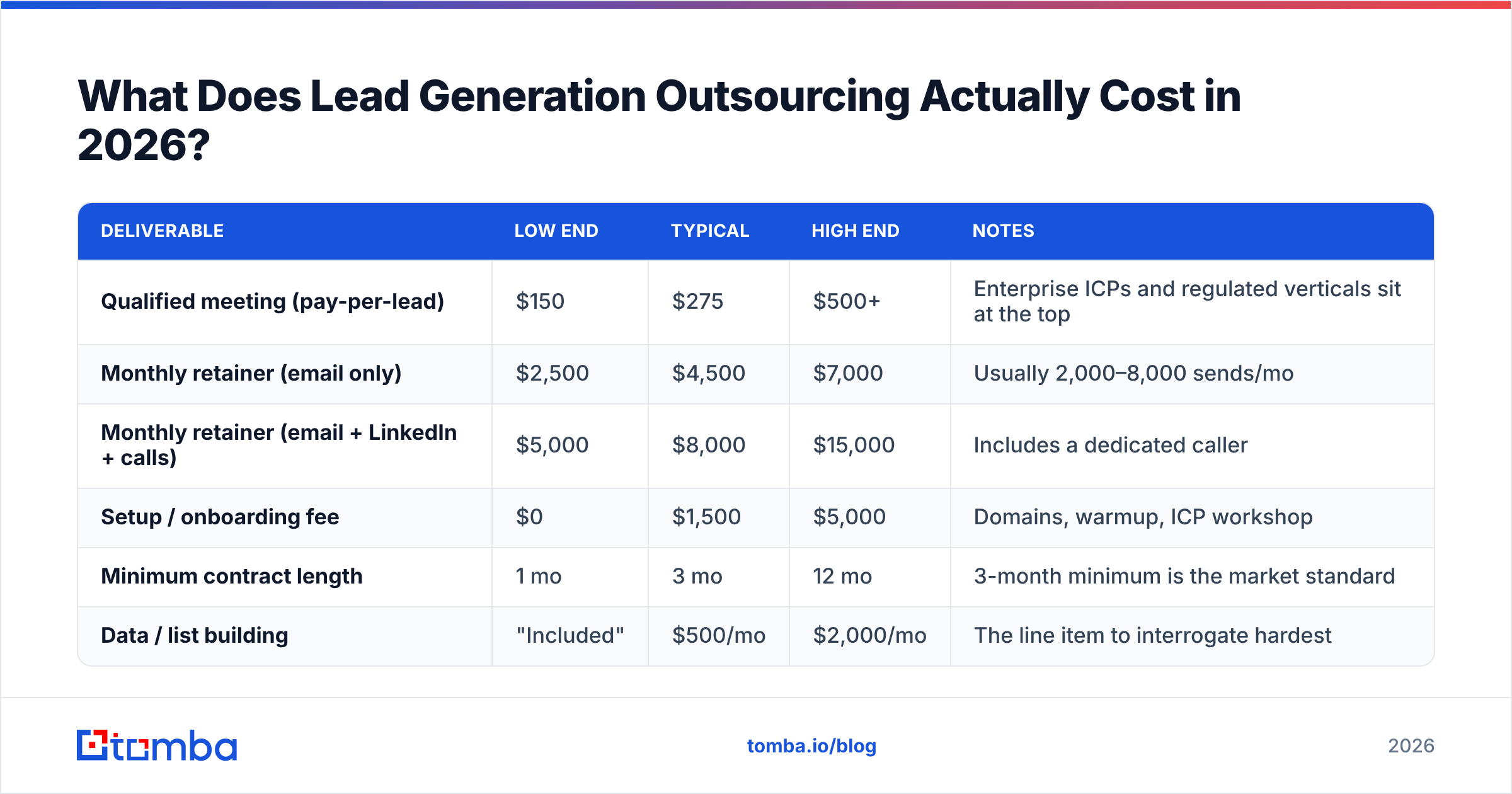
Published pricing is rare, so here's the working range from deals we see quoted across the B2B market. Treat it as a negotiating baseline, not gospel.
| Deliverable | Low end | Typical | High end | Notes |
|---|---|---|---|---|
| Qualified meeting (pay-per-lead) | $150 | $275 | $500+ | Enterprise ICPs and regulated verticals sit at the top |
| Monthly retainer (email only) | $2,500 | $4,500 | $7,000 | Usually 2,000–8,000 sends/mo |
| Monthly retainer (email + LinkedIn + calls) | $5,000 | $8,000 | $15,000 | Includes a dedicated caller |
| Setup / onboarding fee | $0 | $1,500 | $5,000 | Domains, warmup, ICP workshop |
| Minimum contract length | 1 mo | 3 mo | 12 mo | 3-month minimum is the market standard |
| Data / list building | "Included" | $500/mo | $2,000/mo | The line item to interrogate hardest |
Two numbers matter more than the headline price.
Cost per qualified meeting (CPQM). Take total spend, divide by meetings that actually happened and met your qualification bar — not meetings booked. No-shows run 20–35% on outsourced booking. If an agency quotes $250/meeting and 30% ghost, your real CPQM is $357.
Cost per closed deal. If you close 20% of qualified meetings, a $357 CPQM means $1,785 in acquisition cost before your AE's time. Compare that to your ACV before you sign anything. If you sell a $4,000 annual contract, the math is already broken.
Is Outsourcing Cheaper Than Hiring an SDR?#
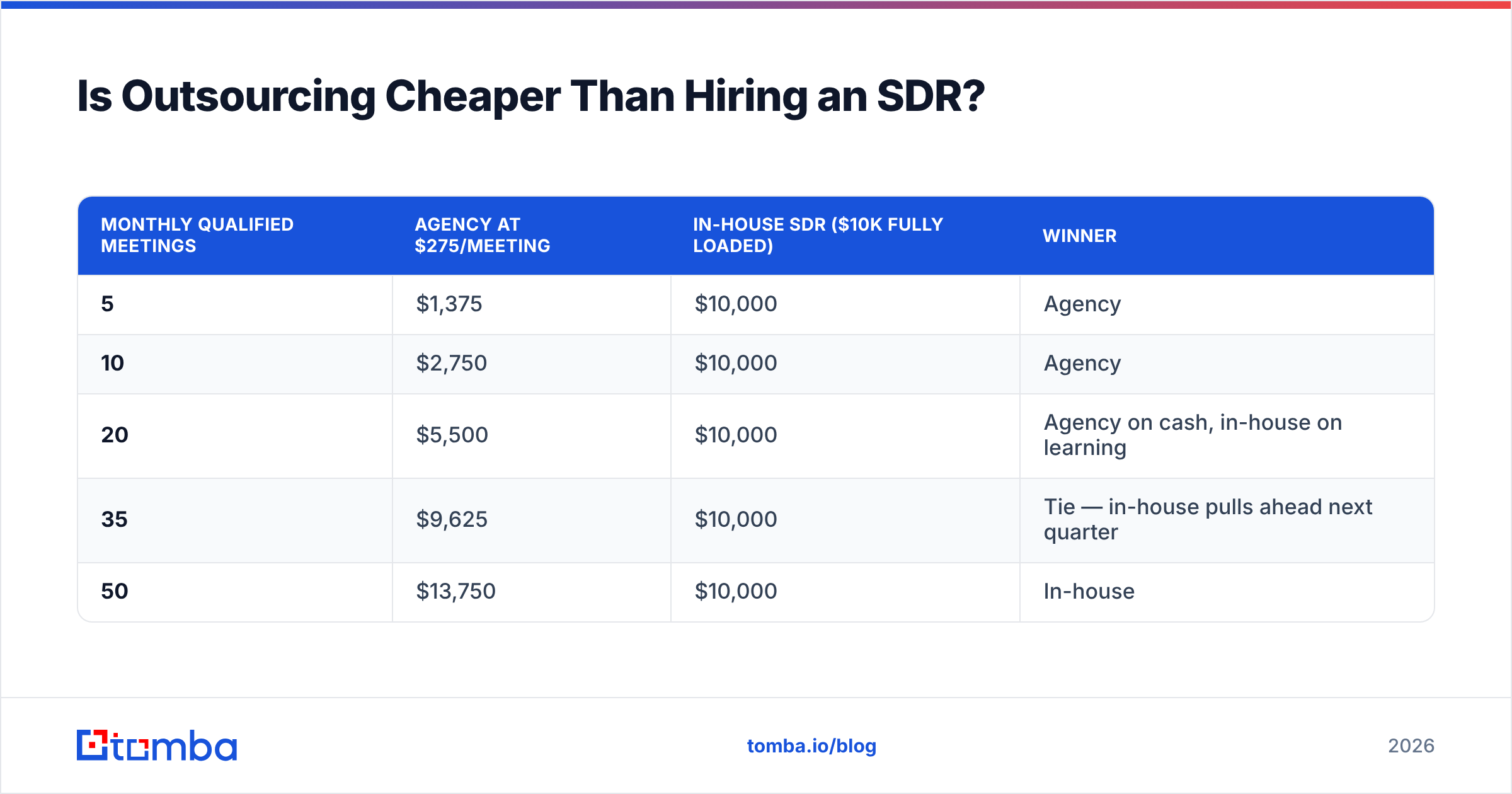
Below roughly 10 qualified meetings a month, yes. Above it, usually no.
A fully loaded US SDR costs around $9,000–$11,000/mo. If that rep books 15 qualified meetings a month at full ramp, your CPQM is about $650 — worse than most agencies on paper. But the SDR also generates something an agency never hands you: compounding institutional knowledge. Every objection, every dead vertical, every subject line that flopped stays inside your company.
The break-even table:
| Monthly qualified meetings | Agency at $275/meeting | In-house SDR ($10k fully loaded) | Winner |
|---|---|---|---|
| 5 | $1,375 | $10,000 | Agency |
| 10 | $2,750 | $10,000 | Agency |
| 20 | $5,500 | $10,000 | Agency on cash, in-house on learning |
| 35 | $9,625 | $10,000 | Tie — in-house pulls ahead next quarter |
| 50 | $13,750 | $10,000 | In-house |
Volume is only half the picture. The other half is whether your market is findable. If your ICP is "SaaS companies with 50–200 employees using Segment," a rep with the right tooling can build that list in an afternoon. If your ICP is "hospital procurement leads who attended HIMSS," you're paying for relationships, and an agency with those relationships is worth the premium.
What Goes Wrong When You Outsource Lead Generation?#
Six failure modes, ranked by how much money they cost:
- Shared lists. The agency sells to twelve SaaS companies in your category and pulls from the same scraped database for all of them. Your prospect got four near-identical emails last quarter. Ask directly: "Is my list exclusive to me, and can I export it?" If the answer has more than one clause, assume no.
- Your domain gets burned. Some agencies send from your primary domain to "improve reply rates." One bad campaign and your invoices start landing in spam. Insist on separate sending domains, and check email deliverability reporting weekly, not monthly.
- Bounce rates nobody discloses. Unverified lists bounce at 8–15%. Anything above 3% damages sender reputation quickly. Contract a hard bounce ceiling with a credit remedy.
- Meeting-quality drift. Month one is great. Month four, the agency is scraping the bottom of the ICP to hit the number. Define "qualified" in writing — title, company size, budget signal — and audit against it.
- You learn nothing. Twelve months and $80k later you cancel, and your team knows exactly as much about your market as the day you started. This is the single biggest hidden cost.
- No CRM hygiene. Leads arrive as a spreadsheet, get pasted into HubSpot with mismatched fields, and duplicate half your existing accounts. Insist on direct CRM sync from day one.
The HubSpot sales research on outbound response rates is worth reading before you sign — it's a useful sanity check on any agency promising reply rates north of 8%.
What Should Stay In-House No Matter What?#
Four things. Protect them in the contract:
- Your data. Contacts you pay to have discovered should be exportable, in your CRM, under your ownership. An agency that won't export your list is renting you your own customers.
- Your domains. Separate sending domains, registered by you, pointed at inboxes you control. When the engagement ends, the reputation you built stays with you.
- Your positioning. Agencies write in a house voice because it scales across clients. Your differentiation is the thing that voice flattens. Write the first draft yourself.
- Your CRM as the source of truth. Not the agency's dashboard. Not a shared Google Sheet.
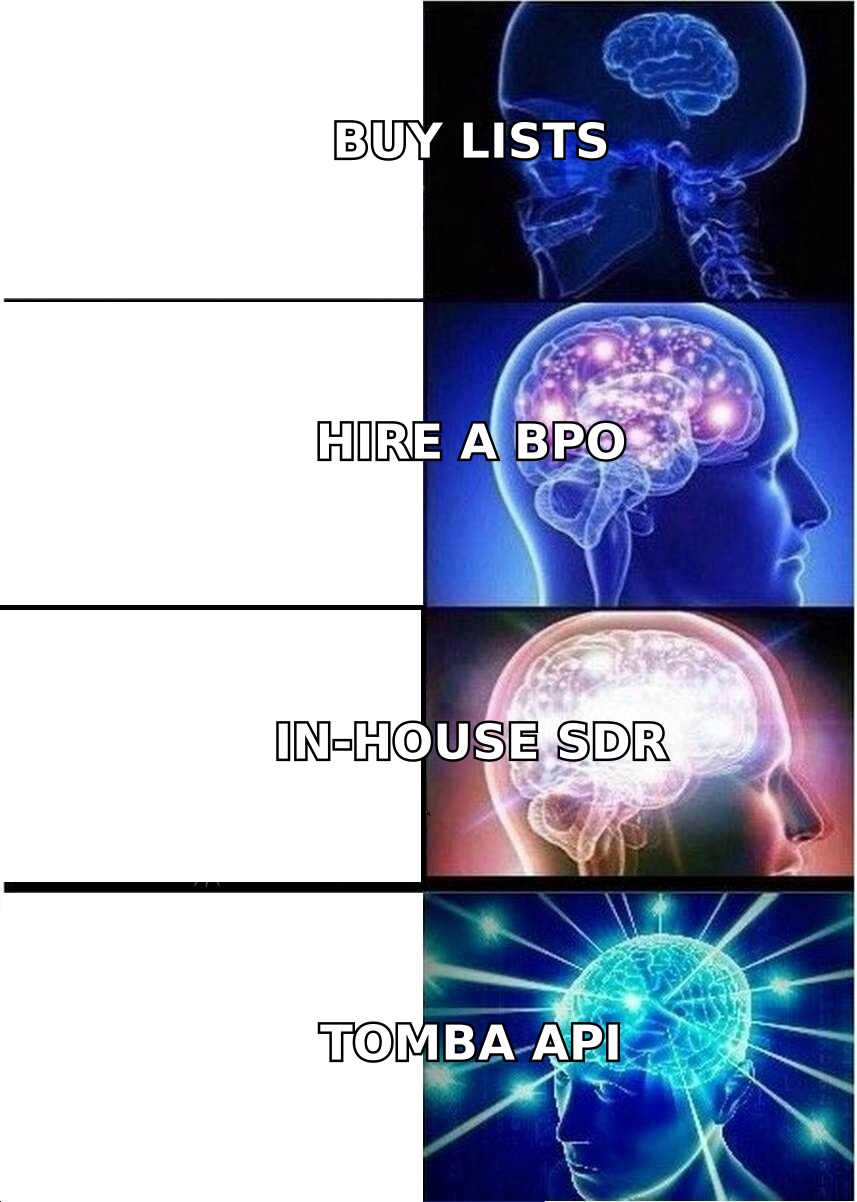
The cheapest way to hold all four is to own the contact layer directly. Instead of paying a "data included" premium, run your own domain search to build the account list, verify it, and hand the agency a clean file they can dial and send against. You've now converted the most opaque line item on the invoice into a fixed, auditable cost.
How Do You Vet a Lead Generation Agency?#
Ten questions. The answers to 3, 6, and 9 tell you almost everything.
- Who are your three most similar clients, and can I talk to one from the last six months?
- What's your average CPQM across clients in my ACV band?
- Is my list exclusive, and can I export it at any time?
- What's your no-show rate, and how is it handled commercially?
- Which domains will you send from, and who owns them?
- What's your average hard bounce rate, and what verification step produces it?
- How is "qualified" defined in my contract, and what's the dispute process?
- Who exactly works on my account, and how many other accounts do they carry?
- What do I keep on day one after cancellation?
- What's the notice period, and is there a performance-based exit?
Check reviews on G2 before the first call — not for the star rating, which is gameable, but for the pattern in one- and two-star reviews. Agencies fail in consistent ways, and the negative reviews will tell you which way this one fails.
For the data side of the conversation, know your alternatives. Established B2B data providers like BookYourData sell verified contact lists directly, which gives you a clean benchmark for what the agency's "data included" line should actually cost. If their number is materially higher than sourcing it yourself, you've found negotiating room.
What Does the Hybrid Model Look Like in Practice?#
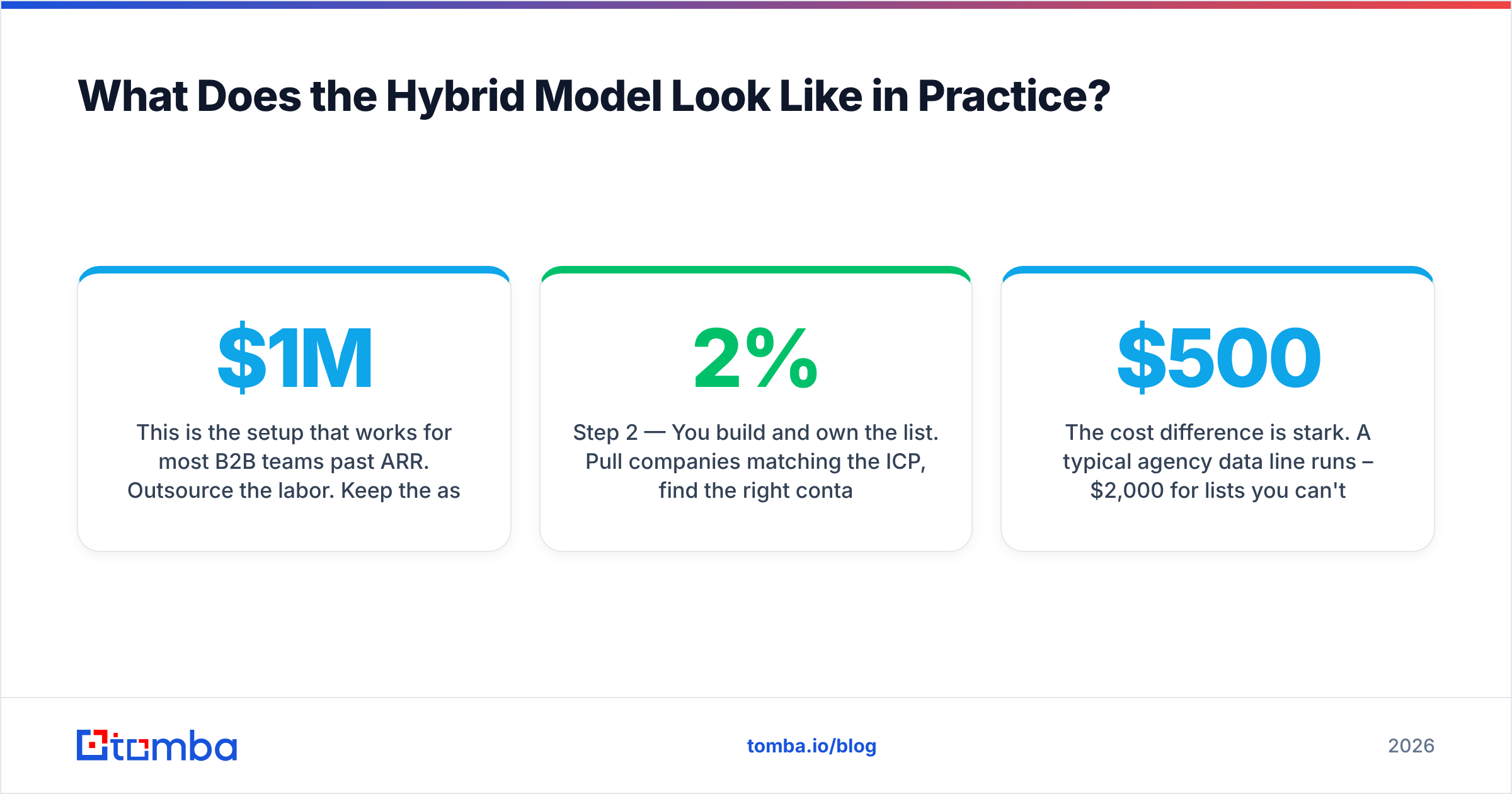
This is the setup that works for most B2B teams past $1M ARR. Outsource the labor. Keep the asset.
Step 1 — You define the ICP. Firmographics, technographics, trigger events. Written down, not implied.
Step 2 — You build and own the list. Pull companies matching the ICP, find the right contacts by role, and verify every address before it reaches anyone's sequencer. A verified list at 1–2% bounce protects every domain downstream.
Step 3 — You enrich it. Titles, headcount, tech stack, direct dials. Data enrichment at this stage is what lets an outsourced caller personalize without guessing.
Step 4 — The agency executes. They send, they call, they follow up, they book. They work from your file, on your dedicated domains, into your CRM.
Step 5 — You own the feedback loop. Reply data, objection patterns, and segment performance come back to your team. Next quarter's list is better because of what this quarter taught you — whether or not you renew the contract.
Step 6 — You audit monthly. CPQM, no-show rate, bounce rate, qualification accuracy. Four numbers, one dashboard, thirty minutes.
The cost difference is stark. A typical agency data line runs $500–$2,000/mo for lists you can't export. Running it yourself on Tomba pricing starts free at 25 searches/mo, with the Starter plan at $49/mo and Growth at $99/mo covering most small outbound programs outright. You're not just saving money — you're converting a rented input into an owned asset.
For teams building large lists at once, a bulk email finder run once a month usually replaces the entire list-building portion of an agency scope.
When Should You Not Outsource At All?#
Skip outsourcing entirely if any of these are true:
- You haven't closed 10 deals yourself. You don't know your objections yet. No agency will find them for you.
- Your ACV is under $3,000 annually. The CPQM math almost never clears.
- Your buyer is genuinely rare — under ~2,000 accounts worldwide. That's a named-account motion run by a human who knows the space, not a volume play.
- You have no capacity to take the meetings. Booked meetings that nobody runs well are the most expensive thing you can buy.
- Your product is mid-pivot. Outbound at scale against a message you're about to change is just paying to burn a market.
In every one of those cases, the better move is a single competent rep with good tooling, working a tight list. Cheaper, faster to correct, and the learning stays with you.
The Bottom Line#
Lead generation outsourcing is a labor decision, not a strategy decision. Rent the dialing, the sending, and the follow-up when you're short on hours. Never rent the ICP, the data, or the messaging — those are the parts that compound.
Start with the asset you'll keep regardless of which agency you sign. Build your target list, find verified contacts by role and domain, and hand your outbound team a file that bounces under 2% instead of one they scraped in a hurry. The Tomba Email Finder does exactly that — search by domain, name, or company, verify before you send, and export straight into your CRM. Free tier is 25 searches a month, which is enough to price-check any agency's data line before you sign their contract.
Related guides#
Ready to find emails that actually work?
Join 150,000+ professionals who stopped guessing and started sending. Free credits on signup — no credit card required.
Get the Tomba newsletter
Practical outbound tactics and product updates — once every two weeks.
About the author