Lead Generation Outsourcing vs In House: 2026 Cost Breakdown
Agencies quote $4,000/mo. An in-house SDR costs $91,000/year fully loaded. We break down the real math, the break-even point, and which model wins at your stage.
TL;DR
- A fully loaded in-house SDR costs roughly $85,000–$105,000/year in the US once you add base, commission, payroll tax, benefits, tooling, and management overhead — not the $55,000 base salary on the job posting.
- A mid-market outsourced lead gen agency runs $3,500–$8,000/month on retainer, often plus per-meeting fees. That's $42,000–$96,000/year for a fractional slice of two or three people's attention.
- Outsourcing wins when you don't yet know your ICP well enough to justify a hire, when you need to test a new market fast, or when you're under 10 reps and can't afford a dedicated SDR manager.
- In-house wins once you have a repeatable motion, a message that converts, and enough volume that the per-meeting cost of an agency exceeds the per-meeting cost of payroll.
- The model that actually beats both in 2026 is hybrid: one or two in-house reps owning the message and the relationships, sitting on top of a data + automation stack you own outright rather than renting through an agency.
What does "lead generation outsourcing vs in house" actually mean in 2026?#
The question used to be simple: hire people or rent people. It isn't anymore.
Three things changed. First, the data layer got unbundled — you can now buy contact data, enrichment, and verification directly for a few hundred dollars a month instead of inheriting whatever list an agency scraped. Second, sequencing and AI-assisted personalization collapsed the labor cost of sending volume. Third, deliverability got strict enough (Google and Yahoo's bulk-sender rules, then the 2025 tightening) that the bottleneck moved from "can you send" to "should you send this to this person."
That reshuffles the math. The old agency pitch was "we have the list and the sending infrastructure." Both are now commodities you can own. What an agency still sells that's genuinely hard to replicate is speed to first meeting and pattern-matched judgment across dozens of similar accounts.
So the real choice in 2026 is not labor-vs-labor. It's:
- Rent the whole function — agency owns list, copy, sending, and booking. You get calendar invites and a monthly report.
- Rent the labor, own the stack — offshore or fractional SDRs working inside your tools, your data, your domains.
- Own the labor, rent the stack — in-house reps using bought data and sequencing tools.
- Own both — full in-house team with a data engineer or RevOps person maintaining sources.
- Hybrid — one in-house owner of message and ICP, plus an agency or contractor for top-of-funnel volume in a segment you're testing.
Most companies under $10M ARR should be choosing between options 1, 3, and 5. Options 2 and 4 make sense at scale or in highly technical categories.
What does an in-house SDR really cost?#
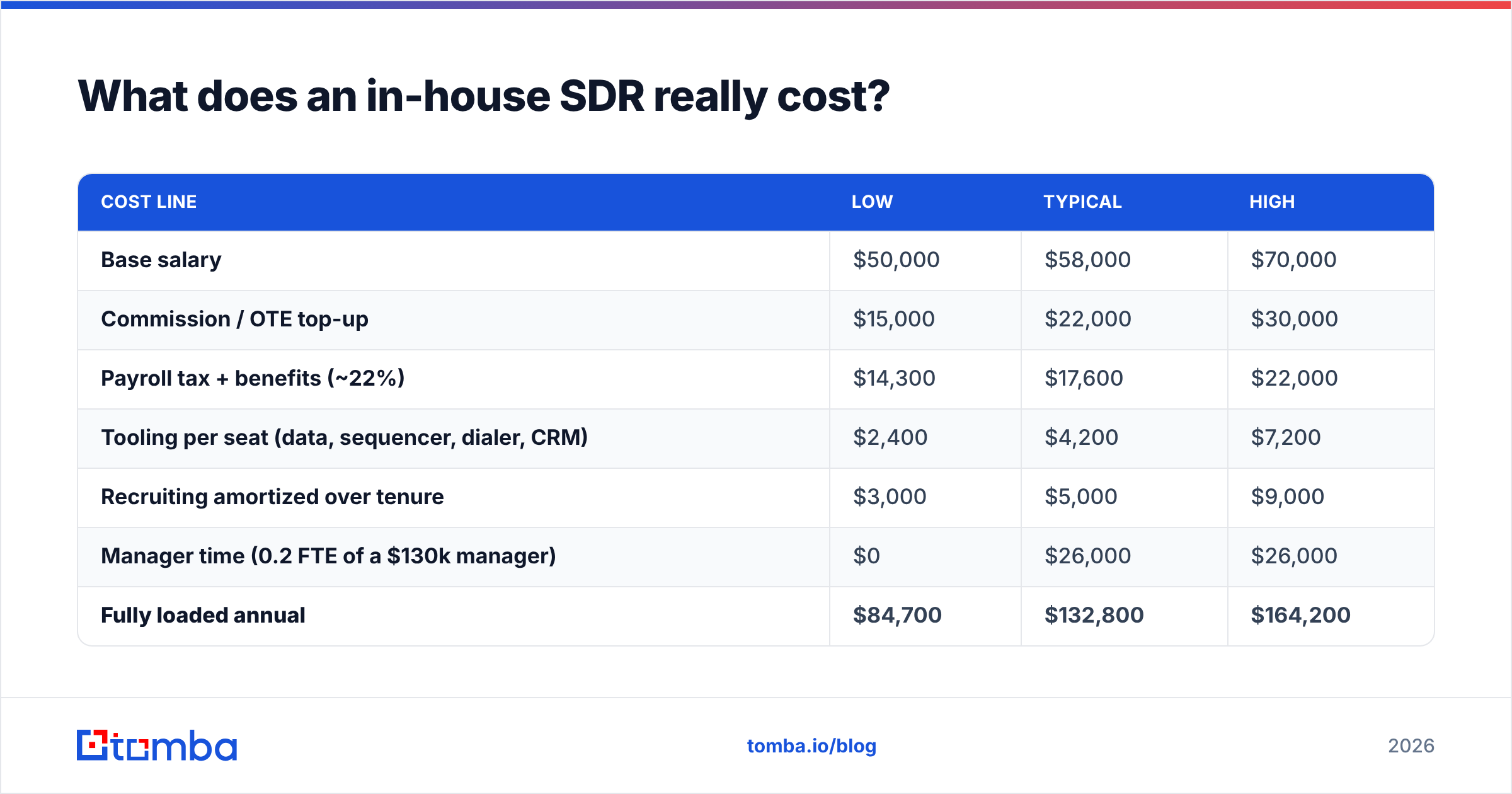
The number on the job posting is not the number. Here's the honest stack for a single US-based SDR in 2026:
| Cost line | Low | Typical | High |
|---|---|---|---|
| Base salary | $50,000 | $58,000 | $70,000 |
| Commission / OTE top-up | $15,000 | $22,000 | $30,000 |
| Payroll tax + benefits (~22%) | $14,300 | $17,600 | $22,000 |
| Tooling per seat (data, sequencer, dialer, CRM) | $2,400 | $4,200 | $7,200 |
| Recruiting amortized over tenure | $3,000 | $5,000 | $9,000 |
| Manager time (0.2 FTE of a $130k manager) | $0 | $26,000 | $26,000 |
| Fully loaded annual | $84,700 | $132,800 | $164,200 |
Two things people get wrong here.
The first is manager overhead. If you hire one SDR and a founder manages them, that cost is real even though it never appears on a P&L line — it's founder hours that stop going to product or closing. If you hire three or more, you eventually need an actual SDR manager, and that's a $110,000–$150,000 role. The economics of in-house only work when you can amortize that manager across four to eight reps.
The second is ramp. Industry data from sources like HubSpot's sales benchmarks and Bridge Group surveys consistently put SDR ramp at three to four months and median tenure around 15–18 months. That means a typical SDR spends roughly 20–25% of their employment not yet productive. Your effective cost per productive month is higher than the annual number divided by twelve.
Offshore changes the picture significantly. A Philippines or LatAm-based SDR runs $18,000–$36,000/year fully loaded. The trade-off is accent and cultural fluency on calls, time zone overlap, and usually a longer ramp on technical products. For email-first and LinkedIn-first motions, offshore in-house is frequently the best cost-per-meeting in the entire comparison — and it's the option most US companies skip past without pricing.

What does outsourced lead generation actually cost?#
Agency pricing in 2026 clusters into four models:
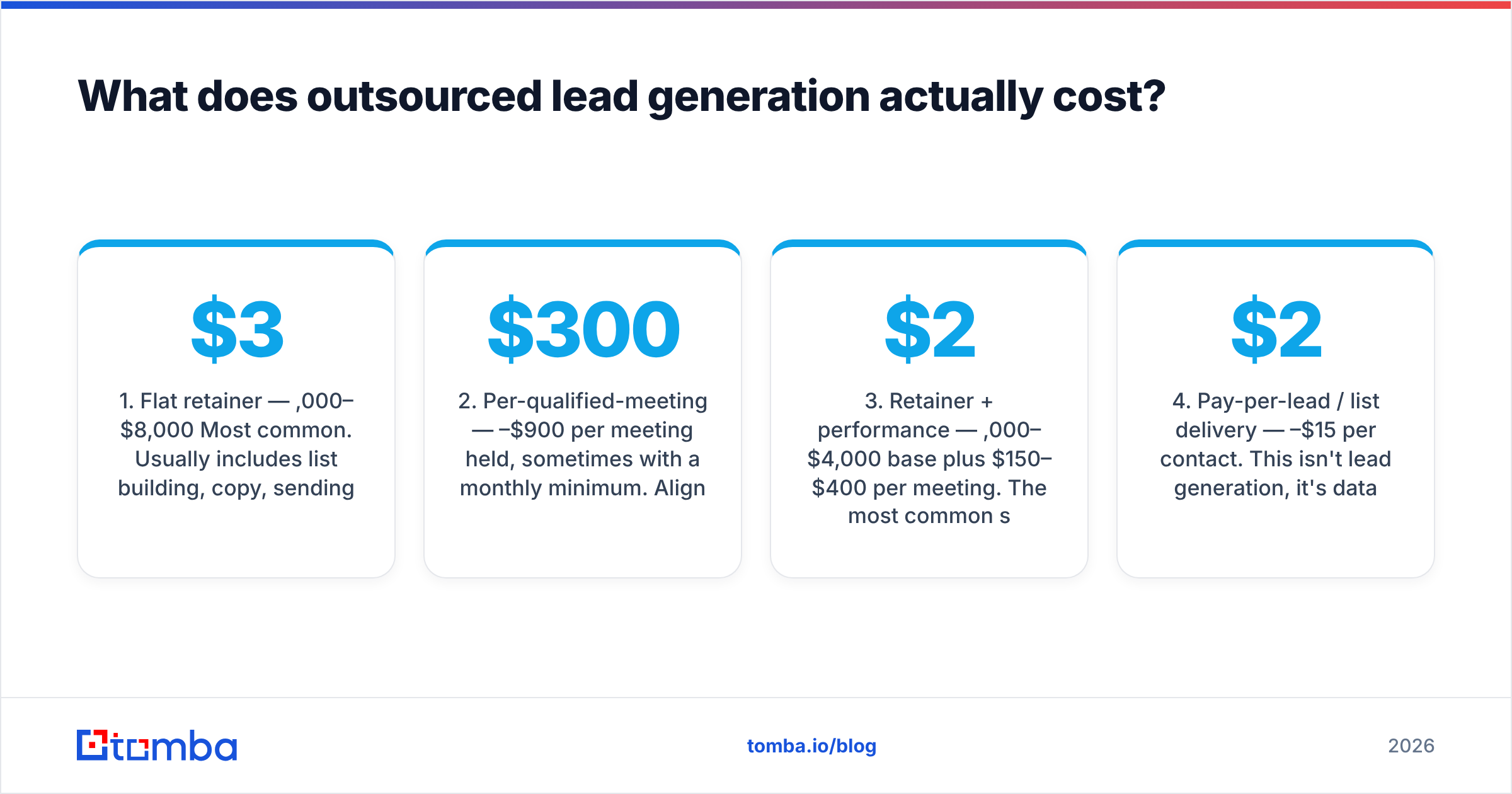
- Flat retainer — $3,000–$8,000/month. Most common. Usually includes list building, copy, sending infrastructure, and a shared account manager. You're typically buying 10–25% of two or three people's week.
- Per-qualified-meeting — $300–$900 per meeting held, sometimes with a monthly minimum. Aligns incentives on volume but not on quality; you'll spend real time disputing what counts as qualified.
- Retainer + performance — $2,000–$4,000 base plus $150–$400 per meeting. The most common structure for agencies that have been burned by pure-performance deals.
- Pay-per-lead / list delivery — $2–$15 per contact. This isn't lead generation, it's data purchasing with extra steps. Price it against buying data directly, because that's what it is.
The headline agency number looks cheap against a fully loaded SDR. A $5,000/month retainer is $60,000/year against $132,800 for one US rep with manager overhead. But the retainer buys you fractional attention, not a full-time person, and there are costs that don't show up in the invoice:
- Domain and reputation risk. If the agency sends from domains you own and burns them, you inherit the damage. If they send from their own domains, you don't own the sending reputation you paid to build. Ask which one before signing, and run your own sender reputation checks monthly either way.
- Data you don't keep. Many agencies hand over booked meetings, not the enriched contact records behind them. When you leave, the asset leaves with them.
- Message drift. The agency writes what converts across their book of clients, which is not always what converts for your specific buyer. Founders routinely discover six months in that their brand is being represented by copy they've never read.
- The switching tax. Ramping a new agency is 4–8 weeks. That's not far off ramping a new rep.
Lead generation outsourcing vs in house: which one wins on the numbers?#
Here's the side-by-side on the dimensions that actually change decisions:
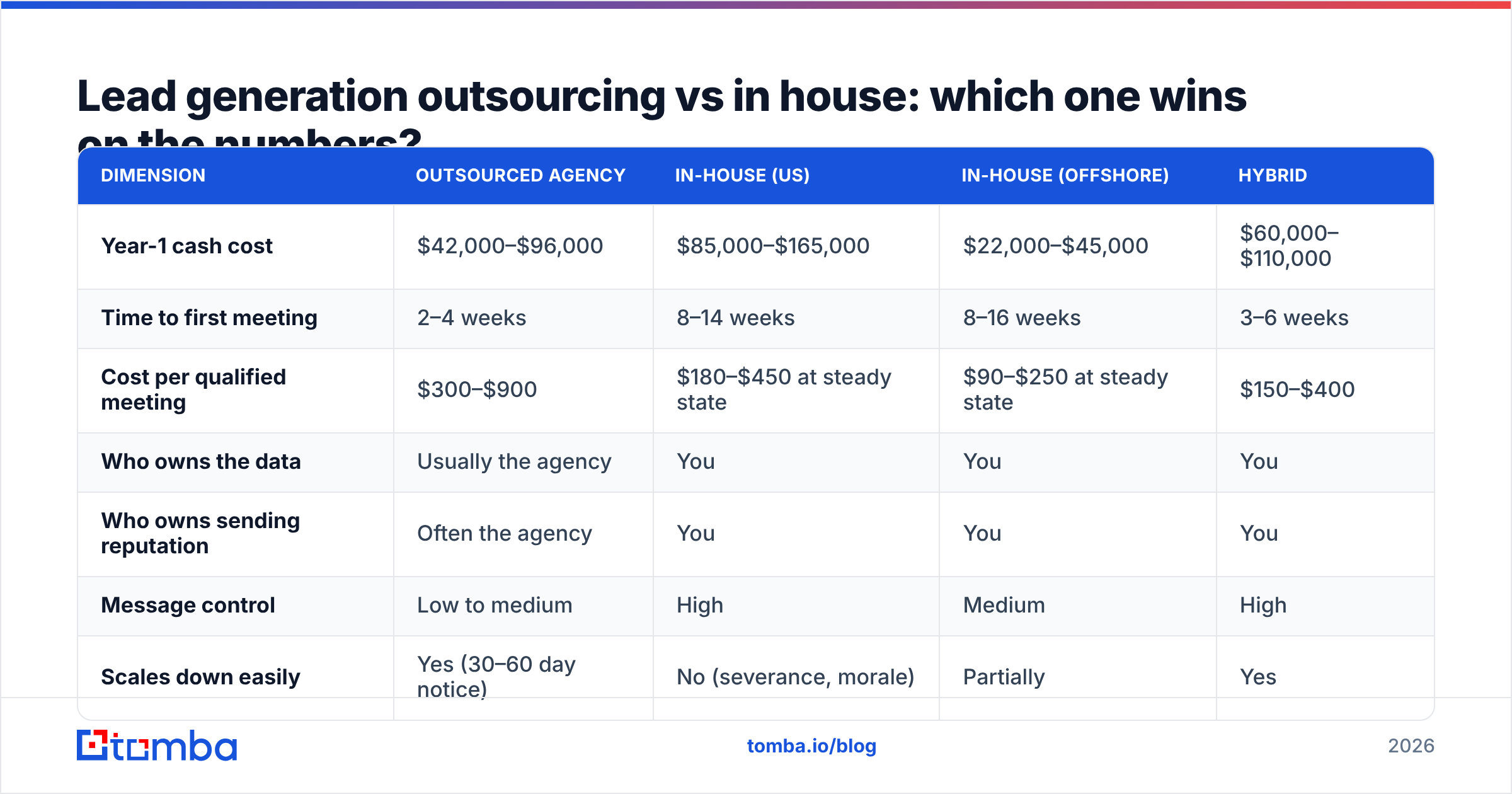
| Dimension | Outsourced agency | In-house (US) | In-house (offshore) | Hybrid |
|---|---|---|---|---|
| Year-1 cash cost | $42,000–$96,000 | $85,000–$165,000 | $22,000–$45,000 | $60,000–$110,000 |
| Time to first meeting | 2–4 weeks | 8–14 weeks | 8–16 weeks | 3–6 weeks |
| Cost per qualified meeting | $300–$900 | $180–$450 at steady state | $90–$250 at steady state | $150–$400 |
| Who owns the data | Usually the agency | You | You | You |
| Who owns sending reputation | Often the agency | You | You | You |
| Message control | Low to medium | High | Medium | High |
| Scales down easily | Yes (30–60 day notice) | No (severance, morale) | Partially | Yes |
| Scales up easily | Yes | Slow (hire + ramp) | Medium | Yes |
| Feedback loop to product | Weak | Strong | Medium | Strong |
| Best stage | Pre-PMF, new market tests | Post-PMF, known ICP | Volume email/LinkedIn motions | $1M–$10M ARR |
Read the cost-per-meeting row carefully, because it's where the decision usually gets made. An agency at $600/meeting delivering 15 meetings a month costs $9,000/month. An in-house rep at steady state producing 15 meetings a month against a $11,000 fully loaded monthly cost is roughly break-even — and the in-house rep also gives you message control, data ownership, and a person who can tell you why prospects said no.
The break-even is usually somewhere around 12–18 qualified meetings per month. Below that, agency economics win because you're not paying for idle capacity. Above that, in-house wins and the gap widens every month.
When should you outsource lead generation?#
Outsource when at least two of these are true:
- You don't know your ICP yet. Paying an agency to run five parallel segment tests is cheaper and faster than hiring someone and having them do it sequentially. You're buying experiments, not pipeline.
- You're entering a new geography or vertical. An agency with existing coverage in DACH or fintech starts at week two where you'd start at week twelve.
- You need pipeline before a fundraise or a quarter close. Speed has a price and this is the situation where paying it is rational.
- You have fewer than ten reps and no one to manage an SDR. An unmanaged SDR is the most expensive way to produce nothing.
- Your motion is genuinely seasonal. If Q3 is dead in your category, a 60-day-notice contract beats a salaried person.
Do not outsource when your product requires deep technical qualification on the first call, when your ACV is under $3,000 (the per-meeting math never works), or when the outreach is the product experience — developer tools and design tools in particular tend to get poor results from generic agency copy.
When should you build lead generation in house?#
Build in-house when:
- You have a repeatable message. If you can point at ten closed-won deals and describe the pattern that produced them, you have something worth teaching a full-time person.
- Your cost per meeting from agencies has stopped improving. Agencies optimize hard in months one through four and then plateau. If month eight looks like month four, you've extracted the available value.
- You need the feedback loop. In-house reps hear objections in real time and carry them to product and marketing. That intelligence never survives an agency's monthly report.
- Your data is a competitive asset. If knowing exactly who's in-market in your category is part of your moat, don't rent that knowledge.
- You can amortize a manager. Four reps under one manager is roughly the point where per-rep overhead stops looking absurd.
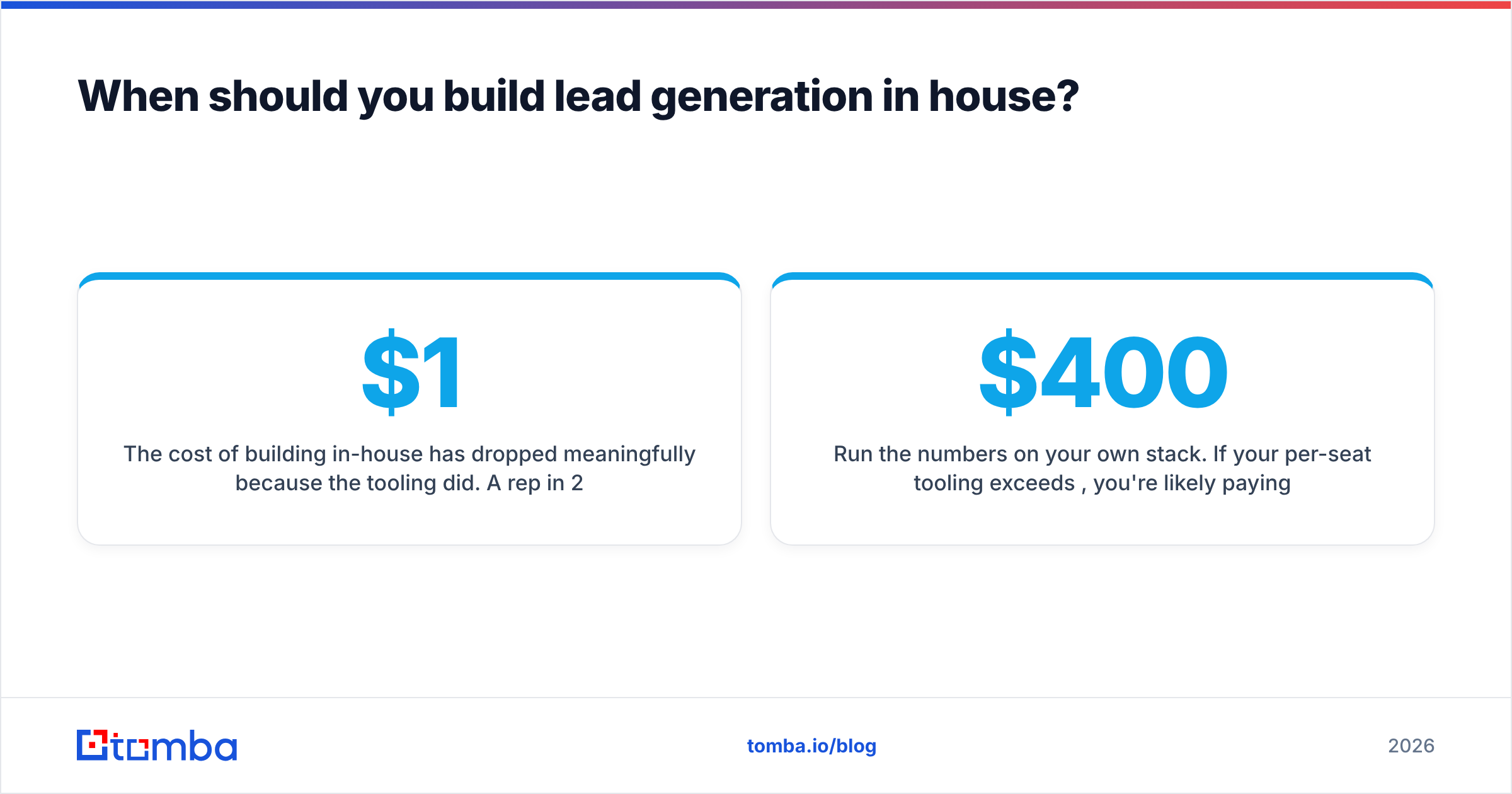
The cost of building in-house has dropped meaningfully because the tooling did. A rep in 2026 needs a CRM, a sequencer, and a data source. That's it. The data source is the part most teams over-buy: a $1,200/month all-in-one platform seat often gets replaced by a $99/month email finder plus verification with no loss in connect rate, because contact accuracy — not database size — is what determines whether the sequence lands.
Run the numbers on your own stack. If your per-seat tooling exceeds $400/month, you're likely paying for database access you could get cheaper à la carte, and that difference alone can fund a meaningful chunk of a second rep.
What does the hybrid model look like in practice?#
The best-performing setup we see at the $1M–$10M ARR range isn't either pole. It's:
- One in-house owner. A single SDR or a founder-adjacent person who owns ICP definition, messaging, and any conversation that requires product knowledge. This person is non-negotiable — they're the institutional memory.
- An owned data layer. You buy and control contact discovery and verification. Lists live in your CRM, enriched by you, and they stay yours when vendors change. A domain search plus email verifier workflow covers most of what an agency's "list building" line item charges for.
- Owned sending domains. Separate from your primary domain, warmed, monitored. Never let a vendor send from a domain whose reputation you can't audit.
- Rented volume. An agency, contractor, or offshore team executes the repetitive top-of-funnel work against the segments your in-house owner has already validated.
- A shared scoreboard. Same CRM, same definition of a qualified meeting, same dashboard. If the agency reports from their own system, you don't have a hybrid model — you have two disconnected motions.
The reason this works is that it separates the two things agencies bundle: judgment and labor. Judgment should be in-house because it compounds. Labor should go wherever it's cheapest, because it doesn't.

How do you measure whether the switch worked?#
Whichever direction you move, instrument it before you move. The metrics that matter:
- Cost per qualified meeting, fully loaded. Include tooling and management time, not just salary or retainer.
- Meeting-to-opportunity rate. An agency hitting volume targets with a 20% opp rate is worse than an in-house rep at half volume and 55%. This single number catches most "our agency books junk" complaints before they become a renewal fight.
- Pipeline-to-close velocity by source. Outsourced meetings frequently close slower because the prospect had less context going in.
- Bounce and spam-complaint rate. If it's climbing, someone is trading your email deliverability for short-term volume. Catch it in week three, not month six.
- Data retention. How many enriched contact records do you own today versus 90 days ago? If the number is flat while you're spending, you're renting, not building.
Give any change at least 90 days before judging it — 60 for ramp, 30 for signal. Killing an agency at day 45 or an SDR at month two tells you nothing except that you're impatient. Vendor review sites like G2's lead generation category are useful for shortlisting agencies, but treat the reviews as directional — the sample skews toward customers who were asked at a good moment.
What's the actual recommendation?#
If you're pre-product-market-fit or testing a new segment: outsource, on a 3–6 month contract, with a written agreement that enriched contact data is delivered to you monthly and that sending happens from domains you own.
If you're post-PMF with a known ICP and doing more than 15 meetings a month: build in-house, and strongly price the offshore option before defaulting to a US hire. The cost delta funds an entire second rep.
If you're somewhere in between — which is most companies reading this — run hybrid. One in-house owner, owned data and domains, rented volume. Revisit every two quarters.
The thing that stays constant across all three: the quality of your contact data sets the ceiling on everything downstream. A perfect sequence to a wrong or dead address is worth exactly zero, and the fastest way to make any model look broken is to feed it a bad list.
Start by owning the layer that survives every model change. Whether you outsource, hire, or run hybrid, verified contact data is the asset you keep. Tomba's Email Finder finds and verifies professional email addresses by domain, name, or company — with a free tier at 25 searches/month to test against your current list, and paid plans starting at $49/month. Check the full Tomba pricing to see how it compares to the per-seat data cost buried in your current stack, or wire it into your CRM through the Tomba API so every new lead lands enriched and verified before a rep — yours or someone else's — ever touches it.
Related guides#
// get started
Find, verify and enrich your first contacts today
Start on the free plan with 25 searches a month, then scale when your team is ready.
Free plan · No credit card required · GDPR & CCPA
// about the author