Lead Generation Phone Numbers: The Complete 2026 Guide
Most B2B phone lists are switchboards, stale direct dials, and numbers that were never checked. Here's how to source, validate, and legally dial phone numbers that actually reach a human in 2026.
TL;DR
- Most "lead generation phone numbers" you buy are company switchboards, not the prospect's line. Connect rates collapse because of routing, not because of your pitch.
- Direct-dial coverage on a typical B2B list runs far lower than vendors imply. Expect 25-45% direct-dial coverage on mid-market titles, less in the EU.
- Validate before you dial. HLR/carrier lookups catch disconnected, reassigned, and landline-vs-mobile mismatches for a fraction of a wasted rep-hour.
- Phone data decays faster than email. Job changes, mobile churn, and number porting mean a list older than six months is a different list.
- The winning stack in 2026 is waterfall sourcing plus validation plus consent hygiene, not one vendor with a big logo wall.
What are lead generation phone numbers, actually?#
Think of a phone list like a set of apartment keys. Some open the lobby door, some open the actual apartment. A switchboard number is the lobby. A direct dial is the apartment. Most lists sell you a ring of lobby keys and let you assume the rest.
In practice, "lead generation phone numbers" covers four distinct data objects that get blurred together in vendor marketing:
- Company main line — the HQ switchboard. Nearly 100% available, nearly worthless for outbound. It routes to a receptionist or an IVR tree.
- Department line — sales, support, or AP. Useful for vendor-of-record research, terrible for reaching a VP.
- Direct dial (desk) — an extension that rings at one person's desk. Still valuable in on-site industries: manufacturing, logistics, healthcare, public sector.
- Mobile / cell — the number that actually gets answered in 2026, and the one with the tightest legal constraints in the US, Canada, and the EU.
- Reassigned or ported numbers — a former employee's direct dial that now belongs to someone else. These are the numbers that quietly generate complaints.
When a vendor quotes "90% phone coverage," ask which of those five they are counting. The honest answer is usually categories one and two.
Where do B2B phone numbers actually come from?#
There is no magic registry of everyone's cell phone. Every provider assembles the same raw material in different proportions:
- Public web and filings — company sites, press releases, SEC/Companies House filings, conference speaker pages, support docs. Reliable for main lines, thin for mobiles.
- Contributory networks — users install an extension or sync a CRM, and their contact records feed a shared pool. This is where a large share of "direct dials" originate, and why coverage skews toward tech and SaaS.
- Licensed panel and telco-adjacent data — carrier-derived metadata used for line-type and status checks rather than for discovery.
- Opt-in registration data — webinar forms, gated content, trade show badges. Highest consent quality, smallest volume.
- Manual and offshore research — humans calling switchboards to confirm extensions. Slow, expensive, and still the most accurate method for enterprise accounts.
A serious stack draws from several of these and reconciles conflicts. A weak one resells a single scraped dump with a fresh coat of UI.

Which phone data source should you pay for?#
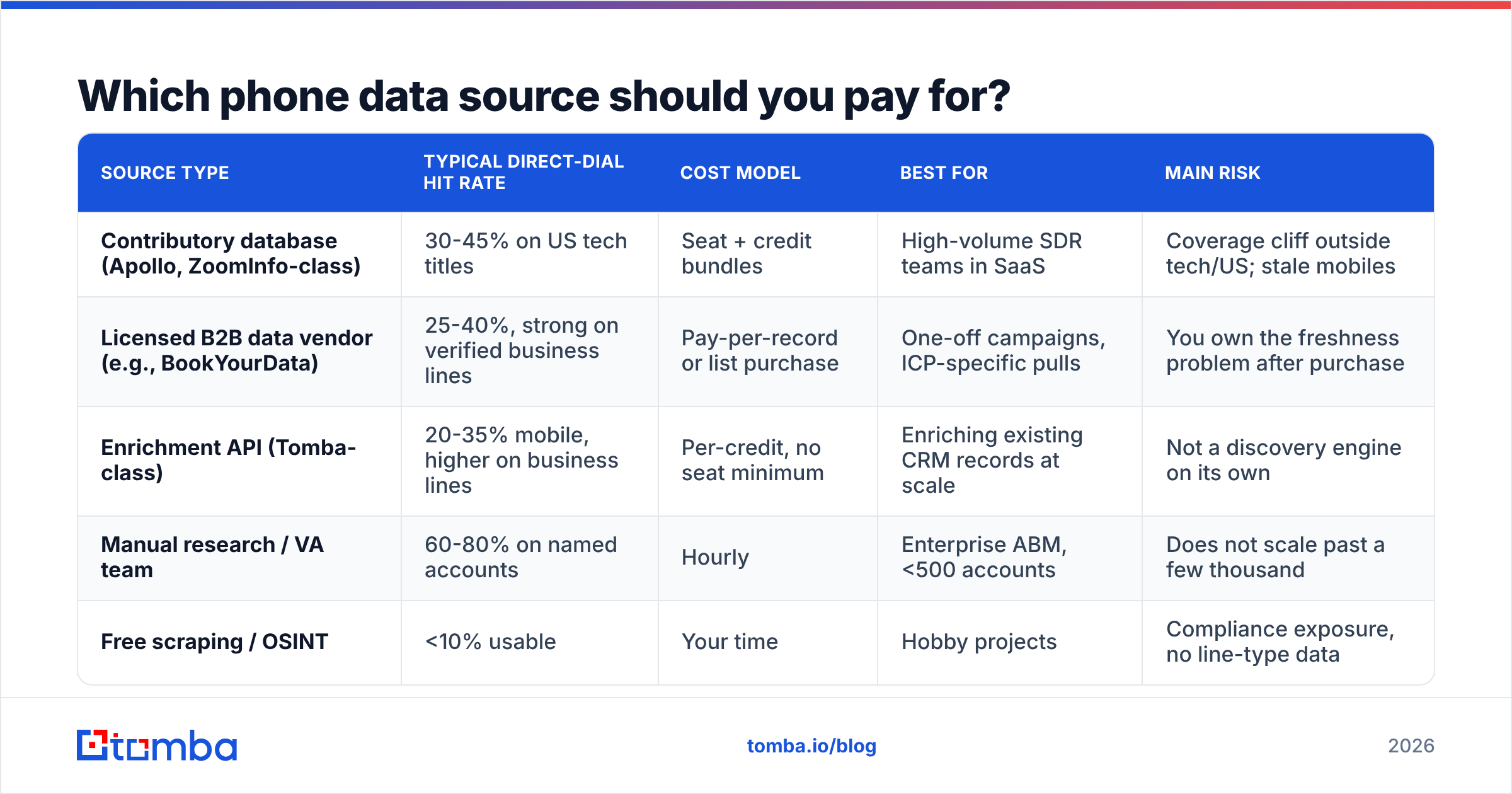
Compare source types before you compare logos. The trade-offs are structural, not brand-specific.
| Source type | Typical direct-dial hit rate | Cost model | Best for | Main risk |
|---|---|---|---|---|
| Contributory database (Apollo, ZoomInfo-class) | 30-45% on US tech titles | Seat + credit bundles | High-volume SDR teams in SaaS | Coverage cliff outside tech/US; stale mobiles |
| Licensed B2B data vendor (e.g., BookYourData) | 25-40%, strong on verified business lines | Pay-per-record or list purchase | One-off campaigns, ICP-specific pulls | You own the freshness problem after purchase |
| Enrichment API (Tomba-class) | 20-35% mobile, higher on business lines | Per-credit, no seat minimum | Enriching existing CRM records at scale | Not a discovery engine on its own |
| Manual research / VA team | 60-80% on named accounts | Hourly | Enterprise ABM, <500 accounts | Does not scale past a few thousand |
| Free scraping / OSINT | <10% usable | Your time | Hobby projects | Compliance exposure, no line-type data |
The pattern most teams land on: use a broad database for discovery, an enrichment API as a waterfall fallback for records the database misses, and manual research only for named enterprise accounts. Chaining sources this way usually adds 10-20 points of coverage over any single vendor, which is exactly why contact enrichment has become a separate line item from "the database."
How accurate is B2B phone data in 2026?#
Accuracy has two components people constantly conflate: connectivity (is this number live?) and attribution (does it belong to this person?).
Connectivity is cheap to test. A carrier lookup tells you whether a number is in service, its line type, its carrier, and its country. A phone validator run costs a fraction of a cent per record and removes the single largest source of wasted dials: numbers that were never going to ring.
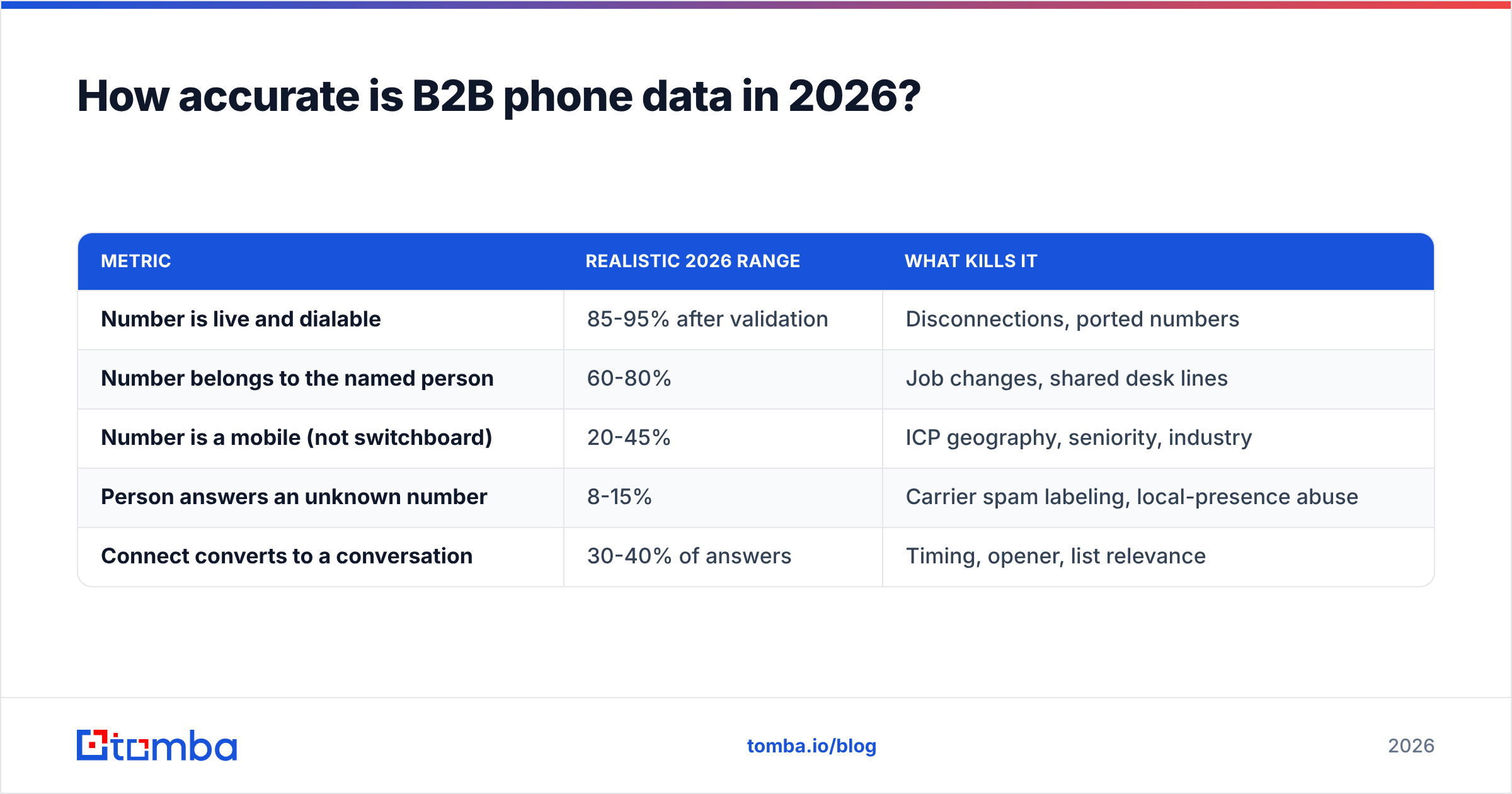
Attribution is hard and nobody solves it perfectly. The honest benchmarks look roughly like this:
| Metric | Realistic 2026 range | What kills it |
|---|---|---|
| Number is live and dialable | 85-95% after validation | Disconnections, ported numbers |
| Number belongs to the named person | 60-80% | Job changes, shared desk lines |
| Number is a mobile (not switchboard) | 20-45% | ICP geography, seniority, industry |
| Person answers an unknown number | 8-15% | Carrier spam labeling, local-presence abuse |
| Connect converts to a conversation | 30-40% of answers | Timing, opener, list relevance |
Multiply those and you get the number nobody puts on a pricing page: from 1,000 purchased records, you might hold 40-80 real conversations. That is a good campaign, not a bad one. Plan headcount and quota against that math, not against the vendor's coverage slide.
Two forces made 2026 harder than 2023. First, carrier-level spam labeling now filters aggressively on call patterns, so high-volume dialing from a poorly configured number gets flagged before your list quality even matters. Second, average B2B job tenure keeps shrinking, which pushes phone data decay past 2% per month on senior titles.
How do you validate phone numbers before dialing?#
Run every list through the same four gates. Skipping any one of them is how teams end up with a spam-labeled caller ID.
- Format and country normalization — convert everything to E.164. Malformed numbers are not "bad data," they are unparsed data, and dialers silently drop them.
- Line-type and carrier lookup — mobile, landline, VoIP, or toll-free. Line type drives both your legal obligations and your call windows.
- Status check — active, disconnected, or unallocated. Disconnected numbers are pure waste and, at volume, a signal that your source is stale.
- Suppression matching — DNC registries, prior opt-outs, litigator lists, and your own CRM's do-not-call flags. Do this every run, not once at import.
For teams working from a CRM export or a spreadsheet, the practical workflow is: pull the list, enrich missing numbers via phone finder, validate everything, then push only the survivors into the dialer. A bulk lead generation run handles the enrichment and validation legs in one pass, which matters when the list is 20,000 rows and not 200.
Is it legal to call the phone numbers you bought?#
Short answer: buying a number is not the same as being allowed to call it, and the gap is where the fines live.
In the United States, the Telephone Consumer Protection Act governs automated dialing and prerecorded messages, with stricter rules for mobile numbers. Manual B2B dialing to a business line sits in a comparatively permissive lane; auto-dialing cell phones does not. The reassigned-numbers problem is real: a number that legitimately belonged to your prospect two years ago may now be a consumer's personal line, and consent does not travel with the digits.
In the EU and UK, GDPR treats a direct dial or mobile as personal data. You need a lawful basis (usually legitimate interest for B2B), a documented balancing test, and a way to honor objections. Several member states layer on national marketing-call registers that apply to sole traders and small businesses.
Three operational rules that keep most teams out of trouble:
- Keep provenance. Store where each number came from and when it was last verified. "It was in the CSV" is not a defense.
- Honor opt-outs globally. One suppression list, enforced across every tool, not per-campaign.
- Prefer business lines for cold outreach. Mobiles convert better and carry more risk. Use them where you have a warmer signal — a form fill, an event, a referral.

How do you build a phone-enriched list, step by step?#
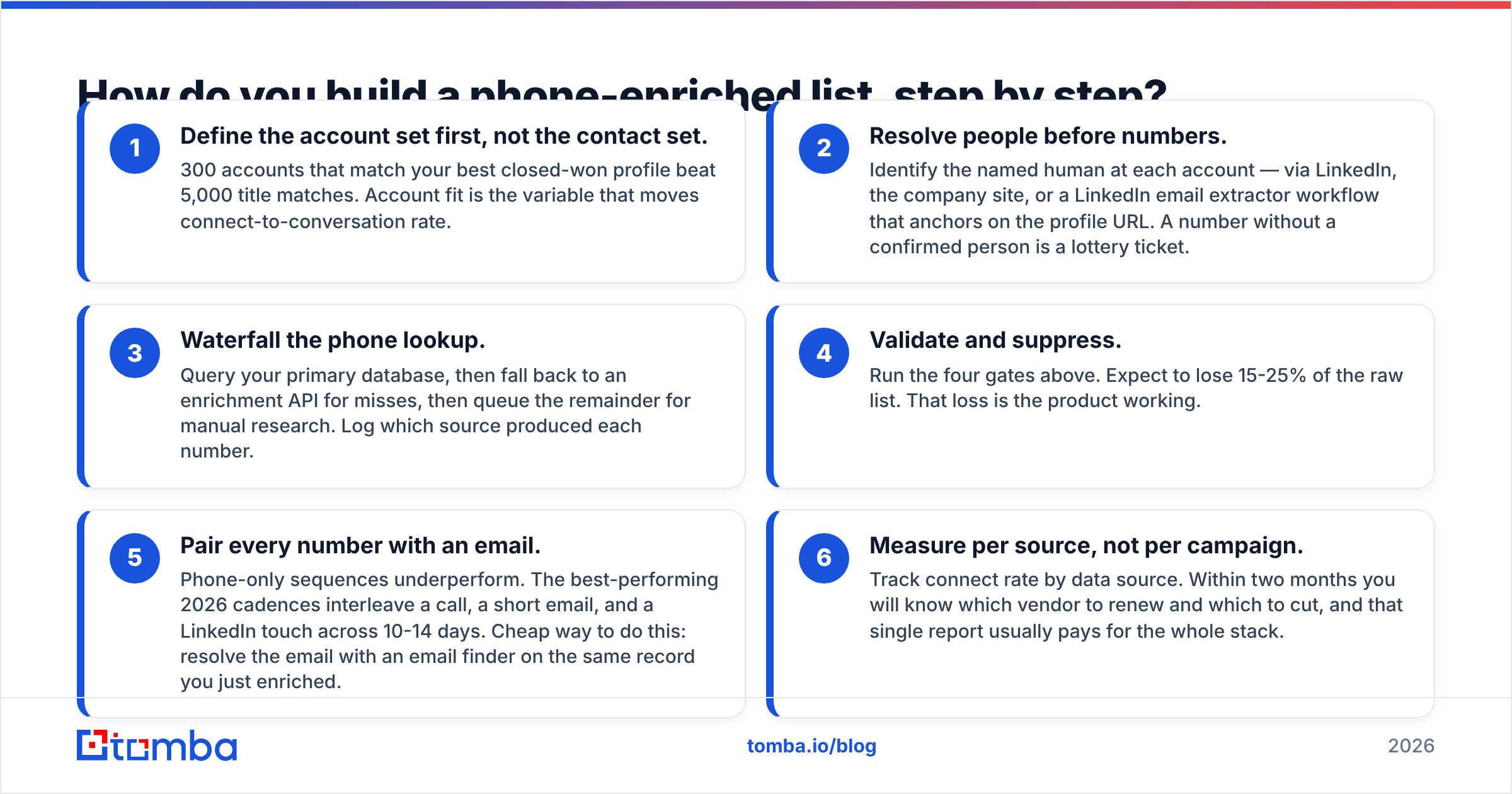
Here is the sequence that consistently outperforms buying a prebuilt list:
- Define the account set first, not the contact set. 300 accounts that match your best closed-won profile beat 5,000 title matches. Account fit is the variable that moves connect-to-conversation rate.
- Resolve people before numbers. Identify the named human at each account — via LinkedIn, the company site, or a LinkedIn email extractor workflow that anchors on the profile URL. A number without a confirmed person is a lottery ticket.
- Waterfall the phone lookup. Query your primary database, then fall back to an enrichment API for misses, then queue the remainder for manual research. Log which source produced each number.
- Validate and suppress. Run the four gates above. Expect to lose 15-25% of the raw list. That loss is the product working.
- Pair every number with an email. Phone-only sequences underperform. The best-performing 2026 cadences interleave a call, a short email, and a LinkedIn touch across 10-14 days. Cheap way to do this: resolve the email with an email finder on the same record you just enriched.
- Measure per source, not per campaign. Track connect rate by data source. Within two months you will know which vendor to renew and which to cut, and that single report usually pays for the whole stack.
What should lead generation phone data cost?#
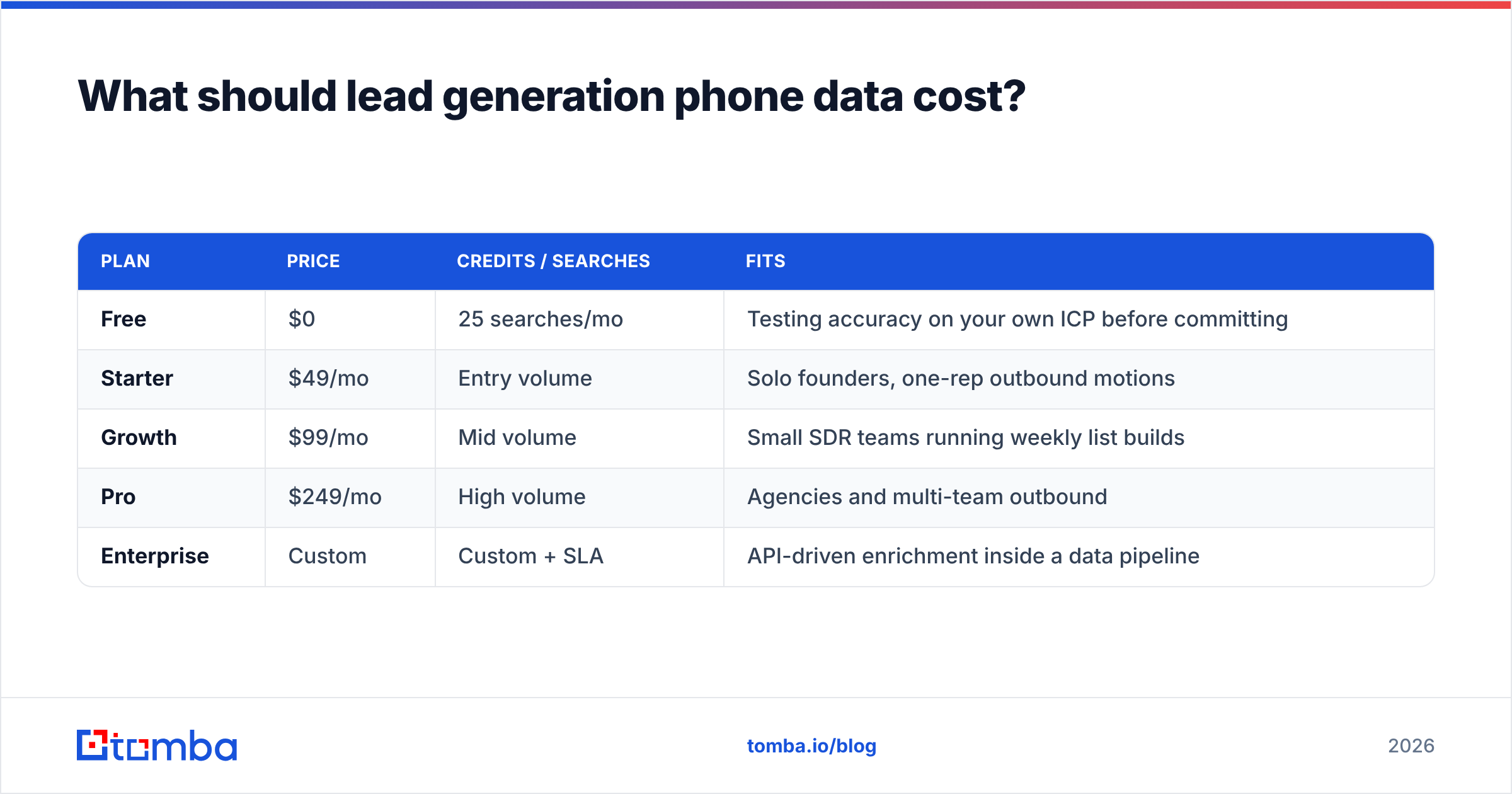
Budget in cost-per-conversation, not cost-per-record. A $0.10 record that never connects is more expensive than a $0.60 record that does.
| Plan | Price | Credits / searches | Fits |
|---|---|---|---|
| Free | $0 | 25 searches/mo | Testing accuracy on your own ICP before committing |
| Starter | $49/mo | Entry volume | Solo founders, one-rep outbound motions |
| Growth | $99/mo | Mid volume | Small SDR teams running weekly list builds |
| Pro | $249/mo | High volume | Agencies and multi-team outbound |
| Enterprise | Custom | Custom + SLA | API-driven enrichment inside a data pipeline |
Full Tomba pricing is per-plan credit based, which matters for phone work: you pay for lookups, not for seats, so adding a rep does not multiply your data bill. Compare that against seat-plus-credit vendors listed on G2's sales intelligence category before you sign an annual contract — the seat model quietly becomes the dominant cost as headcount grows.
One more budgeting note grounded in how outbound actually converts: HubSpot's sales research has consistently shown that most deals require multiple touches across channels. If your phone budget crowds out your email and sequencing budget, you are optimizing the wrong constraint.
Where teams go wrong#
- Treating coverage as accuracy. A vendor can have a number for 95% of your list and be wrong about half of them.
- Never re-validating. Phone data decays monthly. Quarterly revalidation of your active calling list is the highest-ROI hygiene task available.
- Ignoring line type. Calling a VoIP number at 8am local time with an auto-dialer is how caller IDs get burned.
- Single-sourcing. Every database has a geographic and industry shape. If your ICP is European manufacturing, a US-tech-heavy contributory database will disappoint you regardless of its brand.
- Dialing before deduping. Two reps calling the same prospect in one week is worse than not calling at all.
Get numbers and emails from the same record#
Phone outreach works best as one lane of a multichannel sequence, and that means every enriched record needs both a dialable number and a deliverable address. Start with the Tomba Email Finder to resolve the person and their verified work email, then layer phone enrichment and validation on the same record so your dialer and your sequencer are working from one source of truth. The free tier gives you 25 searches a month — enough to test accuracy against accounts you already know before you spend a dollar on a list.
Related guides#
// get started
Find, verify and enrich your first contacts today
Start on the free plan with 25 searches a month, then scale when your team is ready.
Free plan · No credit card required · GDPR & CCPA
// about the author