Lead Generation Plan: How to Build One That Fills Pipeline
Most lead generation plans are channel wish-lists with no math behind them. Here's how to build one that works backward from revenue, sets real targets per channel, and survives contact with a quota.
TL;DR
- A lead generation plan is a revenue-backward math document, not a list of channels you'd like to try. Start from the annual number, divide down to weekly activity, then pick channels.
- Four inputs decide everything: average deal size, win rate, sales-cycle length, and lead-to-opportunity conversion. If you don't have these, your plan is fiction.
- Most teams over-invest in net-new channels and under-invest in data quality. Bad contact data quietly burns 20-40% of your outbound budget before a single reply.
- Budget split that holds up for most B2B teams: 50% to your one proven channel, 30% to a second scaling channel, 20% to experiments with a kill date.
- Review cadence beats plan quality. A mediocre plan reviewed weekly outperforms a brilliant plan reviewed quarterly.
What Is a Lead Generation Plan?#
A lead generation plan is a written document that connects a revenue target to a specific, measurable set of weekly activities across named channels, with an owner and a budget attached to each.
Think of it like a flight plan. A pilot doesn't just point the nose at the destination and take off. They calculate fuel, weight, headwinds, and alternate airports before wheels-up — because discovering mid-flight that you're 200 gallons short is not recoverable. A lead generation plan does the same thing: it proves on paper that the pipeline math works before you spend a quarter finding out it doesn't.
What separates a real plan from a channel wish-list is a single test: can you trace any line item back to a revenue number? If your plan says "launch a podcast" and you can't say how many opportunities that podcast needs to produce to justify its cost, it isn't in the plan. It's a hope.
Here's what a complete plan contains:
- Revenue target and the math that decomposes it — annual number → quarterly → monthly opportunities → monthly qualified leads → weekly activity per channel.
- Named channels with owners — not "marketing," but a person. Unowned channels drift.
- Per-channel conversion assumptions — stated explicitly so you can be wrong on paper and correct fast.
- Budget allocation with a proven/scaling/experimental split — and a kill date on every experiment.
- Data and infrastructure requirements — CRM fields, contact data source, enrichment, email verification, sequencing tool.
- A review cadence — weekly leading indicators, monthly channel review, quarterly reallocation.
Skip item 3 and you'll spend a year unable to explain why you missed. Skip item 6 and the plan becomes a document nobody opens after week two.
How Do You Calculate Lead Targets Backward From Revenue?#
Start with the revenue number and divide. This is the least glamorous part of the plan and the only part that actually matters.
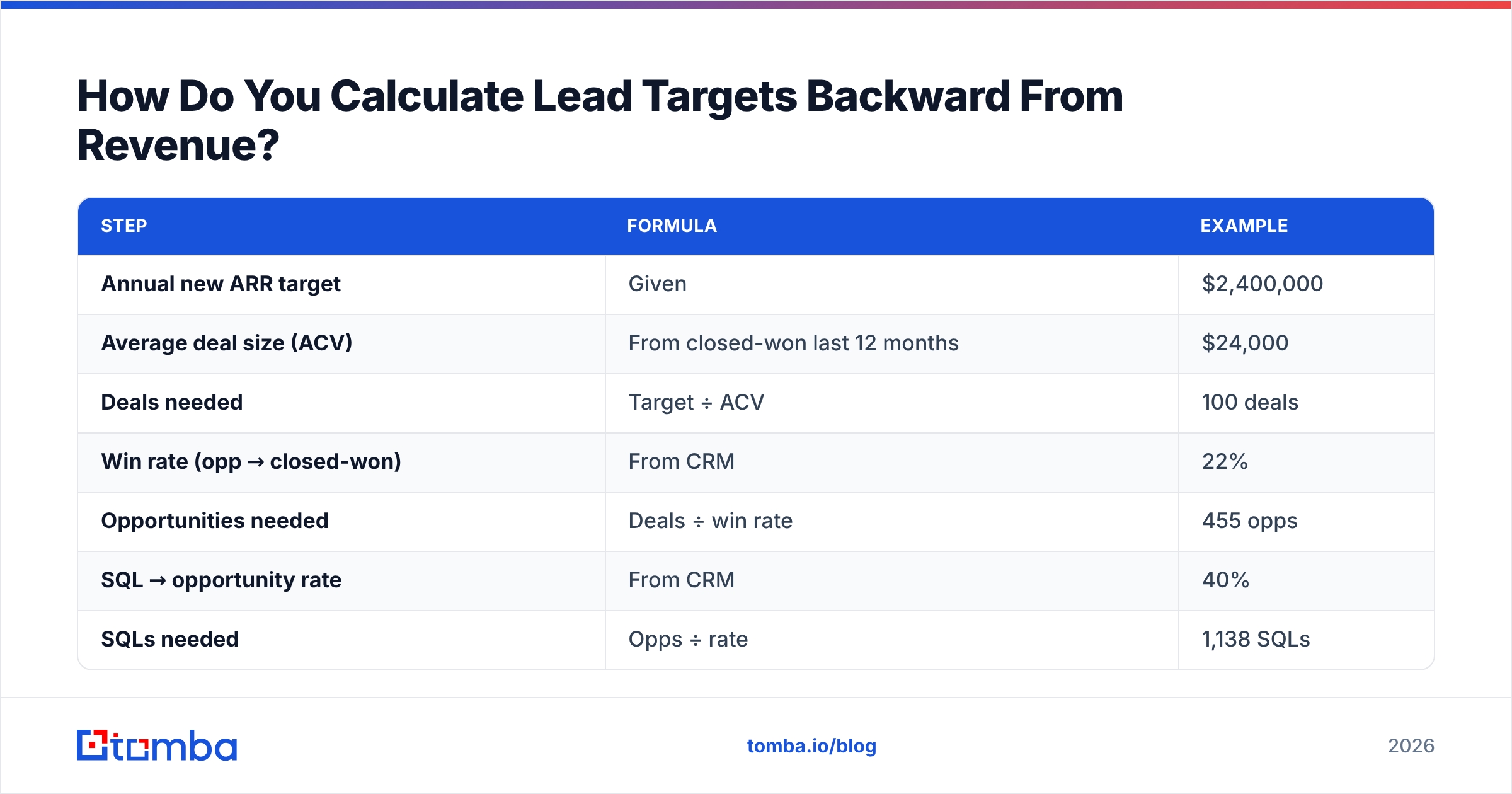
Work through it with concrete numbers. Say your team needs $2.4M in new ARR next year:
| Step | Formula | Example |
|---|---|---|
| Annual new ARR target | Given | $2,400,000 |
| Average deal size (ACV) | From closed-won last 12 months | $24,000 |
| Deals needed | Target ÷ ACV | 100 deals |
| Win rate (opp → closed-won) | From CRM | 22% |
| Opportunities needed | Deals ÷ win rate | 455 opps |
| SQL → opportunity rate | From CRM | 40% |
| SQLs needed | Opps ÷ rate | 1,138 SQLs |
| MQL → SQL rate | From CRM | 30% |
| MQLs needed annually | SQLs ÷ rate | 3,793 MQLs |
| MQLs needed monthly | ÷ 12 | 316 MQLs/month |
Now you have a number you can actually manage against: 316 marketing qualified leads a month. Not "more leads." Not "grow pipeline." A number.
Two adjustments most teams forget:
Sales cycle lag. If your average cycle is 90 days, leads generated in Q4 close next year. Your Q1 pipeline was built last Q3. Shift your generation calendar forward by one full cycle length or you'll under-generate for three months and feel it nine months later.
Pipeline coverage multiple. Most B2B teams target 3x-4x coverage against quota, not 1x. If you build exactly enough pipeline to hit the number at your historical win rate, a single slipped quarter puts you under. Multiply your opportunity target by your coverage ratio.

Run this math before you have perfect data. Estimated conversion rates you revisit monthly beat no conversion rates at all. Write down the assumption, date it, and correct it when real data arrives.
Which Channels Belong in Your Plan?#
Pick channels based on where your buyers already are and what your team can execute consistently — not on what worked for a company with a different motion.
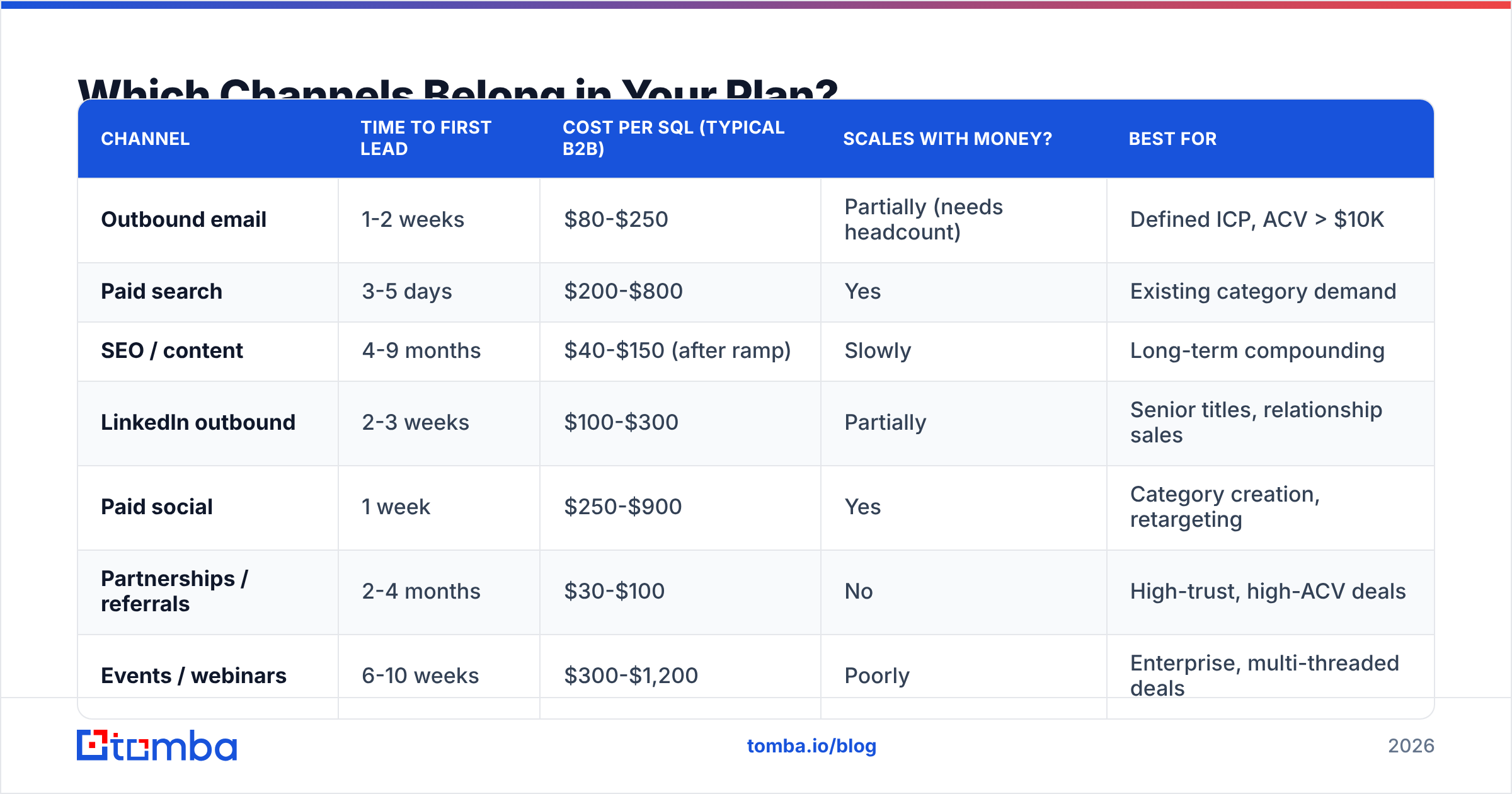
The honest comparison:
| Channel | Time to first lead | Cost per SQL (typical B2B) | Scales with money? | Best for |
|---|---|---|---|---|
| Outbound email | 1-2 weeks | $80-$250 | Partially (needs headcount) | Defined ICP, ACV > $10K |
| Paid search | 3-5 days | $200-$800 | Yes | Existing category demand |
| SEO / content | 4-9 months | $40-$150 (after ramp) | Slowly | Long-term compounding |
| LinkedIn outbound | 2-3 weeks | $100-$300 | Partially | Senior titles, relationship sales |
| Paid social | 1 week | $250-$900 | Yes | Category creation, retargeting |
| Partnerships / referrals | 2-4 months | $30-$100 | No | High-trust, high-ACV deals |
| Events / webinars | 6-10 weeks | $300-$1,200 | Poorly | Enterprise, multi-threaded deals |
Ranges vary enormously by industry — treat these as shape, not gospel. Pull your own numbers from the last four quarters and replace the middle column.
A useful rule: you need one channel that reliably works before you add a second. Teams running five half-committed channels almost always underperform teams running one channel properly. Each channel has a competence threshold — a level of execution below which it produces nothing. Five channels at 40% competence produces less than one channel at 90%.
The 50/30/20 budget split handles this cleanly:
- 50% to the proven channel. The one with documented CAC and predictable volume. Fund it to the point of diminishing returns before diverting a dollar.
- 30% to the scaling channel. Working, but not yet at full volume. This is where growth comes from next year.
- 20% to experiments. Every experiment gets a hypothesis, a budget cap, a success threshold, and a kill date written on day one. If it hasn't hit the threshold by the date, it dies. No extensions.
That last rule is the one teams break. An experiment without a kill date becomes a permanent line item defended by whoever launched it.
How Do You Build the Outbound Layer of the Plan?#
Outbound is the only channel where you fully control volume, which makes it the backbone of most B2B lead generation plans. It's also the channel where data quality determines whether the whole thing works.
Work in this order:
- Define the ICP tightly enough to exclude. "B2B SaaS companies" is not an ICP. "Series A-B B2B SaaS, 50-250 employees, US/UK, with an existing SDR team and HubSpot in the stack" is. If your ICP doesn't exclude 95% of the market, it isn't an ICP.
- Build the account list before the contact list. Accounts first, then 3-5 contacts per account across the buying committee. Single-threaded outbound to one contact per account converts far worse than multi-threading.
- Source and verify contact data. This is where budgets quietly evaporate. A 15% bounce rate doesn't just waste 15% of your sends — it damages sender reputation and suppresses inbox placement for the other 85%.
- Set per-rep capacity honestly. A rep can personalize and send roughly 40-60 high-quality emails a day alongside calls and follow-up. Plans built on 200/day/rep are building for a bounce rate, not a reply rate.
- Instrument the funnel at every step. Sent → delivered → opened → replied → meeting booked → opportunity. If you only measure meetings, you can't diagnose which step broke.
On step 3: contact data decay is the most underestimated line in any lead generation plan. B2B contact records go stale at roughly 25-30% a year through job changes alone, and that's before company moves, domain changes, and restructuring. A list you bought in January is measurably worse in July.
That makes verification a recurring cost, not a one-time purchase. Build it into the plan as an ongoing line. Running your list through an email verifier before every campaign — not just at import — is the cheapest insurance in outbound. For lists that include catch-all domains, which most enterprise lists do, a dedicated catch-all verifier separates the genuinely deliverable from the "accepts everything and silently drops" category that inflates your apparent delivery rate.
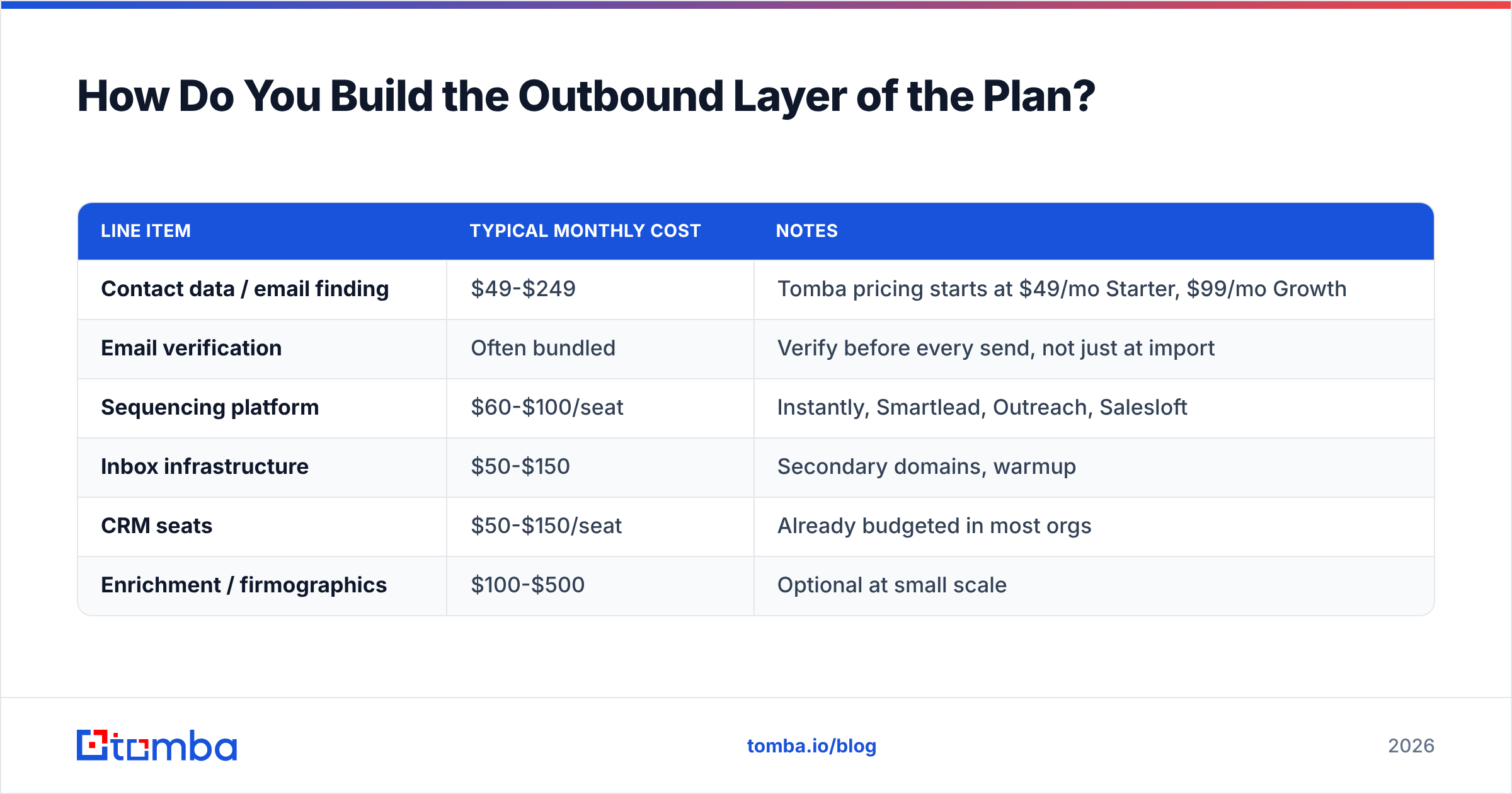
Tooling costs for a five-rep outbound team, planned honestly:
| Line item | Typical monthly cost | Notes |
|---|---|---|
| Contact data / email finding | $49-$249 | Tomba pricing starts at $49/mo Starter, $99/mo Growth |
| Email verification | Often bundled | Verify before every send, not just at import |
| Sequencing platform | $60-$100/seat | Instantly, Smartlead, Outreach, Salesloft |
| Inbox infrastructure | $50-$150 | Secondary domains, warmup |
| CRM seats | $50-$150/seat | Already budgeted in most orgs |
| Enrichment / firmographics | $100-$500 | Optional at small scale |
Budget the data layer first. Everything downstream — the sequencer, the inboxes, the rep hours — multiplies whatever quality your data has. Garbage in, amplified garbage out.
What Metrics Should the Plan Track Weekly?#
Track leading indicators weekly and lagging indicators monthly. Confusing the two is why teams panic in week three of a quarter.
Weekly (leading — you can still change these):
- Activity volume per channel — emails sent, calls dialed, content published, ad spend deployed.
- Contact data health — bounce rate, verification pass rate, catch-all percentage.
- Reply rate and positive reply rate — positive reply rate is the real signal; total reply rate includes "unsubscribe me."
- Meetings booked vs. meetings held — a 30% no-show rate is a confirmation-process problem, not a lead-quality problem.
Monthly (lagging — these tell you if the plan works):
- MQL → SQL conversion by channel
- Cost per SQL by channel
- Pipeline created vs. plan
- Win rate by lead source
The trap is judging channels on lagging metrics too early. With a 90-day sales cycle, a channel launched in January has no win-rate data until April. Judge it on leading indicators for the first cycle length, then switch to lagging metrics. Killing a channel at week six because "no revenue yet" kills channels that were working.

One more measurement discipline: segment everything by source at the record level. If your CRM can't tell you win rate by lead source, that's the first infrastructure fix in the plan — ahead of any new channel.
What Does a 90-Day Rollout Look Like?#
Don't launch everything at once. Sequence it so each phase produces data the next phase depends on.
Days 1-30 — Foundation. Finish the revenue math. Fix CRM source tracking and stage definitions. Lock the ICP and build the first account list. Source and verify contact data. Pick the one proven channel and fund it properly. Ship nothing new yet. This month feels unproductive and determines everything after it.
Days 31-60 — Execute one channel well. Run the proven channel at full intended volume. Instrument every funnel step. Run two messaging tests — not ten. Establish the real baseline conversion rates that replace your estimates from day one. Start the second channel at 20% of eventual volume as a pilot.
Days 61-90 — Scale and reallocate. Compare actual conversion rates to planned. Rewrite the math with real numbers. Scale the second channel if its leading indicators cleared the threshold; kill it if they didn't. Launch the first genuine experiment with a written kill date. Set the quarterly reallocation meeting on the calendar as a recurring event.
Then repeat. A lead generation plan isn't an annual document — it's a quarterly document with an annual target. Teams that rewrite the plan every quarter with real data beat teams that write a beautiful plan in January and discover in October that the win-rate assumption was 12 points off.
How Do You Choose Tools Without Overbuying?#
Buy in this order: data, then sequencing, then analytics, then everything else. Most teams invert this and buy a $2,000/month orchestration platform to send messages to contacts sourced from a bad list.
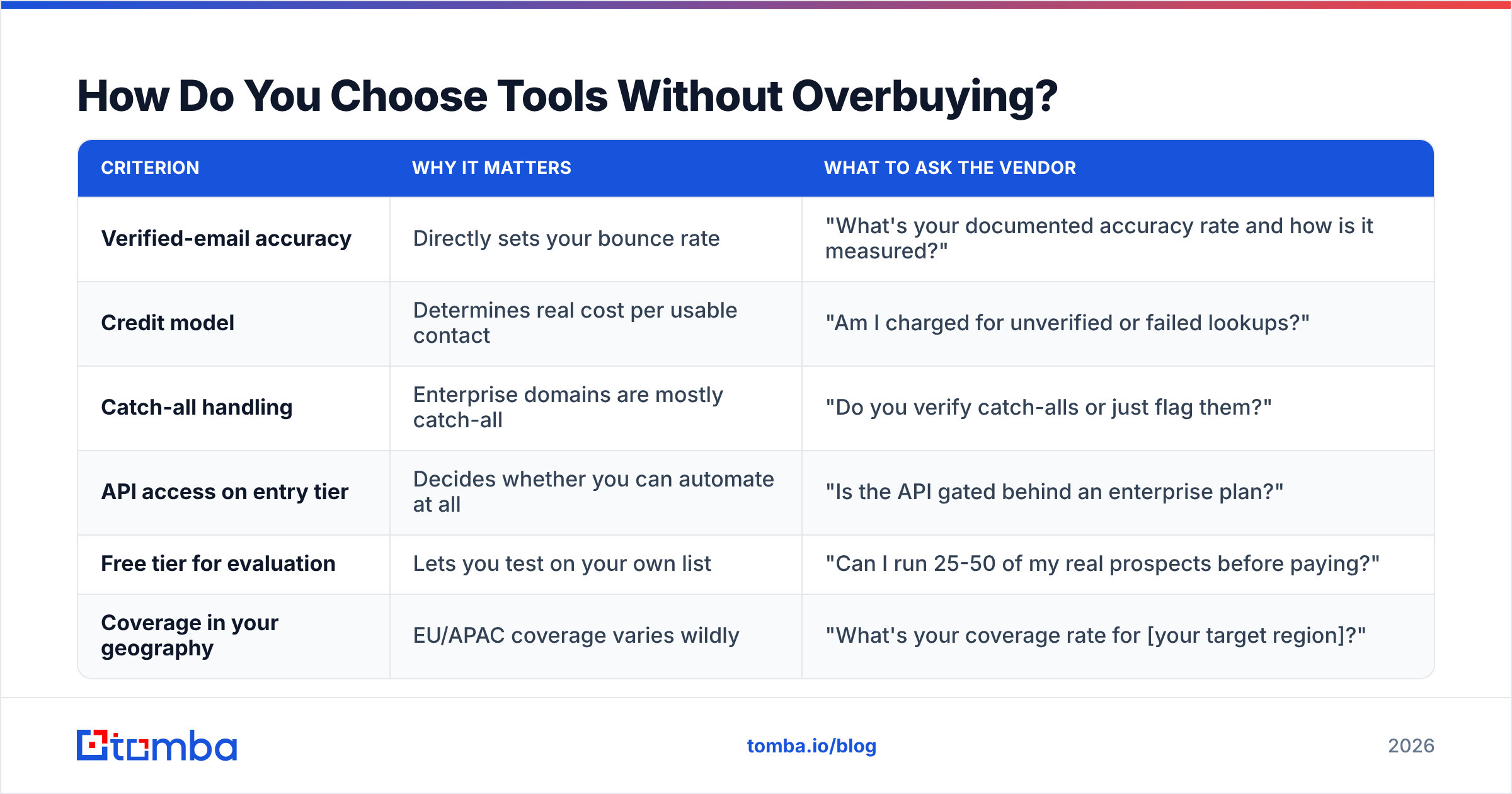
Compare on the criteria that actually change outcomes:
| Criterion | Why it matters | What to ask the vendor |
|---|---|---|
| Verified-email accuracy | Directly sets your bounce rate | "What's your documented accuracy rate and how is it measured?" |
| Credit model | Determines real cost per usable contact | "Am I charged for unverified or failed lookups?" |
| Catch-all handling | Enterprise domains are mostly catch-all | "Do you verify catch-alls or just flag them?" |
| API access on entry tier | Decides whether you can automate at all | "Is the API gated behind an enterprise plan?" |
| Free tier for evaluation | Lets you test on your own list | "Can I run 25-50 of my real prospects before paying?" |
| Coverage in your geography | EU/APAC coverage varies wildly | "What's your coverage rate for [your target region]?" |
Test every vendor on your own list, never on their demo list. Take 50 contacts you already know the correct emails for, run them through each tool, and measure accuracy and bounce rate yourself. Vendor-published accuracy figures are measured on datasets vendors chose. Your list is the only benchmark that predicts your results.
Peers worth evaluating alongside each other in this category include Tomba, Hunter, Apollo, and BookYourData — each sits at a different point on the coverage-versus-precision tradeoff, and the right pick depends on whether your ICP is broad mid-market or a narrow enterprise segment. For a structured look at how buyers rate these categories, G2's lead intelligence grid is a reasonable starting filter, and HubSpot's lead generation resources cover the inbound side of the plan in depth.
Also decide early whether you need a bulk email finder for list-based workflows or an email finder API for programmatic enrichment inside your own systems. Those are different purchases with different pricing shapes, and buying the wrong one means paying for capacity you can't reach.
What Usually Breaks a Lead Generation Plan?#
Five failure modes account for most misses:
- Assumptions never revisited. You estimated a 30% MQL→SQL rate in January. It's actually 18%. Nobody updated the plan, so the volume targets were 40% too low all year.
- Too many channels, none committed. Every channel sits below its competence threshold. Total output is lower than a single well-run channel would have produced.
- Data quality treated as a one-time cost. The list was verified once, in month one, and has been decaying since. Bounce rates climb, deliverability degrades, and reply rates fall for reasons nobody traces back to data.
- No owner per channel. "Marketing owns it" means nobody owns it. Unowned channels get the leftover hours.
- Review cadence that quietly dies. The weekly pipeline review becomes biweekly, then monthly, then a Slack thread. By the time anyone notices the shortfall, there isn't enough runway in the cycle to fix it.
Every one of these is a process failure, not a strategy failure. The plans that work aren't smarter — they're the ones that got reviewed.
Where Should You Start This Week?#
Do the math first. Open a spreadsheet, pull your last four quarters of closed-won data, and calculate the five numbers: ACV, win rate, SQL→opp rate, MQL→SQL rate, and cycle length. If any of them are unknowable from your CRM, fixing that is task one — before any channel decision.
Then audit your contact data. Take a sample of 100 records from your current list and verify them. If more than 8-10% fail, your outbound numbers are being held down by something no amount of copy testing will fix.
When you're ready to build the outbound layer, start with the data foundation: the Tomba Email Finder finds verified professional emails by domain, name, or company, with a free tier of 25 searches a month so you can test accuracy on your own prospect list before committing budget. Paid plans start at $49/mo (Starter) and $99/mo (Growth), with API access for teams building enrichment into their own pipeline. Run 25 of your real target accounts through it, measure the accuracy yourself, and let the result — not the marketing page — decide whether it belongs in your plan.
Related guides#
Ready to find emails that actually work?
Join 150,000+ professionals who stopped guessing and started sending. Free credits on signup — no credit card required.
Get the Tomba newsletter
Practical outbound tactics and product updates — once every two weeks.
About the author