Lead Generation Pricing in 2026: What You Should Really Pay
Agencies quote $2,500/mo, data tools quote $49/mo, and pay-per-lead vendors quote $75 a lead. Here is what each model actually costs once you account for bad data, minimums, and rework.
TL;DR
- Lead generation pricing in 2026 splits into four models: pay-per-lead ($25–$400 per lead), agency retainers ($2,000–$12,000/mo), in-house tooling ($49–$500/mo), and per-appointment ($150–$800 per booked meeting).
- The headline price is never the real price. Bad data, annual lock-ins, credit rollover rules, and rework routinely add 30–60% to your effective cost per usable lead.
- Cost per usable lead is the only number worth tracking. A $30 lead with a 40% bounce rate costs you more than a $60 lead that's verified.
- In-house data tooling is the cheapest model per contact by an order of magnitude — but it only wins if you already have someone to run the outreach.
- Most teams under $5M ARR overpay for done-for-you services before they've tested whether their offer converts at all.
What does lead generation pricing actually cover in 2026?#
The phrase "lead generation pricing" covers four fundamentally different products that vendors deliberately blur together.
When an agency quotes you $4,000/mo, you're buying labor: a strategist, a copywriter, and a list-builder working on your account for some fraction of their week. When a pay-per-lead vendor quotes $75, you're buying an outcome — a form fill, a demo request, or a marked-interested reply. When a data platform quotes $49/mo, you're buying raw contact records and the tooling to find and verify them. When an appointment-setting firm quotes $400, you're buying a calendar event, which may or may not show up.
These are not substitutes. Comparing their prices side by side without normalizing for what you get is how teams end up paying $6,000/mo for something a $99 tool plus one SDR could deliver.
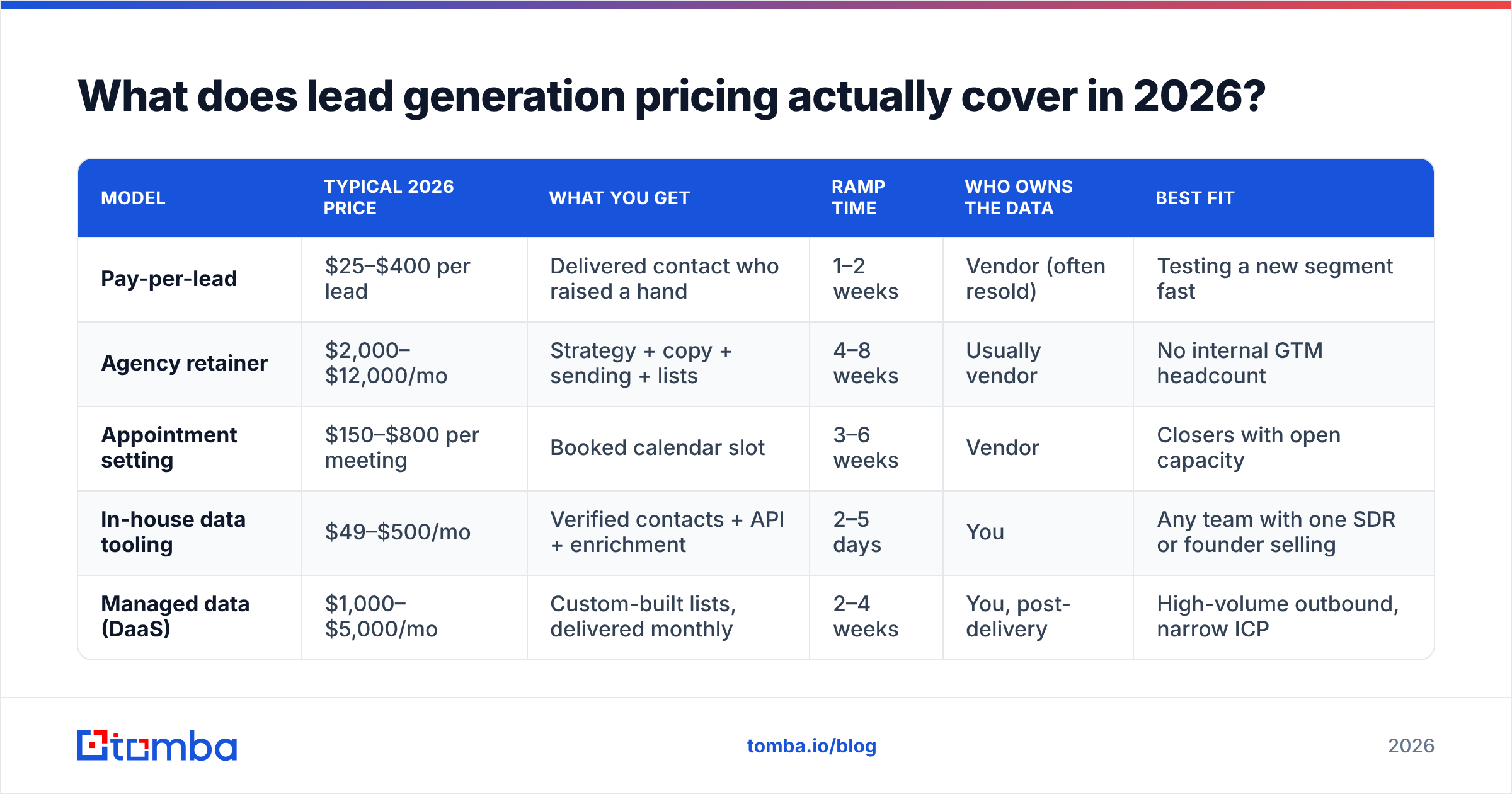
Here's how the four models break down on the dimensions that actually matter:
| Model | Typical 2026 price | What you get | Ramp time | Who owns the data | Best fit |
|---|---|---|---|---|---|
| Pay-per-lead | $25–$400 per lead | Delivered contact who raised a hand | 1–2 weeks | Vendor (often resold) | Testing a new segment fast |
| Agency retainer | $2,000–$12,000/mo | Strategy + copy + sending + lists | 4–8 weeks | Usually vendor | No internal GTM headcount |
| Appointment setting | $150–$800 per meeting | Booked calendar slot | 3–6 weeks | Vendor | Closers with open capacity |
| In-house data tooling | $49–$500/mo | Verified contacts + API + enrichment | 2–5 days | You | Any team with one SDR or founder selling |
| Managed data (DaaS) | $1,000–$5,000/mo | Custom-built lists, delivered monthly | 2–4 weeks | You, post-delivery | High-volume outbound, narrow ICP |
Notice the ramp-time column. It's the line item nobody quotes. An agency retainer that takes six weeks to produce its first meeting has already burned $6,000 before you learn whether the channel works.

How much should you pay per lead?#
Benchmark first, then negotiate. Median B2B cost per lead in 2026 clusters by channel and deal size, not by vendor quality.
- Inbound content / SEO: $30–$90 per MQL once the content is live. High upfront cost, near-zero marginal cost.
- Paid search: $60–$250 per lead in most B2B SaaS categories, more in legal, insurance, and cyber.
- Paid social: $25–$120 per lead, but with the worst lead-to-opportunity conversion of any channel.
- Outbound cold email: $8–$35 per positive reply when run in-house with verified data; $90–$250 when outsourced.
- Purchased pay-per-lead: $25–$400, with quality correlating loosely — not reliably — with price.
The number that matters isn't cost per lead. It's cost per usable lead, which you get by dividing the invoice by the leads that actually pass your qualification bar.
Run the math on a real scenario. You buy 200 leads at $50 = $10,000. Of those, 22% bounce or are role-based catch-alls, 15% are outside your ICP on company size, and another 10% are duplicates of contacts already in your CRM. You're left with 106 usable leads. Your real price is $94 per lead, not $50.
That's the arithmetic that makes verification economics obvious. Running the same list through an email verifier before you pay per record, or building it yourself with a domain search, changes the denominator completely.
Why is agency pricing so much higher than tool pricing?#
Because you're paying for people, and people don't get cheaper.
A typical $5,000/mo outbound agency retainer decomposes roughly like this:
- Labor (55–65%) — a fractional strategist, a copywriter, a list researcher. You're buying maybe 15–20 hours a month across those roles, not a full-time team.
- Tooling passthrough (10–15%) — sending infrastructure, inboxes, domains, warmup, and a data provider they're already paying for and reselling to you at markup.
- Data acquisition (10–15%) — list building, either manual or via the same platforms you could license directly.
- Margin (15–25%) — the agency's profit, which is legitimate and should be expected.
The uncomfortable implication: 20–30% of your retainer is tooling and data you could buy directly at list price. A Tomba Growth plan at $99/mo covers the data layer that an agency might bill as $700/mo of "list building."
That does not make agencies a bad deal. It makes them a labor deal. If you don't have someone to write sequences, monitor deliverability, and handle replies, the retainer is buying you a function you genuinely lack. If you do have that person, you're paying a markup on software.
The honest test: could you hire a $4,500/mo SDR and hand them $250/mo of tooling? If yes, and if you can manage them, in-house almost always wins on cost per meeting after month three. If you can't manage them, the agency wins — management overhead is real and you'll pay it one way or another.
What hidden costs do lead gen vendors leave out of the quote?#
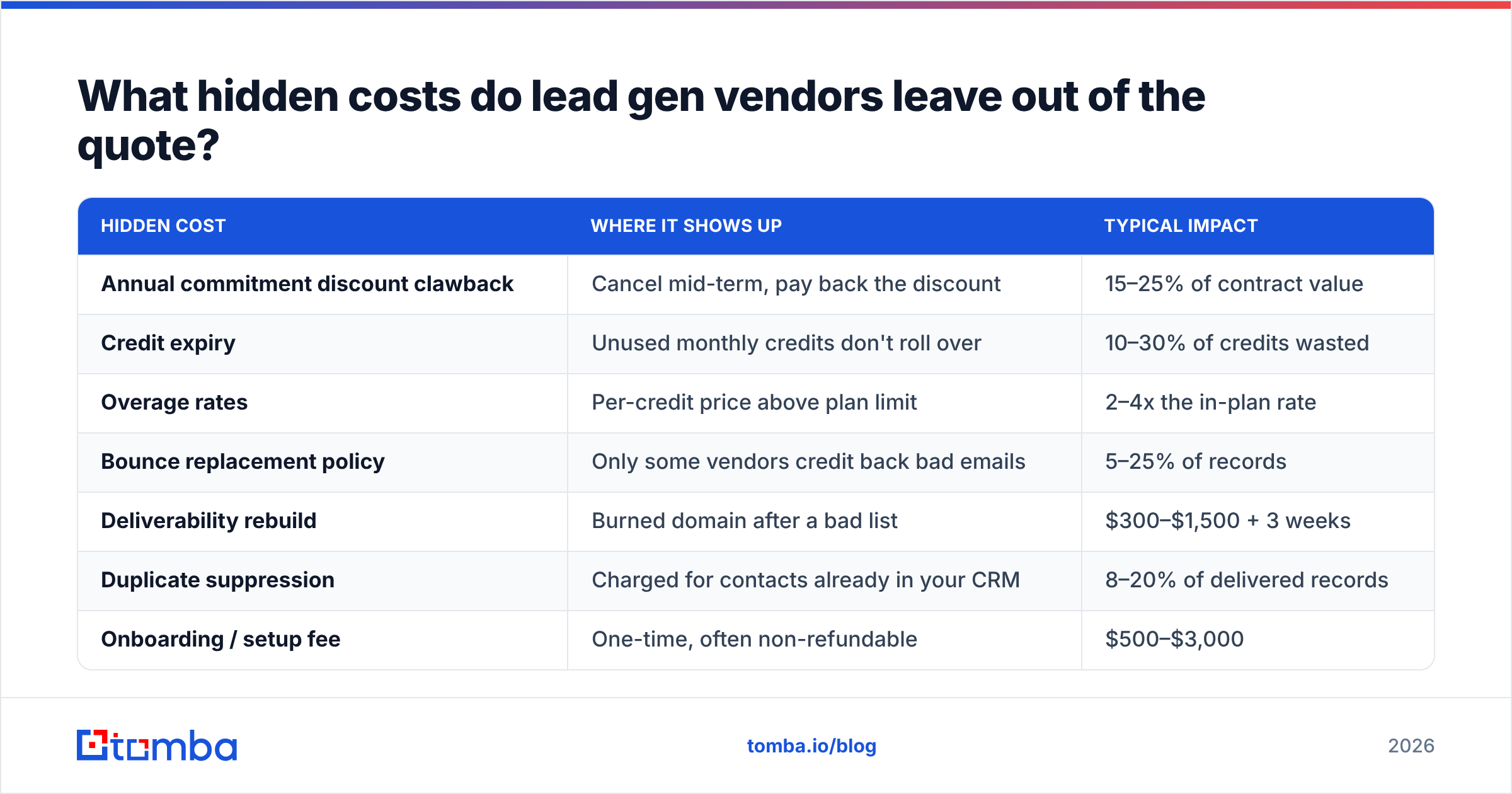
Every model has line items that don't appear until invoice two.
| Hidden cost | Where it shows up | Typical impact |
|---|---|---|
| Annual commitment discount clawback | Cancel mid-term, pay back the discount | 15–25% of contract value |
| Credit expiry | Unused monthly credits don't roll over | 10–30% of credits wasted |
| Overage rates | Per-credit price above plan limit | 2–4x the in-plan rate |
| Bounce replacement policy | Only some vendors credit back bad emails | 5–25% of records |
| Deliverability rebuild | Burned domain after a bad list | $300–$1,500 + 3 weeks |
| Duplicate suppression | Charged for contacts already in your CRM | 8–20% of delivered records |
| Onboarding / setup fee | One-time, often non-refundable | $500–$3,000 |
| Minimum contract length | 6–12 months typical for agencies | Locks in a failed test |
Two of those deserve special attention.
Credit expiry is the quiet one. If you buy 10,000 credits a month and use 6,500, most vendors let the remainder evaporate. Over a year that's 42,000 credits you paid for and never touched. Always ask whether credits roll over and for how long before you compare plan prices — a $79 plan with rollover can beat a $49 plan without it.
Deliverability rebuild is the expensive one. Send to an unverified list, hit a spam trap cluster, and you're not just out the cost of the list — you're out the domain. Rebuilding sender reputation takes weeks, and the opportunity cost of a paused outbound motion dwarfs the price of verification. The email deliverability math here is brutal and asymmetric: verification costs cents per record, recovery costs thousands.
How do the main pricing tiers compare across vendor types?#
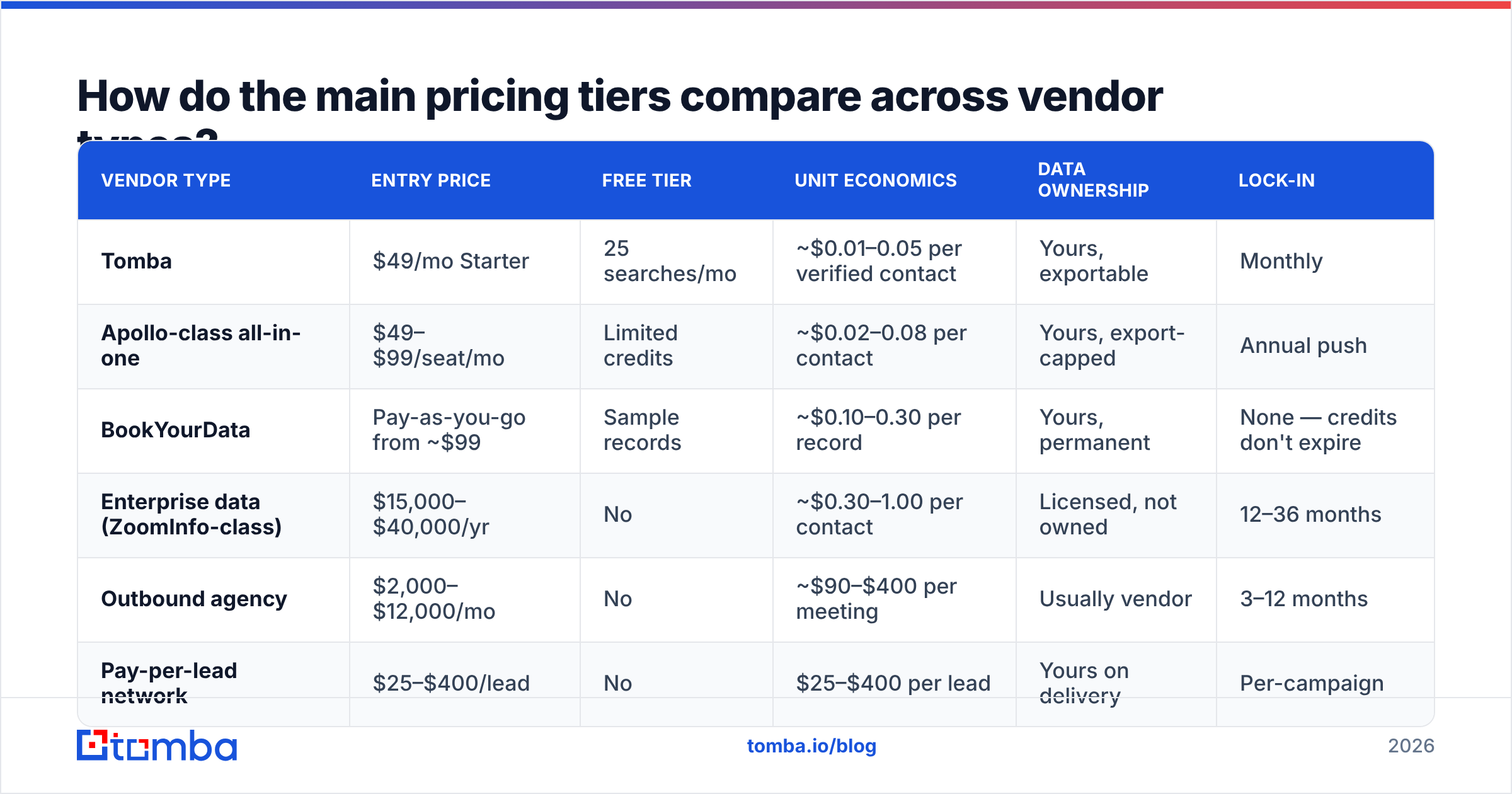
Here's what the market actually charges at entry level in 2026, normalized where possible.
| Vendor type | Entry price | Free tier | Unit economics | Data ownership | Lock-in |
|---|---|---|---|---|---|
| Tomba | $49/mo Starter | 25 searches/mo | ~$0.01–0.05 per verified contact | Yours, exportable | Monthly |
| Apollo-class all-in-one | $49–$99/seat/mo | Limited credits | ~$0.02–0.08 per contact | Yours, export-capped | Annual push |
| BookYourData | Pay-as-you-go from ~$99 | Sample records | ~$0.10–0.30 per record | Yours, permanent | None — credits don't expire |
| Enterprise data (ZoomInfo-class) | $15,000–$40,000/yr | No | ~$0.30–1.00 per contact | Licensed, not owned | 12–36 months |
| Outbound agency | $2,000–$12,000/mo | No | ~$90–$400 per meeting | Usually vendor | 3–12 months |
| Pay-per-lead network | $25–$400/lead | No | $25–$400 per lead | Yours on delivery | Per-campaign |
A note on BookYourData: its pay-as-you-go model with non-expiring credits is genuinely the right structure for teams with lumpy demand — if you prospect hard in Q1 and go quiet in Q2, a subscription penalizes you and credits that never expire don't. Different shape of problem, different right answer.
The enterprise row is where most budget waste lives. A $30,000/year contract for a five-person sales team works out to $500/mo per seat before anyone sends an email. That's defensible at 50 seats with a dedicated RevOps function. At five seats, you're buying a Ferrari to drive to the mailbox.
When does in-house lead generation beat buying leads?#
Run this decision in order. The threshold is usually clearer than people expect.
- Have you validated the offer? If you've never closed a deal from cold outreach, don't buy a $5,000/mo retainer to find out. Spend $49–$99 on tooling, send 200 emails yourself, and read the replies. You'll learn more in three weeks than any agency deck will tell you.
- Do you have a person with 10+ hours a week? Outbound is not a background task. Without dedicated time, in-house tooling becomes shelfware and the agency is the cheaper option despite the higher invoice.
- Is your ICP narrow or broad? Narrow ICPs (under 3,000 accounts) favor in-house — you can build the list manually and the data cost is trivial. Broad ICPs at volume favor managed data or DaaS.
- What's your ACV? Under $5,000 ACV, per-lead pricing above $75 rarely pencils out. Above $50,000 ACV, a $400 qualified appointment is a bargain.
- Do you need the data to persist? If contacts must live in your CRM permanently and be re-enriched later, you need ownership, not a license. Several enterprise contracts explicitly restrict what happens to records after you churn.
- How fast do you need pipeline? Pay-per-lead is the fastest to first conversation. In-house is the fastest to sustainable cost per conversation. Those aren't the same goal.
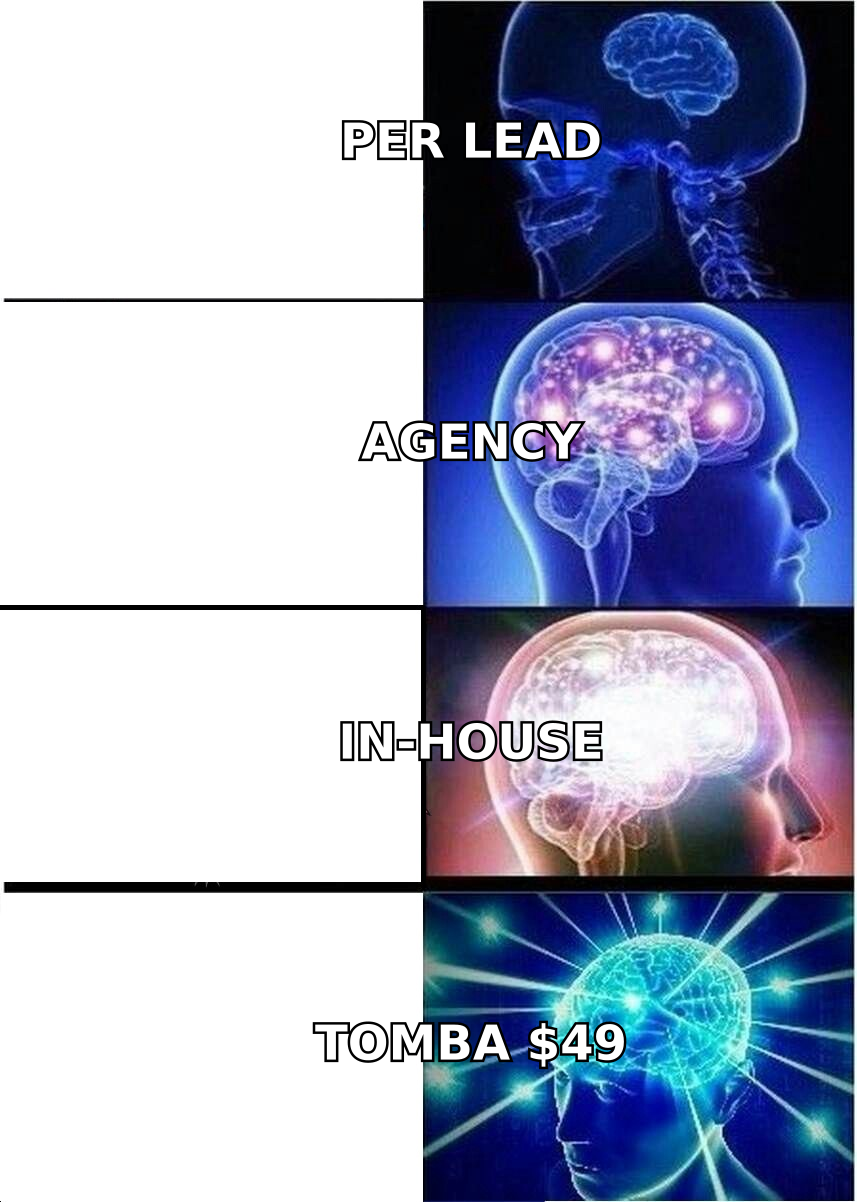
For most teams between $500K and $5M ARR, the answer is a hybrid: in-house data tooling plus one person, with pay-per-lead used tactically to test new segments before committing list-building effort.
What does the real cost per meeting look like?#
Normalize everything to cost per booked meeting and the comparison stops being mushy.
Assume a competent outbound motion: 3% positive reply rate on verified data, 40% of positive replies converting to a booked meeting.
In-house path. Tooling at $99/mo gets you roughly 5,000 verified contacts. One SDR at $4,500/mo sends to 2,000 of them. At 3% positive reply you get 60 replies, at 40% conversion you book 24 meetings. Total monthly cost: $4,599. Cost per meeting: $192.
Agency path. A $5,000/mo retainer at typical volumes delivers 8–15 meetings in a steady month. Cost per meeting: $333–$625. You save the management overhead and the hiring risk.
Pay-per-appointment path. $400 per booked meeting, with a 20–30% no-show rate that most contracts don't credit back. Effective cost per held meeting: $500–$570.
Pay-per-lead path. 200 leads at $50 = $10,000, of which 106 are usable and perhaps 12% book. That's 13 meetings at $769 each — worse than everything else unless the lead quality is genuinely higher than the market average.
In-house wins on cost per meeting in almost every scenario where you can actually staff it. The catch is the word "competent." That 3% positive reply rate assumes verified data, working SPF records, warmed domains, and copy that isn't generic. Miss any of those and the in-house number degrades fast — which is precisely why agencies stay in business.
For teams running the in-house path at volume, the bulk email finder and API-driven enrichment matter more than the per-seat price, since throughput rather than seat count becomes the constraint.
How should you negotiate lead generation pricing?#
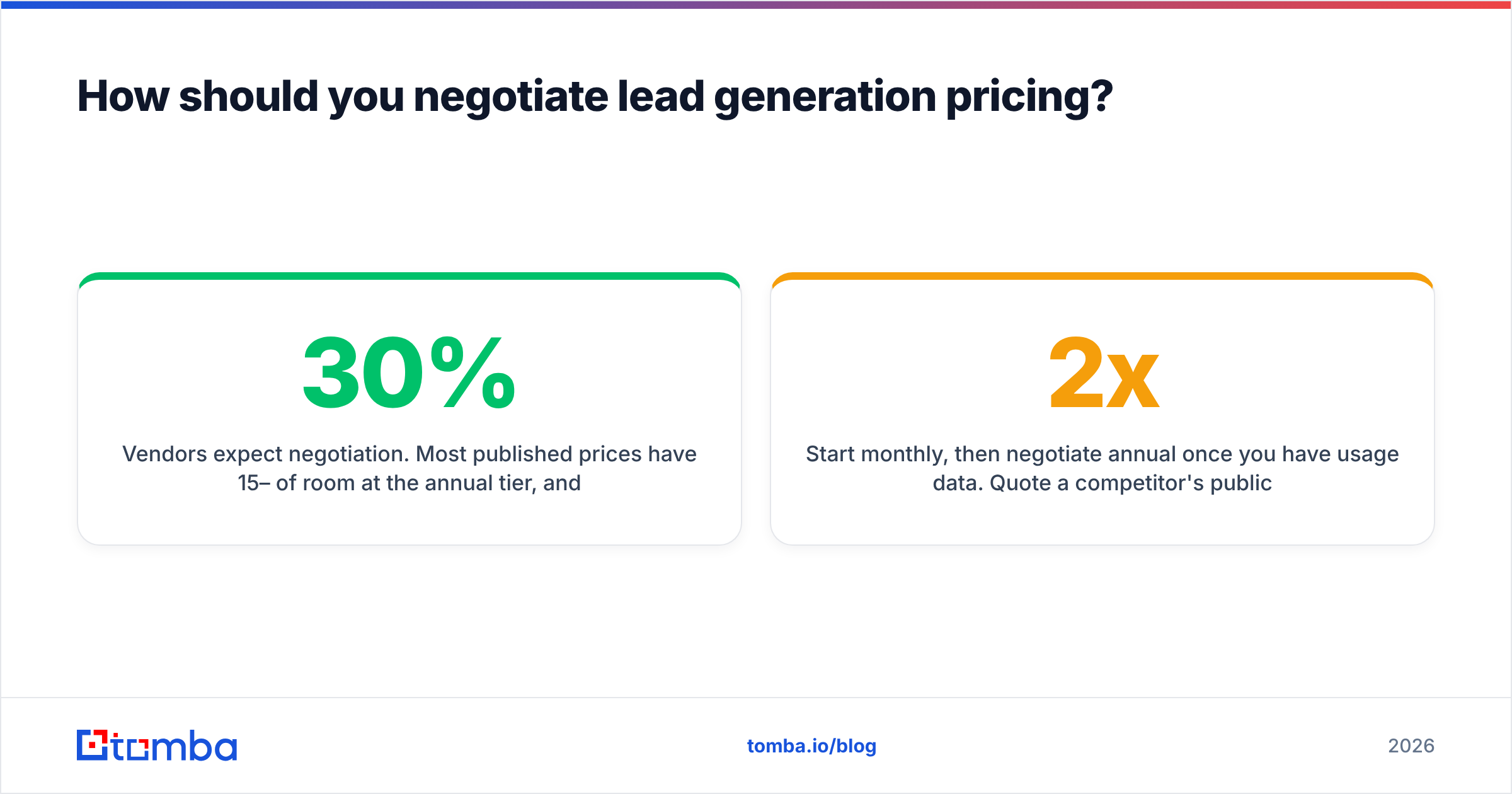
Vendors expect negotiation. Most published prices have 15–30% of room at the annual tier, and the terms are often more negotiable than the number.
Ask for these before discussing price:
- Bounce replacement policy in writing — what percentage triggers a credit, and how fast
- Credit rollover window (3 months is a reasonable ask, 12 is generous)
- A 30-day out on the first term, even if the contract is annual
- Suppression list honoring — they must exclude contacts already in your CRM at no charge
- Data export rights post-termination, spelled out explicitly
Leverage points that work:
Start monthly, then negotiate annual once you have usage data. Quote a competitor's public pricing — most vendors will match rather than lose the deal. Ask for the credits, not the discount: vendors protect headline price more than volume, so "same price, 2x credits" often closes faster than "20% off."
Red flags worth walking away from:
A vendor who won't quote per-record economics is hiding markup. A vendor with no free tier or trial doesn't trust their own data quality. A vendor who requires an annual commitment before you've sent a single email is transferring all the risk to you. And any "guaranteed leads" promise without a defined qualification standard is a promise to deliver rows in a spreadsheet, not pipeline.
Independent review data on G2 and Capterra is useful here, but read the 3-star reviews specifically — that's where billing surprises and data-quality complaints actually surface. HubSpot's research on cost per lead benchmarks is a reasonable sanity check on channel-level numbers before you accept a vendor's framing of what's "normal."
What's the cheapest credible way to start?#
Start with data, not services. The sequence that wastes the least money:
Build a list of 300 accounts that match your ICP by hand or with a domain-level search. Find and verify contacts at those accounts — this is the part that costs almost nothing at small volumes. Write three sequence variants yourself. Send 200 emails over two weeks from a warmed domain. Read every reply, including the rude ones.
Total spend: under $150. What you learn: whether your offer resonates, which persona answers, what objection comes up first, and what your realistic reply rate is. Those four data points are what every agency will spend your first two retainer months discovering — with your money.
Only after that should you scale, and the scaling decision becomes easy because you now have real numbers to plug into the cost-per-meeting math above.
If you want the data layer without the enterprise contract, start with the Tomba Email Finder — the free tier gives you 25 searches a month to validate the approach, and the $49/mo Starter plan covers a full first outbound test with verified contacts you own outright. No annual lock-in, no credit games, and no markup on data you could have licensed yourself.
Related guides#
// get started
Find, verify and enrich your first contacts today
Start on the free plan with 25 searches a month, then scale when your team is ready.
Free plan · No credit card required · GDPR & CCPA
Get the Tomba newsletter
Product and data updates
// about the author