The Lead Generation Process: A 7-Stage Framework for 2026
Most teams treat lead generation as one activity. It's actually seven stages, and the handoffs between them are where pipeline quietly dies. Here's the full framework with benchmarks.
TL;DR
- The lead generation process is seven stages: ICP definition, sourcing, enrichment, verification, scoring, outreach, and handoff. Most teams run four of them well and wonder why pipeline stalls.
- Stage 4 (verification) is where the money leaks. A 12% bounce rate on a cold list doesn't just waste sends — it damages the sending domain that every later campaign depends on.
- Conversion math compounds: a 10% improvement at each of five stages produces a 61% improvement end to end. Fixing one stage in isolation rarely moves the number.
- Cost per qualified lead is the only metric that survives channel changes. Track it per stage, not just at the end.
- Tooling matters less than sequencing. Running enrichment before ICP definition is the single most common — and most expensive — ordering mistake.
What Is the Lead Generation Process?#
The lead generation process is the repeatable sequence a revenue team uses to turn an undefined market into a named, contactable, qualified buyer sitting in a sales rep's queue. It is not "running ads" or "sending cold email." Those are tactics that live inside one stage of it.
Here's the useful analogy: think of it like water treatment. Raw water goes in at one end, drinking water comes out the other, and there are distinct filtration stages in between. Skip the sediment filter and you clog the fine filter downstream. Skip chlorination and everything upstream was pointless. Lead generation works identically — each stage removes a specific kind of impurity, and the order is not negotiable.
Most organizations describe their process in two steps ("we generate leads, then we call them") and then discover that their SDRs spend 40% of their week on data cleanup. That gap between the described process and the actual process is where the diagnosis lives.
What Are the Seven Stages of the Lead Generation Process?#
- Define the ICP. Firmographics, technographics, trigger events, and — critically — disqualifiers. A written list of who you will not sell to is worth more than another persona deck.
- Source raw records. Databases, intent providers, LinkedIn, conference lists, website visitors, inbound forms. Output: company names and person names. Not contact data yet.
- Enrich. Attach the attributes you need to prioritize and personalize — headcount, funding, tech stack, role seniority, recent job change. This is where a raw name becomes a workable record.
- Verify. Confirm the email is real, deliverable, and not a spam trap. Confirm the phone connects. This is the stage teams skip most often and pay for most severely.
- Score and route. Rank by fit and intent, then assign. A marketing qualified lead that sits unrouted for 48 hours is functionally a lost lead.
- Sequence and engage. Multichannel outreach with a defined cadence, defined exit criteria, and defined reply handling.
- Hand off and close the loop. Push outcomes back into the ICP definition so stage 1 gets smarter every quarter.
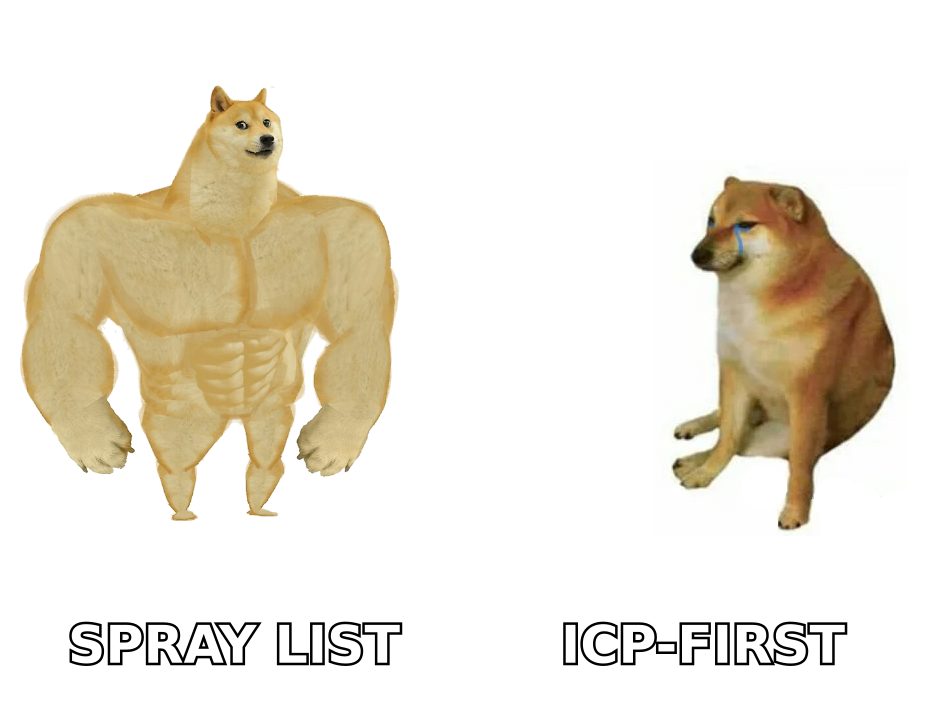
Stages 1 and 7 form a loop, not a line. Teams that never close the loop are running the same process on the same assumptions two years later, which is why their cost per lead keeps climbing while everyone insists nothing changed.
Which Stage Actually Breaks Most Often?#
Verification. Consistently, and by a wide margin.
The reason is structural: verification is the only stage whose failure damages other stages retroactively. Bad ICP work wastes effort. Bad enrichment wastes personalization. But bad verification produces bounces, bounces produce sender reputation damage, and damaged sender reputation means your next campaign — built on a perfectly clean list — lands in spam anyway.
The thresholds are not subjective. Google and Yahoo's bulk sender requirements set a hard spam complaint ceiling of 0.3%, and mailbox providers treat sustained bounce rates above roughly 2% as a strong negative signal. A list that hasn't been verified typically bounces somewhere between 8% and 25% depending on source age. You do not get to average that out over time.
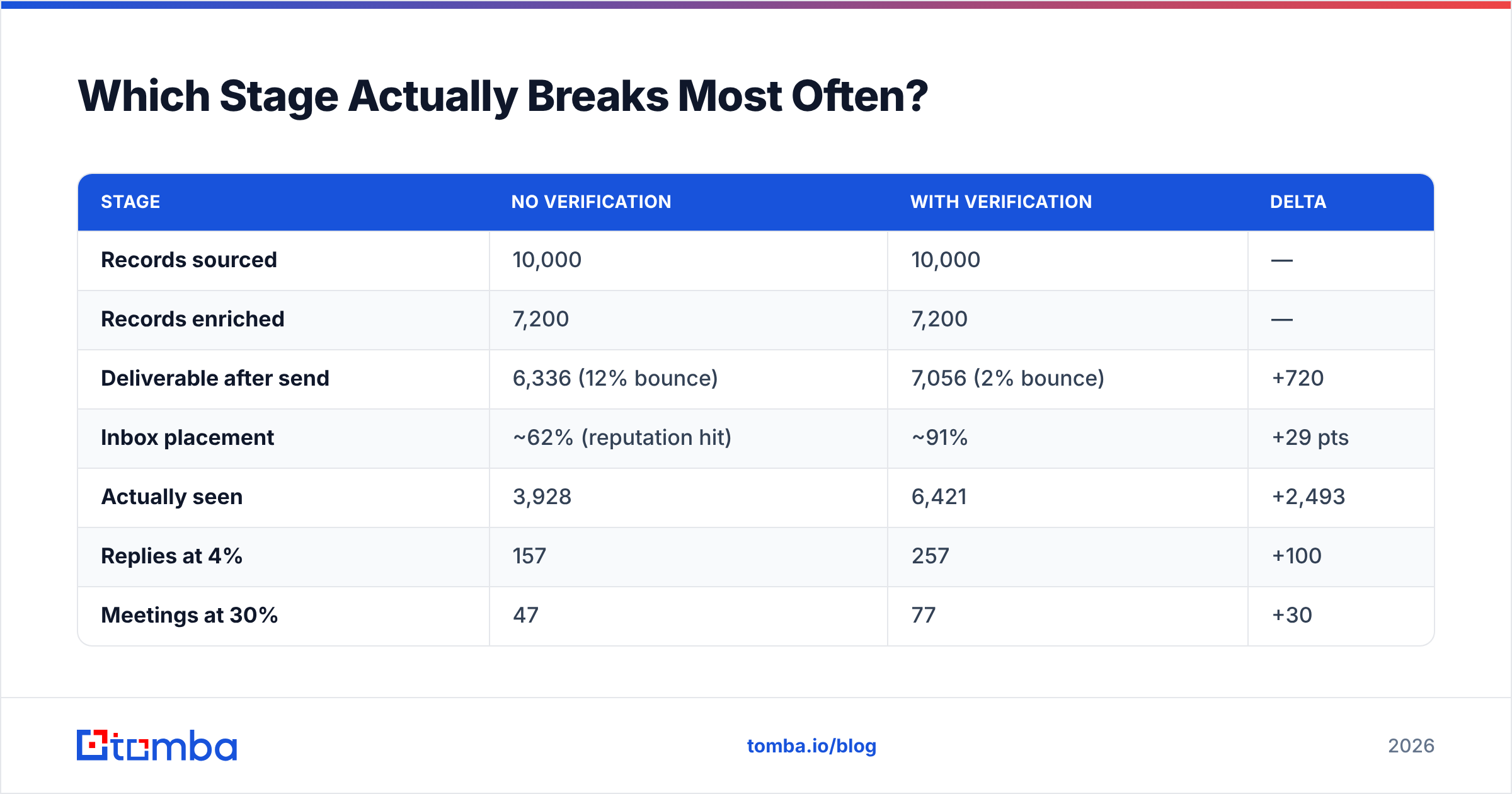
Here's the stage-by-stage leak math on a 10,000-record starting list, comparing a team that verifies against one that doesn't:
| Stage | No verification | With verification | Delta |
|---|---|---|---|
| Records sourced | 10,000 | 10,000 | — |
| Records enriched | 7,200 | 7,200 | — |
| Deliverable after send | 6,336 (12% bounce) | 7,056 (2% bounce) | +720 |
| Inbox placement | ~62% (reputation hit) | ~91% | +29 pts |
| Actually seen | 3,928 | 6,421 | +2,493 |
| Replies at 4% | 157 | 257 | +100 |
| Meetings at 30% | 47 | 77 | +30 |
Same list, same copy, same sender. The only variable is one filtration stage. Thirty extra meetings per 10,000 records is the difference between a channel that works and a channel that gets cut in the next budget review.
How Do You Build Stage 1 So the Rest of the Process Works?#
Write disqualifiers first. It feels backwards and it is the fastest way to a usable ICP.
A workable ICP definition has four components:
- Firmographic floor and ceiling. Not "SMB to enterprise." Specify: 50–500 employees, $5M–$80M revenue, US/UK/DACH. Ranges with edges, because edges are what your sourcing queries actually consume.
- Trigger events that create urgency. Funding round, new VP in a relevant function, a compliance deadline, a competitor's product sunset. Without a trigger, you are selling to a company that has no reason to act this quarter.
- Technographic qualifiers. What must already be in their stack for your product to be installable and valuable. This is the single highest-leverage filter for technical products.
- Explicit disqualifiers. Industries you can't serve for compliance reasons, company sizes where your pricing breaks, geographies you can't support. Put them in writing and enforce them in the sourcing query.
Run this against your last 40 closed-won deals before you run it against the market. If your stated ICP doesn't describe the customers you already won, the ICP is aspirational, not operational.
What Does Stage 3 Enrichment Actually Need to Produce?#
Enough to make stage 5 scoring possible and stage 6 personalization non-generic. That's it. Enrichment is not a data-hoarding exercise — every field you attach is a field someone has to maintain.
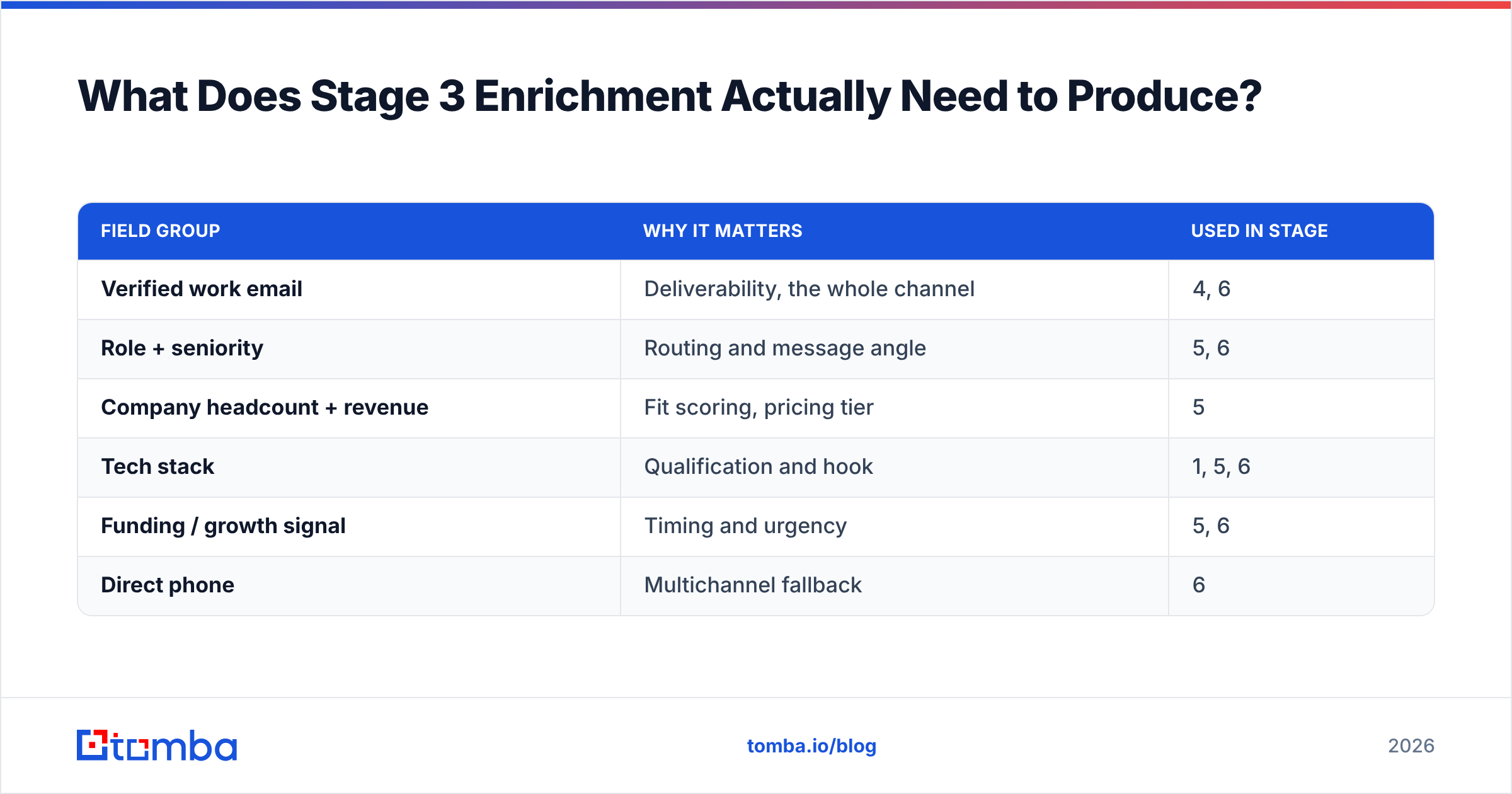
The practical minimum for a B2B outbound motion:
| Field group | Why it matters | Used in stage |
|---|---|---|
| Verified work email | Deliverability, the whole channel | 4, 6 |
| Role + seniority | Routing and message angle | 5, 6 |
| Company headcount + revenue | Fit scoring, pricing tier | 5 |
| Tech stack | Qualification and hook | 1, 5, 6 |
| Funding / growth signal | Timing and urgency | 5, 6 |
| Direct phone | Multichannel fallback | 6 |
Note what's missing: personal social handles, birthdays, "hobbies." Personalization built on scraped trivia reads as surveillance, not research. Buyers notice.
For teams working from a domain rather than a name list, domain search inverts the workflow — you start from the account and pull every discoverable contact pattern at that company, which is materially faster than sourcing people first and matching companies second. If you're working the other direction and already have emails but no context, reverse email lookup fills in the person behind the address.
How Do You Compare Lead Generation Approaches?#
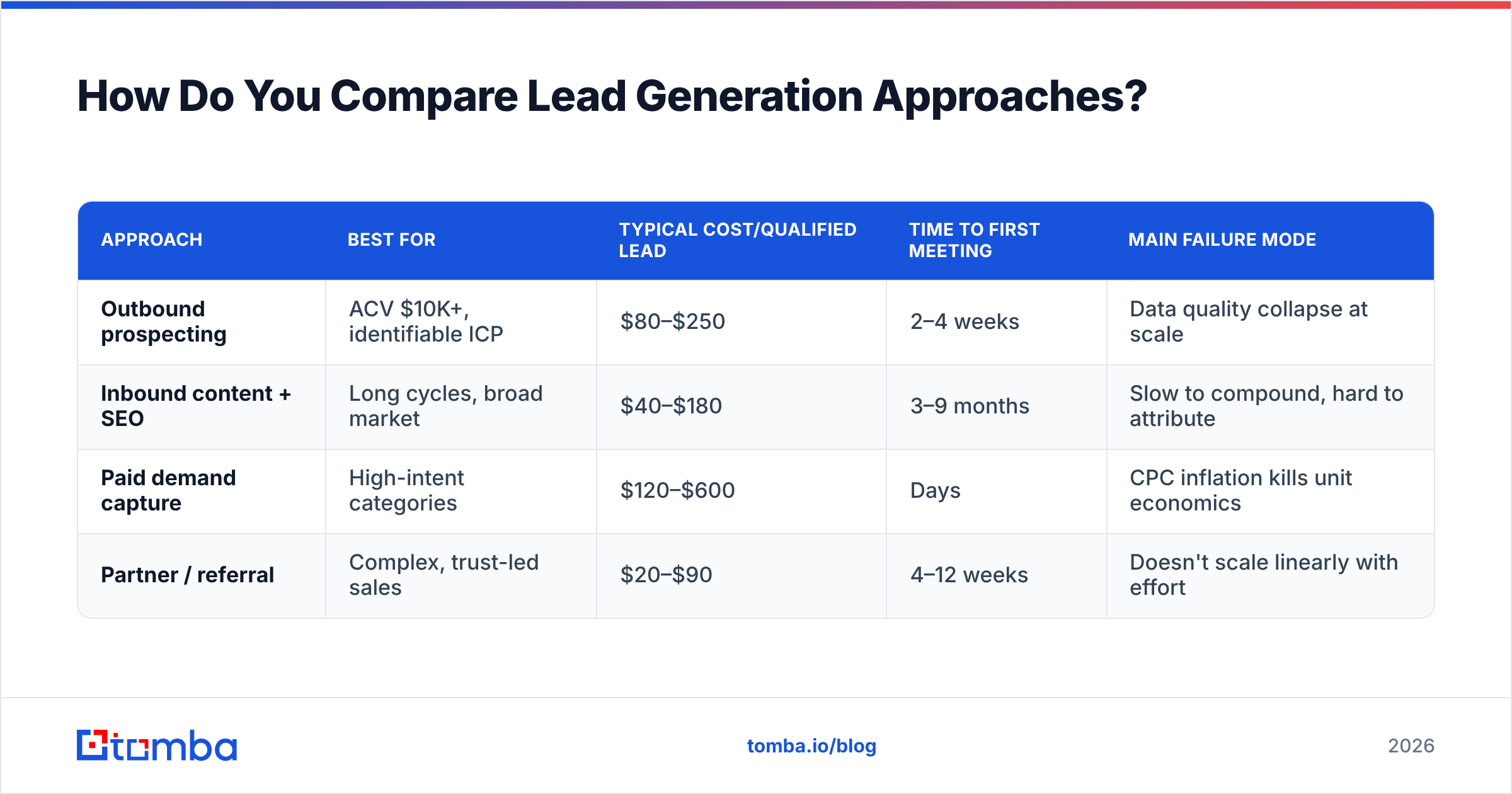
There is no single correct process shape. The right one depends on ACV, sales cycle length, and how identifiable your buyers are. Four common configurations:
| Approach | Best for | Typical cost/qualified lead | Time to first meeting | Main failure mode |
|---|---|---|---|---|
| Outbound prospecting | ACV $10K+, identifiable ICP | $80–$250 | 2–4 weeks | Data quality collapse at scale |
| Inbound content + SEO | Long cycles, broad market | $40–$180 | 3–9 months | Slow to compound, hard to attribute |
| Paid demand capture | High-intent categories | $120–$600 | Days | CPC inflation kills unit economics |
| Partner / referral | Complex, trust-led sales | $20–$90 | 4–12 weeks | Doesn't scale linearly with effort |
Most functioning revenue teams run two of these simultaneously and treat the third as an experiment. Running all four at 25% effort produces four mediocre channels and no learning. G2's buyer behavior research consistently shows buyers arriving through multiple touchpoints, which is an argument for channel overlap — not for channel dilution.
What Metrics Should You Track at Each Stage?#
Stage-level metrics, not just funnel-end metrics. If you only track cost per meeting, you know something is broken but not where.
- Stage 2 — Source match rate. Of records sourced, what percentage match the full ICP definition including disqualifiers? Below 60% means your sourcing query is too loose.
- Stage 3 — Enrichment coverage. Percentage of records with all required fields populated. Below 70% and your scoring model is running on guesses.
- Stage 4 — Verified deliverable rate. Percentage passing verification. This is your data supplier's report card. Below 85% means change suppliers.
- Stage 5 — Routing latency. Median minutes from qualification to rep assignment. Harvard Business Review's classic lead response study found contact odds drop off a cliff after the first hour; nothing since has contradicted it.
- Stage 6 — Reply rate and positive reply rate. Track both. A 9% reply rate that's 80% negative is worse than a 4% reply rate that's 50% positive.
- Stage 7 — Closed-won ICP match. Of deals closed, what percentage matched the stated ICP? Divergence here is your stage 1 correction signal.
The compounding argument is worth stating plainly. Improve five stages by 10% each and end-to-end throughput rises 61%, not 10%. That's why process work beats tactic work — and why the team optimizing subject lines while running a 12% bounce rate is solving the wrong problem.
What Tooling Does Each Stage Require?#
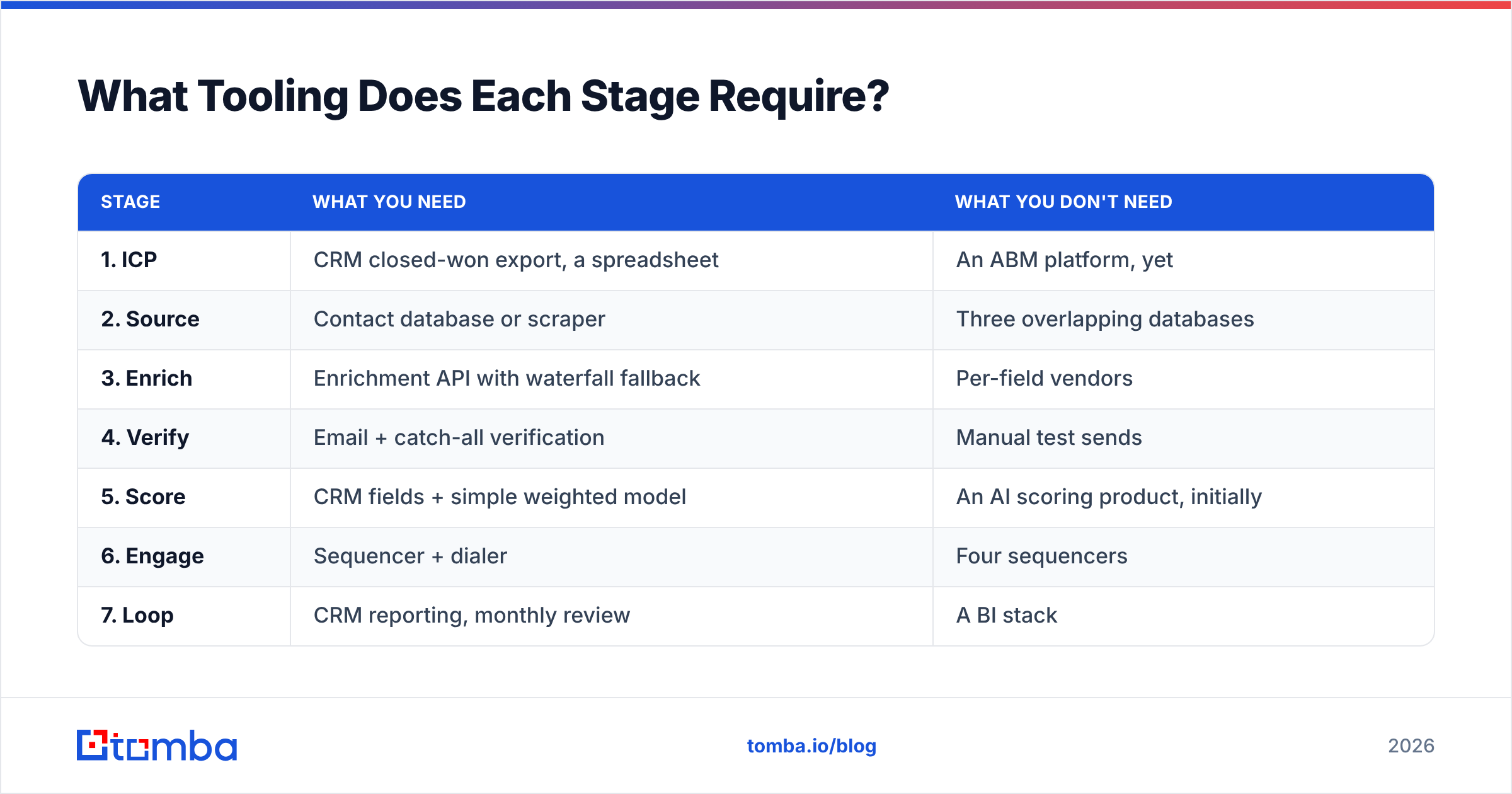
Fewer tools than most stacks contain. A common failure is buying a platform per stage and then spending the year on integration work instead of pipeline.
| Stage | What you need | What you don't need |
|---|---|---|
| 1. ICP | CRM closed-won export, a spreadsheet | An ABM platform, yet |
| 2. Source | Contact database or scraper | Three overlapping databases |
| 3. Enrich | Enrichment API with waterfall fallback | Per-field vendors |
| 4. Verify | Email + catch-all verification | Manual test sends |
| 5. Score | CRM fields + simple weighted model | An AI scoring product, initially |
| 6. Engage | Sequencer + dialer | Four sequencers |
| 7. Loop | CRM reporting, monthly review | A BI stack |
Two practical notes. First, catch-all domains — where the mail server accepts everything and validates nothing — are the genuinely hard case; a standard verifier returns "unknown" and teams either discard good contacts or send blindly. A dedicated catch-all verifier resolves a meaningful share of those. Second, if your process runs at volume, do stages 3 and 4 as a batch job rather than record-by-record. A bulk email finder workflow that processes a 5,000-row CSV overnight costs a fraction of what the same volume costs through per-record UI lookups, both in credits and in analyst hours.
On sourcing: general-purpose databases like Apollo, ZoomInfo, and BookYourData each index the market differently, and none has complete coverage. BookYourData in particular does well on verified B2B records in niches where the big aggregators thin out. The realistic answer is that one source gets you 50–70% coverage of any given ICP, and the remainder comes from a second source or from pattern-based discovery at the domain level.
How Do You Fix a Broken Lead Generation Process?#
Diagnose in reverse order. Start at stage 7 and walk backwards until you find the first stage where the numbers stop making sense.
A four-week sequence that works:
- Week 1 — Measure. Instrument every stage. Do not change anything. Most teams discover the bottleneck is not where they assumed.
- Week 2 — Fix the worst stage only. Single variable. If you change sourcing and copy simultaneously, you learn nothing from the result.
- Week 3 — Re-measure and confirm. Give the fix a full cycle. Reply rates in particular are noisy over short windows.
- Week 4 — Move to the next-worst stage. Repeat.
Resist the rebuild instinct. Teams that tear the whole process down and start fresh lose their baseline, and without a baseline you cannot tell whether the new process is better or just newer.
One more thing about stage 4, since it's the recurring culprit: verification decays. A list verified in January is not a verified list in June — roughly 2–3% of B2B contacts change jobs monthly, which compounds to meaningful rot over two quarters. Build re-verification into the cadence rather than treating it as a one-time cleanup. Running the list through an email verifier before each major campaign is cheaper than one reputation recovery.
Where Should You Start?#
Start where the leak is largest, which for most teams reading this is the gap between stage 3 and stage 5 — records that are enriched but never actually verified before they hit a sequence.
If you want to test that claim on your own data, take your last campaign's list, run it through verification, and compare the deliverable rate against the bounce rate you actually experienced. The gap is your annual loss rate, and it's usually larger than anyone expects.
Tomba's Email Finder covers stages 2 through 4 in one pass — discovery, pattern-based finding, and verification before the record ever reaches your sequencer. The free tier runs 25 searches a month, which is enough to audit a sample list and see your real deliverable rate; paid plans start at $49/mo on Starter, with Growth at $99/mo and Pro at $249/mo. Full Tomba pricing is public, and the Tomba API handles the same workflow programmatically if your process is already scripted. Fix stage 4 first — everything downstream of it gets cheaper.
Related guides#
// get started
Find, verify and enrich your first contacts today
Start on the free plan with 25 searches a month, then scale when your team is ready.
Free plan · No credit card required · GDPR & CCPA
// about the author