Lead Generation Service Pricing in 2026: What You Actually Pay
Agencies quote $2,000/mo, data vendors quote $0.03 a record, and appointment setters want $250 per meeting. Here is what each lead generation pricing model really costs once you do the math.
TL;DR
- Lead generation service pricing splits into five models: monthly retainer ($2,000–$15,000), per-lead ($15–$200+), per-appointment ($150–$500), per-qualified-opportunity ($800–$3,000), and raw data/tooling ($0–$500/mo).
- The number that matters is not the invoice — it's fully loaded cost per booked meeting. A $6,000 retainer that books 12 meetings costs $500 each; a $49/mo data tool plus 10 SDR hours a week can land under $120.
- Retainers hide setup fees, mailbox/domain costs, and 3–6 month lock-ins. Per-lead deals hide the definition of "lead" — often just a form fill or an exported contact row.
- Agencies rarely give you the data. If you churn, you leave with nothing. Owning your contact data is the single biggest cost lever in the whole category.
- Most teams under $5M ARR are better served by a data + sequencing stack ($150–$400/mo all-in) and one in-house SDR than by a mid-tier agency retainer.
Lead generation service pricing is deliberately confusing. Every vendor prices on a different unit — one sells hours, one sells contacts, one sells conversations, one sells "pipeline." Comparing them straight across is like comparing a taxi fare to a monthly transit pass to the cost of owning a car: the sticker numbers are incomparable until you convert everything to cost per trip.
This post does that conversion. Below you'll find real 2026 market ranges by model, the line items vendors leave out of the proposal, a break-even calculator you can run in five minutes, and an honest read on when paying an agency actually beats building in-house.
What Are the Main Lead Generation Pricing Models?#
There are five, and each one shifts risk between you and the vendor differently.
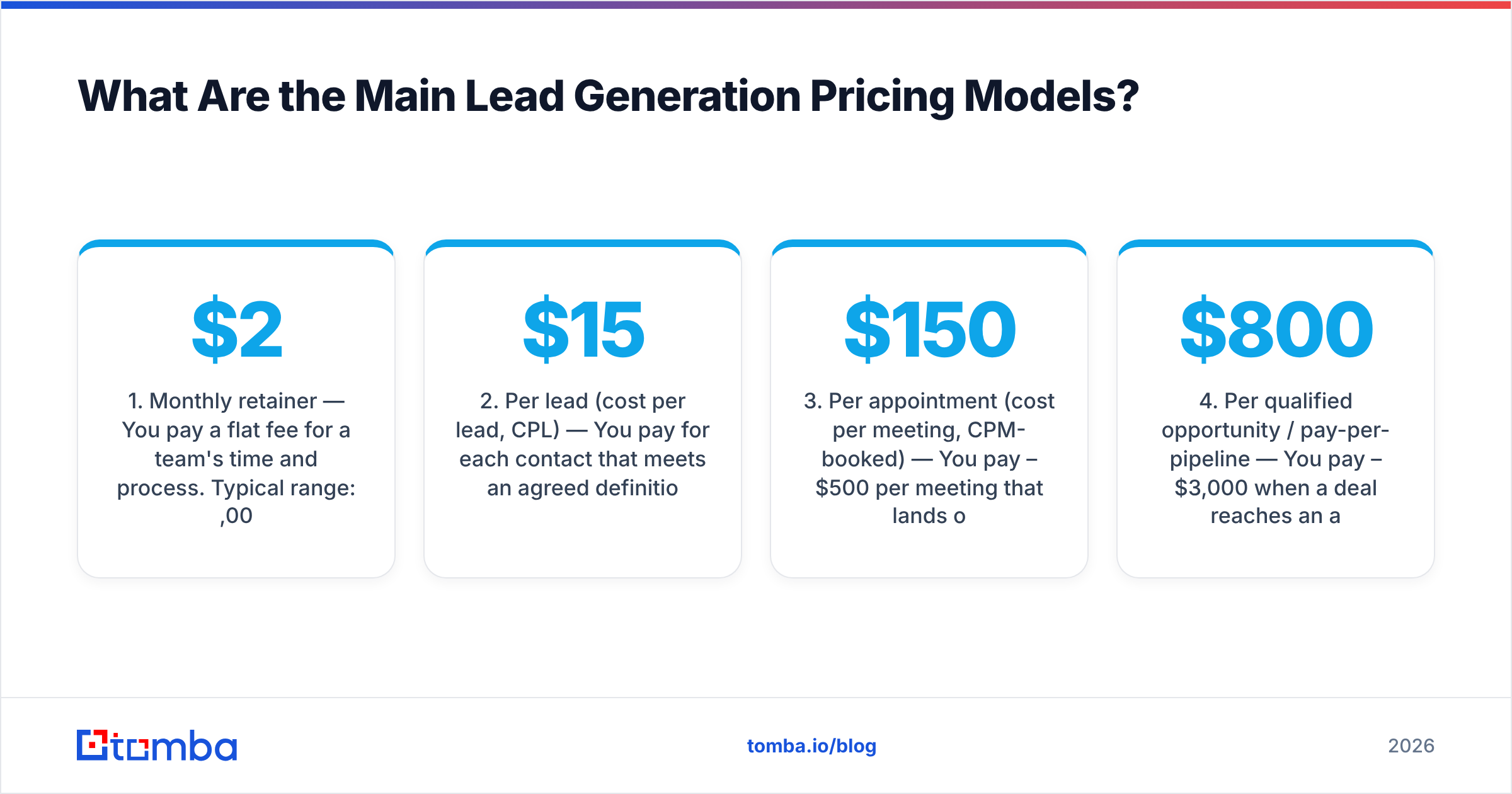
- Monthly retainer — You pay a flat fee for a team's time and process. Typical range: $2,000/mo for a solo freelancer or offshore shop, $4,000–$8,000/mo for a mid-market outbound agency, $10,000–$15,000+/mo for a full ABM or demand-gen firm. Risk sits almost entirely with you: you pay whether or not meetings happen.
- Per lead (cost per lead, CPL) — You pay for each contact that meets an agreed definition. B2B ranges from $15–$40 for a top-of-funnel content download, $50–$120 for a mid-market MQL, and $150–$400+ for regulated or enterprise verticals (fintech, healthcare, cybersecurity). Risk is shared, but the lead definition decides who's actually carrying it.
- Per appointment (cost per meeting, CPM-booked) — You pay $150–$500 per meeting that lands on a rep's calendar, sometimes with a smaller base retainer. SMB-targeted appointment setting clusters at $150–$250; enterprise targets run $400–$800. Risk is mostly the vendor's — until you read the no-show clause.
- Per qualified opportunity / pay-per-pipeline — You pay $800–$3,000 when a deal reaches an agreed stage (discovery completed, budget confirmed). Vendors offering this usually demand a base retainer too, and they cherry-pick clients with proven close rates.
- DIY data + tooling — You buy the inputs instead of the outcome: a contact database or email finder, a sequencer, and mailbox infrastructure. Software cost lands between $150 and $600/mo for a small team; the real cost is the human running it.
Nobody sells you one clean model. Most proposals in 2026 are hybrids — a $3,000 base plus $200 per meeting is the most common shape in mid-market outbound, and it exists because pure performance pricing bankrupted a lot of agencies in 2023–2024.
How Much Does Each Model Actually Cost?#
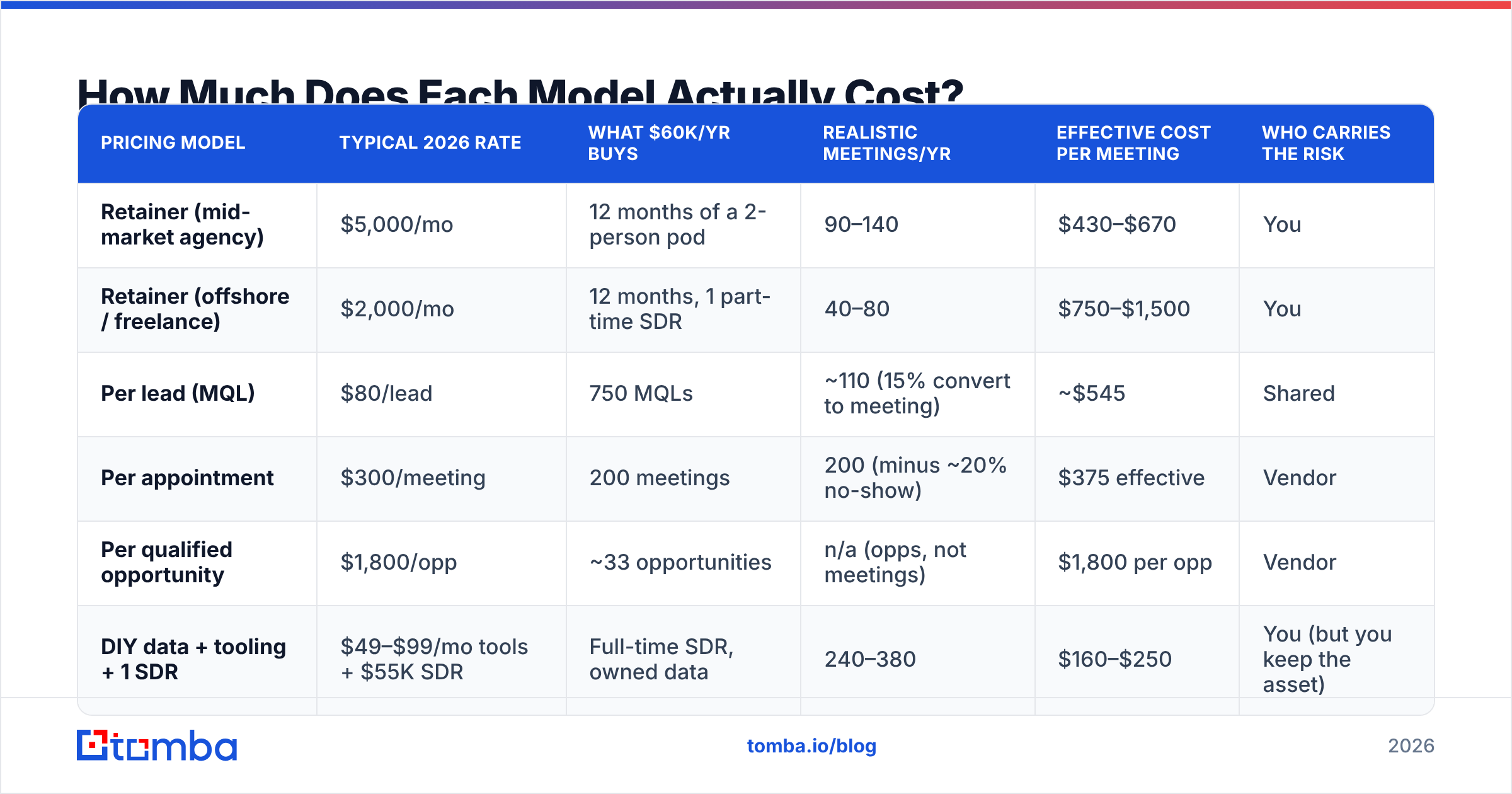
Here's the same $60,000 annual budget run through each model, assuming a B2B SaaS company selling a $12,000 ACV product with a 22% meeting-to-opportunity rate.
| Pricing model | Typical 2026 rate | What $60K/yr buys | Realistic meetings/yr | Effective cost per meeting | Who carries the risk |
|---|---|---|---|---|---|
| Retainer (mid-market agency) | $5,000/mo | 12 months of a 2-person pod | 90–140 | $430–$670 | You |
| Retainer (offshore / freelance) | $2,000/mo | 12 months, 1 part-time SDR | 40–80 | $750–$1,500 | You |
| Per lead (MQL) | $80/lead | 750 MQLs | ~110 (15% convert to meeting) | ~$545 | Shared |
| Per appointment | $300/meeting | 200 meetings | 200 (minus ~20% no-show) | $375 effective | Vendor |
| Per qualified opportunity | $1,800/opp | ~33 opportunities | n/a (opps, not meetings) | $1,800 per opp | Vendor |
| DIY data + tooling + 1 SDR | $49–$99/mo tools + $55K SDR | Full-time SDR, owned data | 240–380 | $160–$250 | You (but you keep the asset) |
Two things jump out of that table.
First, per-appointment pricing looks best on paper and usually isn't, because the meeting quality varies wildly. A vendor paid per booked calendar slot optimizes for booked calendar slots. Ask any RevOps lead who has audited an appointment-setting engagement: show rates of 60–75% and "wrong persona entirely" rates above 20% are normal. Adjust for that and $300 per meeting becomes $500+ per meeting that matters.
Second, the DIY row wins on unit economics and loses on speed. You need 60–90 days to hire, ramp, and dial in messaging. An agency is producing in week three. If you need pipeline this quarter and you have budget but not headcount, the agency premium is buying you time, not efficiency. That's a legitimate purchase — just know that's what you're buying.
What Do Lead Generation Vendors Not Put in the Proposal?#
The quoted number is rarely the number you pay. Budget for these:
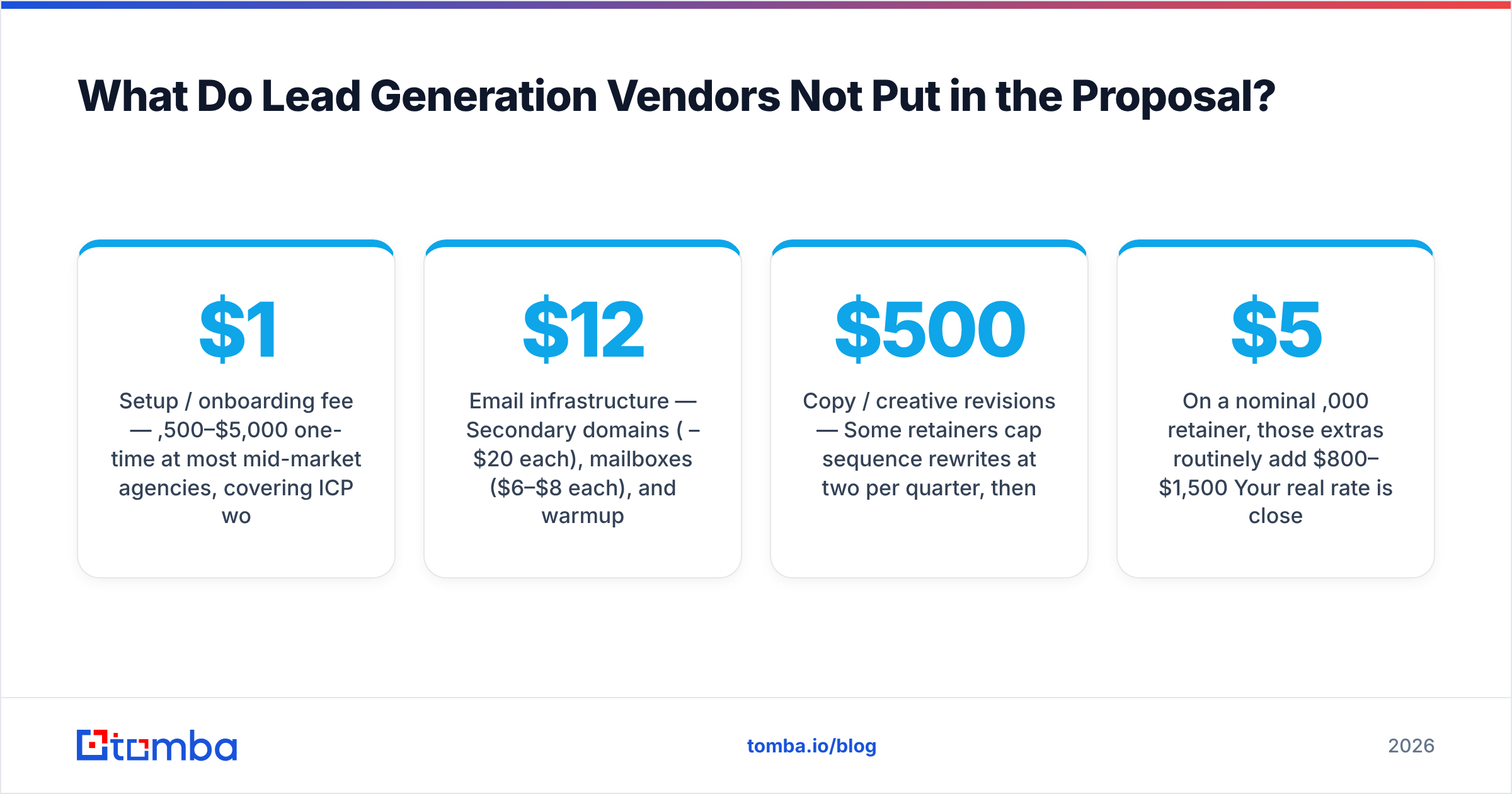
- Setup / onboarding fee — $1,500–$5,000 one-time at most mid-market agencies, covering ICP workshops, domain purchases, and sequence builds. Often non-refundable even if you cancel in month two.
- Email infrastructure — Secondary domains ($12–$20/yr each), mailboxes ($6–$8/mo each), and warmup tooling ($30–$100/mo). A serious outbound program runs 10–30 mailboxes. That's $200–$400/mo that many agencies pass through at cost plus margin.
- Data / enrichment credits — Some agencies bill their contact-data spend back to you, often at 2–3x their actual rate. Ask explicitly whether data is included and at what volume.
- Minimum term — Three months is standard; six is common; twelve exists. Outbound genuinely takes 8–12 weeks to produce signal, so a short term is a red flag too. But a twelve-month lock with no performance out is just a loan you're giving the vendor.
- List ownership — The expensive one. If the contract says the agency retains the prospect data, you are renting your own market. When you leave, the list leaves.
- Copy / creative revisions — Some retainers cap sequence rewrites at two per quarter, then bill $500+ per additional revision cycle.
On a nominal $5,000/mo retainer, those extras routinely add $800–$1,500/mo. Your real rate is closer to $6,200. Run every proposal through that adjustment before comparing.

How Do You Calculate Your Own Break-Even?#
Work backwards from revenue, not forwards from budget. Four numbers:
- Average contract value (ACV) — Say $12,000.
- Meeting-to-close rate — Say 8% (industry median for cold-sourced B2B meetings sits between 5% and 12%; your CRM knows the truth).
- Target CAC payback — Say you'll tolerate acquisition cost at 25% of first-year ACV, so $3,000 per customer.
- Meetings needed per customer — 1 ÷ 0.08 = 12.5 meetings.
Maximum defensible cost per meeting = $3,000 ÷ 12.5 = $240.
Now re-read the table above. At $240, the per-appointment agency at $300/meeting is underwater before no-shows. The mid-market retainer at $430–$670 is deeply underwater. Only the DIY stack clears the bar — which is why so many companies with sub-$20K ACVs eventually bring outbound in-house.
Flip the ACV to $60,000 and the math inverts completely: maximum cost per meeting becomes $1,200, and almost every agency model works. This is the single determining variable. High ACV forgives expensive lead generation; low ACV does not. Any vendor who doesn't ask for your ACV and close rate in the first call is selling you activity, not outcomes.
For a sanity check on the downstream assumptions, it helps to have consistent definitions for what counts as a marketing qualified lead and how you measure response rate across channels. Vendors love definitional drift; a written definition in the SOW prevents most billing disputes.
Is a Lead Gen Agency Better Than Building In-House?#
Depends on three things: time pressure, ACV, and whether you have a repeatable message.
Hire an agency when:
- ACV exceeds ~$25,000, so cost per meeting has room.
- You need pipeline inside 30 days and can't hire that fast.
- You're testing a brand-new segment or geography and want someone else's learning curve.
- Your founders are still the best salespeople and their time is worth more than the retainer.
Build in-house when:
- ACV is under $15,000 and unit economics are tight.
- You already know what message works — you're scaling volume, not discovering product-market fit.
- Data ownership matters (competitive market, long sales cycles, repeat nurture).
- You expect to run outbound for more than 12 months. Past a year, the retainer almost always exceeds a loaded SDR salary plus tooling.
The hybrid most operators land on: run data and list-building in-house so you own the asset, and outsource only the labor-intensive top of funnel. You keep the B2B database and the domain expertise; the agency supplies volume. If you ever switch vendors, your prospect universe stays yours.
Worth noting on the data side: providers differ enormously in model as well as accuracy. Credit-based finders like Tomba charge per lookup, subscription databases like BookYourData sell verified contact lists outright with pay-as-you-go packs — a genuinely good fit when you want a static list you own immediately rather than an ongoing search API. Neither is universally better; it depends on whether your need is one-time volume or continuous, triggered enrichment. Check current buyer sentiment on G2's lead intelligence category before committing to either.
What Does the DIY Stack Actually Cost in 2026?#
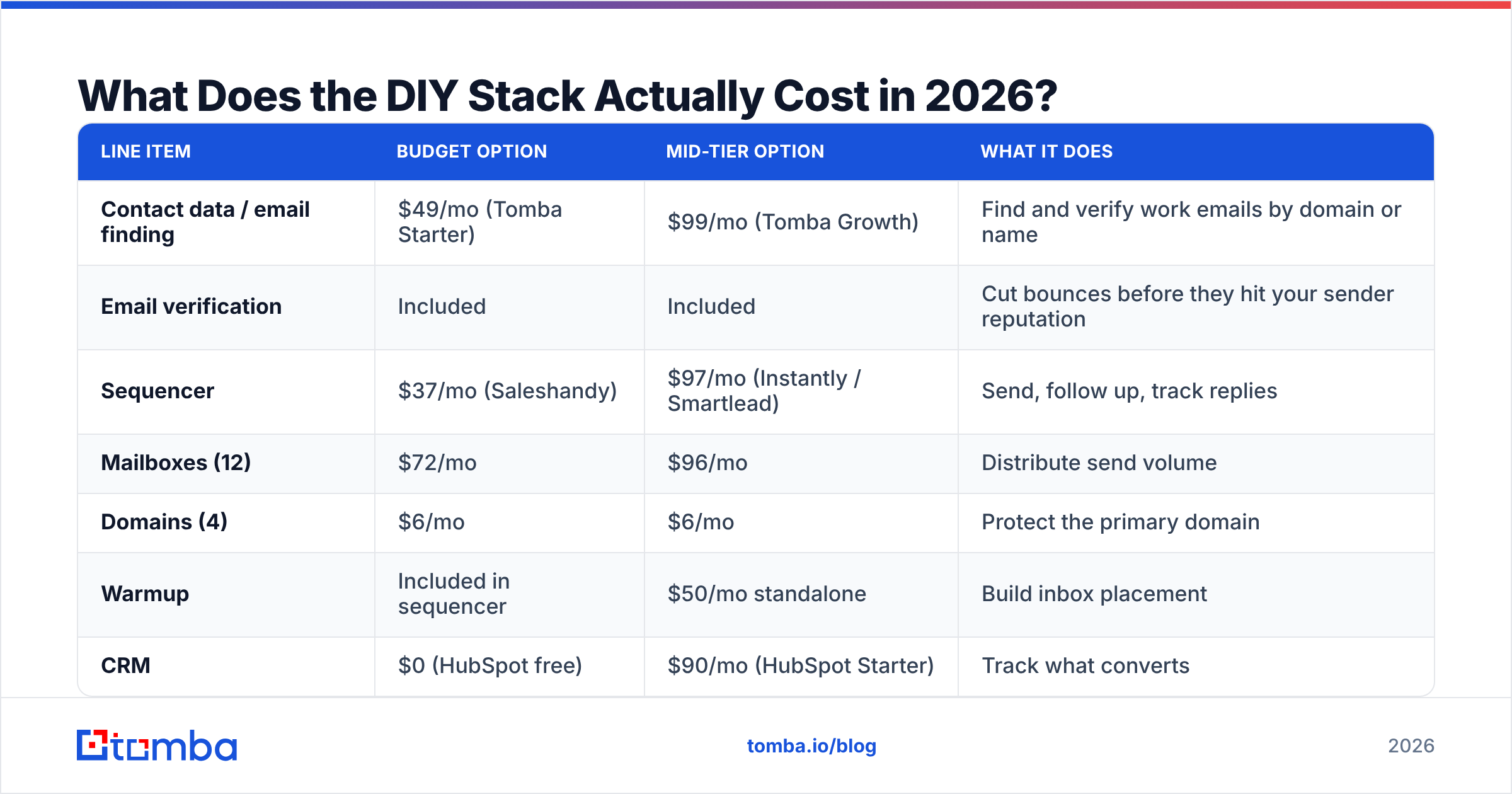
Here's a real line-item budget for a two-rep outbound team running roughly 3,000 contacts a month.
| Line item | Budget option | Mid-tier option | What it does |
|---|---|---|---|
| Contact data / email finding | $49/mo (Tomba Starter) | $99/mo (Tomba Growth) | Find and verify work emails by domain or name |
| Email verification | Included | Included | Cut bounces before they hit your sender reputation |
| Sequencer | $37/mo (Saleshandy) | $97/mo (Instantly / Smartlead) | Send, follow up, track replies |
| Mailboxes (12) | $72/mo | $96/mo | Distribute send volume |
| Domains (4) | $6/mo | $6/mo | Protect the primary domain |
| Warmup | Included in sequencer | $50/mo standalone | Build inbox placement |
| CRM | $0 (HubSpot free) | $90/mo (HubSpot Starter) | Track what converts |
| Monthly software total | ~$164 | ~$438 | — |
| Human cost (1 SDR, loaded) | $4,600/mo | $5,800/mo | The actual expense |
Software is 3–7% of the real cost. Everyone obsesses over tool pricing and then pays $5,000/mo for a rep who spends 40% of their week manually hunting contacts. The highest-leverage spend in that table is anything that gives the rep back hours — which is why bulk email finder workflows and CRM-native enrichment beat cheaper-but-manual alternatives even at 2x the license fee.
On the tooling side, Tomba pricing runs a free tier at 25 searches/mo, Starter at $49/mo, Growth at $99/mo, Pro at $249/mo, and custom Enterprise. The free tier is enough to validate whether your ICP is even findable before you commit budget anywhere — run 25 searches against your dream-100 account list and see what hit rate you get. If it's above 80%, in-house is viable. If it's under 50%, your segment may genuinely require a specialist data partner, and that changes the agency math.
How Should You Structure the Contract?#
Assume you're going with a vendor. Four clauses to negotiate before price:
- Data ownership. Insist that all contact, engagement, and reply data is yours, exported monthly in CSV, with no post-termination restriction. Non-negotiable. If they refuse, walk.
- Performance out. A 90-day initial term with a defined minimum (e.g., 20 qualified meetings in the first quarter) and a no-penalty exit if missed. Vendors confident in their process accept this; vendors selling hours resist it.
- Lead definition in writing. Persona titles, company size, geography, and what disqualifies. Attach it as an exhibit. Vague definitions are how a $200 meeting becomes a $200 no-show.
- Pass-through transparency. Infrastructure and data costs billed at cost, itemized, with receipts. Not "included in retainer" — that's where the margin hides.
Get those four and the headline rate matters much less. Most of the value destruction in lead gen contracts comes from structure, not price. HubSpot's own sales research on lead cost benchmarks and Gartner's B2B buying research both reinforce the same point: buyers now self-educate through most of the journey, so paying for volume at the top of funnel yields less than it did five years ago. Pay for precision instead.
What's the Cheapest Credible Path to First Pipeline?#
If you're starting from zero with under $1,000/mo to spend:
- Define 200 target accounts manually. Not 2,000. Two hundred you'd genuinely be thrilled to close.
- Find the decision-makers. Use domain search to pull the org structure per account, then verify before sending.
- Verify everything. A 3% bounce rate is the ceiling; above that your domain reputation degrades and every subsequent campaign suffers.
- Run 40 contacts a day across 4 mailboxes. Small volume, high personalization beats blast-and-pray at this stage.
- Measure cost per meeting from week one. You now have the number that makes every vendor quote comparable.
Do that for 60 days and you'll know your real cost per meeting. Take that number into any agency conversation and the negotiation changes completely — you're no longer buying on vibes, you're buying against a benchmark you generated yourself.
Start with the data layer, because it's the cheapest part and the part you keep. Tomba's Email Finder gives you 25 free searches a month to test your ICP's findability, with verification built in so you're not paying for bounces — and every contact you pull stays yours whether you end up hiring an agency or never speaking to one.
Related guides#
// get started
Find, verify and enrich your first contacts today
Start on the free plan with 25 searches a month, then scale when your team is ready.
Free plan · No credit card required · GDPR & CCPA
// about the author