Lead Generation Sources: 12 Channels Ranked for 2026
Not all lead generation sources are worth your budget. Here is a neutral, numbers-first breakdown of 12 channels — what each really costs per qualified lead, how fast it ramps, and when it quietly stops working.
TL;DR
- A lead generation source is anything that produces a contact record you can act on. There are only three families: owned, earned, and bought. Everything else is a subcategory.
- Cost per qualified lead varies roughly 30x across sources — from about $8 on a well-run outbound motion to $250+ on paid search in crowded B2B categories.
- Speed and cost trade off hard. Outbound and paid ads produce pipeline in weeks; SEO, community, and referrals are cheaper per lead but take 6–12 months to compound.
- The source rarely fails. The data layer under it does. Unverified contacts inflate bounce rates, wreck sender reputation, and make a good channel look broken.
- Most teams under $5M ARR should run two sources properly instead of seven badly: one fast (outbound or paid), one compounding (SEO, partnerships, or community).
What counts as a lead generation source?#
A lead generation source is any repeatable system that hands you a named human, at a named company, with enough context to start a conversation. That definition is deliberately narrow. A webinar that produces 400 anonymous registrations from free-email addresses is not a source — it is an audience. A source ends in a record you can route, score, and contact.
Every source you will ever evaluate falls into one of three buckets:
- Owned sources — your website, blog, product-led signups, newsletter, customer base, and existing CRM. You control the asset and the cost is mostly your own time. Slow to build, cheapest at scale.
- Earned sources — referrals, partner introductions, review-site listings, community presence, podcasts, and PR. You do not control distribution, so volume is lumpy, but intent is the highest of any category.
- Bought sources — paid search, paid social, sponsorships, list purchases, intent data, and contact databases. Instant volume, linear cost, zero compounding. Turn off the spend and the leads stop the same day.
- Built sources — the hybrid most B2B teams actually live in: you define an ideal customer profile, build the target list yourself from public and licensed data, then enrich and verify it. This is outbound prospecting done properly, and it behaves like a bought source on speed and an owned source on cost curve.
The reason this taxonomy matters is budgeting. Owned and earned sources need patience and headcount. Bought sources need cash. Built sources need data quality — which is where most teams lose the money they think they are saving.

Why do most lead generation source lists mislead you?#
Because they count leads, not conversations.
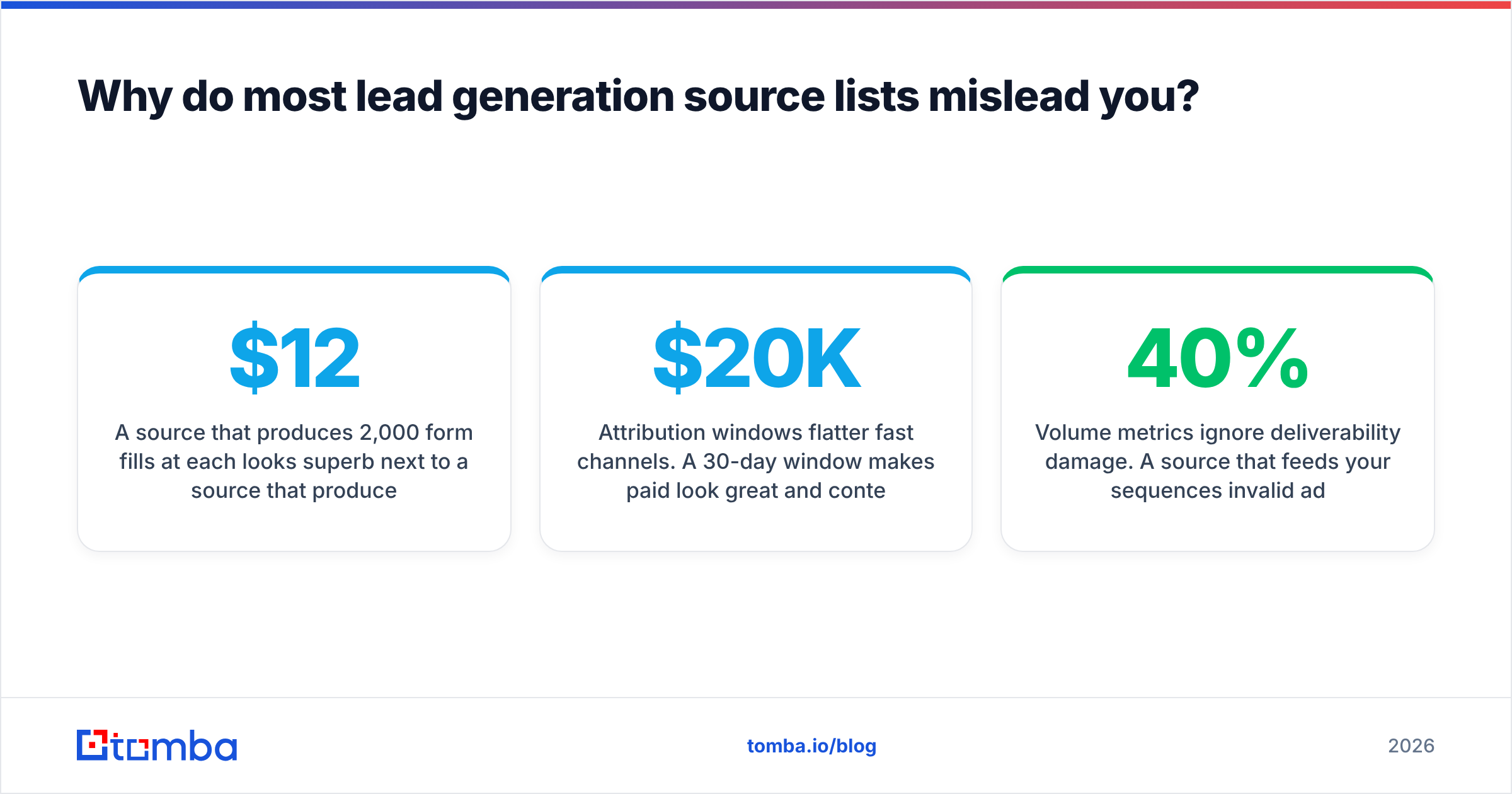
A source that produces 2,000 form fills at $12 each looks superb next to a source that produces 90 contacts at $40 each. But if 71% of the form fills are students, competitors, and role-based inboxes, and 78% of the 90 contacts are decision-makers who reply, the expensive source is roughly four times cheaper per meeting. Gartner's sales research has been making the same point for years: B2B buying groups now average six to ten people, so a single unqualified contact inside a target account is worth far less than one mapped stakeholder.
Three distortions to watch for when you read any ranking, including this one:
- Blended CAC hides the free riders. Branded search and direct traffic get credited to "SEO" or "paid" when they were actually produced by a podcast, a partner, or a sales rep who called six months ago.
- Attribution windows flatter fast channels. A 30-day window makes paid look great and content look dead. Most B2B deals with a $20K+ ACV take longer than that to even open.
- Volume metrics ignore deliverability damage. A source that feeds your sequences 40% invalid addresses is not neutral — it is actively degrading every other email you send from that domain.
Which lead generation sources actually perform in 2026?#
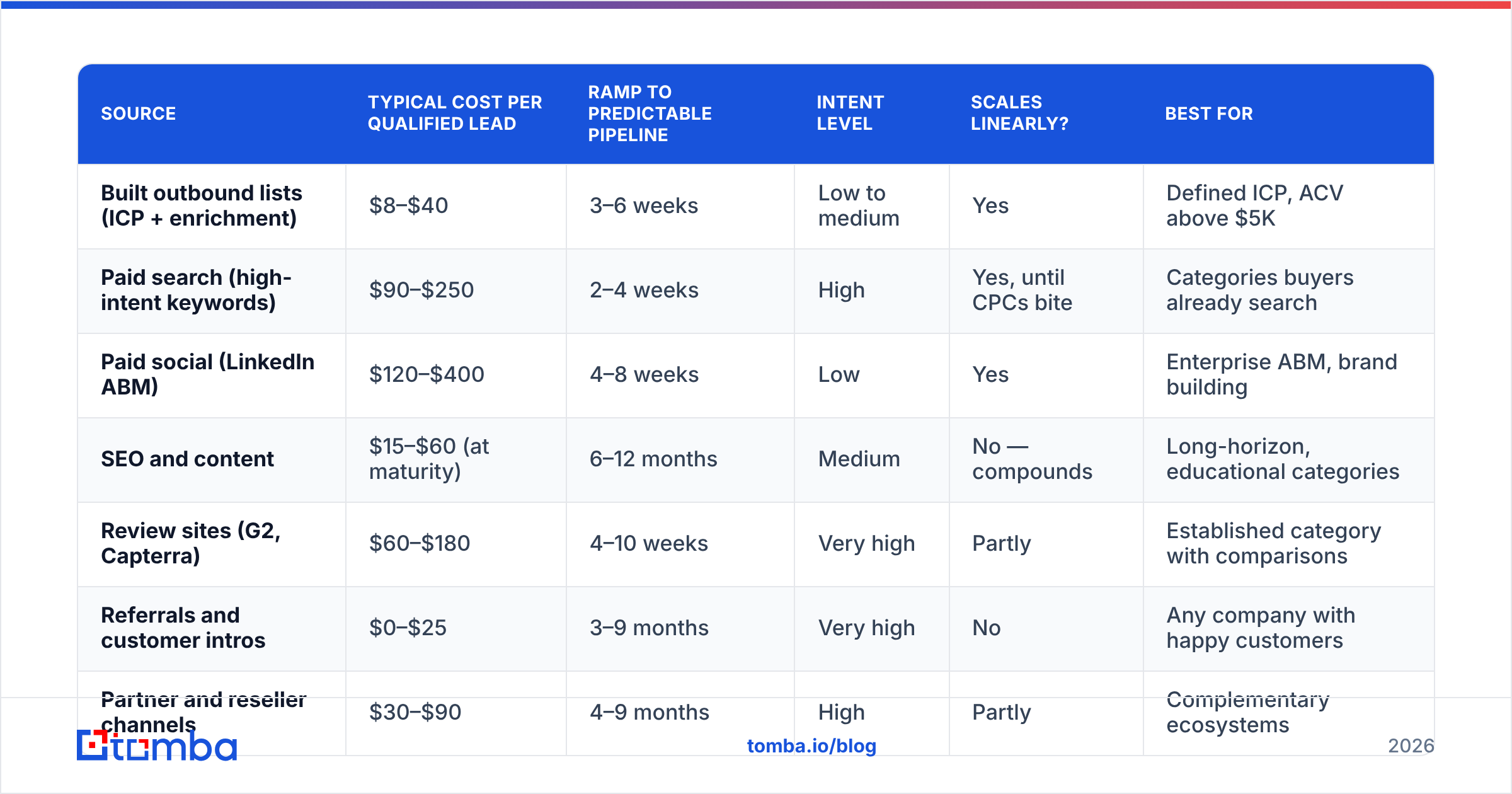
Here is the honest comparison. Cost figures are typical B2B SaaS ranges for a company between $1M and $20M ARR; your category and ACV will move them. "Ramp" is time to first predictable pipeline, not time to first lead.
| Source | Typical cost per qualified lead | Ramp to predictable pipeline | Intent level | Scales linearly? | Best for |
|---|---|---|---|---|---|
| Built outbound lists (ICP + enrichment) | $8–$40 | 3–6 weeks | Low to medium | Yes | Defined ICP, ACV above $5K |
| Paid search (high-intent keywords) | $90–$250 | 2–4 weeks | High | Yes, until CPCs bite | Categories buyers already search |
| Paid social (LinkedIn ABM) | $120–$400 | 4–8 weeks | Low | Yes | Enterprise ABM, brand building |
| SEO and content | $15–$60 (at maturity) | 6–12 months | Medium | No — compounds | Long-horizon, educational categories |
| Review sites (G2, Capterra) | $60–$180 | 4–10 weeks | Very high | Partly | Established category with comparisons |
| Referrals and customer intros | $0–$25 | 3–9 months | Very high | No | Any company with happy customers |
| Partner and reseller channels | $30–$90 | 4–9 months | High | Partly | Complementary ecosystems |
| Community and events | $70–$300 | 3–12 months | Medium to high | No | Niche, relationship-led markets |
| Product-led signups (free tier) | $5–$30 | 2–6 months | Medium | Yes, with traffic | Self-serve entry point |
| Website visitor identification | $20–$70 | 1–3 weeks | Medium to high | Yes | Sites with 5K+ monthly B2B visits |
| Purchased contact databases | $10–$50 | 1–2 weeks | Low | Yes | Fast TAM coverage, ABM list building |
| Cold calling from enriched lists | $25–$80 | 2–5 weeks | Low | Yes, with headcount | High ACV, phone-friendly personas |
Two patterns fall out of that table. First, the cheapest sources per lead are the ones that compound (referrals, SEO, product-led) and they all take at least a quarter to matter. Second, everything that produces pipeline inside a month is either paid media or built outbound — and built outbound is 3–10x cheaper, which is why it remains the default first motion for most B2B teams.
How do inbound and outbound sources really differ?#
The useful distinction is not "inbound good, outbound bad." It is who controls the timing.
Inbound sources wait for the buyer. You get higher intent, shorter sales cycles, and better win rates — HubSpot's marketing research has documented that gap across multiple years of survey data. The cost is control: you cannot decide on Monday that you want 40 enterprise manufacturing leads by Friday.
Outbound sources let you choose the accounts. You decide the segment, the geography, the headcount band, the tech stack, and the persona. You pay for that control in reply rates — a strong cold email sequence lands somewhere between 4% and 12% positive reply, not the 30% some vendors advertise.
In practice, the teams with the best unit economics run both and let them feed each other: content answers the questions outbound creates, and outbound puts content in front of accounts that would never have found it. That is also why mixing sources is not a hedge — it is a multiplier. A prospect who has read two of your articles replies to a cold email at a materially higher rate than one who has never heard of you.
What makes a built outbound source work or fail?#
Built outbound is the source most teams can start fastest, and the one they most often execute badly. The channel is almost never the problem. The list is.
A workable build looks like this:
- Define the ICP as filters, not adjectives. "Mid-market SaaS" is not a filter. "Software companies, 50–500 employees, US/UK/DE, using Stripe, hiring for RevOps" is.
- Source the accounts before the people. Start with company lists — from a B2B database, review-site category pages, job boards, conference attendee lists, or your own website visitor reveal data — then map roles inside them.
- Find contacts by domain, not by guesswork. A domain search returns the real people and the company's actual email pattern, which beats permutating
first.last@and hoping. - Verify before you send, every time. Run the whole list through an email verifier and handle catch-all domains separately rather than lumping them in as valid.
- Cap volume per domain. Sending 300 cold emails a day from one mailbox is how a functioning source turns into a spam-folder problem in three weeks.
- Refresh quarterly. B2B contact data decays at roughly 22–30% per year through job changes alone. A list built last January is not the list you think it is.
Skip step four and the entire source looks broken. Bounce rates above 5% suppress inbox placement for everything else you send, and the sequence that would have booked eight meetings books one. Most "cold email doesn't work anymore" postmortems are actually data postmortems.

Which third-party data sources are worth paying for?#
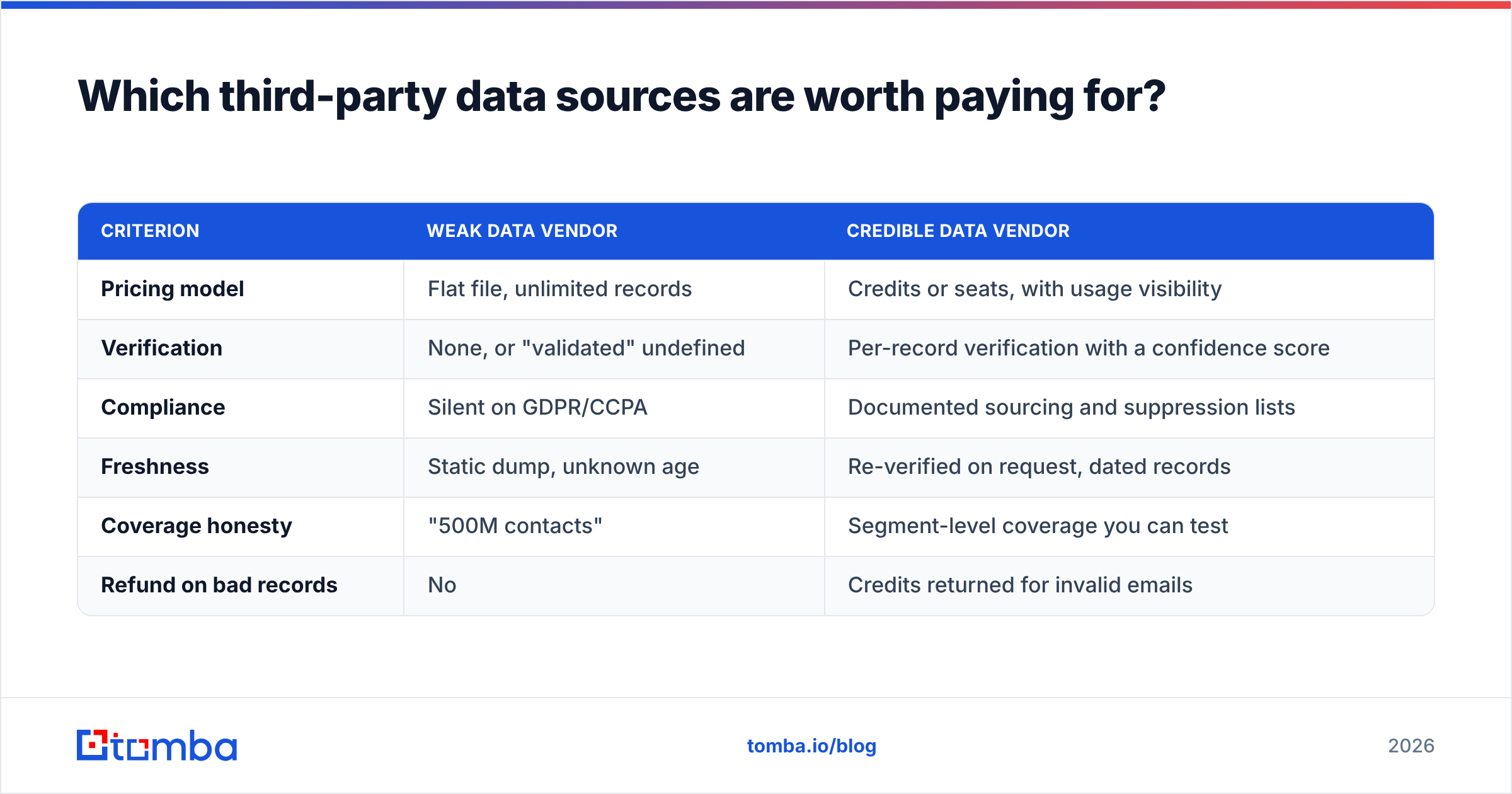
Purchased data gets a bad reputation it only half deserves. There is a real difference between a scraped file sold by the million and a licensed, permission-checked database with verification built in.
| Criterion | Weak data vendor | Credible data vendor |
|---|---|---|
| Pricing model | Flat file, unlimited records | Credits or seats, with usage visibility |
| Verification | None, or "validated" undefined | Per-record verification with a confidence score |
| Compliance | Silent on GDPR/CCPA | Documented sourcing and suppression lists |
| Freshness | Static dump, unknown age | Re-verified on request, dated records |
| Coverage honesty | "500M contacts" | Segment-level coverage you can test |
| Refund on bad records | No | Credits returned for invalid emails |
Vendors like BookYourData built their reputation on the pay-as-you-go, verified-record end of that spectrum, which is a reasonable fit when you want a finite list without a subscription. Tools that sit closer to the enrichment side — finding and verifying contacts on demand rather than selling you a static file — suit teams who already know their accounts and need the people inside them. Review platforms like G2 are useful for sanity-checking vendor claims, though remember that review volume correlates with marketing spend as much as with product quality.
Whichever you pick, test the same way: take 200 accounts you know well, run them through the vendor, and measure match rate and bounce rate yourself. Vendor-reported accuracy is a marketing number. Your bounce rate is a fact.
How should you pick your lead generation source mix?#
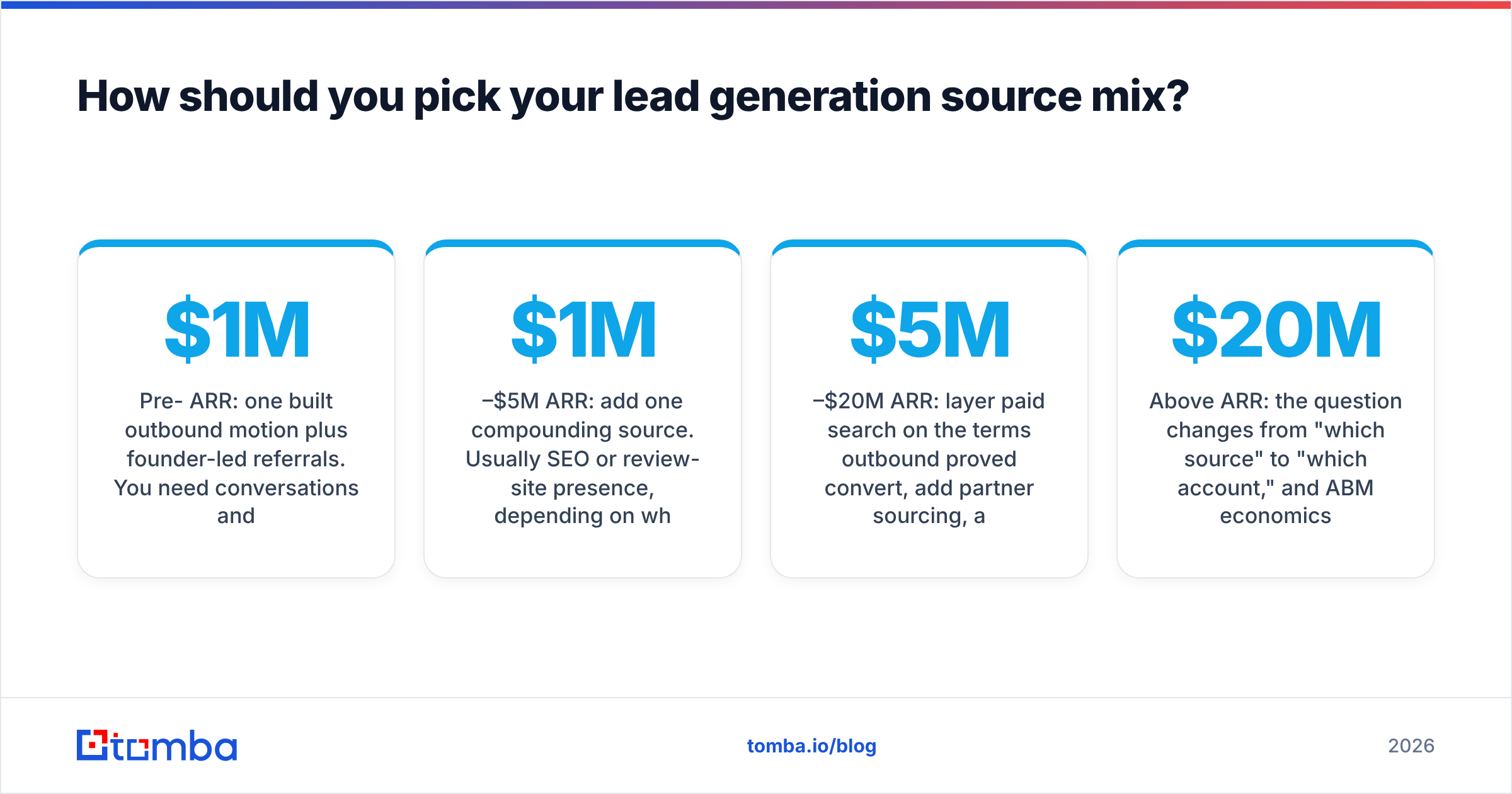
Match the mix to your stage, not to what worked for a company ten times your size.
Pre-$1M ARR: one built outbound motion plus founder-led referrals. You need conversations and learning, not reach. Keep lists small and hand-picked; personalization beats volume when you are still testing messaging.
$1M–$5M ARR: add one compounding source. Usually SEO or review-site presence, depending on whether buyers in your category search for solutions or compare vendors. Keep outbound running — it funds the patience the compounding source requires.
$5M–$20M ARR: layer paid search on the terms outbound proved convert, add partner sourcing, and formalize data enrichment so every inbound form fill arrives with firmographics attached and routes itself.
Above $20M ARR: the question changes from "which source" to "which account," and ABM economics take over. At that point you are buying intent signals and orchestrating across sources rather than choosing between them.
One discipline holds at every stage: measure sources by cost per closed-won, not cost per lead. The ranking flips dramatically when you do. Paid social frequently looks worst on CPL and respectable on CAC payback for enterprise deals; free-tier product signups often look brilliant on CPL and terrible on revenue.
How do you keep a good source from producing bad leads?#
Put a quality gate between the source and the CRM. Three checks catch most of the damage:
Validate at capture. Every form, every import, every enrichment call goes through verification before the record is created. A free email checker handles spot checks; an API call handles volume.
Score before routing. Firmographic fit plus behavioral signal, scored at insert. Reps should never be the filter — their time is the most expensive thing in the funnel.
Deduplicate ruthlessly. The same human arriving from three sources should be one record with three attribution touches, not three records and three reps.
Do this and your source comparison finally becomes trustworthy, because every channel is measured on the same definition of "lead." Skip it and you will spend next quarter arguing about attribution instead of pipeline.
Where should you start this week?#
Pick one built source and do it properly. Define 200 accounts that match your ICP exactly, find the right people inside them, verify every address, and send a sequence you would be willing to receive. That single exercise will teach you more about your market in three weeks than a quarter of channel experiments.
The part that decides whether it works is the contact layer. Tomba's Email Finder finds professional email addresses by domain, name, or company, returns a confidence score on each one, and flags catch-all domains before you send rather than after. The free tier gives you 25 searches a month to test coverage on accounts you already know; paid plans start at $49/mo on Starter, with Growth at $99/mo — see Tomba pricing for the full breakdown. Build the list, verify it, then judge the source on results you can actually trust.
Related guides#
// get started
Find, verify and enrich your first contacts today
Start on the free plan with 25 searches a month, then scale when your team is ready.
Free plan · No credit card required · GDPR & CCPA
// about the author