Lead Generation Specialist: Role, Skills, Salary & Stack
What a lead generation specialist actually does in 2026, what they get paid, which skills separate the good ones from the list-scrapers, and the exact tool stack a working specialist runs.
TL;DR
- A lead generation specialist owns the top of the funnel: building target lists, sourcing and verifying contact data, and handing sales a pipeline of qualified names. They are not an SDR, and they are not a marketer.
- Typical US salary in 2026 runs $52,000–$78,000 base for in-house roles; offshore contractors run $8–$25/hour and agencies charge $2,000–$6,000/month.
- The skill that actually separates a good specialist from a list-scraper is data hygiene — bounce rate under 3%, not raw volume.
- A working stack costs $150–$400/month: a data source, an email finder plus verifier, an enrichment layer, a sequencer, and a CRM.
- Hire one when your reps spend more than 30% of their week researching instead of talking. Below that threshold, buy tooling instead of headcount.
What is a lead generation specialist?#
A lead generation specialist builds and maintains the list of people your sales team talks to. That's the whole job in one sentence. Everything else — the tooling, the scraping, the enrichment scripts, the ICP documents — is downstream of that single responsibility.
Think of it like a restaurant. The SDR is the server taking orders in the dining room. The account executive is the chef closing the plate. The lead generation specialist is the buyer at the market at 5am, deciding which suppliers to trust, rejecting the produce that looks fine but will rot by Thursday. Nobody in the dining room sees them. Everybody tastes their work.
Technically, the role sits between marketing operations and sales development. A specialist owns:
- ICP definition and segmentation — translating "we sell to mid-market fintech" into a filterable query: 50–500 headcount, US/UK, using Stripe, hiring for compliance roles.
- Sourcing — pulling company and contact records from databases, LinkedIn, job boards, review sites, conference attendee lists, and public filings.
- Contact discovery — finding the actual email address and phone number for a named person at a named company.
- Verification and hygiene — removing bounces, catch-alls, role accounts, and duplicates before anything reaches a sequencer.
- Enrichment and routing — attaching firmographic and technographic fields, scoring the record, and pushing it into the CRM with the right owner.
- Reporting — bounce rate, connect rate, list-to-meeting conversion by segment.
Notice what isn't on that list: writing the cold email, running the call, booking the meeting. A specialist who also does those things is an SDR with a spreadsheet habit, and you should pay and measure them accordingly.
How is a lead generation specialist different from an SDR?#
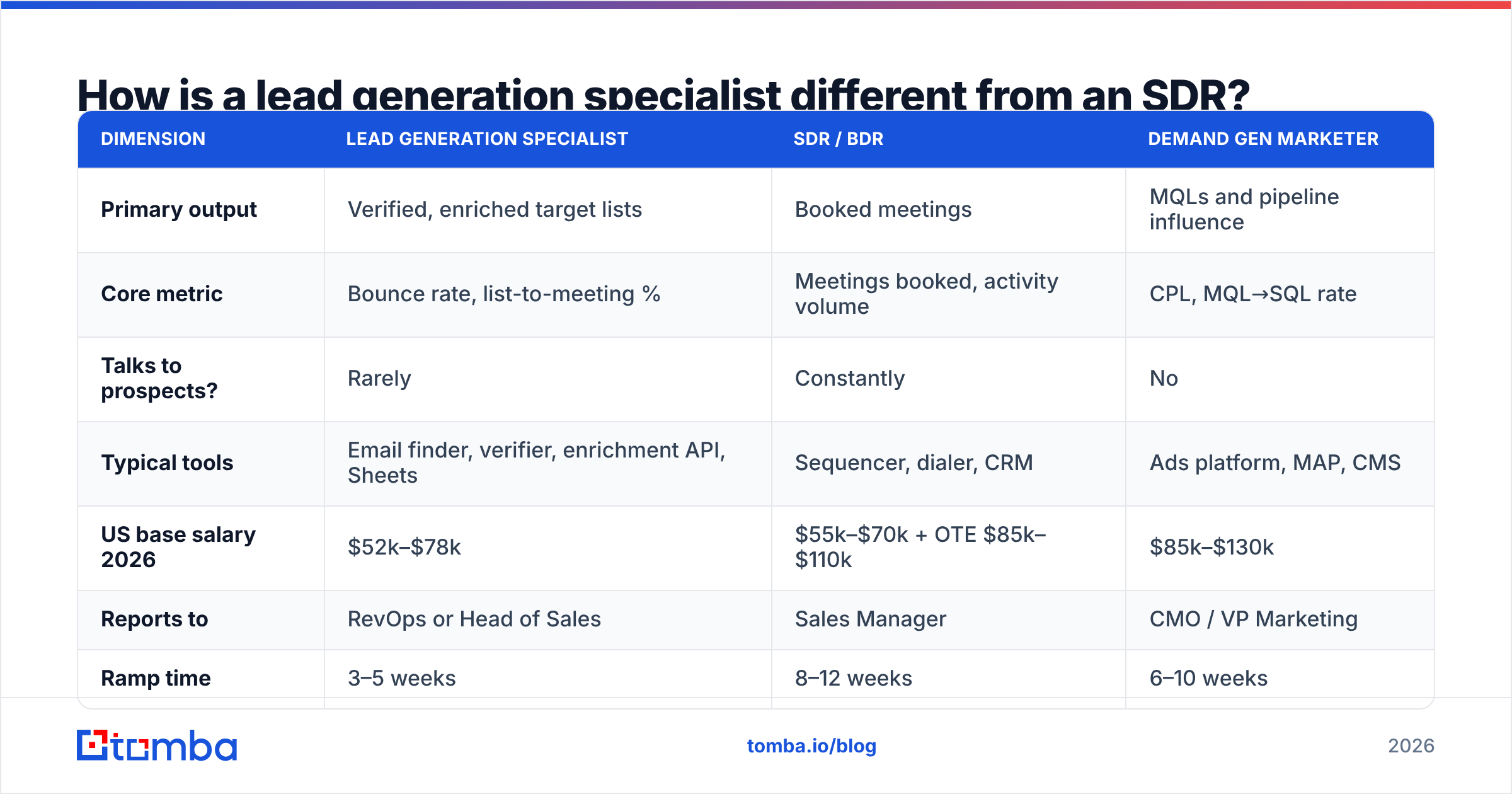
This is the single most expensive hiring confusion in B2B sales. Companies post a "lead generation specialist" job, describe an SDR role, pay SDR money, then wonder why their data quality never improves.
| Dimension | Lead Generation Specialist | SDR / BDR | Demand Gen Marketer |
|---|---|---|---|
| Primary output | Verified, enriched target lists | Booked meetings | MQLs and pipeline influence |
| Core metric | Bounce rate, list-to-meeting % | Meetings booked, activity volume | CPL, MQL→SQL rate |
| Talks to prospects? | Rarely | Constantly | No |
| Typical tools | Email finder, verifier, enrichment API, Sheets | Sequencer, dialer, CRM | Ads platform, MAP, CMS |
| US base salary 2026 | $52k–$78k | $55k–$70k + OTE $85k–$110k | $85k–$130k |
| Reports to | RevOps or Head of Sales | Sales Manager | CMO / VP Marketing |
| Ramp time | 3–5 weeks | 8–12 weeks | 6–10 weeks |
| Fails when | Data decays, lists go stale | Messaging is weak | Budget dries up |
The practical test: if the person's week is measured in conversations, they're an SDR. If it's measured in records, they're a specialist. A team of three SDRs sharing one specialist is a common and efficient structure — one person doing research well beats three people doing it badly between calls.
What skills does a lead generation specialist actually need?#
Job posts list "attention to detail" and "communication skills," which tells you nothing. Here is what separates a specialist who returns 4x on their salary from one who hands you a spreadsheet of bounces.
Boolean and query fluency. They should be able to write a LinkedIn Sales Navigator search or an Apollo filter chain that returns 400 relevant companies instead of 40,000 vaguely related ones. Precision beats recall at the top of the funnel, always.
Email pattern reasoning. Knowing that a company uses first.last@ versus flast@ versus first@ is the difference between a 92% hit rate and a 60% one. Good specialists check the company email pattern before they run a batch, not after.
Verification discipline. Every list gets verified before it ships. No exceptions, no "it's only 200 records." This is the habit that protects your domain reputation, and it's the one most often skipped under deadline pressure.
Catch-all handling. Roughly 15–20% of B2B domains are catch-all, meaning the server accepts everything and verifies nothing. A junior specialist either dumps all of them (losing real prospects) or sends to all of them (poisoning the domain). A senior one segments them, uses a catch-all verifier, and routes the survivors to a secondary sending domain.
Spreadsheet and light scripting ability. VLOOKUP and pivot tables are the floor. The good ones write Google Apps Script or hit an API directly so the same job doesn't eat four hours next month.
Deduplication and CRM hygiene. Pushing a duplicate into Salesforce is how a prospect gets three cold emails from three reps in one week. That's a brand cost, not a data cost.
What does a lead generation specialist cost in 2026?#
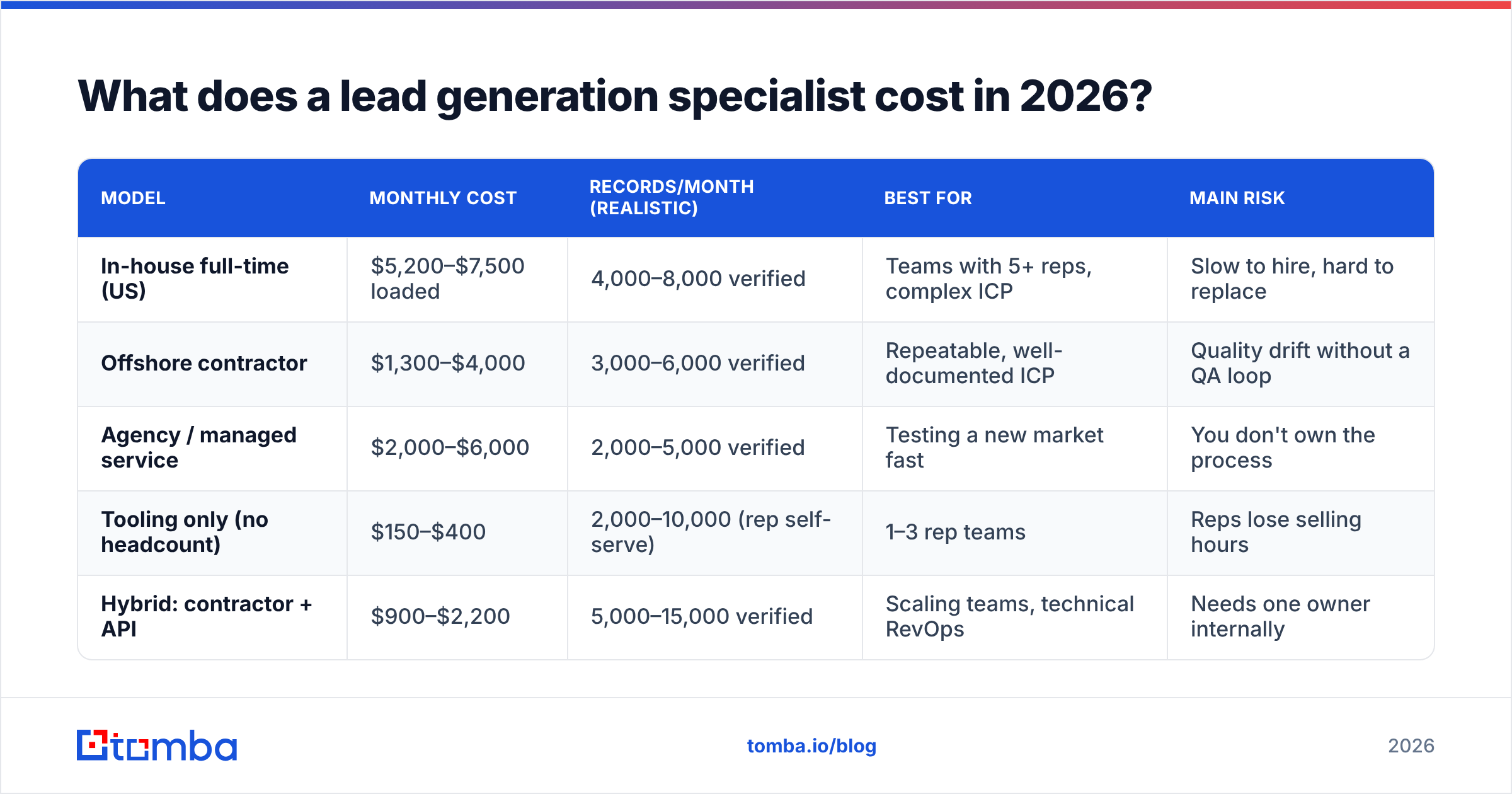
Three hiring models, three very different cost structures.
| Model | Monthly cost | Records/month (realistic) | Best for | Main risk |
|---|---|---|---|---|
| In-house full-time (US) | $5,200–$7,500 loaded | 4,000–8,000 verified | Teams with 5+ reps, complex ICP | Slow to hire, hard to replace |
| Offshore contractor | $1,300–$4,000 | 3,000–6,000 verified | Repeatable, well-documented ICP | Quality drift without a QA loop |
| Agency / managed service | $2,000–$6,000 | 2,000–5,000 verified | Testing a new market fast | You don't own the process |
| Tooling only (no headcount) | $150–$400 | 2,000–10,000 (rep self-serve) | 1–3 rep teams | Reps lose selling hours |
| Hybrid: contractor + API | $900–$2,200 | 5,000–15,000 verified | Scaling teams, technical RevOps | Needs one owner internally |
The hybrid row is where most efficient teams land in 2026. A part-time contractor running a documented process against an email finder API produces more clean records per dollar than a full-time hire doing everything by hand, because the expensive part of the job — clicking through profiles — gets automated and the human handles judgment calls.
One caution on the agency model: ask for their bounce rate on the last three clients, in writing, before signing. Agencies that won't share it are optimizing for volume delivered, not volume that lands. Compare offers against a straightforward Tomba pricing baseline — Free at 25 searches/month, Starter at $49/mo, Growth at $99/mo, Pro at $249/mo — so you know what the raw data layer actually costs versus the service markup.
What tool stack does a lead generation specialist run?#
Five layers. You need something in each one; you do not need the most expensive option in any of them.
1. Company and contact database. Where the raw universe comes from. Apollo, ZoomInfo, and BookYourData all serve this layer well — BookYourData in particular is a solid pick when you want pay-as-you-go, pre-verified B2B lists without an annual contract. Sales Navigator is the manual fallback and still the best filter set for people-level targeting.
2. Contact discovery. Turning "Priya Raman, VP Engineering, Acme" into a deliverable address. This is where an email finder or a domain search does the work — domain search when you want every reachable person at an account, email finder when you have a named target. For sourced-from-LinkedIn workflows, a LinkedIn finder removes the copy-paste step entirely.
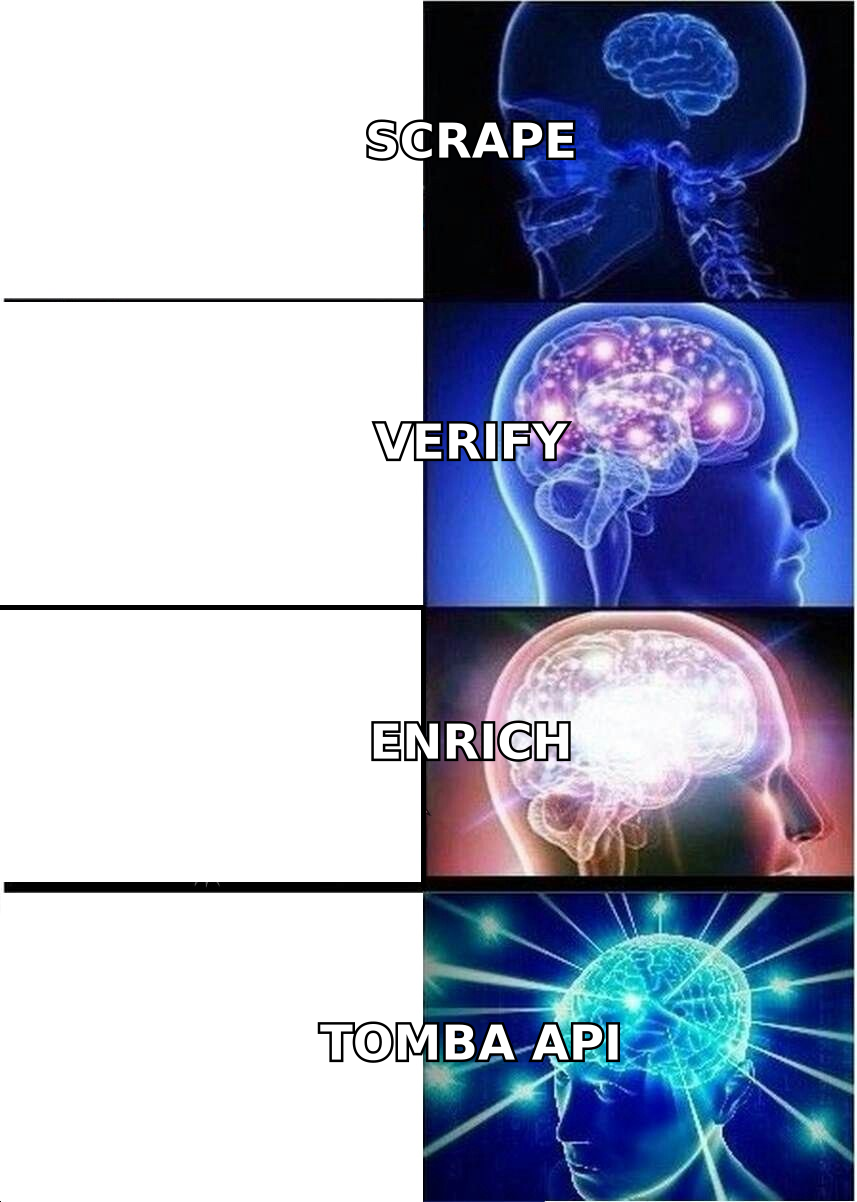
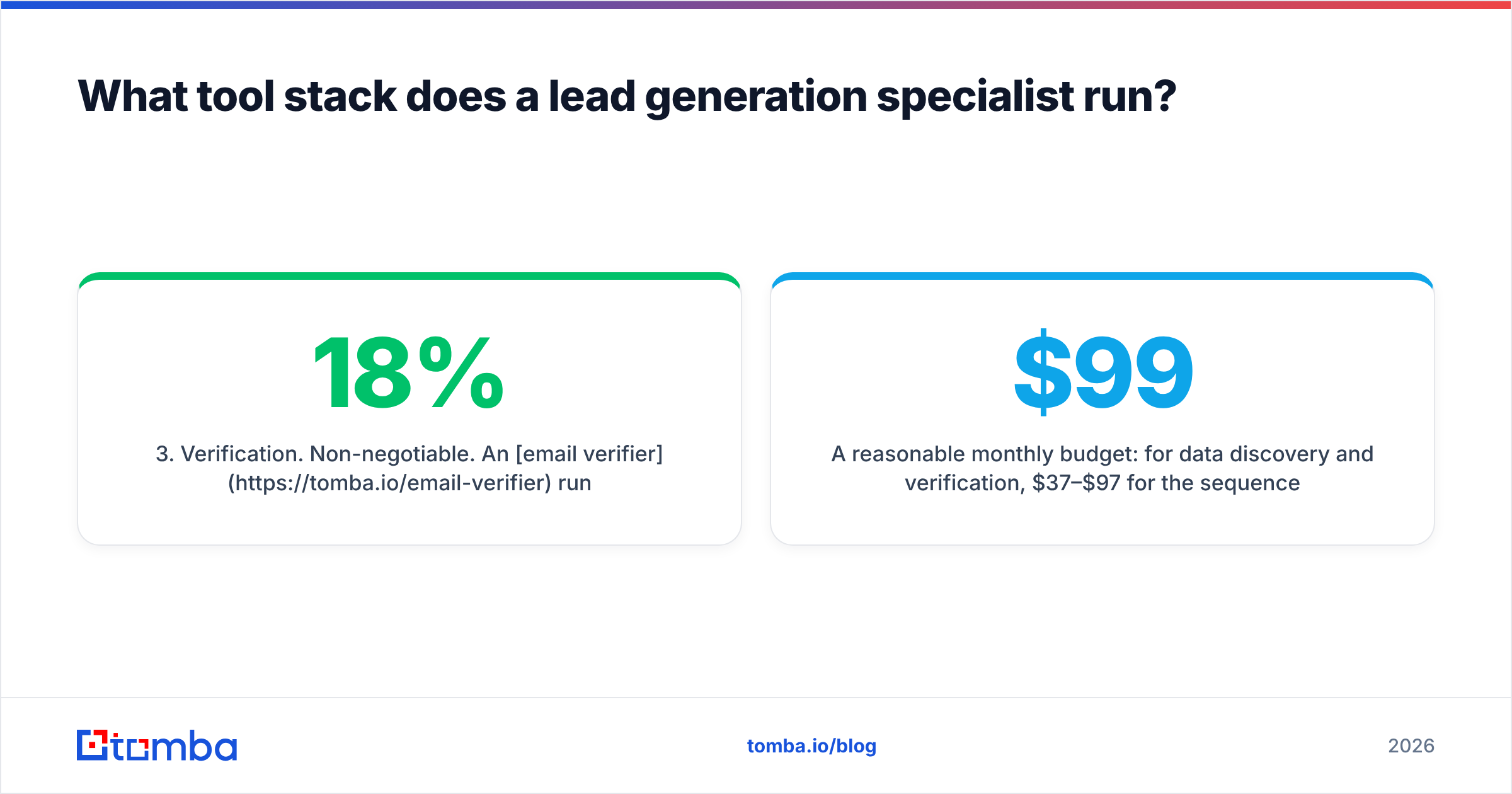
3. Verification. Non-negotiable. An email verifier run before every send, plus catch-all handling for the ~18% of domains that will lie to you. Target under 3% bounce; above 5% and your sender reputation starts degrading measurably.
4. Enrichment. Firmographics, technographics, headcount, funding. Data enrichment fills the fields your sequencing personalization tokens depend on. Empty tokens are worse than no personalization.
5. Sequencer and CRM. Instantly, Smartlead, Outreach, or Salesloft for sending; HubSpot or Salesforce for storage. HubSpot's own research has consistently shown that response rates collapse when list quality drops, which is the whole argument for spending on layers 2 and 3 rather than on a fancier sequencer.
A reasonable monthly budget: $99 for data discovery and verification, $37–$97 for the sequencer, and whatever your CRM already costs. Anything beyond $400/month for a team under five reps is usually a procurement failure, not a capability need.

How do you measure a lead generation specialist?#
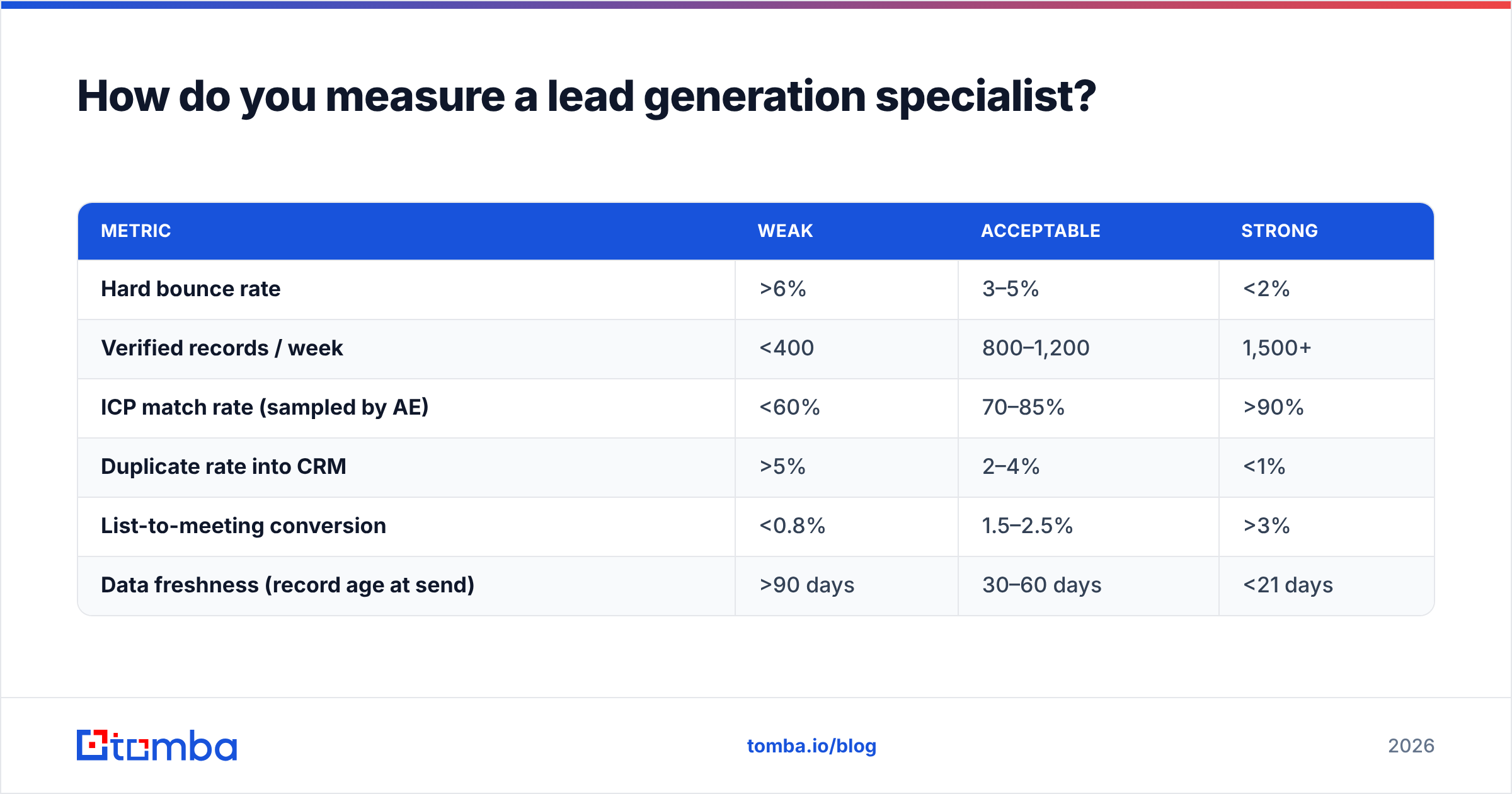
Measure outputs they control, not outcomes they don't. A specialist cannot make your product compelling or your AE good at discovery. Here's a scorecard that holds up:
| Metric | Weak | Acceptable | Strong |
|---|---|---|---|
| Hard bounce rate | >6% | 3–5% | <2% |
| Verified records / week | <400 | 800–1,200 | 1,500+ |
| ICP match rate (sampled by AE) | <60% | 70–85% | >90% |
| Duplicate rate into CRM | >5% | 2–4% | <1% |
| List-to-meeting conversion | <0.8% | 1.5–2.5% | >3% |
| Data freshness (record age at send) | >90 days | 30–60 days | <21 days |
That last row is underrated. B2B contact data decays at roughly 25–30% per year, and faster in tech where tenure is short. A list built in January and sent in June is a different list than the one you paid for. Build refresh into the process — re-verify anything older than 60 days before it re-enters a sequence.
The ICP match rate needs a human in the loop. Pull 25 random records each week, hand them to an AE, and ask a single question: would you take this meeting? Anything under 70% means the sourcing query is wrong, not that the AE is picky.
Should you hire a lead generation specialist or buy tools?#
Run the arithmetic before the job post. The trigger is rep time, not team size.
If each rep loses 12 hours a week to research, and you have four reps at a fully loaded cost of $110,000, you're burning roughly $132,000 a year on research done by people you hired to sell. A $65,000 specialist who recovers even two-thirds of those hours pays for itself twice over — and the lists get better, because one person doing it full-time develops judgment that four people doing it part-time never will.
Below three reps, the math flips. A single bulk email finder run plus a verification pass takes a rep about 90 minutes a week and costs under $100/month. Headcount at that stage is premature; you don't yet have enough repeatable process for a specialist to optimize.
Middle case — three to five reps, growing: hire a contractor, document the process in a runbook, and automate the mechanical steps through an API. Revisit in two quarters. The runbook is the real asset; whoever executes it is replaceable, and that's the point.
There's a third option teams forget: make the specialist role a rotation. Have one rep own list-building for a quarter with dedicated time and tooling. You'll learn what the role actually requires at your company before you commit $65k to a job description you wrote from a template. Most teams discover their bottleneck is ICP clarity, not sourcing capacity — and no hire fixes that.
What does a lead generation specialist's week look like?#
Concrete, because job descriptions are useless here.
Monday. Review last week's bounce report and the AE feedback sample. Kill any source that produced >4% bounces. Pull the week's target account list from the database layer against the current ICP filters.
Tuesday. Contact discovery. Run domain searches on named accounts, email finder on individually sourced targets, and flag catch-all domains into a separate sheet. Typically the heaviest tooling day.
Wednesday. Verification and enrichment. Everything from Tuesday goes through the verifier. Catch-alls get a secondary check. Survivors get enriched with headcount, tech stack, and funding stage.
Thursday. Dedupe against the CRM, assign owners, push. Write the segment notes that tell the SDR why this cohort was selected — this is the step that makes personalization possible downstream.
Friday. Refresh old records, test one new source, update the runbook. The best specialists spend Friday making next Tuesday shorter.
That rhythm produces roughly 1,000–1,400 verified, enriched, CRM-ready records a week for one person. If someone promises 5,000, ask what verification step they dropped.
Where do you go from here?#
If you're hiring: write the job post around data quality metrics, not activity volume. Ask candidates to describe how they handle catch-all domains — the answer sorts juniors from seniors in about thirty seconds.
If you're buying tools instead: start with the layer that breaks first, which is almost always contact discovery and verification. Get your bounce rate under 3% before you optimize anything else, because every downstream metric — response rate, meetings booked, pipeline — is capped by it.
Tomba's Email Finder covers the discovery layer that eats the most specialist hours: find professional email addresses by domain, name, or company, with verification built into the same workflow rather than bolted on after. Start on the free tier at 25 searches a month to test your ICP against real data, then move to Starter at $49/mo when the process proves out. Whether you hire a specialist or not, the data layer has to be right first — everything else is built on top of it.
Related guides#
// get started
Find, verify and enrich your first contacts today
Start on the free plan with 25 searches a month, then scale when your team is ready.
Free plan · No credit card required · GDPR & CCPA
// about the author