Lead Generation Startup Playbook: What Works in 2026
Most startup lead gen advice assumes a budget you do not have. Here is what actually fills a pipeline in the first 24 months — channel by channel, with real costs, timelines, and the tradeoffs nobody writes down.
TL;DR
- Most lead generation startup advice fails for a boring reason. Founders copy the playbook of companies with 50x their budget and 10x their brand recognition.
- Before $1M ARR, exactly three channels reliably work: founder-led outbound, warm network mining, and one narrow content bet. Everything else is a distraction you can afford later.
- Outbound is still the cheapest channel you control. Verified contacts cost $0.02–$0.10 each. A paid-search lead in a competitive B2B category costs $150–$400.
- Your data quality matters more than your copy. A 22% bounce rate kills your domain before anyone reads your third sentence.
- Budget realistically: $200–$600/month in tooling gets a two-person team to 400+ qualified conversations a quarter. That is enough to find product-market fit.
Most lead generation startup plans share one flaw. You do not have a lead generation problem. You have a sequencing problem.
Most early-stage teams try to run six channels at 15% effort each, then conclude that "outbound doesn't work" or "content takes too long." Both statements are true at 15% effort. Neither is true at 80%. This guide is about picking what to run at 80%, and when. It also shows what the costs look like when you are the one paying them.
What does a lead generation startup plan actually mean?#
A lead generation startup plan builds a repeatable, measurable flow of people who match your ideal customer profile and will take a call. The key word is repeatable. Your cofounder's former colleague booking a demo is not lead generation. That is luck, and luck has no growth rate.
Three things make startup lead gen different from lead gen at a big company:
- No brand equity to borrow. When HubSpot emails a VP of Sales, the name does half the work. When you email them, your subject line does all of it.
- The ICP is still a hypothesis. You are generating leads and discovering who your leads should be at the same time. So aim for volume and variety early, precision later.
- Cash is a constraint, not a lever. You cannot buy your way out of a slow channel. You have to pick channels where effort substitutes for money.
That third point eliminates most of the advice on the internet. Paid acquisition, ABM platforms, conference sponsorships, and SDR teams all convert money into pipeline. They work. They just are not available to you yet.
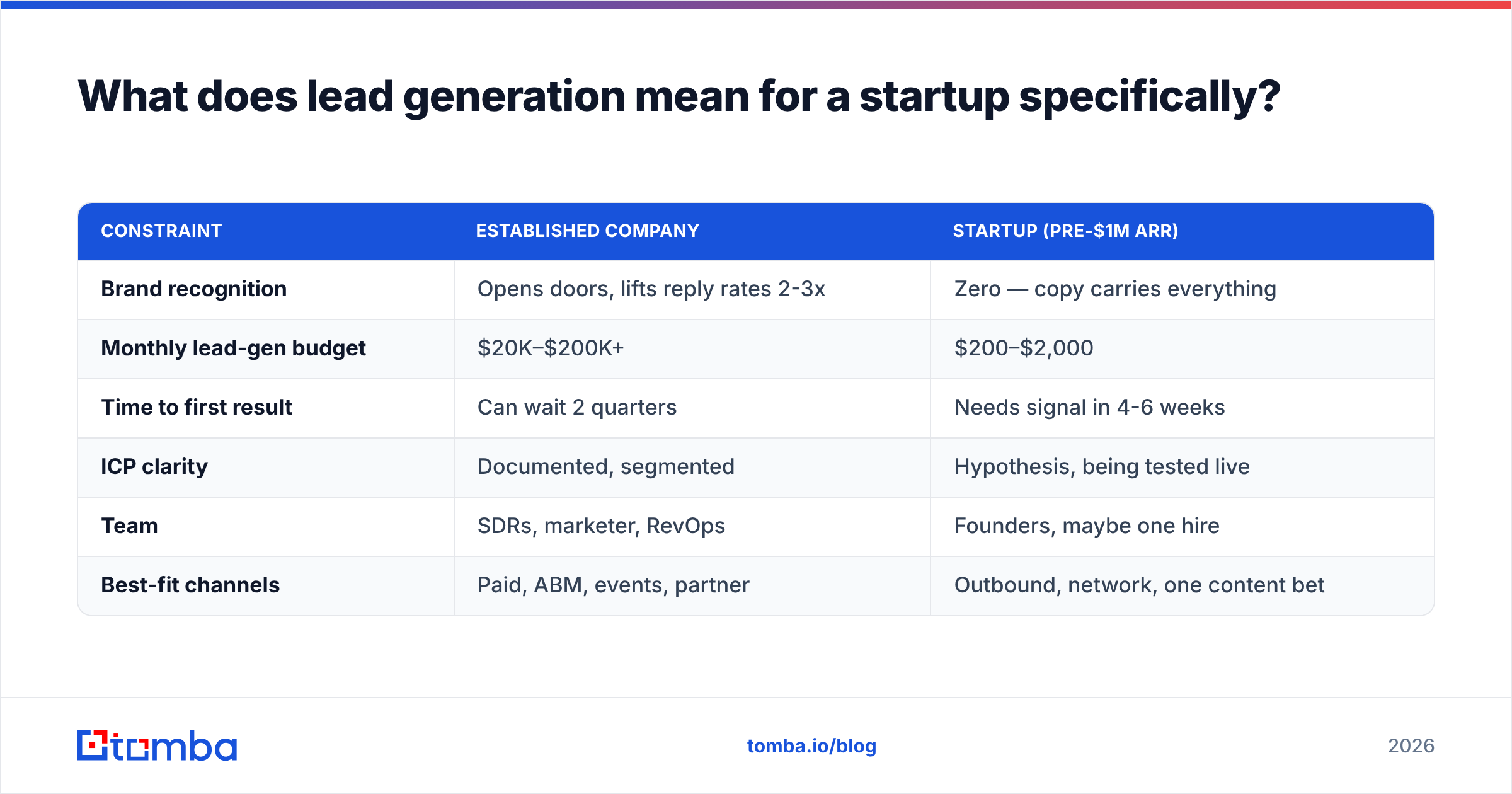
| Constraint | Established company | Startup (pre-$1M ARR) |
|---|---|---|
| Brand recognition | Opens doors, lifts reply rates 2-3x | Zero — copy carries everything |
| Monthly lead-gen budget | $20K–$200K+ | $200–$2,000 |
| Time to first result | Can wait 2 quarters | Needs signal in 4-6 weeks |
| ICP clarity | Documented, segmented | Hypothesis, being tested live |
| Team | SDRs, marketer, RevOps | Founders, maybe one hire |
| Best-fit channels | Paid, ABM, events, partner | Outbound, network, one content bet |
Which lead generation startup channels work before product-market fit?#
Here is the honest ranking. It is based on conversations per dollar and per founder-hour at seed stage.
1. Founder-led outbound. The highest-leverage channel for a startup. You control the input volume completely: who gets contacted, when, and what the message says. No algorithm sits between you and the buyer. Data and tooling drive the cost, usually $50–$250 a month.
2. Warm network mining. Your LinkedIn connections, your investors' portfolios, your last company's customers, your Slack communities. Reply rates of 30-60% versus 3-8% cold. The catch: it does not scale and it burns down. Treat it as a one-time fuel reserve that buys you three months to build a real channel.
3. One narrow content bet. Not "content marketing." One asset, one keyword cluster, one format, updated relentlessly. A comparison page, a free tool, a benchmark report. It compounds slowly, usually 4-8 months to real traffic. That is why it must run alongside outbound, never instead of it.
4. Community and founder-brand. Posting where your buyers already argue with each other. Cheap, slow, and genuinely unpredictable. Worth 2-3 hours a week, not 20.
5. Paid acquisition. Deprioritized, not dismissed. In most B2B categories, a qualified lead from paid search costs $150 to $400. Spending it well takes conversion data you do not have yet. Revisit paid after you know your close rate and your average contract value.

How do you build an outbound engine on a startup budget?#
Every lead generation startup needs an outbound engine, and it has five components. Most teams over-invest in the fifth and under-invest in the first two. That is exactly backwards.
Targeting. Write down the firmographic and technographic filters that define a good-fit account. Employee count, funding stage, tech stack, hiring signals. If your list criteria fit in one sentence, it is too broad. Signal-based targeting beats static filters by a wide margin. Look for companies that just hired a role you sell to, or just adopted a tool you integrate with.
Contact data. You need names, verified work emails, and ideally direct dials. Most startups go wrong twice here. They overpay for a bloated all-in-one platform, or they underpay for a scraped list that destroys their sender reputation. A focused email finder plus a verification pass is the right shape at this stage. You pay for what you use, and you can check accuracy before you commit.
Verification. Non-negotiable. Run every address through an email verifier before it enters a sequence. Mailbox providers read repeated hard bounces as a spam signal. A young domain has no reputation buffer to absorb it. Keep bounce rate under 3%. Under 2% if your domain is less than six months old.
Infrastructure. Separate sending domains, SPF/DKIM/DMARC configured correctly, 3-4 weeks of warmup, and a hard cap of 30-50 sends per mailbox per day. Google and Yahoo's bulk sender requirements made this table stakes, not optional hygiene. Their published sender guidelines are the source of truth. Read them once rather than trusting a blog summary.
Copy and sequencing. Yes, it matters. It matters fourth. Great copy sent to a badly built list still fails. Adequate copy sent to a precisely built list still works.
What does a realistic monthly outbound stack cost?#
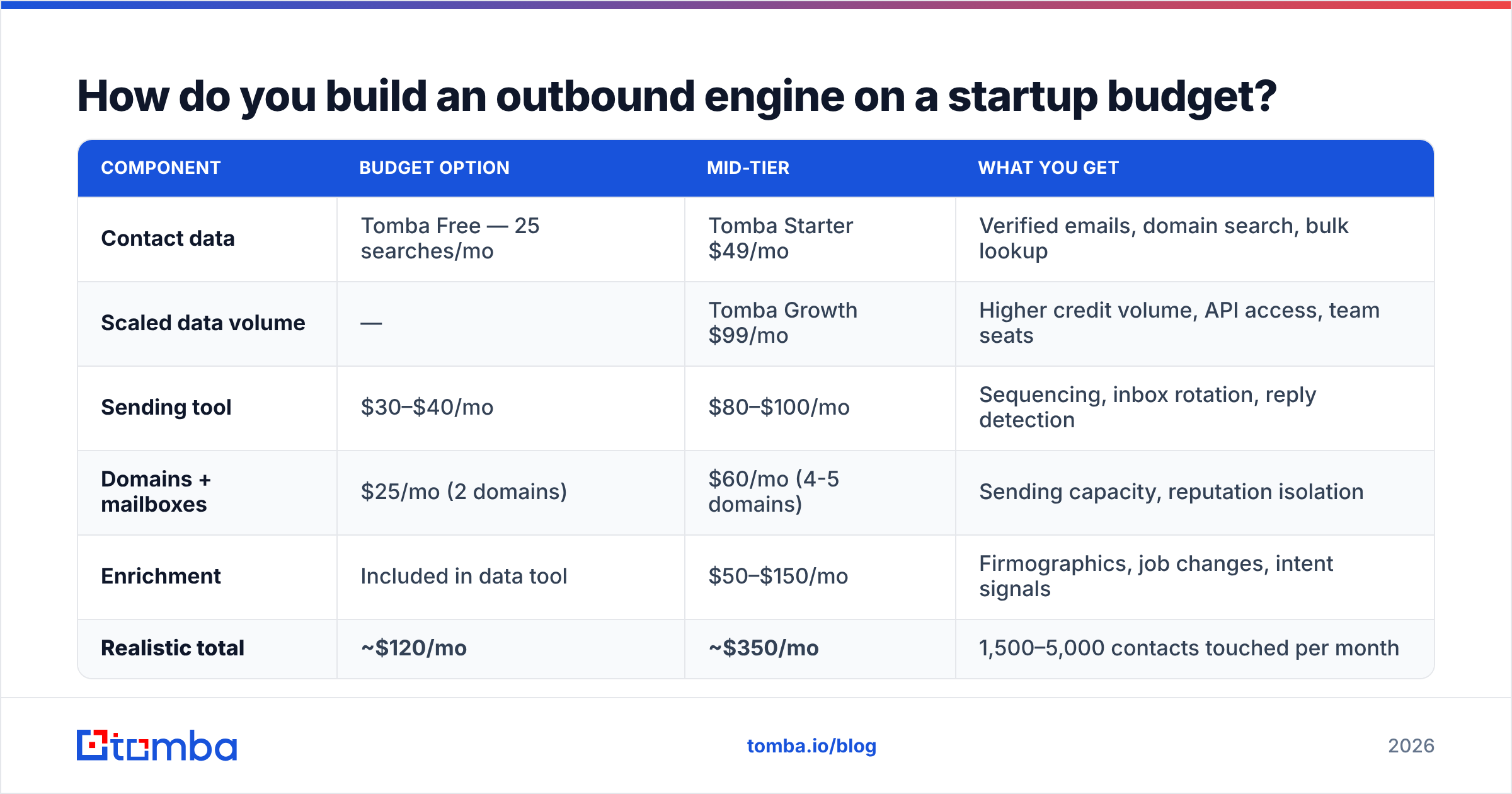
| Component | Budget option | Mid-tier | What you get |
|---|---|---|---|
| Contact data | Tomba Free — 25 searches/mo | Tomba Starter $49/mo | Verified emails, domain search, bulk lookup |
| Scaled data volume | — | Tomba Growth $99/mo | Higher credit volume, API access, team seats |
| Sending tool | $30–$40/mo | $80–$100/mo | Sequencing, inbox rotation, reply detection |
| Domains + mailboxes | $25/mo (2 domains) | $60/mo (4-5 domains) | Sending capacity, reputation isolation |
| Enrichment | Included in data tool | $50–$150/mo | Firmographics, job changes, intent signals |
| Realistic total | ~$120/mo | ~$350/mo | 1,500–5,000 contacts touched per month |
The point of this table is not the exact numbers. It is that a lead generation startup budget buys a working outbound engine for less than a single mid-market SaaS seat. Founders routinely spend more on project management software than on the system that generates their revenue.
Compare that to a lead-gen agency retainer at $3,000–$8,000 a month. It delivers meetings qualified against criteria you did not write. At seed stage, the agency buys you time you should be spending yourself, because the conversations are the customer research.
How do you get contact data without buying a bad list?#
This is where startups get hurt, so it deserves its own section. The classic lead generation startup mistake is a purchased list.
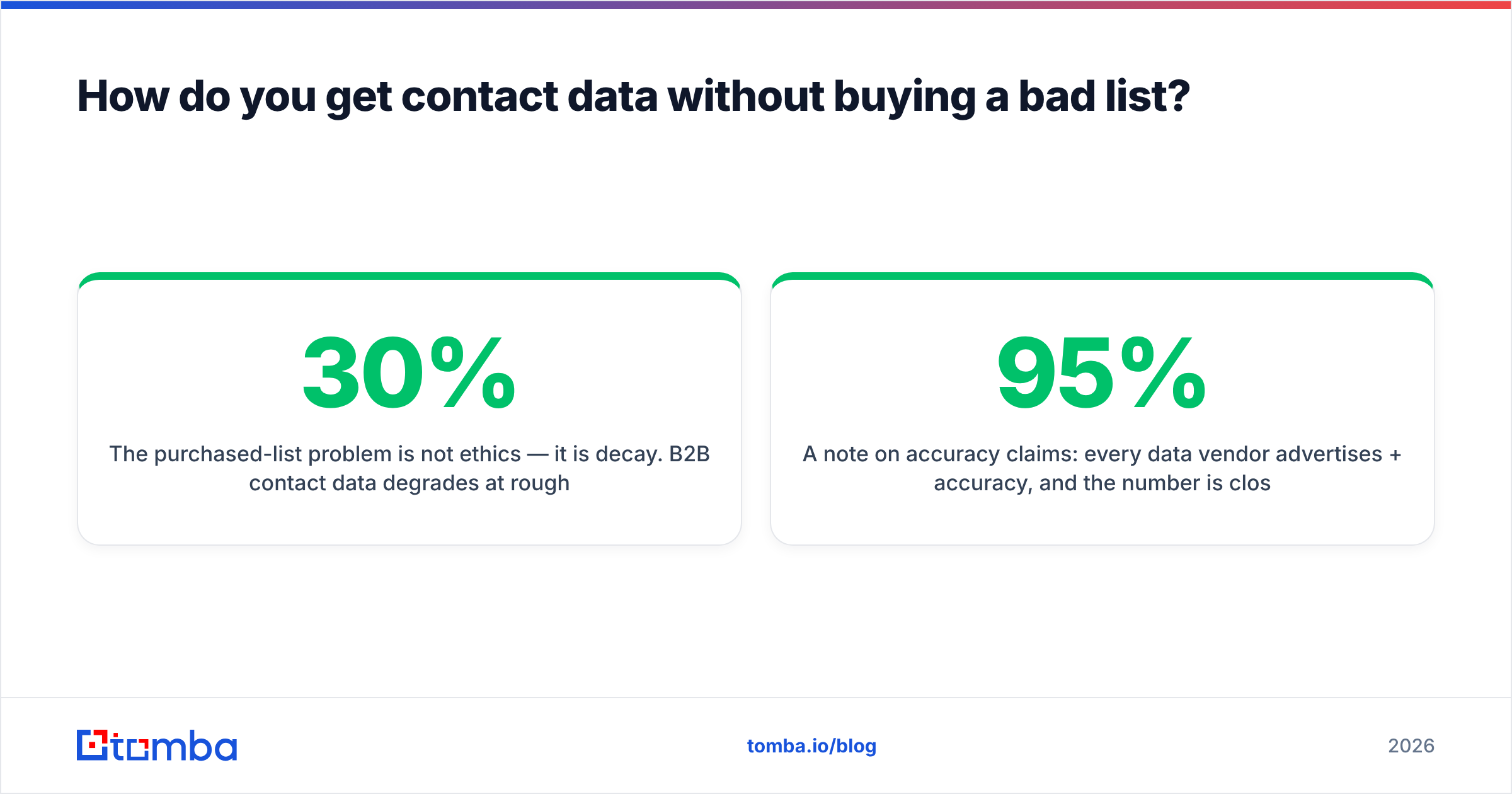
The purchased-list problem is not ethics. It is decay. Job changes alone rot B2B contact data by 25-30% a year, so a list you bought in January is much worse by June. Purchased lists also sell many times over. Dozens of other vendors have emailed those contacts, and the spam-trap density is high.
Three viable approaches, in order of preference for a startup:
- Build lists on demand. Define an account list first, then find contacts at those accounts using a domain search to pull every relevant person at a company. Fresh lookup, verified at the moment of use. This is the default.
- Enrich what you already have. Website visitors, trial signups, webinar attendees, LinkedIn engagers. Run them through data enrichment to turn a name and company into a complete, contactable record. Highest intent, lowest volume.
- Buy from a reputable, permission-aware provider. If you genuinely need volume fast in a well-defined segment, vendors like BookYourData sell verified B2B lists with accuracy guarantees. That is a reasonable option once your ICP is stable and geographically defined. The failure mode is buying too early. You pay for 10,000 contacts and then learn you needed a different 10,000.

Every data vendor advertises 95%+ accuracy. The number means little without the denominator. What matters is your bounce rate on your ICP. Run a 200-contact test batch with two providers against the same account list. Send both through the same verifier and compare. The test costs less than $100 and settles the argument for good.
What do the first 90 days of a lead generation startup plan look like?#
Structure beats intensity. A concrete sequence:
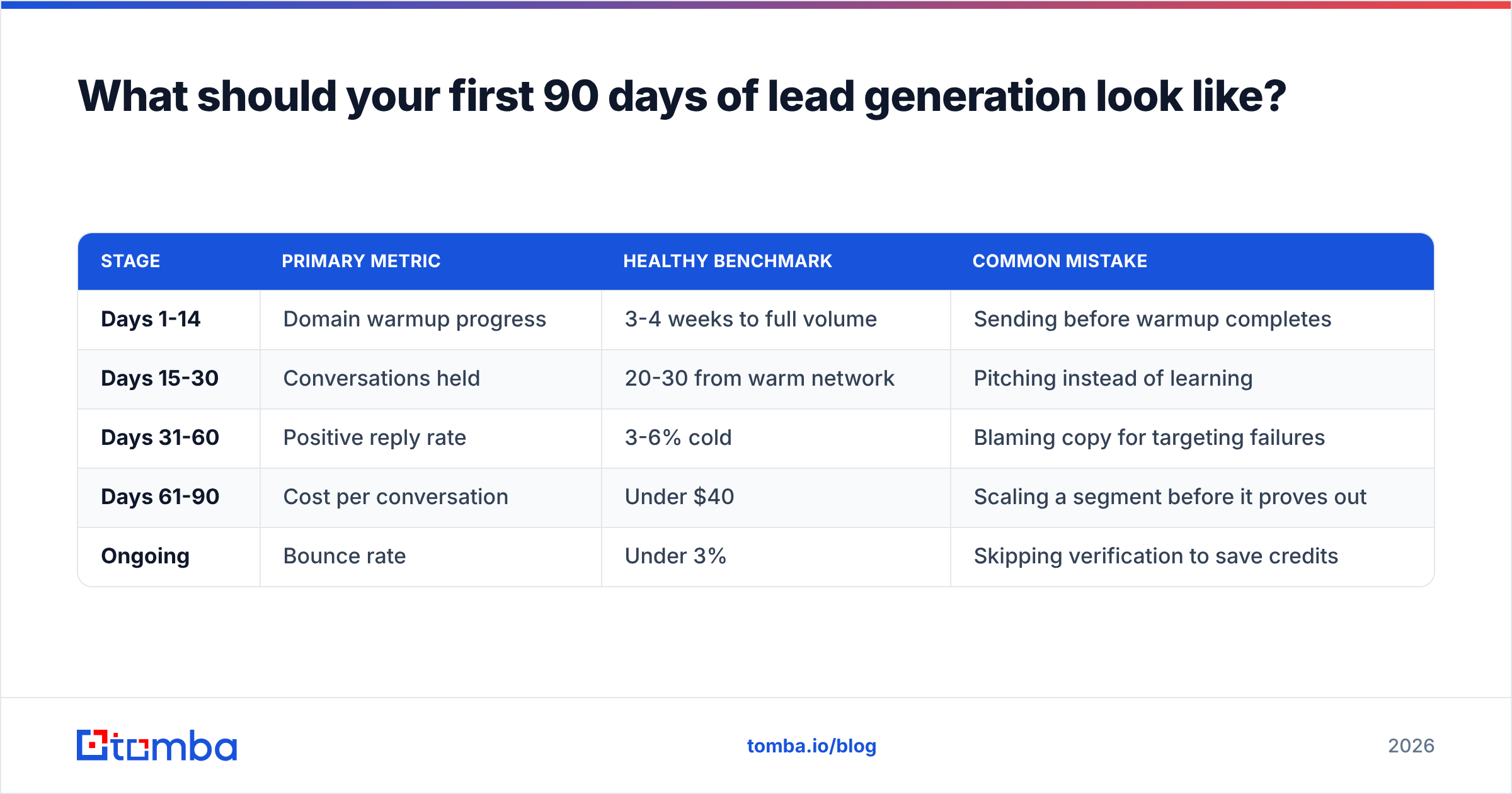
Days 1-14 — Define and instrument. Write the ICP hypothesis in one paragraph. Set up sending domains and start warmup on day one. That clock runs in the background no matter what else you do. Configure your CRM with the minimum viable fields: source, ICP segment, stage, and loss reason.
Days 15-30 — Mine the warm network. While domains warm, work your existing connections. Target 100 personal outreaches. These are not sequences. They are individual messages. Your goal is 20-30 conversations that sharpen the ICP, not closed deals.
Days 31-60 — Launch outbound at small volume. Build a 500-contact list against your sharpened ICP. Verify everything. Run two message variants at 30 sends/day/mailbox. You are measuring reply rate and reply quality, not meetings booked. Positive reply rate above 4% means keep going. Below 2% means your targeting is wrong, not your copy.
Days 61-90 — Scale what replied and ship the content bet. Double volume on the segment that responded. Kill the segment that did not. Publish your one content asset. Start tracking cost per conversation. That one metric will govern every budget decision for the next two years.
| Stage | Primary metric | Healthy benchmark | Common mistake |
|---|---|---|---|
| Days 1-14 | Domain warmup progress | 3-4 weeks to full volume | Sending before warmup completes |
| Days 15-30 | Conversations held | 20-30 from warm network | Pitching instead of learning |
| Days 31-60 | Positive reply rate | 3-6% cold | Blaming copy for targeting failures |
| Days 61-90 | Cost per conversation | Under $40 | Scaling a segment before it proves out |
| Ongoing | Bounce rate | Under 3% | Skipping verification to save credits |
How do you know a channel is working or dead?#
Kill criteria keep a lead generation startup honest. Write them before you start. They are the difference between a disciplined team and one that runs four half-broken channels for a year.
For outbound, the honest read is available at roughly 1,000 sends. If positive reply rate is under 2% at that volume with clean data and correct infrastructure, your ICP hypothesis is wrong. Change the target, not the subject line.
For content, the signal window is longer and the metric is different. At month four, the asset should rank somewhere in the top 30 for its target term and bring in a trickle of organic signups. No movement by month six, with steady publishing, means the keyword was too competitive for your domain. Pick a narrower one.
For paid, the kill criterion is simple math. If your cost per qualified lead exceeds 20% of your average contract value, the channel is not viable at your current conversion rate. Fix conversion or stop spending.
One caveat on measurement: attribution at startup scale is mostly theater. With 40 deals a year, multi-touch models produce noise dressed as insight. Ask new customers how they found you, write the answer down word for word, and trust that more than your dashboard. G2's buyer behavior research shows that B2B buyers touch many sources before a first conversation. Your job is to show up in two or three of them, not to apportion credit perfectly.
Should you hire an SDR or keep founder-led outbound?#
Most lead generation startup teams hire an SDR too early. Keep it founder-led longer than feels comfortable. Hire your first SDR only after you have personally run a channel that produces predictable results. You cannot hand over a process you have not built.
Concretely, three conditions should hold before the hire:
- You can predict output from input. "500 verified contacts produces 20 replies produces 6 meetings produces 1.5 deals." If you cannot say that sentence with real numbers, an SDR will not discover it for you.
- The math supports a seat. A junior SDR costs $60K–$85K fully loaded in most US markets. That seat needs to source enough pipeline to cover itself several times over. Run the arithmetic against your actual ACV.
- You have something to hand them. Documented ICP, working sequences, a list-building process, and a B2B database or data workflow they can operate without you. Otherwise you have hired someone to be confused expensively.
Until then, founder-led outbound has a hidden benefit that gets undervalued: the objections you hear are product feedback. An SDR files those in a CRM field. You hear them directly and change the roadmap.
What is the closing advice?#
Pick two channels. Run them at 80%. Write your kill criteria down before you start, verify every email address before it enters a sequence, and measure cost per conversation as the metric that governs everything else.
Winning at lead generation startup growth is rarely about the cleverest copy or the largest budget. The teams that win built a list of the right 500 people and then contacted all 500 of them with a message worth reading.
When you are ready to build that list, start with the Tomba Email Finder. The free tier covers 25 searches a month, enough to test your ICP hypothesis before you spend anything. Starter at $49/mo handles a founder-led outbound motion with no annual contract. Check current Tomba pricing to see where your volume lands, verify everything you find, and go have the conversations.
Related guides#
// get started
Find, verify and enrich your first contacts today
Start on the free plan with 25 searches a month, then scale when your team is ready.
Free plan · No credit card required · GDPR & CCPA
// about the author