Lead Generation Strategy: A 2026 Framework That Fills Pipeline
Most lead gen plans are a list of channels with no math behind them. Here's how to build a lead generation strategy backed by ICP data, channel economics, and a pipeline target you can actually defend.
TL;DR
- A lead generation strategy is not a channel list. It's a math problem: revenue target → pipeline coverage → qualified leads → raw contacts, worked backwards.
- Most teams skip the arithmetic, buy a list, and discover their cost per meeting is four times what they assumed.
- Inbound, outbound, and ABM have wildly different payback curves. Inbound is cheap per lead but slow; outbound is fast but expensive; ABM is expensive per account and only works above a certain deal size.
- Data quality is the silent multiplier. A 30% invalid contact rate doesn't cost you 30% of results — it compounds through bounce rates, sender reputation damage, and rep time.
- Pick two channels, instrument them properly, and give each one a full sales cycle before you judge it.
What is a lead generation strategy, actually?#
A lead generation strategy is the documented set of decisions about who you target, which channels you use to reach them, what you offer in exchange for attention, and how much you're willing to pay per qualified opportunity.
That last part is what separates a strategy from a to-do list. If you can't state your target cost per qualified meeting, you don't have a strategy — you have activity.
Here's the uncomfortable framing: every channel works for somebody. Cold email works. SEO works. Paid works. Events work. LinkedIn works. The question was never "does this channel work" but "does this channel work at a cost my deal size can absorb, at a volume my target requires, within a timeline my runway allows."
Three constraints. Most strategies fail one of them and nobody notices for two quarters.
How do you size a lead generation strategy backwards from revenue?#
Start at the number the board cares about and divide until you hit something a human can do on a Tuesday.
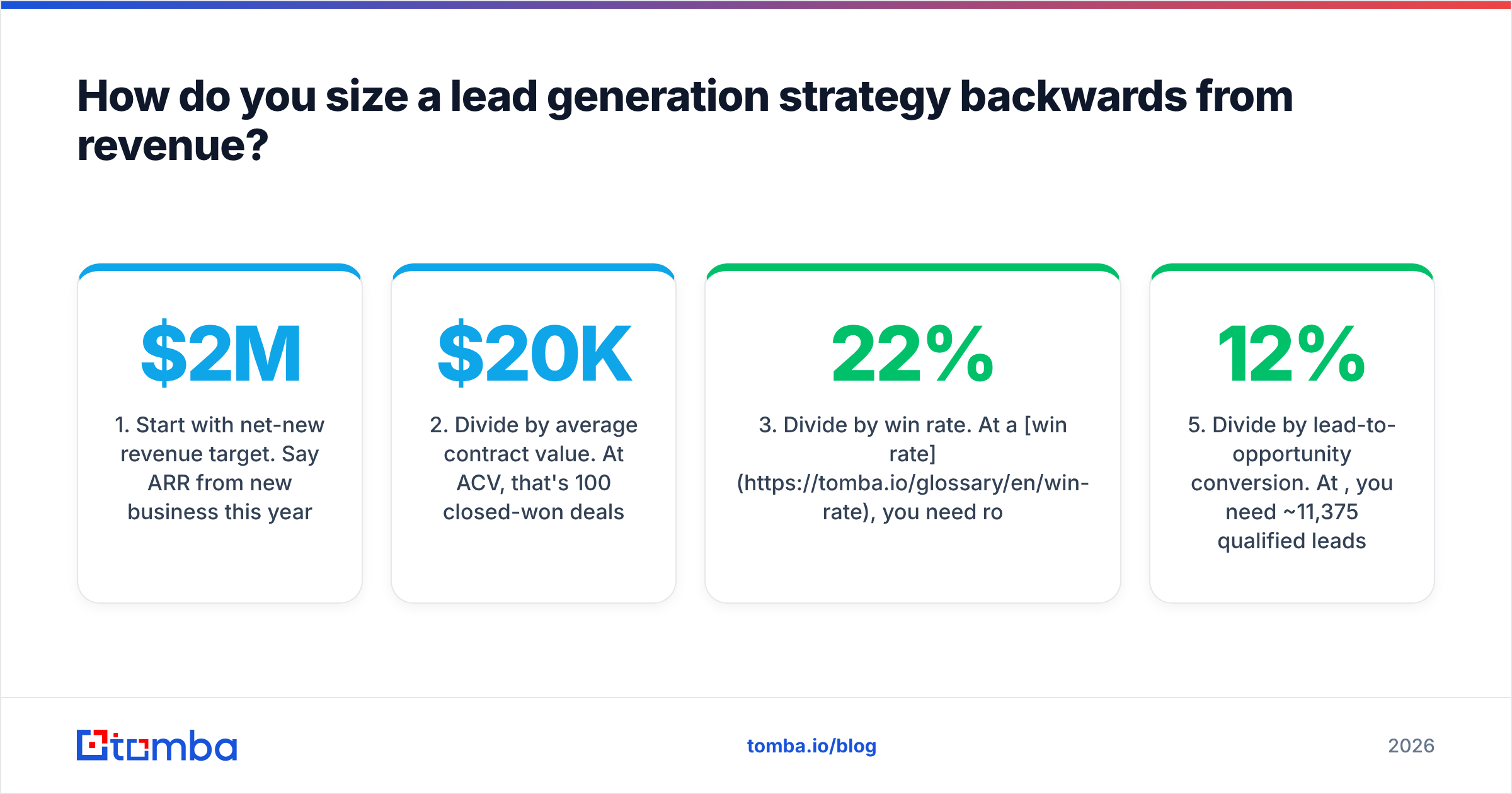
- Start with net-new revenue target. Say $2M ARR from new business this year.
- Divide by average contract value. At $20K ACV, that's 100 closed-won deals.
- Divide by win rate. At a 22% win rate, you need roughly 455 qualified opportunities.
- Apply pipeline coverage. Most B2B teams plan 3x coverage, so ~1,365 opportunities entering pipeline.
- Divide by lead-to-opportunity conversion. At 12%, you need ~11,375 qualified leads.
- Divide by contact-to-lead rate. At a 4% response-to-qualified rate on outbound, you're touching roughly 284,000 contacts — which immediately tells you outbound alone cannot carry this plan.
That last line is the whole point of the exercise. The math either validates your channel mix or exposes it as fantasy in about ten minutes. Run it before you write a single sequence.
Most teams that run this calculation honestly discover they need a blend: inbound to lower blended cost, outbound to control timing, and a partner or community motion to cover the gap. Single-channel strategies are almost always underfunded plans in disguise.
Which lead generation channels should you actually pick?#
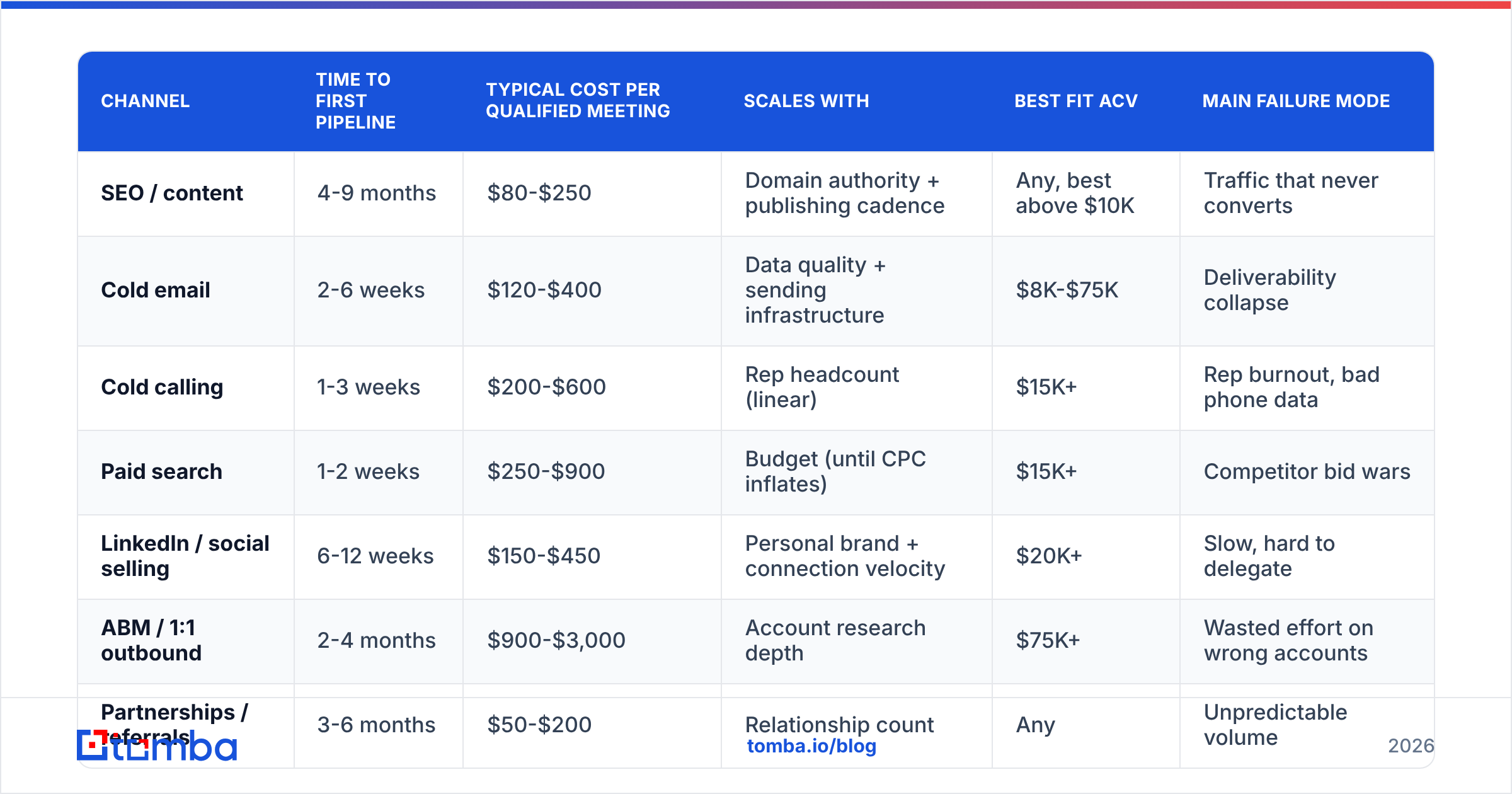
Channel selection is an economics decision, not a preference. Here's how the main motions compare on the dimensions that matter when you're allocating budget.
| Channel | Time to first pipeline | Typical cost per qualified meeting | Scales with | Best fit ACV | Main failure mode |
|---|---|---|---|---|---|
| SEO / content | 4-9 months | $80-$250 | Domain authority + publishing cadence | Any, best above $10K | Traffic that never converts |
| Cold email | 2-6 weeks | $120-$400 | Data quality + sending infrastructure | $8K-$75K | Deliverability collapse |
| Cold calling | 1-3 weeks | $200-$600 | Rep headcount (linear) | $15K+ | Rep burnout, bad phone data |
| Paid search | 1-2 weeks | $250-$900 | Budget (until CPC inflates) | $15K+ | Competitor bid wars |
| LinkedIn / social selling | 6-12 weeks | $150-$450 | Personal brand + connection velocity | $20K+ | Slow, hard to delegate |
| ABM / 1:1 outbound | 2-4 months | $900-$3,000 | Account research depth | $75K+ | Wasted effort on wrong accounts |
| Partnerships / referrals | 3-6 months | $50-$200 | Relationship count | Any | Unpredictable volume |
Read this table as a set of trade-offs, not a ranking. Referrals have the best unit economics and the worst predictability — you cannot build a plan on them. Paid search is the most predictable and among the most expensive. Cold email sits in the middle, which is exactly why it remains the default for most B2B teams under $50M ARR.
The practical rule: pick one fast channel and one compounding channel. Fast channels (outbound, paid) buy you pipeline this quarter. Compounding channels (SEO, community, partnerships) lower your blended cost in year two. Teams that only run fast channels are on a treadmill. Teams that only run compounding channels miss their number while waiting for Google.
How do you define an ICP that actually narrows anything?#
Most ICP documents are useless because they describe a market segment, not a filter. "Mid-market SaaS companies in North America" is not an ICP — it's 40,000 companies and no prioritization.
A usable ICP has four layers:
- Firmographic floor — headcount, revenue band, geography, industry. This is your hard filter. Non-negotiable.
- Technographic or operational signal — what they already use or do that implies they need you. Running HubSpot, hiring SDRs, using a competitor, operating multiple warehouses.
- Trigger event — what makes now the right time. Funding round, new VP of Sales, office expansion, pricing page change, a job posting for a role your product supports.
- Buyer persona map — who champions, who signs, who blocks. Named titles, not "decision makers."
Layers 1 and 4 are static. Layers 2 and 3 are where the leverage lives, and they're the reason list-buying underperforms. A purchased list gives you layer 1 and maybe layer 4. It gives you zero timing signal, which is why response rates on generic purchased lists sit in the low single digits while trigger-based outbound routinely clears 8-12%.
Build the target list yourself. Use domain search to map the contacts at accounts that pass your firmographic filter, layer in a trigger, and you're working a list of 200 accounts that actually converts instead of 20,000 that doesn't.
Why does data quality break more lead generation strategies than channel choice?#
Because bad data fails silently until it fails catastrophically.
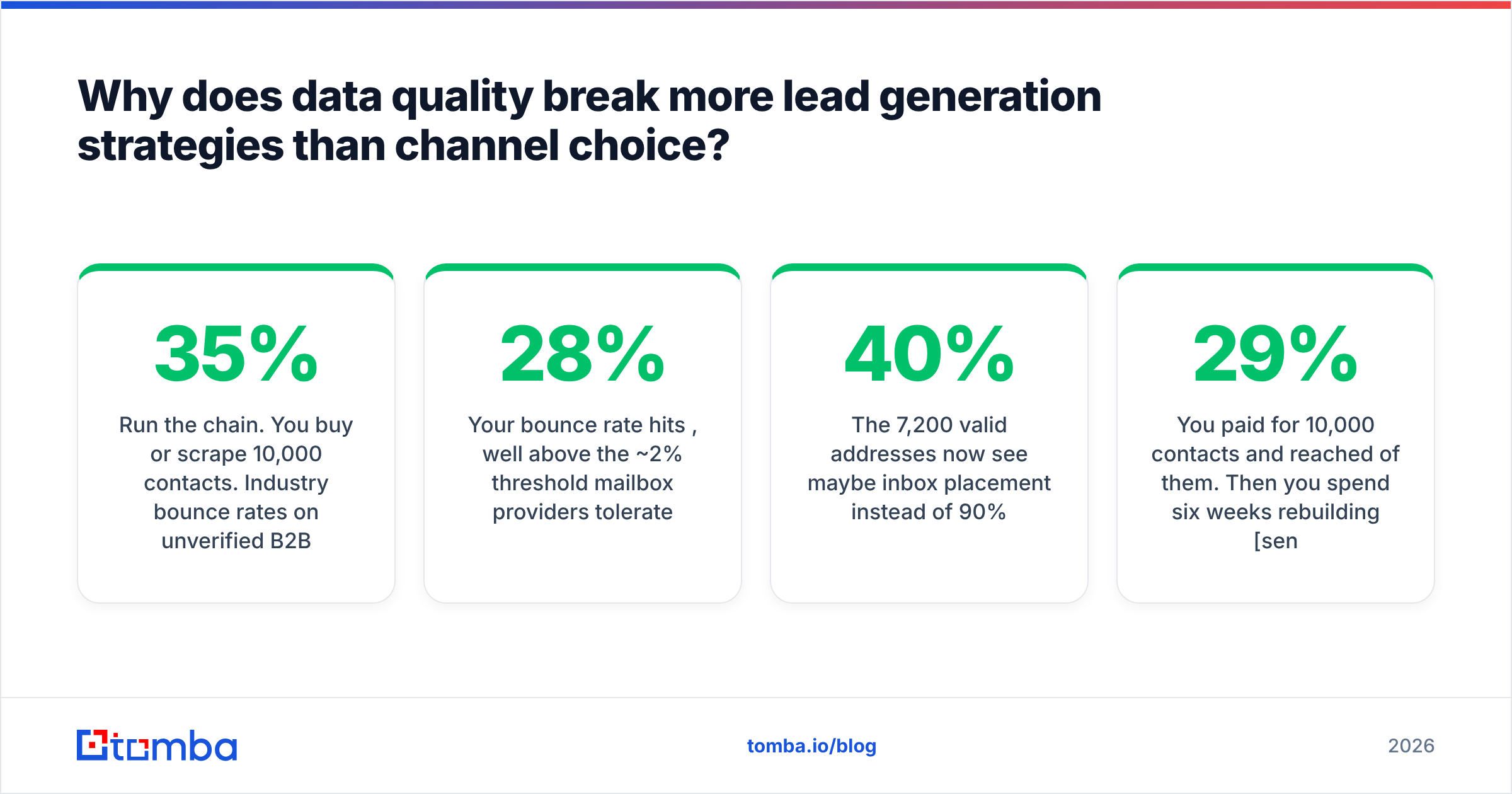
Run the chain. You buy or scrape 10,000 contacts. Industry bounce rates on unverified B2B data run 20-35%. You send to all 10,000:
- 2,800 hard bounce
- Your bounce rate hits 28%, well above the ~2% threshold mailbox providers tolerate
- Google and Microsoft start routing your domain to spam
- The 7,200 valid addresses now see maybe 40% inbox placement instead of 90%
- Your effective reach is ~2,900 people, not 10,000
You paid for 10,000 contacts and reached 29% of them. Then you spend six weeks rebuilding sender reputation, during which your outbound channel produces nothing. The cost isn't the wasted list — it's the quarter.

This is why verification is not an optional line item. Run every list through an email verifier before the first send, re-verify anything older than 90 days, and treat catch-all domains as a separate risk bucket rather than lumping them in with clean sends. B2B contact data decays at roughly 22-30% per year as people change roles, so a list that was clean in January is meaningfully degraded by autumn.
The second-order effect matters too. Reps who work bad data stop trusting the list, start freelancing their own prospecting, and your carefully designed strategy dissolves into 12 different personal workflows you can't measure.
What does a 90-day lead generation strategy rollout look like?#
Ambitious plans fail on sequencing more than substance. Here's a rollout that survives contact with reality.
Days 1-14 — Instrument before you act. Define your qualified lead criteria in writing. Set up source tracking so every opportunity carries a channel attribute. Agree the single metric you'll judge each channel on (cost per qualified meeting, not leads, not MQLs). Audit your current CRM hygiene — if you can't trust the existing data, new data won't help.
Days 15-30 — Build the target list. Apply your ICP filter to build an account list, then find and verify contacts. Aim for 3-5 contacts per account in the buying committee, not one. Verify everything. Segment by trigger so you can personalise at the segment level rather than one-by-one.
Days 31-45 — Launch the fast channel. Warm up sending domains properly (two to three weeks minimum for new domains). Start at 20-30 sends per mailbox per day and ramp. Run three message variants, not one. Track replies by segment, not in aggregate — aggregate reply rate hides which segment is actually working.
Days 46-75 — Start the compounding channel. Publish, build partnerships, or launch the community motion. These won't produce pipeline in this window. That's expected. You're planting so that quarter three costs less than quarter one.
Days 76-90 — Cut and double down. Kill the worst-performing segment and the worst-performing message. Reallocate that capacity to whatever cleared your cost-per-meeting threshold. Resist the urge to kill an entire channel this early unless it's failing by more than 2x.
The hardest discipline here is not adding a third channel in week six because someone read a post about a new tactic. Two channels, run properly, beat five channels run badly every single time.
How do inbound, outbound, and ABM compare over a full year?#
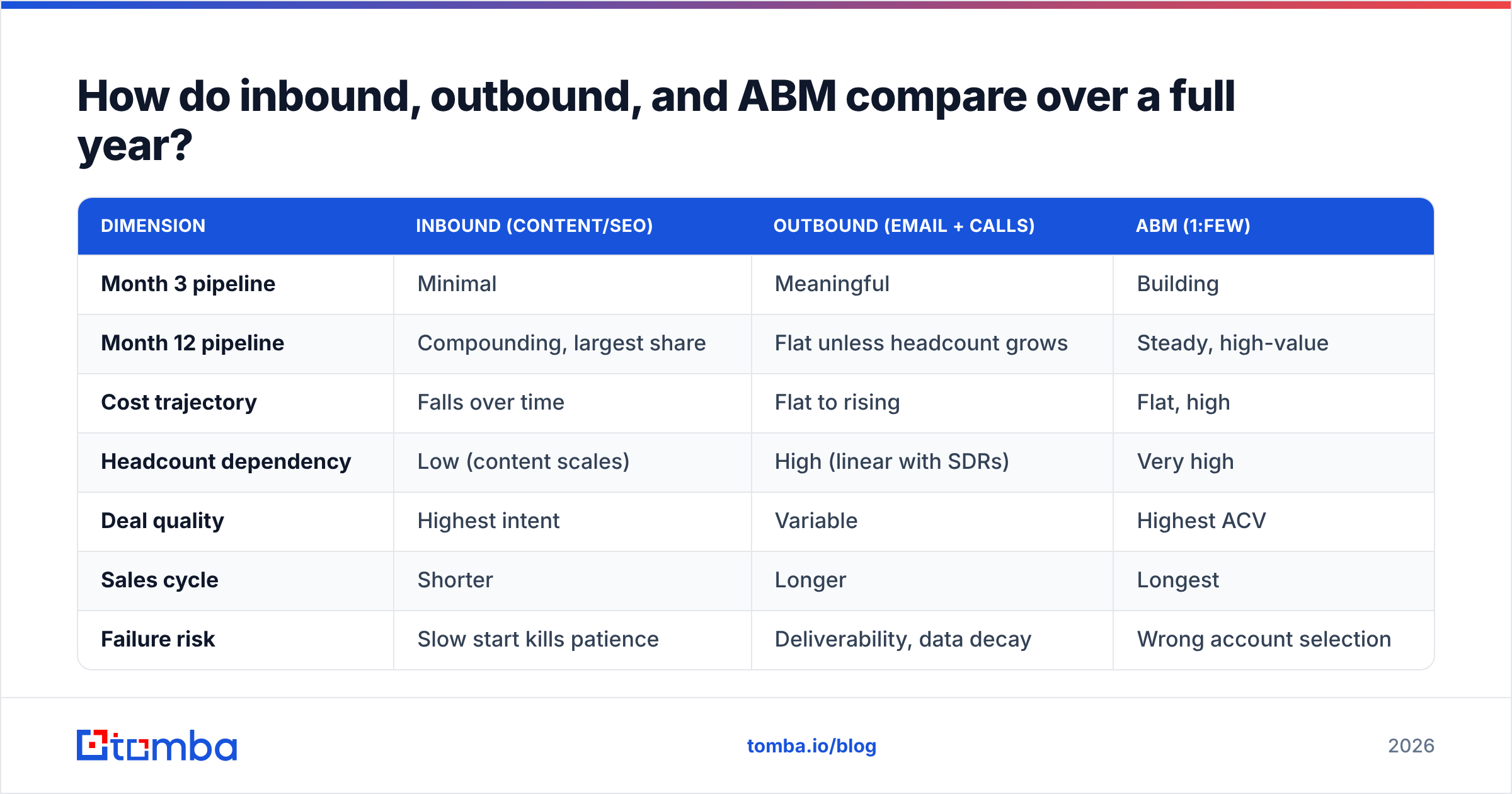
The 90-day view flatters fast channels. Stretch the window to twelve months and the picture changes.
| Dimension | Inbound (content/SEO) | Outbound (email + calls) | ABM (1:few) |
|---|---|---|---|
| Month 3 pipeline | Minimal | Meaningful | Building |
| Month 12 pipeline | Compounding, largest share | Flat unless headcount grows | Steady, high-value |
| Cost trajectory | Falls over time | Flat to rising | Flat, high |
| Headcount dependency | Low (content scales) | High (linear with SDRs) | Very high |
| Deal quality | Highest intent | Variable | Highest ACV |
| Sales cycle | Shorter | Longer | Longest |
| Failure risk | Slow start kills patience | Deliverability, data decay | Wrong account selection |
| Minimum viable budget | $4K-$10K/mo | $3K-$8K/mo + reps | $15K+/mo |
Notice the headcount row. Outbound's dirty secret is that it scales linearly with people — double the pipeline means roughly double the SDRs. Inbound and product-led motions break that link, which is why almost every company that gets past $20M ARR has shifted its blended mix toward compounding channels whether they planned to or not. HubSpot's research on inbound economics and G2's buyer behaviour data both point the same direction: buyers self-educate well before they'll take a meeting, and channels that meet them during that phase cost less per closed deal.
None of that means abandon outbound. It means budget for outbound as your timing-control lever and your compounding channel as your margin lever.
What metrics should govern a lead generation strategy?#
Track fewer things, but track them per-channel and per-segment.
- Cost per qualified meeting — the only number that lets you compare channels honestly. Include tooling, data, and fully-loaded rep cost.
- Lead-to-opportunity rate — if this is below 8%, your qualification criteria are too loose and you're wasting AE time.
- Response rate by segment — aggregate reply rate is a vanity number. Segment-level tells you which ICP slice to expand.
- Bounce rate and inbox placement — leading indicators of channel death. Watch weekly.
- Time to first meeting from list build — measures operational drag. If it's over three weeks, your process, not your strategy, is the bottleneck.
- Pipeline coverage ratio — are you actually at 3x, or did you get there by leaving dead deals open?
One governance rule: review channel economics monthly, but only change strategy quarterly. Monthly reviews catch operational problems. Quarterly reviews catch strategic ones. Confusing the two produces whiplash.
Where should you start if you're building this from zero?#
Do the backwards math first. It takes an afternoon and it will either confirm your plan or save you a quarter.
Then build one clean, verified, trigger-segmented list of 300-500 accounts before you spend a dollar on tooling beyond data. Nearly every lead gen strategy that fails in month two failed in week one, when someone decided the list was "good enough to start."
If you want that list built properly, Tomba's Email Finder finds and verifies professional email addresses by name, domain, or company, so the contacts entering your sequences are ones that actually land. Pair it with the bulk email finder for account-level list building and verification in one pass. The free tier covers 25 searches a month for testing the workflow; Tomba pricing starts at $49/mo on Starter and $99/mo on Growth when you're ready to run volume. Build the list right, and every downstream number in your strategy gets easier.
Related guides#
Ready to find emails that actually work?
Join 150,000+ professionals who stopped guessing and started sending. Free credits on signup — no credit card required.
Get the Tomba newsletter
Practical outbound tactics and product updates — once every two weeks.
About the author