Lead Generation Tactics B2B Teams Use: 9 Plays for 2026
The lead generation tactics B2B teams still run were built for cheap attention and forgiving inboxes. Both are gone. Here are the nine plays that still book meetings in 2026, with costs, ramp time, and the failure modes nobody puts in the case study.
Most lead generation tactics B2B teams still run were built for cheap attention and forgiving inboxes. Both are gone. Here are the nine plays that still book meetings in 2026, with real costs and ramp times.
TL;DR
- Volume tactics collapsed first. Gmail and Outlook now punish unverified lists, so list hygiene is a tactic, not an ops chore.
- The nine tactics below are ranked by cost per qualified meeting, ramp time, and how badly they break at 5x scale.
- Outbound still works, but only with a narrow ICP, verified data, and a bounce rate under 2%. Sloppy outbound damages the domain every other tactic depends on.
- Intent signals (visits, hiring, tech changes) help you rank a list, not build one. Use them to sequence accounts you already picked.
- Data accuracy beats stack cost. A $99/mo data layer with 95% deliverable emails beats a $2,000/mo platform feeding a broken sequencer.
What counts as a B2B lead generation tactic in 2026?#
A lead generation tactic is any repeatable motion that turns a stranger into a contact you may follow up with. That matters, because much of the advice online blends three different jobs: getting attention, capturing an identity, and booking a meeting.
Most teams are not short on traffic. They are short on the middle step: turning anonymous demand into a named person with a working email address and a reason to reply. That is the gap this guide attacks.
Two structural changes reset the playbook:
- Inbox enforcement got real. Google and Yahoo now require authentication, one-click unsubscribe, and a spam-complaint rate under 0.3%. Tactics built on scraped lists now cost you the domain.
- Buying committees grew and went dark. Gartner puts the average committee at six to ten people. Most of them research without ever filling in a form, so gated content reaches a shrinking slice of the buyers who decide.
The result: tactics that identify specific people and reach them accurately beat tactics that broadcast and wait.
Why do most B2B lead generation tactics fail?#
Failure is rarely about the tactic. It is about one of five execution gaps.
- The ICP is a filter, not a thesis. "SaaS, 50–500 employees, US" is a filter. "Companies that just hired a first RevOps manager" is a thesis, and it gives you a reason to write.
- The list is bought, not built. Purchased lists carry unknown age, consent, and bounce rates. You inherit someone else's decay curve.
- Data is never verified before send. A 12% bounce rate does not just waste 12% of your sends. It also suppresses inbox placement for the other 88%.
- Channels run in isolation. Email, LinkedIn, ads, and events get measured separately, so credit goes to whichever touch fired last.
- Nobody defines "lead." If marketing counts an ebook download and sales counts a booked demo, your reporting is fiction. Agree on what a marketing qualified lead is first.
Fix those five and mediocre tactics start working. Skip them and the best tactic underperforms.
Which lead generation tactics B2B teams should run first#
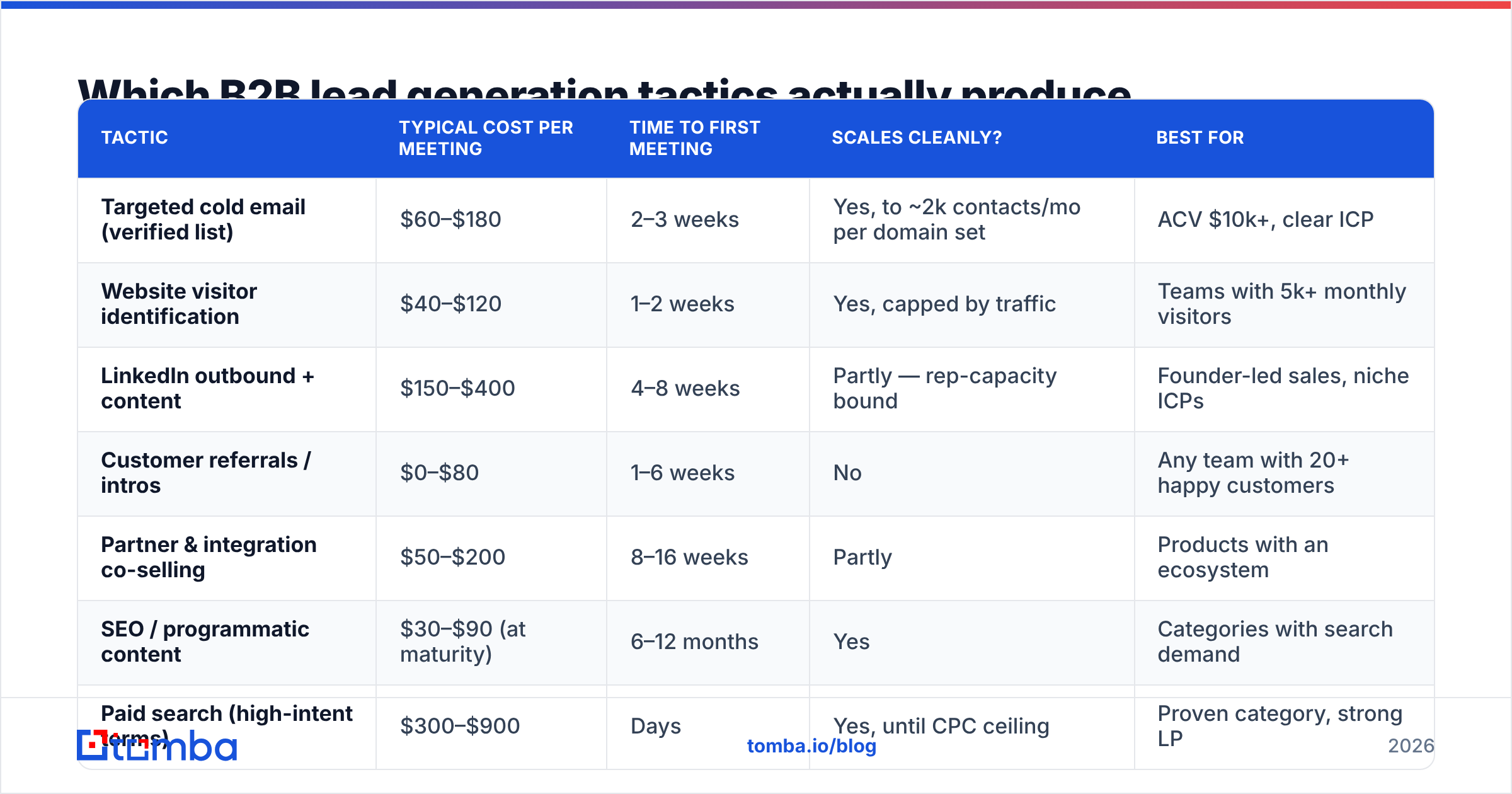
Here is the honest ranking. Costs are directional and vary by market and ACV, but the order holds for most deal sizes between $5k and $100k.
| Tactic | Typical cost per meeting | Time to first meeting | Scales cleanly? | Best for |
|---|---|---|---|---|
| Targeted cold email (verified list) | $60–$180 | 2–3 weeks | Yes, to ~2k contacts/mo per domain set | ACV $10k+, clear ICP |
| Website visitor identification | $40–$120 | 1–2 weeks | Yes, capped by traffic | Teams with 5k+ monthly visitors |
| LinkedIn outbound + content | $150–$400 | 4–8 weeks | Partly — rep-capacity bound | Founder-led sales, niche ICPs |
| Customer referrals / intros | $0–$80 | 1–6 weeks | No | Any team with 20+ happy customers |
| Partner & integration co-selling | $50–$200 | 8–16 weeks | Partly | Products with an ecosystem |
| SEO / programmatic content | $30–$90 (at maturity) | 6–12 months | Yes | Categories with search demand |
| Paid search (high-intent terms) | $300–$900 | Days | Yes, until CPC ceiling | Proven category, strong LP |
| Webinars & niche events | $200–$600 | 3–6 weeks | No | Complex, education-led sales |
| Paid social (cold) | $600–$2,000+ | Days | Yes, badly | Brand, retargeting fuel only |
Three things jump out. The cheapest tactics per meeting start from a known identity: a verified email, an identified visitor, an existing relationship. The fastest tactics are also the most expensive. And SEO has the best long-run number on the table and the worst short-run one, which is why teams keep abandoning it in month four.
If you run only two tactics this quarter, run targeted outbound and visitor identification. They feed each other. Visitor data tells you which accounts to work, and outbound is how you reach them.
How do you build a target list that doesn't bounce?#
This is where the lead generation tactics B2B teams rely on live or die, so be mechanical about it.
Step 1 — Define the account set, not the contact set. Start with 200–500 companies that match your thesis. Good sources: your closed-won patterns, competitor customer pages, review-site categories on G2, job boards filtered by the role that signals your problem, and conference attendee lists.
Step 2 — Map the domain, then the people. For each company, pull the email pattern and any known contacts. A domain search returns the format (first.last@, f.last@, first@) plus discovered addresses. That is faster and safer than guessing permutations one at a time.
Step 3 — Find the specific humans. Titles decay fast. Pull the current holder of the role you need, then resolve the address with an email finder. Pattern generators produce plausible strings; finders produce sourced ones.
Step 4 — Verify before anything touches a sequencer. Run the list through an email verifier and drop anything undeliverable. Treat catch-all domains as a separate bucket with its own lower send volume. Do not blend them into your main sends.
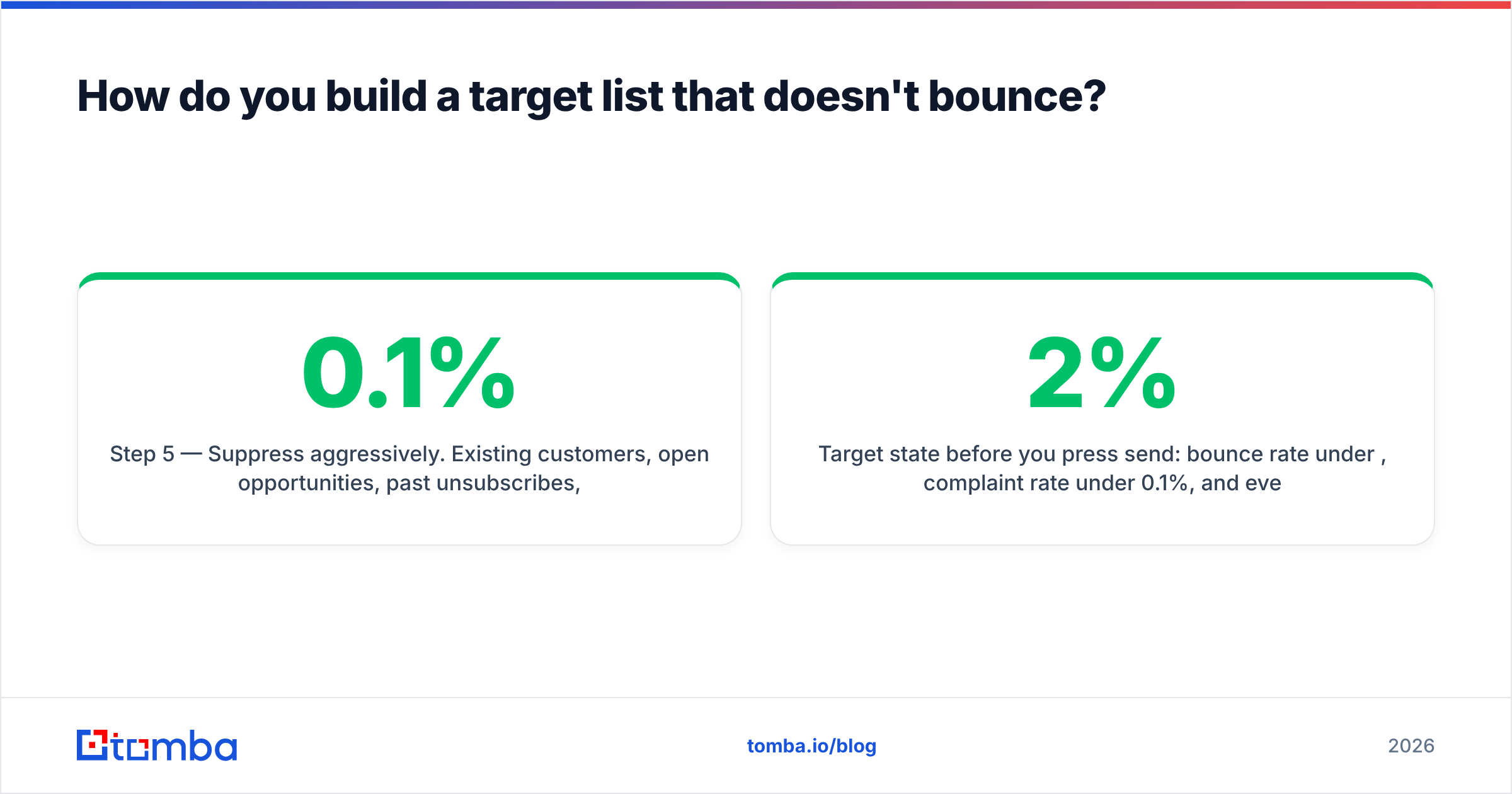
Step 5 — Suppress aggressively. Customers, open opportunities, past unsubscribes, competitors, and anyone contacted in the last 90 days. Suppression lists are unglamorous. They are also the difference between a 0.1% and a 0.4% complaint rate.
Target state before you send: bounce rate under 2%, complaint rate under 0.1%, every row traceable to a source. If you cannot hit those numbers, the list is not ready. No amount of copywriting fixes that.

Is cold email still worth it as a B2B lead generation tactic?#
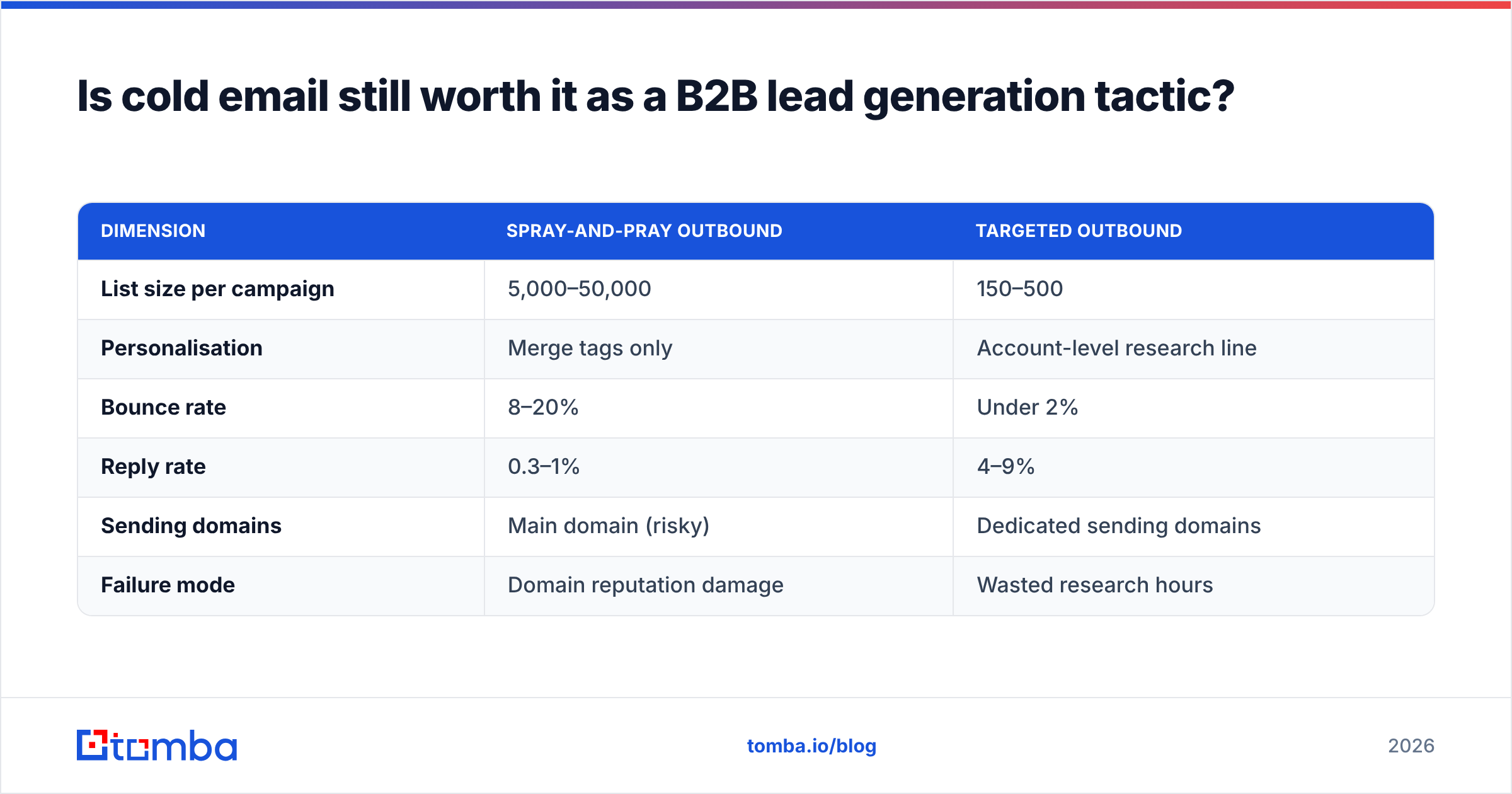
Yes, with two conditions: narrow targeting and clean data. The version that died is the 10,000-contact blast. The version that works is a research-led campaign across 300 accounts.
What separates the two in practice:
| Dimension | Spray-and-pray outbound | Targeted outbound |
|---|---|---|
| List size per campaign | 5,000–50,000 | 150–500 |
| Personalisation | Merge tags only | Account-level research line |
| Bounce rate | 8–20% | Under 2% |
| Reply rate | 0.3–1% | 4–9% |
| Sending domains | Main domain (risky) | Dedicated sending domains |
| Failure mode | Domain reputation damage | Wasted research hours |
The second column's worst outcome is wasted time. The first column's worst outcome is losing your ability to email anyone at all, customers included. That asymmetry is why email deliverability now belongs in the lead generation conversation instead of the ops backlog.
Tactical notes that consistently move reply rates:
- One ask per email. "Worth a 15-minute look?" beats a menu of options.
- Lead with the observation, not the pitch. The research line earns the next sentence.
- Three to four touches, then stop. Past five touches, you raise complaints more than replies.
- Send from a human, reply from the same human. Shared inboxes kill reply rates.
How should intent data change your priorities?#
Intent data is a sequencing tool, not a targeting tool. Its job is to tell you which 40 of your 400 accounts to work this week.
The signals worth acting on, roughly in order of reliability:
- First-party website behaviour — someone from the account read pricing twice. It is the strongest signal available, and it is yours. Visitor identification turns that anonymous session into an account you can route.
- Hiring signals — a job post for the role that owns your problem means budget exists.
- Tech-stack changes — adding or dropping an adjacent tool creates a window.
- Funding and leadership changes — new VP, new priorities, new vendors, usually in the first 120 days.
- Third-party topic surges — useful as direction, noisy at the account level, weak at the contact level.
The mistake is treating third-party intent as a contact list. It tells you a company researched a topic. It rarely tells you who. You still need the contact layer, which is why intent works best on a list you already built and verified.
What does a modern B2B lead gen stack cost?#
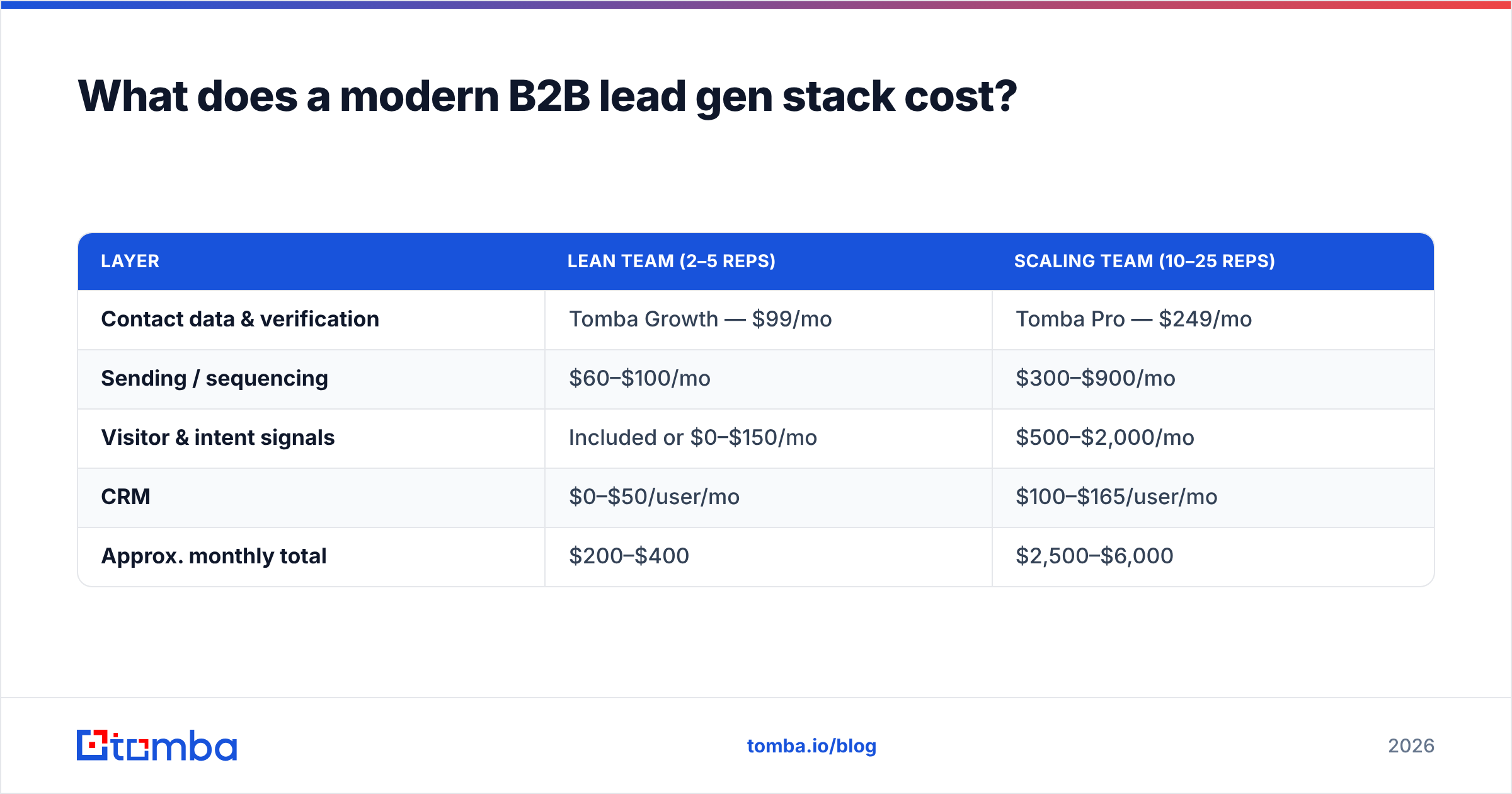
You need four layers: data, outreach, signals, and CRM. Here is a realistic small-team setup next to an enterprise one.
| Layer | Lean team (2–5 reps) | Scaling team (10–25 reps) |
|---|---|---|
| Contact data & verification | Tomba Growth — $99/mo | Tomba Pro — $249/mo |
| Sending / sequencing | $60–$100/mo | $300–$900/mo |
| Visitor & intent signals | Included or $0–$150/mo | $500–$2,000/mo |
| CRM | $0–$50/user/mo | $100–$165/user/mo |
| Approx. monthly total | $200–$400 | $2,500–$6,000 |
Tomba's own tiers run Free (25 searches/mo), Starter $49/mo, Growth $99/mo, Pro $249/mo, and Enterprise custom. Full Tomba pricing is public, which is more than most data vendors can say. For a two-person team, the whole data layer costs less than a single paid-search click in many enterprise categories.
A neutral note on alternatives. If your motion needs pre-built, bulk-downloadable lists rather than on-demand lookups, a database-first provider like BookYourData solves a different problem well. Pick based on the job: enriching a list you built (lookup tools), or buying coverage in a market you do not know yet (database tools). Plenty of teams run both.
How do you measure lead generation tactics honestly?#
Four metrics, tracked per tactic, reviewed monthly:
- Cost per qualified meeting — total spend (tools plus labour) divided by meetings that passed qualification. Not per lead. Leads lie.
- Meeting-to-opportunity rate — if a tactic books meetings that never convert, it is a distraction with good optics.
- Time to first revenue — how long from first touch to closed-won. This tells you whether a tactic funds this quarter or next year.
- Blast radius — what breaks when you 5x it. Paid scales linearly on cost. Outbound scales until deliverability caps. Referrals do not scale at all.
Set a 90-day review cadence. Most teams kill tactics at week three, which is far too early for SEO and partnerships. They also keep tactics two years past their expiry, such as paid social and gated ebooks. Both errors cost more than picking the "wrong" tactic.
One more discipline: track response rate by segment, not just overall. An aggregate 3% reply rate often hides a 9% segment and a 0.4% segment. Kill the second, double the first.
What should you test first this quarter?#
If you are starting from zero, run this 30-day sequence:
- Week 1: Write the ICP thesis. Build a 250-account list. Map domains and email patterns.
- Week 2: Find and verify contacts. Set up authentication (SPF, DKIM, DMARC) on dedicated sending domains. Warm them.
- Week 3: Launch two campaigns of 125 contacts each with different research angles. Same offer, same CTA.
- Week 4: Measure reply and meeting rates per angle. Kill the loser. Rebuild the list for the winner at 2x size.
That is a complete loop with a real answer at the end. It beats a quarter spent debating channel mix.
Start with the data layer#
Every one of the lead generation tactics B2B teams win with depends on one thing: knowing who to contact and being able to reach them. Get that wrong and your sequencer, your CRM, and your ad budget all optimise against noise.
Start with the Tomba Email Finder. Build your 250-account list, resolve the contacts you actually need, and verify them before a single send. The free tier gives you 25 searches a month. Run it against ten current customers and check the accuracy yourself before you pay anyone anything.
Related guides#
// get started
Find, verify and enrich your first contacts today
Start on the free plan with 25 searches a month, then scale when your team is ready.
Free plan · No credit card required · GDPR & CCPA
// about the author