Lead Generation Techniques That Actually Work in 2026
Most lead gen advice is recycled listicle filler. Here are the techniques that still produce pipeline in 2026, what each one costs, and how to sequence them without burning your domain.
TL;DR
- Most "50 lead generation techniques" posts are padding. In practice, five channels produce nearly all B2B pipeline: outbound email, LinkedIn, inbound/SEO, paid, and referrals/partnerships.
- The channel matters less than the data behind it. A mediocre sequence sent to verified, well-segmented contacts beats a brilliant sequence sent to a scraped list every time.
- Cost per qualified meeting — not cost per lead — is the only metric that separates techniques worth scaling from ones that just inflate your CRM.
- Volume is now a liability. Google and Microsoft's 2024 bulk-sender rules made a 6% spam-complaint tolerance into a hard 0.3% ceiling, so list hygiene is a lead gen technique, not an ops chore.
- Pick two channels, instrument them properly for one quarter, and only add a third once the first two hit a repeatable cost per meeting.
What are lead generation techniques, really?#
A lead generation technique is any repeatable method for turning a stranger into a named contact who has a plausible reason to talk to you. That's it. Everything else — the tooling, the sequences, the intent scores — is implementation detail.
The reason this definition matters is that most teams conflate technique with channel. Channels are where you show up (email, LinkedIn, search, events). Techniques are how you generate and qualify the contact before you show up. Two companies can both "do cold email" and get results that differ by 20x, because one built a 400-contact list of operations leaders at logistics companies with 50–200 employees who just posted a warehouse-automation job, and the other exported 40,000 rows from a database and hit send.
Here's the honest hierarchy, ordered by how much leverage each layer gives you:
- Targeting — who you contact. The single biggest multiplier. A tight ICP with a trigger event outperforms everything downstream.
- Data quality — whether the contact details are real and current. Bad data does not just waste sends; it actively damages your ability to reach the good contacts.
- Offer and relevance — why this person should care this week. Personalization is a proxy for this, not a substitute.
- Channel mix — email, LinkedIn, phone, ads, content. Matters, but less than people think.
- Copy and cadence — the actual words and timing. Real, but the last 15% of the outcome, not the first.
- Tooling — sequencers, CRMs, dialers. Amplifiers only. They multiply whatever quality already exists.
Most teams optimize in reverse order — buying a new sequencer before fixing the list. That's why their results stay flat.

Which lead generation techniques actually produce pipeline in 2026?#
Six methods still carry the load. Each has a real cost profile and a real failure mode.
1. Targeted cold email. Still the highest-leverage outbound technique per dollar, provided you keep lists small and verified. The failure mode is volume: blasting 10,000 unverified contacts now gets your domain throttled before your best 200 prospects ever see an inbox.
2. LinkedIn-led outbound. Connection requests plus content plus light DMs. Slower and volume-capped (roughly 100–200 connection requests a week before restrictions), but reply quality is materially higher. Works best when paired with email rather than run alone — a LinkedIn finder lets you turn a profile you've already engaged with into a deliverable business email.
3. Inbound content and SEO. The slowest to start, the cheapest at steady state. Realistically a 6–12 month investment before meaningful pipeline. Worth starting now precisely because it takes that long.
4. Website visitor identification. Deanonymizing the companies already researching you. Conversion rates beat cold outbound by a wide margin because intent is real, but volume depends entirely on existing traffic. Useless at 500 monthly visits, excellent at 50,000.
5. Referrals and partner co-selling. The highest close rate of any technique and the hardest to scale deliberately. Most teams leave it entirely to chance instead of running a quarterly ask cadence into their existing customer base.
6. Paid search and paid social. Fast, measurable, and instantly expensive. Useful for validating messaging quickly and for capturing bottom-funnel demand, but rarely the foundation of an efficient B2B motion below a certain deal size.
Notably absent: gated ebooks behind 11-field forms, mass LinkedIn group posting, and buying "verified" lists of 100,000 contacts for $300. These still get recommended. They stopped working years ago.
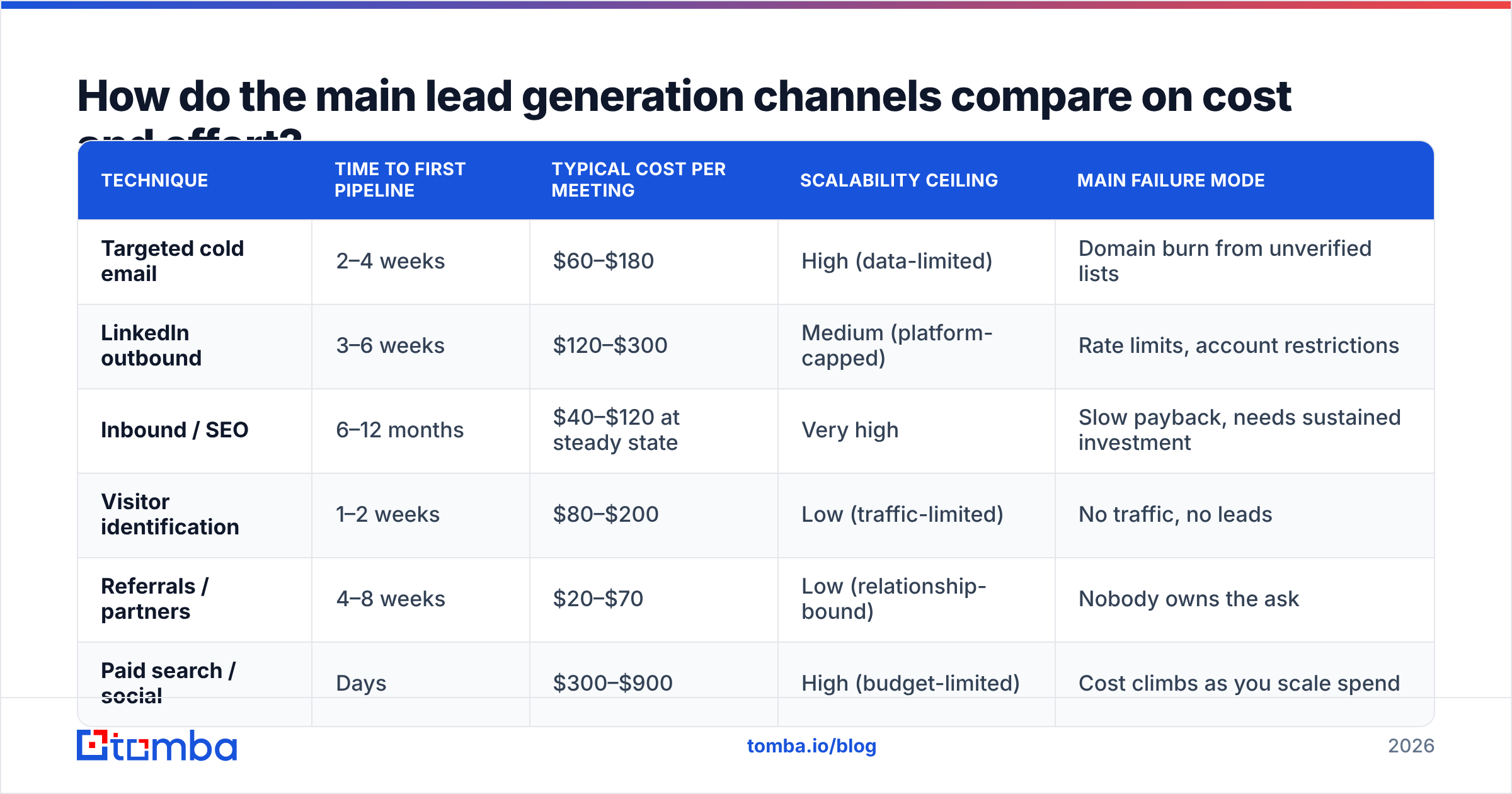
How do the main lead generation channels compare on cost and effort?#
Numbers below are directional benchmarks for mid-market B2B (deal sizes roughly $5k–$50k ACV). Your mileage varies with ICP and category maturity.
| Technique | Time to first pipeline | Typical cost per meeting | Scalability ceiling | Main failure mode |
|---|---|---|---|---|
| Targeted cold email | 2–4 weeks | $60–$180 | High (data-limited) | Domain burn from unverified lists |
| LinkedIn outbound | 3–6 weeks | $120–$300 | Medium (platform-capped) | Rate limits, account restrictions |
| Inbound / SEO | 6–12 months | $40–$120 at steady state | Very high | Slow payback, needs sustained investment |
| Visitor identification | 1–2 weeks | $80–$200 | Low (traffic-limited) | No traffic, no leads |
| Referrals / partners | 4–8 weeks | $20–$70 | Low (relationship-bound) | Nobody owns the ask |
| Paid search / social | Days | $300–$900 | High (budget-limited) | Cost climbs as you scale spend |
Two things jump out. First, referrals are by far the cheapest per meeting and almost nobody systematizes them. Second, paid is the most expensive channel and the one most often started first — because it's the only one that produces a number in week one.
The practical read: start with the two channels whose failure mode you can actually control. For most teams that's targeted email plus referrals, with inbound running in the background as a long-term compounding bet.
Why does data quality decide whether any technique works?#
Because in 2026, bad data doesn't just waste a send — it removes your ability to make good sends.
When Google and Yahoo rolled out their bulk sender requirements in February 2024, they set a spam complaint rate threshold of 0.3%, with 0.1% as the target to stay under. Microsoft followed with similar enforcement for high-volume senders. Before that, mailbox providers tolerated complaint rates an order of magnitude higher. What changed materially is the consequence: exceed the threshold and your legitimate mail to good prospects starts landing in spam, including mail to accounts already in your pipeline.
Unverified lists drive complaints and bounces in three ways:
- Dead addresses produce hard bounces, which providers read as a signal you didn't earn the list.
- Spam traps — recycled addresses that once belonged to real people — sit in old scraped databases and flag you instantly.
- Wrong-person hits generate complaints, because someone who never fit your ICP has no reason to be charitable about an unsolicited email.
So list hygiene is not an operational chore that happens after the strategy. It is part of the strategy. Running your list through an email verifier before a campaign is the cheapest insurance in outbound: a few cents a contact against the cost of rehabilitating a burned sending domain, which typically takes 4–8 weeks and a new domain.
Catch-all domains deserve a specific note. A large share of enterprise domains accept mail to any address, so standard verification returns "unknown" rather than valid or invalid. Treating every unknown as valid inflates bounce rates; discarding them all throws away a meaningful slice of enterprise TAM. A dedicated catch-all verifier resolves a good portion of that grey zone, which matters most if you sell upmarket.

How do you build a target list that's worth contacting?#
The mechanics are unglamorous and take about a day for a first pass.
Step 1 — Define the account filter, not the person filter. Start with firmographics you can verify: industry, headcount band, geography, and at least one technographic or behavioral signal. "Marketing directors in SaaS" is not a filter. "Series A–B SaaS, 30–150 employees, running HubSpot, hiring a demand gen role" is.
Step 2 — Add a trigger. Funding rounds, leadership hires, job postings, tech stack changes, and expansion announcements all give you a reason to reach out now. Reply rates on trigger-based outreach are consistently multiples of untriggered outreach, because relevance is baked into the first line instead of bolted on.
Step 3 — Find the right person and their contact details. Map the role that owns the problem, then retrieve verified contact data. If you're working account-first, a domain search returns the contacts and email patterns at a company; if you're working person-first from a list of names, an email finder resolves individuals. For account-based lists you can run the whole thing through a bulk email finder rather than one at a time.
Step 4 — Verify, then segment. Verify everything before it enters a sequence. Then split the list into segments small enough that one message can be genuinely relevant to all of it. If you can't write a first line that's true for every contact in a segment, the segment is too big.
Step 5 — Cap the list. For a first campaign, 200–400 contacts per segment is plenty. You are testing whether a message resonates, not filling a quarter. Small lists let you read signal from replies instead of guessing from open rates, which are now unreliable anyway thanks to Apple's Mail Privacy Protection inflating them.
A note on where the data comes from. Providers differ substantially in how they source and refresh records, which shows up directly in bounce rates and in your GDPR/CCPA posture. Vendors that document their data sources publicly are easier to defend in a procurement or legal review than ones that don't. Among providers that are transparent here, BookYourData is a solid option for teams that prefer buying pre-built, verified lists by industry and role, while tools like Tomba fit teams that want to build lists from their own ICP definitions and enrich continuously via API. Both approaches are legitimate; they suit different workflows.
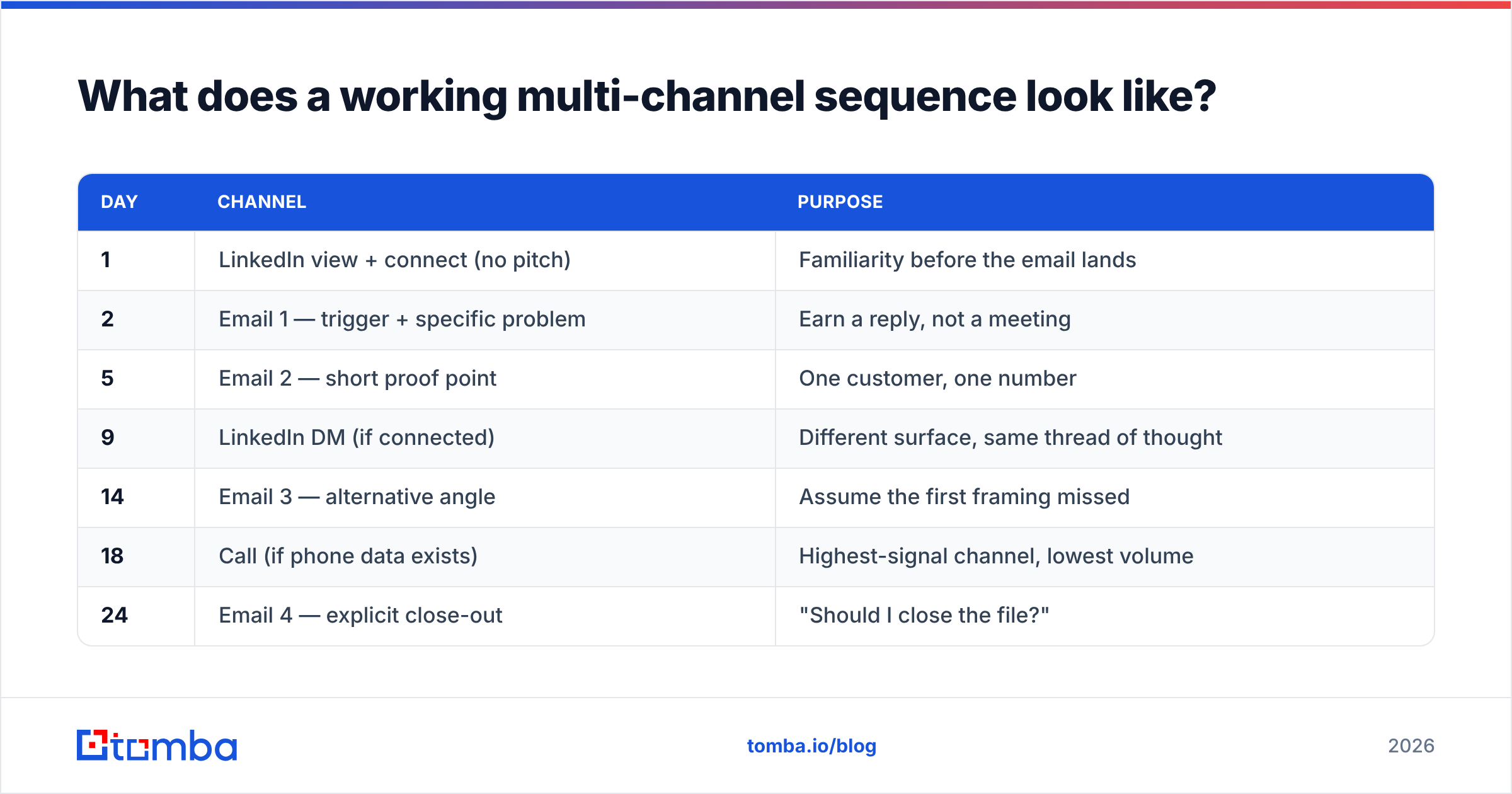
What does a working multi-channel sequence look like?#
Sequencing is where most teams over-engineer. A 14-step cadence across five channels is not sophistication — it's a way to annoy 400 people efficiently.
A reasonable baseline for a 200-contact segment:
| Day | Channel | Purpose |
|---|---|---|
| 1 | LinkedIn view + connect (no pitch) | Familiarity before the email lands |
| 2 | Email 1 — trigger + specific problem | Earn a reply, not a meeting |
| 5 | Email 2 — short proof point | One customer, one number |
| 9 | LinkedIn DM (if connected) | Different surface, same thread of thought |
| 14 | Email 3 — alternative angle | Assume the first framing missed |
| 18 | Call (if phone data exists) | Highest-signal channel, lowest volume |
| 24 | Email 4 — explicit close-out | "Should I close the file?" |
Seven touches over three-and-a-half weeks. That's enough. Past that, incremental replies drop sharply and complaint risk rises.
Two specifics worth getting right. First, keep the first email under 90 words and ask for a reply, not a calendar slot — the ask should be proportionate to the relationship, which at this point is zero. Second, if you're going to include a call step, source real direct dials. A phone step with switchboard numbers is theatre; a phone finder that returns verified direct lines is what makes step six worth the rep's time.
For benchmarks on what "good" looks like, HubSpot's annual sales research and Gartner's B2B buying studies are more reliable than the vendor-published stats circulating on LinkedIn, most of which have no methodology attached.
How should you measure lead generation techniques?#
Measure cost per qualified meeting and pipeline-to-close by source. Nothing else survives contact with a board meeting.
The metrics to deliberately de-emphasize:
- Open rate. Broken since Mail Privacy Protection. Directionally useful for comparing two subject lines on the same list, useless as an absolute.
- Raw lead count. Rewards volume, which is the exact behavior that burns domains.
- MQL volume without downstream tracking. An MQL that never converts to a meeting is a cost, not an asset.
The metrics that matter:
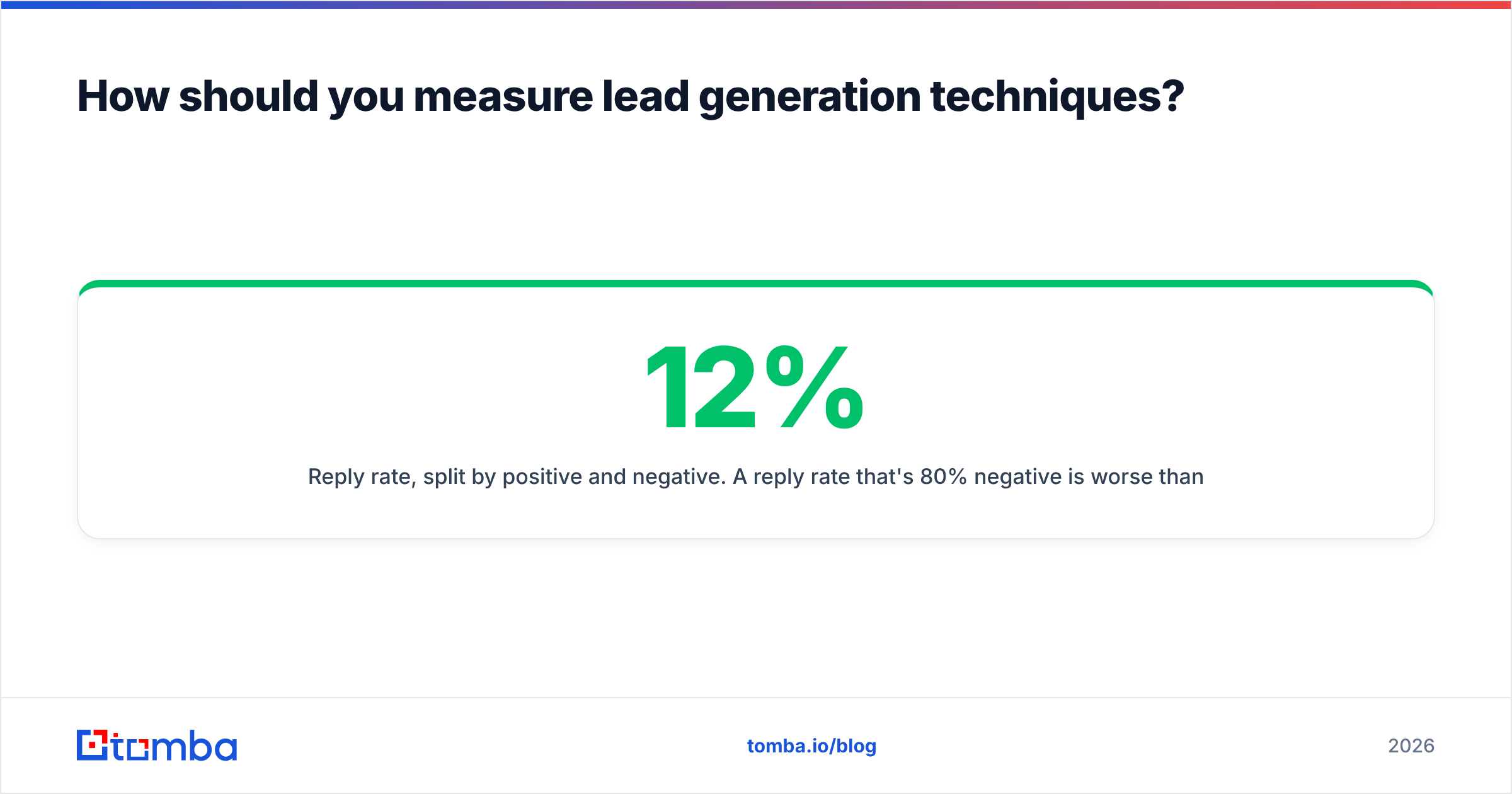
- Reply rate, split by positive and negative. A 12% reply rate that's 80% negative is worse than a 4% rate that's 60% positive.
- Meeting-held rate, not meeting-booked. No-shows are a targeting signal.
- Cost per qualified meeting by channel, fully loaded with tooling and rep time.
- Bounce rate and complaint rate per sending domain, watched weekly. These are leading indicators; by the time deliverability drops, you're already 2–3 weeks into the damage.
- Win rate by source. Some channels produce meetings that never close. Referrals almost always win here, which is why their true cost is even lower than the table above suggests.
Give each technique a full quarter before judging it, with one exception: kill anything that's damaging your sender reputation immediately, regardless of how many meetings it's producing.
What should you actually do this quarter?#
Pick two techniques. Not six.
If you have traffic (25k+ monthly visits), run visitor identification plus targeted email. If you don't, run targeted email plus a systematic referral cadence into existing customers. Start SEO content in the background either way, because the 9-month lag means starting later is strictly worse than starting now.
Then spend the first two weeks on data, not copy. Define the account filter, pick a trigger, build a 300-contact segment, verify every address, and only then write the sequence. Teams that invert this order spend six weeks polishing emails that go to people who were never going to buy.
Review at 30 days on reply quality, at 60 days on meetings held, and at 90 days on pipeline created. Add a third channel only when the first two have a cost per meeting you'd be comfortable defending to a CFO.
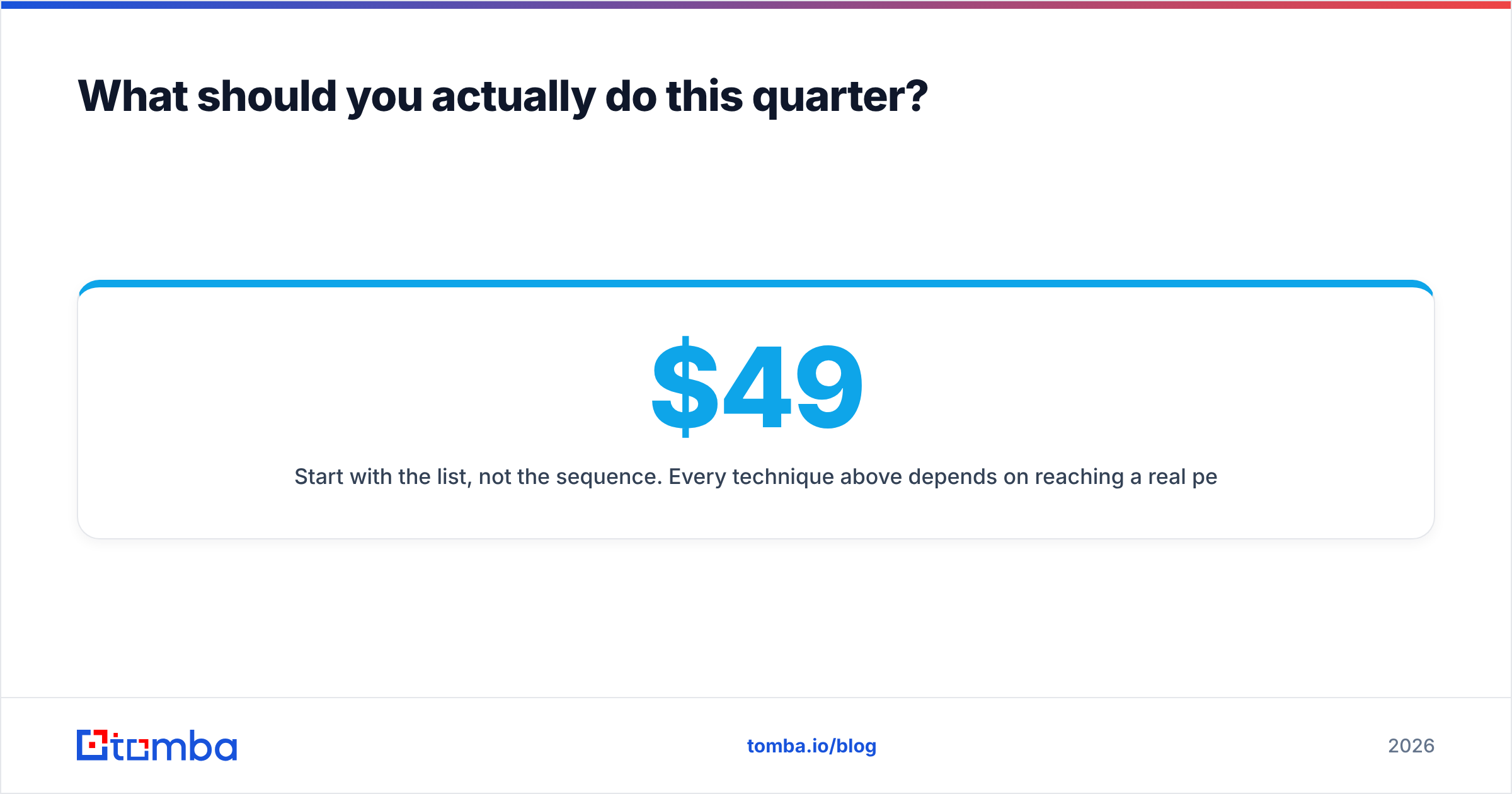
Start with the list, not the sequence. Every technique above depends on reaching a real person at a real company with a real reason to care. Tomba's Email Finder resolves verified business emails by name, domain, or company, with verification built in so you're not testing your sequence against dead addresses. The free tier includes 25 searches a month to check accuracy against contacts you already know; paid plans start at $49/mo on Starter, $99/mo on Growth, and $249/mo on Pro — see full Tomba pricing for credit limits and API access. Build the 300-contact list properly, and the rest of your lead generation gets easier by default.
Related guides#
// get started
Find, verify and enrich your first contacts today
Start on the free plan with 25 searches a month, then scale when your team is ready.
Free plan · No credit card required · GDPR & CCPA
// about the author