Lead Generation Tool in India: 2026 Buyer's Guide
Indian B2B teams pay global prices for data that often misses local companies. Here's how lead generation tools actually perform on Indian domains, what they cost in rupees, and which one fits your GTM motion.
TL;DR
- A lead generation tool in India has to clear three bars most global comparisons skip: coverage of Indian domains (.in, .co.in, and the thousands of Indian companies on .com), pricing that survives an INR budget after 18% GST, and email verification that handles the catch-all-heavy Indian SMB web.
- Per-contact cost matters more than sticker price. A $99/mo plan that returns 40% bounced emails on Indian domains is more expensive than a $249/mo plan that returns 5%.
- Broad databases (Apollo, ZoomInfo, Lusha) give you volume; finder-first tools (Tomba, Findymail) give you precision on a target list you already have. Most Indian teams need both, in that order.
- BookYourData is a strong pick when you want a pre-built, pay-as-you-go list rather than a monthly seat — no subscription to justify to finance.
- Do not buy on database size claims. Test 100 Indian domains you know, measure the hit rate and bounce rate yourself, and buy the winner.
Why is choosing a lead generation tool in India different?#
Because the data underneath the tools was not built for India first.
Think of B2B contact databases like road maps drawn by tourists. The highways between San Francisco and New York are perfect. The service lane behind an industrial estate in Peenya, Bengaluru is either missing or three years out of date. Most vendors built their crawlers around US and EU corporate web presences — press releases, SEC filings, well-structured team pages. Indian mid-market companies publish far less of that, use WhatsApp instead of email for a lot of business communication, and rotate domains more often.
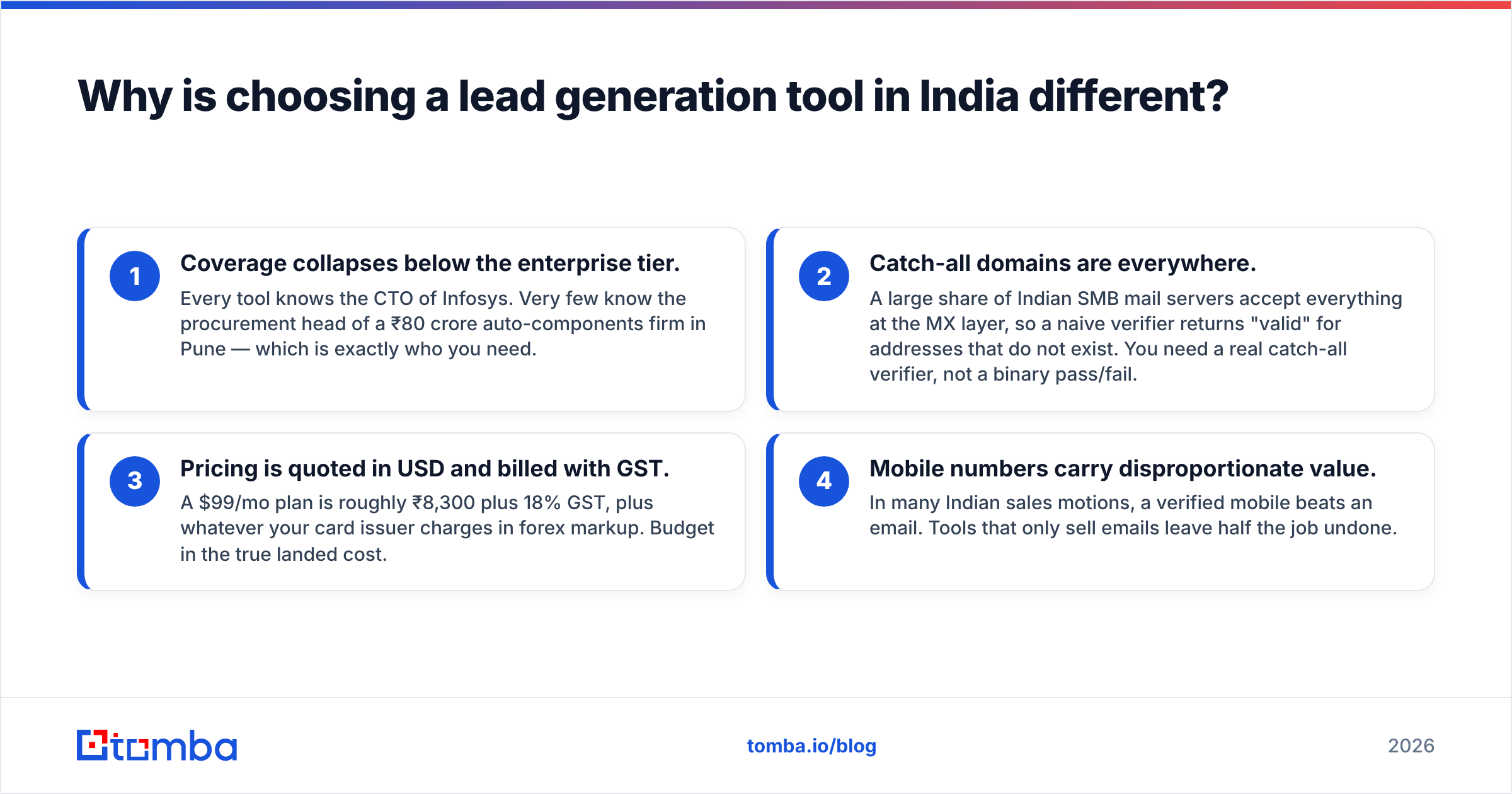
That produces four practical problems when you buy a lead generation tool in India:
- Coverage collapses below the enterprise tier. Every tool knows the CTO of Infosys. Very few know the procurement head of a ₹80 crore auto-components firm in Pune — which is exactly who you need.
- Catch-all domains are everywhere. A large share of Indian SMB mail servers accept everything at the MX layer, so a naive verifier returns "valid" for addresses that do not exist. You need a real catch-all verifier, not a binary pass/fail.
- Pricing is quoted in USD and billed with GST. A $99/mo plan is roughly ₹8,300 plus 18% GST, plus whatever your card issuer charges in forex markup. Budget in the true landed cost.
- Mobile numbers carry disproportionate value. In many Indian sales motions, a verified mobile beats an email. Tools that only sell emails leave half the job undone.
If your ICP is Indian SMB or mid-market, treat "global database size" claims as noise. What matters is hit rate on your list.

What types of lead generation tools should you consider?#
There are four categories, and buying the wrong category is the most common and most expensive mistake.
- Database platforms — Apollo, ZoomInfo, Lusha, Seamless.AI. You search filters (industry, headcount, geography) and export contacts. Strength: discovery, when you do not yet know who to target. Weakness: India coverage thins out fast, and export credits get consumed by records you never contact.
- Email finders and verifiers — Tomba, Findymail, Hunter. You bring a list of companies or people and the tool returns verified work emails. Strength: precision and cost per usable contact. Weakness: it will not build your target list for you.
- Purchased list providers — BookYourData and similar. You filter, pay per record, and download. Strength: no subscription, transparent per-record cost, useful when your buying cycle is lumpy. Weakness: you own the freshness risk from the moment you download.
- Engagement and sequencing platforms — Instantly, Saleshandy, Reply.io. They send and track; they are not data sources, even when they bundle a database. Never evaluate them on data quality.
A typical Indian outbound team ends up running category 1 or 3 for discovery, category 2 for verification and enrichment, and category 4 for delivery. That stack is more effective and usually cheaper than paying one vendor to do all three badly.
How do the main options compare on price and India fit?#
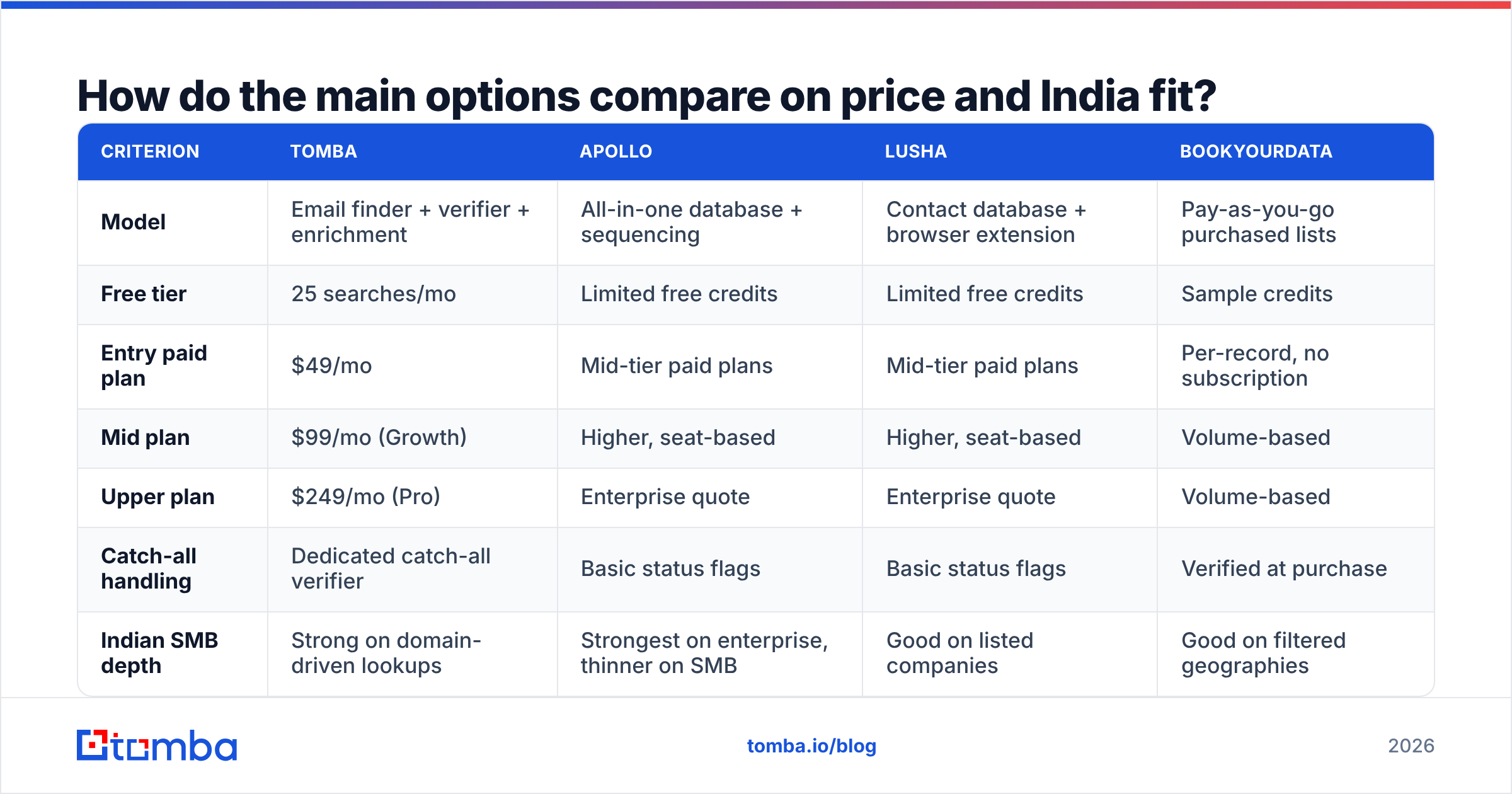
Here is the honest comparison. Prices are list prices as published by each vendor and exclude Indian GST; verify current numbers before you sign.
| Criterion | Tomba | Apollo | Lusha | BookYourData |
|---|---|---|---|---|
| Model | Email finder + verifier + enrichment | All-in-one database + sequencing | Contact database + browser extension | Pay-as-you-go purchased lists |
| Free tier | 25 searches/mo | Limited free credits | Limited free credits | Sample credits |
| Entry paid plan | $49/mo | Mid-tier paid plans | Mid-tier paid plans | Per-record, no subscription |
| Mid plan | $99/mo (Growth) | Higher, seat-based | Higher, seat-based | Volume-based |
| Upper plan | $249/mo (Pro) | Enterprise quote | Enterprise quote | Volume-based |
| Catch-all handling | Dedicated catch-all verifier | Basic status flags | Basic status flags | Verified at purchase |
| Indian SMB depth | Strong on domain-driven lookups | Strongest on enterprise, thinner on SMB | Good on listed companies | Good on filtered geographies |
| Phone numbers | Yes, separate phone finder | Yes, credit-gated | Yes, a core strength | Yes, on selected records |
| API / automation | Full REST API, CLI, MCP | API on higher tiers | API on higher tiers | Bulk export |
| Best for | Precision enrichment of a known list | Discovery at scale | Quick single-lead lookups | One-off campaigns without a subscription |
Two things stand out for Indian teams.
First, seat-based pricing punishes small teams. If you have three SDRs and a founder doing outbound, a per-seat database subscription multiplies fast. Credit-based or per-record models scale with output, not headcount. Tomba's pricing runs $49, $99 and $249 per month on a credit model, which means a two-person team pays the same as a ten-person team at the same volume.
Second, the free tier is a real evaluation tool, not a lead magnet. Twenty-five searches is enough to test 25 Indian domains you already know the answer for. Run that test before any demo call.
How do you actually test accuracy on Indian domains?#
Run a blind benchmark. It takes 40 minutes and it will overrule every vendor claim you read.
- Build a truth set of 100 contacts. Use people whose real work email you already know — past customers, partners, your own alumni network, LinkedIn connections who replied to you. Weight it toward your actual ICP: if you sell to Tier-2 manufacturing, do not stuff it with Bengaluru SaaS.
- Strip it down to name plus domain. That is all a finder gets as input.
- Run the same list through each tool's free tier. Record three numbers per tool: hit rate (returned any address), accuracy (returned the correct address), and catch-all rate (returned "accept-all" or "unknown").
- Send a 100-email validation blast from a warmed throwaway domain with a genuinely useful message. Measure hard bounces.
- Compute cost per verified contact, not cost per credit. Monthly price ÷ (credits × accuracy rate). This single number usually reorders the vendor shortlist entirely.
- Repeat on a second list 30 days later. Freshness decay is real; a vendor that wins once may have a stale India index.
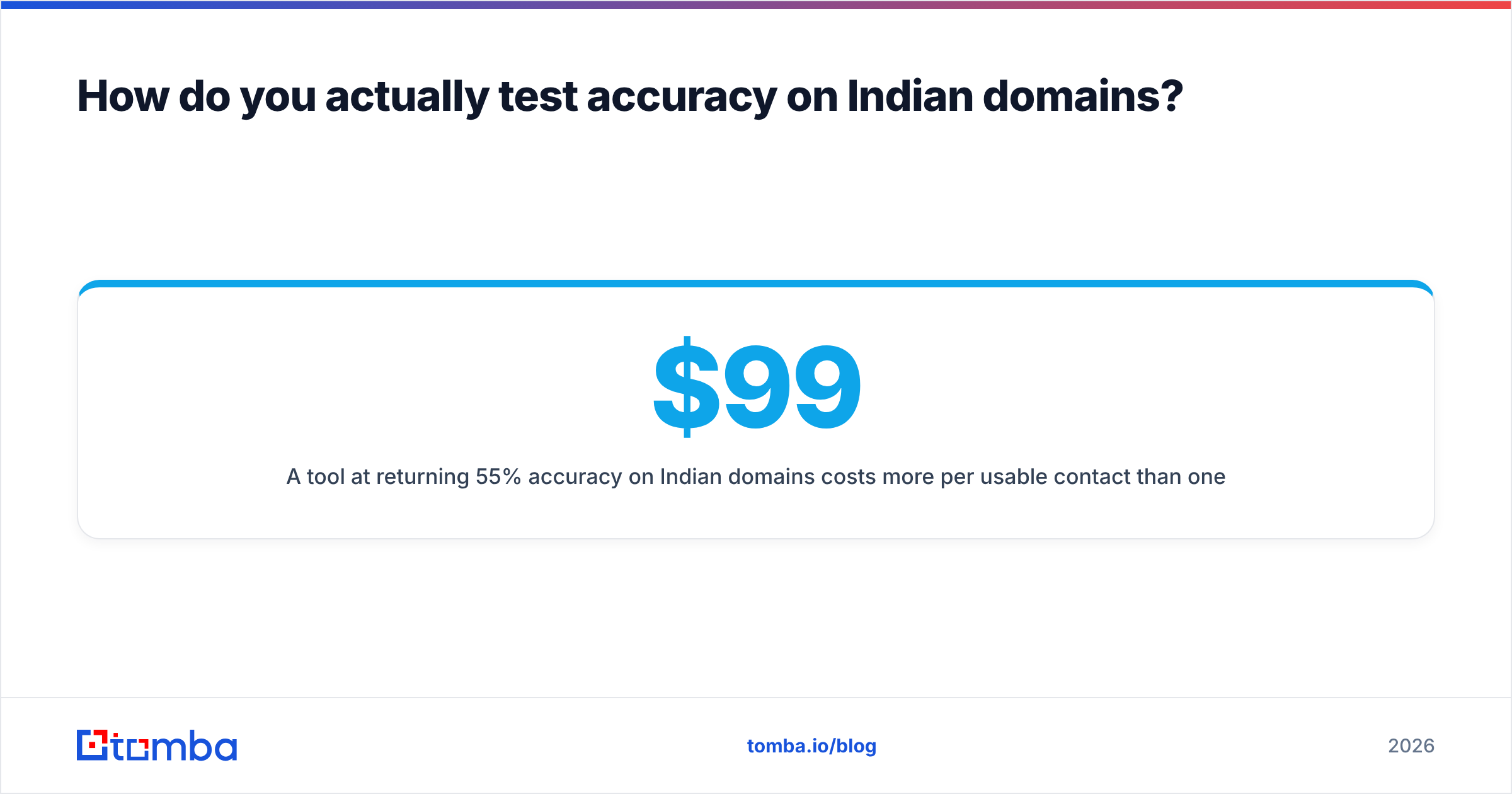
A tool at $99/mo returning 55% accuracy on Indian domains costs more per usable contact than one at $249/mo returning 92%. The sticker price is the least informative number in the entire evaluation.
For step 3, the email verifier and the catch-all verifier matter more than the finder on Indian lists, because accept-all MX configurations are common on shared Indian hosting. A verifier that returns a confidence score plus SMTP evidence beats one that returns only "valid."
What features actually matter for Indian B2B teams?#
Ignore the feature matrix marketing pages and grade on these.
- Domain-first search. Most Indian prospecting starts from a company list — an exhibitor directory, a chamber of commerce roster, an MCA extract — not from a name. A strong domain search that returns every published address at a domain plus the naming pattern is worth more than a billion-record database you cannot filter to India.
- Email pattern detection. Once you know a company uses
first.last@, you can generate and verify the rest of the org. This is the single highest-leverage feature for Indian mid-market, where team pages are sparse. - Bulk processing. You will work in batches of 500 to 5,000. A bulk email finder that takes a CSV and returns statuses beats clicking through a UI.
- Spreadsheet and CRM integration. Most Indian SMB sales teams still run on Google Sheets and a lightweight CRM. Native Google Sheets and HubSpot connections remove the export-import tax.
- API access on entry plans. If the API is gated behind enterprise pricing, you cannot automate, and manual enrichment does not scale past one SDR.
- Phone coverage as a separate capability. Indian buyers answer calls. A phone finder that returns direct dials and mobiles, validated, is a meaningful uplift on email-only outreach.
Is a free lead generation tool in India good enough?#
For validation, yes. For a running pipeline, no — and the reason is deliverability, not features.
Free scraping tools and Chrome extensions return unverified addresses. Send 500 unverified emails and you will hit a bounce rate above 5%, at which point Google and Microsoft start throttling your domain. Repairing a burned sending domain takes weeks and costs far more than the subscription you avoided. Review email deliverability fundamentals before you optimise for cost.
A sane free-tier strategy for an Indian startup:
- Use free tiers across two or three tools to build your first 100-lead list and validate that the ICP responds at all.
- Verify every address before sending, even the free ones.
- Move to a paid plan the moment outbound becomes a repeatable motion — usually when you are sending more than 300 emails a week.
- Never buy a scraped list off a marketplace. The accuracy is unknowable, the consent basis is nonexistent, and the bounce damage is permanent.
What about compliance and data privacy in India?#
India's Digital Personal Data Protection Act (DPDP Act, 2023) governs processing of personal data of individuals in India, and enforcement rules have been rolling out since. B2B contact data is not automatically exempt — a work email tied to a named individual is still personal data.
Practical guardrails for outbound teams:
- Prefer business contact data with a clear legitimate basis and document where each record came from. Vendors that publish their data sources make this materially easier than vendors that do not.
- Honour opt-outs immediately and permanently, across every tool in your stack, not just the one that sent the email.
- If you sell into the EU or UK, GDPR still applies to those contacts regardless of where your team sits. Verify vendor DPAs before you export.
- Keep purchase records. If a regulator or a prospect asks how you got their address, "we bought a list" without provenance is the worst possible answer.
Independent review sites are useful for sanity-checking vendor claims here. G2 and Capterra both carry volume-weighted reviews with geography filters, and reading the two-star reviews from Indian reviewers tells you more about coverage than any datasheet. For a broader view of how buying committees evaluate GTM data vendors, Gartner publishes ongoing research on revenue technology consolidation.
How should you sequence your stack?#
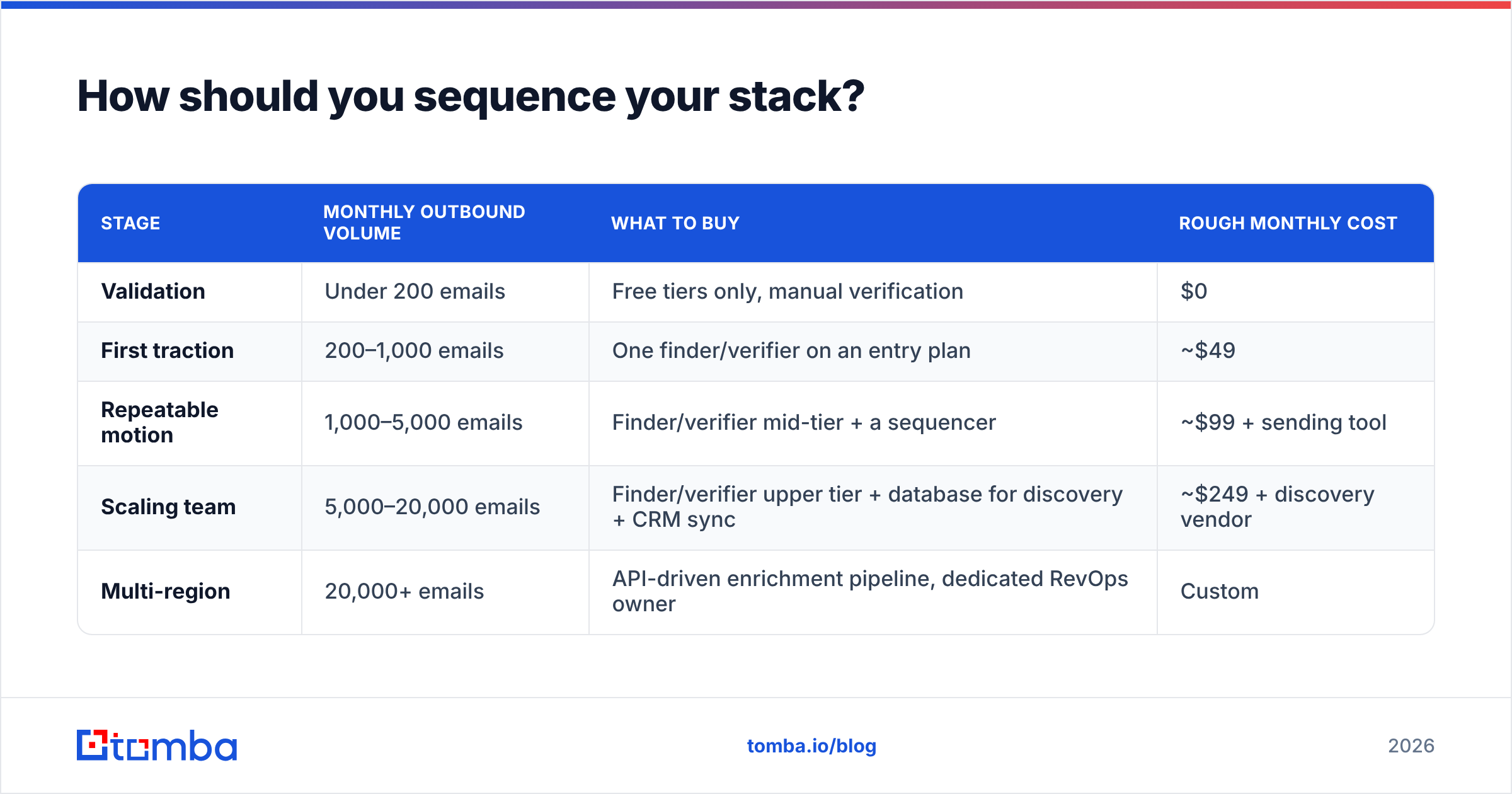
Buy in this order, and stop as soon as your pipeline is full.
| Stage | Monthly outbound volume | What to buy | Rough monthly cost |
|---|---|---|---|
| Validation | Under 200 emails | Free tiers only, manual verification | $0 |
| First traction | 200–1,000 emails | One finder/verifier on an entry plan | ~$49 |
| Repeatable motion | 1,000–5,000 emails | Finder/verifier mid-tier + a sequencer | ~$99 + sending tool |
| Scaling team | 5,000–20,000 emails | Finder/verifier upper tier + database for discovery + CRM sync | ~$249 + discovery vendor |
| Multi-region | 20,000+ emails | API-driven enrichment pipeline, dedicated RevOps owner | Custom |
The mistake Indian teams make most often is skipping to stage four on day one — signing an annual enterprise database contract before proving that the ICP replies. Prove the motion on a $49 plan and a spreadsheet. Then scale the tooling.
The second mistake is treating data spend as a fixed cost rather than a variable one. If your cost per verified contact is ₹6 and your cost per meeting is ₹4,000, the data line is not where your money is going — your reply rate is. Fix the response rate before you fix the data bill.
Which lead generation tool in India should you pick?#
It depends on where your list comes from.
- You have a target company list already (exhibitor lists, portfolio companies, industry directories, MCA data): buy a finder and verifier. This is the cheapest path to pipeline and the highest accuracy on Indian domains.
- You do not know who to target yet: start with a database platform's free tier to explore segments, then move the shortlist into a finder for verification.
- You run campaigns in bursts, not continuously: a pay-as-you-go provider like BookYourData avoids paying for months you do not prospect, and their per-record pricing is easy to justify to a finance team that dislikes subscriptions.
- You need volume enrichment inside your own systems: buy on API quality. Check whether the API is available on the entry plan, what the rate limits are, and whether there is a CLI or MCP server for automation.
Whatever you pick, decide with your own 100-domain benchmark rather than a vendor's slide. The variance between tools on Indian data is far wider than the variance on US data, which means the "best tool" ranking from an American review site may be actively wrong for your ICP.
Ready to test coverage on your own Indian domain list?#
Start with the free tier and run the benchmark described above. Drop 25 Indian companies you already know into the Tomba Email Finder, check the returned addresses against your truth set, and look at what the catch-all handling does on shared-hosting domains — that is where most tools quietly fail. If the hit rate holds, the $49/mo Starter plan covers a solo founder or a first SDR, and $99/mo Growth covers a small team running a repeatable motion. If it does not hold, you will have learned that in 40 minutes instead of after an annual contract.
Related guides#
// get started
Find, verify and enrich your first contacts today
Start on the free plan with 25 searches a month, then scale when your team is ready.
Free plan · No credit card required · GDPR & CCPA
// about the author