Lead Generation Trends 2026: 9 Shifts That Change Pipeline
Most 2026 lead gen predictions are recycled 2023 talking points. Here are the nine shifts that actually changed how pipeline gets built this year — with the numbers, the trade-offs, and the tactics worth dropping.
TL;DR
- Volume outbound is dead as a default strategy — inbox providers now enforce complaint-rate ceilings that punish spray-and-pray before a human ever sees the message.
- AI SDR tools moved from "replace your team" to "compress your team's research step." The teams winning with them run 3-5x fewer sends at 4x the reply rate.
- Signal-based prospecting (hiring, funding, tech-stack changes, site visits) beats static ICP lists. The signal is the segmentation now.
- B2B contact data decays roughly 25-30% per year, so a data refresh cadence is now an operational requirement, not a nice-to-have.
- The biggest 2026 winner isn't a channel — it's a smaller list of better-verified contacts hit across email, phone, and LinkedIn in a coordinated sequence.
What are the biggest lead generation trends in 2026?#
The short version: fewer contacts, better data, tighter triggers, more channels per contact.
Everything else on this list is a consequence of that sentence. For roughly a decade, B2B lead generation scaled linearly with list size — double the contacts, double the meetings. That relationship broke somewhere around 2024 when Google and Microsoft started enforcing bulk-sender requirements with actual teeth, and it stayed broken through 2026 as reply rates on generic sequences fell into the sub-1% range.
Here's what replaced it, ranked by how much it should change your 2026 plan.
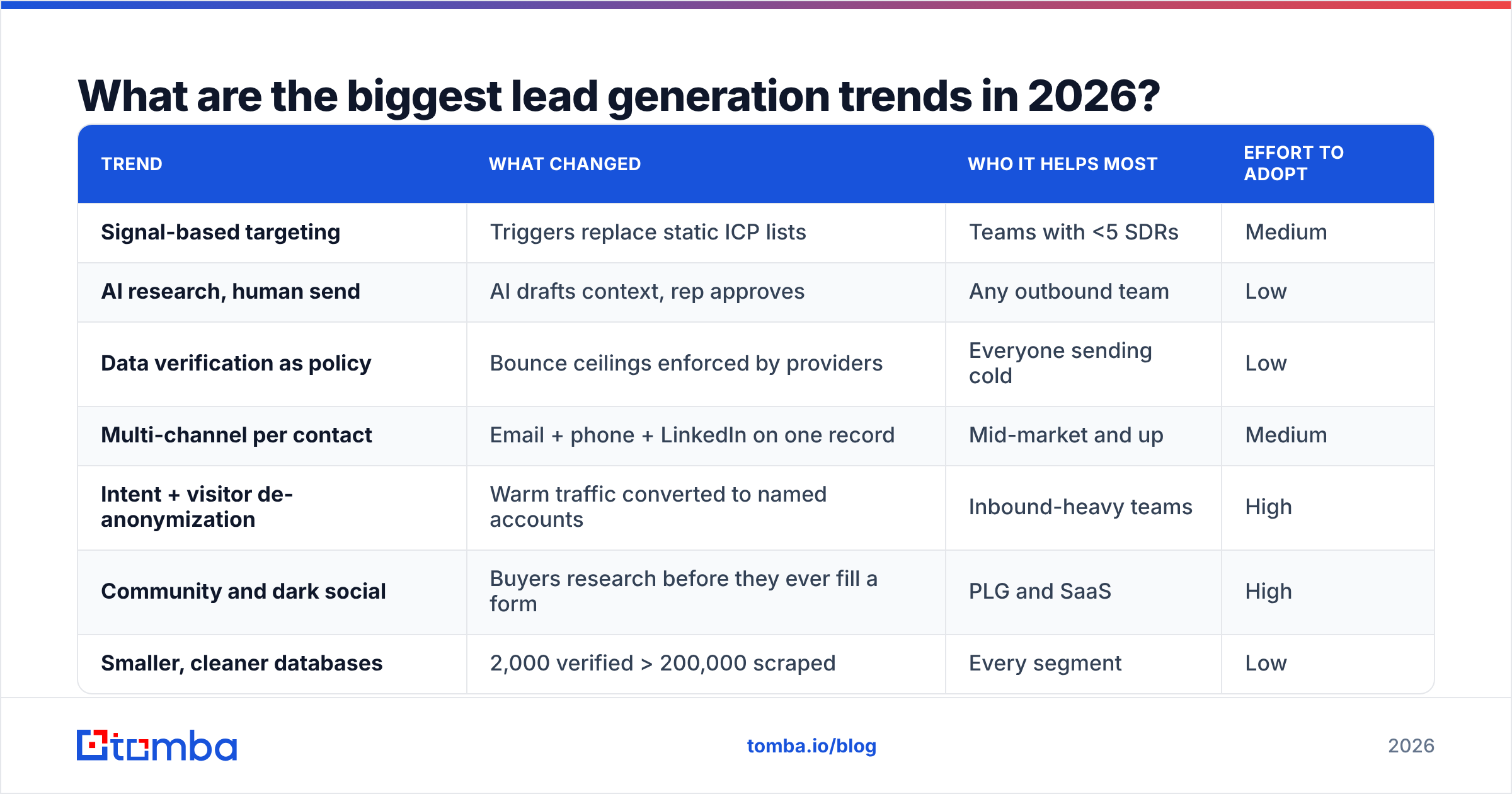
| Trend | What changed | Who it helps most | Effort to adopt |
|---|---|---|---|
| Signal-based targeting | Triggers replace static ICP lists | Teams with <5 SDRs | Medium |
| AI research, human send | AI drafts context, rep approves | Any outbound team | Low |
| Data verification as policy | Bounce ceilings enforced by providers | Everyone sending cold | Low |
| Multi-channel per contact | Email + phone + LinkedIn on one record | Mid-market and up | Medium |
| Intent + visitor de-anonymization | Warm traffic converted to named accounts | Inbound-heavy teams | High |
| Community and dark social | Buyers research before they ever fill a form | PLG and SaaS | High |
| Smaller, cleaner databases | 2,000 verified > 200,000 scraped | Every segment | Low |
Why did volume outbound stop working?#
Because the mailbox providers made it expensive.
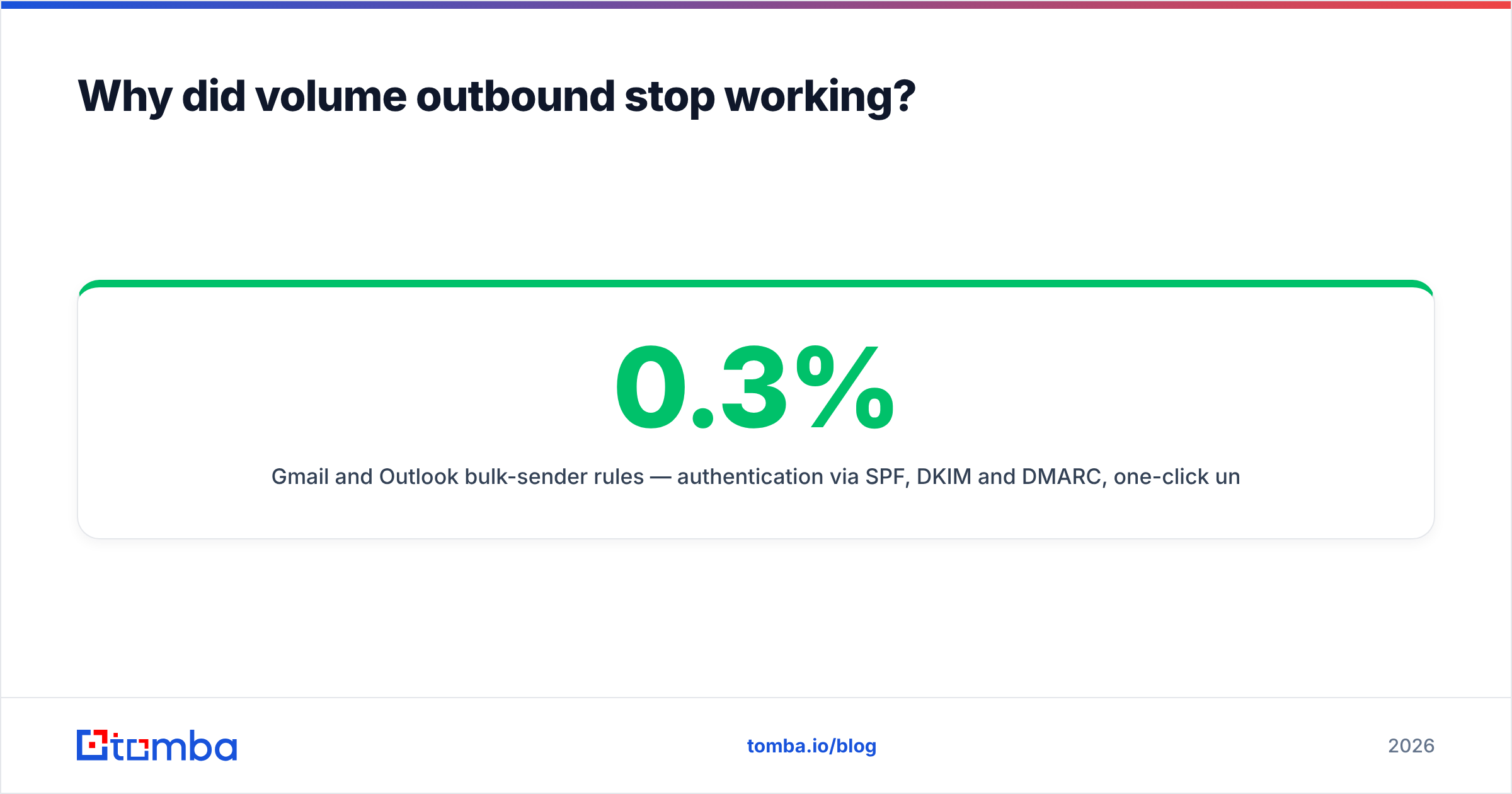
Gmail and Outlook bulk-sender rules — authentication via SPF, DKIM and DMARC, one-click unsubscribe, and a spam complaint rate held under 0.3% — turned deliverability into a hard gate. You can't buy your way past it. A sender who blasts 10,000 unverified contacts and collects a 6% bounce rate plus a 0.5% complaint rate gets throttled, and the throttle applies to every message from that domain, including the good ones.
The economics flipped. In 2021, an extra 50,000 contacts on a list was upside with roughly zero marginal cost. In 2026, an extra 50,000 unverified contacts is a liability that degrades the performance of the 3,000 contacts you actually cared about.
This is why email verification moved from "the ops person's chore" to a gate in the sequence-launch checklist. The teams that survived the transition run a verification pass immediately before every send, not quarterly.

Is AI actually generating leads, or just generating noise?#
Both — and the difference is where you put the AI in the workflow.
The 2024-2025 promise was the autonomous AI SDR: a bot that finds, writes, sends, and books. In practice, fully autonomous sending produced high volume and terrible reply rates, because the thing AI is worst at is knowing whether a claim about a prospect is actually true. The thing it's best at is compressing research that used to take a rep eight minutes per account into eight seconds.
The pattern that works in 2026:
- AI handles research, not the relationship. Summarize the company's last funding round, job posts, product launches, and recent press into three bullets for the rep.
- AI drafts, a human approves. Generated first lines get reviewed before send. Reps reject roughly a third of them — that rejection rate is the quality control.
- AI does list hygiene at scale. Deduping, normalizing job titles, classifying seniority, inferring email patterns. Unglamorous, fully automatable, high ROI.
- AI scores and routes. Pattern-matching on which accounts replied historically beats hand-built lead scores that nobody has updated since 2023.
- AI does NOT pick your ICP. It amplifies whatever you point it at. Point it at a bad segment and you'll get bad pipeline faster than ever.
Gartner's sales research has been consistent on this point: the productivity gain comes from removing manual research and data entry, not from removing the seller. Teams that cut headcount first and added AI second generally lost pipeline.
What is signal-based prospecting and why did it replace static lists?#
Signal-based prospecting means you build the list at the moment something changes, rather than pulling a list once a quarter and working it until it's stale.
A static list says: "VP of Engineering at 200-1,000 employee SaaS companies in North America." That's 40,000 people, all of whom get the same message, 39,600 of whom have no reason to care today.
A signal list says: "VP of Engineering at a company that posted three backend roles in the last 14 days." That's 60 people, and your opening line writes itself.
The signals with the highest hit rates in 2026:
- Hiring signals. Job postings reveal budget, priority, and pain in one artifact. A company hiring its first RevOps lead is telling you exactly what's broken.
- Funding and leadership changes. New VPs rip out and replace tooling in their first 90 days. That window is the whole opportunity.
- Tech-stack changes. A company adding or dropping a tool in your category is in an active evaluation cycle.
- Website visits. Anonymous traffic on a pricing page is the warmest signal you own, and website visitor reveal turns a share of it into named accounts.
- Content and community activity. Someone commenting on a competitor comparison post is mid-research.
The operational shift is that signals arrive continuously, so your enrichment has to run continuously too. You detect the trigger, then you need the contact — name, verified email, direct dial — within minutes, not next Tuesday. That's why contact enrichment and API-first data delivery became standard infrastructure rather than an add-on.
How bad is the B2B data decay problem in 2026?#
Bad enough that it's the silent killer of most outbound programs.
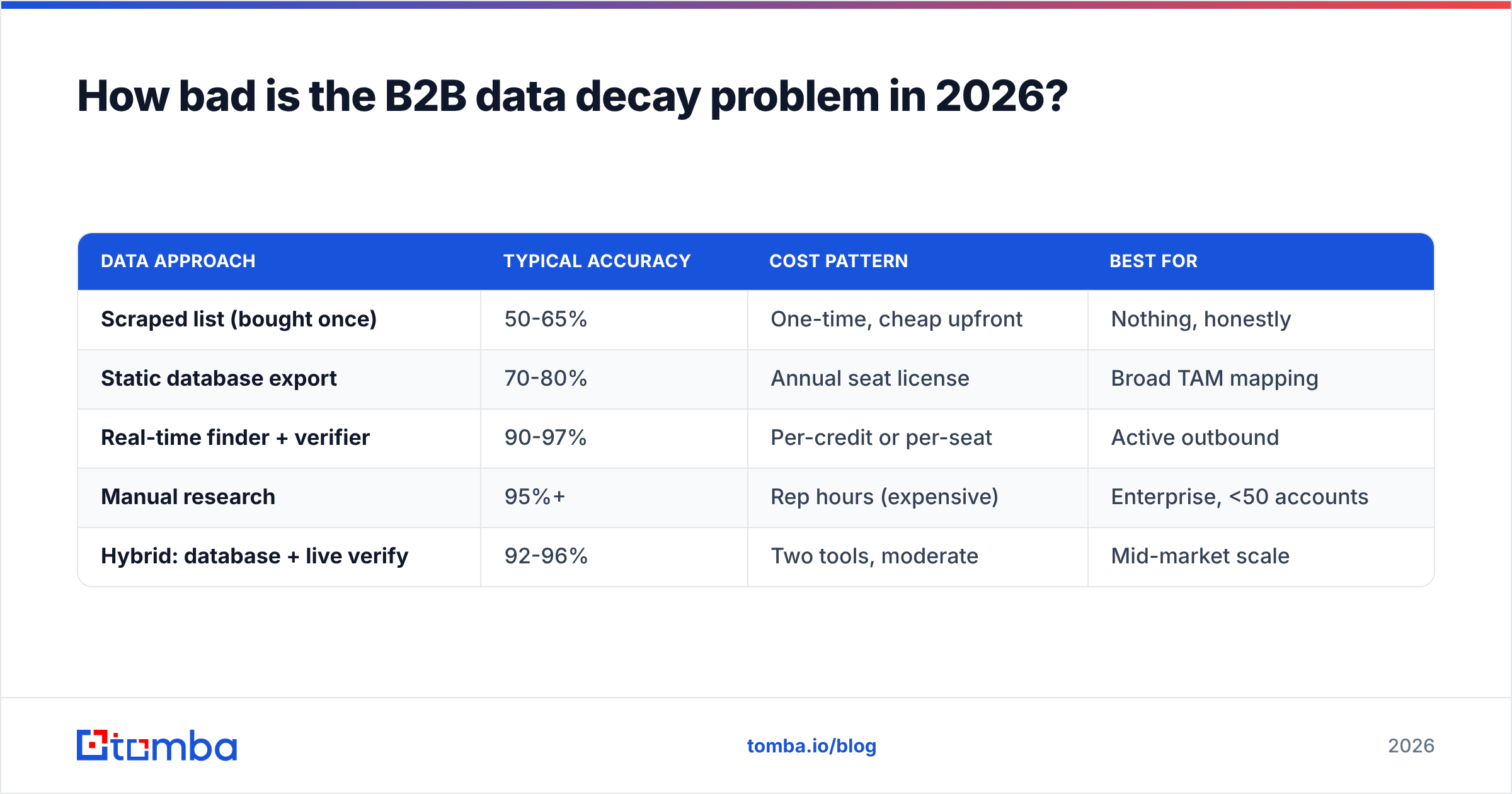
B2B contact records degrade at roughly 25-30% per year through job changes, company changes, domain migrations, and role shifts. Post-2023 tech-sector churn pushed that higher in some segments. Do the math on a list you bought 18 months ago: something close to 40% of it is wrong, and every wrong record is a bounce, a complaint, or a rep's wasted minute.
| Data approach | Typical accuracy | Cost pattern | Best for |
|---|---|---|---|
| Scraped list (bought once) | 50-65% | One-time, cheap upfront | Nothing, honestly |
| Static database export | 70-80% | Annual seat license | Broad TAM mapping |
| Real-time finder + verifier | 90-97% | Per-credit or per-seat | Active outbound |
| Manual research | 95%+ | Rep hours (expensive) | Enterprise, <50 accounts |
| Hybrid: database + live verify | 92-96% | Two tools, moderate | Mid-market scale |
The practical answer most teams landed on is the hybrid: pull the universe from a B2B database, then verify the specific slice you're about to contact right before you contact it. You get breadth without eating the bounce rate. On Tomba pricing, that pattern costs $49/mo on Starter for a small team and $99/mo on Growth for a team running consistent volume — which is well under what a single week of degraded sender reputation costs you.
One caveat worth stating plainly: "accuracy" claims from data vendors are not comparable across vendors because everyone measures differently. Some count catch-all domains as valid. Some exclude them from the denominator. Test with your own sample of 200 known-good contacts before believing any number, including ours.
Are multi-channel sequences worth the extra work?#
Yes, but not in the way most teams implement them.
The failed version of multi-channel is the same message copy-pasted into email, LinkedIn, and a voicemail script, fired at a stranger within 48 hours. That reads as automation from three directions at once, and it converts worse than email alone.
The version that works treats channels as a sequence of escalating permission:
- Email first, because it's the lowest-friction and the easiest to ignore politely.
- LinkedIn view and a relevant comment, not a connection request with a pitch attached.
- A phone call on day 5-8, once your name has appeared twice. Connect rates on a warmed name are meaningfully higher than on a cold one.
- A second email that references something new — a trigger, a resource, a customer story — not "just bumping this."
- A genuine break-up and a re-entry date 90 days out.
The data requirement here is the part teams underestimate: this only works if one contact record carries a verified work email, a direct dial, and a LinkedIn URL. Assembling that per contact by hand takes 10+ minutes. Tools like a combined phone finder and LinkedIn finder exist because the multi-channel motion made single-field enrichment obsolete.
For teams that would rather buy a pre-built multi-channel dataset than assemble one, providers like BookYourData offer pay-as-you-go verified lists with phone coverage, which is a reasonable fit when you need a defined segment quickly and don't want to run live enrichment infrastructure.
What lead generation tactics should you stop doing in 2026?#
Cutting is as valuable as adding. These are the ones with the worst returns right now:
- Gated PDFs as the primary MQL source. Buyers give you a fake email and read the summary on a competitor's ungated page. If the asset is good, ungate it and capture demand at the demo request instead.
- Buying a large static list and running it for a year. See the decay math above.
- Sending from your primary domain. Use dedicated sending domains so a bad experiment can't take your corporate mail down with it.
- Lead scoring models nobody has retrained. A score built on 2022 behavior is actively misrouting leads today.
- "Quick question" and "circling back" subject lines. They're pattern-matched to spam by both filters and humans.
- Measuring SDRs on activity volume. Activity targets are exactly the incentive that produces the unverified blasting that gets your domain throttled. Measure meetings held and pipeline sourced.
HubSpot's State of Marketing research has tracked the form-fill decline for several cycles now, and peer reviews on G2 tell the same story from the buyer side: people evaluate tools through communities, comparison content, and free tiers long before they identify themselves to a vendor.
How should a small team apply these trends?#
Start with the cheapest, highest-leverage moves and ignore the rest until those work.
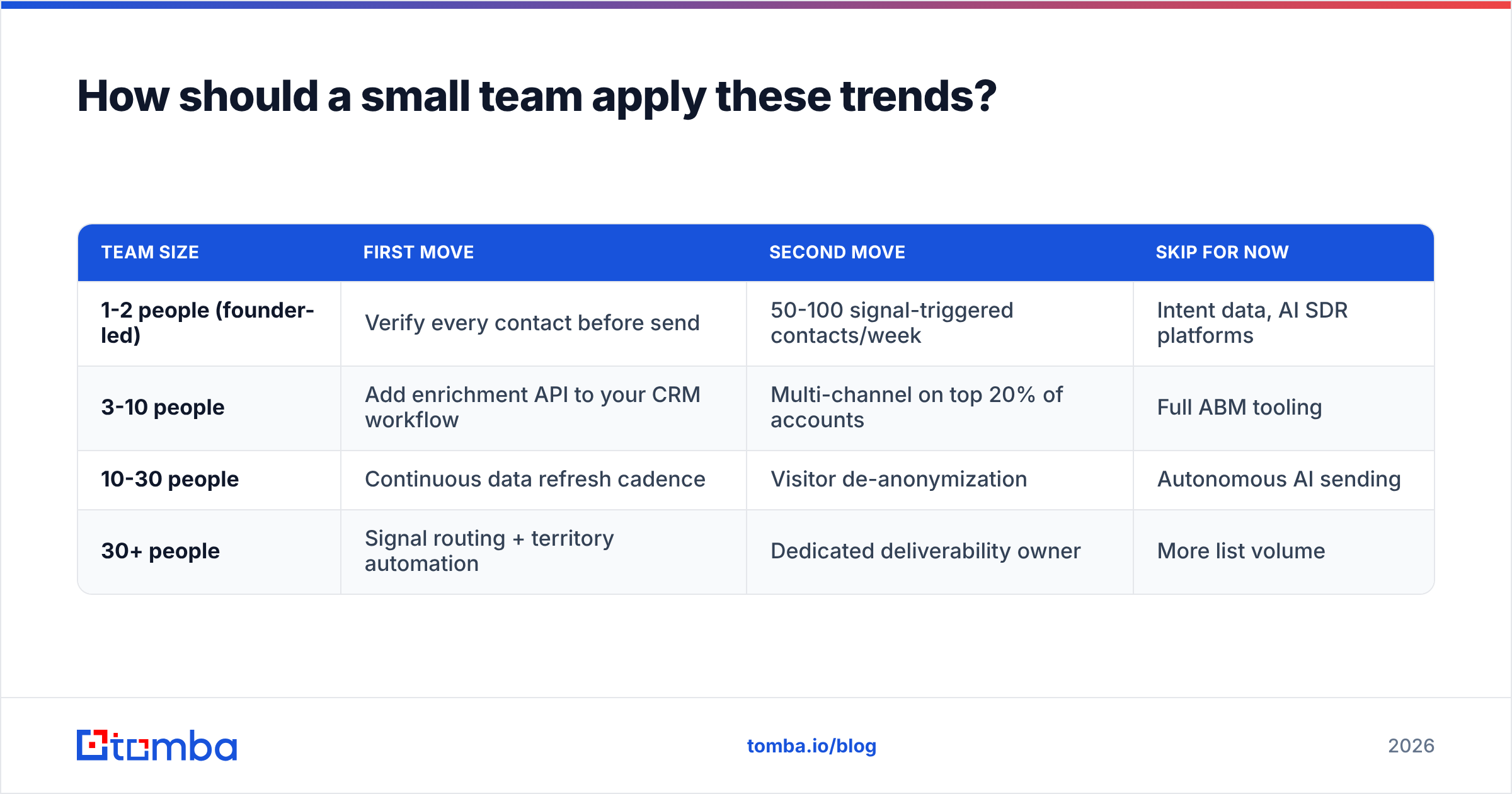
| Team size | First move | Second move | Skip for now |
|---|---|---|---|
| 1-2 people (founder-led) | Verify every contact before send | 50-100 signal-triggered contacts/week | Intent data, AI SDR platforms |
| 3-10 people | Add enrichment API to your CRM workflow | Multi-channel on top 20% of accounts | Full ABM tooling |
| 10-30 people | Continuous data refresh cadence | Visitor de-anonymization | Autonomous AI sending |
| 30+ people | Signal routing + territory automation | Dedicated deliverability owner | More list volume |
The common thread across every row: nobody's second move is "get more contacts." The constraint in 2026 is relevance and data quality, not reach.
If you're running lean, the honest 30-day plan is this. Week one: verify your existing list and delete everything that fails. Week two: pick one trigger signal and build a weekly 50-contact list from it. Week three: write one sequence with a human-written first line per contact. Week four: add a phone touch to the accounts that opened twice. That's it. It's not exciting, and it outperforms a 100,000-contact blast by a wide margin on meetings booked per hour of rep time.
What's the one thing to fix first?#
Your contact data, because every other trend on this list depends on it.
Signal-based prospecting fails if you can't get the right person's email within minutes of the trigger firing. Multi-channel fails if the phone number is wrong. AI personalization fails if it's personalizing a message to someone who left the company in March. Deliverability fails if a quarter of your sends bounce. Data quality isn't one trend among nine — it's the substrate the other eight run on.
If you want to fix that layer without a procurement cycle, start with the Tomba Email Finder. Give it a name and a domain, or a whole domain, and get back verified professional addresses with a confidence score and the sources behind them. The free tier covers 25 searches a month if you just want to sanity-check your current list against something independent, and Starter at $49/mo covers a small team running weekly signal-based campaigns. Verify first, then send — that's the entire 2026 playbook compressed into five words.
Related guides#
// get started
Find, verify and enrich your first contacts today
Start on the free plan with 25 searches a month, then scale when your team is ready.
Free plan · No credit card required · GDPR & CCPA
// about the author