Lead Generation Types: The 9 Models That Actually Fill Pipeline
Inbound, outbound, PLG, ABM, referral, events — nine lead generation types, what each one actually costs per meeting, and how to pick the two that fit your motion.
TL;DR
- There are nine lead generation types worth running in B2B: inbound content, SEO, paid acquisition, outbound email, cold calling, social selling, referral/partner, event-based, and product-led. Everything else is a variant of one of these.
- Cost per booked meeting ranges roughly 10x across the nine — from ~$40 for referral to ~$400+ for paid search in crowded categories. Ramp time ranges from days (outbound) to 9+ months (SEO).
- Most teams under $10M ARR should run exactly two types: one that compounds slowly (SEO or product-led) and one that produces meetings this quarter (outbound or paid).
- Every outbound-adjacent type collapses without clean contact data. Bounce rate above 3% quietly kills the other types too, because domain reputation is shared.
- Pick by sales cycle and ACV, not by what's trending. Under $5K ACV, self-serve and product-led win. Over $50K ACV, ABM plus events plus referral.
What are the main lead generation types?#
Lead generation types are the distinct mechanisms by which a stranger becomes a named, contactable, interested person in your pipeline. Not channels — mechanisms. LinkedIn is a channel; you can run outbound, social selling, and paid acquisition through it, and those are three different lead generation types with different economics.
The distinction matters because you budget, staff, and measure by mechanism. An SEO program and a cold email program both "generate leads," but one needs a writer and nine months, and the other needs a list and a week. Confusing them is why so many teams report a blended CAC that tells them nothing.
Here's the field, grouped by how the lead initiates contact:
- Buyer-initiated (pull) — Inbound content, organic SEO, product-led signups, review-site traffic. The prospect finds you. High intent, low volume control.
- Seller-initiated (push) — Outbound email, cold calling, LinkedIn prospecting, direct mail. You pick the target. Full volume control, lower intent.
- Third-party-initiated (borrowed trust) — Referrals, partner co-sell, affiliate, community advocacy. Someone else vouches. Highest conversion, hardest to scale.
- Paid-initiated (rented) — Search ads, paid social, sponsorships, intent-data purchases. Instant volume, stops the day you stop paying.
- Event-initiated (gathered) — Conferences, webinars, roadshows, dinners. Compressed relationship-building, lumpy and expensive.
- Account-initiated (ABM) — A named list of 50–500 accounts worked across multiple types at once. Technically a strategy layered on top of the others, but budgeted separately by nearly everyone who runs it.
Most "which lead generation type is best" arguments are actually arguments about which phase a company is in. A pre-PMF startup running SEO is burning runway on a bet that pays out after the runway ends.
How do the lead generation types compare on cost and speed?#
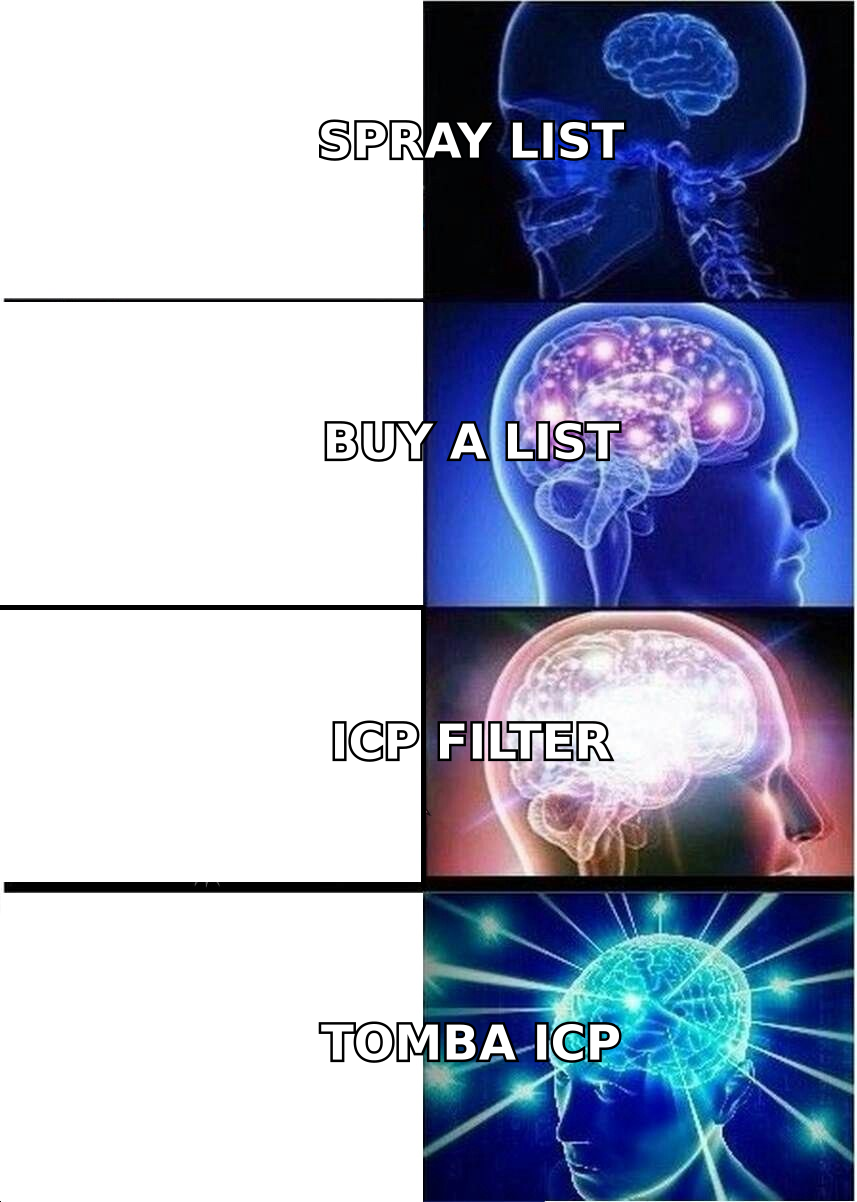
The numbers below are medians from B2B SaaS teams in the $1M–$50M ARR band. Your category shifts them — legal tech and cybersecurity paid search run 2–3x the figures here — but the ratios between types hold up remarkably well.
| Lead generation type | Time to first meeting | Typical cost per meeting | Scales with | Breaks when |
|---|---|---|---|---|
| Referral / partner | 1–3 weeks | $30–$80 | Customer count | You have <30 happy customers |
| Product-led (free tier) | 2–6 weeks | $50–$120 | Signup volume | Product needs onboarding to show value |
| Outbound email | 3–10 days | $90–$180 | Data quality + SDR headcount | Deliverability drops or list is stale |
| Organic SEO | 6–12 months | $60–$150 (after ramp) | Domain authority | Category has 10 funded competitors bidding |
| Cold calling | 1 week | $150–$300 | Dials + connect rate | Personas don't answer phones (devs, designers) |
| Social selling | 4–8 weeks | $80–$200 | Personal brand reach | Rep leaves and takes the audience |
| Webinars | 3–5 weeks | $120–$250 | Email list size | You have no list to invite |
| Events / conferences | 6–16 weeks | $350–$900 | Budget | ACV under $15K |
| Paid search | 2–5 days | $200–$450 | Budget | Category CPCs exceed $25 |
Two things jump out. First, the fastest types are also the ones most sensitive to input quality — outbound at $90 per meeting assumes a verified list; at 25% bounce it's closer to $400 and you've damaged your sending domain on top. Second, the cheapest type (referral) is the one you cannot buy your way into.
A useful frame: treat referral and product-led as yield on assets you already own, SEO and social as investments with a lag, and outbound and paid as spend that converts money to meetings at a fixed exchange rate. You need at least one from the spend column while the investment column matures.
Which lead generation type should you start with?#
Start with the one your ACV and sales cycle can actually support. This is the decision most teams get wrong, and it's not a close call once you write it down.
- ACV under $3K, self-serve possible — Product-led plus SEO. A human touching every lead destroys the unit economics. Your job is to make signup frictionless and let content do qualification.
- ACV $3K–$25K, 30–60 day cycle — Outbound email plus SEO. This is the classic SDR-plus-content motion. Outbound funds the quarter; SEO compounds into year two.
- ACV $25K–$100K, 90–180 day cycle — Outbound plus events plus referral. Multiple stakeholders means you need in-person trust-building, and a warm intro shortens the cycle by weeks.
- ACV over $100K, 6–18 month cycle — ABM plus executive referral plus targeted events. Twelve accounts matter more than twelve hundred leads. Stop counting MQLs entirely.
- Developer or technical buyer, any ACV — Product-led plus community plus docs-as-SEO. Cold calling a backend engineer is a well-documented way to get blocked.
Note what's missing: paid search doesn't appear as a starting type in any band. Paid works brilliantly as an amplifier once you know which message converts, and works terribly as a discovery mechanism when you don't. Teams that start with paid learn what they can afford, not what their market wants.
Why does contact data quality decide three of the nine types?#
Because outbound email, cold calling, and ABM are all fundamentally the same bet: that you can reach a specific named human at a specific company on demand. Every one of them fails identically when the contact record is wrong.
The failure chain is worth spelling out, because teams usually diagnose it as a copywriting problem:
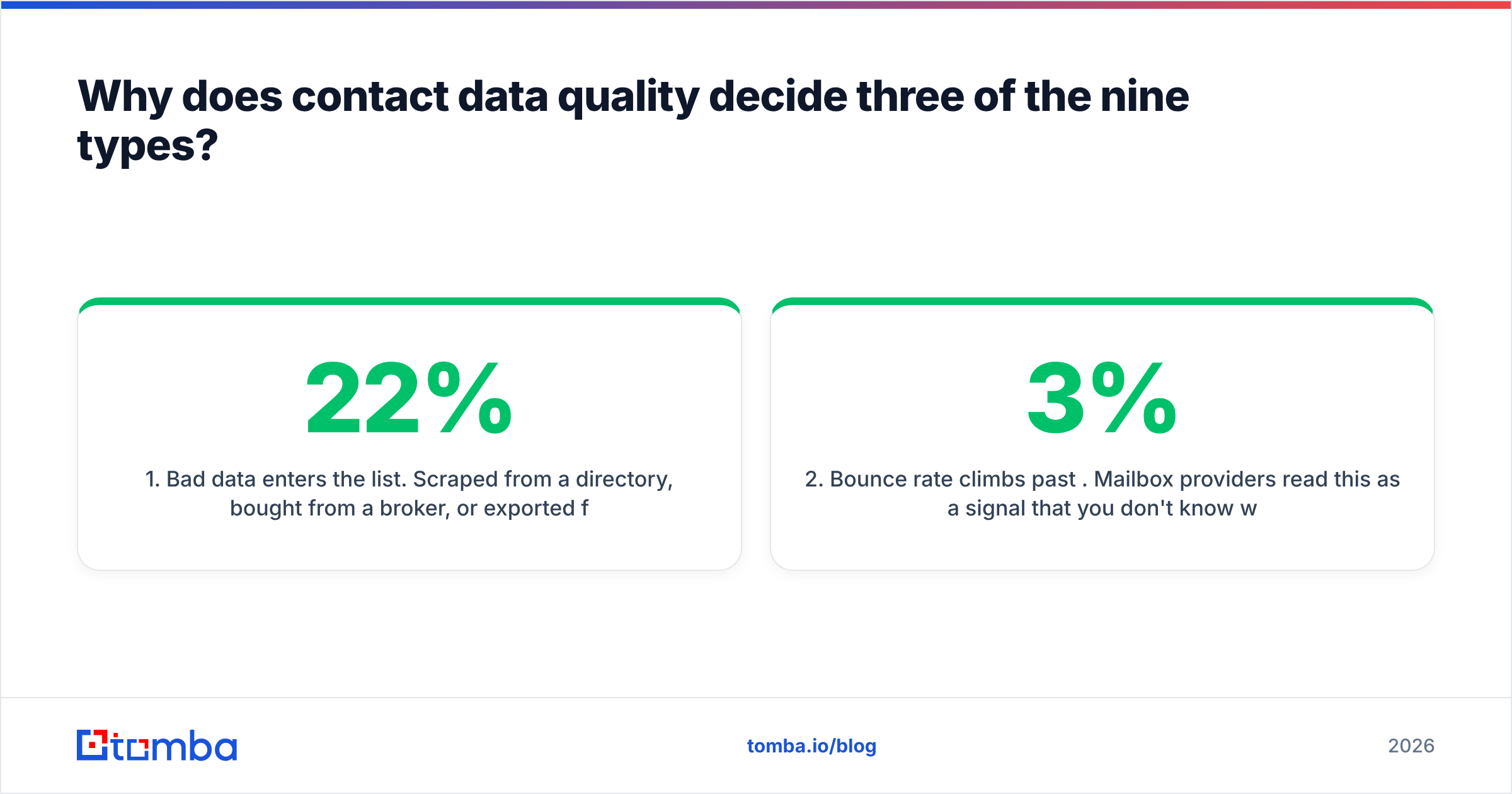
- Bad data enters the list. Scraped from a directory, bought from a broker, or exported from a CRM nobody has hygiened since 2023. Between 22% and 30% of B2B contact records decay annually — people change jobs, companies rebrand, domains migrate.
- Bounce rate climbs past 3%. Mailbox providers read this as a signal that you don't know who you're emailing, which is exactly what it is.
- Sender reputation drops. Your sender reputation is domain-level, not campaign-level. The outbound campaign poisons the well for your lifecycle emails, your product notifications, and your webinar invites.
- Inbox placement falls for everything. Now your webinar type, your nurture type, and your PLG onboarding emails underperform too — and the dashboards will blame those channels, not the list.
- The team concludes "outbound doesn't work." It worked fine. The inputs didn't.
This is why an email verifier step isn't an optional nicety bolted onto outbound — it's load-bearing infrastructure for four of the nine lead generation types simultaneously. The same applies to catch-all domains, which now represent a large share of enterprise mail servers and require a dedicated catch-all verifier rather than a simple SMTP ping.
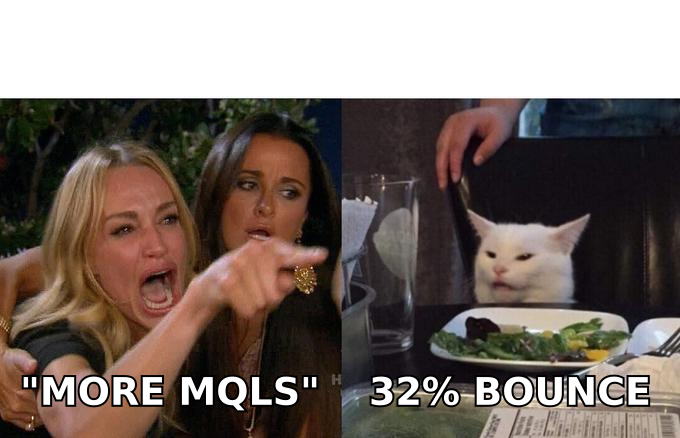
For teams building lists at scale, the practical sequence is: define the ICP firmographically, pull companies, run a domain search to map the org, find the specific personas, verify, then enrich with role and seniority before a single email sends. Skipping the verify step to save a few cents per record is the single most expensive shortcut in B2B demand generation.
Is inbound better than outbound in 2026?#
No — and the framing itself is the problem. Inbound and outbound answer different questions.
Inbound answers "who is already looking for something like us?" That population is finite and, in mature categories, already being fought over by every competitor with a content budget. Its size is capped by category search volume, which you do not control.
Outbound answers "who should be looking for us but isn't yet?" That population is enormous and entirely defined by your ICP criteria. You control its size completely. What you don't control is intent, which is why reply rates sit in the 2–8% band even for good campaigns.
The honest comparison:
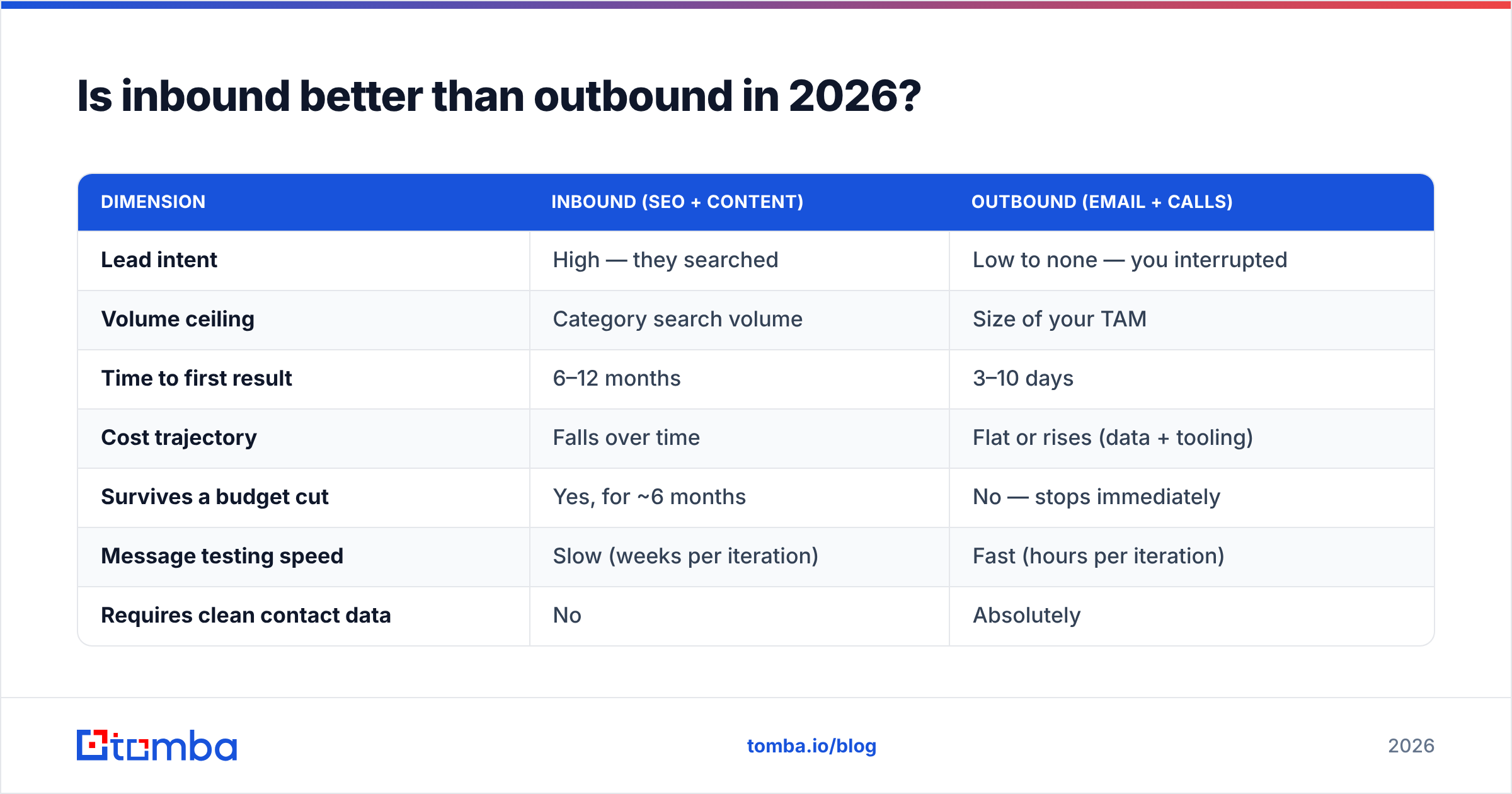
| Dimension | Inbound (SEO + content) | Outbound (email + calls) |
|---|---|---|
| Lead intent | High — they searched | Low to none — you interrupted |
| Volume ceiling | Category search volume | Size of your TAM |
| Time to first result | 6–12 months | 3–10 days |
| Cost trajectory | Falls over time | Flat or rises (data + tooling) |
| Survives a budget cut | Yes, for ~6 months | No — stops immediately |
| Message testing speed | Slow (weeks per iteration) | Fast (hours per iteration) |
| Requires clean contact data | No | Absolutely |
The teams that compound fastest use outbound as the research arm for inbound. Every outbound campaign is a live message test across 500 accounts; the objections you collect in reply threads become your next five blog posts and your next landing-page headline. Running them in isolation wastes the most valuable byproduct outbound produces.
HubSpot's annual State of Marketing research has tracked this convergence for several years now — the highest-performing teams report multi-type programs, not channel purity.
What about referral, partner, and event-based lead generation?#
These three share a structural property: someone else's trust carries the first meeting. That makes them the highest-converting types and the hardest to forecast.
Referral. Conversion from referred lead to closed deal typically runs 2–4x a cold lead, because the qualification and the trust transfer happen before you're involved. The constraint is supply — you cannot generate more referrals than your customer base can produce. The fix is systematizing the ask: a trigger at day 90 post-onboarding, a trigger after a positive support resolution, a trigger after a renewal. Most companies leave this entirely to chance and then wonder why referrals are "unpredictable."
Partner / co-sell. A partner's customer list is a pre-qualified market with an existing budget relationship. The work is operational, not creative: joint account mapping, a shared definition of a qualified handoff, and a commission structure that doesn't require a lawyer. Expect 4–6 months before the first co-sold deal. Integration marketplaces (the G2 category listings and vendor app directories) are the cheapest entry point.
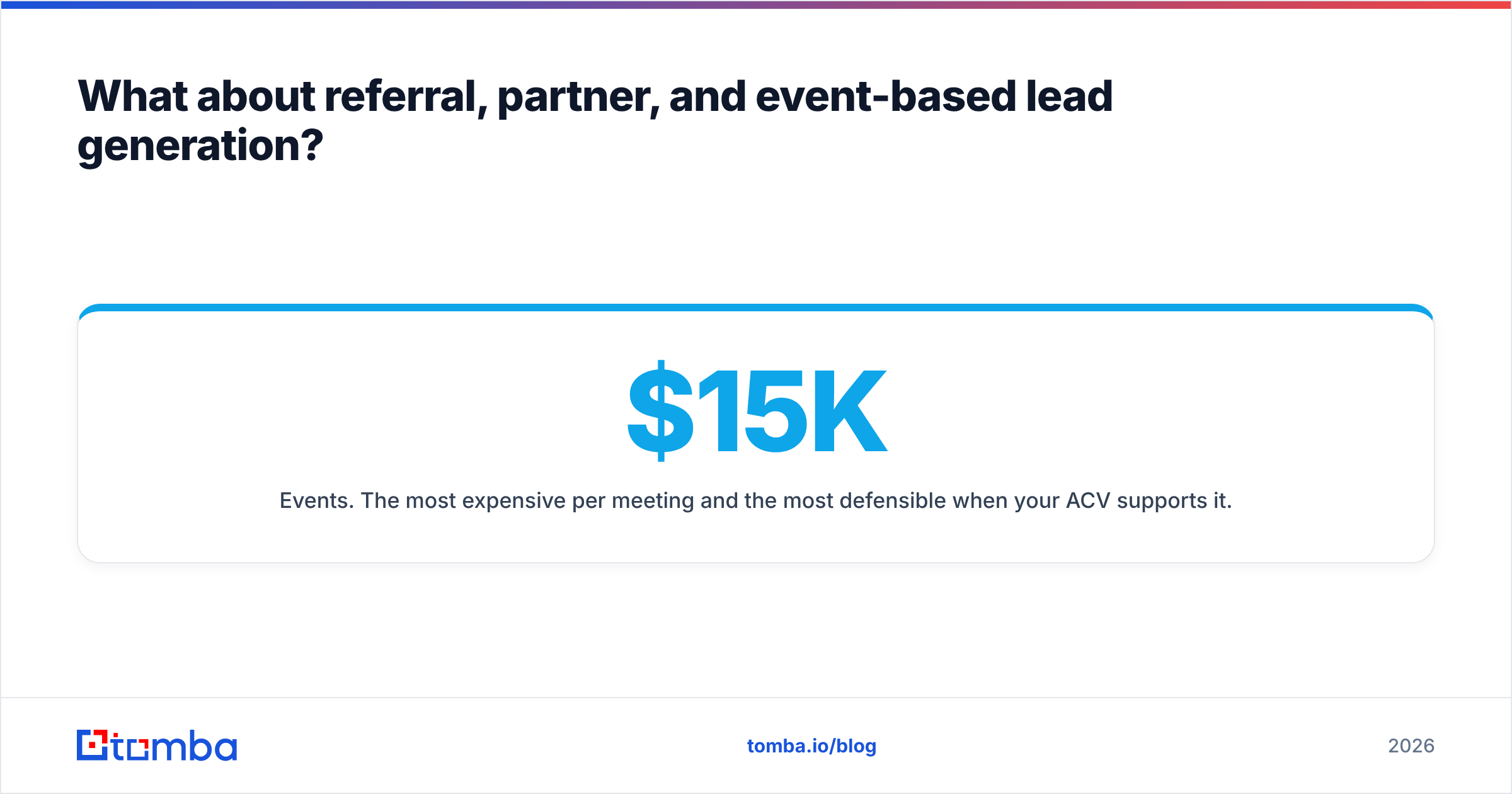
Events. The most expensive per meeting and the most defensible when your ACV supports it. The mistake is measuring events by badge scans. A booth that collects 400 scans and books 6 real meetings performed worse than a 12-person dinner that produced 4. Under $15K ACV, events rarely clear their own cost; over $50K ACV, they're often the highest-ROI type you run.
All three have the same amplification pattern: they generate a name, not a contact record. You still have to find the working email, the direct line, and the LinkedIn profile — which is where a bulk email finder or a phone finder turns a stack of business cards into something your sequencing tool can act on within 24 hours instead of two weeks.
How many lead generation types should you run at once?#
Two, until you're past $10M ARR. Three at most.
The math is unforgiving. Each type needs a dedicated owner, a distinct measurement model, roughly 90 days of iteration before the data means anything, and its own tooling budget. A five-person GTM team running six types is running six half-experiments, none of which will produce a signal clean enough to double down on.
A workable sequencing plan:
- Quarters 1–2 — One fast type (outbound or paid) to prove the message converts, plus one compounding type started at low intensity (two SEO posts a month, or a free tier shipped).
- Quarters 3–4 — Double the budget on whichever fast type produced a sub-$200 meeting cost. Kill the other. Keep the compounding type running untouched.
- Year 2 — Add referral systematization, which costs almost nothing and draws on the customer base the first year built.
- Year 3 — Add events or ABM if ACV supports it, funded by the now-mature compounding type.
The test for adding a fourth type is simple: can you name the person who owns it, the metric that proves it works, and the quarter it should show a result? If any of the three is fuzzy, you're adding activity, not pipeline.
One category note — data vendors differ sharply in how they source contacts. Providers like BookYourData sell pre-built, human-verified lists that suit teams wanting a ready-made file, while API-first tools generate and verify on demand against live sources. Neither is wrong; they suit different operating models. Check where the data comes from before committing, because sourcing method predicts decay rate more than price does.
What metrics prove a lead generation type is working?#
Stop reporting lead volume. It's the metric most likely to be gamed and least likely to correlate with revenue.
Track four numbers per type, every month:
- Cost per booked meeting. Fully loaded — tooling, headcount, media. This is the only number that lets you compare a webinar to a cold-call program honestly.
- Meeting-to-opportunity rate. Filters out types that book meetings with people who cannot buy. Outbound often looks cheap until you see 20% of meetings qualify.
- Opportunity-to-close rate, by type. Referral will run 2–4x your average; paid search on generic keywords often runs half. Same pipeline, wildly different quality.
- Time from first touch to closed-won. Events and referrals usually compress this by 30–50%, which is real money your CAC calculation ignores.
Add one health metric that spans types: bounce rate on all outbound sending, held under 2%. It's a leading indicator for problems that will surface six weeks later in three other types. Run your list through a free email checker before any send larger than 200 records, and treat any spike as a data-source problem, not a copy problem.
Getting the contact layer right#
Whichever two types you pick, at least one of them will require you to reach a specific person at a specific company — and that's the step where most programs silently leak. A $200 conference badge, a perfect referral intro, and a flawlessly targeted ABM list are all worth zero until you have a deliverable email address attached to them.
Tomba's Email Finder handles that layer: search by domain, name, or company, get verified addresses with confidence scores, and push them straight into your sequencer or CRM through the Tomba API or the native integrations. The free tier gives you 25 searches a month to test against a list you already know the answers to; paid plans start at $49/mo for Starter, $99/mo for Growth, and $249/mo for Pro, with full Tomba pricing published rather than quote-gated. Run it against 50 known-good contacts before you commit — that's the only benchmark that reflects your actual ICP.
Related guides#
// get started
Find, verify and enrich your first contacts today
Start on the free plan with 25 searches a month, then scale when your team is ready.
Free plan · No credit card required · GDPR & CCPA
// about the author