Lead Generation vs Lead Nurturing: Which Drives More Revenue?
Most B2B teams over-invest in one and starve the other. Here's how lead generation and lead nurturing actually differ, which one your pipeline needs first, and how to split budget between them.
TL;DR
- Lead generation creates new contacts. Lead nurturing moves existing contacts toward a buying decision. They are sequential stages, not competing strategies.
- If your MQL-to-SQL conversion is under 10%, you have a nurturing problem. If your sales team runs out of accounts before month-end, you have a generation problem. Diagnose before you spend.
- Typical healthy split for a B2B team under $10M ARR: roughly 60% of budget on generation, 40% on nurturing. Above $10M, that flips as your database compounds.
- Nurturing is cheaper per outcome but slower. Generation is faster but the cost per qualified opportunity is 3-5x higher.
- Both collapse without accurate contact data. A nurture sequence sent to a dead mailbox damages your sender reputation and inflates your "engagement problem" diagnosis.
What is lead generation?#
Lead generation is the work of turning strangers into known contacts. That's it. Someone who was anonymous — a name on a LinkedIn profile, a company on a target list, a visitor on your pricing page — becomes a record in your CRM with a name, a role, a company, and a way to reach them.
The channels vary wildly in cost and quality:
- Outbound prospecting — you build a target account list, find the decision-makers, and reach out cold. Highest control, highest volume, lowest baseline intent.
- Inbound content — blog posts, SEO, gated assets. Slower to compound, but the contacts arrive with a problem already in mind.
- Paid acquisition — LinkedIn Ads, Google, retargeting. Fast and predictable, expensive per lead, quality varies by offer.
- Events and community — conferences, webinars, Slack groups. Low volume, unusually high close rates.
- Website visitor identification — visitor identification turns anonymous traffic into named companies you can prospect into.
- Referrals and partnerships — the cheapest source per closed deal, and the one nobody systematizes.
The defining trait of generation is that it adds rows to the database. Success is measured in volume and cost: leads per month, cost per lead, percentage of leads that match your ICP.
Where generation quietly fails is data quality. A list of 5,000 contacts where 30% of the emails bounce isn't 5,000 leads — it's 3,500 leads plus a damaged sending domain. This is why the verification step matters as much as the sourcing step. Running new contacts through an email verifier before they enter a sequence is not optional hygiene; it is part of generation itself.
What is lead nurturing?#
Lead nurturing is everything you do with a contact between "we know who you are" and "we're ready to talk price." It's the long middle.
Most B2B buyers are not in-market when you first reach them. The often-cited estimate from the B2B Institute is that roughly 95% of your addressable market isn't buying right now. Nurturing is how you stay present for the 5% who will be in-market next quarter, and the quarter after that.
In practice, nurturing looks like:
- Sequenced email education — a multi-touch flow that teaches rather than pitches, spread over weeks not days.
- Behavioral triggers — a contact visits your pricing page twice in a week, so a rep gets a task instead of an automated drip.
- Retargeting and social touches — light-weight presence between emails so you're not only in the inbox.
- Segment-specific content — a security lead and a RevOps lead should not get the same five emails.
- Reactivation of stale records — contacts who went quiet 9 months ago, re-approached with a new angle.
Nurturing success is measured in progression, not volume: MQL-to-SQL rate, time-to-opportunity, response rate, and reactivation percentage on dormant records.
Lead generation vs lead nurturing: what's the actual difference?#
The clean way to hold the distinction: generation is a sourcing function, nurturing is a conversion function. Generation is judged on how many qualified names you added. Nurturing is judged on how many of those names moved forward.
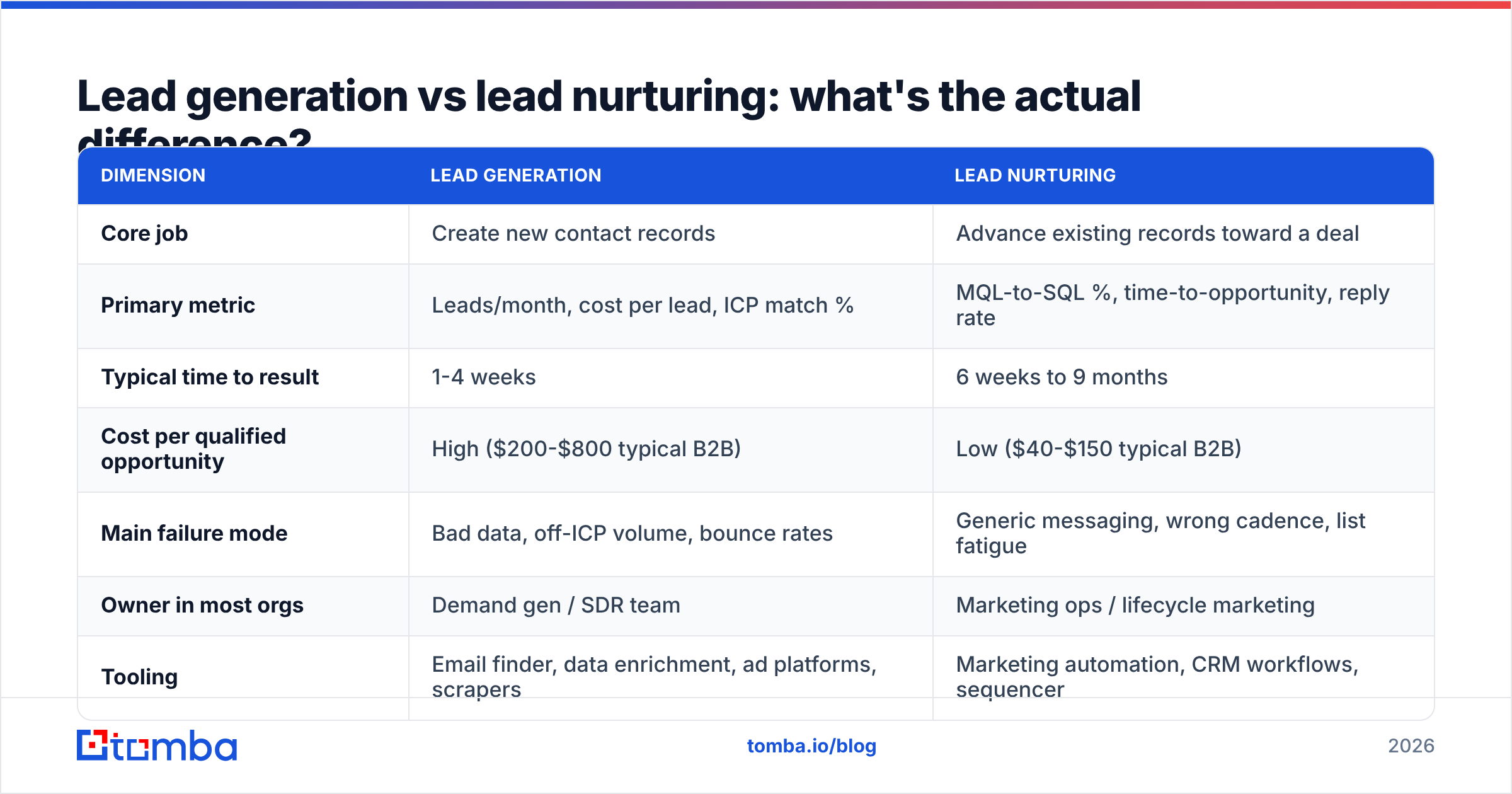
| Dimension | Lead generation | Lead nurturing |
|---|---|---|
| Core job | Create new contact records | Advance existing records toward a deal |
| Primary metric | Leads/month, cost per lead, ICP match % | MQL-to-SQL %, time-to-opportunity, reply rate |
| Typical time to result | 1-4 weeks | 6 weeks to 9 months |
| Cost per qualified opportunity | High ($200-$800 typical B2B) | Low ($40-$150 typical B2B) |
| Main failure mode | Bad data, off-ICP volume, bounce rates | Generic messaging, wrong cadence, list fatigue |
| Owner in most orgs | Demand gen / SDR team | Marketing ops / lifecycle marketing |
| Tooling | Email finder, data enrichment, ad platforms, scrapers | Marketing automation, CRM workflows, sequencer |
| Scales with | Budget and headcount | Database size and content library |
| Breaks when | Your ICP definition is vague | Your data is stale or unsegmented |
Notice the asymmetry in cost per opportunity. Nurturing an existing contact is dramatically cheaper than sourcing a new one — which is why teams with mature databases shift budget toward nurturing over time. But nurturing has a hard ceiling: you cannot nurture contacts you don't have. Generation sets the ceiling; nurturing determines how much of it you actually reach.
Which one does your pipeline need first?#
Run this diagnostic before you move a dollar.
Symptom: reps run out of accounts before month-end. You have a generation problem. Your database is too small or too narrow for your team's capacity. Fix sourcing first — a nurture program on an empty database is an expensive no-op.
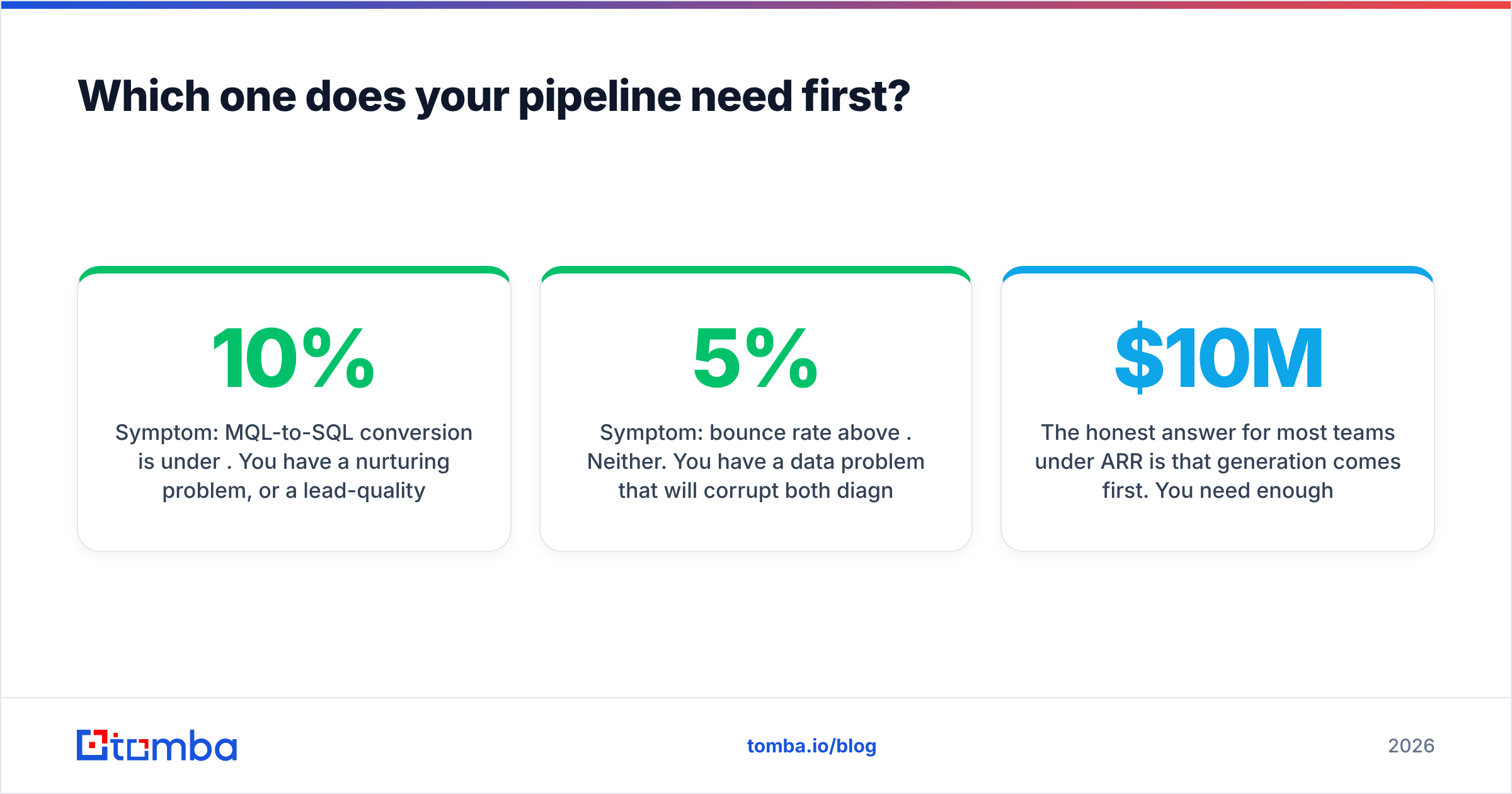
Symptom: MQL-to-SQL conversion is under 10%. You have a nurturing problem, or a lead-quality problem masquerading as one. Before rebuilding your drip campaigns, audit whether the leads matched ICP at the point of capture. Generating the wrong people and then nurturing them harder is the most expensive mistake in B2B marketing.
Symptom: high open rates, low reply rates. Nurturing content problem. Your subject lines work; your body copy doesn't earn a response.
Symptom: bounce rate above 5%. Neither. You have a data problem that will corrupt both diagnostics until you fix it. Bounces suppress deliverability, which suppresses opens, which makes your nurturing look worse than it is.
Symptom: pipeline is fine but deal velocity is slow. Nurturing — specifically mid-funnel. You're generating and converting, but contacts stall between demo and decision.
The honest answer for most teams under $10M ARR is that generation comes first. You need enough contacts for statistical signal before nurturing optimization means anything. Testing three nurture variants across 200 contacts tells you nothing.
How should you split budget between them?#
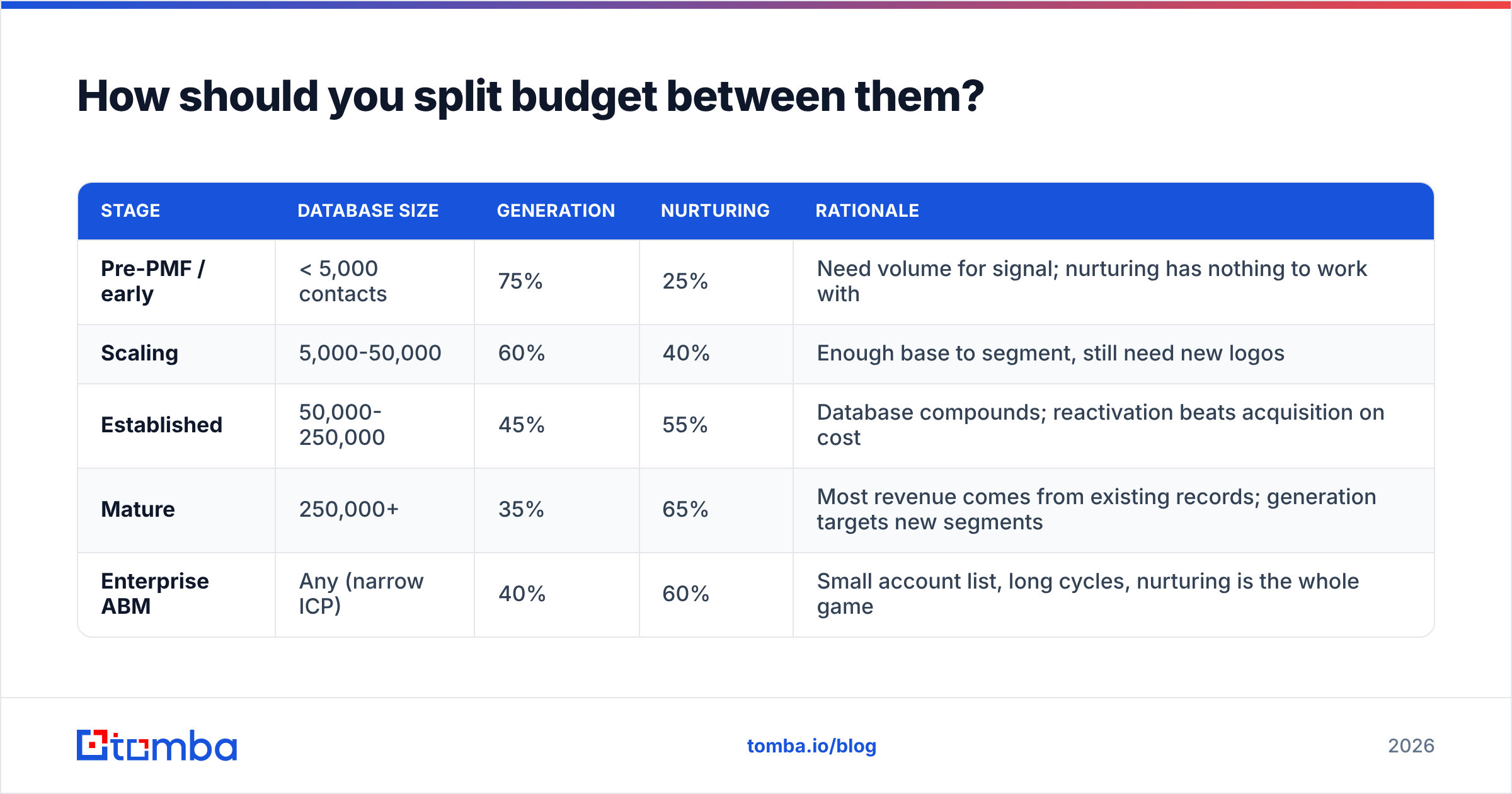
There's no universal ratio, but there's a defensible pattern tied to database maturity.
| Stage | Database size | Generation | Nurturing | Rationale |
|---|---|---|---|---|
| Pre-PMF / early | < 5,000 contacts | 75% | 25% | Need volume for signal; nurturing has nothing to work with |
| Scaling | 5,000-50,000 | 60% | 40% | Enough base to segment, still need new logos |
| Established | 50,000-250,000 | 45% | 55% | Database compounds; reactivation beats acquisition on cost |
| Mature | 250,000+ | 35% | 65% | Most revenue comes from existing records; generation targets new segments |
| Enterprise ABM | Any (narrow ICP) | 40% | 60% | Small account list, long cycles, nurturing is the whole game |
Two caveats. First, this assumes your data decays at the normal B2B rate — roughly 22-30% of contact records go stale annually as people change jobs. If you're not re-enriching, your "established" database is functionally a "scaling" one. Second, ABM breaks the pattern entirely: when your total addressable list is 300 accounts, you're not generating leads, you're nurturing a fixed set of relationships.

How do the tool stacks compare?#
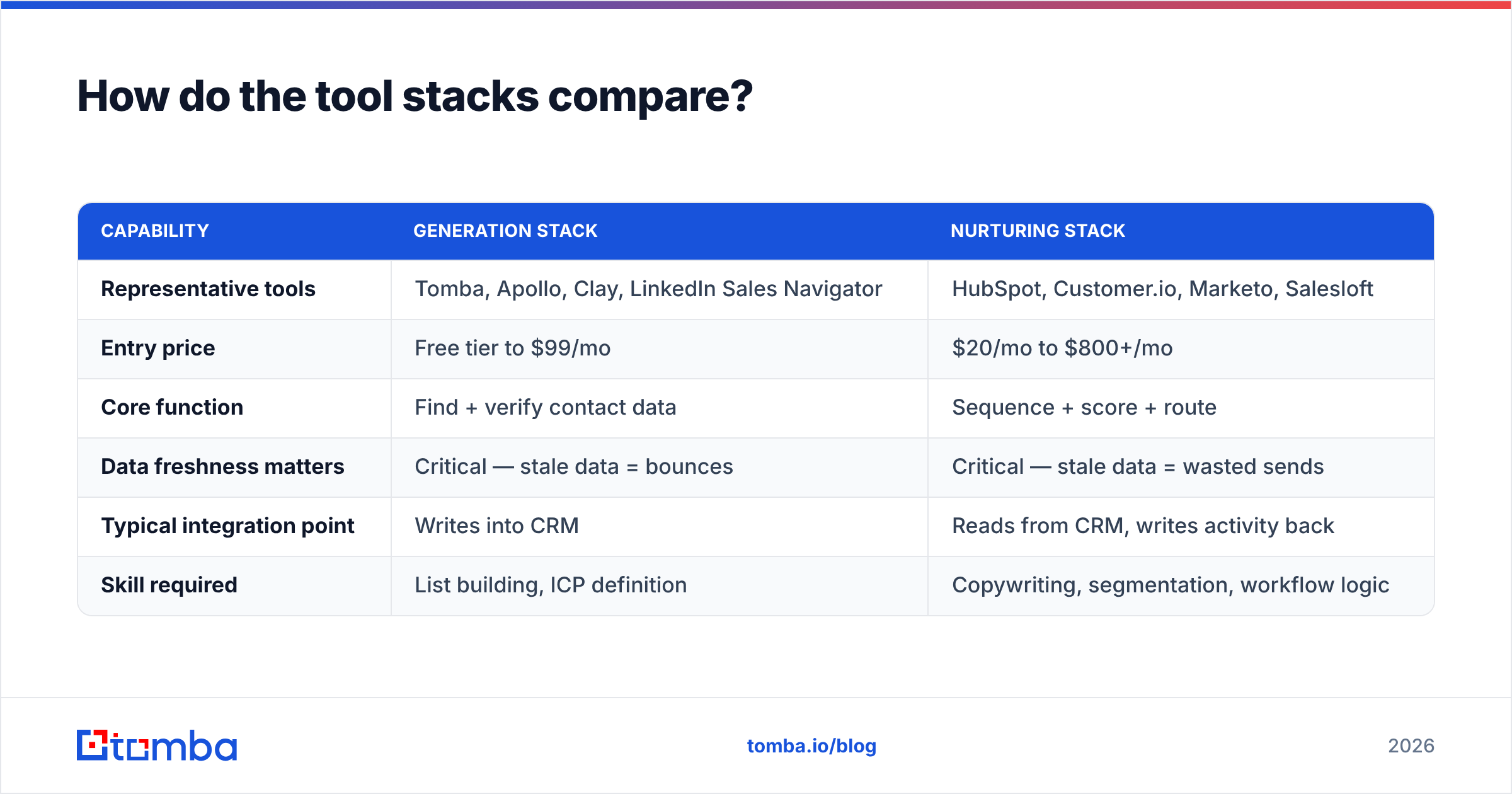
The stacks barely overlap, which is why teams often buy one and assume it covers both.
| Capability | Generation stack | Nurturing stack |
|---|---|---|
| Representative tools | Tomba, Apollo, Clay, LinkedIn Sales Navigator | HubSpot, Customer.io, Marketo, Salesloft |
| Entry price | Free tier to $99/mo | $20/mo to $800+/mo |
| Core function | Find + verify contact data | Sequence + score + route |
| Data freshness matters | Critical — stale data = bounces | Critical — stale data = wasted sends |
| Typical integration point | Writes into CRM | Reads from CRM, writes activity back |
| Skill required | List building, ICP definition | Copywriting, segmentation, workflow logic |
On the generation side, Tomba pricing starts with a free tier at 25 searches/month, Starter at $49/mo, Growth at $99/mo, and Pro at $249/mo — which puts verified contact sourcing well below the cost of most marketing automation platforms. Apollo bundles sourcing and sequencing, which is convenient but means you're locked into their data quality for both. BookYourData takes a different approach with pay-as-you-go verified lists, which suits teams that build campaigns in bursts rather than continuously.
On the nurturing side, HubSpot remains the default for mid-market teams because the CRM and the automation live in the same object model. Standalone sequencers are cheaper but create attribution gaps you'll pay for later.
The connective tissue is enrichment. A nurture workflow that fires on "job title contains VP" only works if job titles are populated and current. Running contact enrichment on your existing database is often the highest-ROI nurturing project available — not new content, not new sequences, just making the data good enough for the segmentation you already designed.
Where does data quality sit between the two?#
It sits underneath both, and it's the variable most teams ignore while blaming strategy.
Consider a realistic scenario. You source 10,000 contacts. 18% of the emails are invalid or stale. You load them into a nurture sequence.
- 1,800 hard bounce over the first two sends.
- Your bounce rate crosses the threshold where mailbox providers start throttling.
- Sender reputation drops, so the 8,200 valid contacts see lower inbox placement.
- Open rates fall from 42% to 24%.
- You conclude your nurture content is weak and rewrite the sequence.
The sequence was fine. The list wasn't. This failure mode is common enough that "our nurturing doesn't work" should always trigger a data audit before a content audit. Verify before you send, re-verify quarterly, and treat catch-all verification as a separate step — catch-all domains accept everything at the SMTP layer and tell you nothing about whether a mailbox exists.
For teams doing outbound generation at volume, running finds and verifications through the Tomba API inside your enrichment pipeline keeps the data layer consistent rather than a manual CSV step someone forgets.
Can you run both at once with a small team?#
Yes, with a structural constraint: separate the cadences, share the data.
A two-person team can realistically run:
- One generation motion. Pick a single channel — outbound to a tightly-defined ICP is usually the right first choice because you control volume. Build 200-400 verified contacts per month.
- One nurture track. A single 6-touch sequence over 8 weeks, segmented at most two ways. Not five personas with branching logic.
- One shared data layer. Both motions read from the same CRM records. Generation writes new contacts, nurturing writes engagement signals back.
The failure pattern for small teams is running four half-built nurture tracks because a tool made it easy to duplicate workflows. Depth beats breadth until you have enough volume for each track to produce statistically meaningful results — roughly 500 contacts per track minimum.
Also worth naming: for small teams, the highest-leverage nurturing is often not automated at all. A rep who reads a prospect's last three LinkedIn posts and sends one specific email beats a nine-step drip. Automation scales mediocre relevance; it doesn't create relevance.
How do you measure whether the split is working?#
Track four numbers monthly, and read them as a system rather than in isolation.
- Cost per qualified opportunity, by source. Split generation-sourced from nurture-sourced. If nurture-sourced opportunities cost 4x less, you're under-investing in nurturing.
- Database growth rate vs. database decay rate. If you add 2,000 contacts monthly but 2,200 go stale, your "growth" is negative. Most teams never measure decay.
- MQL-to-SQL conversion, trended. A falling rate with flat lead volume means nurturing degradation. A falling rate with rising volume usually means generation quality slipped.
- Reactivation rate on dormant contacts. What percentage of 6-month-quiet records re-engage per quarter? Below 3% and your nurturing isn't reaching them; above 10% and you should be spending more here.
- Bounce and spam-complaint rate. The canary. Any upward movement invalidates the other four metrics until resolved.
Compare your numbers against category benchmarks — G2 and analyst data from Gartner are more useful for directional sanity checks than for targets, since medians hide enormous variance by ACV and sales motion.
What's the practical sequence to fix both?#
If you're starting from a mess, run it in this order:
- Audit data quality first. Verify your existing database. You cannot diagnose anything downstream of a 15% bounce rate.
- Define ICP precisely enough to disqualify. If your ICP doesn't exclude anyone, it isn't an ICP.
- Build one clean generation motion that produces verified, ICP-matched contacts at a known cost.
- Build one nurture track for the largest segment that motion produces.
- Measure for a full sales cycle before changing anything. Most teams iterate faster than their cycle length, which means they're reading noise.
- Then expand — second channel, second segment, branching logic.
Steps 1 and 3 are generation work. Steps 2, 4, and 5 are nurturing work. They're not in competition; they're in sequence.
Get the data layer right first#
Lead generation and lead nurturing both sit on the same foundation: contact records that are accurate, current, and complete enough to segment. Get that wrong and you'll spend a year optimizing copy that was never the problem.
Start with the source. Tomba Email Finder finds and verifies professional email addresses by domain, name, or company — so the contacts entering your generation motion are real before they ever hit a nurture sequence. The free tier gives you 25 searches a month to test it against your own ICP, and Starter runs $49/mo when you're ready to scale the list. Verify first, nurture second, and the rest of the funnel math starts working.
Related guides#
// get started
Find, verify and enrich your first contacts today
Start on the free plan with 25 searches a month, then scale when your team is ready.
Free plan · No credit card required · GDPR & CCPA
// about the author