Lead Generation vs Prospecting: What Actually Differs in 2026
Lead generation and prospecting are not synonyms, and treating them as one function is why pipeline stalls. Here is the honest breakdown of what each does, what each costs, and which one your team should fund next quarter.
TL;DR
- Lead generation is a pull motion. You create assets — content, ads, webinars, free tools — that make buyers raise a hand. You do not choose who responds.
- Prospecting is a push motion. You pick named accounts and named people, find their contact data, and reach out first. You choose exactly who you talk to.
- Cost behaves differently. Lead gen is a high fixed cost with a decaying long tail; prospecting is a near-linear variable cost that scales with headcount and data quality.
- Most teams under $10M ARR should fund prospecting first, because it produces pipeline in weeks instead of quarters — but only if the contact data is clean.
- The overlap is contact data. Both motions die on bad emails. That is where an email verifier and a reliable finder become shared infrastructure, not a line item for one team.
What is the actual difference between lead generation and prospecting?#
The difference is who initiates.
Lead generation builds a machine that attracts strangers and converts a small fraction of them into identified contacts. You publish a comparison guide, run a LinkedIn ad, host a webinar, ship a free calculator. People arrive, some of them fill in a form, and marketing routes them to sales. The buyer moves first.
Prospecting starts from a list you construct on purpose. You define an ICP — say, Series B fintechs in EMEA with 50–200 employees running HubSpot — build the account list, identify the three people who would care, find their email and phone, and send a message. The seller moves first.
That single distinction cascades into everything else: who owns the number, how fast results appear, what the unit economics look like, and which tools you buy.
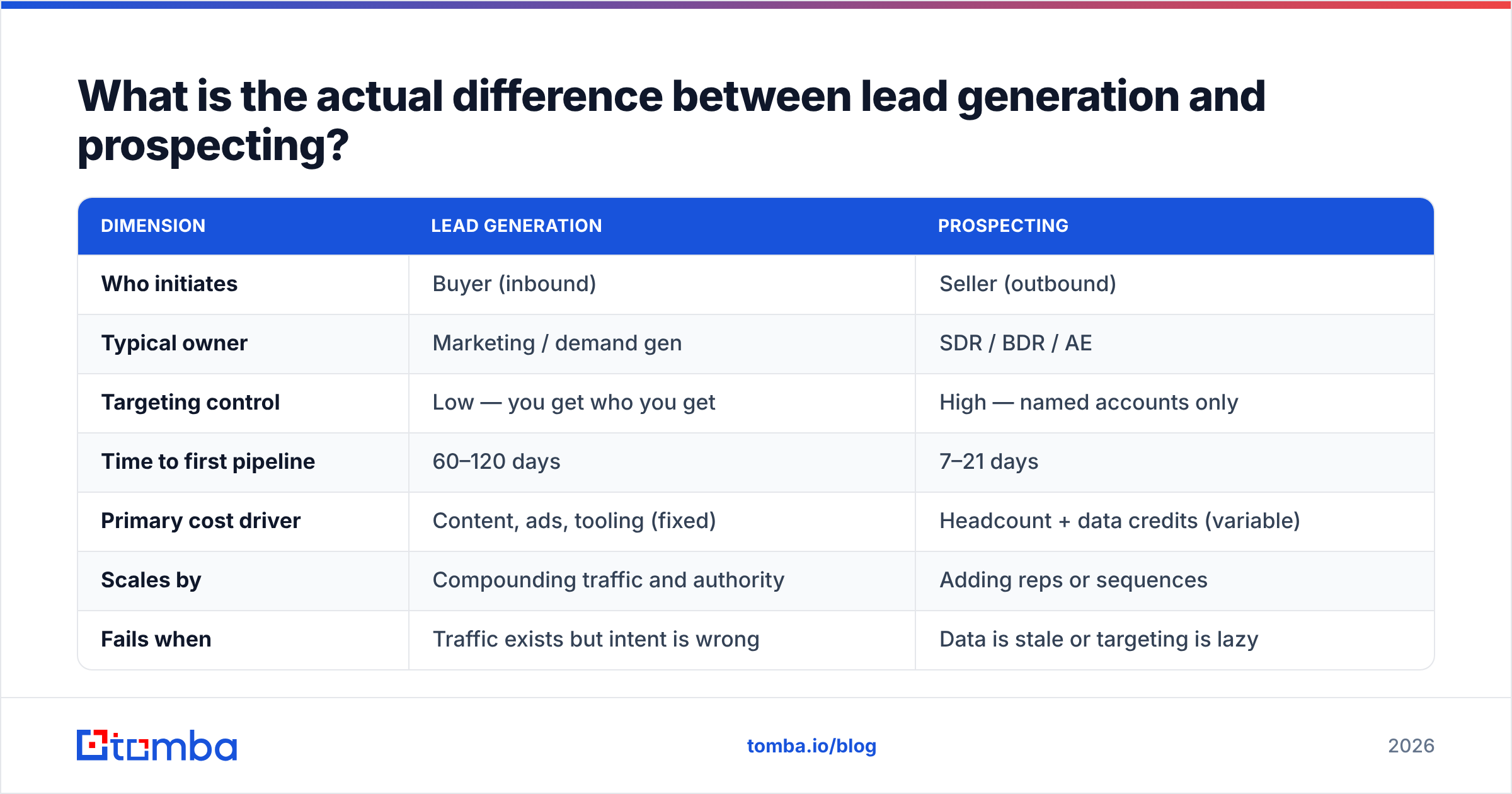
| Dimension | Lead generation | Prospecting |
|---|---|---|
| Who initiates | Buyer (inbound) | Seller (outbound) |
| Typical owner | Marketing / demand gen | SDR / BDR / AE |
| Targeting control | Low — you get who you get | High — named accounts only |
| Time to first pipeline | 60–120 days | 7–21 days |
| Primary cost driver | Content, ads, tooling (fixed) | Headcount + data credits (variable) |
| Scales by | Compounding traffic and authority | Adding reps or sequences |
| Fails when | Traffic exists but intent is wrong | Data is stale or targeting is lazy |
| Core metric | MQL volume, cost per MQL, MQL→SQL rate | Meetings booked, reply rate, connect rate |
Neither column is "better." They fail in different directions, and knowing which failure you are currently living in tells you where the next dollar goes.
Why do teams keep confusing the two?#
Because the job titles blurred. "Lead generation agency" usually means outbound cold email. "Growth marketer" sometimes means SDR with a content budget. The vocabulary collapsed while the functions stayed distinct.
There is also a measurement problem. Both motions report into pipeline, so a dashboard showing "$2.1M sourced this quarter" hides whether that came from a form fill or a cold sequence. When you cannot separate the sources, you cannot fix the broken one.
Four practical tests to tell them apart in your own org:
- Ask who built the list. If the list is "everyone who downloaded the ebook," that is lead generation. If it is "47 named accounts we chose," that is prospecting.
- Ask what happens if you turn it off for a month. Lead gen keeps trickling for weeks from existing content. Prospecting stops the same day.
- Ask where the contact data comes from. Lead gen collects it from a form. Prospecting has to go find it — which means a data vendor, an enrichment API, or manual research.
- Ask who gets blamed when it misses. Lead gen misses are argued about in a marketing QBR. Prospecting misses show up in a rep's 1:1 on Monday.
If you cannot answer all four cleanly, you probably have one budget funding two motions and no way to attribute either.
Which produces pipeline faster?#
Prospecting, decisively — and it is not close in the first two quarters.
A competent SDR with a validated list can book meetings in week two. The work is bounded: define ICP, pull 500 contacts, verify them, write three sequences, send. The feedback loop is days long, so you can fix targeting or messaging fast.
Lead generation has a long ramp. A blog post published today might rank in four months. A paid campaign produces clicks immediately, but the cost per qualified lead is usually ugly for the first 60 days while you learn which creative and which audience convert. Webinars need an audience you do not yet have.
The trade-off is what happens at month 18. Lead gen compounds. A page that ranks keeps producing leads at near-zero marginal cost for years. Prospecting does not compound — a rep who books 12 meetings a month books 12 meetings next month too, unless you hire another rep. That linear cost is why VP Sales headcount plans and pipeline plans are the same document.
According to HubSpot's research on inbound and outbound, teams that report the strongest pipeline health run both, but they sequence them — outbound to survive, inbound to scale.
What does each motion actually cost in 2026?#
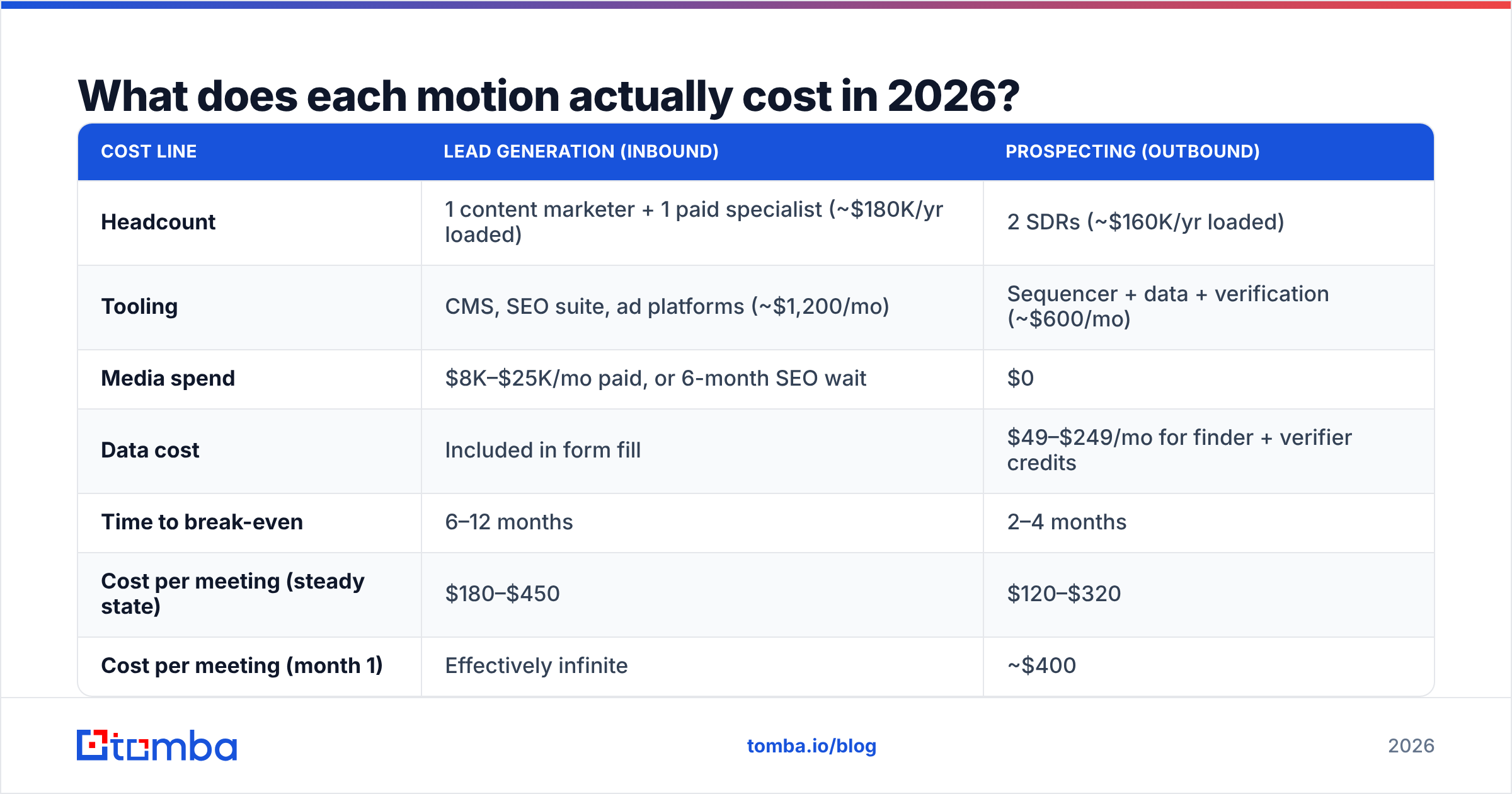
Here is a grounded model for a team targeting mid-market B2B, using realistic 2026 numbers. Treat these as directional, not gospel — your ACV and category move them a lot.
| Cost line | Lead generation (inbound) | Prospecting (outbound) |
|---|---|---|
| Headcount | 1 content marketer + 1 paid specialist (~$180K/yr loaded) | 2 SDRs (~$160K/yr loaded) |
| Tooling | CMS, SEO suite, ad platforms (~$1,200/mo) | Sequencer + data + verification (~$600/mo) |
| Media spend | $8K–$25K/mo paid, or 6-month SEO wait | $0 |
| Data cost | Included in form fill | $49–$249/mo for finder + verifier credits |
| Time to break-even | 6–12 months | 2–4 months |
| Cost per meeting (steady state) | $180–$450 | $120–$320 |
| Cost per meeting (month 1) | Effectively infinite | ~$400 |
The interesting line is data cost. Outbound has an explicit per-contact cost that inbound hides. A team burning 5,000 contact lookups a month is paying real money for that — which is why Tomba pricing matters more to an SDR leader than to a demand gen lead: Free covers 25 searches/mo for testing, Starter is $49/mo, Growth $99/mo, and Pro $249/mo when you are running volume across a team.
The uncomfortable part: inbound's data is "free" but frequently worse. Form fills contain typos, personal Gmail addresses, and role accounts. Outbound data is paid for but verified before it is used. Teams routinely discover their inbound list has a 12–18% bounce rate while their outbound list sits under 3%.
Is prospecting just cold email with extra steps?#
No, and this is the most common flattening of the term.
Prospecting is four distinct jobs, and cold email is only the last one:
- Account selection — deciding which companies deserve attention, usually via firmographics, tech stack signals, hiring activity, or funding events. Skip this and everything downstream is noise.
- Contact identification — finding the specific humans inside the account. A domain search that returns every public email at a company, sorted by department, does this in seconds instead of an hour of LinkedIn scrolling.
- Data validation — confirming the address is real and will accept mail before you send. This is non-negotiable in 2026; Google and Yahoo's bulk sender rules put a hard spam-complaint ceiling on senders, and a bouncing list burns your domain.
- Outreach and follow-up — the sequence itself, across email, phone, and LinkedIn.
Most "outbound doesn't work for us" post-mortems trace to step 1 or step 3, not step 4. Teams rewrite subject lines for a month when the real problem is that 30% of their list is unreachable or that they targeted 400-person companies when their product only lands at 40-person companies.
Worth noting: providers differ in how they handle step 2 and 3. BookYourData takes a pay-as-you-go database approach with a bounce guarantee, which suits teams that want a one-time list purchase rather than an ongoing API. Tomba leans toward continuous verification and enrichment through its email finder API, which suits teams rebuilding lists monthly. Both are legitimate answers to different buying patterns.
When should you run lead generation instead?#
Fund lead generation first in four situations:
- Your ACV is under $3K and self-serve. The CAC math on an SDR rarely works. You need volume and low touch.
- Your buyer is impossible to cold-reach. Some roles — clinicians, certain government functions, security leadership at large enterprises — filter aggressively. Content and community outperform.
- You already have distribution. An existing newsletter, a community, an integration marketplace listing. You are converting attention you already own, which removes the ramp problem.
- You are category-creating. If nobody searches for your solution, outbound explains it one conversation at a time — expensively. Content can explain it once, at scale.
Conversely, prospecting wins when your ACV is above $15K, your buyer is a named role you can list, and you need pipeline this quarter rather than next year. Most seed-to-Series-B B2B companies are in exactly that box, which is why outbound keeps getting rebuilt even after everyone declares it dead.

How do the two motions actually feed each other?#
The best-performing teams treat them as one pipeline with two entry points. Three concrete handoffs:
Inbound signal routes outbound targeting. Someone from Acme Corp read three pricing-adjacent pages but never filled a form. That is an account signal. A rep should now prospect the other four people at Acme who own that budget. Visitor identification turns anonymous traffic into named accounts your reps can work, which is inbound intent powering outbound execution.
Outbound conversations write inbound content. Every objection a rep hears fifteen times is a blog post that will rank. Sales calls are the cheapest keyword research available, and they are already happening.
Shared enrichment fixes both lists. A form fill that captures only an email is a weak lead. Run it through contact enrichment and you now have title, company size, and location — enough to score and route it properly instead of dumping it on an AE who wastes a call on a student.
The failure mode is treating them as competing budgets defended in separate meetings. When marketing's MQL number and sales' meeting number are graded independently, nobody owns the handoff, and the handoff is where most revenue leaks. This is the practical case for a unified revenue operations function — a single owner for the definitions, the routing rules, and the data quality standard both motions depend on.
What metrics should you grade each on?#
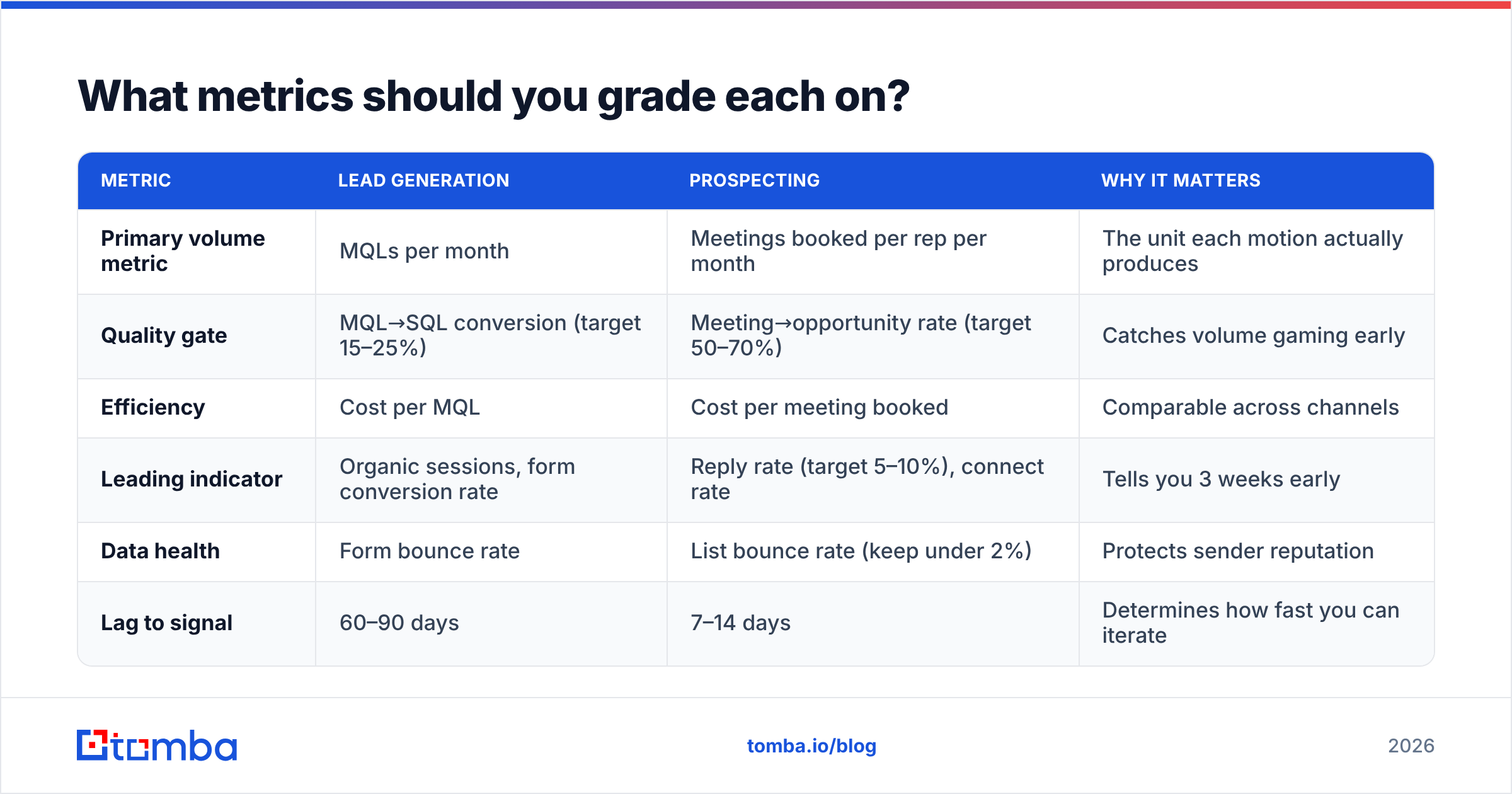
Different motions, different scoreboards. Grading outbound on MQL volume or inbound on reply rate produces nonsense.
| Metric | Lead generation | Prospecting | Why it matters |
|---|---|---|---|
| Primary volume metric | MQLs per month | Meetings booked per rep per month | The unit each motion actually produces |
| Quality gate | MQL→SQL conversion (target 15–25%) | Meeting→opportunity rate (target 50–70%) | Catches volume gaming early |
| Efficiency | Cost per MQL | Cost per meeting booked | Comparable across channels |
| Leading indicator | Organic sessions, form conversion rate | Reply rate (target 5–10%), connect rate | Tells you 3 weeks early |
| Data health | Form bounce rate | List bounce rate (keep under 2%) | Protects sender reputation |
| Lag to signal | 60–90 days | 7–14 days | Determines how fast you can iterate |
Two notes on that bottom row. First, the bounce-rate line applies to both, and most teams only monitor it on outbound. Inbound lists silently rot — people change jobs, and the average B2B contact record decays roughly 25–30% per year. Second, G2's software buyer behavior research consistently shows buyers engaging multiple sources before ever talking to sales, which means your inbound-attributed deals were probably also touched by outbound and vice versa. Do not over-trust single-touch attribution in either direction.
What should you actually do next quarter?#
Pick based on where you are, not on what sounds more modern.
If you have zero pipeline and under 18 months of runway: fund prospecting. Two SDRs, a tight ICP, verified data, three sequences. Accept that it does not compound. You need proof of demand before you can afford patience.
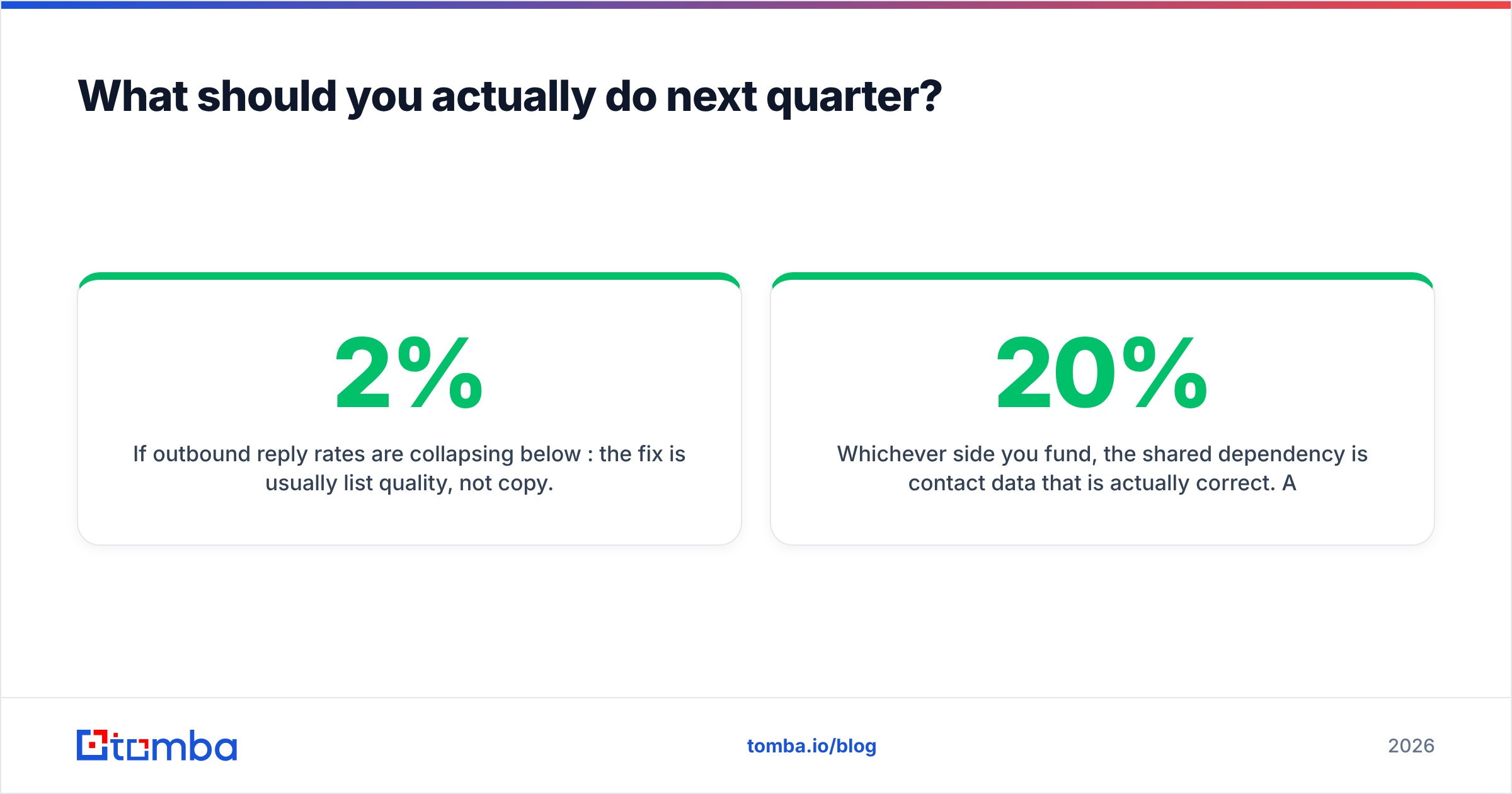
If outbound reply rates are collapsing below 2%: the fix is usually list quality, not copy. Rebuild the ICP, verify everything, and cut list size by 60%. Smaller and cleaner beats bigger and rotten every time.
If you have inbound volume but sales complains about quality: you have a routing and enrichment problem, not a volume problem. Enrich every form fill, score against ICP, and send everything below the bar to nurture instead of to a rep.
If both are working: build the loop. Route inbound intent signals to outbound reps, and mine outbound objections for content. That is when the two motions stop being a comparison and start being a system.
Whichever side you fund, the shared dependency is contact data that is actually correct. A prospecting motion with a 20% bounce rate is not a prospecting motion — it is a deliverability incident waiting to happen. Start with the Tomba Email Finder to build and verify your first list on the free tier's 25 searches, then scale to Starter at $49/mo once you know your ICP holds. Clean data is the cheapest performance improvement either motion will get this year.
Related guides#
// get started
Find, verify and enrich your first contacts today
Start on the free plan with 25 searches a month, then scale when your team is ready.
Free plan · No credit card required · GDPR & CCPA
// about the author