Lead Generator Definition: What It Means in B2B Sales
"Lead generator" gets used for a person, a software tool, an agency, and a web form — often in the same meeting. Here is the precise definition, the four types that actually exist, what each costs in 2026, and how to judge one before you sign.
TL;DR
- The short lead generator definition: anything — a person, a software tool, an agency, or a channel — whose job is to produce named potential buyers. Enough contact data, enough context, ready for a sales conversation.
- The word is used for four very different things. Confusing them is why "we need a lead generator" meetings go in circles for an hour.
- Output quality comes down to two things. Targeting accuracy: is this the right company and person? Data accuracy: does this email actually deliver?
- Budgets in 2026 range from roughly $0 (manual research) to $49–$99/month for self-serve data tools, to $3,000–$12,000/month for outsourced agencies.
- Before you buy, settle your own lead generator definition and write down what your company counts as a lead. Most sales and marketing disputes are definition problems in a metrics costume.
Lead generator definition: what is a lead generator?#
Here is the lead generator definition in one line. A lead generator is any person or system that turns a broad market into named buyers you can contact today.
That covers a lot of ground. It covers a junior SDR building a list in a spreadsheet. It covers a pop-up form on a pricing page, an API that returns verified work emails, and an agency sending 4,000 cold emails a week for you. All four ship the same thing: a record a rep can act on.
The confusion is simple. "Lead generator" is used as a job title, a product category, a channel name, and — in a lot of marketing copy — a vague compliment. When someone says "our webinar is a great lead generator," they mean a channel. When a recruiter posts a "Lead Generator" role, they mean a person doing list research and first-touch outreach. When a SaaS review site lists lead generators, it means software.
The lead generator definition holds across all of them, because the job is the same: cut the whole market down to the people you can email, call, or message today.
What a lead generator is not: a closer. Making a lead and qualifying a deal are two jobs with two metrics. Mixing them is the fastest way to make both look broken. Lead generation sits at the top of the funnel; qualification sits immediately after it.

What actually counts as a lead?#
Every lead generator definition rests on a second one: what counts as a lead. Write yours down before you evaluate a vendor. Ask five people in a B2B company and you get five answers. That is why pipeline reports so often fail an audit.
Here is the practical hierarchy most B2B teams converge on:
- Raw contact — A name, company, and email with no signal of interest. Technically a lead in database terms, realistically just a row. This is what most "lead lists" contain.
- Fit-qualified lead (ICP match) — The contact matches your ideal customer profile: industry, headcount, tech stack, region, and job level. No interest signal yet, but worth an email.
- Marketing qualified lead — The contact did something that implies interest: downloaded a guide, joined a webinar, visited pricing three times. A marketing qualified lead is a behavior tier, not a data tier.
- Sales accepted lead — A rep has reviewed the record and agrees it is worth working. This is the first point where a lead consumes real selling time.
- Sales qualified lead — Discovery happened, budget and need were confirmed, and the record is now an opportunity in the making.
A lead generator that promises "10,000 leads" is almost always talking about tier 1. A lead generator that costs $8,000 a month should be delivering tier 3 or better. Price the promise against the tier, not against the volume.
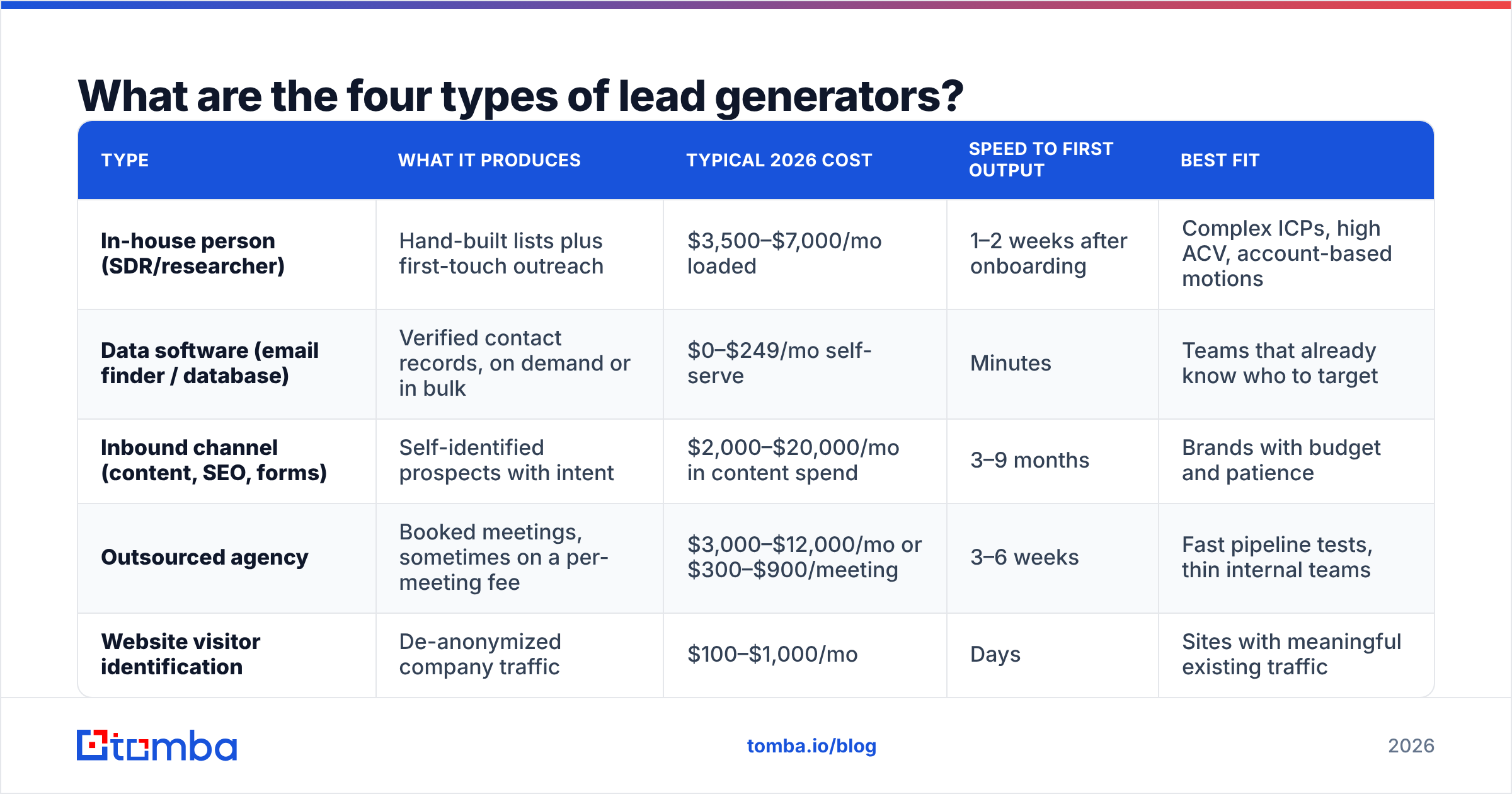
What are the four types of lead generators?#
| Type | What it produces | Typical 2026 cost | Speed to first output | Best fit |
|---|---|---|---|---|
| In-house person (SDR/researcher) | Hand-built lists plus first-touch outreach | $3,500–$7,000/mo loaded | 1–2 weeks after onboarding | Complex ICPs, high ACV, account-based motions |
| Data software (email finder / database) | Verified contact records, on demand or in bulk | $0–$249/mo self-serve | Minutes | Teams that already know who to target |
| Inbound channel (content, SEO, forms) | Self-identified prospects with intent | $2,000–$20,000/mo in content spend | 3–9 months | Brands with budget and patience |
| Outsourced agency | Booked meetings, sometimes on a per-meeting fee | $3,000–$12,000/mo or $300–$900/meeting | 3–6 weeks | Fast pipeline tests, thin internal teams |
| Website visitor identification | De-anonymized company traffic | $100–$1,000/mo | Days | Sites with meaningful existing traffic |
One lead generator definition covers all four types. Most companies do not pick just one. A realistic 2026 stack is a data tool feeding an SDR. Inbound content fills the slow months, and an agency tests a new segment when you need speed.
The mistake is buying two types that solve the same problem. An agency brings its own data. Add a $249/month data tool and a visitor-ID tool on top, and you pay three times for the same accounts.
How do software lead generators actually find contact data?#
Here is where the lead generator definition gets practical. Vendors describe this part with the least precision, and it decides whether your emails bounce.
Contact data reaches a lead generation tool in four ways:
- Public web crawling. Company sites, press releases, staff directories, conference speaker pages, GitHub commits, and published articles. This source is the most trusted one, because you can see where the email came from.
- Pattern inference. The tool learns that a company uses
first.last@domain.com. It then builds a likely address for someone whose email was never published. Useful, but it stays a guess until checked. - Contributed and licensed data. Pulled from partner networks, browser extensions, or bought databases. Coverage is broad, but freshness varies a lot.
- SMTP and MX verification. The step that splits a guess from a real address. The tool opens a connection to the mail server and asks whether the mailbox exists. Nothing is sent.
That last step is where lead generators quietly split. A vendor claiming "98% accuracy" may be scoring its own pattern guesses, not real inbox delivery. Ask which one it is. If the answer is fuzzy, run a 100-record test against your own list before committing.
Catch-all domains make this harder. A catch-all server accepts mail sent to any address at the domain. Standard checks return "unknown" instead of valid or invalid. Roughly 15–25% of B2B domains work this way. Watch how a tool handles them: flagging them honestly is a sharp quality tell, and marking them all valid is a red flag. A dedicated catch-all verifier exists for exactly this gap.
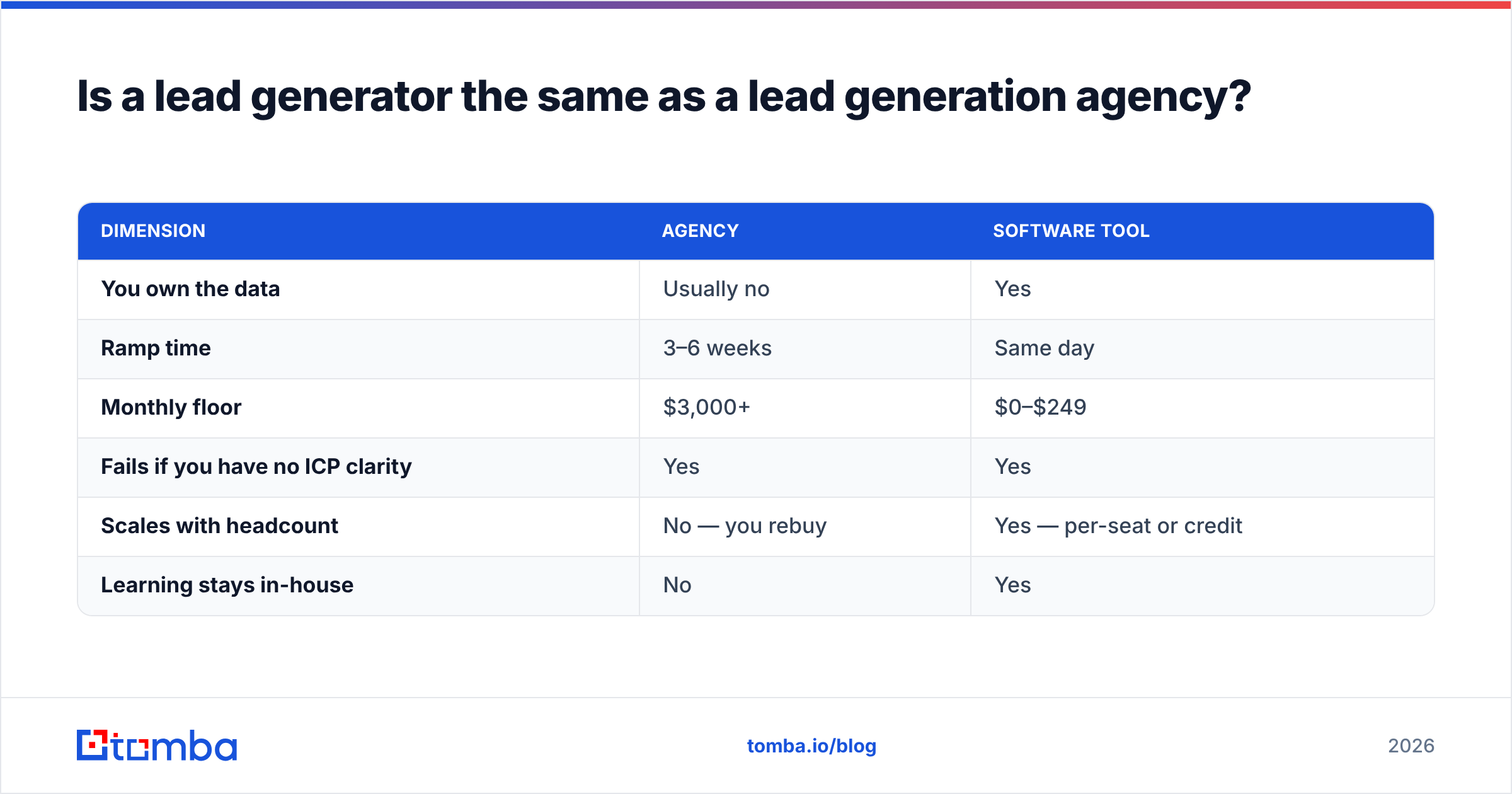
Is a lead generator the same as a lead generation agency?#
No. The lead generator definition covers both, yet the two bill you in very different ways.
A lead generation agency sells you an outcome: booked meetings. You pay a monthly retainer, wait out a ramp period, and sign a minimum contract. You buy capacity and process. You do not own the data, the sending setup, or the playbook.
A lead generation tool sells you inputs: records, checks, extra data, sometimes sequencing. You own what it makes, and you supply the work.
| Dimension | Agency | Software tool |
|---|---|---|
| You own the data | Usually no | Yes |
| Ramp time | 3–6 weeks | Same day |
| Monthly floor | $3,000+ | $0–$249 |
| Fails if you have no ICP clarity | Yes | Yes |
| Scales with headcount | No — you rebuy | Yes — per-seat or credit |
| Learning stays in-house | No | Yes |
The honest tiebreaker is your ICP. If it is still moving, an agency will spend six weeks learning that at full price. Tools are a cheaper place to be wrong. Once the ICP is stable and the message converts, an agency is a fair way to buy volume you cannot hire fast enough.

What should you look for when evaluating a lead generator?#
Once your lead generator definition is settled, the rest is mechanical. Run every candidate — person, tool, or agency — through the same six questions.
The first three are about data quality:
- What is the verified deliverability rate on my domains? Not their case study's domains. Ask for a free test on 100 accounts from your own target list. Any vendor that refuses is telling you something.
- How fresh is the data? B2B contact data decays at roughly 25–30% per year through job changes alone. A record found in 2023 and never re-checked is a coin flip. Ask for the last-verified date on each record.
- What is the coverage rate for my segment? A tool with 500 million records worldwide might still cover 40% of German mid-market makers. Coverage is segment by segment, and averages hide everything.
The last three questions are about commercials rather than data:
- Where does the data come from? Vendors that publish their data sources are easier to audit for GDPR and CCPA posture than those that say "proprietary."
- What happens to credits I don't use? Rollover policy, overage pricing, and whether a failed lookup still burns a credit. These three lines decide your real cost per usable record.
- Can it push into the systems I already run? A lead generator that cannot write into your CRM creates a second manual job. Check the integrations list against your actual stack before you fall in love with the UI.
On question three: no vendor wins everywhere. Specialist databases like BookYourData are often strongest in one vertical or one region. Crawl-based finders tend to win on fresh contacts and technical roles. Test two sources on the same 200 accounts. It is cheap, and it settles the argument with data instead of opinion.
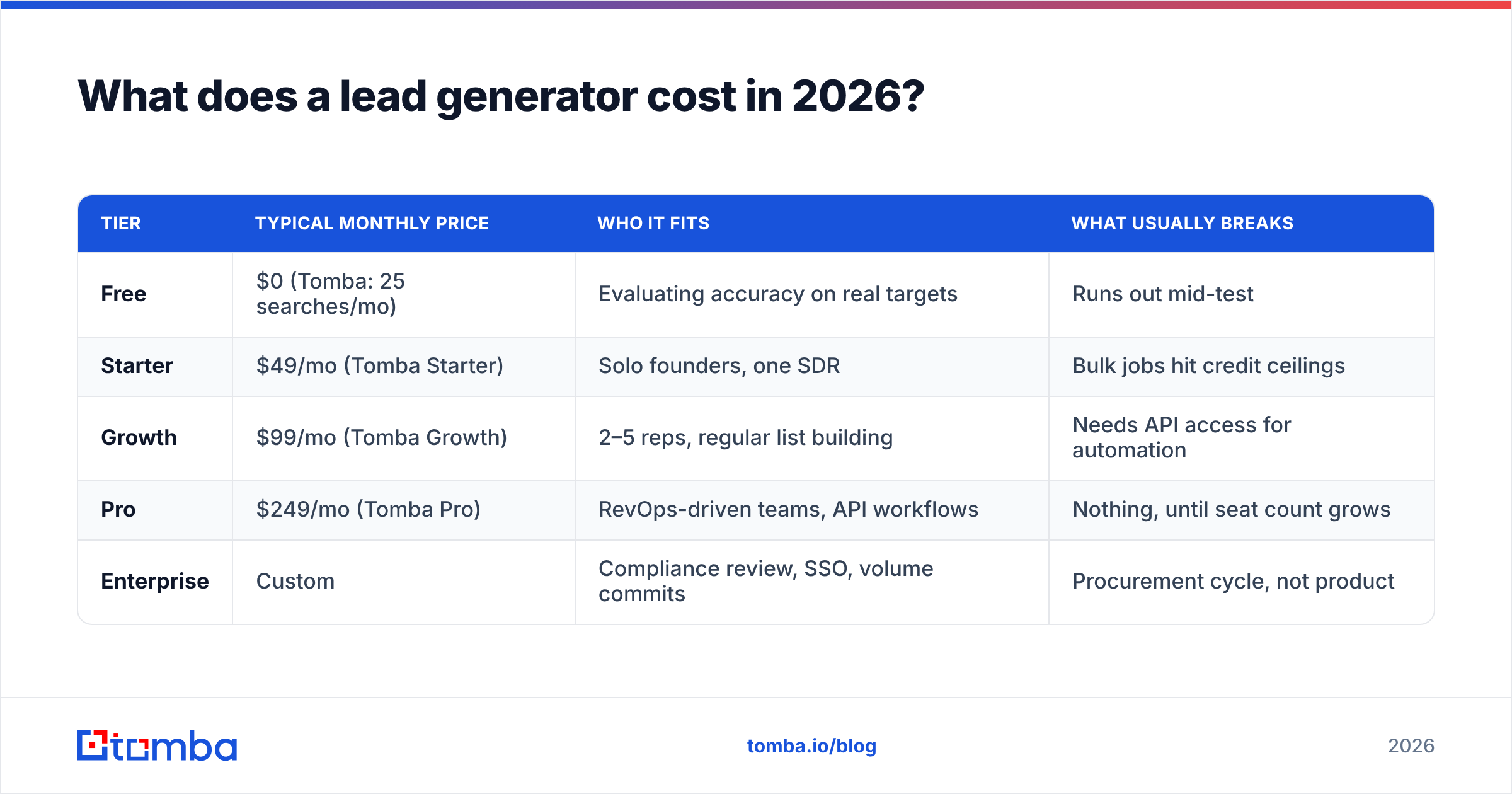
What does a lead generator cost in 2026?#
Price depends on which lead generator definition you are buying against. Self-serve data tools have settled into a clear band, shown here tier by tier:
| Tier | Typical monthly price | Who it fits | What usually breaks |
|---|---|---|---|
| Free | $0 (Tomba: 25 searches/mo) | Evaluating accuracy on real targets | Runs out mid-test |
| Starter | $49/mo (Tomba Starter) | Solo founders, one SDR | Bulk jobs hit credit ceilings |
| Growth | $99/mo (Tomba Growth) | 2–5 reps, regular list building | Needs API access for automation |
| Pro | $249/mo (Tomba Pro) | RevOps-driven teams, API workflows | Nothing, until seat count grows |
| Enterprise | Custom | Compliance review, SSO, volume commits | Procurement cycle, not product |
Compare that against $3,500–$7,000 fully loaded for one in-house researcher, or $3,000–$12,000 a month for an agency retainer. The math usually says the same thing: buy the data tool first, prove the motion converts, then add people. Full Tomba pricing is published rather than quote-gated, so the comparison is easy to run.
How do you measure whether a lead generator is working?#
Volume is the vanity metric. A lead generator definition only proves out in four numbers:
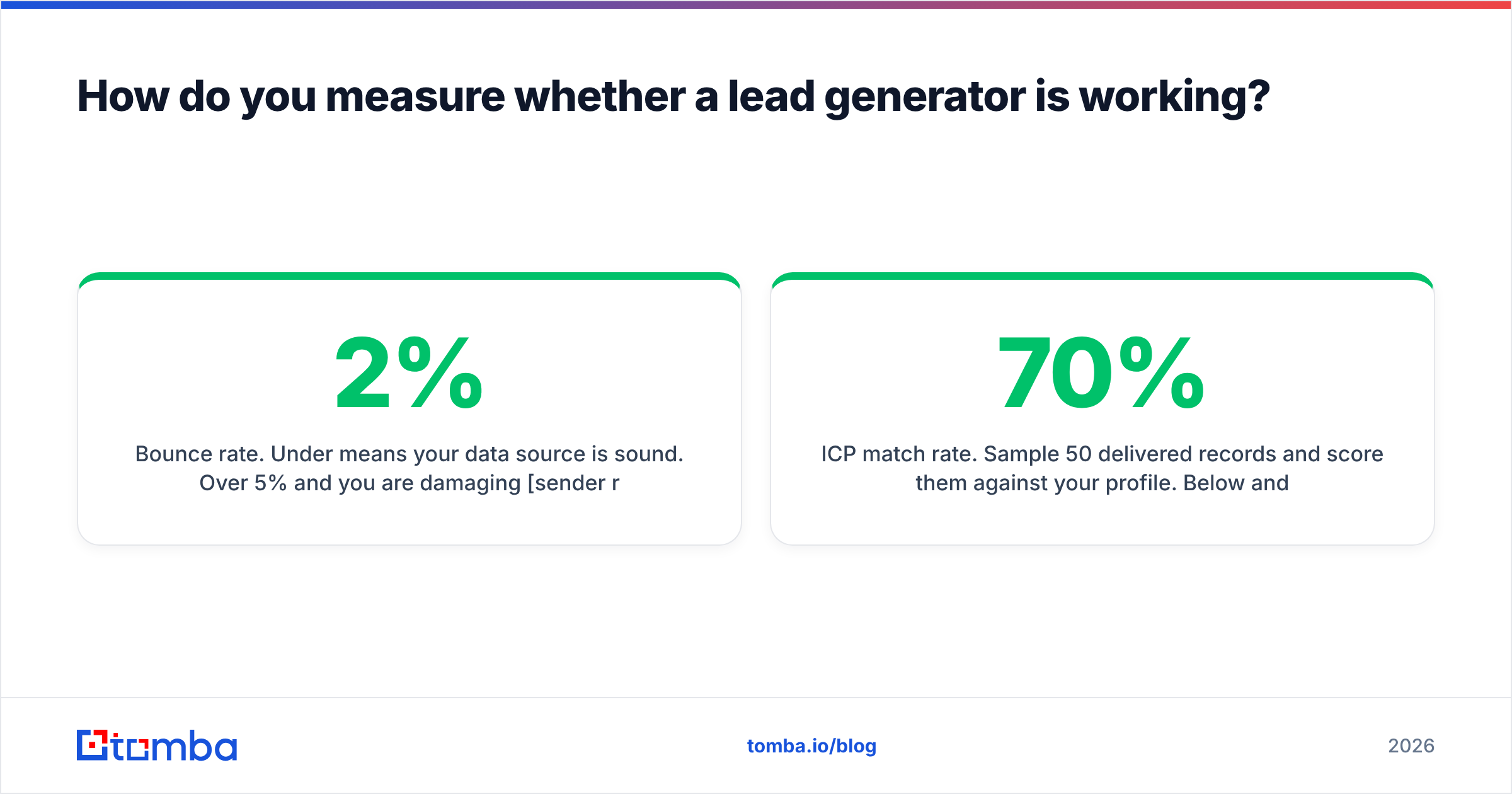
- Bounce rate. Under 2% means your data source is sound. Over 5% and you are hurting sender reputation faster than you build pipeline. This metric is about the lead generator, not the copy.
- ICP match rate. Sample 50 delivered records and score them against your profile. Below 70% and your targeting filters are wrong, regardless of how good the emails are.
- Cost per sales-accepted lead. Total spend divided by leads a rep actually agreed to work. This is the number that compares an agency to a tool to a headcount on equal footing.
- Time from record created to first touch. If it runs past two weeks, data decay and stale triggers have already eaten most of the value.
Track these monthly. Benchmarks from HubSpot's lead generation research and G2's lead intelligence listings are useful for a sanity check. Your own four numbers still beat any benchmark.
What is the simplest lead generator setup that works?#
If you are starting from zero this week, this sequence gets you from nothing to first conversations in about three days:
- Write the ICP in one sentence. Industry, size band, role, and the trigger that makes them buy. If it takes a paragraph, it is not an ICP yet.
- Build a 200-account target list manually. LinkedIn, industry directories, conference attendee lists. Manual is fine here, and it teaches you more than any filter.
- Find the people. Run a domain search per account to see who is listed in public. Then use an email finder for the people you named.
- Verify before sending. Push the full list through an email verifier and delete everything that is not confirmed valid. Accept a smaller list. This step protects your domain.
- Send 30 a day, each one written by hand. Volume comes later. The first 200 exist to test whether your message works at all.
- Measure the four metrics above. Only then decide whether to scale with software, headcount, or an agency.
That sequence costs well under $100. It answers the same question a $9,000 retainer would have answered in six weeks.
Ready to build the list?#
The lead generator definition matters less than the deliverability of what it produces. Do you have a target account list and need the real people behind those domains? Start with the Tomba Email Finder — 25 free searches a month, no card. Every address is checked against live mail servers rather than guessed from a pattern. Test it on 25 of your own target accounts before you decide anything else about your stack.
Related guides#
// get started
Find, verify and enrich your first contacts today
Start on the free plan with 25 searches a month, then scale when your team is ready.
Free plan · No credit card required · GDPR & CCPA
// about the author