Lead Handoff: How to Move Leads From Marketing to Sales
Most leads die in the gap between marketing and sales. Here's how to build a lead handoff process with clear SLAs, scoring thresholds, and data quality checks that actually holds.
TL;DR
- A lead handoff is the moment a lead stops belonging to marketing and starts belonging to sales. Most revenue leaks happen right here, not in the campaign or the pitch.
- Three things break handoffs: no agreed definition of "qualified," no response-time SLA, and incomplete contact data that forces reps to do research instead of selling.
- Response speed dominates everything else. Contact attempts inside the first hour convert dramatically better than attempts made the next day.
- Build the handoff as a contract: a scoring threshold both teams sign off on, a routing rule, a time-boxed SLA, and a rejection path back to marketing.
- Enrich before you route, not after. A lead record with a verified email, direct phone, and firmographics gets worked; a record with just a form email gets skipped.
What Is a Lead Handoff?#
A lead handoff is the transfer of ownership for a prospect from marketing to sales — typically the moment an MQL becomes an SQL and lands in a rep's queue.
Think of it like a relay race. The baton pass is the only part of the race where two runners touch the same object, and it's where most teams lose the race. Nobody loses a 4x100 because a runner ran slowly for 0.3 seconds. They lose because the baton hit the track.
The same logic applies to your funnel. Marketing spends months and a real budget generating demand. Sales spends careers learning to close. The handoff is a two-minute administrative event sitting between them, and it routinely wastes more pipeline than either team's actual performance.
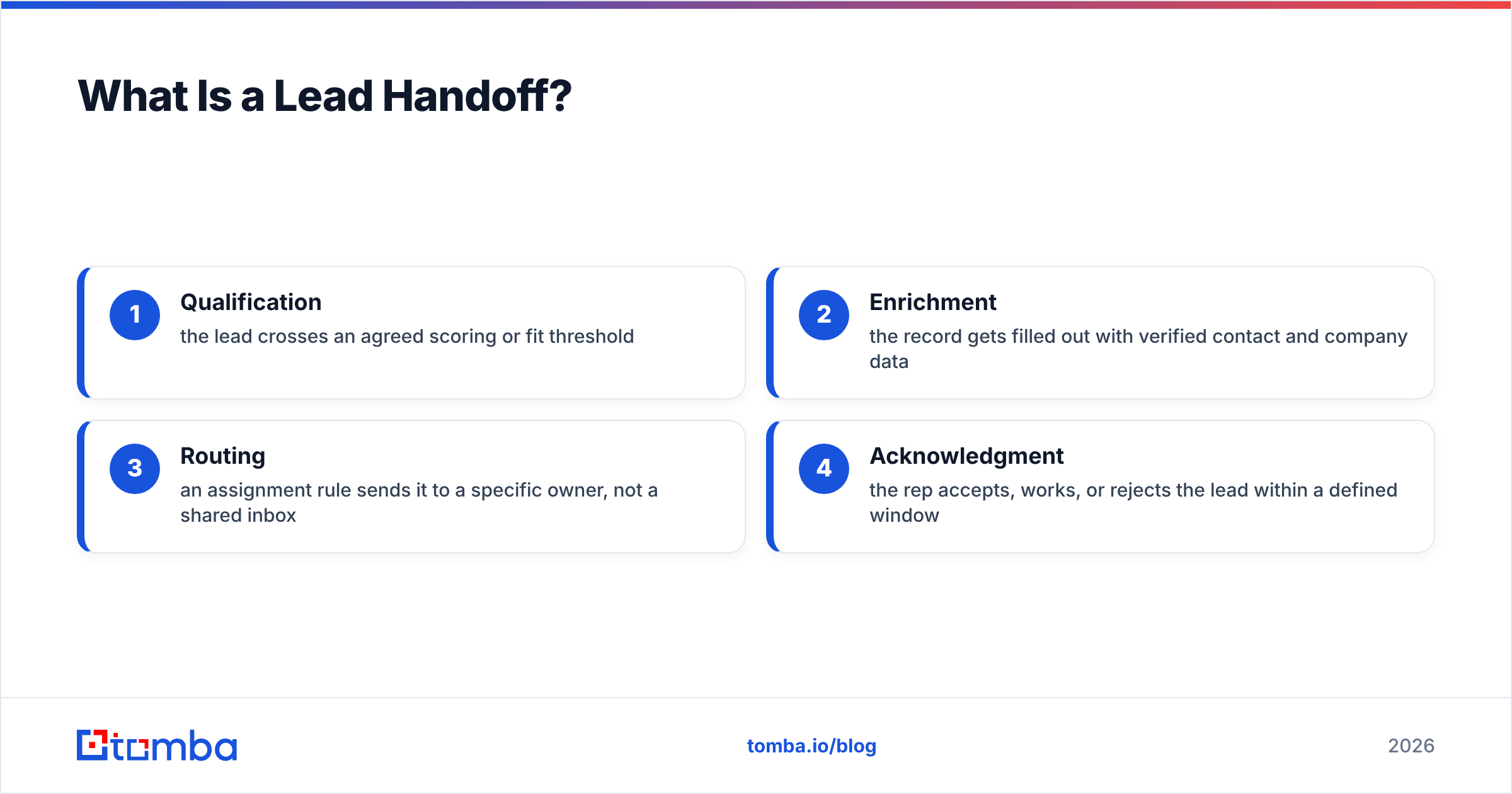
Technically, a handoff involves four things happening in sequence:
- Qualification — the lead crosses an agreed scoring or fit threshold
- Enrichment — the record gets filled out with verified contact and company data
- Routing — an assignment rule sends it to a specific owner, not a shared inbox
- Acknowledgment — the rep accepts, works, or rejects the lead within a defined window
Skip any one of those and the handoff becomes a hope. If you want the vocabulary straight, a marketing qualified lead is not the same as a sales-accepted lead, and conflating them is the root of most handoff arguments.

Why Do Most Lead Handoffs Fail?#
They fail because the two teams never wrote down what "ready" means, so each side quietly uses its own definition.
Here's the failure pattern in practice. Marketing counts a whitepaper download as an MQL because the person gave an email address. Sales works the first ten, finds that eight were students or competitors, and stops working the rest. Marketing sees MQL volume climb and reports success. Sales sees junk and reports that marketing sends junk. Both are correct given their own definitions, and the argument never resolves because it's a definitional dispute disguised as a performance dispute.
Four specific breakdowns cause the bulk of the damage:
- No shared threshold. If marketing and sales haven't co-signed the score or fit criteria that triggers a handoff, every lead is negotiable and every lead gets re-litigated.
- No response SLA. A lead sitting in a queue for 26 hours is functionally a lost lead. HubSpot's research on response time has consistently shown that contacting leads within the first hour dramatically outperforms later attempts — and yet most teams measure follow-up in days.
- Thin records. A record with a name and a Gmail address requires 6-10 minutes of manual research before a rep can send anything credible. Multiply that across 60 leads a week and you've deleted a full workday of selling.
- No rejection path. If sales can't formally push a lead back with a reason code, bad leads get silently ignored, and marketing never learns which source is producing garbage.
The fourth one is the sneakiest. A silent rejection destroys the feedback loop. Without reason codes, marketing keeps buying the same bad traffic.
What Does a Good Lead Handoff Process Look Like?#
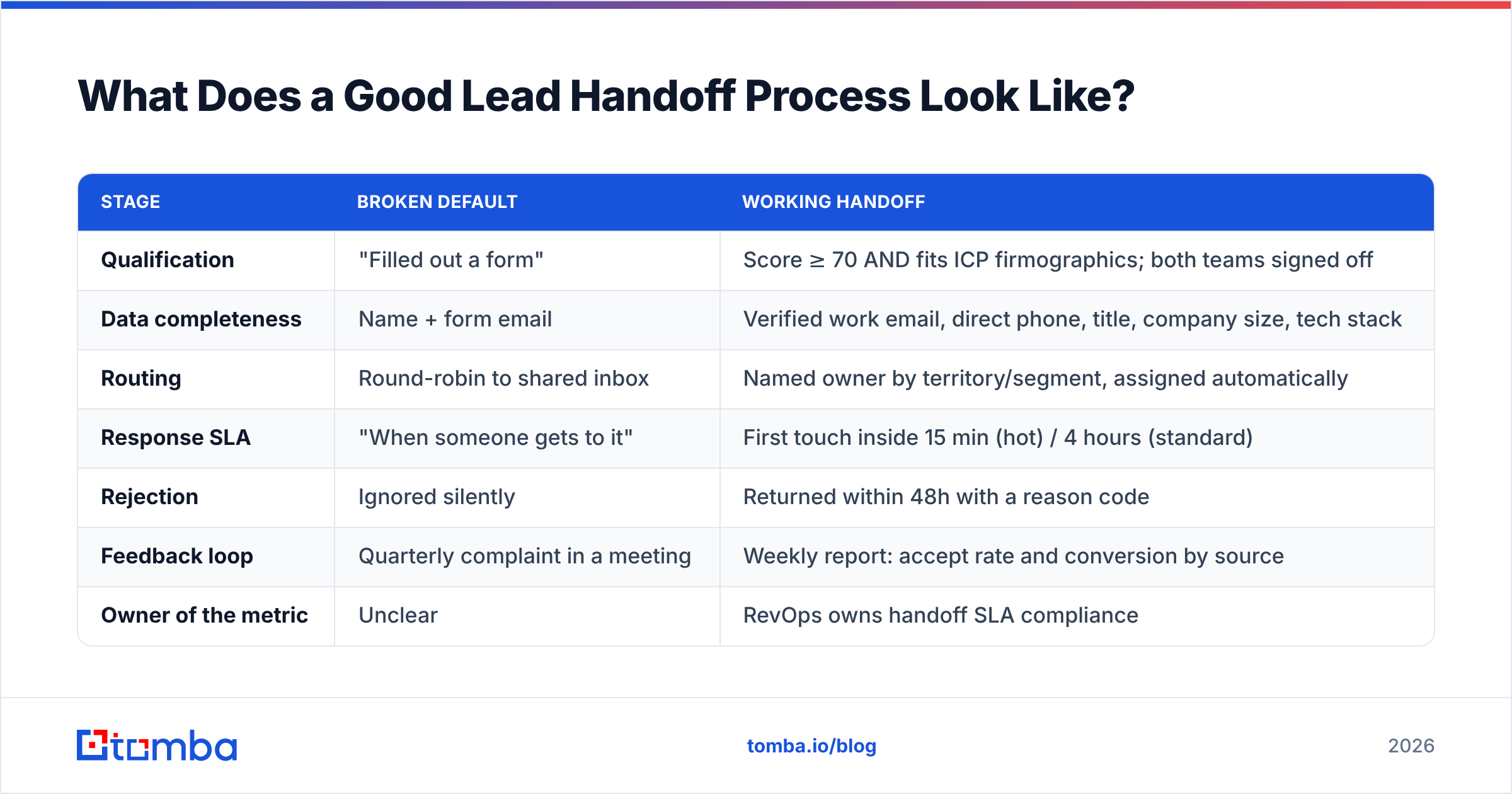
A good handoff is a written contract with four clauses: threshold, enrichment, routing, and SLA. Here's what a functioning version looks like against the broken default most teams run.
| Stage | Broken default | Working handoff |
|---|---|---|
| Qualification | "Filled out a form" | Score ≥ 70 AND fits ICP firmographics; both teams signed off |
| Data completeness | Name + form email | Verified work email, direct phone, title, company size, tech stack |
| Routing | Round-robin to shared inbox | Named owner by territory/segment, assigned automatically |
| Response SLA | "When someone gets to it" | First touch inside 15 min (hot) / 4 hours (standard) |
| Rejection | Ignored silently | Returned within 48h with a reason code |
| Feedback loop | Quarterly complaint in a meeting | Weekly report: accept rate and conversion by source |
| Owner of the metric | Unclear | RevOps owns handoff SLA compliance |
Notice what's not in the "working" column: more leads. Volume isn't the fix. A team that handles 40 well-enriched, quickly-routed leads will out-earn a team drowning in 400 raw form fills, every time. This is exactly the kind of process ownership that falls to revenue operations rather than to either team individually — because whoever owns the handoff has to be neutral between them.
The four clauses in detail#
- Threshold clause. Write the exact score or criteria set. Include negative scoring for disqualifiers (competitor domains, free email providers when you sell enterprise, job titles outside the buying committee). Review it monthly for the first quarter.
- Enrichment clause. Define the minimum viable record. A lead should not route until it has a verified email and, for high-value segments, a direct phone number. Automate this — don't make reps do it.
- Routing clause. Every lead gets a named human owner within 60 seconds of qualifying. Shared queues are where accountability goes to die.
- SLA clause. Tiered by lead heat. Demo requests: 15 minutes. Content downloads that hit threshold: 4 business hours. Publish compliance weekly by rep.
- Rejection clause. Fixed reason codes — wrong ICP, bad data, no budget authority, already a customer, duplicate. Route rejections back into the marketing report automatically.
How Do You Fix the Data Quality Problem in Handoffs?#
Enrich before routing, because a rep who has to research is a rep who isn't selling.
This is the most fixable part of the whole chain and the most commonly neglected. Consider what arrives from a typical form fill: first name, last name, a personal email, and a company name that may or may not be spelled correctly. Now consider what a rep needs to make a credible first touch: a deliverable work email, the person's actual title, company headcount, and ideally a phone number for the multichannel follow-up.
The gap between those two lists is either automated or paid for in rep hours.
A practical enrichment layer at the handoff point does three things:
- Resolves the work email. Take the name plus the company domain and return the verified professional address. Domain search handles the case where you know the company but not the individual; an email finder handles the case where you have a name and need the address.
- Validates before sending. Routing an invalid address into a sequence damages your sender reputation and gets your whole domain throttled. Run every handed-off address through an email verifier first. This matters more than most teams realize — a 12% bounce rate on a handoff batch can suppress inbox placement for the legitimate leads in the same batch.
- Adds the missing firmographics. Headcount, industry, and funding stage turn a name into a prioritization decision. Data enrichment at the routing step means the rep opens a record that already tells them whether this is a 15-minute call or a 5-minute email.

The economics are straightforward. If enrichment costs you a fraction of a cent per record and saves eight minutes of rep research, the payback is immediate at any rep salary above minimum wage. Most teams still don't do it, because the cost of rep research is invisible — it never shows up as a line item.
Which Tools Support the Lead Handoff Chain?#
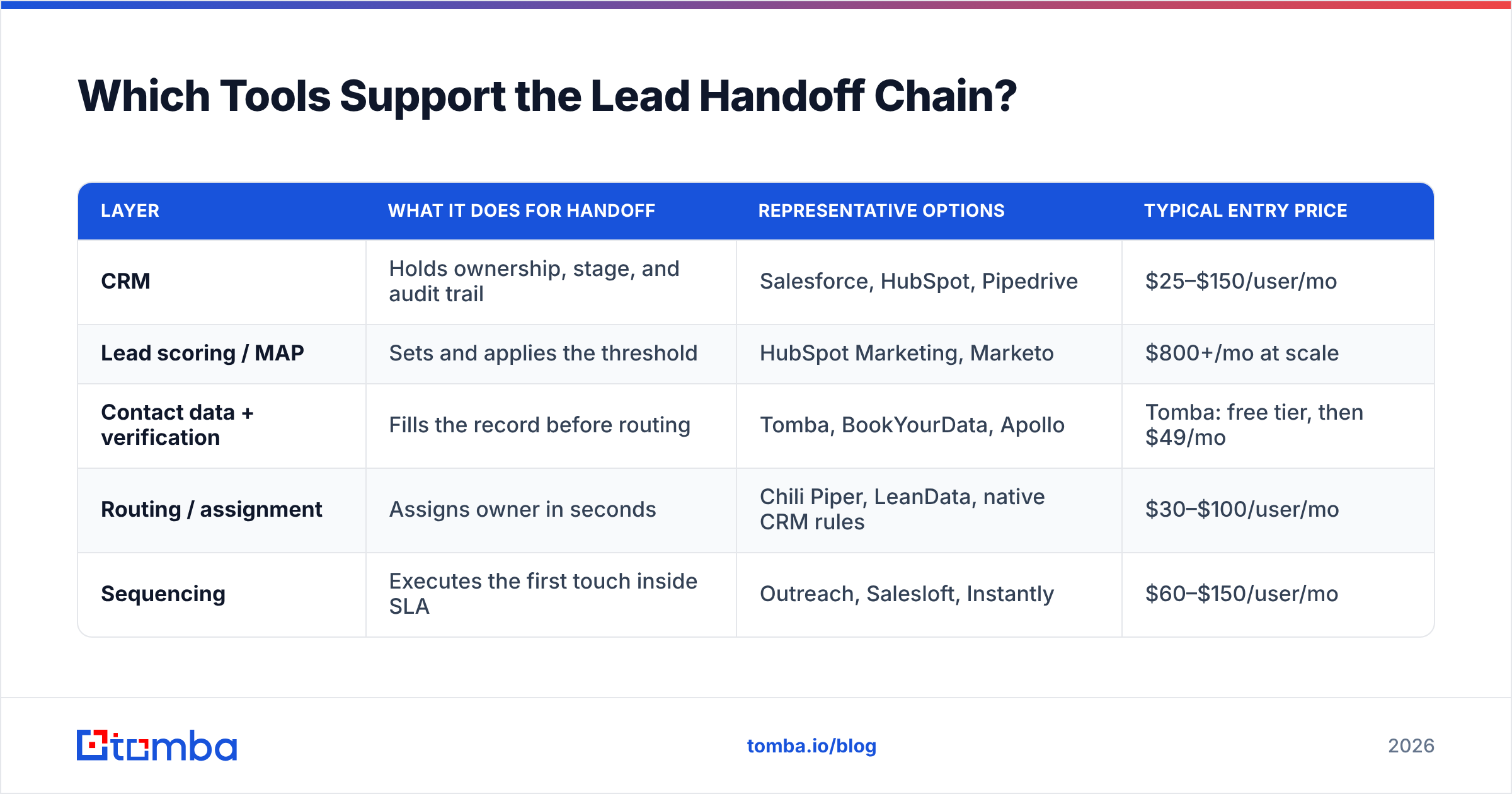
Different links in the chain need different tools, and stacking them wrong is expensive. Here's how the main categories compare on what they actually contribute to a handoff.
| Layer | What it does for handoff | Representative options | Typical entry price |
|---|---|---|---|
| CRM | Holds ownership, stage, and audit trail | Salesforce, HubSpot, Pipedrive | $25–$150/user/mo |
| Lead scoring / MAP | Sets and applies the threshold | HubSpot Marketing, Marketo | $800+/mo at scale |
| Contact data + verification | Fills the record before routing | Tomba, BookYourData, Apollo | Tomba: free tier, then $49/mo |
| Routing / assignment | Assigns owner in seconds | Chili Piper, LeanData, native CRM rules | $30–$100/user/mo |
| Sequencing | Executes the first touch inside SLA | Outreach, Salesloft, Instantly | $60–$150/user/mo |
A few honest notes on that table:
- You don't need all five to start. A small team can run a working handoff with a CRM, an enrichment API, and a native assignment rule. The routing and sequencing layers earn their cost around 8-10 reps.
- Contact data is the cheapest fix with the largest effect. Tomba's pricing starts with a free tier at 25 searches a month, then $49/mo on Starter, $99/mo on Growth, and $249/mo on Pro. BookYourData is a solid alternative if you prefer buying pre-built lists over resolving contacts on demand — the two approaches suit different motions, and plenty of teams run both.
- Scoring tools are only as good as the threshold you feed them. Buying a scoring platform before agreeing on a definition of qualified just automates the disagreement.
If you're building the enrichment step directly into your handoff automation rather than doing it by hand, the Tomba API lets you resolve and verify addresses at the moment a lead crosses threshold — so the record is complete before it ever hits a rep's queue. For teams working inside HubSpot or Salesforce, the integrations cover the same job without code.
How Fast Should Sales Respond After a Handoff?#
Faster than you think, and the curve is brutal. Response speed isn't one variable among many — it dominates.
The pattern is well-documented across Gartner's demand-generation research and vendor studies alike: the probability of connecting with a lead drops sharply within the first hour and continues falling through the first day. By the time a lead is 24 hours old, you're often contacting someone who has already spoken to a competitor.
Practical tiering that works:
- Inbound demo request or pricing page inquiry: 5-15 minutes. These people are in-market right now. If you can't staff this, use a scheduling link that books directly into a rep's calendar at the moment of intent.
- High-score content lead: within 4 business hours, first touch by email, second touch by phone the next morning.
- Mid-score nurture graduate: within 1 business day, enrolled in a sequence.
- Event or list-sourced lead: within 48 hours, but only after verification — these lists carry the highest invalid-address rates.
Measure this as a distribution, not an average. An average first-response time of "3 hours" usually hides a bimodal reality where half the leads get touched in 10 minutes and half get touched in six hours. The median and the 90th percentile tell you the truth.
And track the follow-up count, not just the first touch. A single email is not a worked lead. Most connected conversations come from the third attempt onward, which means your handoff SLA should specify a cadence, not just an initial response. Your response rate on the first email is a weak signal of lead quality; the rate across a full five-touch sequence is a much stronger one.
How Do You Measure Whether the Handoff Is Working?#
Track four numbers, weekly, in one place both teams can see.
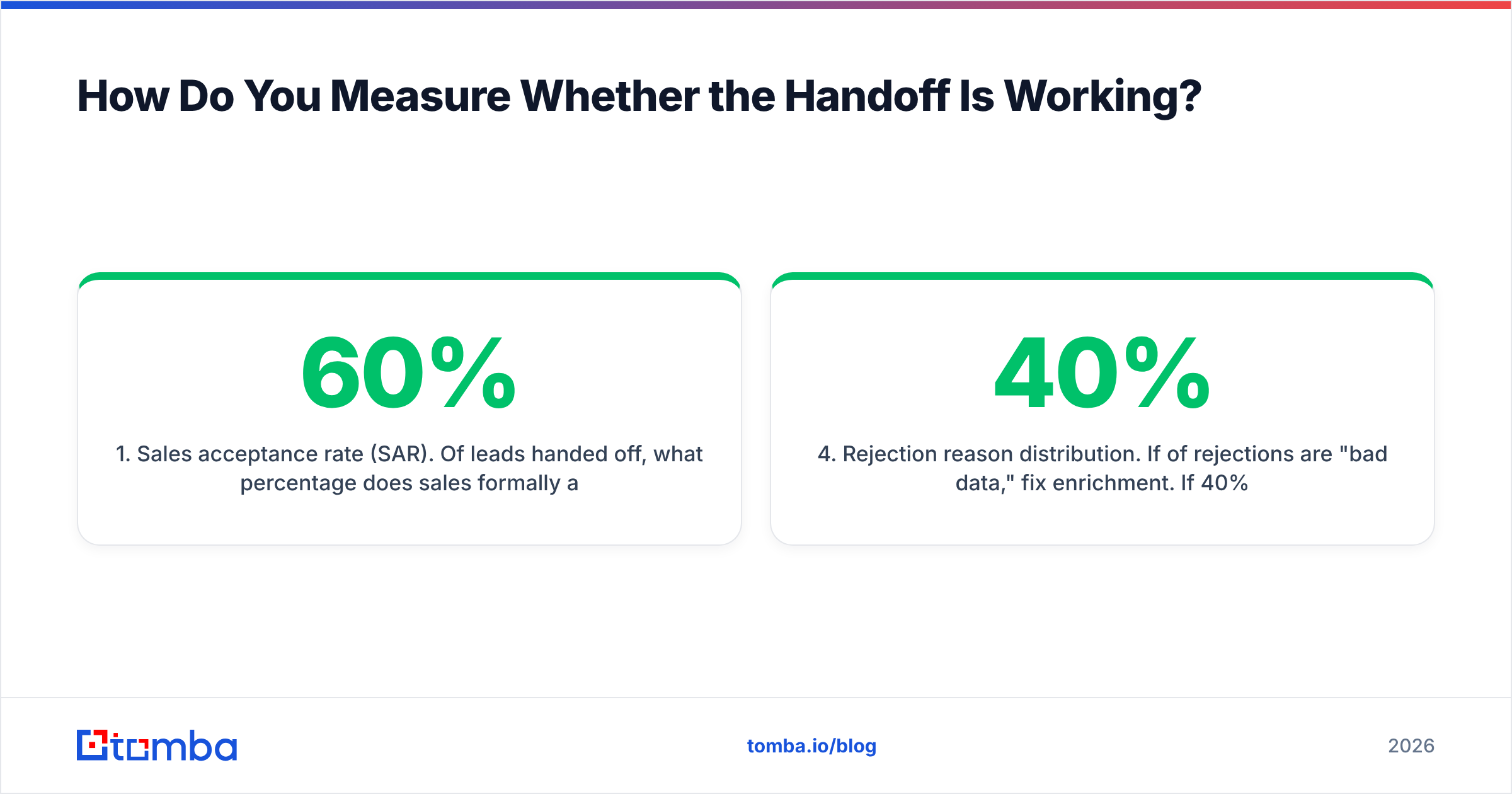
- Sales acceptance rate (SAR). Of leads handed off, what percentage does sales formally accept? Below 60% means your threshold is wrong. Above 95% means sales is accepting everything to avoid conflict, which is also a problem.
- Time to first touch (median and p90). Split by lead tier. This is your SLA compliance number.
- MQL-to-opportunity conversion by source. This is the number that tells marketing which channels deserve budget. Without the handoff feedback loop, this metric is unmeasurable.
- Rejection reason distribution. If 40% of rejections are "bad data," fix enrichment. If 40% are "wrong ICP," fix targeting. The distribution tells you which lever to pull.
Add a fifth if you can: data completeness rate at handoff — the percentage of routed leads that arrived with a verified email and a phone number. Teams that track this find it correlates with acceptance rate more tightly than almost anything else, because reps accept leads they can actually contact.
Review these in a 30-minute weekly meeting with one person from each team and a RevOps owner who can change the rules. Quarterly reviews are too slow — a broken threshold costs you a full quarter of pipeline before anyone notices.
What Should You Do First?#
If you're fixing a broken handoff from scratch, do it in this order. The sequence matters because each step makes the next one measurable.
- Week 1: Write the definition. Get marketing and sales in one room and define qualified in writing. No tooling, no automation, just a document both leads sign.
- Week 2: Instrument the SLA. Add first-touch timestamps and a rejection field with fixed reason codes to your CRM. You can't fix what you can't see.
- Week 3: Automate enrichment. Insert verification and contact resolution before the routing rule fires. This is usually the single highest-ROI week of the whole project.
- Week 4: Turn on routing and start the weekly review. Named owners, tiered SLAs, and a standing 30-minute meeting.
Most teams try to start at step 4 with a routing tool purchase. That's why most handoff projects fail — you can route garbage very efficiently and still close nothing.
Fix the Data Layer First#
The fastest measurable improvement to any lead handoff is making sure every routed record has a contact method that actually works. Reps accept leads they can reach and quietly abandon the ones they can't.
Tomba Email Finder resolves verified professional email addresses from a name and domain, so leads arrive at the rep's desk complete instead of half-built. Start on the free tier at 25 searches a month to test it against your current handoff batch — run last week's MQLs through it and compare the completeness rate. If the gap is as big as it is for most teams, the case for automating the enrichment step makes itself.
Related guides#
// get started
Find, verify and enrich your first contacts today
Start on the free plan with 25 searches a month, then scale when your team is ready.
Free plan · No credit card required · GDPR & CCPA
// about the author