Lead Leakage: Where Your Pipeline Loses Leads and How to Fix It
Most pipelines don't lose deals at the proposal stage. They lose leads long before a rep ever sees them. Here are the seven places lead leakage happens, how to measure each one, and how to fix it.
TL;DR
- Lead leakage is any qualified or potentially qualified lead that drops out of your funnel without a clear decision. It isn't won, it isn't lost, it just stops moving.
- Most leakage happens in seven places: slow response, bad contact data, routing gaps, messy MQL-to-SDR handoffs, follow-up that stops too early, closed-lost leads nobody recycles, and duplicate or orphaned CRM records.
- Leakage is easy to measure. Track the share of leads with no owner, no activity, or no disposition after a set number of days.
- Most fixes are process fixes, not new tools: SLAs, routing rules, required disposition fields, and verified contact data at the point of entry.
- Plugging leaks is almost always cheaper than buying more top-of-funnel volume.
What is lead leakage?#
Lead leakage is the gap between the leads your marketing and prospecting work produces and the leads your sales team actually works to a clear result. A leaked lead isn't a lost deal. A lost deal has a reason attached. A leaked lead has nothing attached. It sits in a queue, a spreadsheet, or a CRM view nobody opens until it goes cold.
Think of your funnel as plumbing. You can keep turning up the water pressure by buying more ads, more lists, and more events. But if the pipes have seven small holes, most of the extra water ends up on the floor. Teams that complain about "lead quality" often have a leakage problem instead. The leads were fine when they arrived. They just weren't handled.
Leakage is usually invisible because no single report shows it. Marketing sees a healthy marketing qualified lead count. Sales sees a healthy set of opportunities. The leads that fell between those two dashboards don't show up in either.
Why does lead leakage matter so much in 2026?#
Buyers now do most of their research before they raise a hand. When they do fill out a form, book a demo, or reply to a cold email, they're usually comparing you with two or three other vendors at the same moment. The window where you have their attention is short.
The research on this has been consistent for more than a decade. A widely cited Harvard Business Review study on online sales leads found that companies contacting a lead within an hour were close to seven times more likely to qualify it than companies that waited longer. The same study found that many firms took more than a day to respond, and some never responded at all. Buyer patience hasn't grown since then.
There's also a cost argument. Every leaked lead already cost you money: ad spend, content, SDR research time, data credits. Letting it leak means paying acquisition cost twice to replace it.

Where does lead leakage actually happen?#
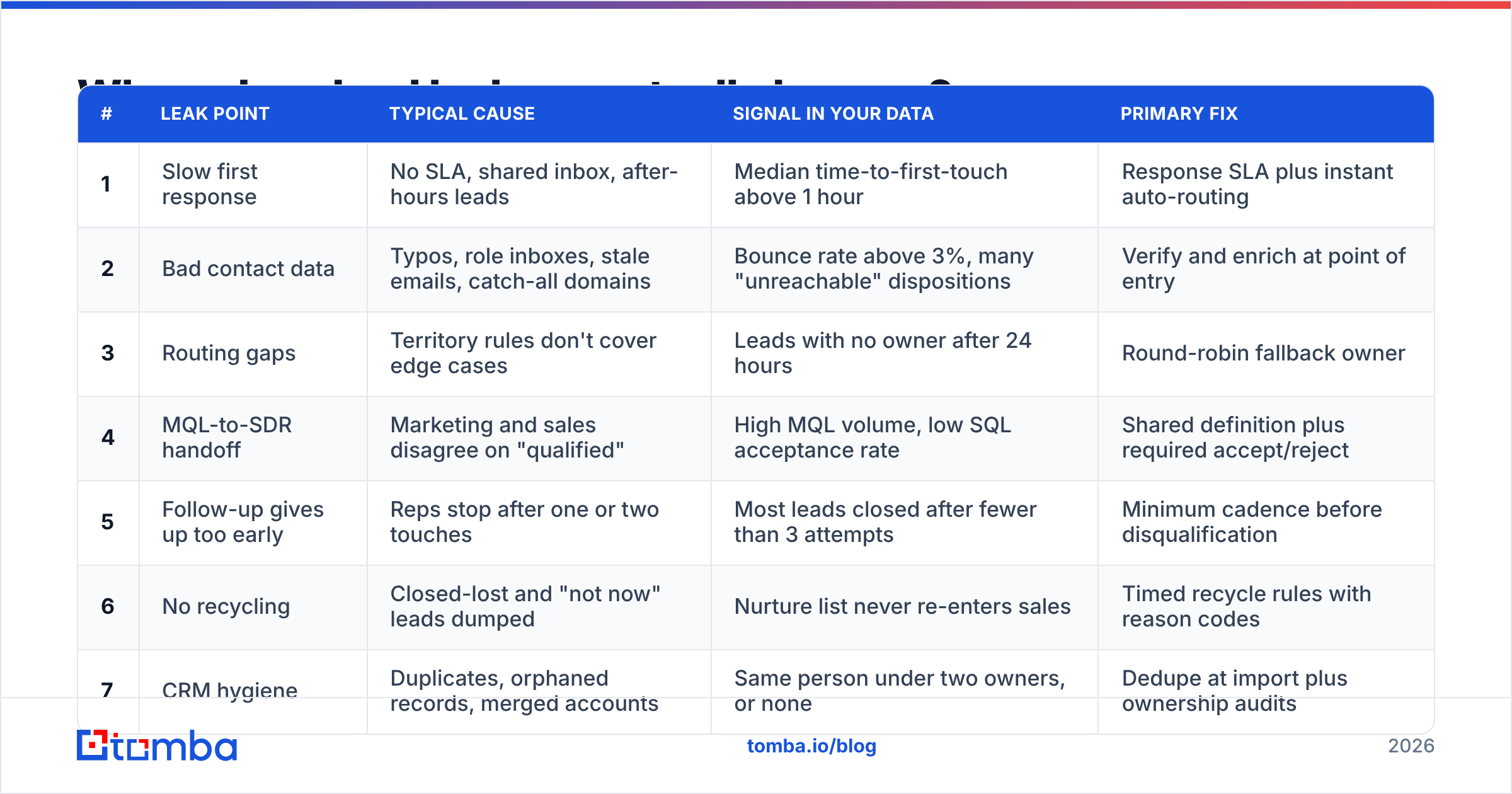
Nearly every leak we see falls into one of seven categories. The table below maps each one to its usual cause, the signal that shows up in your data, and the fix that usually works.
| # | Leak point | Typical cause | Signal in your data | Primary fix |
|---|---|---|---|---|
| 1 | Slow first response | No SLA, shared inbox, after-hours leads | Median time-to-first-touch above 1 hour | Response SLA plus instant auto-routing |
| 2 | Bad contact data | Typos, role inboxes, stale emails, catch-all domains | Bounce rate above 3%, many "unreachable" dispositions | Verify and enrich at point of entry |
| 3 | Routing gaps | Territory rules don't cover edge cases | Leads with no owner after 24 hours | Round-robin fallback owner |
| 4 | MQL-to-SDR handoff | Marketing and sales disagree on "qualified" | High MQL volume, low SQL acceptance rate | Shared definition plus required accept/reject |
| 5 | Follow-up gives up too early | Reps stop after one or two touches | Most leads closed after fewer than 3 attempts | Minimum cadence before disqualification |
| 6 | No recycling | Closed-lost and "not now" leads dumped | Nurture list never re-enters sales | Timed recycle rules with reason codes |
| 7 | CRM hygiene | Duplicates, orphaned records, merged accounts | Same person under two owners, or none | Dedupe at import plus ownership audits |
Let's go through each.
1. How does slow response cause lead leakage?#
This is the biggest and simplest leak. A demo request that arrives at 6:40 p.m. on a Friday and gets a reply on Monday afternoon has, for practical purposes, already leaked. The buyer booked with whoever answered first.
Fix it: set a written response SLA (for example, first touch within 15 minutes during business hours and by 9 a.m. the next business day otherwise) and measure against it every week. Pair it with automatic routing so no human has to triage the inbox before a rep is assigned. If you can't staff after-hours coverage, send an immediate, personal-sounding reply with a calendar link. That alone recovers a surprising share of weekend leads.
2. Why is bad contact data a leakage problem?#
Teams rarely call this leakage, but it's one of the biggest sources. A lead with a mistyped email, a dead mailbox from a job change, or a generic info@ address can't be worked no matter how fast your rep is. The rep sends three emails, all bounce or vanish, and the lead gets marked "unresponsive." The truth is that it was unreachable from the start.
Outbound makes this worse. If you prospect from purchased or scraped lists, a real share of contacts will have moved on since the data was collected. B2B contact data decays steadily as people change roles, companies rebrand domains, and mail servers change configuration.
Fix it: verify at the point of entry, not after the bounce. Run form fills and imported lists through an email verifier before they reach a rep's queue. For inbound leads with thin data (a free Gmail address, a first name only), use data enrichment to attach company, role, and a working business email so the lead can actually be routed and worked. Pay extra attention to catch-all domains, where the server accepts every address and a normal SMTP check can't confirm the mailbox exists.
On data vendors: the market is crowded, and several established providers do solid work here, including Tomba, BookYourData, and others with their own coverage strengths by region and industry. The vendor matters less than the discipline. Verify before you send, and re-verify anything older than about 90 days.
3. How do routing gaps leak leads?#
Routing rules are written for the common case. A US mid-market lead goes to the West team, an enterprise account goes to the named AE. Then a lead arrives from a country nobody owns, or from a company that isn't in the territory map, or with an employee count field left blank. The rule doesn't match, and the lead lands in an unassigned queue that nobody checks.
Fix it: every routing rule set needs a catch-all fallback owner, whether that's a person or a round-robin pool. Then build a CRM report of "leads with no owner older than 4 hours" and send it to a manager's inbox daily. If that report is ever non-empty, your rules have a hole. Most modern CRM platforms, including HubSpot and Salesforce, support fallback assignment natively. It's usually a configuration problem, not a tooling problem.
4. Why does the MQL-to-SDR handoff leak so badly?#
This is the political leak. Marketing passes leads it considers qualified. Sales looks at them, decides they aren't, and ignores them quietly instead of rejecting them. Nobody records a reason, so marketing never learns and keeps sending the same kind of lead.
Fix it: agree on a written definition of "sales-ready" that both teams sign off on, usually a mix of fit (industry, size, role) and intent (pricing page visit, demo request, reply to outreach). Then make disposition mandatory. A rep has to either accept a handed-off lead or reject it with a reason code within a set window. Rejected leads go back to marketing nurture with the reason attached. The rule that matters: no lead can sit in "handed off" status indefinitely.
5. How early is too early to stop following up?#
Many reps give up after one or two touches, especially on inbound leads they assume should be "warm." But buyers are busy, emails get buried, and a lack of response is often about timing, not interest.
Fix it: set a minimum cadence before a lead can be disqualified for non-response. A common baseline is five to eight touches over two to three weeks across at least two channels (email plus phone or LinkedIn). Put the cadence in your sequencing tool so it runs by default instead of depending on each rep's discipline. Track your response rate by touch number. Most teams find a meaningful share of replies come after the third touch.

6. What happens to leads that said "not now"?#
Closed-lost and "not a fit right now" leads are some of the most valuable records in your CRM. They already know who you are, and you already know their pain points. Yet most teams drop them into a generic newsletter and never look at them again. Meanwhile, SDRs are pushed to chase net-new logos because new pipeline is what gets celebrated.
Fix it: require a reason code on every closed-lost or disqualified lead, and attach a recycle date to the codes that are about timing: "budget next quarter," "renewal with competitor in 8 months," "champion left." When the date arrives, the lead goes back to an owner automatically with its context. Re-verify the contact at that point, because the person may have changed jobs. If they did, that's two leads: the new contact at the old account, and your former champion at their new company.
7. How do duplicates and CRM hygiene cause leakage?#
Duplicates cause leakage in two directions. Sometimes the same person exists as two records with two owners, both reps assume the other is handling it, and nobody does. Other times a lead gets merged into an old record owned by a rep who left the company a year ago, and it disappears into their abandoned queue.
Fix it: dedupe at import, not quarterly. Match on email, then on name plus company domain. Reassign all records owned by deactivated users as part of offboarding. Run a monthly audit of records with no activity in 60 days and no disposition. Those records are your leakage, sitting in plain sight.
How do you measure lead leakage?#
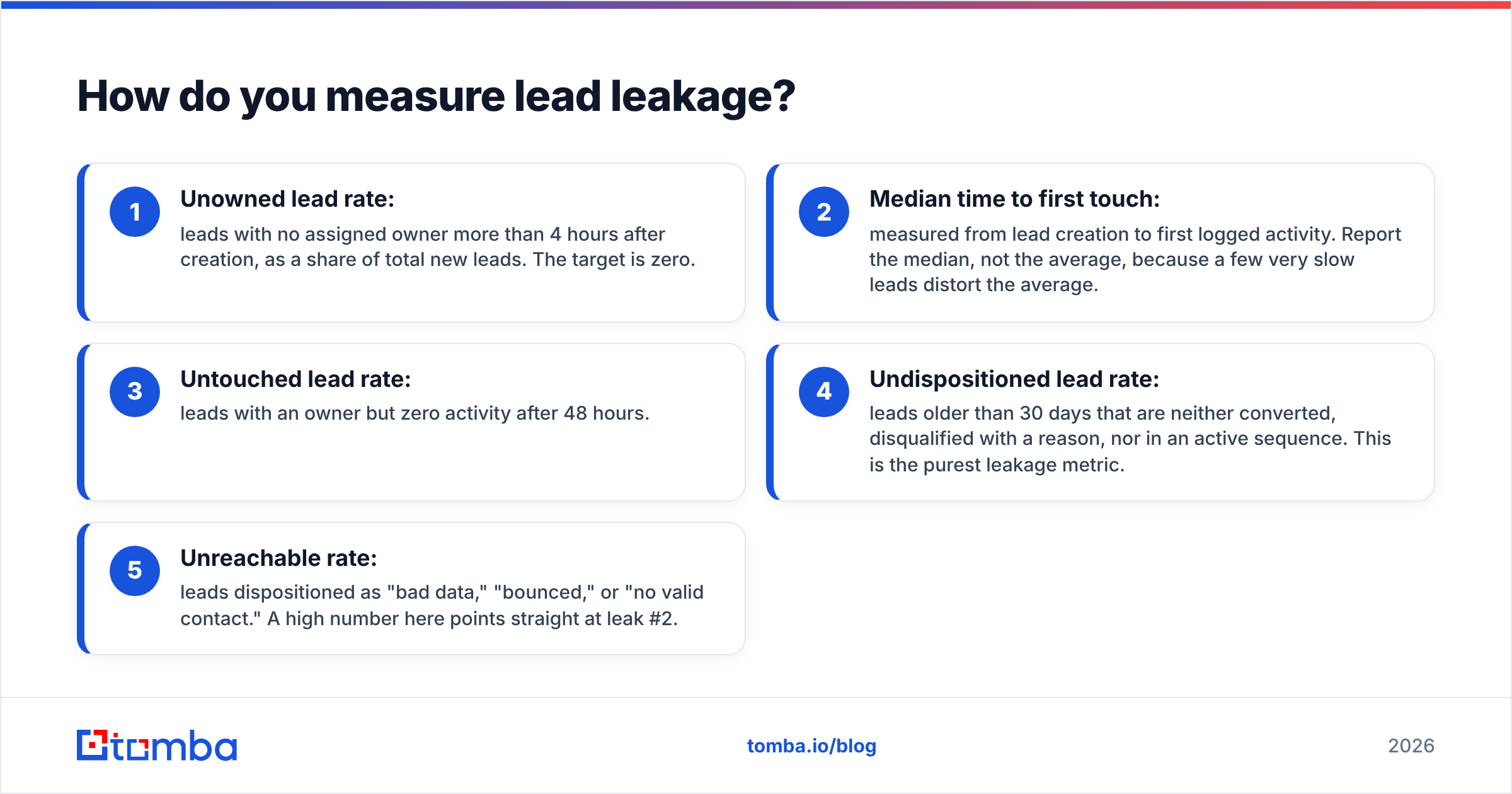
You can't fix what you don't measure, and leakage hides because nobody owns the metric. Start with these five numbers, reviewed weekly by whoever owns revenue operations (or your sales manager, if you don't have RevOps yet):
- Unowned lead rate: leads with no assigned owner more than 4 hours after creation, as a share of total new leads. The target is zero.
- Median time to first touch: measured from lead creation to first logged activity. Report the median, not the average, because a few very slow leads distort the average.
- Untouched lead rate: leads with an owner but zero activity after 48 hours.
- Undispositioned lead rate: leads older than 30 days that are neither converted, disqualified with a reason, nor in an active sequence. This is the purest leakage metric.
- Unreachable rate: leads dispositioned as "bad data," "bounced," or "no valid contact." A high number here points straight at leak #2.
Add these five up and you have a rough leakage number. Most teams that measure it for the first time find it's bigger than they expected.
Is lead leakage a people problem or a tooling problem?#
Mostly people and process, with tooling as the enforcement layer. Buying a new sales engagement platform won't fix a handoff that marketing and sales never agreed on. Adding more intent data won't help if the leads it produces sit unassigned.
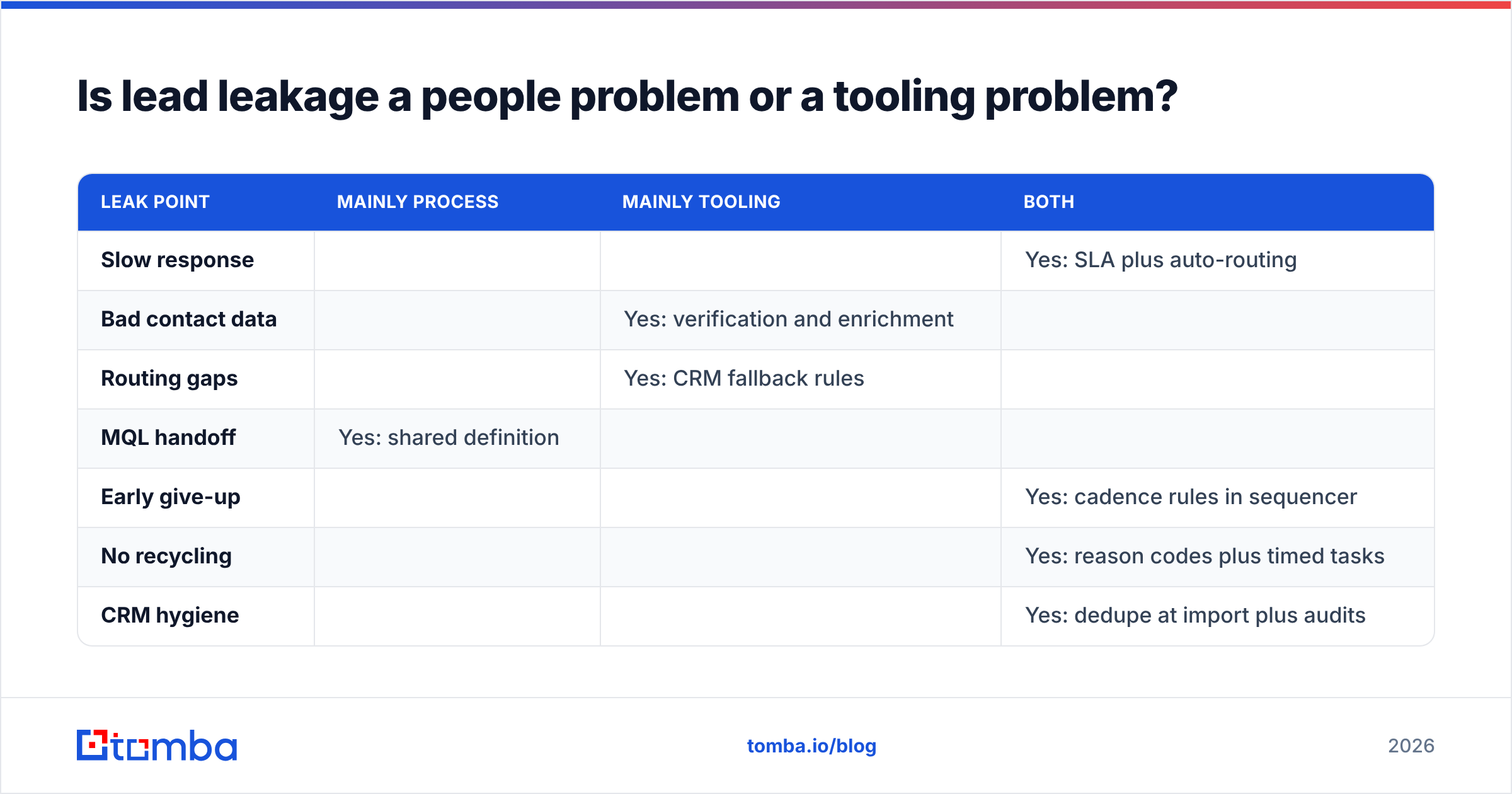
That said, tooling does fix some leaks outright. Here's a practical split:
| Leak point | Mainly process | Mainly tooling | Both |
|---|---|---|---|
| Slow response | Yes: SLA plus auto-routing | ||
| Bad contact data | Yes: verification and enrichment | ||
| Routing gaps | Yes: CRM fallback rules | ||
| MQL handoff | Yes: shared definition | ||
| Early give-up | Yes: cadence rules in sequencer | ||
| No recycling | Yes: reason codes plus timed tasks | ||
| CRM hygiene | Yes: dedupe at import plus audits |
The pattern is that tools enforce decisions you've already made. Make the decision first, whether that's the SLA, the definition, or the minimum cadence, and then configure the tool to hold everyone to it.
What's a realistic 30-day plan to reduce lead leakage?#
You don't need a six-month transformation project. Here's a sequence that fits in a month:
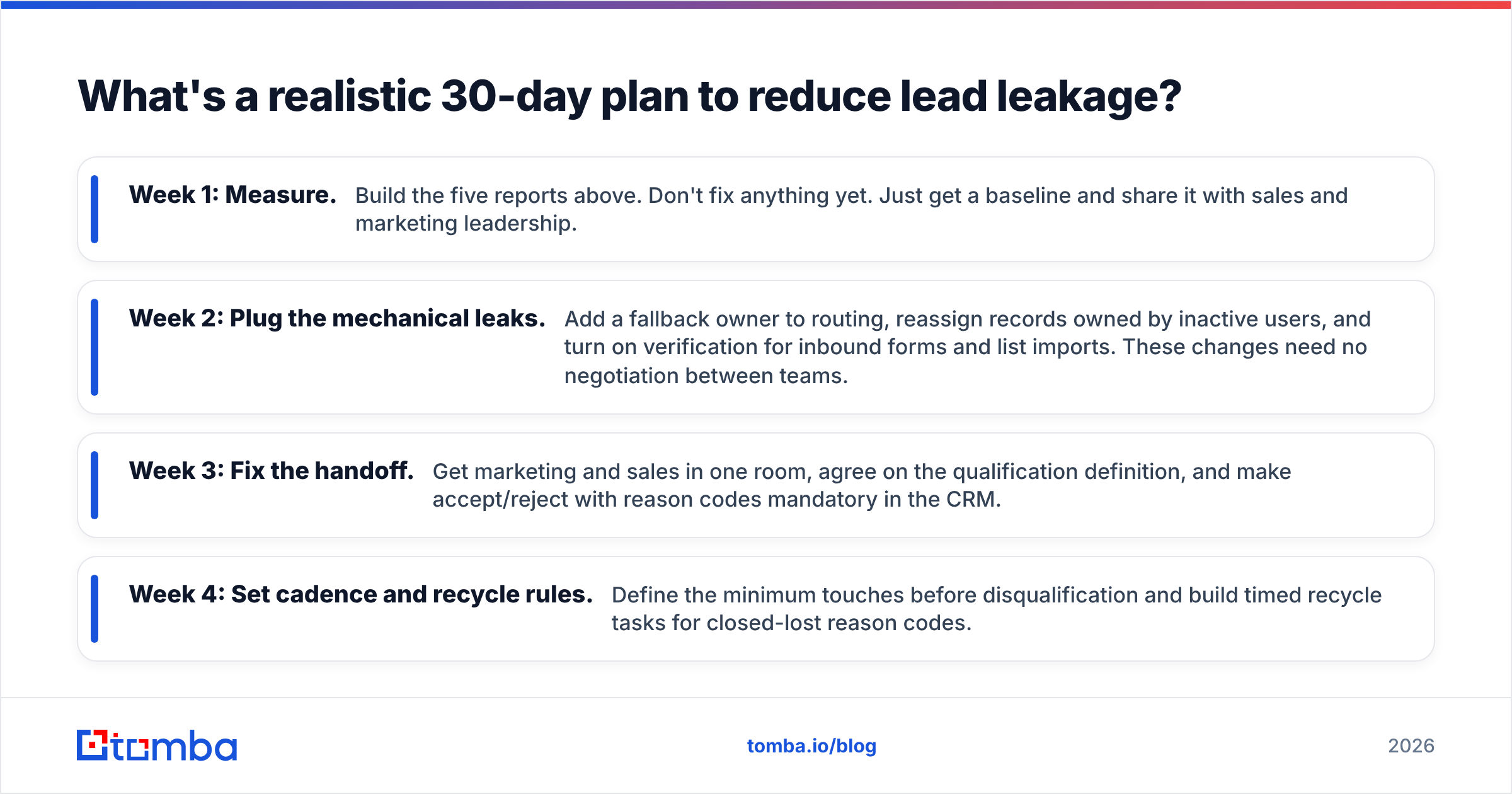
- Week 1: Measure. Build the five reports above. Don't fix anything yet. Just get a baseline and share it with sales and marketing leadership.
- Week 2: Plug the mechanical leaks. Add a fallback owner to routing, reassign records owned by inactive users, and turn on verification for inbound forms and list imports. These changes need no negotiation between teams.
- Week 3: Fix the handoff. Get marketing and sales in one room, agree on the qualification definition, and make accept/reject with reason codes mandatory in the CRM.
- Week 4: Set cadence and recycle rules. Define the minimum touches before disqualification and build timed recycle tasks for closed-lost reason codes.
Then re-run the baseline reports. The before-and-after comparison is usually the easiest budget argument a sales leader gets all year, because recovered pipeline costs a fraction of new pipeline.
Which leak should you fix first?#
Fix the one with the biggest volume and the least politics. For most teams that's either response time or contact data quality, because neither needs anyone to agree on anything. They just need configuration and a weekly report.
If your unreachable rate is high, start with data. A fast response to an email address that bounces is still a leaked lead. Tomba Email Finder helps you plug that leak at the source. It finds verified professional emails by name, company, or domain, so the leads reaching your reps can actually be reached. You can start on the free plan with 25 searches a month and test it against your own leaked leads before you commit to a paid plan.
Related guides#
// get started
Find, verify and enrich your first contacts today
Start on the free plan with 25 searches a month, then scale when your team is ready.
Free plan · No credit card required · GDPR & CCPA
Get the Tomba newsletter
Product and data updates
// about the author