Lead Liaison Pricing, Reviews, Pros and Cons: 2026 Verdict
Lead Liaison doesn't publish a price list, so the real cost depends on contacts, modules and add-ons. Here's what drives the quote, what reviewers praise and complain about, and when a leaner stack costs less.
TL;DR
- Lead Liaison uses quote-based pricing. You won't find a public price list, so your cost depends on contact volume, which modules you buy (marketing automation, direct mail, event capture, enrichment), and how much onboarding you need.
- Reviewers regularly praise the support team and the breadth of features. The most common complaints are a dated interface, a learning curve, and a quote process that's hard to budget around.
- It suits mid-market B2B teams that run trade shows, send direct mail, and need Salesforce-grade lead routing in one platform.
- If you mainly need to find and verify contacts before outreach, an all-in-one automation suite is overkill. A dedicated data tool starting at $49/mo covers that for a fraction of the cost.
- Before you sign, ask for the contact-tier ceiling, the add-on price list, and the renewal uplift in writing.
What is Lead Liaison?#
Lead Liaison is a B2B revenue-generation platform that combines marketing automation, lead management, and a few features you rarely see together in one suite. Those include direct mail automation, trade show and event lead capture, and website visitor tracking. The company markets it as an alternative to buying separate tools for email nurturing, lead scoring, event capture, and physical mail sends.
The core pieces, based on the product pages at leadliaison.com:
- Marketing automation: email campaigns, nurture flows, landing pages, forms, and dynamic content.
- Lead management and scoring: grading, scoring, routing, and lifecycle stages, with tight CRM sync (Salesforce is the headline integration).
- Direct mail automation: triggered postcards, letters, and gifts fired from the same workflows as your emails.
- Event and trade show capture: a mobile app for scanning badges and business cards, plus qualifier forms that push leads straight into nurture.
- Visitor tracking and prospect data: identifying which companies visit your site and enriching records with firmographic data.
That breadth is the main selling point, and it's also why the pricing is complicated. You aren't buying a single product. You're buying a configuration.
How much does Lead Liaison cost in 2026?#
Short answer: you have to ask. Lead Liaison doesn't publish fixed prices for its main platform, and third-party listings on sites like Capterra and G2 generally show "contact vendor" or pricing that's out of date. Any blog that gives you one exact monthly figure is guessing or quoting an old sheet.
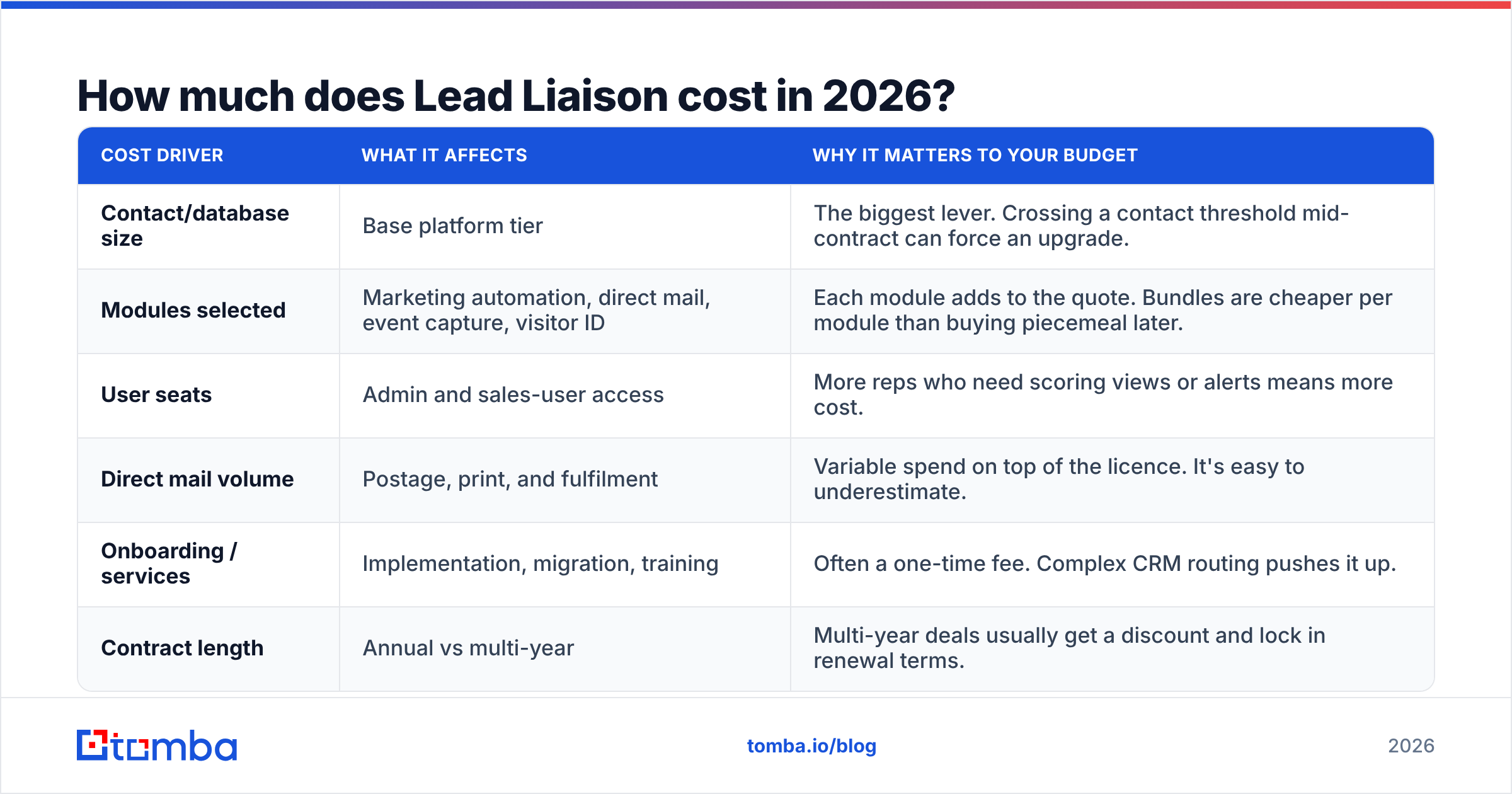
What you can do is understand what moves the quote. From the product structure and what buyers report in reviews, these are the levers:
| Cost driver | What it affects | Why it matters to your budget |
|---|---|---|
| Contact/database size | Base platform tier | The biggest lever. Crossing a contact threshold mid-contract can force an upgrade. |
| Modules selected | Marketing automation, direct mail, event capture, visitor ID | Each module adds to the quote. Bundles are cheaper per module than buying piecemeal later. |
| User seats | Admin and sales-user access | More reps who need scoring views or alerts means more cost. |
| Direct mail volume | Postage, print, and fulfilment | Variable spend on top of the licence. It's easy to underestimate. |
| Onboarding / services | Implementation, migration, training | Often a one-time fee. Complex CRM routing pushes it up. |
| Contract length | Annual vs multi-year | Multi-year deals usually get a discount and lock in renewal terms. |
A practical way to think about it: Lead Liaison competes in the mid-market marketing automation bracket. Its list prices tend to sit between entry-level email tools (tens of dollars a month) and enterprise suites like Salesforce's Marketing Cloud Account Engagement (formerly Pardot), which start in four figures per month. If your quote comes back well above what a comparable HubSpot Marketing Hub Professional setup costs for the same contact count, you have room to negotiate.
What are the hidden costs in Lead Liaison pricing?#
"Hidden" is a strong word. None of these are secret, but they rarely appear in the first number a rep gives you:
- Direct mail isn't in the licence. Postage, printing, and gift fulfilment are billed on top. A campaign of 2,000 postcards has a real per-piece cost whatever you pay for the software.
- Contact overages. Marketing automation tools usually count every contact in the database, not just the ones you actively mail. If you import a big list from an event or a data vendor, your tier can jump.
- Implementation time. The platform is deep. Lead scoring models, routing rules, and Salesforce field mapping take real hours, whether you pay Lead Liaison's services team or spend your own RevOps time.
- Data you still need to buy. Visitor identification tells you which company visited. It doesn't reliably hand you a verified email for the right decision-maker. Most teams still need a separate contact-data source.
- Renewal uplift. Ask what the renewal price will be. Year-two increases are standard in this category and worth capping in the contract.
What do Lead Liaison reviews say?#
Across the major review sites, a consistent picture shows up. Ratings are generally positive. The praise clusters around people and breadth, and the criticism clusters around usability and transparency.
What reviewers tend to like:
- Customer support. This is the most repeated positive. Reviewers describe responsive, hands-on help, which matters on a platform this configurable.
- All-in-one breadth. Teams that run events and direct mail like not stitching three vendors together.
- Salesforce integration. The CRM sync and lead routing get good marks from ops teams.
- Trade show capture. The event app is often singled out as a real differentiator.
What reviewers tend to criticise:
- Interface feels dated. Next to newer tools, some screens look old and take more clicks.
- Learning curve. Power users are happy, but casual users need training.
- Reporting depth. Some reviewers want more flexible, custom dashboards.
- Pricing opacity. Buyers who want to compare options quickly are frustrated by quote-only pricing.
Read the most recent reviews yourself on G2 before deciding. Filter by company size close to yours, because a 20-person team and a 2,000-person team rate the same tool very differently.
What are the pros and cons of Lead Liaison?#
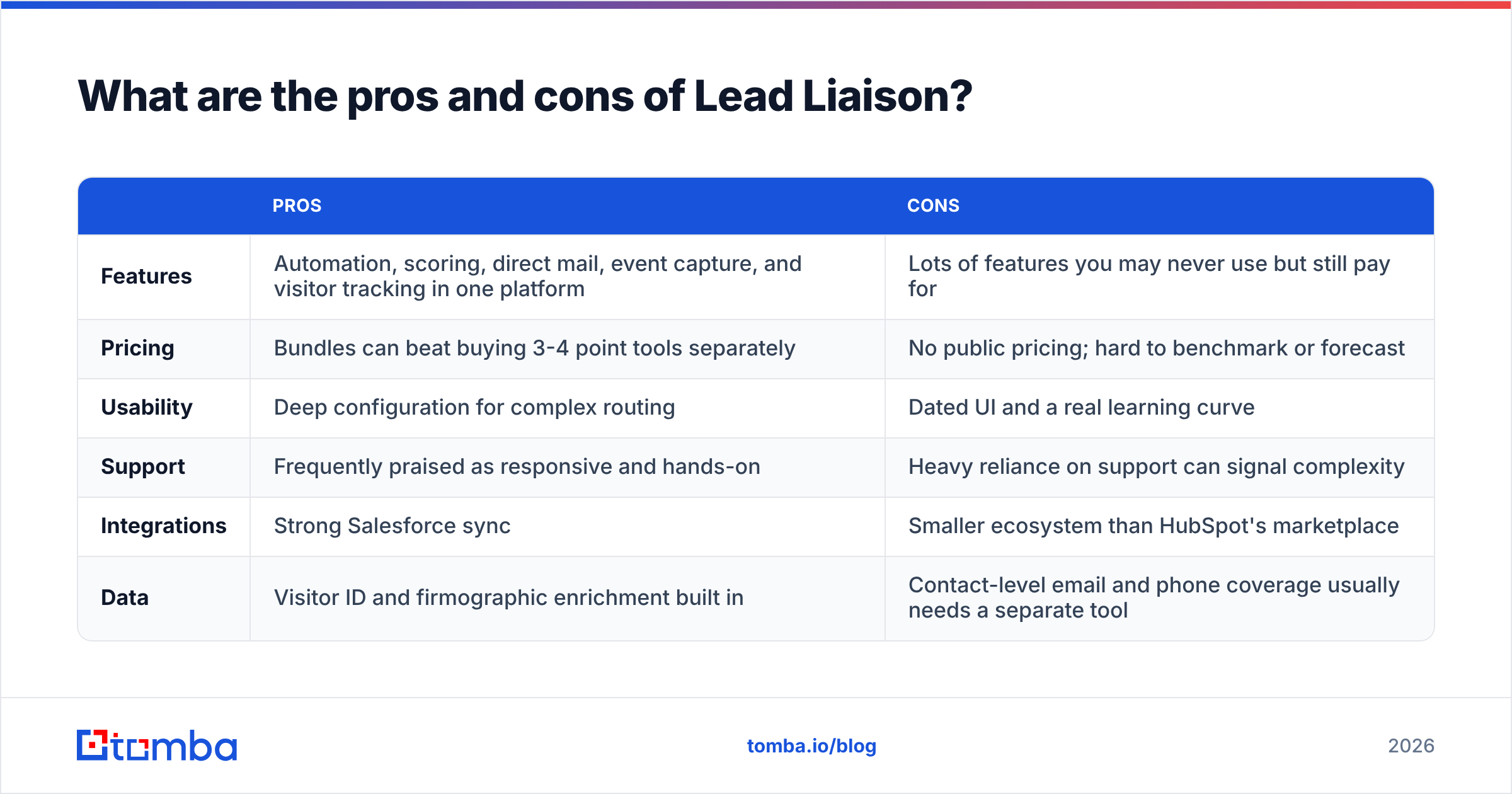
| Pros | Cons | |
|---|---|---|
| Features | Automation, scoring, direct mail, event capture, and visitor tracking in one platform | Lots of features you may never use but still pay for |
| Pricing | Bundles can beat buying 3-4 point tools separately | No public pricing; hard to benchmark or forecast |
| Usability | Deep configuration for complex routing | Dated UI and a real learning curve |
| Support | Frequently praised as responsive and hands-on | Heavy reliance on support can signal complexity |
| Integrations | Strong Salesforce sync | Smaller ecosystem than HubSpot's marketplace |
| Data | Visitor ID and firmographic enrichment built in | Contact-level email and phone coverage usually needs a separate tool |
How does Lead Liaison compare to alternatives?#
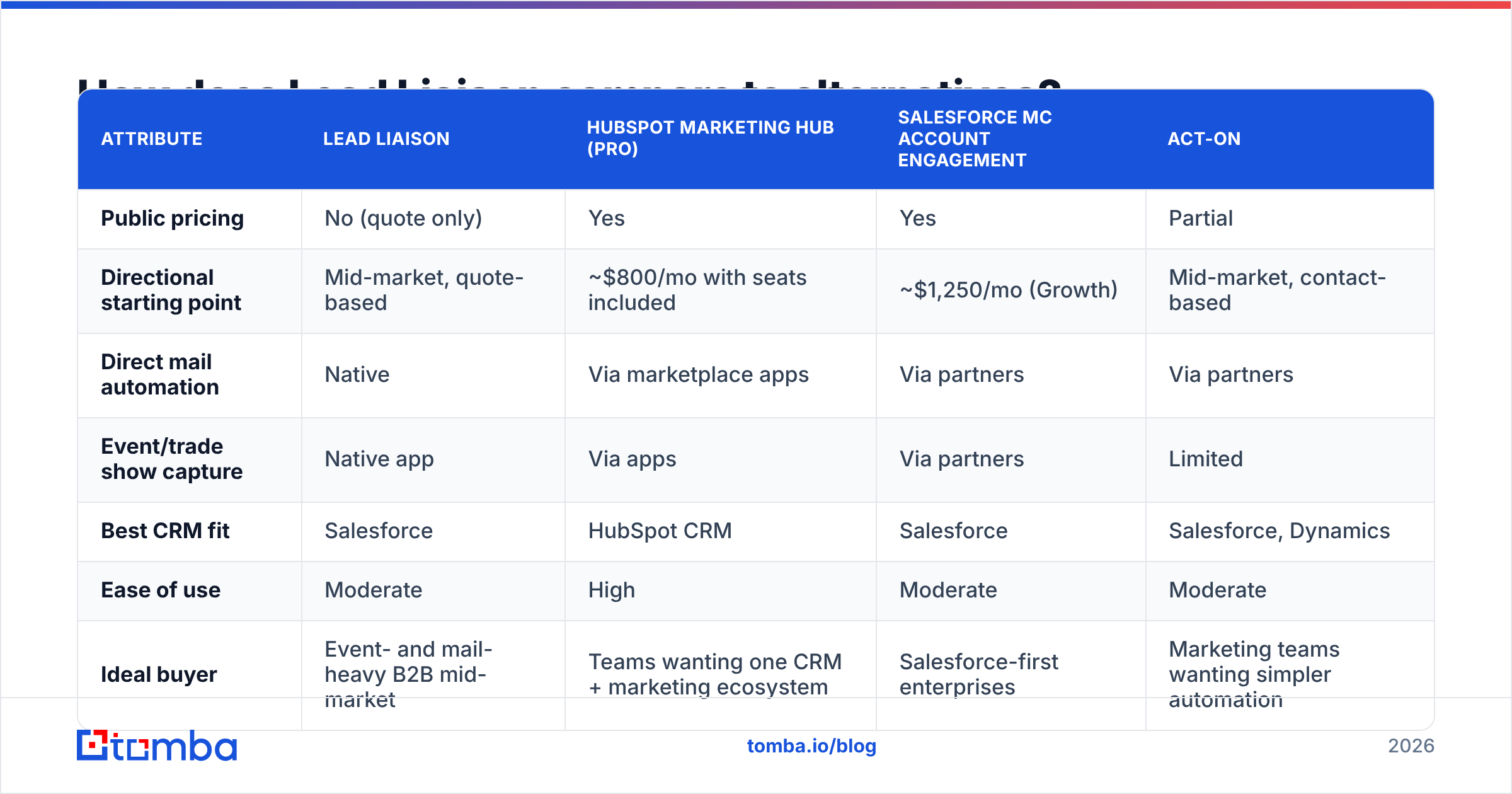
Lead Liaison's main rivals are other mid-market automation suites. List prices change often and depend on contacts and seats, so treat the figures below as directional and check each vendor's pricing page.
| Attribute | Lead Liaison | HubSpot Marketing Hub (Pro) | Salesforce MC Account Engagement | Act-On |
|---|---|---|---|---|
| Public pricing | No (quote only) | Yes | Yes | Partial |
| Directional starting point | Mid-market, quote-based | ~$800/mo with seats included | ~$1,250/mo (Growth) | Mid-market, contact-based |
| Direct mail automation | Native | Via marketplace apps | Via partners | Via partners |
| Event/trade show capture | Native app | Via apps | Via partners | Limited |
| Best CRM fit | Salesforce | HubSpot CRM | Salesforce | Salesforce, Dynamics |
| Ease of use | Moderate | High | Moderate | Moderate |
| Ideal buyer | Event- and mail-heavy B2B mid-market | Teams wanting one CRM + marketing ecosystem | Salesforce-first enterprises | Marketing teams wanting simpler automation |
How to read this: If you don't run trade shows or direct mail, Lead Liaison's biggest differentiators don't apply to you, and HubSpot's ecosystem or a lighter tool is probably the better deal. If you do both, Lead Liaison can replace two or three vendors, and that's where its pricing starts to make sense.
Is Lead Liaison worth the price?#
It depends on how many of its modules you'll actually use. Here's a quick way to decide:
- Count the tools it replaces. Add up what you currently pay for email automation, event capture, direct mail, and visitor tracking. If Lead Liaison's quote is lower and you use at least three of those, it's likely worth it.
- Check your contact growth. If your database will double in 12 months, get the next-tier price in writing now.
- Budget admin time. Plan for someone to own the platform. Without an owner, sales automation suites turn into expensive email senders.
- Separate "automation" from "data." Automation moves leads through a funnel. It doesn't fill the funnel with accurate contacts. That's a different job and a different budget line.
The fourth point is where many teams overspend. They buy a big suite hoping it'll fix pipeline, then find the real bottleneck is that they don't have verified emails for the people they want to reach.

When is a leaner stack cheaper than Lead Liaison?#
If your team is mostly doing outbound, meaning finding decision-makers, verifying their addresses, and loading them into a sequencer, you don't need mid-market automation pricing. A typical lean outbound stack looks like this:
- Contact data: an email finder to get addresses by name and domain, plus data enrichment to add job title, company size, and socials to records you already have.
- Verification: an email verifier run before every send to protect your domain.
- Sending: a cold email sequencer, which is priced per inbox, not per contact.
- CRM: whatever you already use.
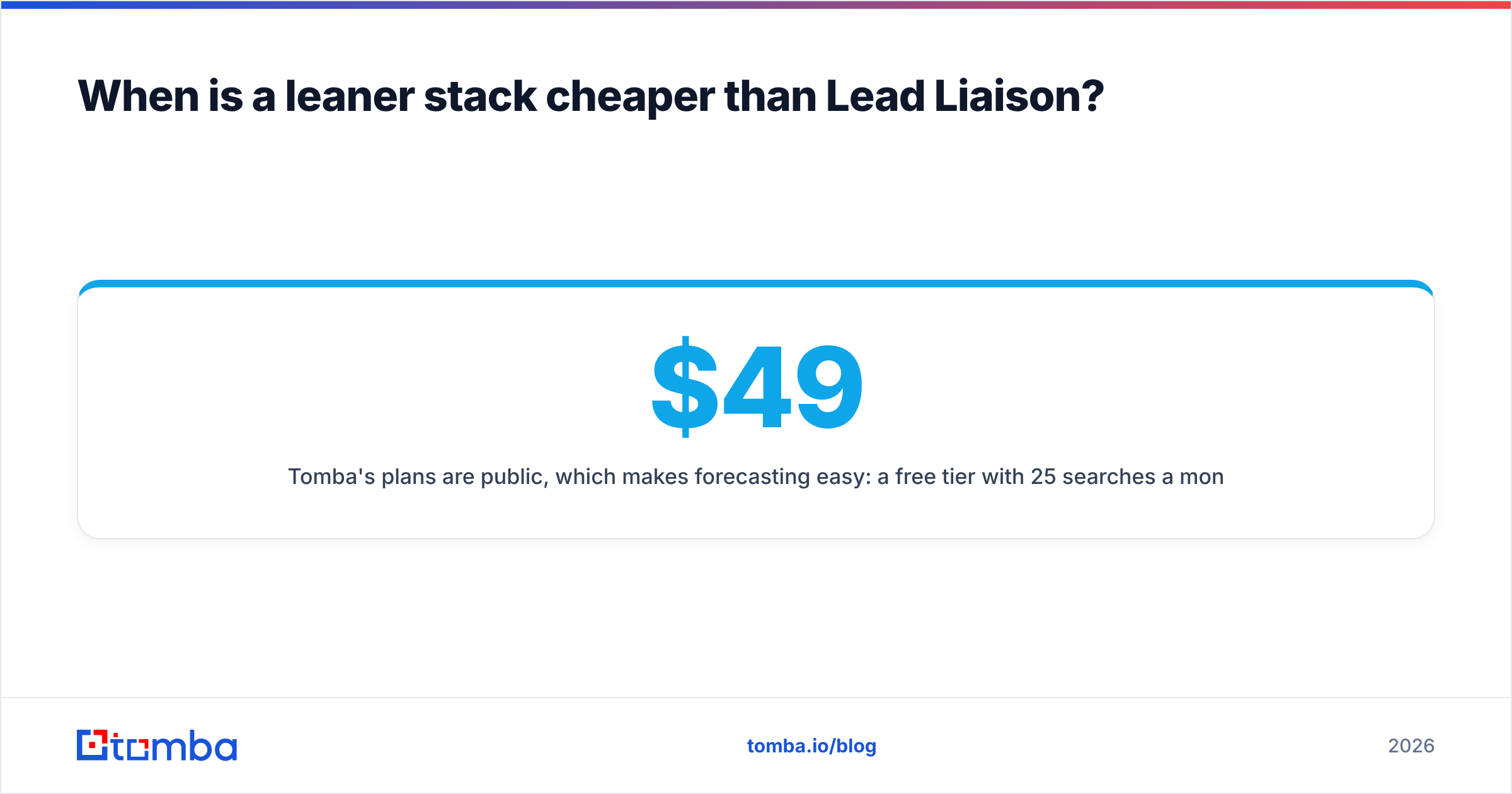
Tomba's plans are public, which makes forecasting easy: a free tier with 25 searches a month, Starter at $49/mo, Growth at $99/mo, Pro at $249/mo, and custom Enterprise. You can see full Tomba pricing without a sales call. Pair that with a sequencer and your all-in outbound cost is usually well below a mid-market automation contract.
This isn't a case for replacing Lead Liaison. If you run events and direct mail at scale, its native modules have real value. The point is to split the decision: buy automation for nurturing and routing, and buy contact data for reach. Mixing the two budgets is how teams end up paying suite prices for a data problem.
What should you ask Lead Liaison sales before signing?#
Take this list into the call:
- What's the contact ceiling on the quoted tier, and what's the price for the next tier?
- Which modules are in the quote, and what does each add-on cost on its own?
- Is onboarding a one-time fee, and what does it include (scoring model, Salesforce mapping, templates)?
- How are direct mail costs billed: per piece, prepaid credits, or pass-through?
- What's the renewal increase cap?
- Can you start with a shorter term or a pilot before a multi-year commitment?
Get the answers in writing. A vendor that's confident in its value will put them in the order form.
The bottom line on Lead Liaison pricing#
Lead Liaison is a capable, well-supported platform. It makes the most sense for mid-market B2B teams that run trade shows, send direct mail, and route leads through Salesforce. Its quote-only pricing makes comparison shopping harder, and some reviewers find the interface dated, but teams that use most of the modules often get good value from the bundle. Teams that mainly need contacts to email will overpay.
If your pipeline problem is really a data problem, fix that first. Tomba Email Finder finds professional email addresses by domain, name, or company, verifies them before you send, and plugs into the CRM and sequencer you already use. It has published pricing starting at $49/mo and a free tier to test it. Start with the free searches, check the hit rate on your own target accounts, and then decide how much automation you really need on top.
Related guides#
// get started
Find, verify and enrich your first contacts today
Start on the free plan with 25 searches a month, then scale when your team is ready.
Free plan · No credit card required · GDPR & CCPA
// about the author