Lead Magnet Email Sequence: 5 Emails That Turn Downloads Into Deals
Most lead magnets get downloaded, skimmed, and forgotten. Here is a 5-email lead magnet email sequence, with timing, copy rules, and metrics, that moves a new subscriber from download to a sales conversation.
TL;DR
- A lead magnet email sequence is the automated series of emails that goes out after someone downloads your checklist, template, report, or tool. Its job is to turn a download into a sales conversation.
- Five emails over about 12 days works for most B2B magnets: deliver, quick win, proof, objection, direct ask.
- Each email gets one job and one call to action. If an email asks for three things, the reader usually does none of them.
- Deliverability decides whether the sequence works at all. Verify addresses when you capture them, keep the first email plain, and watch complaint rates.
- Judge the sequence by meetings booked or trials started, not open rate.
What is a lead magnet email sequence?#
A lead magnet email sequence is a short, automated nurture flow that starts the moment someone exchanges their email address for a free resource. The resource might be an ebook, a pricing calculator, a cold email template pack, a benchmark report, or a webinar recording. The sequence is everything that follows it.
Most teams treat the lead magnet as the finish line: the form fills, the PDF arrives, and the contact goes into a monthly newsletter. That throws away the moment when the prospect is paying the most attention. Someone who downloaded "The 2026 Outbound Playbook" ten minutes ago has told you what problem they have, roughly when they're thinking about it, and that they're willing to hear from you. In classic lead generation terms, they've moved from anonymous visitor to known lead. The sequence decides whether they move any further.
A good sequence does three things in order:
- Delivers value quickly. The asset arrives right away, along with one reason to open it.
- Builds belief. It shows that the problem is real, that your way of solving it works, and that people like them have already done it.
- Asks for the next step. That might be a demo, a trial, a reply, or a short call. The ask should be specific and easy to say yes to.
Why does a single "here's your download" email fail?#
A lone delivery email assumes the prospect will read the asset, understand what it implies, connect it to your product, and come back to buy on their own. Very few people do all four.
Here's how it usually goes. The PDF gets saved to a downloads folder. The prospect means to read it on Friday. Friday brings a fire drill, and by next week they no longer remember which vendor sent it. When sales follows up three weeks later, the lead has gone cold and your brand means nothing to them.
A sequence fixes this by spreading the value across several touches, each with its own small win. It also gives you behavioral data: who clicked the implementation guide, who opened the case study twice, who went quiet. You can route leads to sales on that data instead of guessing.
A single email also teaches mailbox providers very little about you. A sender whose recipients open and reply over several messages builds engagement history. A sender who fires one attachment-heavy email and disappears doesn't.
What should a 5-email lead magnet sequence look like?#
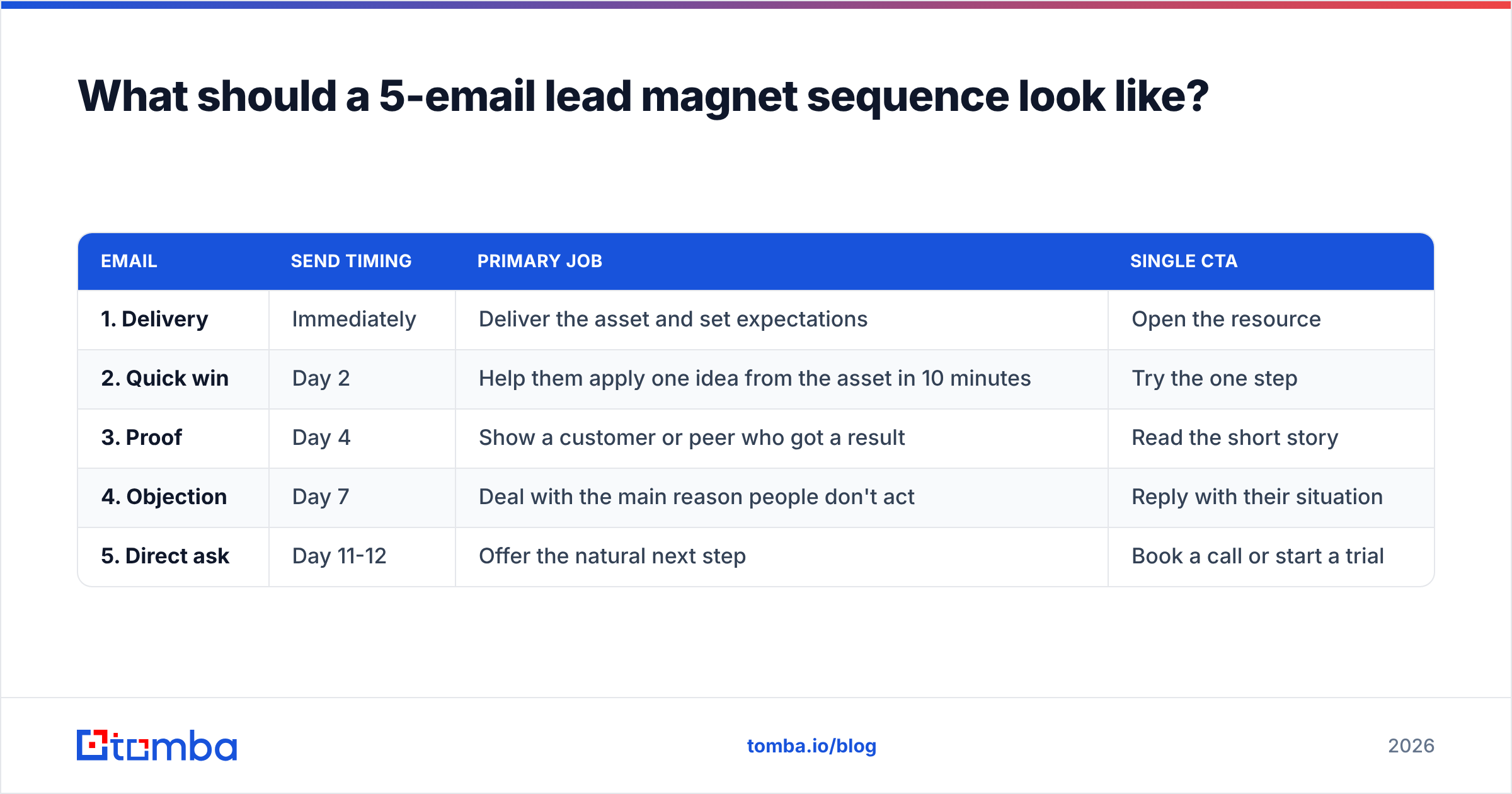
This structure holds up for most B2B lead magnets. Adjust the timing to your sales cycle: go faster for self-serve tools and slower for enterprise reports.
| Send timing | Primary job | Single CTA | |
|---|---|---|---|
| 1. Delivery | Immediately | Deliver the asset and set expectations | Open the resource |
| 2. Quick win | Day 2 | Help them apply one idea from the asset in 10 minutes | Try the one step |
| 3. Proof | Day 4 | Show a customer or peer who got a result | Read the short story |
| 4. Objection | Day 7 | Deal with the main reason people don't act | Reply with their situation |
| 5. Direct ask | Day 11-12 | Offer the natural next step | Book a call or start a trial |
Email 1: Delivery (immediate)#
Keep it short and plain. Put the link to the asset in the first two lines. Add one sentence on where to start, for example "Skip to page 6 if you only have five minutes." Don't use heavy HTML, don't put your logo in the header, and don't give a list of five links. The subject line should match what they asked for, such as "Your outbound playbook (page 6 first)."
Email 2: Quick win (day 2)#
Pick the most actionable idea in the asset and walk them through doing it today. If the magnet is a cold email template pack, show one template filled in for a real persona. The quick win proves the asset is useful, and it makes them more likely to open the next email.
Email 3: Proof (day 4)#
Tell one story about a customer, a peer, or your own team, and make it specific. "A 12-person agency booked 9 meetings in three weeks using template #3" works better than "Our customers love us." If you can't share customer data, walk through what you do internally. Keep it under 200 words and link to the longer case study for anyone who wants it.
Email 4: Objection (day 7)#
Every lead magnet topic has one main objection. For outbound, it's usually "we tried cold email and it didn't work" or "our list quality is bad." Say the objection out loud, explain why it happens, and show how to get past it. End by asking them to reply with their situation. Replies are the best engagement signal you can get, and they start real conversations.
Email 5: Direct ask (day 11-12)#
Now you ask. Make one clear offer tied to the magnet's topic: "Want us to audit your first 50 prospects against this playbook? It's a 20-minute call." Give them a way out, too: "If the timing's wrong, no reply needed. You'll just get our monthly notes." Being honest about the ask tends to earn more replies than hiding it.
Which sequence type fits your lead magnet?#
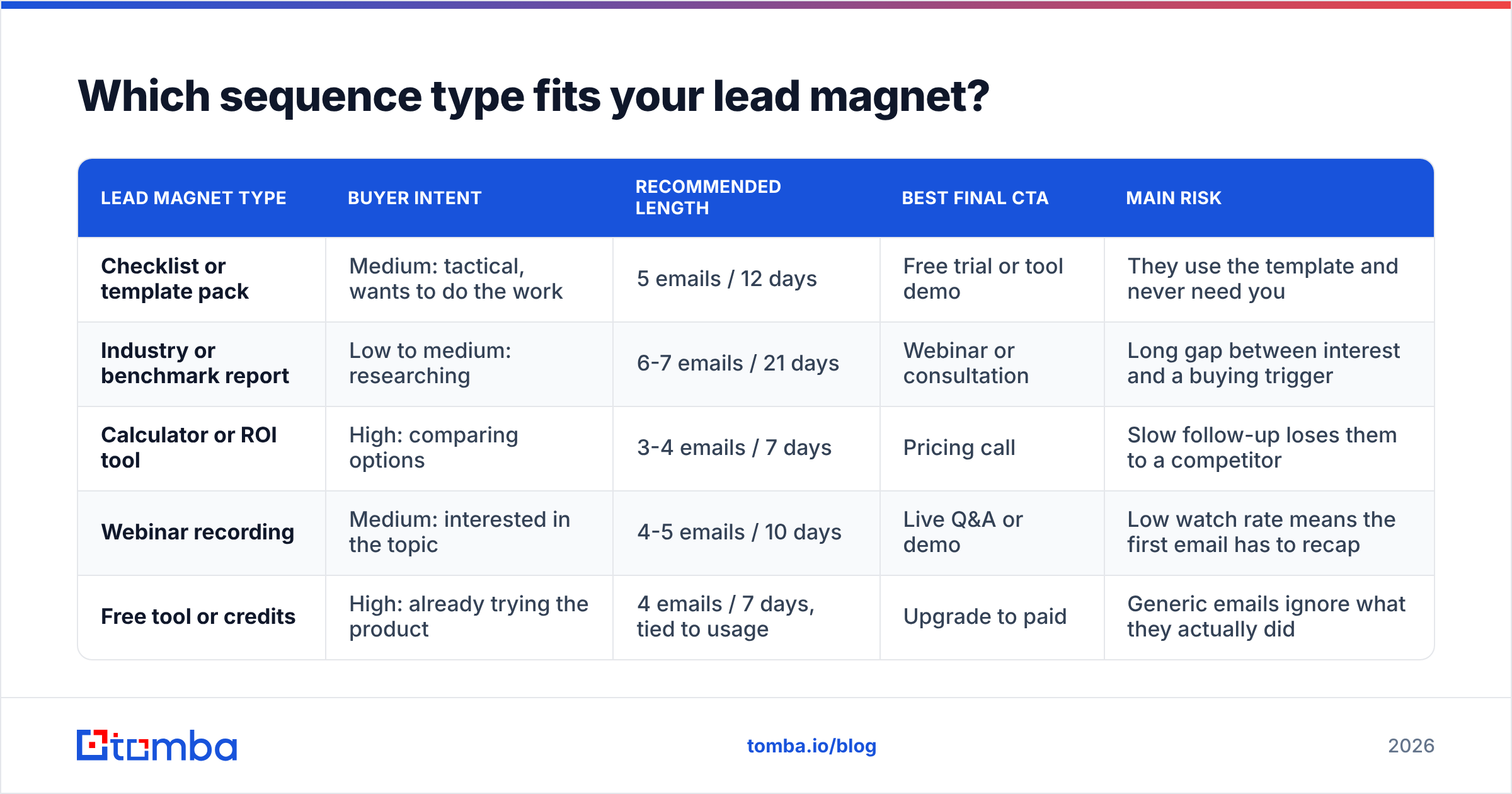
Lead magnets don't all behave the same way. A calculator user is ready to act far sooner than someone who downloaded a 40-page industry report. Match the sequence to the asset.
| Lead magnet type | Buyer intent | Recommended length | Best final CTA | Main risk |
|---|---|---|---|---|
| Checklist or template pack | Medium: tactical, wants to do the work | 5 emails / 12 days | Free trial or tool demo | They use the template and never need you |
| Industry or benchmark report | Low to medium: researching | 6-7 emails / 21 days | Webinar or consultation | Long gap between interest and a buying trigger |
| Calculator or ROI tool | High: comparing options | 3-4 emails / 7 days | Pricing call | Slow follow-up loses them to a competitor |
| Webinar recording | Medium: interested in the topic | 4-5 emails / 10 days | Live Q&A or demo | Low watch rate means the first email has to recap |
| Free tool or credits | High: already trying the product | 4 emails / 7 days, tied to usage | Upgrade to paid | Generic emails ignore what they actually did |
Use the table to pick a starting point. The longer the gap between reading and buying, the more emails you need, and the more those emails should teach rather than ask.
How do you write each email so it gets read?#
The same rules apply to all five emails. Here's what changes results most:
- One email, one job. Give each message a single goal and a single link or reply prompt. A second CTA splits attention and makes both weaker.
- Write like a person, not a newsletter. Plain text, first person, a real sender name, and short paragraphs. Nurture emails that look like 1:1 notes tend to get more replies than designed templates, and they get past promotional filters more often too.
- Subject lines that continue the conversation. Refer back to the asset or the previous email, as in "the page-6 trick, applied" or "why template #3 works." Run your drafts through a subject line tester to catch spammy phrasing and length problems before you ship.
- Keep it short. Aim for 80-150 words per email. If an idea needs more room, link to a blog post or a section of the asset.
- Say what's coming. Close each email with a line about the next one: "Thursday: the one mistake that kills reply rates." It sets up the next open and makes the sequence read as a series.
You'll likely have to rewrite the copy two or three times. First drafts nearly always cover too much. Cut every sentence that doesn't serve the email's one job.
How do you protect deliverability for a new-subscriber sequence?#
A sequence that lands in spam is the same as having no sequence. New-subscriber flows are exposed here because they email addresses you've never sent to before. Some of those are typos, some are throwaway inboxes, and some are role accounts nobody reads.
Protect the sequence at four points:
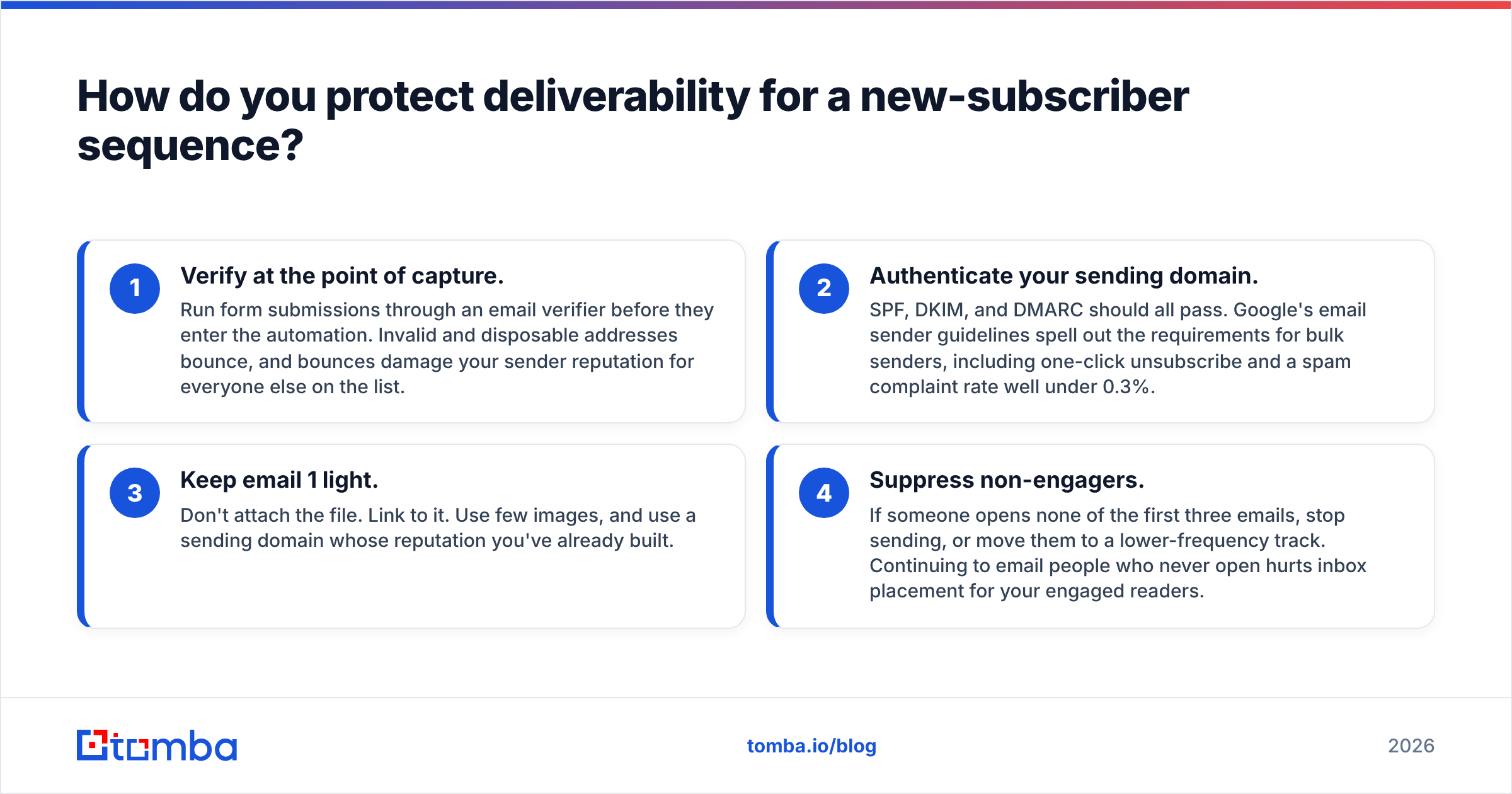
- Verify at the point of capture. Run form submissions through an email verifier before they enter the automation. Invalid and disposable addresses bounce, and bounces damage your sender reputation for everyone else on the list.
- Authenticate your sending domain. SPF, DKIM, and DMARC should all pass. Google's email sender guidelines spell out the requirements for bulk senders, including one-click unsubscribe and a spam complaint rate well under 0.3%.
- Keep email 1 light. Don't attach the file. Link to it. Use few images, and use a sending domain whose reputation you've already built.
- Suppress non-engagers. If someone opens none of the first three emails, stop sending, or move them to a lower-frequency track. Continuing to email people who never open hurts inbox placement for your engaged readers.
This matters more if you also send cold outreach. A good practice is to send nurture sequences from your main marketing domain and cold email from separate, warmed secondary domains, so problems on one don't spread to the other.
How should you segment and personalize after the download?#
Everyone who downloads the same asset gets the same five emails, which is fine as a baseline. The biggest gains come from splitting by who the person is and what they do next.
Segment by firmographics. A download form usually collects a name and an email. Data enrichment can fill in company size, industry, job title, and location from the email domain, so your form can stay short and your follow-up can still be relevant. A VP of Sales at a 500-person company should get a different proof email (email 3) than a founder running a five-person team.
Branch on behavior. Use your automation tool's conditional logic:
- Clicked the pricing link in any email: skip to the direct ask, or alert a rep right away.
- Replied to email 4: pull them out of the automation and hand off to a human.
- Opened nothing by day 7: suppress them, or send one re-engagement note and stop.
Personalize the ask, not every sentence. Mail-merging the company name into email 2 doesn't achieve much. What helps is making the final CTA fit their segment: a self-serve trial for small teams and a scoped consultation for enterprise. Most marketing automation platforms, including HubSpot, support this kind of branching natively.
Which metrics tell you the sequence is working?#
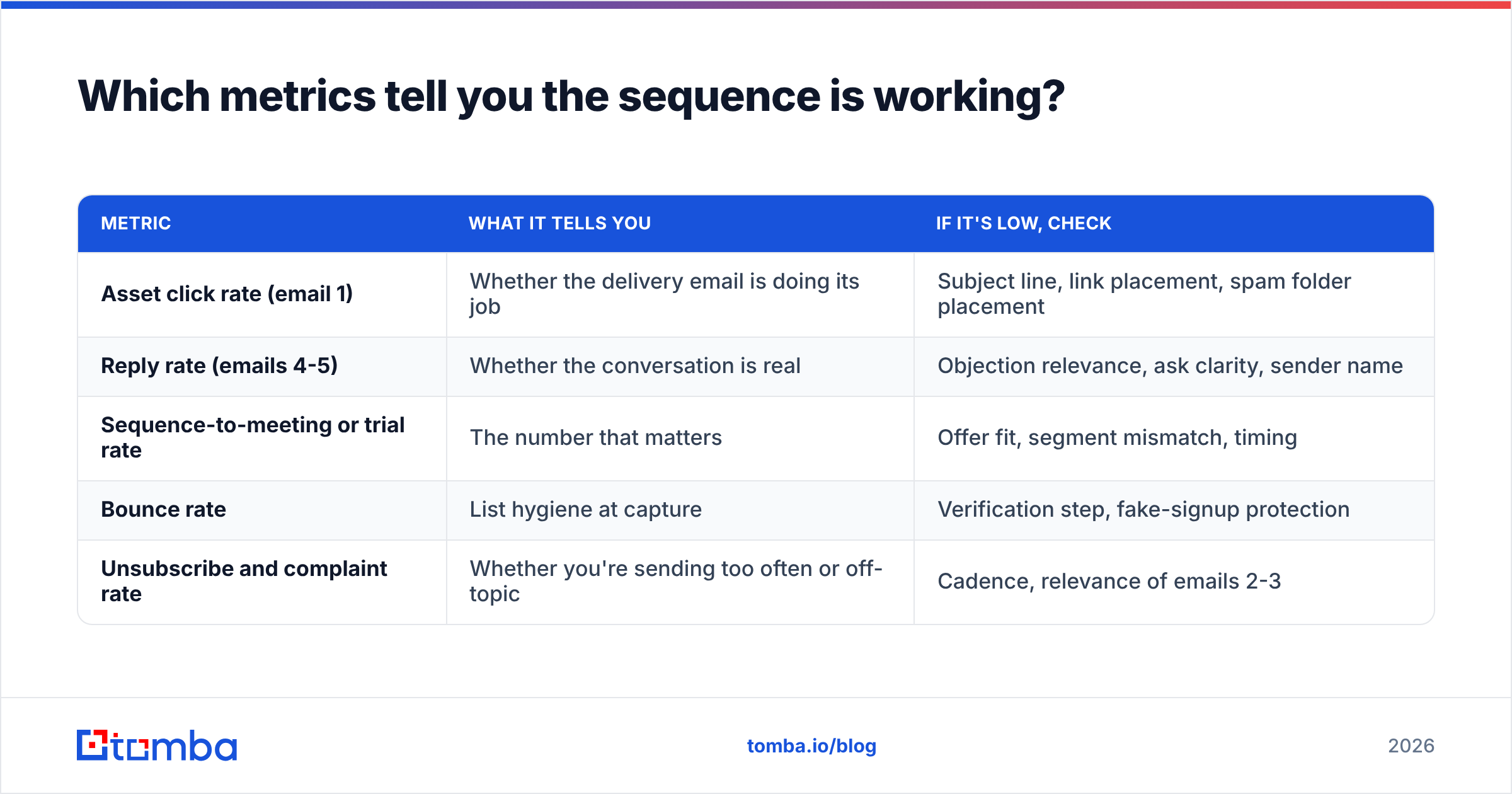
Open rates can be misleading because of privacy features that auto-load images. Measure what happens further down.
| Metric | What it tells you | If it's low, check |
|---|---|---|
| Asset click rate (email 1) | Whether the delivery email is doing its job | Subject line, link placement, spam folder placement |
| Reply rate (emails 4-5) | Whether the conversation is real | Objection relevance, ask clarity, sender name |
| Sequence-to-meeting or trial rate | The number that matters | Offer fit, segment mismatch, timing |
| Bounce rate | List hygiene at capture | Verification step, fake-signup protection |
| Unsubscribe and complaint rate | Whether you're sending too often or off-topic | Cadence, relevance of emails 2-3 |
Track results by cohort, meaning everyone who downloaded in a given week. That way you can see how a copy change affects conversion without mixing in older subscribers who got a different version. Review monthly, change one email at a time, and give each version enough volume to draw a real conclusion.
A related point: your email response rate on the final ask is the best early signal of pipeline quality. Downloads without replies usually mean the magnet attracts the wrong audience, not that the sequence is broken.
What mistakes kill lead magnet sequences?#
These are the patterns that most often turn a working magnet into a dead list:
- The magnet and the product don't connect. A generic "productivity tips" ebook attracts people who will never buy a sales tool. Choose a magnet that solves a small part of the problem your product solves completely.
- Asking too early. Putting "book a demo" in email 1 treats a curious reader like a hand-raiser. Earn the ask first.
- Asking too late, or never. The opposite mistake is ten "value" emails and no offer. By then the reader thinks of you as a free resource, not a vendor.
- No handoff to sales. If a prospect replies to email 4 and the automation keeps sending email 5, you look careless. Stop the flow when someone replies.
- Letting bad data in. Fake signups, typo'd domains, and role addresses pile up. Clean them at the door, not six months later when your domain reputation has already dropped.
What do people usually ask about lead magnet sequences?#
How many emails should a lead magnet sequence have?#
Most B2B sequences land between 4 and 7 emails. Five is a reasonable default. Use fewer for high-intent magnets like calculators and more for top-of-funnel reports where the buying trigger may be weeks away.
How often should the emails go out?#
Front-load them. Send email 1 immediately, email 2 within 48 hours, and then space the rest by three to four days. Interest is highest right after the download and drops quickly.
Should the sequence come from a person or from the company?#
From a person, using a real name and a real reply-to address. Replies are the goal, and people rarely reply to "Marketing Team."
What happens after the sequence ends?#
Move non-converters into a regular newsletter or a slower monthly nurture track. Anyone who engaged heavily but didn't book should be flagged for a rep to follow up personally.
Ready to fill your sequence with contacts who can actually buy?#
A lead magnet email sequence only works if it's reaching the right people. That means verified addresses, decision-makers rather than role inboxes, and accounts that fit your ICP. Once your nurture flow is running, the next step is to reach lookalike buyers directly: find the VP or founder at companies that resemble your best downloaders and invite them to the same resource. Tomba Email Finder lets you find professional email addresses by domain, name, or company, so your best-performing lead magnet can go to the people most likely to become customers. Start on the free tier with 25 searches a month, then move to Starter at $49/mo when the sequence proves itself.
Related guides#
// get started
Find, verify and enrich your first contacts today
Start on the free plan with 25 searches a month, then scale when your team is ready.
Free plan · No credit card required · GDPR & CCPA
Get the Tomba newsletter
Product and data updates
// about the author