Lead Magnets for Cold Email: 9 Offers That Earn Replies in 2026
Most cold emails with a lead magnet get ignored because the offer is too big, too generic, or gated. Here are 9 lead magnets that earn replies, how to match them to your buyer, and the copy that makes them work.
TL;DR
- A cold email lead magnet is not the same as an inbound one. It has to be small, specific to the prospect, and easy to accept by replying. It should not send them to a landing page with a form.
- The best-performing offers are usually personalized: mini-audits, benchmarks, teardowns, and custom lists. Generic ebooks and whitepapers do poorly in cold outreach.
- Ask a question first ("Want me to send it?") and deliver the asset in the second email. Putting links or attachments in email one hurts deliverability.
- Your offer only works if it lands in the right inbox. Verified addresses and a clean list matter as much as the asset.
- Match the magnet to how much your prospect already knows. Cold buyers who aren't aware of the problem need a diagnosis, and buyers comparing vendors need proof.
What is a lead magnet in cold email?#
In inbound marketing, a lead magnet is something valuable you give away in exchange for contact details, such as an ebook, a template pack, or a webinar seat. HubSpot's definition describes it as an offer that gets a visitor to hand over their information.
Cold email turns that around. You already have the prospect's email address, so the lead magnet has a different job: it gives the prospect a low-risk reason to reply. Nobody is filling out a form. The trade is their attention and one short reply in return for something useful to them specifically.
That difference explains why most inbound lead magnets flop when people move them into outbound. A 40-page "State of the Industry" PDF works on a landing page because the visitor went looking for it. In a cold inbox, the same PDF looks like homework from a stranger.
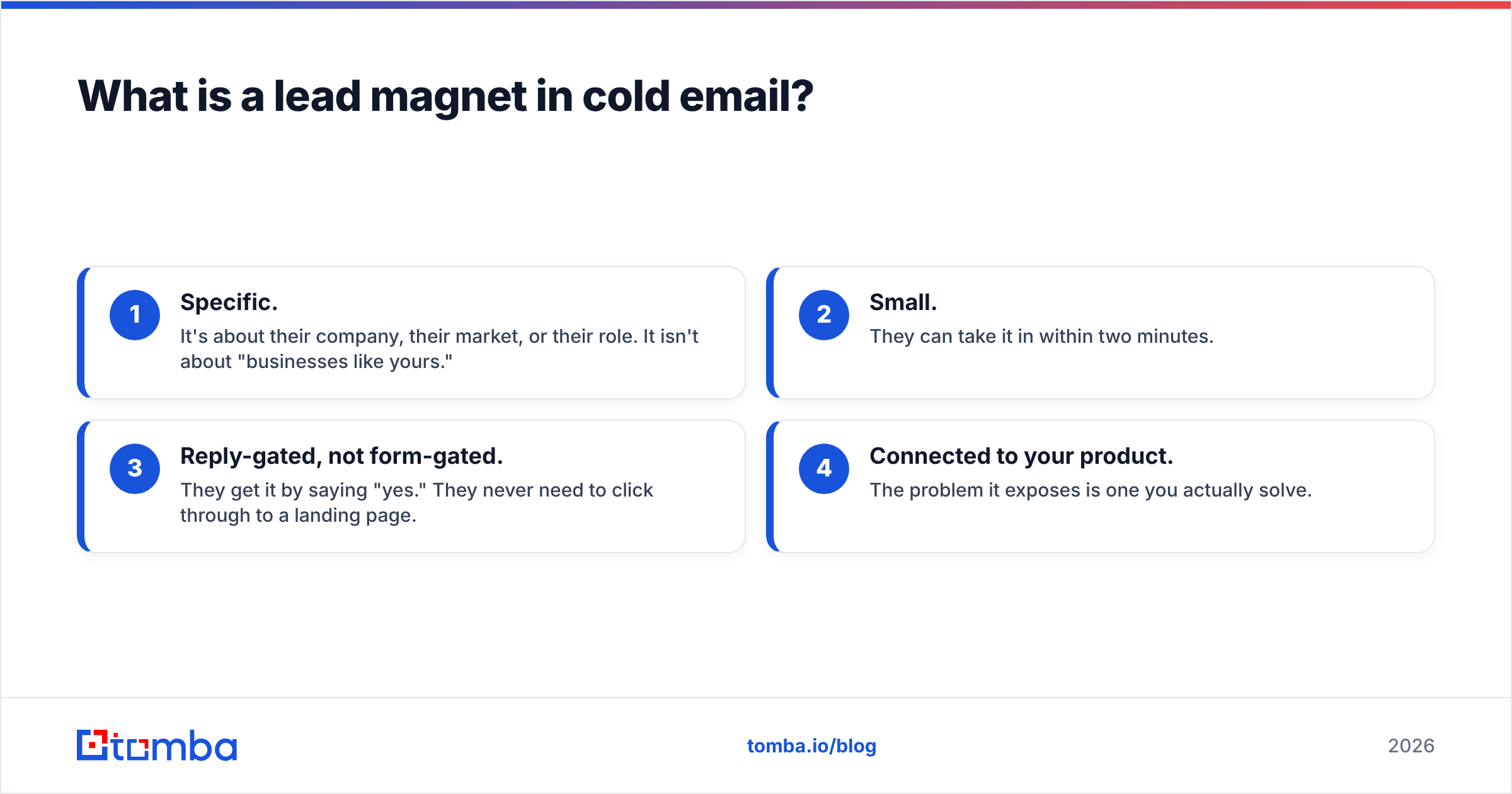
A good lead magnet for cold email has four properties:
- Specific. It's about their company, their market, or their role. It isn't about "businesses like yours."
- Small. They can take it in within two minutes.
- Reply-gated, not form-gated. They get it by saying "yes." They never need to click through to a landing page.
- Connected to your product. The problem it exposes is one you actually solve.
Why do lead magnets improve cold email reply rates?#
A lead magnet changes what you're asking for. With no offer, a typical cold email asks for 30 minutes on a call with someone the prospect has never heard of. That's a lot of trust to request from a stranger. With a lead magnet, you're asking for one word: "Sure."
Three things work in your favor:
- Reciprocity. You showed up with something useful before asking for anything, and people tend to want to repay that.
- Curiosity. "I found three pages on your site that are losing organic traffic" leaves a gap the reader wants to close. A generic pitch doesn't.
- Lower commitment. It's easy to say yes to a free benchmark and much harder to agree to a demo. Once someone has replied, the next step (a call) comes more naturally.
The measurable result is a better email response rate. The replies also tend to be warmer, because they're conversations about the prospect's own problem.
Which lead magnets work best for cold email?#
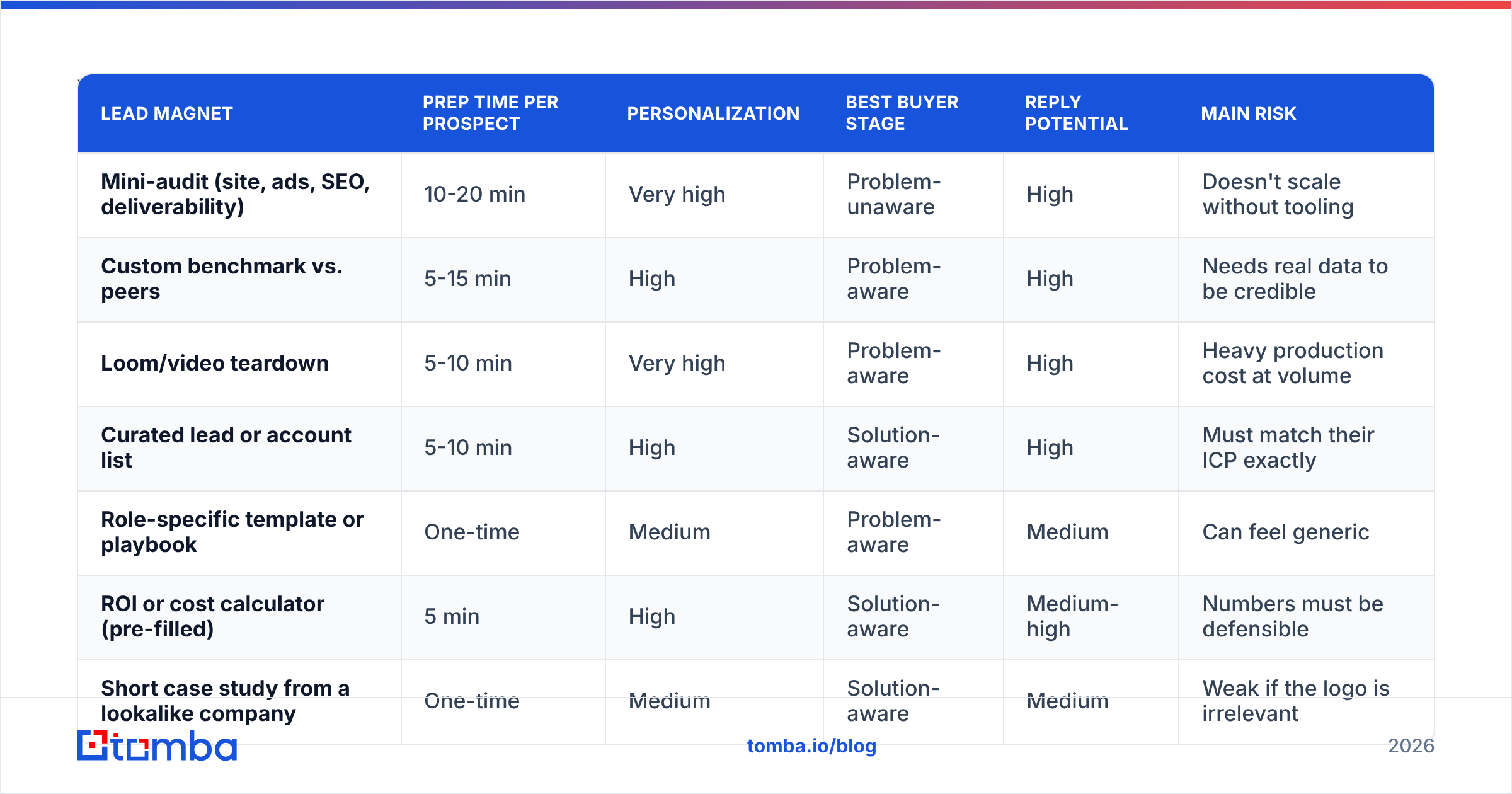
Below are nine formats that suit outbound, compared on the things that matter when you're sending at volume: how long each one takes to make per prospect, how personalized it feels, and which stage of the buying journey it fits.
| Lead magnet | Prep time per prospect | Personalization | Best buyer stage | Reply potential | Main risk |
|---|---|---|---|---|---|
| Mini-audit (site, ads, SEO, deliverability) | 10-20 min | Very high | Problem-unaware | High | Doesn't scale without tooling |
| Custom benchmark vs. peers | 5-15 min | High | Problem-aware | High | Needs real data to be credible |
| Loom/video teardown | 5-10 min | Very high | Problem-aware | High | Heavy production cost at volume |
| Curated lead or account list | 5-10 min | High | Solution-aware | High | Must match their ICP exactly |
| Role-specific template or playbook | One-time | Medium | Problem-aware | Medium | Can feel generic |
| ROI or cost calculator (pre-filled) | 5 min | High | Solution-aware | Medium-high | Numbers must be defensible |
| Short case study from a lookalike company | One-time | Medium | Solution-aware | Medium | Weak if the logo is irrelevant |
| Original research snippet (one stat + chart) | One-time | Low-medium | Problem-unaware | Medium | Depends on data quality |
| Free trial or credits | None | Low | Product-aware | Low-medium | Reads as a pitch, not a gift |
Some notes on the strongest options:
Mini-audits get the most replies because they're about the prospect and nobody else. A performance agency might write: "I ran your top five landing pages through PageSpeed. Two load in over 6 seconds on mobile. Want the breakdown?" That offer is specific, can be checked, and is hard to ignore.
Custom benchmarks are useful when you have aggregated data. "Companies your size in fintech average X; you're at Y" works because nobody likes being below average. Only use numbers you can defend if someone asks where they came from.
Curated lists suit anyone who sells to sales or marketing teams. "I pulled 25 heads of procurement at mid-market logistics firms that match your customer profile. Want the list?" gives them something they can use right away. If you're building these lists yourself, an email finder or a data provider such as BookYourData can speed up the sourcing. Check fit by hand before you send, though. A list full of wrong-fit contacts costs you more credibility than sending nothing.
Video teardowns stand out, but they take real time to make. Keep them for your top tier of accounts.
How do you pick the right lead magnet for your ICP?#
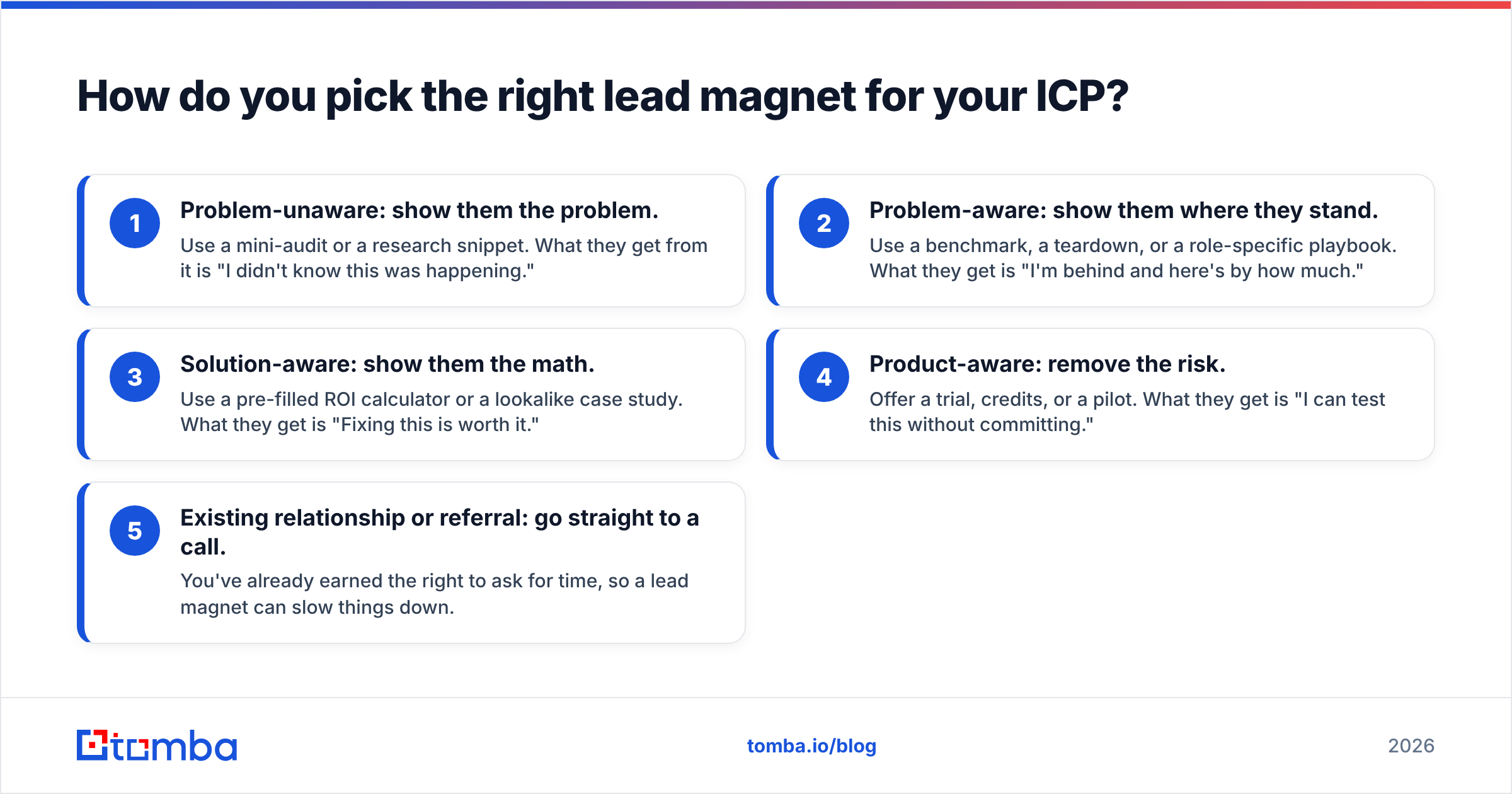
Start with how much your prospect already knows about the problem, then match the offer to it. This framework keeps you from sending a product-comparison PDF to someone who doesn't yet know they have a problem.
- Problem-unaware: show them the problem. Use a mini-audit or a research snippet. What they get from it is "I didn't know this was happening."
- Problem-aware: show them where they stand. Use a benchmark, a teardown, or a role-specific playbook. What they get is "I'm behind and here's by how much."
- Solution-aware: show them the math. Use a pre-filled ROI calculator or a lookalike case study. What they get is "Fixing this is worth it."
- Product-aware: remove the risk. Offer a trial, credits, or a pilot. What they get is "I can test this without committing."
- Existing relationship or referral: go straight to a call. You've already earned the right to ask for time, so a lead magnet can slow things down.
Most cold outbound goes to people in stages 1 and 2. That's why diagnostic magnets tend to beat case studies and trials in first-touch sequences.
How should you deliver a lead magnet in a cold email?#
Offer the asset in the first email and send it only after they reply. This two-step approach is better for both replies and deliverability.
Here's why. First-touch cold emails that contain links, attachments, or tracked URLs are more likely to be filtered. Google's email sender guidelines stress authentication, low spam-complaint rates, and sending mail that recipients want. A stranger's first message with a PDF attached works against all of that. A plain-text question with no links doesn't.
A sequence structure that works:
- Email 1 (plain text, no links): A one-line observation, the offer, and a yes/no question.
- Email 2 (follow-up, day 3): The same offer from a different angle, or a single finding from the audit as a teaser.
- Email 3 (day 7): A soft break-up ("Should I send it to someone else on your team?").
- On reply: Send the asset right away, add one line of context, and suggest a next step.
Here's an example first email for a deliverability consultancy:
Subject: your SPF record
Hi Dana, I noticed acme.com has two SPF records, which usually means one of them gets ignored and some of your outbound lands in spam.
I put together a one-page check of your SPF, DKIM, and DMARC setup. Want me to send it over?
Sam
The email is under 60 words and has no links. The observation is specific and easy to verify, and the question takes one word to answer. If you want more starting points, Tomba's cold email templates include several offer-first structures you can adapt.
What mistakes kill lead magnet cold emails?#
Most failed lead magnet campaigns share a handful of problems:
- Attaching the asset to email one. You pay a deliverability cost, and the prospect gets no reason to reply because they already have the thing.
- Gating behind a form. Making a cold prospect fill out a form is treating them like an inbound visitor who came looking for you.
- Offering something generic. "Our 2026 guide to digital transformation" could have been sent to anyone, and prospects can tell.
- Promising personalization you won't deliver. If you say "custom audit" and send a template with their logo pasted in, you've spent the trust you just earned.
- Sending to bad addresses. Your offer can't earn a reply if the email bounces or ends up in a spam trap.
That last point gets less attention than it should. Teams spend hours on a great audit template and then send it to a scraped list that bounces at 8%. High bounce rates damage sender reputation, and once your reputation drops, even your best offers stop reaching inboxes. Before a list goes into your sequencer, run it through an email verifier and remove invalid and risky addresses. Then run your copy through a spam checker to catch trigger phrases like "free download."
How do you scale personalized lead magnets without burning out?#
The most effective lead magnets are also the hardest to scale, since audits and teardowns take real time. There are three ways to deal with that.
Tier your accounts. Send full custom audits or videos to your top 50 accounts. Send the next 500 a semi-custom benchmark generated from a template. Send the long tail a role-specific playbook. Each tier gets personalization in proportion to the deal size.
Automate the data, write the insight by hand. Most of the time spent on a mini-audit goes to collecting data: tech stack, page speed, DNS records, hiring signals, headcount. That part can be automated with APIs, enrichment tools, and spreadsheet workflows. The one or two lines of real insight should still be written by a person. Readers can tell when it wasn't.
Reuse findings across lookalikes. If you audit ten Shopify stores in the same category, patterns show up. Turn those into a benchmark ("7 of 10 stores in your niche are missing X"). Your research snippet then works as a lead magnet for the next hundred.
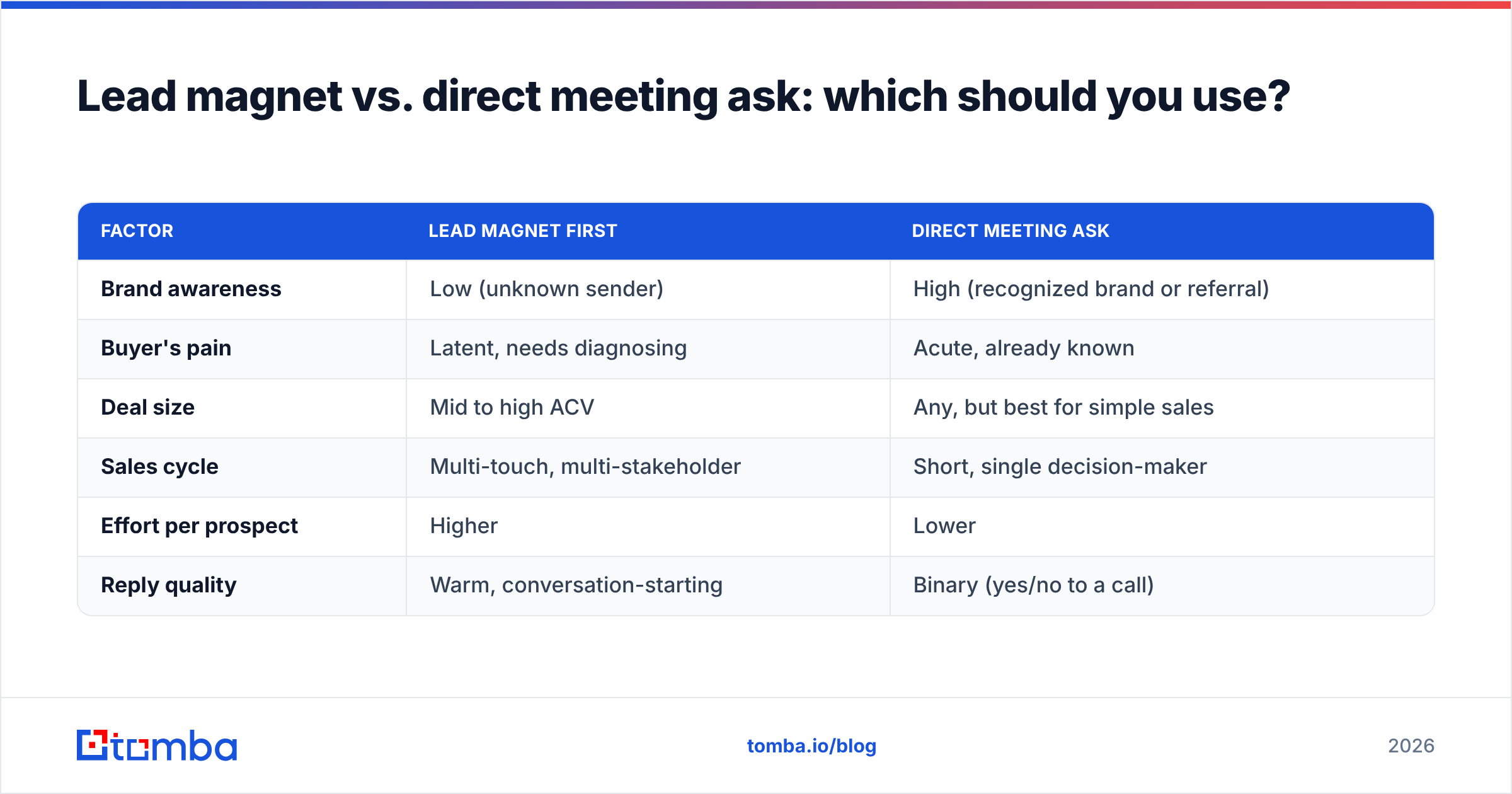
Lead magnet vs. direct meeting ask: which should you use?#
It depends on deal size, how clear the pain is, and how well your brand is known. Neither approach is always better.
| Factor | Lead magnet first | Direct meeting ask |
|---|---|---|
| Brand awareness | Low (unknown sender) | High (recognized brand or referral) |
| Buyer's pain | Latent, needs diagnosing | Acute, already known |
| Deal size | Mid to high ACV | Any, but best for simple sales |
| Sales cycle | Multi-touch, multi-stakeholder | Short, single decision-maker |
| Effort per prospect | Higher | Lower |
| Reply quality | Warm, conversation-starting | Binary (yes/no to a call) |
For most B2B teams sending to cold lists, starting with an offer and asking for the meeting after the asset has been delivered works better than asking for the call on the first touch. If you already have strong intent signals, like a recent funding round, a relevant hire, or a pricing page visit, a direct ask can make sense.
How do you measure whether your lead magnet works?#
Track the whole path, not only the first reply. A magnet that gets plenty of "sure, send it" replies but no meetings is working as entertainment, not pipeline.
Track these in your CRM or sequencer:
- Positive reply rate: replies that accept the offer, divided by delivered emails.
- Asset-to-meeting rate: meetings booked, divided by assets delivered. This tells you whether the magnet leads naturally into your product.
- Bounce rate: keep it under about 2%. Anything higher points to a data problem, not a copy problem.
- Time to first reply: fast replies usually mean the offer is clear. Slow ones usually mean the prospect is confused or unconvinced.
A/B test one variable at a time. Keep the same list segment and change only the magnet (for example, audit vs. benchmark). Then keep the magnet and change only how you frame it. You need a few hundred sends per variant before the numbers mean much.
For a broader primer on how offers fit into outbound funnels, the lead generation overview on Wikipedia covers the inbound and outbound mechanics that lead magnets build on.
What does a complete lead magnet cold email workflow look like?#
Here's the process start to finish:
- Define the ICP and pick the magnet using the awareness framework above.
- Build the list: find decision-makers at target accounts by name and company domain.
- Verify every address before import, and flag catch-all domains for separate handling.
- Pull the data behind the magnet, such as tech stack, DNS records, and headcount, into a sheet.
- Write the plain-text, offer-first email plus two follow-ups.
- Warm up and ramp up sending volume gradually on a properly authenticated domain.
- Deliver the asset the same day someone replies, and suggest a specific next step.
- Review the metrics weekly and change one variable at a time.
Steps 2 and 3 are the ones teams rush, and they cause most of the problems in everything that comes after.
Ready to put your lead magnet in front of the right people?#
Your lead magnet only earns replies if it reaches a real decision-maker's inbox. Tomba Email Finder finds professional email addresses by name, domain, or company, and each result comes with a confidence score, so you can build a list of the right prospects instead of guessing at email formats. You can start on the free plan with 25 searches a month to test your first lead magnet campaign, then move to Starter at $49/mo once the offer is working. Combine it with verification before every send to protect your sender reputation.
Related guides#
// get started
Find, verify and enrich your first contacts today
Start on the free plan with 25 searches a month, then scale when your team is ready.
Free plan · No credit card required · GDPR & CCPA
// about the author