Lead Nurturing in 2026: A Practical Playbook for B2B Teams
Most B2B leads aren't ready to buy the day they convert. Here's how to build lead nurturing that keeps them warm, moves them to pipeline, and doesn't burn your sender reputation.
TL;DR
- Lead nurturing means building a relationship with leads who aren't ready to buy yet, so they pick you when they are. It's not a drip campaign you set up once and forget.
- Most programs don't fail because of the copy. They fail on bad contact data, triggers that ignore behavior, and no clear point where marketing hands the lead to sales.
- Run nurturing across several channels (email, LinkedIn, retargeting, sales touches) and let what the lead actually does decide the next step.
- Measure pipeline created and time-to-opportunity. Open rates alone don't tell you much.
- Before you enroll anyone, clean and enrich your list. One bounce-heavy sequence can hurt deliverability for every campaign you send.
What is lead nurturing?#
Lead nurturing is how you build and keep relationships with potential buyers who have shown some interest but aren't ready for a sales conversation. It covers everyone who downloaded the whitepaper, sat through half the webinar, or visited the pricing page and left.
Most B2B leads fall into this group. A buying committee can take months to move. Budgets open at the start of a fiscal quarter, not the week you capture the email. Nurturing keeps you relevant during that gap, so your name is on the shortlist when the deal becomes real.
It sits between lead generation and the sales process. Generation gets the contact. Nurturing earns the right to a meeting. If you skip it, you end up with a CRM full of contacts that went cold once your SDR's first two follow-ups got no reply.
People often confuse nurturing with a drip campaign. A drip sends a fixed series of emails on a fixed schedule. Nurturing reacts to what the lead does: which content they open, which pages they come back to, whether their company just raised money or hired a new VP. A drip is one of the tools you can use for nurturing. It isn't a full nurturing program.
Why does lead nurturing matter more in 2026?#
Three changes in the last few years raised the cost of neglecting leads.
Inbox providers are stricter. Since 2024, Google and Yahoo have enforced bulk-sender requirements: authentication, one-click unsubscribe, and low spam-complaint thresholds. If you send the same generic sequence to your whole database, you get complaints, and complaints lower your sender reputation. That affects every email you send afterward, including the ones your AEs send to live deals.
Buyers research before they talk to anyone. Research from firms like Gartner keeps finding that B2B buyers spend only a small share of their buying journey with vendor reps. Most of their decision is made alone, reading, comparing, and asking peers. Nurturing is how you take part in that research phase without being in the room.
AI made generic outreach nearly free. Anyone can generate a thousand "personalized" emails an hour, so buyers ignore anything that reads like a template. What stands out now is relevance: the right message sent because of something the lead actually did.
How does a lead nurturing program actually work?#
Every program that works has the same five parts. If one is weak, the others can't make up for it.
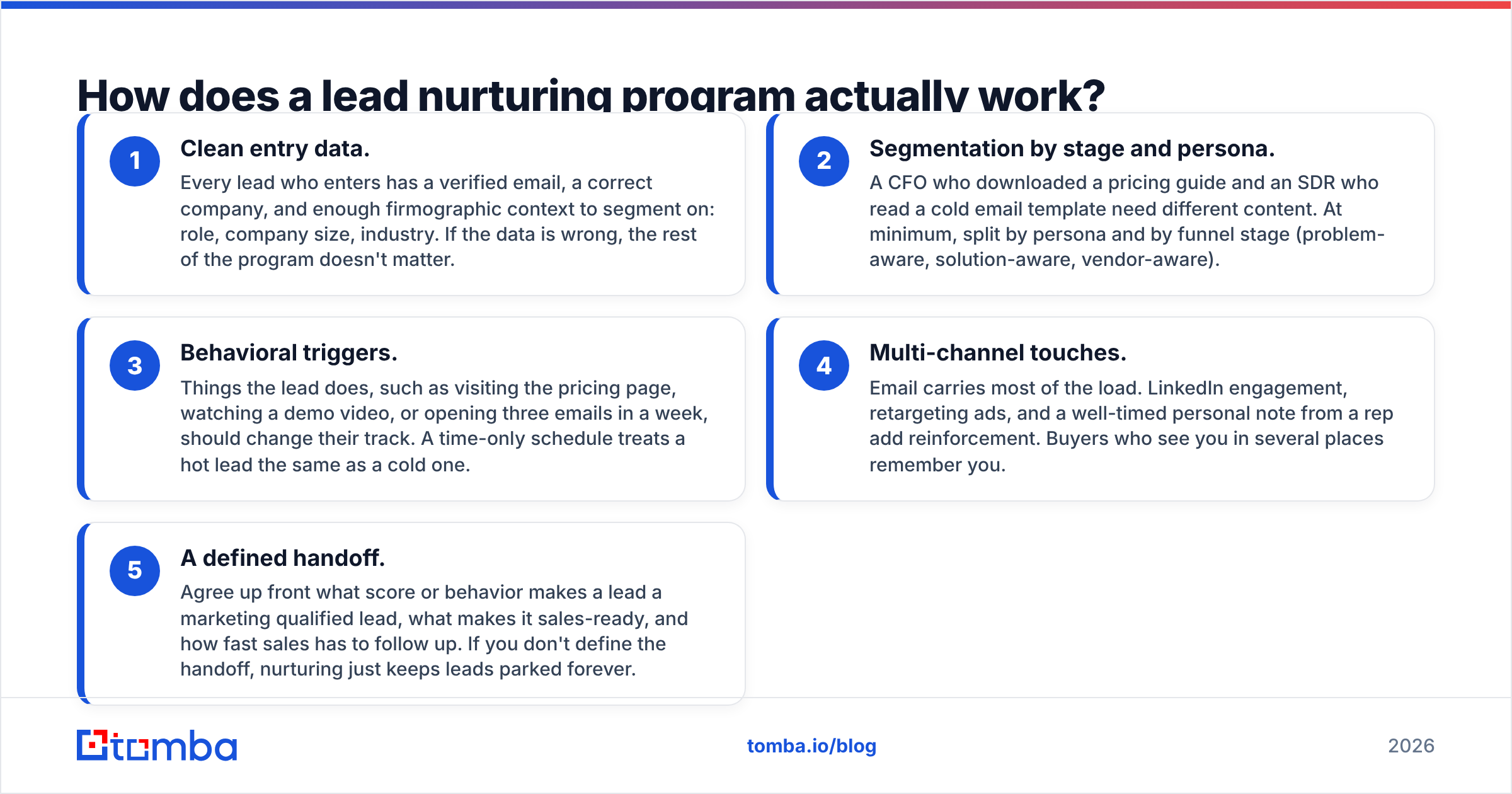
- Clean entry data. Every lead who enters has a verified email, a correct company, and enough firmographic context to segment on: role, company size, industry. If the data is wrong, the rest of the program doesn't matter.
- Segmentation by stage and persona. A CFO who downloaded a pricing guide and an SDR who read a cold email template need different content. At minimum, split by persona and by funnel stage (problem-aware, solution-aware, vendor-aware).
- Behavioral triggers. Things the lead does, such as visiting the pricing page, watching a demo video, or opening three emails in a week, should change their track. A time-only schedule treats a hot lead the same as a cold one.
- Multi-channel touches. Email carries most of the load. LinkedIn engagement, retargeting ads, and a well-timed personal note from a rep add reinforcement. Buyers who see you in several places remember you.
- A defined handoff. Agree up front what score or behavior makes a lead a marketing qualified lead, what makes it sales-ready, and how fast sales has to follow up. If you don't define the handoff, nurturing just keeps leads parked forever.
Which lead nurturing tactics work best?#
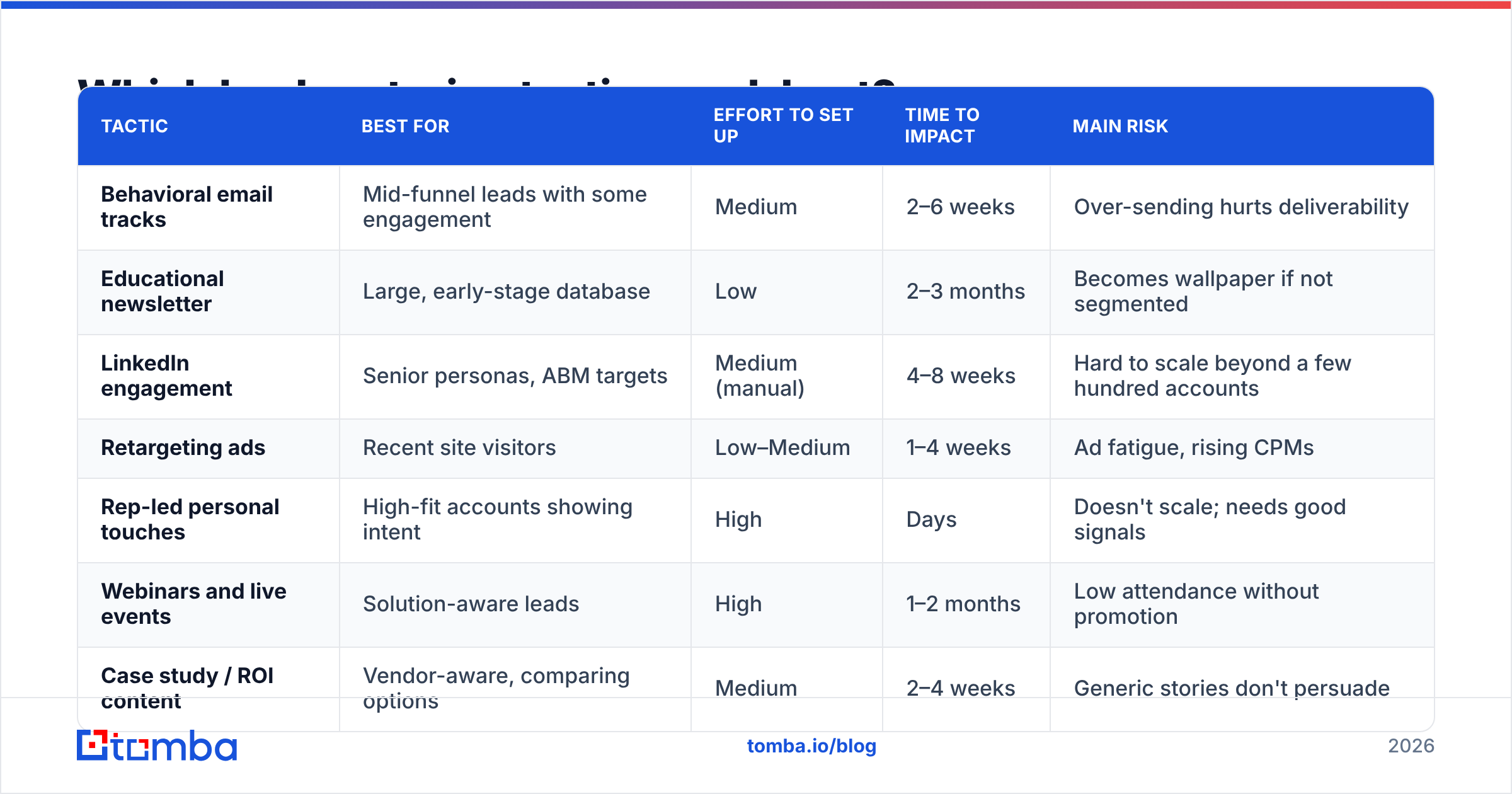
Not every tactic is worth the effort. Here's how the common ones compare on effort, speed, and where they fit.
| Tactic | Best for | Effort to set up | Time to impact | Main risk |
|---|---|---|---|---|
| Behavioral email tracks | Mid-funnel leads with some engagement | Medium | 2–6 weeks | Over-sending hurts deliverability |
| Educational newsletter | Large, early-stage database | Low | 2–3 months | Becomes wallpaper if not segmented |
| LinkedIn engagement | Senior personas, ABM targets | Medium (manual) | 4–8 weeks | Hard to scale beyond a few hundred accounts |
| Retargeting ads | Recent site visitors | Low–Medium | 1–4 weeks | Ad fatigue, rising CPMs |
| Rep-led personal touches | High-fit accounts showing intent | High | Days | Doesn't scale; needs good signals |
| Webinars and live events | Solution-aware leads | High | 1–2 months | Low attendance without promotion |
| Case study / ROI content | Vendor-aware, comparing options | Medium | 2–4 weeks | Generic stories don't persuade |
The pattern: tactics that react to intent (behavioral email, rep touches, retargeting) move deals faster. Broad tactics (newsletters, events) keep you visible over time. You need some of each. A program with only newsletters feels slow, and a program with only rep touches runs out of reps.
What should a nurture email sequence look like?#
For a mid-funnel track aimed at one persona, start with something like this:
- Day 0: Deliver what they asked for (the guide, the recording). Add one sentence of context. Don't pitch.
- Day 3: Point out a related problem they probably have, and link to one useful resource.
- Day 8: Share a short customer story from their industry, focused on the outcome.
- Day 15: Send a tactical how-to they can use without buying anything.
- Day 22: Ask a light question: "Is X on your roadmap this quarter?" Replies go straight to a rep.
- Day 35+: Move non-responders to a lower-frequency track. Move engaged leads to a sales-assist track.
Keep each email short, plain-text or close to it, and focused on one idea. If you need help drafting, start from proven cold email templates and adapt them to nurture. Change the ask from "book a call" to "here's something useful."
What tools do you need for lead nurturing?#
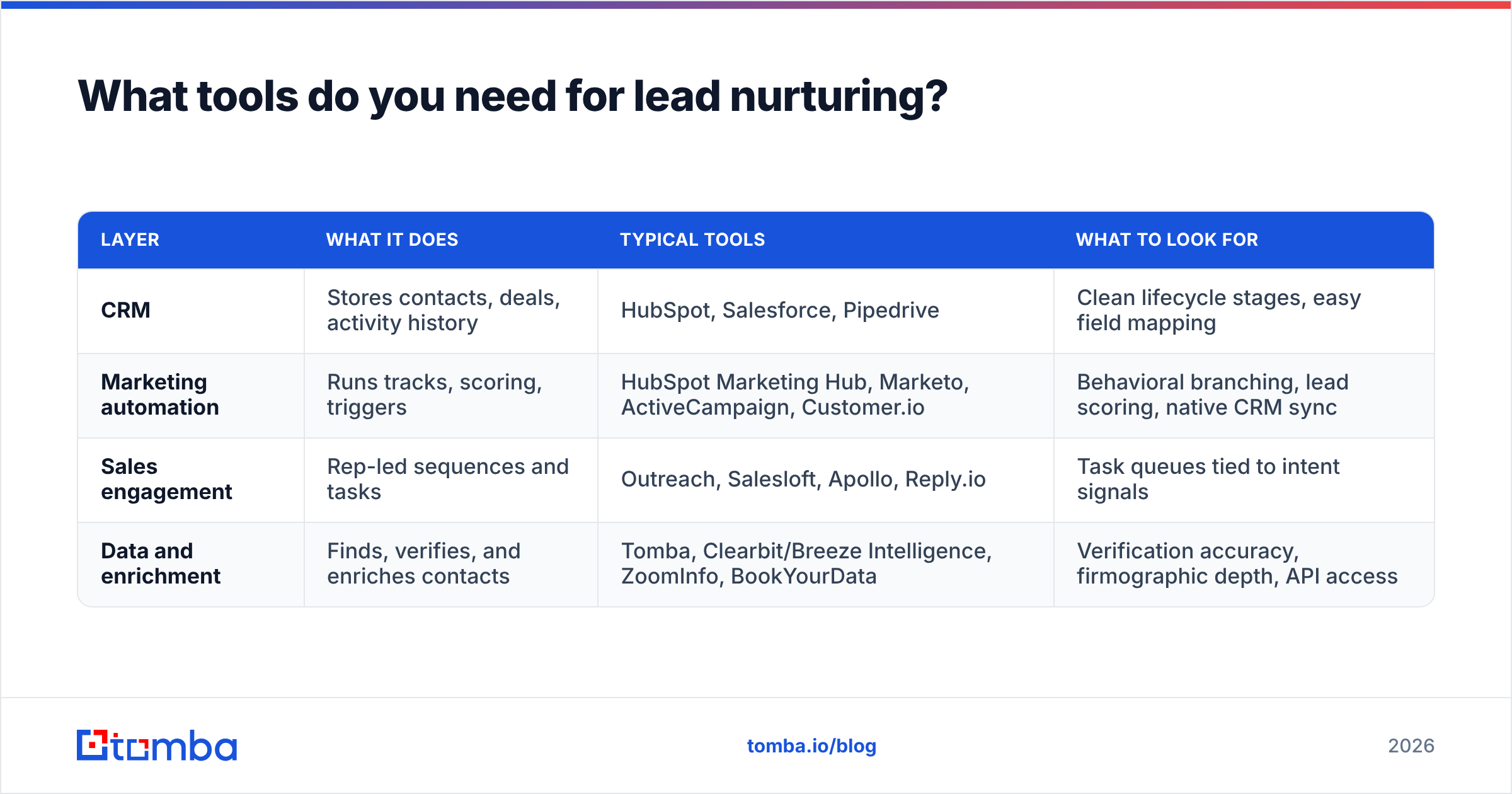
You need three layers: a system of record, an automation engine, and a data layer that keeps contacts accurate. Most teams put a lot of effort into the first two and skip the third.
| Layer | What it does | Typical tools | What to look for |
|---|---|---|---|
| CRM | Stores contacts, deals, activity history | HubSpot, Salesforce, Pipedrive | Clean lifecycle stages, easy field mapping |
| Marketing automation | Runs tracks, scoring, triggers | HubSpot Marketing Hub, Marketo, ActiveCampaign, Customer.io | Behavioral branching, lead scoring, native CRM sync |
| Sales engagement | Rep-led sequences and tasks | Outreach, Salesloft, Apollo, Reply.io | Task queues tied to intent signals |
| Data and enrichment | Finds, verifies, and enriches contacts | Tomba, Clearbit/Breeze Intelligence, ZoomInfo, BookYourData | Verification accuracy, firmographic depth, API access |
For many small and mid-size teams, HubSpot covers the CRM and automation layers well enough. Enterprise teams on Salesforce usually pair it with Marketo or Account Engagement. Whichever you choose, the data layer determines whether the automation reaches actual people.
Why do most lead nurturing programs fail?#
There are usually a few causes, and most of them have little to do with copywriting.
The contact data has gone stale. B2B contact data decays quickly because people change jobs, get promoted, and leave companies. A lead captured nine months ago may have a dead inbox now. Send a nurture track to that list and bounces pile up, your domain reputation drops, and good emails start landing in spam. Run the list through an email verifier before enrollment, and again every quarter.
The form doesn't capture enough to segment. Long forms lower conversions, so teams ask for just an email. Then every lead lands in one generic track because there's no role or company data. The fix is to keep the short form and add data enrichment afterward, filling in job title, company size, industry, and location from the email address.
Scoring is built on vanity signals. If an email open is worth 5 points, Apple Mail Privacy Protection's automatic opens can push a lead to MQL status without them ever reading anything. Weight scoring toward high-intent actions like pricing page visits, demo video views, and replies. Reduce the weight of opens.
Sales doesn't follow up. Marketing passes over a lead and nobody calls for four days. By then the intent has faded. Set an SLA (same business day for hot leads is a reasonable target) and track whether it's met.
Nobody exits the track. Leads keep getting emails after they've booked a meeting, become customers, or asked to stop. Build exit conditions into every track from the start.
That last point matters because reps usually go after the newest leads and let older, already-warm MQLs sit. Leads you nurtured for 90 days often convert better than cold new contacts, but only if someone follows up with them.
How do you measure lead nurturing success?#
Open and click rates are useful for diagnosing problems, but they don't show whether the program is working. Track these instead:
- MQL-to-SQL conversion rate: the share of nurtured leads sales accepts. A low number means your scoring or handoff is off.
- Time to opportunity: how long it takes from first conversion to a created opportunity. Good nurturing should shorten this.
- Pipeline sourced or influenced: the dollar value of opportunities that went through a nurture track. This is the number leadership cares about.
- Reply rate on nurture emails: real replies, not auto-responders. Replies show a conversation has started. See our notes on email response rate for benchmarks.
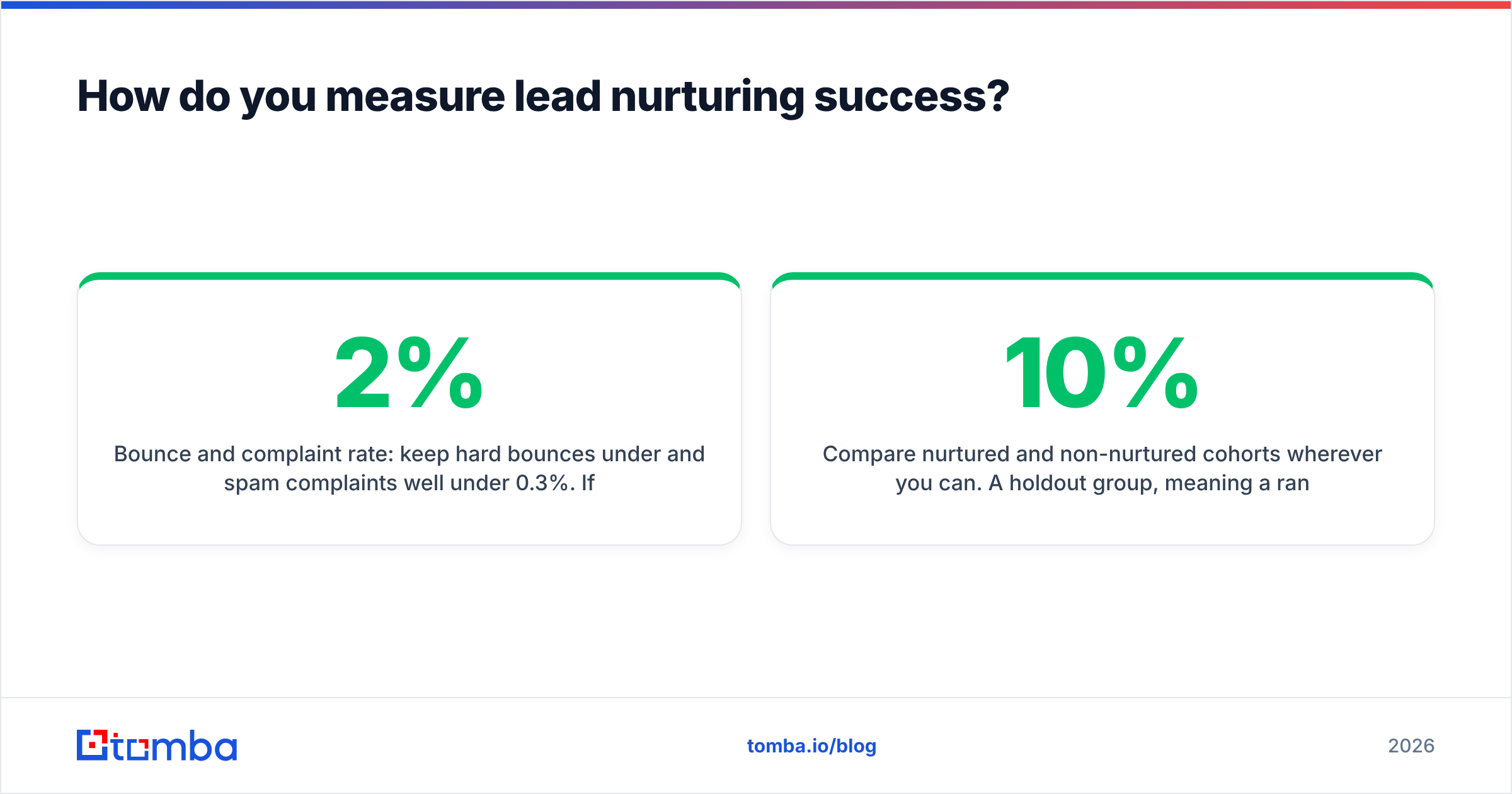
- Bounce and complaint rate: keep hard bounces under 2% and spam complaints well under 0.3%. If either goes above that, pause and clean the list.
- Unsubscribe rate by track: a track with high unsubscribes is sending the wrong content to the wrong segment.
Compare nurtured and non-nurtured cohorts wherever you can. A holdout group, meaning a random 10% of leads who don't get the track, is the most honest way to show the program's impact.
Is lead nurturing the same as lead scoring?#
No, but they depend on each other. Lead scoring measures how ready a lead is: fit (do they match your ICP?) plus engagement (what have they done?). Lead nurturing is what you do based on that score.
Scoring without nurturing means you know who's cold and do nothing about it. Nurturing without scoring means you send the same content to everyone and can't tell when to pass a lead to sales. Build both together, and review score thresholds with sales every quarter. What counted as "sales-ready" in January is often wrong by July.
How do you build a lead nurturing program from scratch?#
If you're starting from nothing, do it in this order:
- Audit your database. Export every non-customer contact. Verify emails, remove duplicates, and flag missing fields. Expect to lose a real share of the list, which is better than having it bounce later.
- Enrich what's left. Add role, seniority, company size, and industry so you can segment.
- Pick one persona and one stage. Build a single six-email track for your highest-value segment. Don't try to cover everyone in week one.
- Define scoring and handoff. Write down, with sales, what makes a lead an MQL and an SQL, and the follow-up SLA.
- Connect CRM and automation. Make sure lifecycle stages sync both ways. A HubSpot integration or native Salesforce sync keeps enriched fields current without manual CSV imports.
- Launch, measure for 30 days, then expand. Add a second persona track only after the first one shows movement in MQL-to-SQL rate.
This takes about six weeks for a small team. It's slower than turning on a 12-email drip to everyone, but it won't damage your domain, and it gives you a baseline to improve on.
What's the bottom line on lead nurturing?#
Lead nurturing is where most B2B pipeline is actually built. The main tactics haven't changed much in years. What changed is the penalty for doing them carelessly: stricter inbox providers, buyers with little patience, and generic AI copy everywhere. Teams that do well in 2026 start with accurate data, let behavior drive each touch, and hold sales to a real handoff.
Start with the data layer, because every other part depends on it. If you need to fill gaps in your lead records or rebuild contacts that went stale, Tomba Email Finder finds verified professional emails by name, domain, or company, and it connects to the CRM and automation tools you already use. The free tier includes 25 searches a month, and paid plans start at $49/mo. That's enough to clean up a first nurture track before you scale it.
Related guides#
Ready to find emails that actually work?
Join 150,000+ professionals who stopped guessing and started sending. Free credits on signup — no credit card required.
Get the Tomba newsletter
Practical outbound tactics and product updates — once every two weeks.
About the author