Lead Nurturing Best Practices: 11 Tactics That Work in 2026
Most nurture sequences fail before the first email is opened: bad data, the wrong timing, one message for everyone. These 11 lead nurturing best practices fix the whole system, from contact data to handoff.
TL;DR
- Lead nurturing works when every message reacts to what a lead has done. A fixed calendar of "checking in" emails does not.
- Before you write any copy, fix your contact data. A nurture track sent to bad addresses damages your sender reputation and your reporting along with it.
- Split your tracks by buying stage and by persona, score on behavior as well as firmographics, and write down the point where a lead goes to sales.
- Use more than one channel (email, LinkedIn, retargeting, phone), and give each channel its own job.
- Judge nurture by pipeline created and time-to-opportunity. Open rate alone tells you very little.
What is lead nurturing, and why do most programs underperform?#
Lead nurturing is how you build a relationship with prospects who aren't ready to buy yet. You keep sending them useful, relevant contact until they are ready, and then you pass them to sales with context.
Think of it like a good bartender. They don't push the most expensive bottle at someone who just walked in. They pay attention to what you order, remember what you liked, and suggest the next drink when it makes sense. Most nurture programs act more like a vending machine: the same product goes to every person on the same schedule, whatever they've said or done.
Most programs fail for three reasons:
- The data underneath is weak. Addresses are outdated, job titles are missing, and the "company" field says "gmail.com." You can't segment people you can't identify.
- The sequence is built around the calendar. Day 1, day 4, day 9, day 14, and nothing changes based on what the lead actually does.
- Nobody owns the handoff. Marketing thinks a lead is ready. Sales disagrees. The lead sits in a CRM queue until it goes cold.
The best practices below cover all three, in the order you should tackle them.
What are the core lead nurturing best practices in 2026?#
Here are the eleven practices, grouped by the part of the system they fix. The first four are prerequisites. If you skip them, the rest won't have much effect.
- Start with verified, enriched contact data. You can't personalize or segment records that are wrong or empty.
- Segment by buying stage and persona. A CFO in the evaluation stage needs different content from an ops manager in the research stage.
- Define lifecycle stages in writing. Agree on the entry criteria for subscriber, lead, MQL, SQL and opportunity before you build anything.
- Score on behavior, not just fit. Firmographics tell you who a lead is. Behavior tells you when they're ready.
- Trigger messages from actions, not dates. A pricing-page visit should change what the lead gets next.
- Give each touch one job. Every email should teach one thing or ask for one small step.
- Go multi-channel on purpose. Email, LinkedIn, retargeting and phone each do different work.
- Personalize past the first-name token. Use industry, tech stack, role and recent activity.
- Set a clear sales handoff and SLA. Decide who follows up, how fast, and with what context.
- Recycle leads that aren't ready, don't delete them. Send them back into a lighter track with a reason code.
- Measure pipeline, not opens. Tie each nurture track to opportunities and revenue.
Why does data quality come before any nurture sequence?#
Nurture programs run for weeks or months, so bad data compounds. If 10% of the addresses in a cold outbound batch bounce, you have one bad day. If a nurture track keeps mailing that same 10% on every step for three months, you build a steady record of hard bounces. Mailbox providers read that as a sign you don't manage your list.
Before a lead enters a track, do two things.
Verify the address. Run every new lead through an email verifier at the point of capture or import. Pay extra attention to catch-all domains, which accept all mail at the server level and hide whether the specific mailbox exists. Flag those records and give them a more conservative sending pattern.
Enrich the record. A form fill with just a name and email doesn't give you enough to segment. Data enrichment adds company size, industry, role, seniority and location. Those are the fields your branching logic needs. Without them, "segment by persona" can't actually happen.
A useful rule: no lead enters a nurture track without a verified email and at least three firmographic fields filled in. Short forms keep conversion high, and enrichment fills in the rest after capture.
How should you segment nurture tracks?#
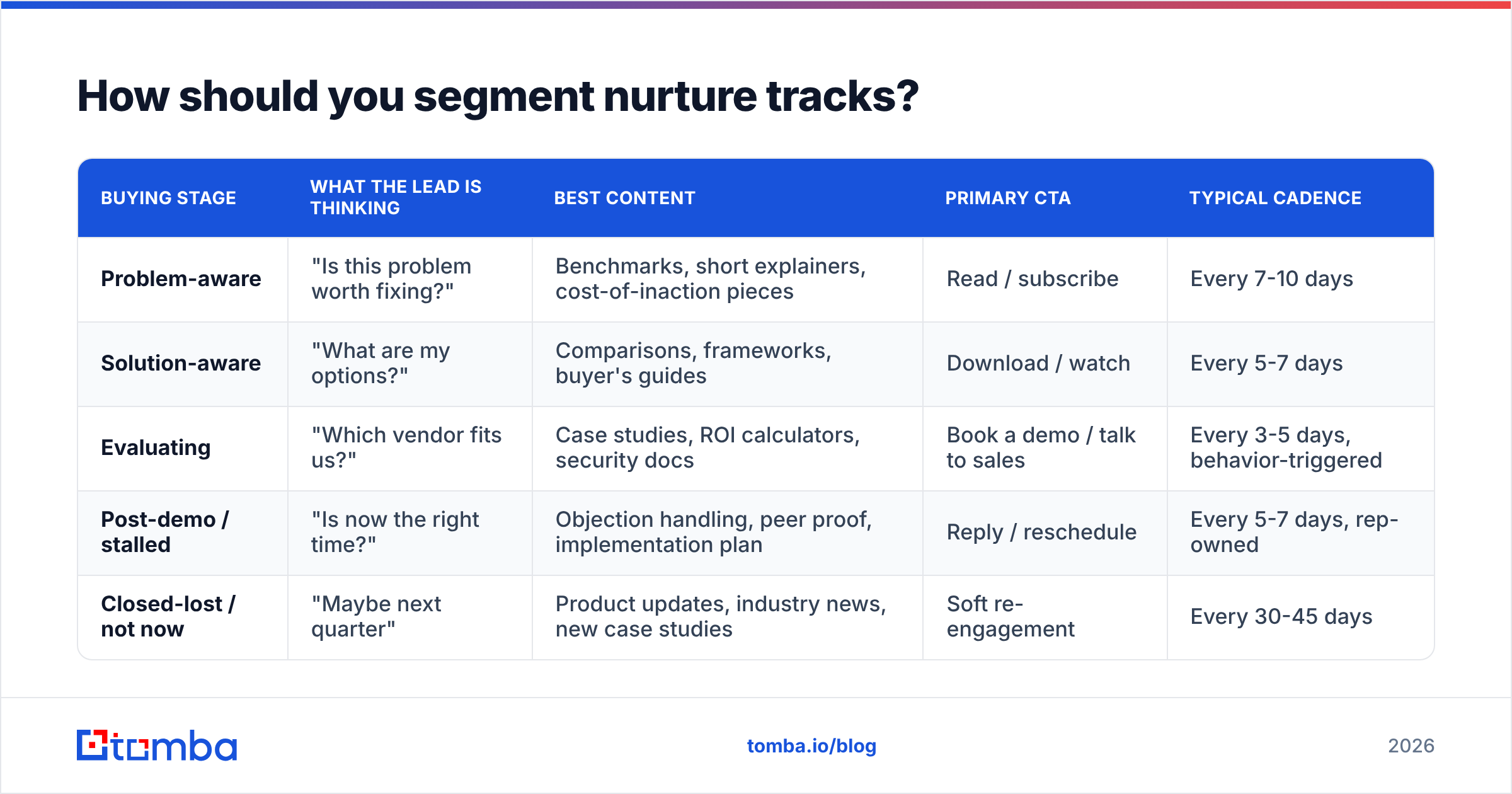
Use two dimensions: buying stage (how close they are to a decision) and persona (what they care about). One generic track for everyone is the most common mistake in B2B nurture.
Here's how the stages usually differ in practice:
| Buying stage | What the lead is thinking | Best content | Primary CTA | Typical cadence |
|---|---|---|---|---|
| Problem-aware | "Is this problem worth fixing?" | Benchmarks, short explainers, cost-of-inaction pieces | Read / subscribe | Every 7-10 days |
| Solution-aware | "What are my options?" | Comparisons, frameworks, buyer's guides | Download / watch | Every 5-7 days |
| Evaluating | "Which vendor fits us?" | Case studies, ROI calculators, security docs | Book a demo / talk to sales | Every 3-5 days, behavior-triggered |
| Post-demo / stalled | "Is now the right time?" | Objection handling, peer proof, implementation plan | Reply / reschedule | Every 5-7 days, rep-owned |
| Closed-lost / not now | "Maybe next quarter" | Product updates, industry news, new case studies | Soft re-engagement | Every 30-45 days |
Then add persona on top. For most B2B products you only need two or three: the economic buyer (budget and risk), the champion (daily workflow) and sometimes a technical evaluator (integration and security). Write one core message per stage, then change the proof points and examples for each persona. You don't need a separate campaign for every combination.
Which scoring model should you use to decide when a lead is ready?#
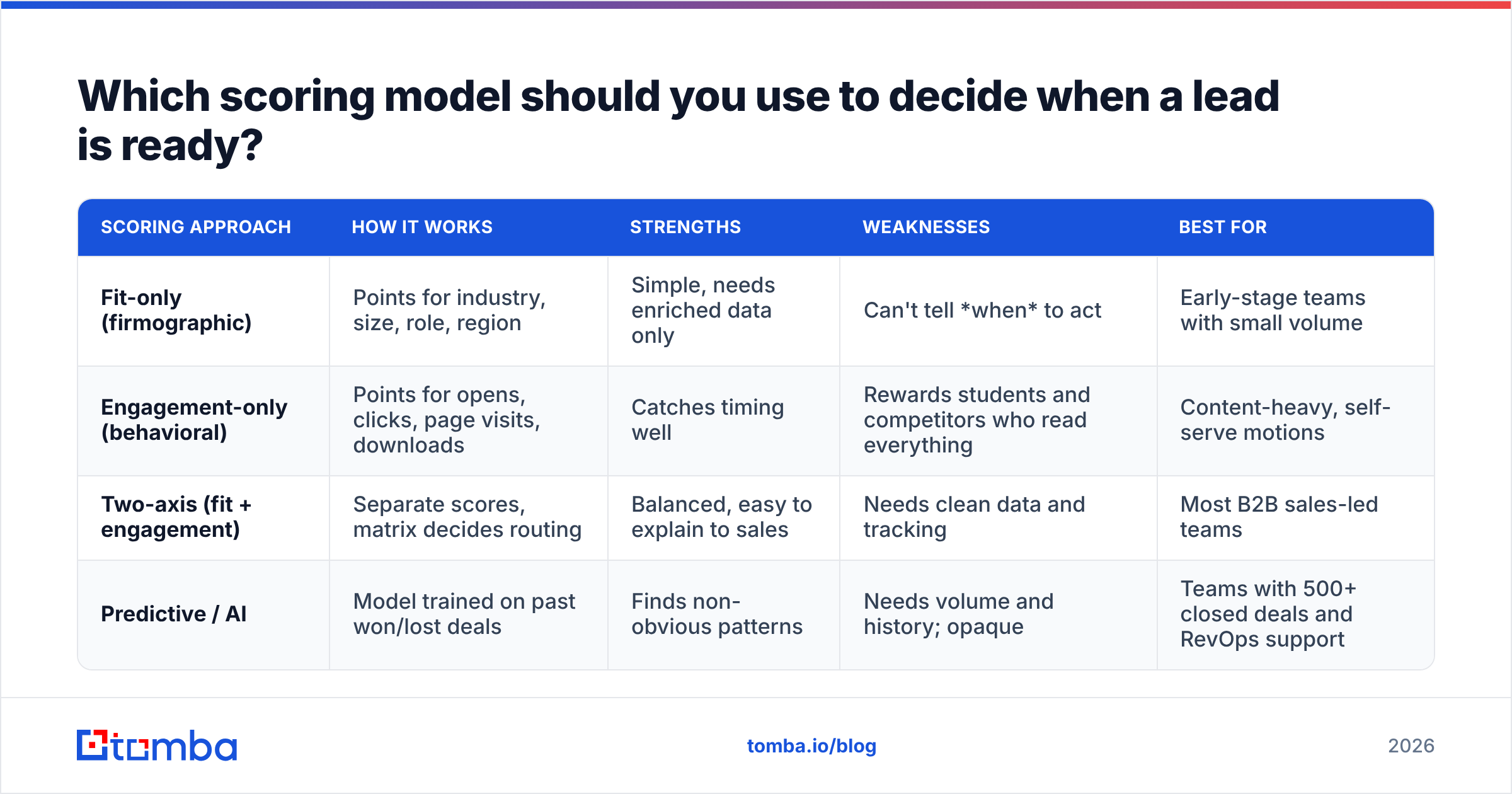
Use a two-axis model: fit score (does this company and person match your ideal customer profile?) plus engagement score (are they showing buying intent right now?). If you use only one of these, you'll either send cold enterprise contacts to sales or ignore warm small-business buyers.
| Scoring approach | How it works | Strengths | Weaknesses | Best for |
|---|---|---|---|---|
| Fit-only (firmographic) | Points for industry, size, role, region | Simple, needs enriched data only | Can't tell when to act | Early-stage teams with small volume |
| Engagement-only (behavioral) | Points for opens, clicks, page visits, downloads | Catches timing well | Rewards students and competitors who read everything | Content-heavy, self-serve motions |
| Two-axis (fit + engagement) | Separate scores, matrix decides routing | Balanced, easy to explain to sales | Needs clean data and tracking | Most B2B sales-led teams |
| Predictive / AI | Model trained on past won/lost deals | Finds non-obvious patterns | Needs volume and history; opaque | Teams with 500+ closed deals and RevOps support |
A few scoring rules that hold up:
- Weight high-intent actions heavily. A pricing-page visit, a return visit within 48 hours, or several people from one account engaging together should count for much more than a newsletter open.
- Decay engagement points. A click from 90 days ago doesn't mean anything today. Take points off over time.
- Stop counting open-based points. Privacy features in mail clients inflate opens. Treat opens as a weak signal at best.
When a lead crosses your threshold, it becomes a marketing qualified lead. Write that threshold down, share it with sales, and review it every quarter against conversion data.
Should nurture emails be time-based or behavior-based?#
Use both, with behavior taking priority. The time-based track is a baseline that stops a lead from going silent. Behavior triggers take over as soon as the lead does something meaningful.
Triggers worth building first:
- Pricing or comparison page visit → send a short, relevant case study within 24 hours, and alert the owning rep if fit is high.
- Multiple contacts from one account engaged → treat it as an account-level signal and route it to the account owner.
- Webinar attended vs. registered but no-show → two different follow-ups. The no-show gets the recording. The attendee gets the next logical step.
- Content download on a specific use case → move the lead into the persona or use-case branch for that topic.
- No engagement for 60+ days → pause the track and put them in a re-engagement or sunset flow.
Most mainstream marketing automation platforms support this branching natively. HubSpot workflows and Salesforce Marketing Cloud journeys both let you branch on page views, form submissions and property changes. If your CRM is the source of truth, a native connector such as the Tomba HubSpot integration keeps enriched fields in sync, so your branching logic isn't reading stale values.
How many channels should a nurture program use?#
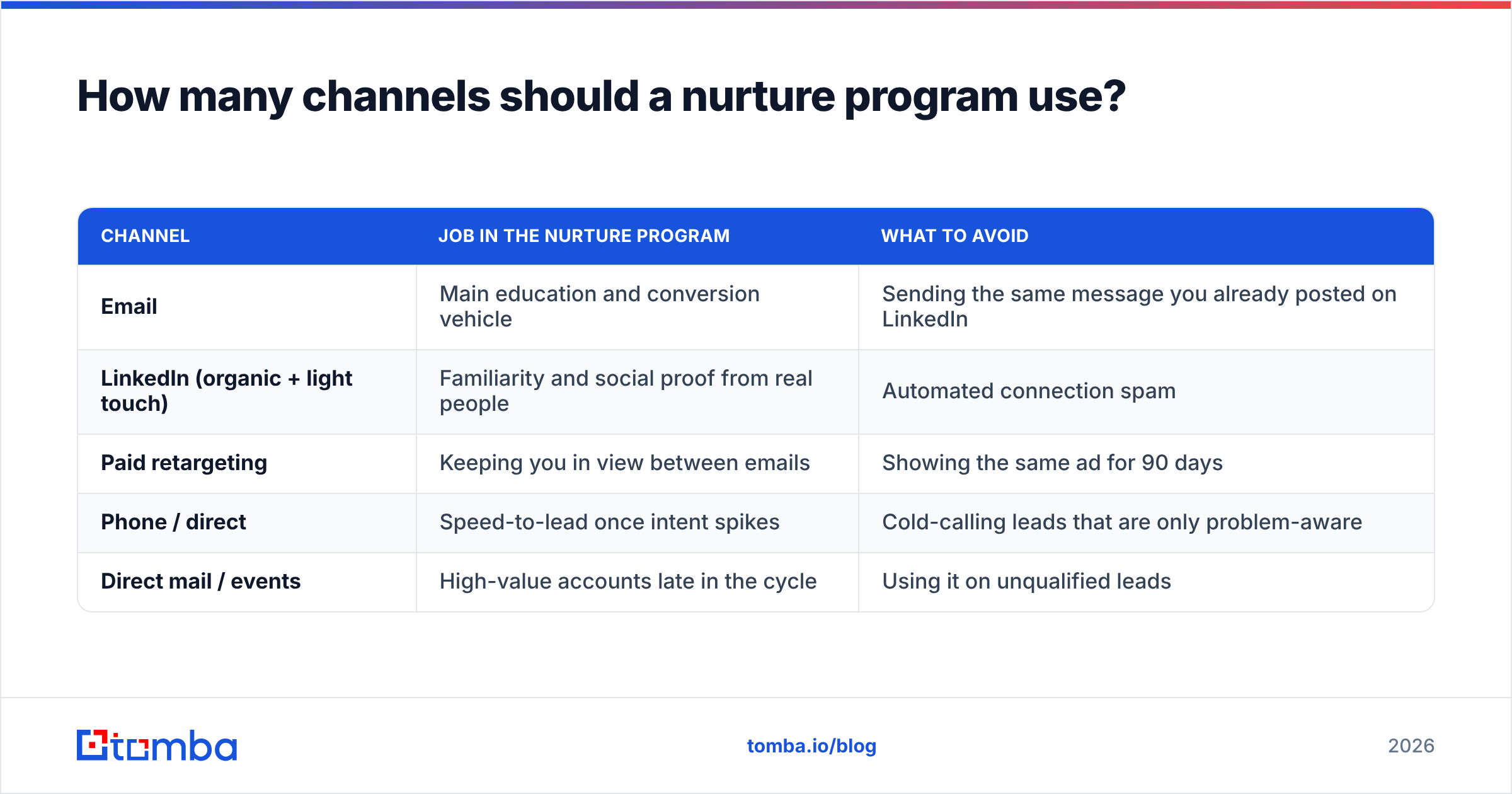
Usually three or four, and each needs a defined job. Using more channels only helps if each one does something the others can't.
| Channel | Job in the nurture program | What to avoid |
|---|---|---|
| Main education and conversion vehicle | Sending the same message you already posted on LinkedIn | |
| LinkedIn (organic + light touch) | Familiarity and social proof from real people | Automated connection spam |
| Paid retargeting | Keeping you in view between emails | Showing the same ad for 90 days |
| Phone / direct | Speed-to-lead once intent spikes | Cold-calling leads that are only problem-aware |
| Direct mail / events | High-value accounts late in the cycle | Using it on unqualified leads |
For account-based motions, coordinate by account, not by individual. If the VP of Sales at an account just booked a demo, the other four contacts there shouldn't keep getting top-of-funnel newsletters. Suppress or reroute them.
How do you personalize nurture content without it feeling creepy?#
Personalize using context the lead would expect you to have. Avoid anything that makes it obvious you've been watching them.
Good personalization:
- Industry-specific examples and case studies
- Role-specific pain points ("for RevOps leaders, the problem is usually…")
- References to their tech stack when it affects your product ("works with your existing Salesforce setup")
- Following up on content they explicitly downloaded
Personalization that feels invasive:
- "I noticed you visited our pricing page three times yesterday at 11pm"
- Referencing personal social media posts
- Naming colleagues who engaged without their consent
The rule is simple. Use behavioral data to decide what to send and when. Don't narrate that data back to the lead.
What makes a good lead nurturing email?#
Give each email one idea and one small ask. Nurture emails compete with a full inbox, so short and specific beats long and complete.
A reliable structure:
- Subject line tied to a specific problem. "How [peer company] cut bounce rates before scaling outbound" works better than "Our March newsletter."
- One or two opening sentences that name the situation. No throat-clearing.
- One insight, stat or example. Only one.
- One low-friction CTA. Read, reply, watch, or book. Pick one of those, not four.
- Plain-text or lightly formatted. Heavily designed templates often look like marketing and get filtered accordingly.
Test with a real person on the other end. Reply-based CTAs ("Does this match what you're seeing? Just reply yes/no") often lead to better conversations than links. They also send a positive engagement signal to mailbox providers.
How should marketing hand leads off to sales?#
Use a written service-level agreement that covers three things: what qualifies a lead, how fast sales responds, and what context comes with the lead.
- Qualification: the fit + engagement threshold from your scoring model, written in plain language.
- Response time: a specific window, such as within one business hour for demo requests or within one business day for score-based MQLs. Speed matters. Research from firms like Gartner consistently finds that B2B buyers spend only a small share of their buying journey talking to vendors, so every live window counts.
- Context: the lead record should show which content they engaged with, what triggered the handoff, and any enriched firmographics. A rep who opens a call with "So, what made you download that?" has already lost points.
Close the loop in both directions. If sales rejects a lead, they choose a reason code ("wrong persona," "no budget," "timing," "bad data"), and the lead goes back into the right recycle track. The "bad data" code in particular usually shows problems upstream in capture or enrichment.
What should you do with leads that aren't ready?#
Recycle them. A lead that isn't ready this quarter is still worth something next quarter, and deleting it throws away acquisition cost you've already paid.
Set up a light "not now" track:
- Contact every 30-45 days, not weekly.
- Send only high-value content: major product updates, original research, strong new case studies.
- Re-verify the email address every six months. People change jobs often, and a contact who was valid at capture may bounce a year later.
- Re-score automatically when engagement picks up again. A dormant lead that suddenly visits three times is often your warmest opportunity.
If a lead has had zero engagement for 6-12 months, sunset it. Suppressing unengaged contacts protects your sender reputation and keeps your engagement metrics honest.
Which metrics prove lead nurturing is working?#
Measure outcomes that lead to revenue. Activity metrics are useful for diagnosing problems, but they don't prove the program works.
Primary metrics (report to leadership):
- Nurture-sourced or nurture-influenced pipeline ($)
- MQL → SQL conversion rate, by track
- Median time from first touch to opportunity
- Win rate of nurtured vs. non-nurtured opportunities
Diagnostic metrics (use to tune the program):
- Click and reply rate per email and per branch
- Bounce rate per track (it should stay low; a spike means a data problem)
- Unsubscribe and spam-complaint rate
- Drop-off step: where leads stop engaging
Review diagnostics weekly and outcomes monthly. If one track has solid clicks but weak MQL conversion, the content is interesting but aimed at the wrong stage. If bounces go up on an older track, re-verify the list before sending again.
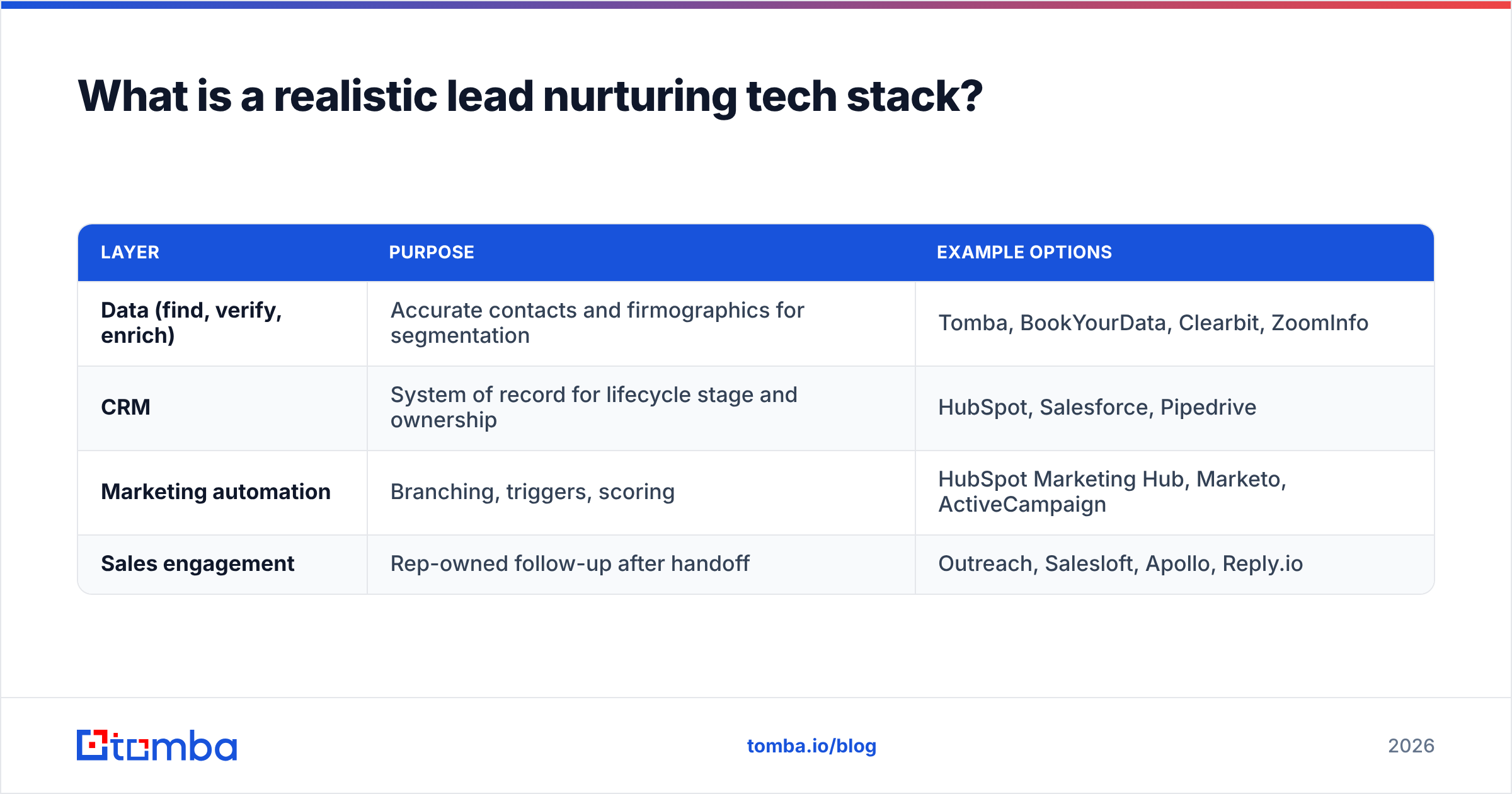
What is a realistic lead nurturing tech stack?#
You don't need an enterprise suite to get this right. A working stack has four layers:
| Layer | Purpose | Example options |
|---|---|---|
| Data (find, verify, enrich) | Accurate contacts and firmographics for segmentation | Tomba, BookYourData, Clearbit, ZoomInfo |
| CRM | System of record for lifecycle stage and ownership | HubSpot, Salesforce, Pipedrive |
| Marketing automation | Branching, triggers, scoring | HubSpot Marketing Hub, Marketo, ActiveCampaign |
| Sales engagement | Rep-owned follow-up after handoff | Outreach, Salesloft, Apollo, Reply.io |
Start with the data layer and the CRM. Once lifecycle stages and clean records are in place, add automation. Automating a workflow built on messy data just scales the mess.
Final checklist before you launch a nurture track#
- Every lead in the track has a verified email and enriched firmographics
- Lifecycle stages and MQL criteria are documented and agreed with sales
- Tracks are segmented by stage and at least two personas
- At least three behavior triggers override the time-based baseline
- Each email has one idea and one CTA
- Handoff SLA includes response time and required context
- Recycle and sunset rules are live
- Reporting ties the track to pipeline, not just opens
A nurture program depends on the data it starts from. If addresses bounce and records are missing role or company fields, segmentation, scoring and handoff all break down. Tomba Email Finder helps you find and verify professional email addresses by name, domain or company, so the leads entering your tracks are real, reachable and ready to segment. You can start on the free tier with 25 searches a month and move to paid plans from $49/mo when your program scales.
Related guides#
// get started
Find, verify and enrich your first contacts today
Start on the free plan with 25 searches a month, then scale when your team is ready.
Free plan · No credit card required · GDPR & CCPA
// about the author