Lead Nurturing Content Strategy: A Stage-by-Stage 2026 Playbook
Most nurture programs fail because the content doesn't match the buying stage, not because there isn't enough of it. Here's how to map every asset to a stage, fill the middle-of-funnel gap, and hand sales leads that are ready to talk.
TL;DR
- A lead nurturing content strategy only works when each asset is tied to a specific buying stage and a specific next action. A publishing calendar alone won't do that.
- Most B2B teams have plenty of top-of-funnel content and very little middle-of-funnel content. The leads stall in that gap.
- Build nurture tracks around behavior triggers, not fixed dates, and give each track one exit condition that signals sales-readiness.
- Bad contact data quietly wrecks nurture programs. Verify and enrich before you enroll anyone, or your engagement metrics will mislead you.
- Measure stage progression and time-to-opportunity, not opens. Opens tell you almost nothing in 2026.
What is a lead nurturing content strategy?#
A lead nurturing content strategy is a plan for which content a prospect should see between first contact and a sales conversation, in what order, and why. It decides what to say to someone who downloaded your guide but isn't ready for a demo. It also decides what signals mean they're ready now.
It's different from a general content strategy. A general strategy asks "what should we publish?" A nurturing strategy asks "what does this lead need next to move one step closer to buying?" The first fills a blog. The second fills a pipeline.
Here's the practical difference. Your blog post on cold email benchmarks brings in a stranger. Your nurture sequence turns that stranger into a marketing qualified lead, and then into someone who takes a meeting. You need both. They are built differently, and they're measured differently.
For background, lead nurturing sits downstream of lead generation. Generation captures the contact. Nurturing earns the conversation.
Why do most lead nurturing programs underperform?#
They usually have the wrong content in the wrong place. Budget and tooling are rarely the problem. When you audit a typical B2B nurture program, three patterns show up again and again.
1. The program is really a newsletter. Every lead gets the same weekly digest whether they read one article or asked for pricing three times. That's broadcasting, and it doesn't nurture anyone.
2. The middle of the funnel is empty. Teams produce lots of awareness content (blog posts, checklists, listicles) and some bottom-funnel content (demos, pricing pages). Almost nothing helps a buyer compare approaches, build an internal business case, or answer "how would this work for a company like mine?"
3. The data underneath is dirty. A meaningful share of enrolled contacts have bounced, changed jobs, or were never valid. Your "engagement rate" is really a rate over a shrinking, noisy base, and you end up optimizing against ghosts.
Gartner's research on the B2B buying journey found that buyers spend only a small share of their buying time, roughly 17%, meeting with potential suppliers. The rest goes to independent research and internal alignment. Your nurture content is doing sales's job for most of that journey, whether you planned it that way or not.
How do you map content to each buying stage?#
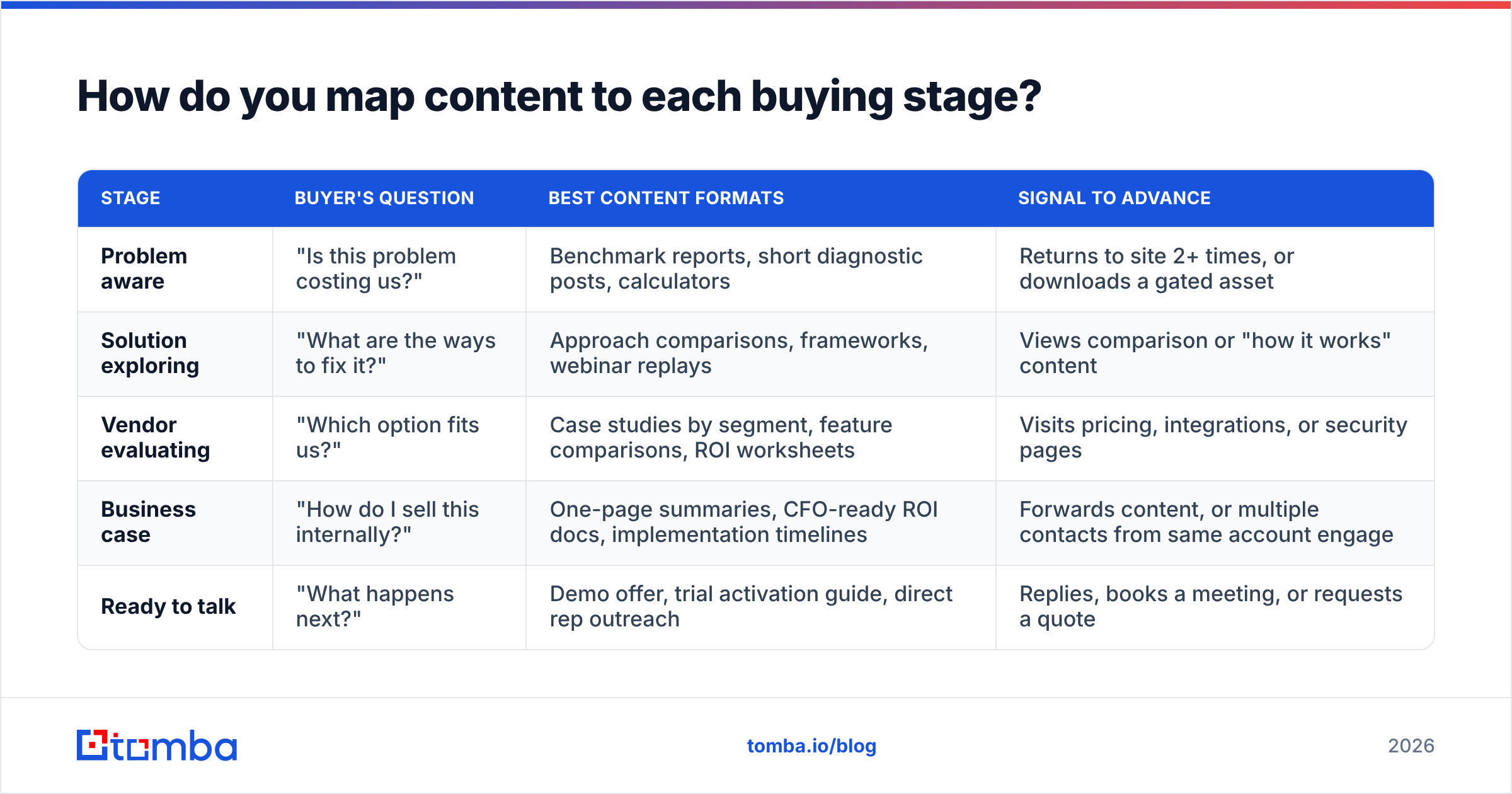
Start with the stages your buyers actually go through, not the funnel diagram from your last board deck. For most B2B products, five stages are enough. The table below shows what the buyer is thinking at each stage, which content formats fit, and which signal tells you to move them forward.
| Stage | Buyer's question | Best content formats | Signal to advance |
|---|---|---|---|
| Problem aware | "Is this problem costing us?" | Benchmark reports, short diagnostic posts, calculators | Returns to site 2+ times, or downloads a gated asset |
| Solution exploring | "What are the ways to fix it?" | Approach comparisons, frameworks, webinar replays | Views comparison or "how it works" content |
| Vendor evaluating | "Which option fits us?" | Case studies by segment, feature comparisons, ROI worksheets | Visits pricing, integrations, or security pages |
| Business case | "How do I sell this internally?" | One-page summaries, CFO-ready ROI docs, implementation timelines | Forwards content, or multiple contacts from same account engage |
| Ready to talk | "What happens next?" | Demo offer, trial activation guide, direct rep outreach | Replies, books a meeting, or requests a quote |
Two notes on using this table.
First, the "signal to advance" column matters more than the formats column. Without explicit signals, leads sit in stage one forever, or sales gets them too early and burns them.
Second, the business-case stage is the one teams skip most. Your champion is rarely the only decision-maker. If you don't give them material they can forward to a CFO or a security lead, the deal stalls in a meeting you're not invited to.
What content belongs in the middle of the funnel?#
The middle of the funnel is where nurture programs are won or lost, so it's worth being specific. Good MOFU content helps the buyer do one of three jobs: compare, justify, or picture the implementation.
Comparison content. This means honest "approach A vs approach B" pieces. They don't have to be vendor comparisons. "In-house SDRs vs outsourced lead gen" or "build vs buy for data enrichment" both work. Buyers trust content that admits trade-offs, so admit them.
Segment-specific case studies. A generic "Company X grew 3x" story doesn't help much. "How a 40-person agency cut research time per prospect" works better, because the reader can map it onto their own situation. Tag every case study by industry, company size, and use case so your automation can serve the right one.
Tools and worksheets. ROI calculators, readiness checklists, and templates get used rather than just read. They also carry your framing into internal meetings you'll never attend.
Objection-handling content. Look through your sales call notes for the five most common objections, then write one piece for each. If "we already have a CRM that does this" comes up weekly, publish the answer before the rep has to give it live.
Implementation previews. "What the first 30 days look like" reduces perceived risk more than a feature list does. Include the timeline, who needs to be involved, and what usually goes wrong.
Should nurture tracks be time-based or behavior-based?#
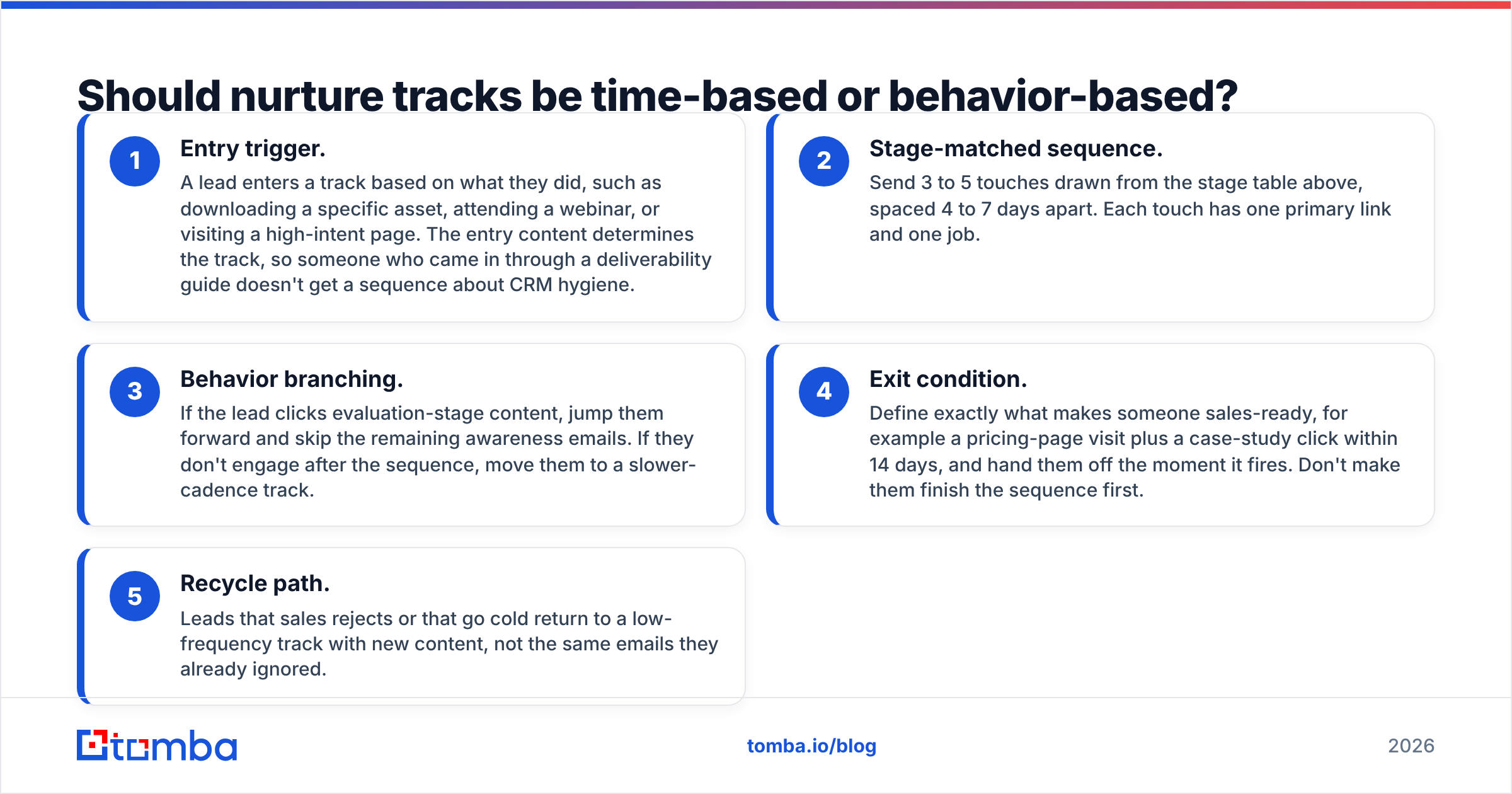
Behavior-based, with a time-based fallback. A pure drip ("email 1 on day 0, email 2 on day 3") ignores everything the lead is telling you through their actions. A pure behavior model can leave quiet leads untouched for months.
Here's a hybrid structure that works for most teams:
- Entry trigger. A lead enters a track based on what they did, such as downloading a specific asset, attending a webinar, or visiting a high-intent page. The entry content determines the track, so someone who came in through a deliverability guide doesn't get a sequence about CRM hygiene.
- Stage-matched sequence. Send 3 to 5 touches drawn from the stage table above, spaced 4 to 7 days apart. Each touch has one primary link and one job.
- Behavior branching. If the lead clicks evaluation-stage content, jump them forward and skip the remaining awareness emails. If they don't engage after the sequence, move them to a slower-cadence track.
- Exit condition. Define exactly what makes someone sales-ready, for example a pricing-page visit plus a case-study click within 14 days, and hand them off the moment it fires. Don't make them finish the sequence first.
- Recycle path. Leads that sales rejects or that go cold return to a low-frequency track with new content, not the same emails they already ignored.
Most marketing automation platforms support this kind of branching logic natively. HubSpot's Marketing Hub is a common choice for mid-market teams. The platform matters less than having the logic written down before you build anything.
How does contact data quality affect nurturing?#
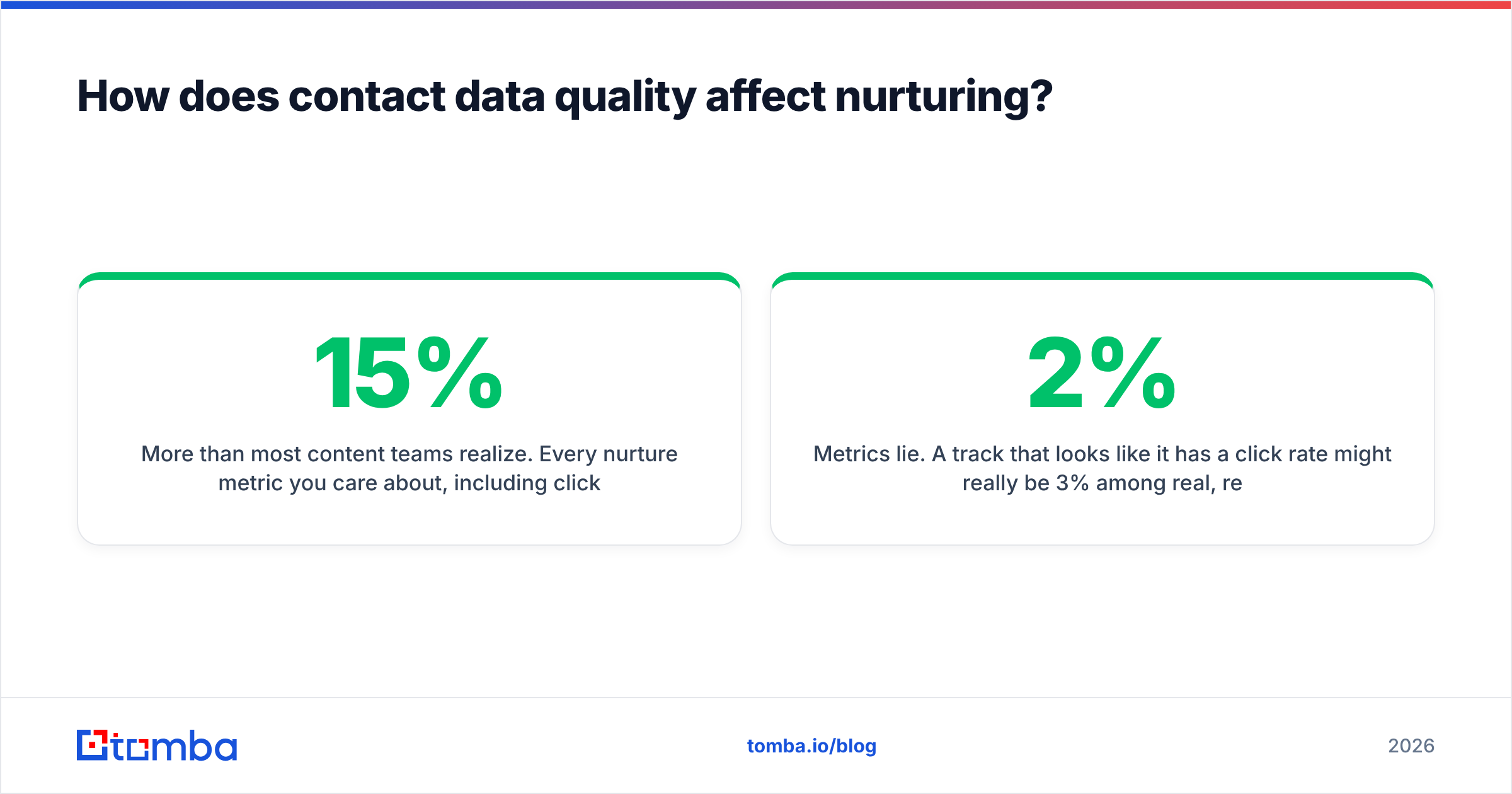
More than most content teams realize. Every nurture metric you care about, including click rate, stage progression, and MQL volume, is calculated over your enrolled list. If 15% of that list is invalid addresses or people who left the company, three things break:
- Deliverability degrades. Bounces and spam-trap hits hurt your sender reputation, so even your valid leads start seeing your emails in spam.
- Metrics lie. A track that looks like it has a 2% click rate might really be 3% among real, reachable humans. You end up rewriting content that was actually fine.
- Segmentation fails. Behavior branching depends on knowing who someone is: role, company size, industry. Thin records mean everyone falls into the default track.
The fix is procedural. Run every new lead through an email verifier before enrollment, and re-verify long-running tracks every quarter because B2B contacts decay as people change jobs. Then fill in the gaps with data enrichment so you have job title, seniority, company size, and industry. Those are the fields your branching logic needs.
When a lead gives you only a personal Gmail address, or when several people from one account engage but you only have one contact, finding the other stakeholders' work addresses lets you run an account-level nurture instead of a one-to-one drip. That matters most at the business-case stage, where multiple decision-makers are involved.
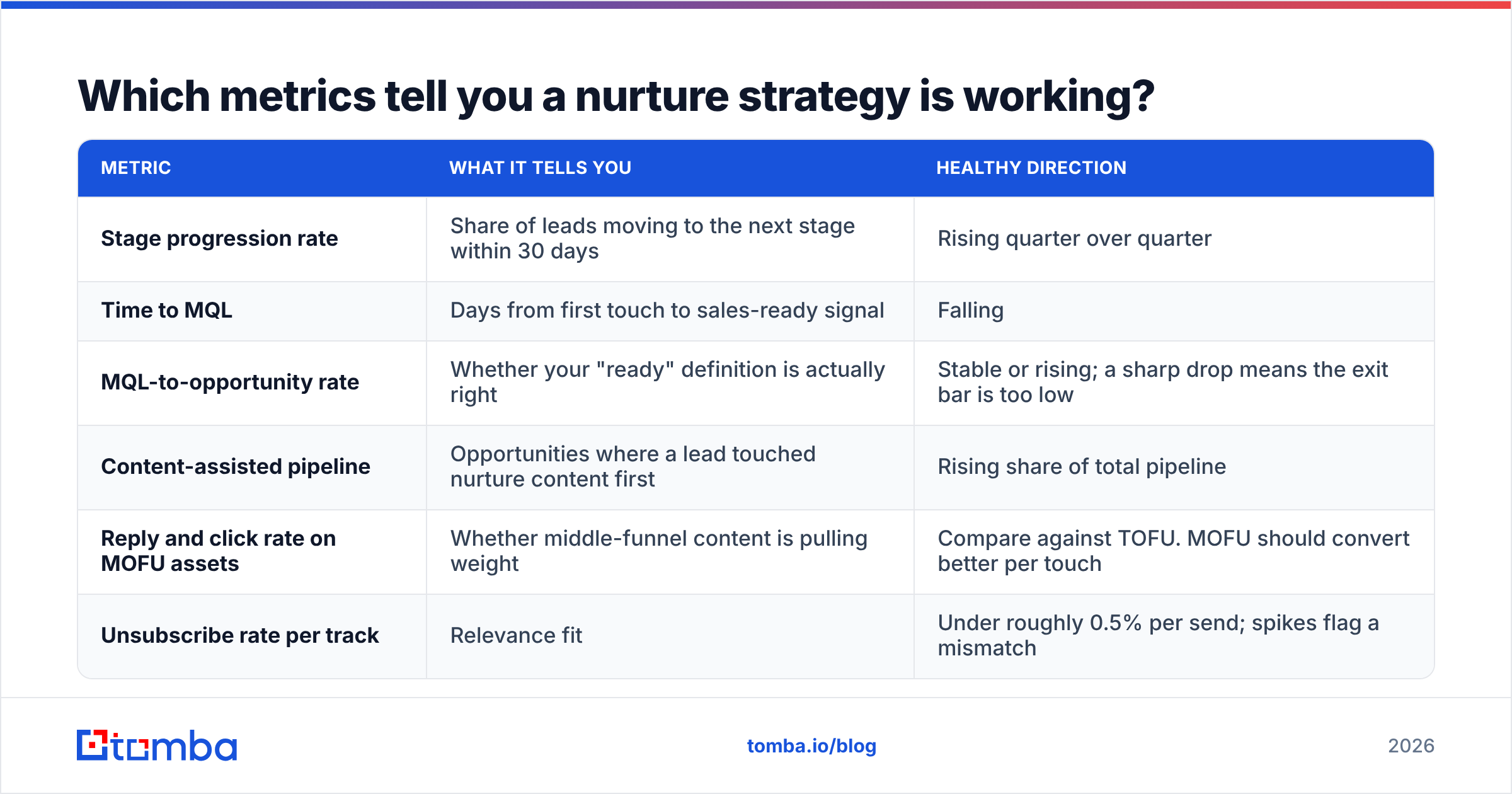
Which metrics tell you a nurture strategy is working?#
Stop reporting open rates as a primary KPI. Privacy protections on major mail clients have made opens unreliable for years. Track these instead:
| Metric | What it tells you | Healthy direction |
|---|---|---|
| Stage progression rate | Share of leads moving to the next stage within 30 days | Rising quarter over quarter |
| Time to MQL | Days from first touch to sales-ready signal | Falling |
| MQL-to-opportunity rate | Whether your "ready" definition is actually right | Stable or rising; a sharp drop means the exit bar is too low |
| Content-assisted pipeline | Opportunities where a lead touched nurture content first | Rising share of total pipeline |
| Reply and click rate on MOFU assets | Whether middle-funnel content is pulling weight | Compare against TOFU. MOFU should convert better per touch |
| Unsubscribe rate per track | Relevance fit | Under roughly 0.5% per send; spikes flag a mismatch |
The MQL-to-opportunity rate is your honesty check. If marketing is sending more MQLs but sales is converting fewer, your exit condition is too loose. That's a content-strategy problem, not just a sales problem. For more on reply behavior, see how response rate is typically defined and benchmarked.
What does a 90-day rollout look like?#
You don't need to rebuild everything at once. A realistic sequence for a small marketing team:
Days 1–30: Audit and map. Tag every existing asset by stage using the table above. You'll likely find 60–70% of your content sits in the first stage. List the gaps, especially evaluation and business-case content. Clean your existing nurture database: verify, suppress invalid contacts, and enrich missing firmographics.
Days 31–60: Build one track properly. Pick your highest-volume entry point, usually your most-downloaded gated asset, and build one full behavior-branched track with a written exit condition. Produce the two or three MOFU pieces that track needs. Agree on the handoff definition with sales in writing.
Days 61–90: Measure and extend. Compare stage progression for the new track against the old broadcast approach. If it's working, clone the structure for your next two entry points. If it isn't, check data quality before you blame the content.
The temptation during this rollout is to keep producing new awareness content because it's easier to make and easier to celebrate. Resist it for one quarter. One more listicle won't fix a pipeline that stalls at evaluation.
What are the most common mistakes to avoid?#
- Gating everything. Gate the assets that signal real intent, like ROI tools and in-depth reports. Leave educational content ungated so it can rank and spread.
- Writing every email as a sales pitch. If every touch ends with "book a demo," you train leads to ignore you. Match the call to action to the stage.
- Ignoring the account. In B2B, three people from the same company reading your content is a much stronger signal than one person reading three pieces. Score and nurture at the account level where you can.
- Setting and forgetting. Nurture content goes stale: outdated stats, retired features, dead links. Review each track at least twice a year.
- Enrolling unverified contacts. It's the cheapest mistake to prevent and one of the most expensive to ignore.
How do you get started this week?#
Pick one entry point, map the next three pieces of content a lead from that entry point needs, and write down the exact behavior that makes them sales-ready. That's a lead nurturing content strategy in miniature. Everything else is repetition and refinement.
Then make sure the people you're nurturing are real and reachable. When a lead gives you a partial record, or you need to reach the other stakeholders on a buying committee, Tomba Email Finder finds verified professional addresses by name, domain, or company, so your stage-matched content lands with the people who actually make the decision. You can start on the free tier with 25 searches a month and move to the Starter plan at $49/mo when your nurture volume grows. See the full Tomba pricing for Growth and Pro tiers.
Related guides#
Ready to find emails that actually work?
Join 150,000+ professionals who stopped guessing and started sending. Free credits on signup — no credit card required.
Get the Tomba newsletter
Practical outbound tactics and product updates — once every two weeks.
About the author