Lead Nurturing Email Best Practices: 11 Rules That Work in 2026
Most nurture sequences stall after the second email. These 11 lead nurturing email best practices cover segmentation, cadence, triggers, data hygiene and hand-off rules so warm leads keep moving toward a sales conversation.
TL;DR
- Lead nurturing emails exist to move a known lead one step closer to a sales conversation, not to "stay top of mind." Every email needs a job.
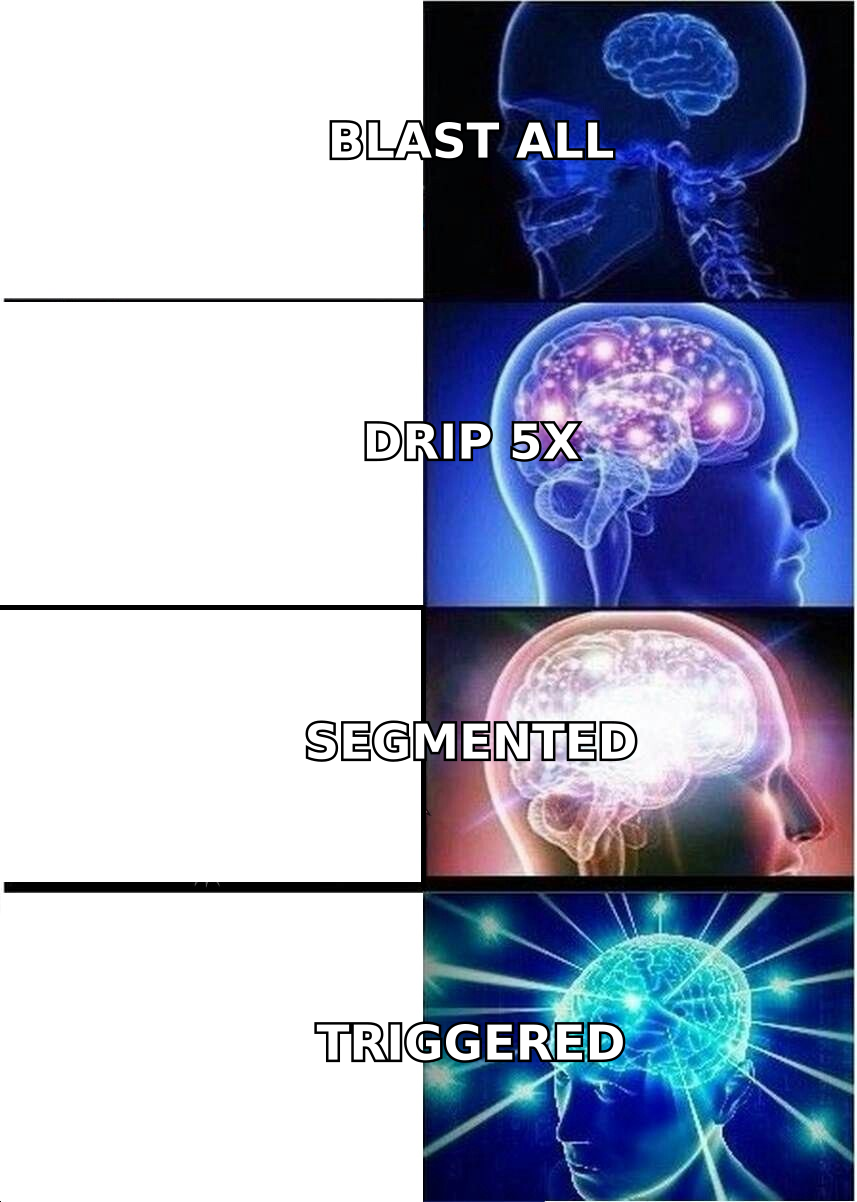
- Segment by stage and intent before you write anything. A five-email drip sent to everyone is a newsletter with a worse open rate.
- Behavioral triggers (pricing page visits, repeat content downloads, product sign-ups) beat fixed calendar cadences for replies and conversions.
- Bad data quietly wrecks nurture programs. Verify addresses and enrich records before a lead enters a sequence, or bounces will drag down your sender reputation.
- Set a clear hand-off rule to sales and a clear exit rule for leads who don't respond. Nurture without an exit turns into spam.
What is a lead nurturing email, and how is it different from cold email?#
A lead nurturing email goes to someone who already knows you. They downloaded a guide, attended a webinar, started a trial, or replied to an outbound message and said "not right now." They gave you a reason to email them again. Your job is to use that reason well.
Cold email is the first knock on the door. Nurture is every conversation after the door opens, up to the point where the lead is ready to talk to sales or has clearly told you they're not a fit.
That distinction changes three things:
- Permission. You have some level of consent or legitimate interest, so you can send more often and include more content than you would in cold outreach.
- Context. You know what the lead did. That behavior should shape every email you send.
- Goal. Cold email aims for a reply. Nurture aims for a stage change: from subscriber to marketing qualified lead, from MQL to sales-accepted, from stalled opportunity back to active.
If your nurture emails read like your cold emails, or like your monthly newsletter, the program isn't doing its job.
Why do most lead nurturing sequences fail?#
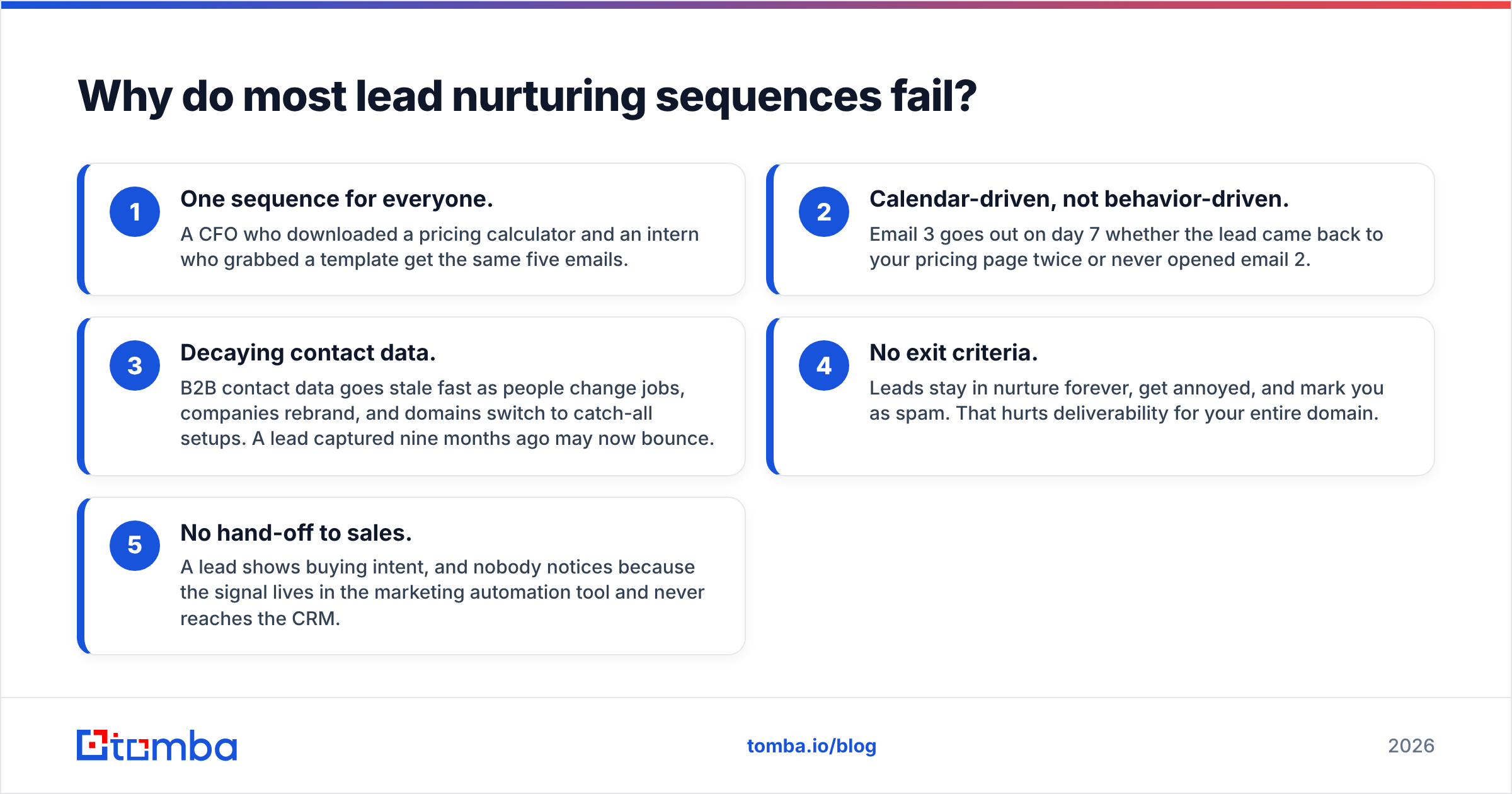
Most nurture programs fail for boring, fixable reasons, not because the copy is bad:
- One sequence for everyone. A CFO who downloaded a pricing calculator and an intern who grabbed a template get the same five emails.
- Calendar-driven, not behavior-driven. Email 3 goes out on day 7 whether the lead came back to your pricing page twice or never opened email 2.
- Decaying contact data. B2B contact data goes stale fast as people change jobs, companies rebrand, and domains switch to catch-all setups. A lead captured nine months ago may now bounce.
- No exit criteria. Leads stay in nurture forever, get annoyed, and mark you as spam. That hurts deliverability for your entire domain.
- No hand-off to sales. A lead shows buying intent, and nobody notices because the signal lives in the marketing automation tool and never reaches the CRM.
Each best practice below fixes one of these.
What are the core lead nurturing email best practices?#
These are the fundamentals. Get them in place before you worry about subject line tests or send-time optimization.
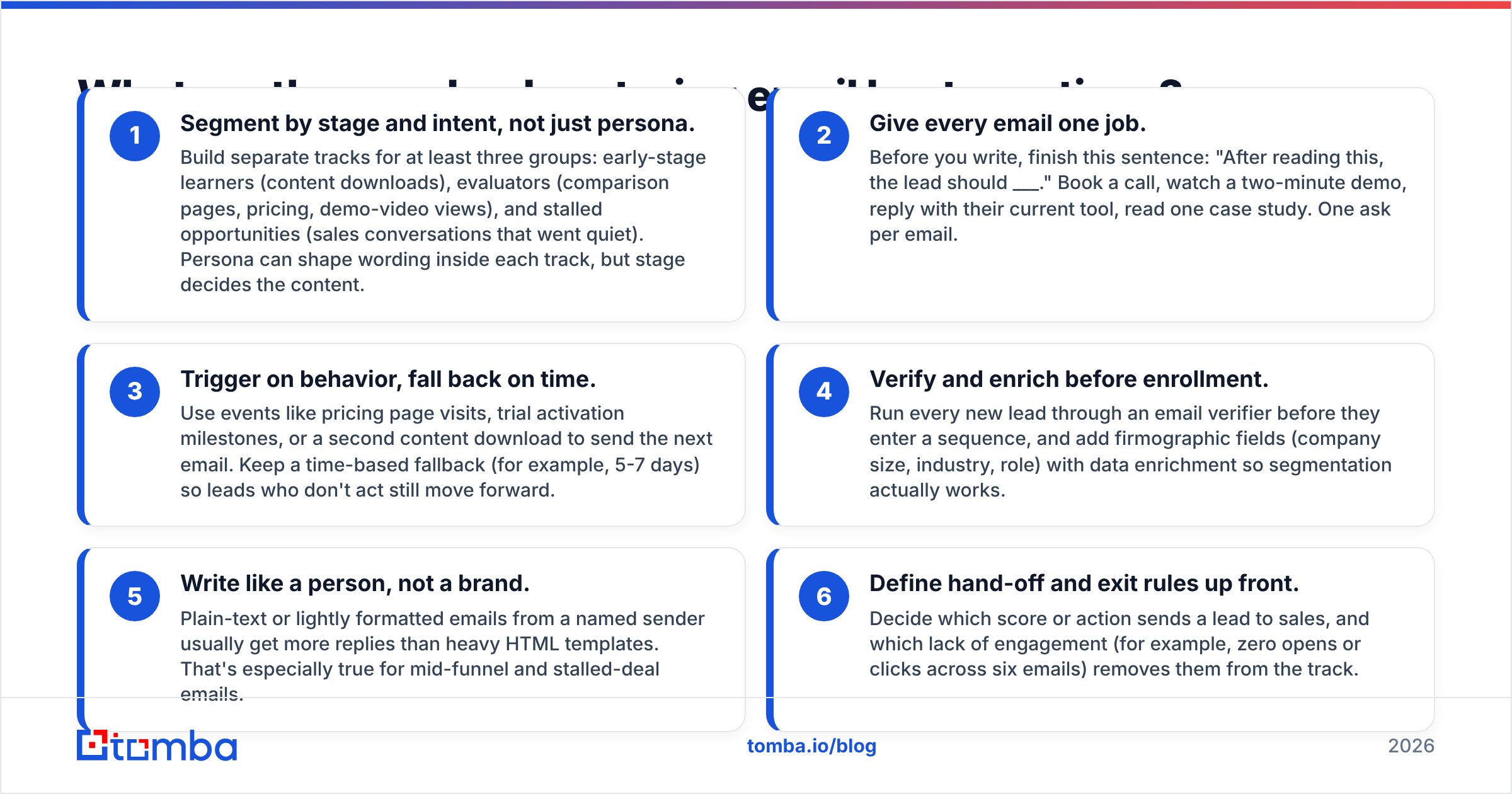
- Segment by stage and intent, not just persona. Build separate tracks for at least three groups: early-stage learners (content downloads), evaluators (comparison pages, pricing, demo-video views), and stalled opportunities (sales conversations that went quiet). Persona can shape wording inside each track, but stage decides the content.
- Give every email one job. Before you write, finish this sentence: "After reading this, the lead should ___." Book a call, watch a two-minute demo, reply with their current tool, read one case study. One ask per email.
- Trigger on behavior, fall back on time. Use events like pricing page visits, trial activation milestones, or a second content download to send the next email. Keep a time-based fallback (for example, 5-7 days) so leads who don't act still move forward.
- Verify and enrich before enrollment. Run every new lead through an email verifier before they enter a sequence, and add firmographic fields (company size, industry, role) with data enrichment so segmentation actually works.
- Write like a person, not a brand. Plain-text or lightly formatted emails from a named sender usually get more replies than heavy HTML templates. That's especially true for mid-funnel and stalled-deal emails.
- Define hand-off and exit rules up front. Decide which score or action sends a lead to sales, and which lack of engagement (for example, zero opens or clicks across six emails) removes them from the track.
These six cover most of the gap between a nurture program that produces pipeline and one that just produces unsubscribes.
How often should you send lead nurturing emails?#
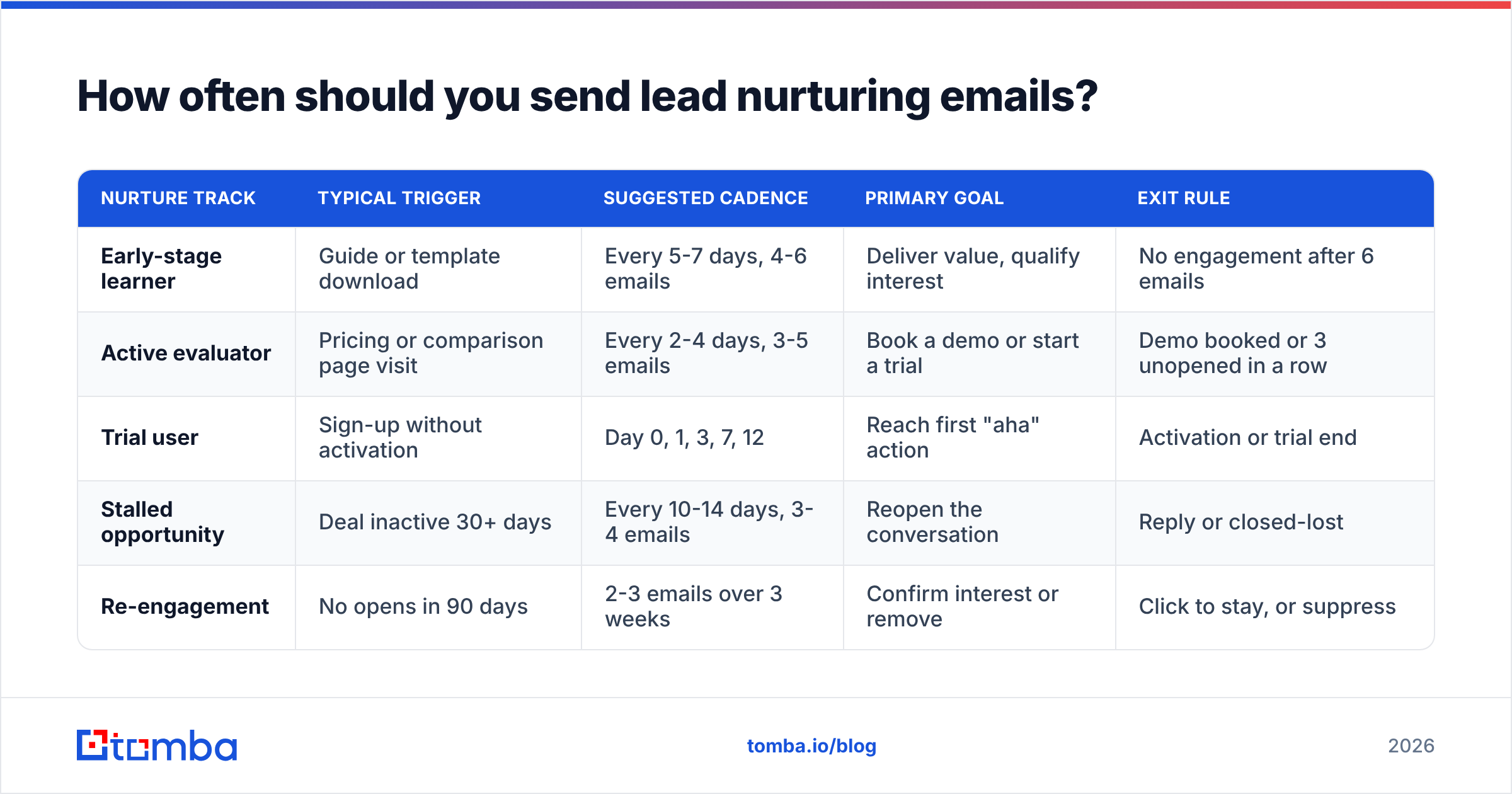
It depends on stage and signal. Mid-funnel nurture tolerates more frequency than cold outreach, but it isn't unlimited. Here's a practical starting point you can adjust based on your own engagement data:
| Nurture track | Typical trigger | Suggested cadence | Primary goal | Exit rule |
|---|---|---|---|---|
| Early-stage learner | Guide or template download | Every 5-7 days, 4-6 emails | Deliver value, qualify interest | No engagement after 6 emails |
| Active evaluator | Pricing or comparison page visit | Every 2-4 days, 3-5 emails | Book a demo or start a trial | Demo booked or 3 unopened in a row |
| Trial user | Sign-up without activation | Day 0, 1, 3, 7, 12 | Reach first "aha" action | Activation or trial end |
| Stalled opportunity | Deal inactive 30+ days | Every 10-14 days, 3-4 emails | Reopen the conversation | Reply or closed-lost |
| Re-engagement | No opens in 90 days | 2-3 emails over 3 weeks | Confirm interest or remove | Click to stay, or suppress |
Two rules sit above this table:
- Behavior overrides schedule. If an early-stage lead visits your pricing page twice in a day, move them to the evaluator track right away. Don't make them finish the learner sequence first.
- Watch your complaint rate, not just opens. Google's email sender guidelines and Yahoo's sender best practices both set spam-complaint thresholds for bulk senders. A nurture program that sends too often to disengaged leads is the fastest way to hit them.
What should each lead nurturing email actually contain?#
Map content to the question the lead is asking at that stage. A simple framework:
- Awareness questions ("Is this a real problem? How do others handle it?"): short frameworks, benchmark data, a single useful checklist. No product pitch beyond a signature link.
- Consideration questions ("What are my options? What does good look like?"): comparisons, buyer's guides, "how we'd approach your situation" breakdowns, customer stories matched to the lead's industry.
- Decision questions ("Will this work for us? What does it cost? Who else uses it?"): pricing explainers, ROI examples, security and integration details, a direct offer to talk.
Then tighten each email:
- Subject line: specific and low-hype. "The 3-field form that doubled our demo rate" beats "Unlock growth today."
- First line: reference the trigger. "You grabbed our outbound benchmark last week, so here's the part most people skip."
- Body: 60-150 words for mid-funnel emails. Link to longer content rather than pasting it in.
- CTA: one link or one question. Questions like "Are you running this in-house or with an agency?" get replies and give sales useful context.
- Sender: a real person, ideally the rep who will own the account or a recognizable team lead.
If you're not sure whether the copy is working, look at response rate and click-to-open rate per email, not the open rate for the whole sequence. Apple Mail Privacy Protection and similar image prefetching have made raw open rates unreliable since 2021.
How do you personalize nurture emails without it feeling creepy?#
Personalization in nurture should reflect what the lead chose to share or do with you, not everything you could scrape about them.
Good personalization signals:
- The content they downloaded or the webinar they attended
- Their company size, industry, and role (from the form or enrichment)
- Product usage events during a trial
- The last thing they said to a rep
Signals to avoid mentioning directly:
- Exact page-view timestamps ("I saw you on our pricing page at 2:14 pm")
- Personal social media activity
- Anything from a data source the lead would be surprised you had
The practical test: if the lead read your email aloud to a colleague, would the personalization sound helpful or would it sound like surveillance? Use the behavior to decide what to send, and keep the email itself focused on their problem.
Enrichment helps here because it lets you personalize by segment (industry, company size, tech stack) without relying on invasive individual tracking. A 40-person agency and a 4,000-person enterprise should get different case studies, and firmographic data is enough to make that call.
Why does data quality matter so much for lead nurturing?#
Nurture programs run for weeks or months, and contact data decays the whole time. That creates problems cold outreach mostly doesn't have:
- Bounces pile up across the sequence. A lead who changes jobs between email 2 and email 4 turns into a hard bounce. Multiply that across thousands of leads and your bounce rate climbs past what mailbox providers tolerate.
- Role-based and catch-all addresses skew your metrics. Addresses like info@ or sales@, and domains that accept every address, can show deliveries that no human ever reads.
- Duplicate records split engagement. The same person with two addresses gets two sequences and has twice the reason to unsubscribe.
A basic hygiene routine that works:
- Verify at capture, using real-time verification on forms where possible.
- Re-verify any lead that has been in your database for more than 90 days before re-enrolling them.
- Enrich new leads with role, seniority, and company data so they land in the right track.
- When a nurtured contact bounces because they changed jobs, find their new work address and the replacement at the old account. Both are warm leads.
- Deduplicate before every major enrollment batch.
That fourth step is underused. A champion who moves to a new company is often one of the best leads you'll get. They already know your product, and a quick email-finder lookup gets you back in touch.

Which tools do you need to run lead nurturing well?#
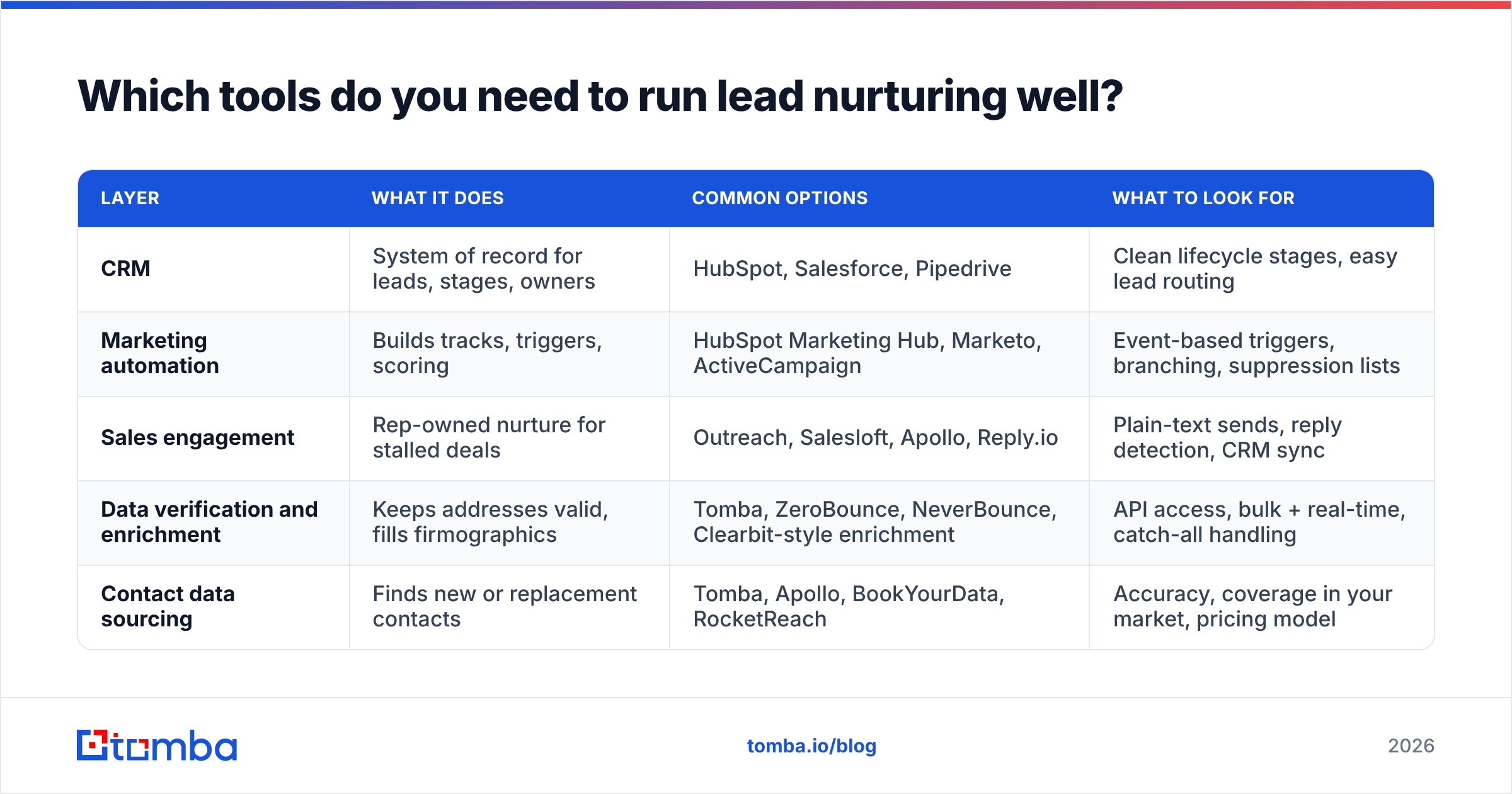
You don't need a huge stack, but you do need each layer covered. Here's how the pieces usually fit together:
| Layer | What it does | Common options | What to look for |
|---|---|---|---|
| CRM | System of record for leads, stages, owners | HubSpot, Salesforce, Pipedrive | Clean lifecycle stages, easy lead routing |
| Marketing automation | Builds tracks, triggers, scoring | HubSpot Marketing Hub, Marketo, ActiveCampaign | Event-based triggers, branching, suppression lists |
| Sales engagement | Rep-owned nurture for stalled deals | Outreach, Salesloft, Apollo, Reply.io | Plain-text sends, reply detection, CRM sync |
| Data verification and enrichment | Keeps addresses valid, fills firmographics | Tomba, ZeroBounce, NeverBounce, Clearbit-style enrichment | API access, bulk + real-time, catch-all handling |
| Contact data sourcing | Finds new or replacement contacts | Tomba, Apollo, BookYourData, RocketReach | Accuracy, coverage in your market, pricing model |
A few honest notes on this stack:
- Many teams already own enough automation. If you're on HubSpot or Salesforce, the nurture features are usually good enough. Better segmentation will get you further than switching platforms.
- Data tools are the most overlooked layer. Teams will spend five figures on automation and then feed it unverified addresses. A verification-and-enrichment step costs far less than the deliverability damage it prevents.
- Pick contact-data providers by market fit. Tomba is strong on domain-based discovery and verification, with a free tier (25 searches/month) and paid plans from $49/month on Tomba pricing. BookYourData is a solid choice if you want pre-built, filterable lists. Apollo bundles data with sequencing. Test each against a sample of your own ICP before you commit.
How do you hand off nurtured leads to sales?#
The hand-off decides whether nurture turns into revenue. Build it on three things:
A shared definition of "ready." Marketing and sales should agree in writing on the actions or score that make a lead sales-ready. Typical triggers include a demo request, two or more pricing-page visits in a week, a reply with a buying question, or a trial user hitting an activation milestone.
Context travels with the lead. When a lead moves to sales, the rep should see which track they were in, which emails they engaged with, and what content they consumed. A rep who opens with "I saw you read our guide on X, so how are you handling Y today?" gets a much better conversation than one starting cold.
Nurture pauses on hand-off. Once a rep owns the lead, automated marketing emails should stop or go through the rep. Nothing kills a sales conversation faster than the lead getting a generic "5 tips" email the morning after a discovery call.
Also plan the reverse path. Leads that sales disqualifies as "not now" (as opposed to "not a fit") should go back into a slower, longer-term nurture track, with the reason logged so the content matches.
How do you measure whether your nurture program is working?#
Track stage movement, not activity. The useful metrics, in rough order of importance:
- Track-to-opportunity conversion rate: the share of leads in each track that become sales opportunities within 90 days.
- Time to stage change: how long leads spend in nurture before moving forward. Shorter usually means the content is doing its job.
- Reply rate per email: especially for mid-funnel and stalled-deal tracks.
- Click-to-open rate: a better content signal than raw opens.
- Unsubscribe and complaint rate per email: tells you which specific emails annoy people.
- Hard bounce rate per enrollment batch: tells you whether your data hygiene is holding up.
Review these monthly per track. When one email in a sequence has a spike in unsubscribes, or a click rate far below its neighbors, rewrite or cut it. Nurture sequences get better through steady pruning, not one big launch.
Lead nurturing email best practices checklist#
Before you turn on your next sequence, confirm:
- Every lead is verified and enriched before enrollment
- At least three tracks exist: learner, evaluator, stalled opportunity
- Each email has a single stated job and a single CTA
- Behavioral triggers are wired up, with time-based fallbacks
- Exit rules suppress disengaged leads automatically
- Sales-ready criteria are written down and routed to the CRM
- Metrics are reviewed per track, per email, every month
Ready to fix the data under your nurture program?#
Good copy and smart triggers can't make up for emails that bounce or reach people who left the company last quarter. The Tomba Email Finder helps you recover contacts who changed jobs, find the replacement stakeholder at accounts where your champion left, and fill gaps in your lead records by domain, name, or company, all before those leads go into a sequence. Start on the free tier, run your stalest nurture segment through it, and compare your bounce rate before and after.
Related guides#
// get started
Find, verify and enrich your first contacts today
Start on the free plan with 25 searches a month, then scale when your team is ready.
Free plan · No credit card required · GDPR & CCPA
// about the author