Lead Nurturing Scoring: How to Build a Model That Converts
Most scoring models reward the wrong behaviour and hand sales leads that aren't ready. Here's how to combine fit, intent, and decay so your nurture tracks surface the right buyers at the right time.
TL;DR
- Lead nurturing scoring combines two things: fit (does this person match your ideal customer?) and engagement (are they acting like a buyer?). If your score uses only one of them, it will fail.
- Email opens stopped being a reliable signal once Apple Mail Privacy Protection arrived. Put your points on replies, pricing-page visits, and high-intent content instead.
- Scores need decay. If a lead clicked twice in March and has done nothing since, it shouldn't still count as sales-ready in September.
- Use your score to route leads between nurture tracks, not only to pass MQLs to sales. The score decides which sequence a lead gets, how often you contact them, and when a human steps in.
- Your fit score can only be as good as your contact data. If emails bounce and job titles are missing, the model scores noise.
What is lead nurturing scoring?#
Lead nurturing scoring gives each lead in a nurture program a number, and that number decides what happens to them next. They might get more educational content, get moved to a product-focused track, or get handed to a sales rep.
Think of an airport check-in desk. Your ticket class (fit) decides which line you join. How early you show up and whether your bags are already tagged (engagement) decide how quickly you get through. A good scoring model looks at both. A bad one sends every passenger to the same line and helps whoever pushes hardest.
Traditional lead scoring was built for one decision: is this lead ready to go to sales? Nurture scoring answers a broader question: what is the right next touch for this lead? A lead with a score of 35 isn't a failure. They belong in a different track from a lead with a score of 80.
That difference matters because most leads in your database aren't ready to buy this quarter. If a model can only say "MQL" or "not MQL", most of your pipeline ends up in one generic newsletter.
How does a lead nurturing score actually work?#
Almost every workable model has two axes and a clock.
- Fit score (who they are). Job title, seniority, company size, industry, tech stack, and region. These change slowly and come from your contact and firmographic data.
- Engagement score (what they do). Replies, page visits, content downloads, webinar attendance, and product sign-ups. These change daily and come from your marketing automation and website tracking.
- Negative scoring (who to ignore). Students, competitors, personal Gmail addresses on B2B forms, unsubscribes, and hard bounces. Subtracting points matters as much as adding them.
- Decay (the clock). Engagement points lose value over time, so a lead has to keep showing interest to keep a high score.
- Thresholds (the routing rules). Score bands that map to specific nurture tracks and sales handoffs.
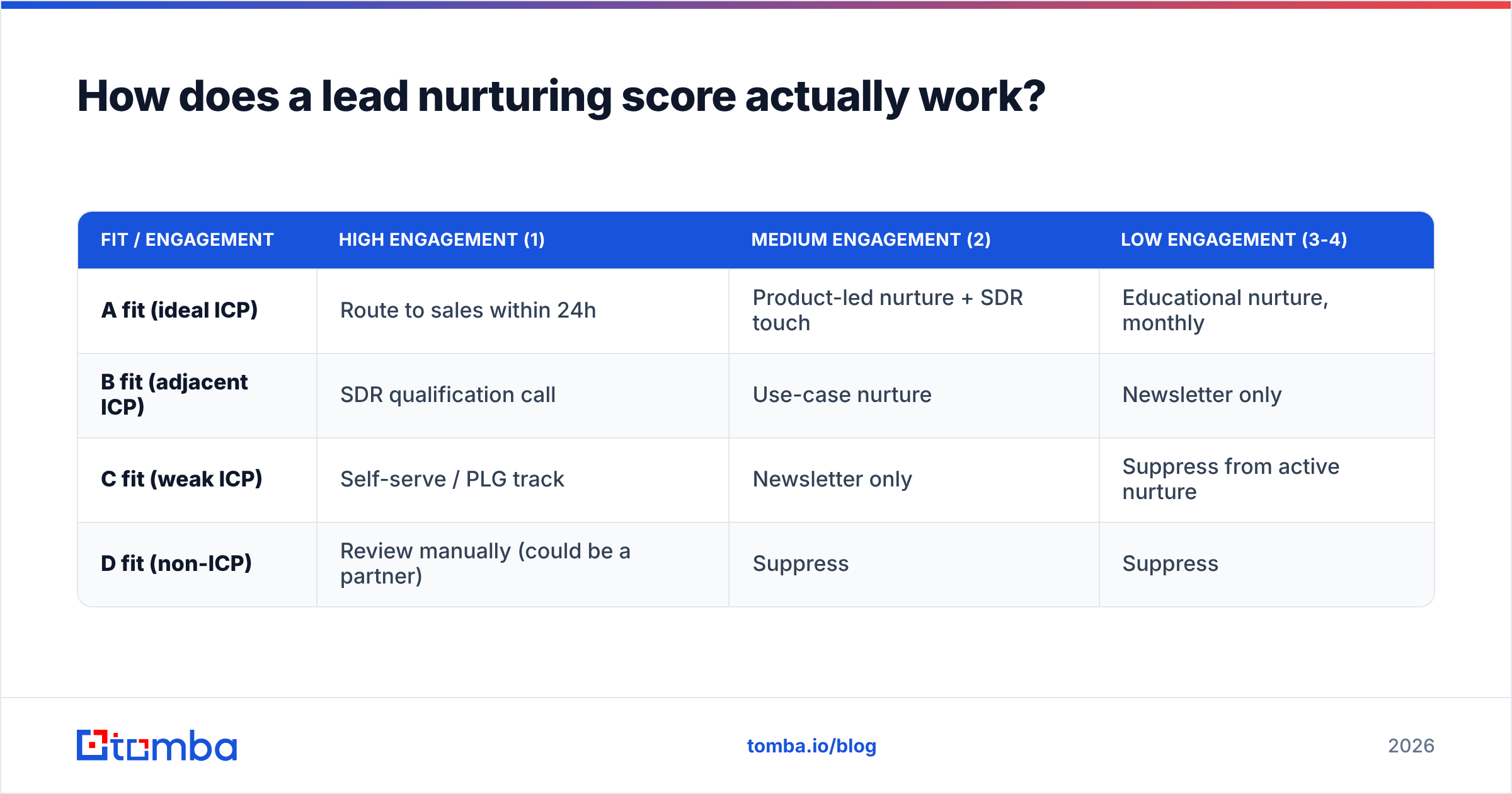
Many teams display the two axes as a letter-number grade: A1 means great fit and high engagement, D4 means poor fit and cold. The grid makes routing easy to read:
| Fit / Engagement | High engagement (1) | Medium engagement (2) | Low engagement (3-4) |
|---|---|---|---|
| A fit (ideal ICP) | Route to sales within 24h | Product-led nurture + SDR touch | Educational nurture, monthly |
| B fit (adjacent ICP) | SDR qualification call | Use-case nurture | Newsletter only |
| C fit (weak ICP) | Self-serve / PLG track | Newsletter only | Suppress from active nurture |
| D fit (non-ICP) | Review manually (could be a partner) | Suppress | Suppress |
The high-engagement, weak-fit cell is where most scoring models go wrong. A student who downloads every ebook you publish will beat a VP of Sales who visited your pricing page once, unless fit carries its own weight in the score.

Which signals should earn points in 2026?#
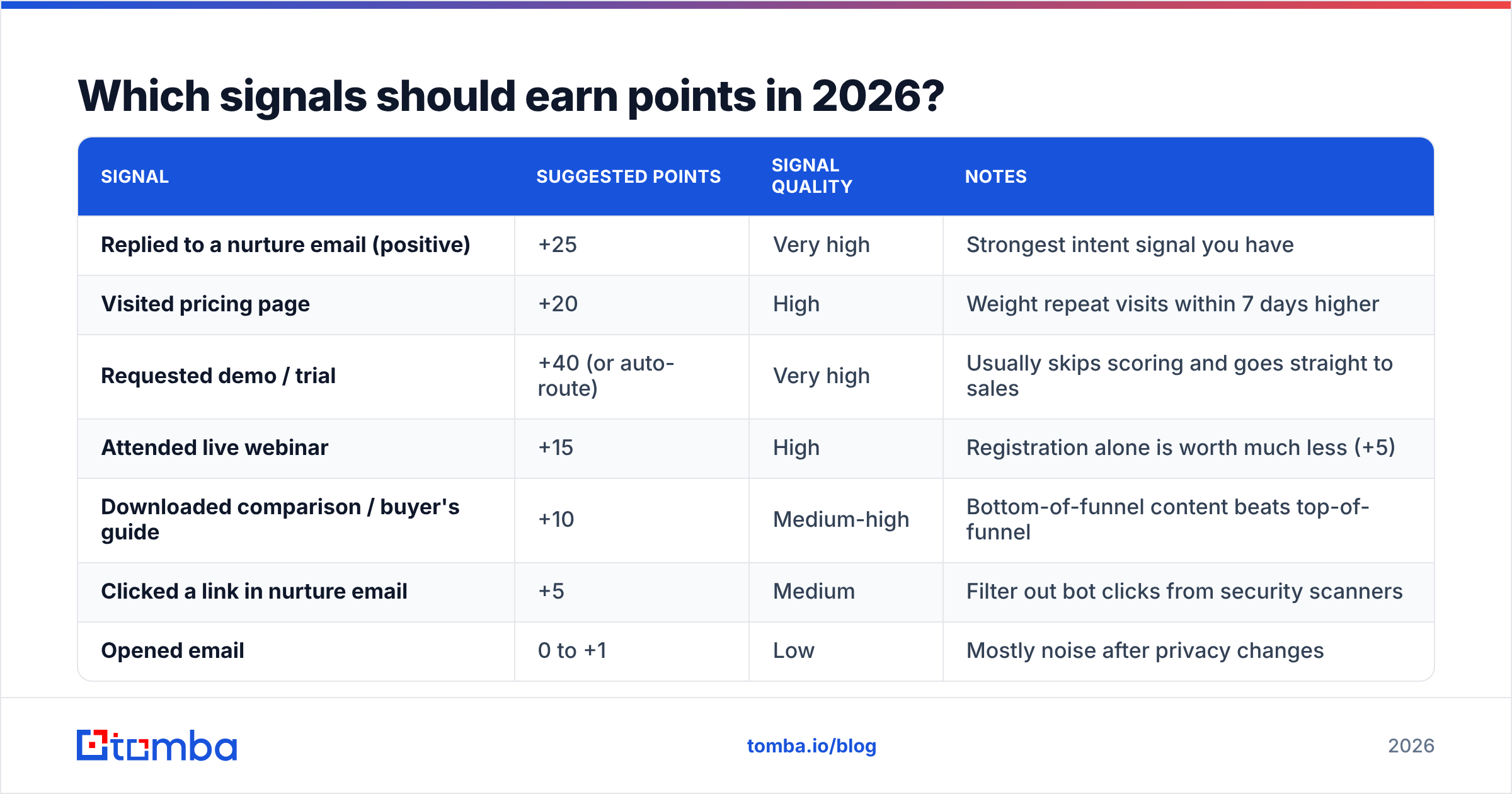
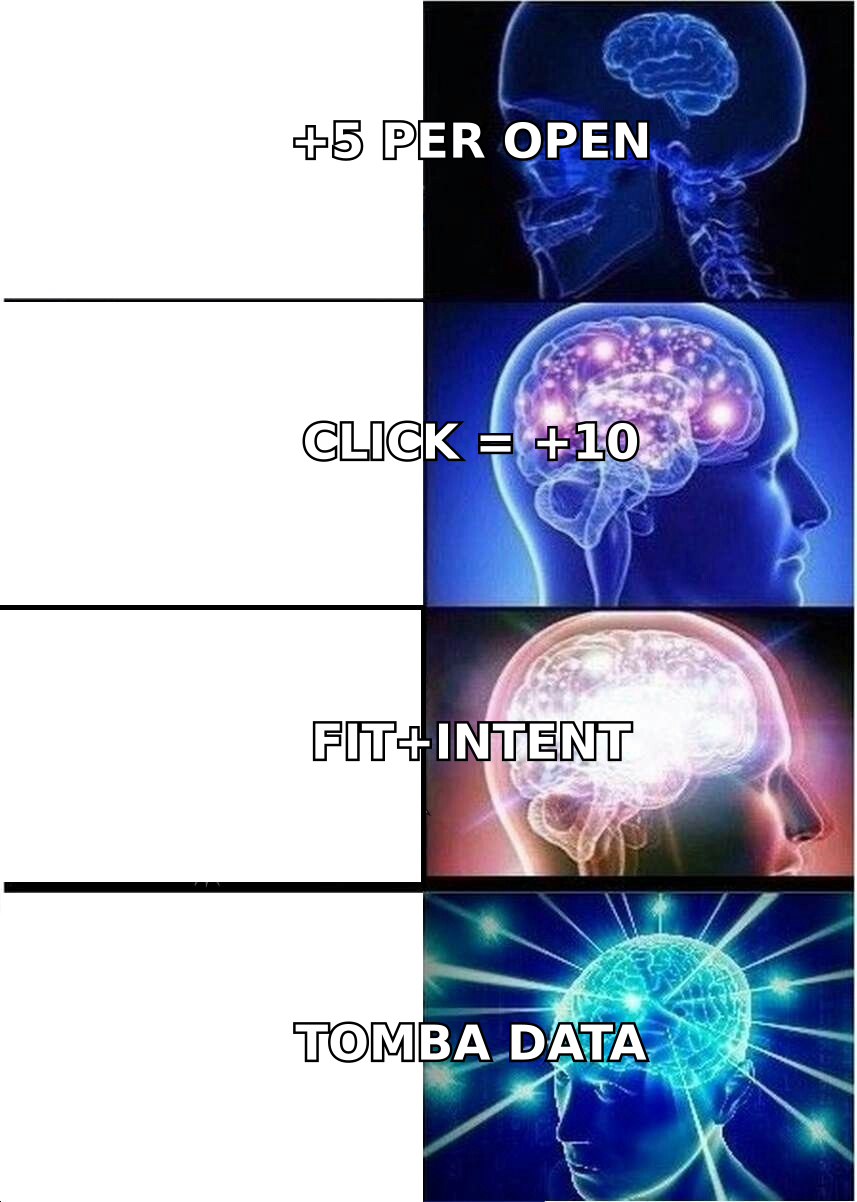
Tracking changes over the last few years have broken some classic signals. Open tracking is the main casualty: privacy features in major mail clients now preload tracking pixels, so an "open" frequently means a machine fetched an image. If you still give 5 points per open, you're scoring email clients.
Here's a starting point-value table that reflects current signal quality. Adjust it against your own closed-won data.
| Signal | Suggested points | Signal quality | Notes |
|---|---|---|---|
| Replied to a nurture email (positive) | +25 | Very high | Strongest intent signal you have |
| Visited pricing page | +20 | High | Weight repeat visits within 7 days higher |
| Requested demo / trial | +40 (or auto-route) | Very high | Usually skips scoring and goes straight to sales |
| Attended live webinar | +15 | High | Registration alone is worth much less (+5) |
| Downloaded comparison / buyer's guide | +10 | Medium-high | Bottom-of-funnel content beats top-of-funnel |
| Clicked a link in nurture email | +5 | Medium | Filter out bot clicks from security scanners |
| Opened email | 0 to +1 | Low | Mostly noise after privacy changes |
| Visited careers page | -10 | Negative | Probably a job seeker |
| Personal email domain on B2B form | -15 | Negative | Try to enrich to a work address first |
| Hard bounce | Remove from scoring | N/A | The lead is unreachable |
Link clicks have a problem of their own. Corporate security gateways often "click" every link in an incoming email to scan it. If a lead clicks all six links within two seconds of delivery, that's a scanner, and your model should ignore it.
How do you build the fit side of the score?#
Most teams under-invest in fit scoring because it needs data they don't have. A form fill gives you a name and an email. It rarely tells you headcount, industry, seniority, or tech stack.
You can fill those gaps three ways:
- Longer forms. They work, but conversion drops with every extra field.
- Progressive profiling. Ask one new question per interaction. It works over time, but fit scores stay incomplete for weeks.
- Automatic enrichment. Look up company and person attributes from the email domain and name as soon as the lead arrives.
The third option is the only one that gives you a complete fit score on day one. A data enrichment step that adds company size, industry, and role to each new lead means a VP at a 300-person SaaS company gets A-fit treatment immediately, not after four nurture emails.
A simple fit rubric might look like this:
- Seniority: C-level / VP +20, Director +15, Manager +10, Individual contributor +3
- Company size: 50-1,000 employees (your sweet spot) +20, 1,000+ +10, under 10 -10
- Industry: Target verticals +15, adjacent +5, excluded -20
- Tech stack: Uses a CRM you integrate with +10
- Region: Served markets +5, unsupported regions -15
Keep fit and engagement as separate fields in your CRM, even if you also calculate a combined total. When a sales rep asks why a lead got routed, "A-fit, low engagement" is much easier to act on than "score 62".
Should lead scores decay over time?#
Yes. A scoring model without decay only ever goes up, so eventually every lead in your database looks sales-ready.
Here are some common decay patterns:
- Linear decay: Engagement points drop by a fixed amount (for example, 10%) every 30 days without new activity.
- Step decay: After 60 days of no activity, reset engagement to zero but keep fit.
- Half-life decay: Each engagement event loses half its value every N days. It's the most accurate option and the hardest to set up in most tools.
Only engagement should decay. Fit changes when the person changes jobs or the company changes size, not when a calendar month passes. Job changes do happen often, though. B2B contact data goes out of date quickly, and a champion who has left the company now has a perfect fit score attached to an email that bounces.
That's why teams with mature scoring re-verify contact data on a schedule. Running the nurture list through an email verifier before each major campaign catches people who have left, which protects both the accuracy of your scores and your sender reputation.
Rules-based vs predictive scoring: which is better?#
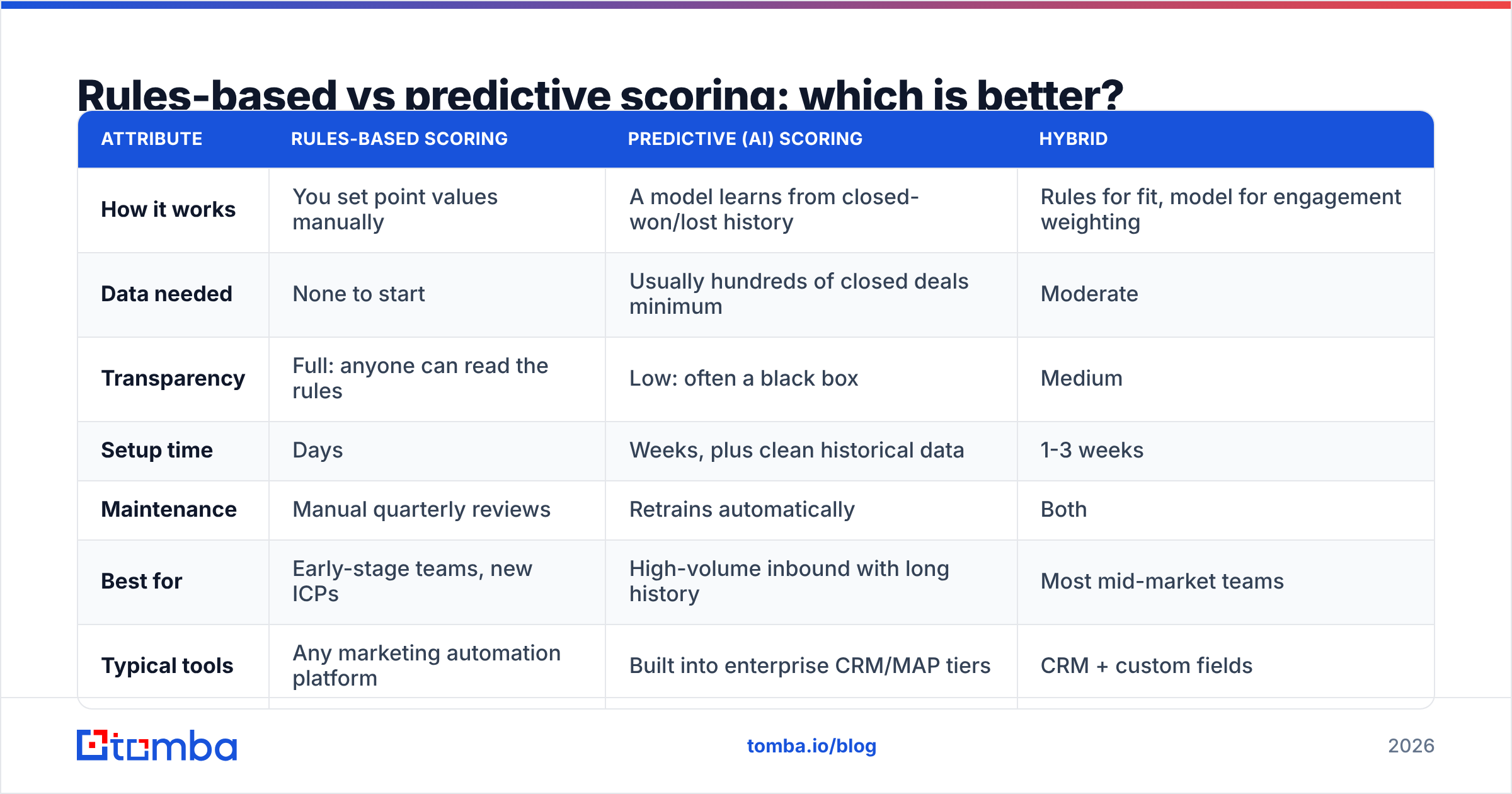
Both work. Which one suits you depends on your data volume and how much of the logic you need to be able to explain.
| Attribute | Rules-based scoring | Predictive (AI) scoring | Hybrid |
|---|---|---|---|
| How it works | You set point values manually | A model learns from closed-won/lost history | Rules for fit, model for engagement weighting |
| Data needed | None to start | Usually hundreds of closed deals minimum | Moderate |
| Transparency | Full: anyone can read the rules | Low: often a black box | Medium |
| Setup time | Days | Weeks, plus clean historical data | 1-3 weeks |
| Maintenance | Manual quarterly reviews | Retrains automatically | Both |
| Best for | Early-stage teams, new ICPs | High-volume inbound with long history | Most mid-market teams |
| Typical tools | Any marketing automation platform | Built into enterprise CRM/MAP tiers | CRM + custom fields |
Platforms like HubSpot and Salesforce offer both manual scoring properties and predictive scoring on higher tiers. Predictive models are only as good as the history you train them on. If your CRM has duplicate records, missing industries, and half your closed-won deals lack a job title, the model will learn patterns from those gaps.
For most teams, the honest recommendation is to start rules-based, run it for two quarters, compare the scores against actual pipeline outcomes, and only then think about predictive scoring.
How do you map scores to nurture tracks?#
This is where "nurture" scoring differs from plain lead scoring. The score does more than trigger a handoff. It picks the conversation.
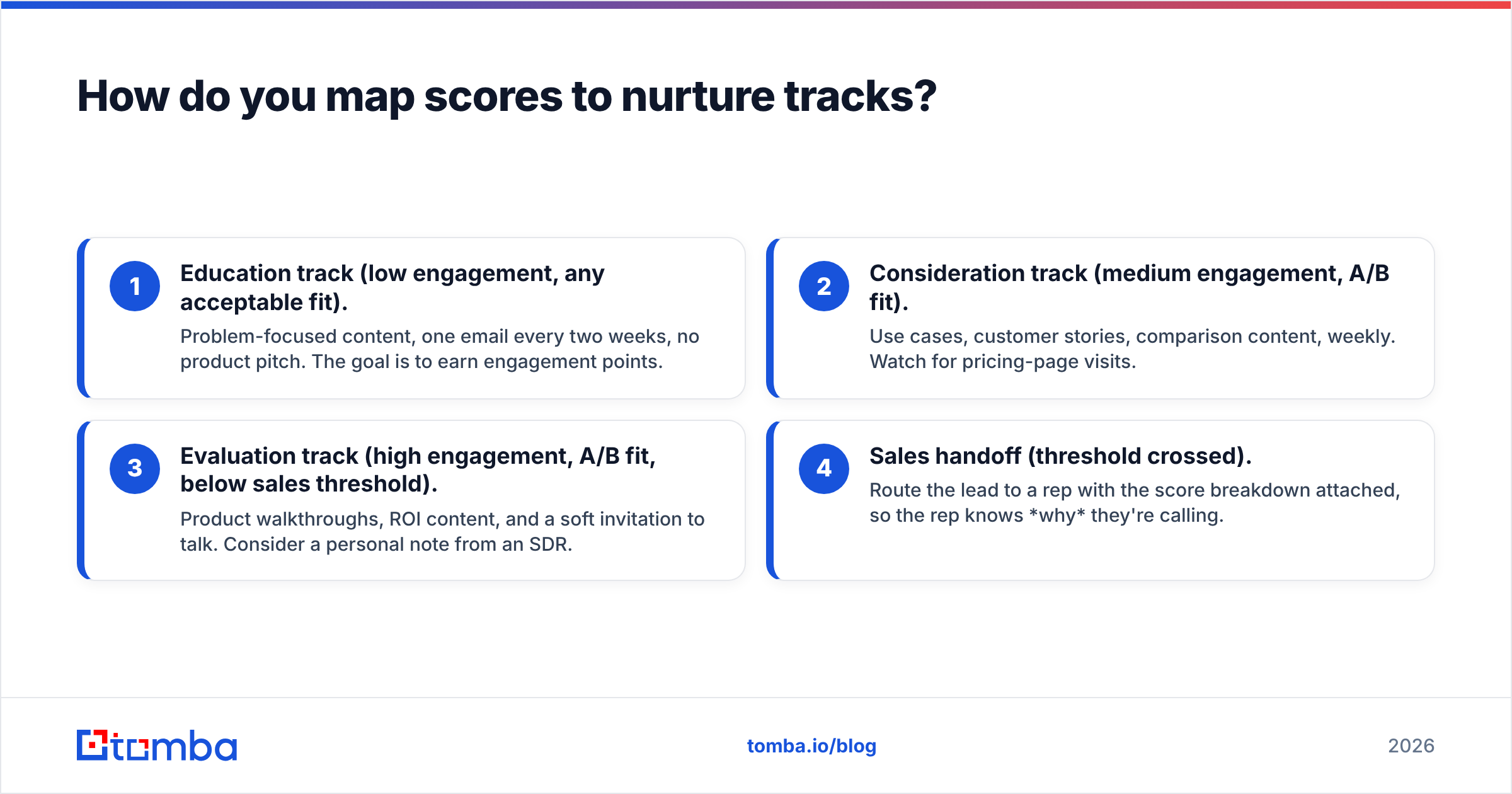
A practical four-track setup:
- Education track (low engagement, any acceptable fit). Problem-focused content, one email every two weeks, no product pitch. The goal is to earn engagement points.
- Consideration track (medium engagement, A/B fit). Use cases, customer stories, comparison content, weekly. Watch for pricing-page visits.
- Evaluation track (high engagement, A/B fit, below sales threshold). Product walkthroughs, ROI content, and a soft invitation to talk. Consider a personal note from an SDR.
- Sales handoff (threshold crossed). Route the lead to a rep with the score breakdown attached, so the rep knows why they're calling.
Two rules keep this from falling apart:
- Leads can move down as well as up. If a lead in the Evaluation track goes quiet for 45 days, decay should move them back to Consideration automatically.
- Sales can reject leads back into nurture. If a rep marks a lead as "not now", it goes into a recycle track with a reason code rather than disappearing. Those reason codes are the best data you'll get for tuning the model.
Agree on the definition of a marketing qualified lead with sales before you set thresholds. If marketing counts a lead as an MQL at 50 points and sales ignores anything under 80, your pipeline reports will show lots of MQLs and hardly any meetings.
What are the most common lead nurturing scoring mistakes?#
After you've built a few of these models, the same failures come up again and again:
- Scoring volume instead of intent. Ten blog visits aren't worth one pricing-page visit. Weight by funnel stage, not by activity count.
- No negative scoring. Without deductions, competitors, students, and job seekers pile up in your high-score bands.
- Scoring unreachable leads. A lead with a score of 90 and an invalid email is worthless. Verify before you score, or at least before you route.
- Never recalibrating. Your ICP changes, your content changes, and buyer behaviour changes. Review point values each quarter against closed-won data.
- One score for every product line. If you sell to both SMB and enterprise, a single threshold will serve one segment badly. Use separate models or segment-specific thresholds.
- Hiding the reasoning. Reps ignore scores they can't explain. Show the top three contributing signals next to the number.
How do you know if your scoring model is working?#
Track these metrics each month:
- MQL-to-SQL conversion rate by score band. Higher bands should convert noticeably better. If an 80 and a 50 convert at about the same rate, your weights are wrong.
- Sales acceptance rate. The share of handed-off leads that reps accept. A falling acceptance rate means the threshold is too low or fit data is poor.
- Time in nurture track. Leads that sit in one track for 90+ days without moving suggest the content isn't producing signals.
- Score distribution. If 60% of your database scores above the sales threshold, you have no decay or no negative scoring.
- Bounce rate within nurture. Rising bounces mean fit scores are attached to outdated contacts.
One useful exercise: take your last 20 closed-won deals and look at what their scores were 30 days before the opportunity was created. If most of them sat in your low bands, your model is measuring something other than buying intent.
Where does contact data quality fit in?#
Every part of this system depends on two things: reaching the person, and knowing who they are. The fit axis needs accurate roles and firmographics. The engagement axis needs emails that get delivered. Decay and re-routing only work when the records underneath them are current.
In practice, a lead nurturing scoring program needs three data steps running in the background:
- Find the correct work email for leads who arrive with partial information, such as a LinkedIn profile or a personal address.
- Enrich each lead with company and role attributes so the fit score is complete from the first touch.
- Verify addresses before campaigns, so bounces don't damage deliverability and dead contacts don't inflate your high-score bands.
If you push leads into your CRM through something like the HubSpot integration, these steps can run automatically when a record is created, so the scoring model always works from clean inputs.
Getting started with a better scoring model#
You don't need a predictive AI platform to fix lead nurturing scoring. You need separate fit and engagement fields, point values that reflect how reliable each signal is today, negative scoring, decay, and a quarterly review against closed-won data. Most teams can have a working version running in their existing marketing automation tool within a week.
The piece teams most often skip is the data underneath: finding the right contact and confirming that the address works. If your nurture list has incomplete records or leads who arrived without a usable work email, Tomba Email Finder can find professional email addresses by name, domain, or company, so each lead you score is one you can actually reach. Start on the free tier with 25 searches a month, then move to Starter at $49/mo once your scoring model is sending qualified leads to sales.
Related guides#
// get started
Find, verify and enrich your first contacts today
Start on the free plan with 25 searches a month, then scale when your team is ready.
Free plan · No credit card required · GDPR & CCPA
Get the Tomba newsletter
Product and data updates
// about the author