Lead Nurturing Software: 8 Best Tools Compared for 2026
Most lead nurturing software does the same job at very different prices. We compare 8 tools on price, scoring, CRM fit, and setup effort, and cover the data problem that sinks most nurture programs before the first email goes out.
TL;DR
- Lead nurturing software sends leads the right content at the right time based on what they do, and moves them toward a sales conversation without a rep chasing each one by hand.
- HubSpot and ActiveCampaign suit most SMB and mid-market teams. Salesforce Account Engagement and Adobe Marketo Engage are built for enterprise complexity and are priced for it.
- Brevo, Mailchimp, Customer.io, and Keap cover budget, product-led, and small-business needs.
- The tool matters less than the data you put into it. Invalid emails and thin contact records hurt deliverability and make scoring unreliable no matter which platform you pick.
- Pick based on your CRM first, then your deal complexity, then price. The reverse order is how teams end up paying for a platform twice.
What is lead nurturing software?#
Lead nurturing software automates the follow-up between "someone showed interest" and "someone is ready to talk to sales." It watches behavior like email opens, page visits, form fills, pricing-page views, and webinar attendance. Then it responds with the next relevant touch and raises or lowers a lead's score as it goes.
Think of it like a good bookstore clerk. They don't push a purchase on someone the moment they walk in. They notice which shelves you browse, recommend something that fits, and only point you to the register when you're holding three books. The software does the same thing across thousands of leads at once.
In practice, most lead nurturing software sits inside a broader marketing automation platform. The category overlaps heavily with what G2 lists under marketing automation software, and the line between "nurture tool," "email platform," and "CRM" has blurred a lot since 2020.
What features actually matter in lead nurturing software?#
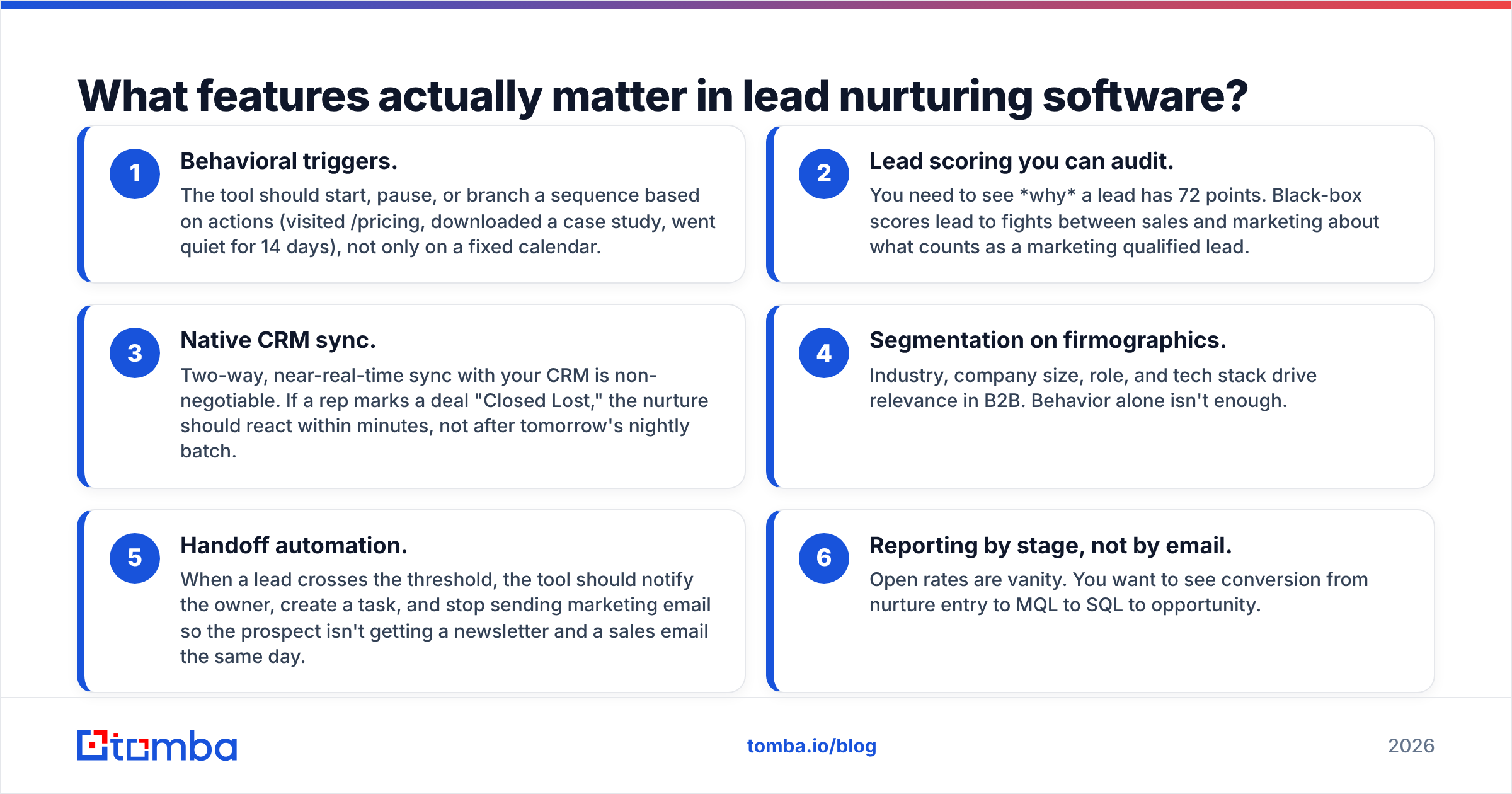
Every vendor's feature page lists 40+ capabilities. Only a handful decide whether a nurture program works. Evaluate these five first:
- Behavioral triggers. The tool should start, pause, or branch a sequence based on actions (visited /pricing, downloaded a case study, went quiet for 14 days), not only on a fixed calendar.
- Lead scoring you can audit. You need to see why a lead has 72 points. Black-box scores lead to fights between sales and marketing about what counts as a marketing qualified lead.
- Native CRM sync. Two-way, near-real-time sync with your CRM is non-negotiable. If a rep marks a deal "Closed Lost," the nurture should react within minutes, not after tomorrow's nightly batch.
- Segmentation on firmographics. Industry, company size, role, and tech stack drive relevance in B2B. Behavior alone isn't enough.
- Handoff automation. When a lead crosses the threshold, the tool should notify the owner, create a task, and stop sending marketing email so the prospect isn't getting a newsletter and a sales email the same day.
- Reporting by stage, not by email. Open rates are vanity. You want to see conversion from nurture entry to MQL to SQL to opportunity.
If a tool is weak on items 1–3, skip it, however good the email editor looks.
Which lead nurturing software tools are worth comparing in 2026?#
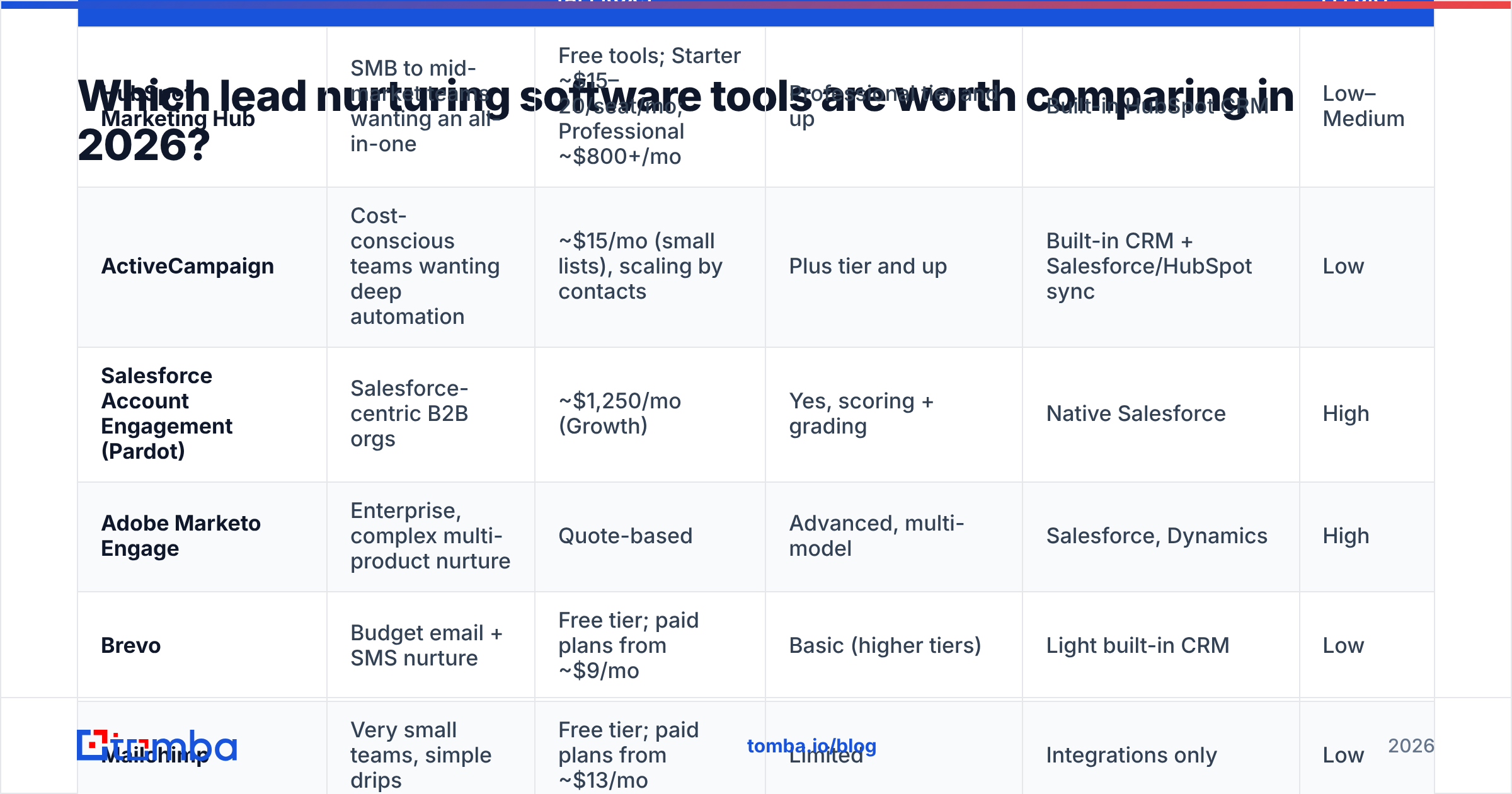
Below are the eight platforms that come up most often in B2B shortlists. Pricing reflects public list prices at the time of writing. Most vendors bill by contact count, so check their pricing pages against your own database size before you budget.
| Tool | Best for | Starting price (approx.) | Lead scoring | Native CRM | Setup effort |
|---|---|---|---|---|---|
| HubSpot Marketing Hub | SMB to mid-market teams wanting an all-in-one | Free tools; Starter ~$15–20/seat/mo; Professional ~$800+/mo | Professional tier and up | Built-in HubSpot CRM | Low–Medium |
| ActiveCampaign | Cost-conscious teams wanting deep automation | ~$15/mo (small lists), scaling by contacts | Plus tier and up | Built-in CRM + Salesforce/HubSpot sync | Low |
| Salesforce Account Engagement (Pardot) | Salesforce-centric B2B orgs | ~$1,250/mo (Growth) | Yes, scoring + grading | Native Salesforce | High |
| Adobe Marketo Engage | Enterprise, complex multi-product nurture | Quote-based | Advanced, multi-model | Salesforce, Dynamics | High |
| Brevo | Budget email + SMS nurture | Free tier; paid plans from ~$9/mo | Basic (higher tiers) | Light built-in CRM | Low |
| Mailchimp | Very small teams, simple drips | Free tier; paid plans from ~$13/mo | Limited | Integrations only | Low |
| Customer.io | Product-led SaaS, event-based nurture | ~$100/mo | Via attributes/segments | Integrations | Medium |
| Keap | Small service businesses, sales + nurture in one | ~$249/mo | Yes | Built-in CRM | Medium |
A few notes the table can't capture:
- HubSpot's jump from Starter to Professional is the biggest pricing cliff in the category. Most features that make it a real nurture platform (scoring, workflows with branching, attribution) sit in Professional. Check the current tiers on HubSpot's marketing pricing page before committing.
- ActiveCampaign consistently punches above its price on automation depth. Its visual builder is one of the easiest to learn, and its pricing page is refreshingly transparent about contact-based scaling.
- Account Engagement and Marketo are powerful but assume you have a marketing ops person, or a team of them. Buying either without that headcount is a common and expensive mistake.
Is HubSpot better than ActiveCampaign for lead nurturing?#
For most B2B teams under 200 employees, the honest answer is: it depends on whether you already live in HubSpot's CRM.
Choose HubSpot if:
- Sales already uses HubSpot CRM, or you want one vendor for marketing, sales, and service.
- You need attribution reporting that ties nurture touches to closed revenue.
- You can justify Professional-tier pricing, which lands in the high hundreds per month before extra seats and contacts.
Choose ActiveCampaign if:
- You want sophisticated branching automation at a fraction of the cost.
- Your CRM is Salesforce, Pipedrive, or something else, and you just need a strong nurture engine alongside it.
- Your team is small and comfortable with a slightly less polished reporting layer.
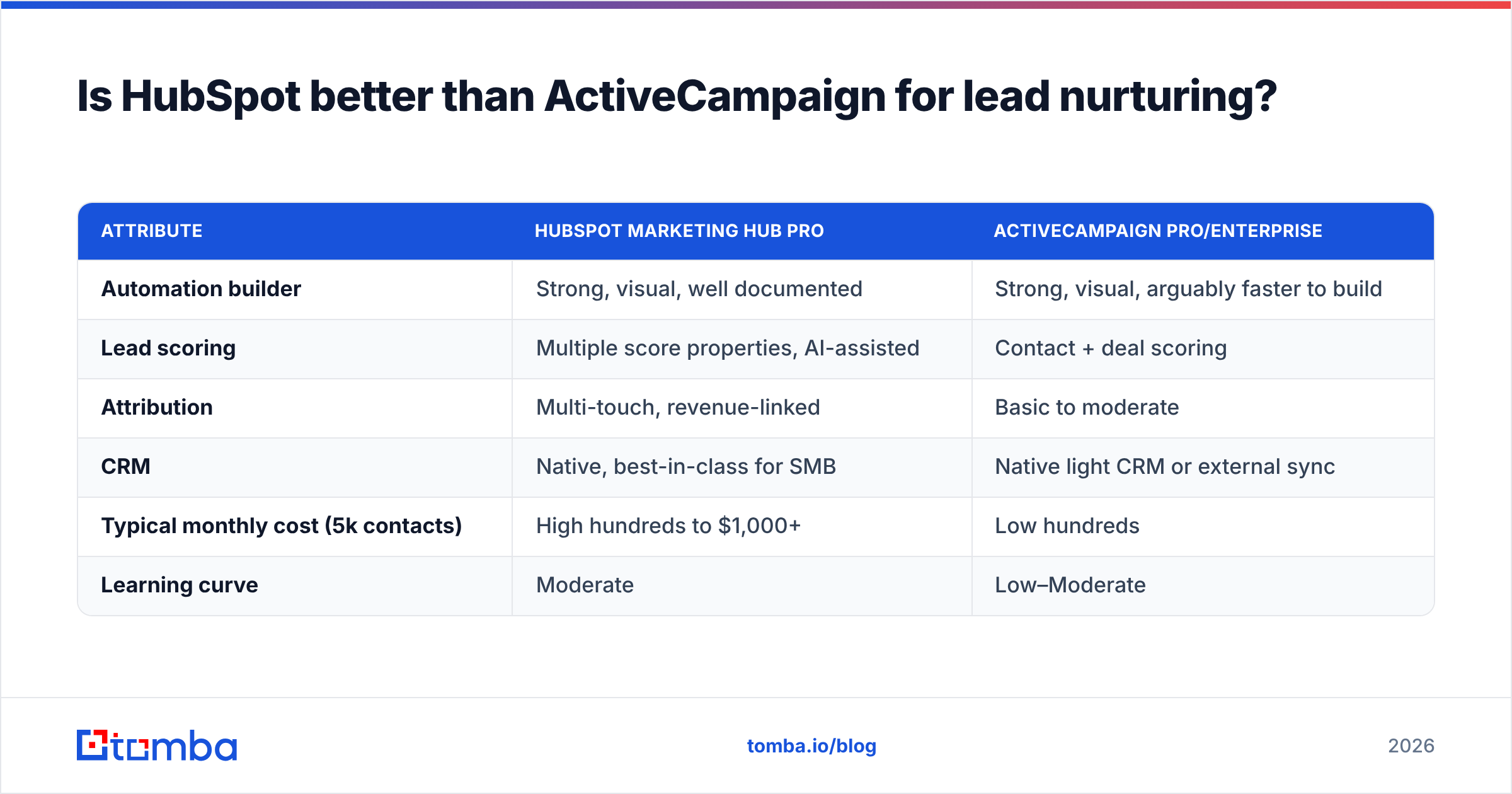
| Attribute | HubSpot Marketing Hub Pro | ActiveCampaign Pro/Enterprise |
|---|---|---|
| Automation builder | Strong, visual, well documented | Strong, visual, arguably faster to build |
| Lead scoring | Multiple score properties, AI-assisted | Contact + deal scoring |
| Attribution | Multi-touch, revenue-linked | Basic to moderate |
| CRM | Native, best-in-class for SMB | Native light CRM or external sync |
| Typical monthly cost (5k contacts) | High hundreds to $1,000+ | Low hundreds |
| Learning curve | Moderate | Low–Moderate |
When do you need enterprise tools like Marketo or Account Engagement?#
You need enterprise-grade lead nurturing software when your problem is complexity rather than volume. That usually looks like this:
- Multiple products or business units, each with its own nurture tracks and scoring models.
- Long, multi-stakeholder sales cycles where you nurture an account's buying committee, not a single lead.
- Strict governance needs: approvals, audit trails, regional data rules, and role-based permissions.
- Deep Salesforce dependence. If your revenue team runs entirely in Salesforce, Account Engagement keeps lead data inside that ecosystem without sync gymnastics.
If none of those apply, an enterprise platform is usually overkill. Teams in that situation tend to use 20% of the product and pay for 100%.
Why do most lead nurturing programs underperform?#
The usual culprit isn't the software. It's what goes into it. Every platform above is only as smart as the contact records it acts on, and nurture programs tend to fail in three predictable ways.
1. Bad email addresses destroy deliverability. Nurture sequences run for weeks or months, so a list with 8% invalid addresses keeps generating bounces with every send. Mailbox providers read a sustained bounce rate as a sign of poor list hygiene, and your inbox placement drops, including for the good leads. Running your list through an email verifier before import, and again every quarter, is the cheapest deliverability insurance you can buy.
2. Thin records break segmentation and scoring. If half your leads came in through a form that only asked for an email, you don't know their company size, industry, or role. Your "enterprise nurture track" and "SMB nurture track" then both receive a random mix. Data enrichment fills in firmographic and role data automatically, so segments and scores reflect reality.
3. Missing buying-committee contacts. B2B deals involve several people. If you only nurture the one person who downloaded the ebook, you're missing the economic buyer, the technical evaluator, and the champion's manager. An email finder lets you add the other stakeholders at an engaged account, so you can run account-level nurture instead of single-threaded drips.
Fix these three and a mid-tier tool will outperform an enterprise platform running on dirty data. That's the hot take in the meme above, and it holds up.
How do you choose the right lead nurturing software?#
Use this decision order. It prevents the most common regret, which is picking a tool that fights your CRM.
- Start with your CRM. If you're on HubSpot CRM, start with HubSpot. If you're on Salesforce, shortlist Account Engagement, Marketo, and ActiveCampaign (which has a solid Salesforce integration). If your CRM is lightweight, consider an all-in-one like ActiveCampaign or Keap.
- Map your deal complexity. Single product, short cycle? Mid-tier tools are plenty. Multiple products, buying committees, 6+ month cycles? You're in enterprise territory.
- Count contacts honestly. Nearly every vendor prices by marketing contacts. Clean out stale and invalid records first so you don't pay to store leads that will never convert.
- Pilot one real nurture track. Don't evaluate from demos. Build your actual post-webinar or post-trial sequence in a trial account and see how long it takes.
- Check the handoff. Have a test lead cross the MQL threshold and confirm the right rep gets notified, the task lands in the CRM, and marketing emails stop.
- Model year-two pricing. Contact growth and seat add-ons often double costs in the second year. Ask vendors for pricing at 2x your current database.
What does a good B2B nurture sequence look like?#
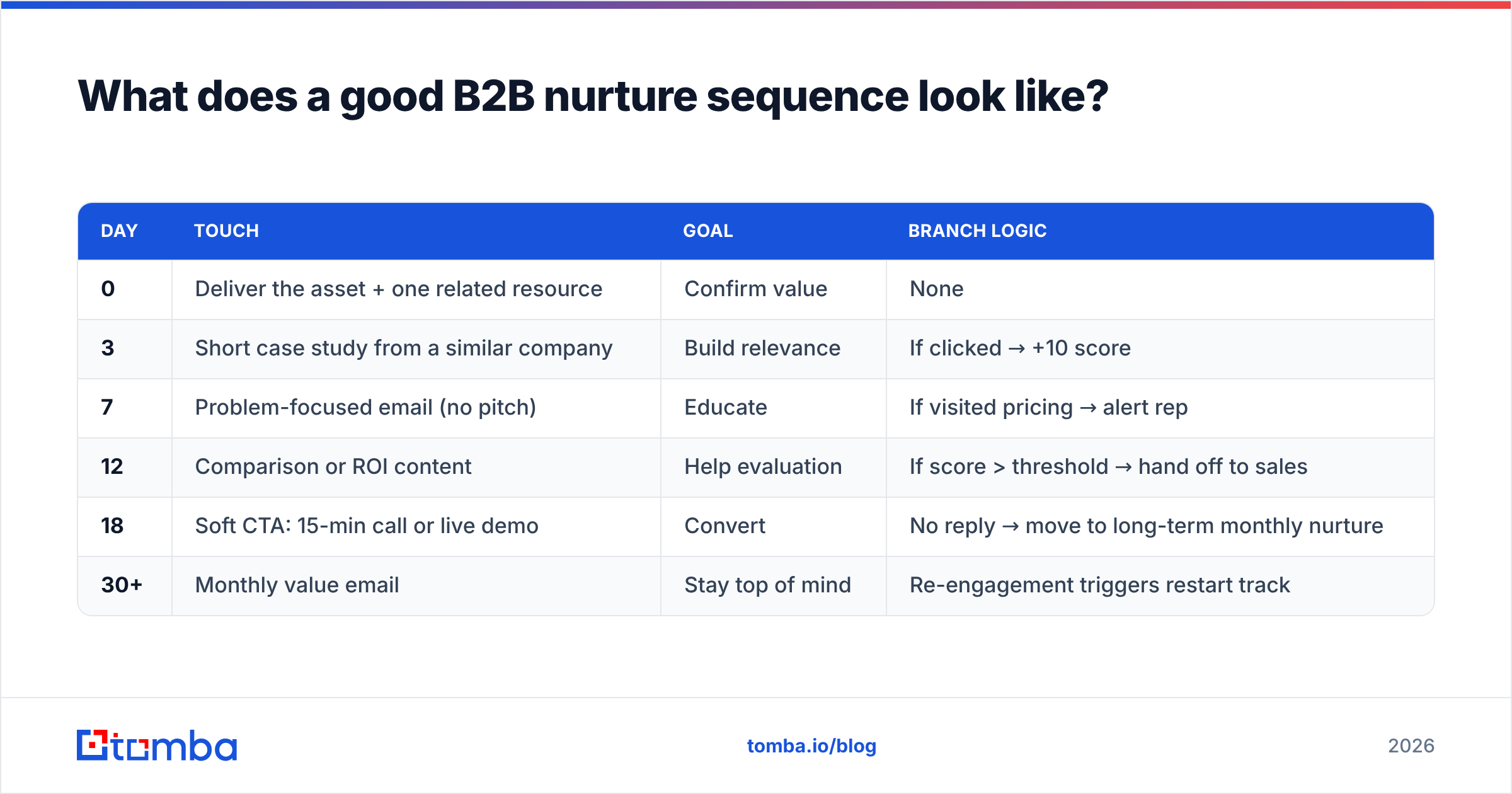
Whatever tool you choose, a solid baseline sequence for a mid-funnel B2B lead (for example, someone who downloaded a guide) looks like this:
| Day | Touch | Goal | Branch logic |
|---|---|---|---|
| 0 | Deliver the asset + one related resource | Confirm value | None |
| 3 | Short case study from a similar company | Build relevance | If clicked → +10 score |
| 7 | Problem-focused email (no pitch) | Educate | If visited pricing → alert rep |
| 12 | Comparison or ROI content | Help evaluation | If score > threshold → hand off to sales |
| 18 | Soft CTA: 15-min call or live demo | Convert | No reply → move to long-term monthly nurture |
| 30+ | Monthly value email | Stay top of mind | Re-engagement triggers restart track |
Keep each email short and single-purpose. Match the sender to the stage: marketing sender early, rep's name after handoff. Suppress anyone who replies so automation never talks over a live conversation.
What results should you expect from lead nurturing software?#
Set expectations in stages, not in open rates.
- Months 1–2: Deliverability and data hygiene stabilize. You'll see which segments engage and which don't.
- Months 3–4: Scoring thresholds get tuned. Sales and marketing agree on what an MQL actually is, often after some argument.
- Months 5–6: You can measure conversion from nurture entry to opportunity and compare it with leads that received no nurture.
Industry research from firms like Forrester and Gartner has long found that nurtured leads convert more efficiently than un-nurtured ones. Your own numbers will depend almost entirely on list quality and how relevant your content is. Treat vendor-quoted uplift statistics as marketing, and benchmark against your own baseline.
Which lead nurturing software should you pick?#
A short verdict:
- Best overall for SMB and mid-market: HubSpot Marketing Hub Professional, if the budget allows and you want one platform.
- Best value: ActiveCampaign. Deep automation at a price small teams can sustain.
- Best for Salesforce-first enterprises: Salesforce Account Engagement.
- Best for complex, multi-product enterprise nurture: Adobe Marketo Engage.
- Best budget or starter option: Brevo, with Mailchimp for very simple drips.
- Best for product-led SaaS: Customer.io.
- Best for small service businesses: Keap.
Whichever you choose, remember the pattern behind most failed nurture programs: good software running on incomplete, unverified contact data.
Ready to feed your nurture engine better data?#
Your lead nurturing software can only nurture the people it knows about, at addresses that actually receive mail. Before you build your next sequence, use the Tomba Email Finder to add the missing stakeholders at engaged accounts. Search by domain, name, or company, and get professional email addresses you can verify before they ever reach your nurture platform. The free tier includes 25 searches a month, and paid plans start at $49/mo, so you can test it on a single account-based nurture track before scaling up.
Related guides#
// get started
Find, verify and enrich your first contacts today
Start on the free plan with 25 searches a month, then scale when your team is ready.
Free plan · No credit card required · GDPR & CCPA
Get the Tomba newsletter
Product and data updates
// about the author