Lead Nurturing Strategy: How to Build One That Converts in 2026
Most of your leads aren't ready to buy when they first raise a hand. Here's a 7-step lead nurturing strategy that moves them from 'just looking' to booked meetings without spamming them.
TL;DR
- A lead nurturing strategy is a planned sequence of touches (email, LinkedIn, calls, retargeting, content) that moves leads who aren't ready yet toward a buying decision.
- Most nurture programs fail on the inputs, not the copy: stale contact data, no segmentation, and no clear hand-off rule to sales.
- The seven steps below cover the whole system: define stages, clean and enrich data, segment, map content to stages, pick channels, score and hand off, then measure and prune.
- Behaviour should decide the cadence, not the calendar. A lead who visits your pricing page twice this week needs a different next touch than one who opened a newsletter in March.
- Nurture only works if your messages arrive. Verify addresses before every major send and re-enrich records at least once a quarter.
What is a lead nurturing strategy?#
A lead nurturing strategy is the plan for what happens to a lead between first contact and a sales conversation. It sets which messages each lead gets, on which channels, in what order, and what signal tells you they're ready for a rep.
Think of it like a garden bed rather than a vending machine. Nobody plants seeds and expects tomatoes the next morning. You water on a schedule, adjust when the weather changes, and harvest when things are ripe. Nurturing works the same way: repeated, relevant contact, adjusted to how each lead behaves, until the timing is right.
In B2B terms, nurturing sits in the middle of the funnel. Lead generation fills the top with contacts. Sales closes at the bottom. Nurturing covers the long stretch where a prospect knows you exist but has no budget, no urgency, or no internal consensus yet.
That stretch is long. B2B purchases usually involve several stakeholders and a lot of independent research before anyone talks to a vendor. Gartner's sales research has repeatedly found that buyers spend only a small share of their buying journey talking to suppliers. If your only move is "book a demo," you're missing most of the journey.
Why do most lead nurturing programs fail?#
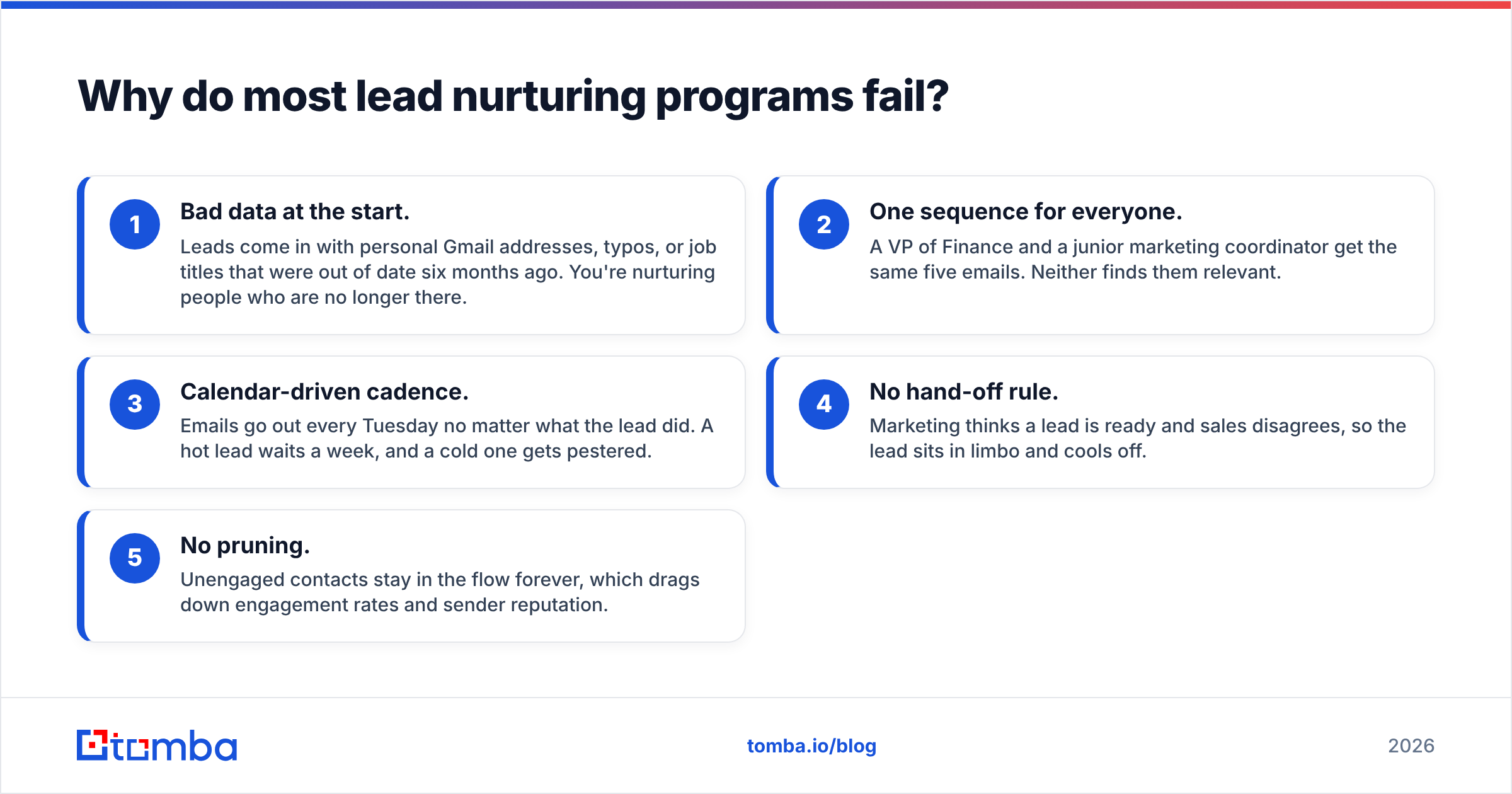
Most programs fail for boring reasons, and better subject lines won't fix any of them.
- Bad data at the start. Leads come in with personal Gmail addresses, typos, or job titles that were out of date six months ago. You're nurturing people who are no longer there.
- One sequence for everyone. A VP of Finance and a junior marketing coordinator get the same five emails. Neither finds them relevant.
- Calendar-driven cadence. Emails go out every Tuesday no matter what the lead did. A hot lead waits a week, and a cold one gets pestered.
- No hand-off rule. Marketing thinks a lead is ready and sales disagrees, so the lead sits in limbo and cools off.
- No pruning. Unengaged contacts stay in the flow forever, which drags down engagement rates and sender reputation.
Each of the seven steps below fixes one or more of these failures.
How do you build a lead nurturing strategy in 7 steps?#
Here's the framework in short. Each step gets its own section after this.
- Define lifecycle stages and exit criteria. Write down what "subscriber," "MQL," "SQL," and "opportunity" mean for your team, with observable triggers for each.
- Clean, verify, and enrich the data. Every lead needs a deliverable work email, a current title, a company, and firmographics before it goes into a flow.
- Segment by fit and intent. Split leads by persona, company size, and behaviour so each group gets a message that fits.
- Map content to stages. Educational content early, comparison and proof content in the middle, ROI and implementation detail late.
- Choose channels and cadence. Mix email with LinkedIn, retargeting, and calls. Let triggers set the timing.
- Score leads and hand them off cleanly. Combine fit and engagement into a score with a threshold both teams agree on.
- Measure, prune, and iterate. Track stage-to-stage conversion, not just opens, and remove dead contacts on a schedule.
Step 1: What lifecycle stages should you define?#
Start with definitions, because every other step depends on them. If marketing and sales can't agree on what a marketing qualified lead is, no nurture sequence will fix the friction.
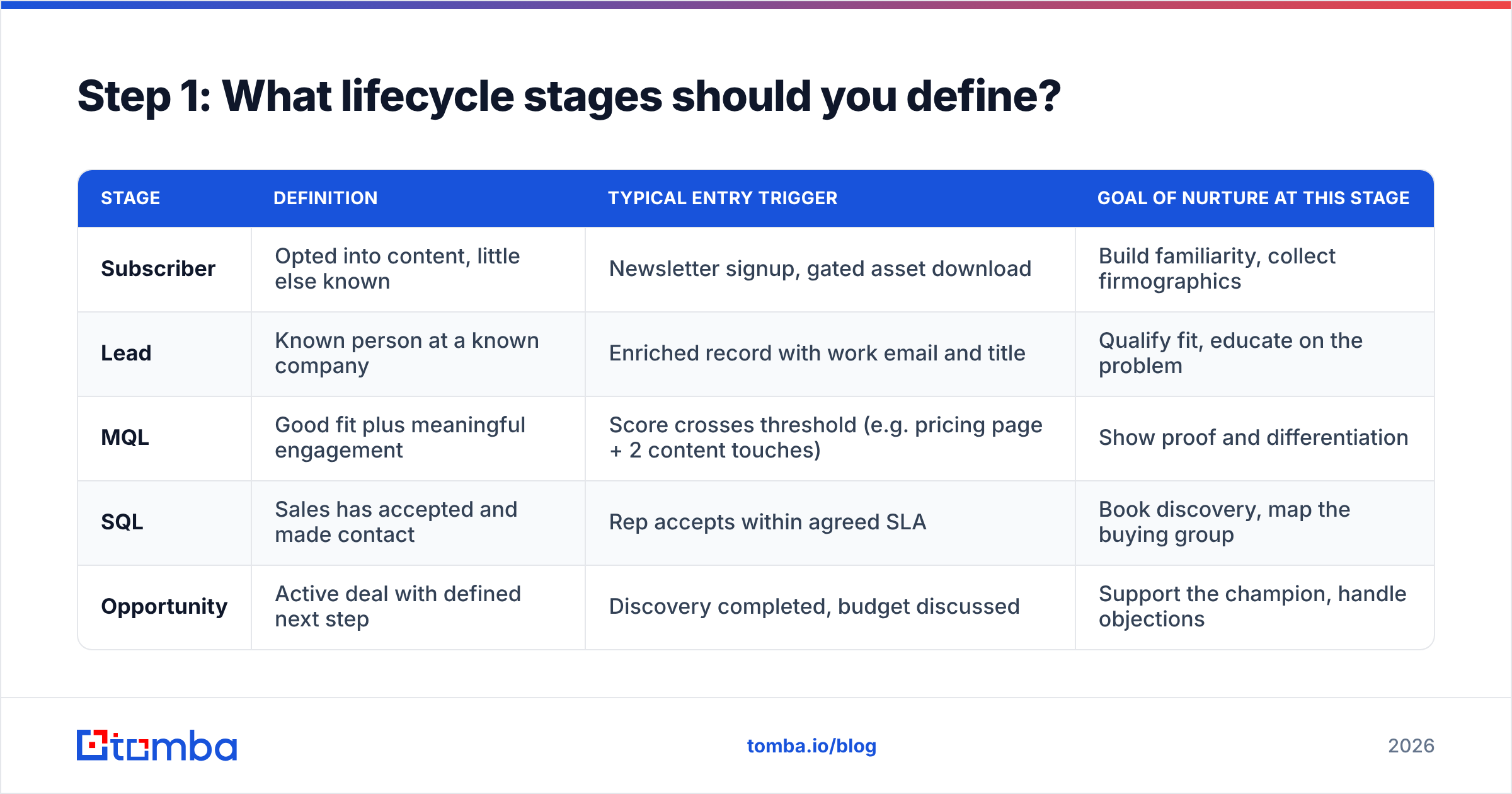
A workable starting model:
| Stage | Definition | Typical entry trigger | Goal of nurture at this stage |
|---|---|---|---|
| Subscriber | Opted into content, little else known | Newsletter signup, gated asset download | Build familiarity, collect firmographics |
| Lead | Known person at a known company | Enriched record with work email and title | Qualify fit, educate on the problem |
| MQL | Good fit plus meaningful engagement | Score crosses threshold (e.g. pricing page + 2 content touches) | Show proof and differentiation |
| SQL | Sales has accepted and made contact | Rep accepts within agreed SLA | Book discovery, map the buying group |
| Opportunity | Active deal with defined next step | Discovery completed, budget discussed | Support the champion, handle objections |
Write the exit criteria as things you can observe, like "visited pricing twice in 14 days." "Seems interested" doesn't count. Put the definitions somewhere both teams can see, and review them every quarter.
Step 2: Why does data quality decide nurture results?#
Your nurture program can only be as good as the list it runs on. B2B contact data decays steadily as people change jobs, get promoted, and leave companies. A list that was clean at signup won't stay clean for a nine-month buying cycle.
Three things need to happen before a lead enters a flow:
- Verify the email. Run every new address through an email verifier and re-verify the whole nurture list before big campaigns. Hard bounces hurt deliverability, and nurture flows send often enough that small bounce rates add up.
- Enrich the record. A form with three fields won't tell you company size, industry, or seniority. Use data enrichment to fill those gaps so segmentation (step 3) is possible without longer forms.
- Replace personal emails where you can. A lead who signed up with a personal Gmail address can often be matched to a work email through an email finder, provided you have a lawful basis for contacting them. Work addresses also make account-level nurture possible.
Data providers vary on coverage, freshness, and region. Tomba, BookYourData, Apollo, and others each have their strengths, so test a sample of your actual ICP before you commit. What matters most is that verification and enrichment happen on a schedule, not only once at capture.
Step 3: How should you segment leads for nurturing?#
Segment on two axes: fit (who they are) and intent (what they're doing).
Fit segments usually come from enriched data:
- Persona or role (economic buyer, technical evaluator, end user)
- Company size band
- Industry or vertical
- Tech stack, when your product integrates with or replaces something specific
Intent segments come from behaviour:
- Topic of the content they consumed
- Product pages visited
- Recency and frequency of engagement
- Replies to sales outreach, including "not now" replies
You don't need 40 segments. Four to eight well-defined ones usually beat a sprawling matrix nobody maintains. A useful rule: create a segment only if you'd actually write different copy for it.
Step 4: What content belongs at each nurture stage?#
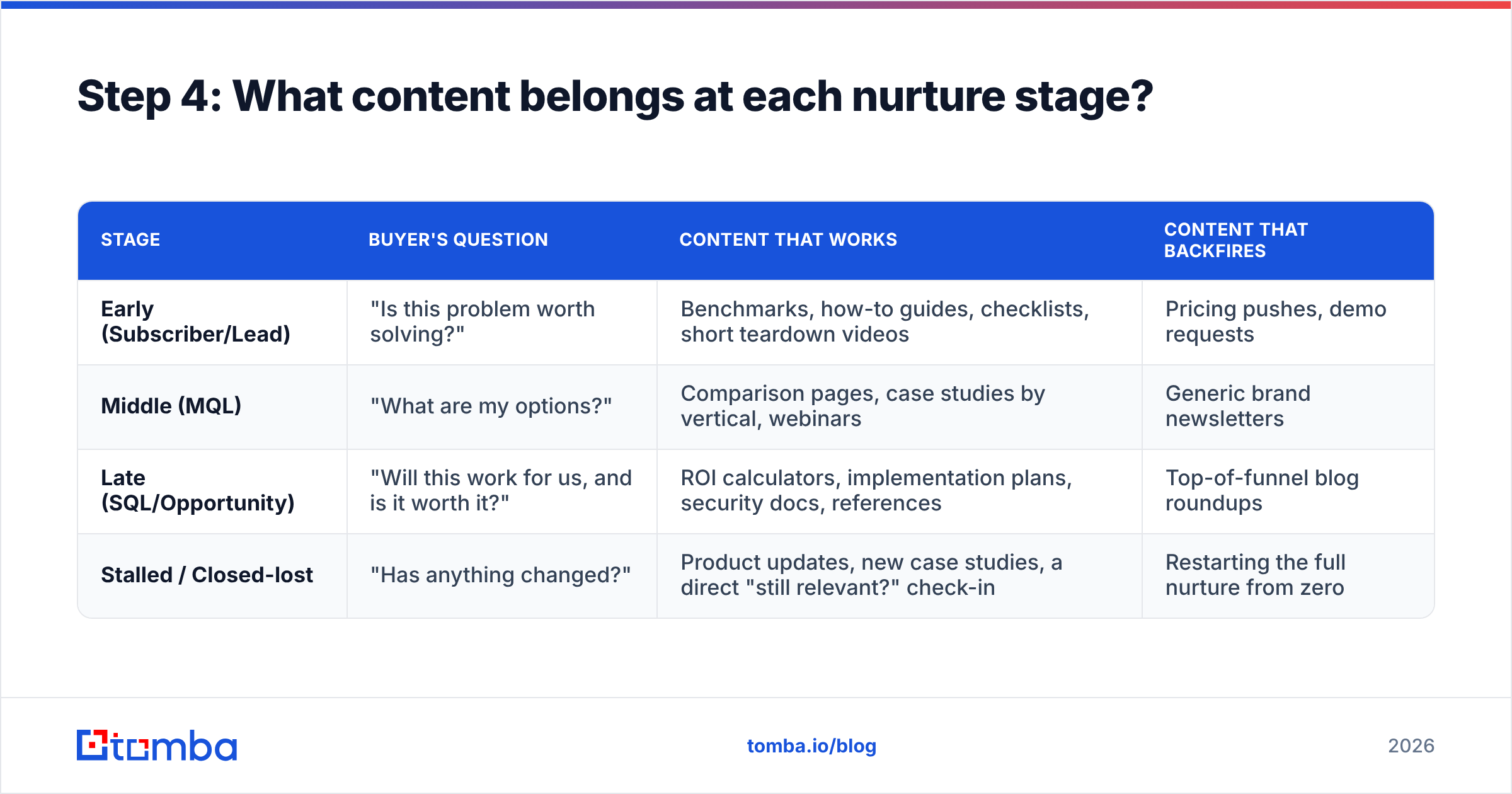
Match the content to the question the lead is asking right now, not the question you want them to ask.
| Stage | Buyer's question | Content that works | Content that backfires |
|---|---|---|---|
| Early (Subscriber/Lead) | "Is this problem worth solving?" | Benchmarks, how-to guides, checklists, short teardown videos | Pricing pushes, demo requests |
| Middle (MQL) | "What are my options?" | Comparison pages, case studies by vertical, webinars | Generic brand newsletters |
| Late (SQL/Opportunity) | "Will this work for us, and is it worth it?" | ROI calculators, implementation plans, security docs, references | Top-of-funnel blog roundups |
| Stalled / Closed-lost | "Has anything changed?" | Product updates, new case studies, a direct "still relevant?" check-in | Restarting the full nurture from zero |
A common mistake is sending late-stage asks to early-stage leads. A request to "hop on a 15-minute call" in email two will get ignored by someone who downloaded a checklist yesterday.
Keep each nurture email short and focused on one idea with one call to action. If you need help drafting variations, a library of cold email templates is a good starting point, but rewrite them in your own voice before sending.
Step 5: Which channels and cadence should you use?#
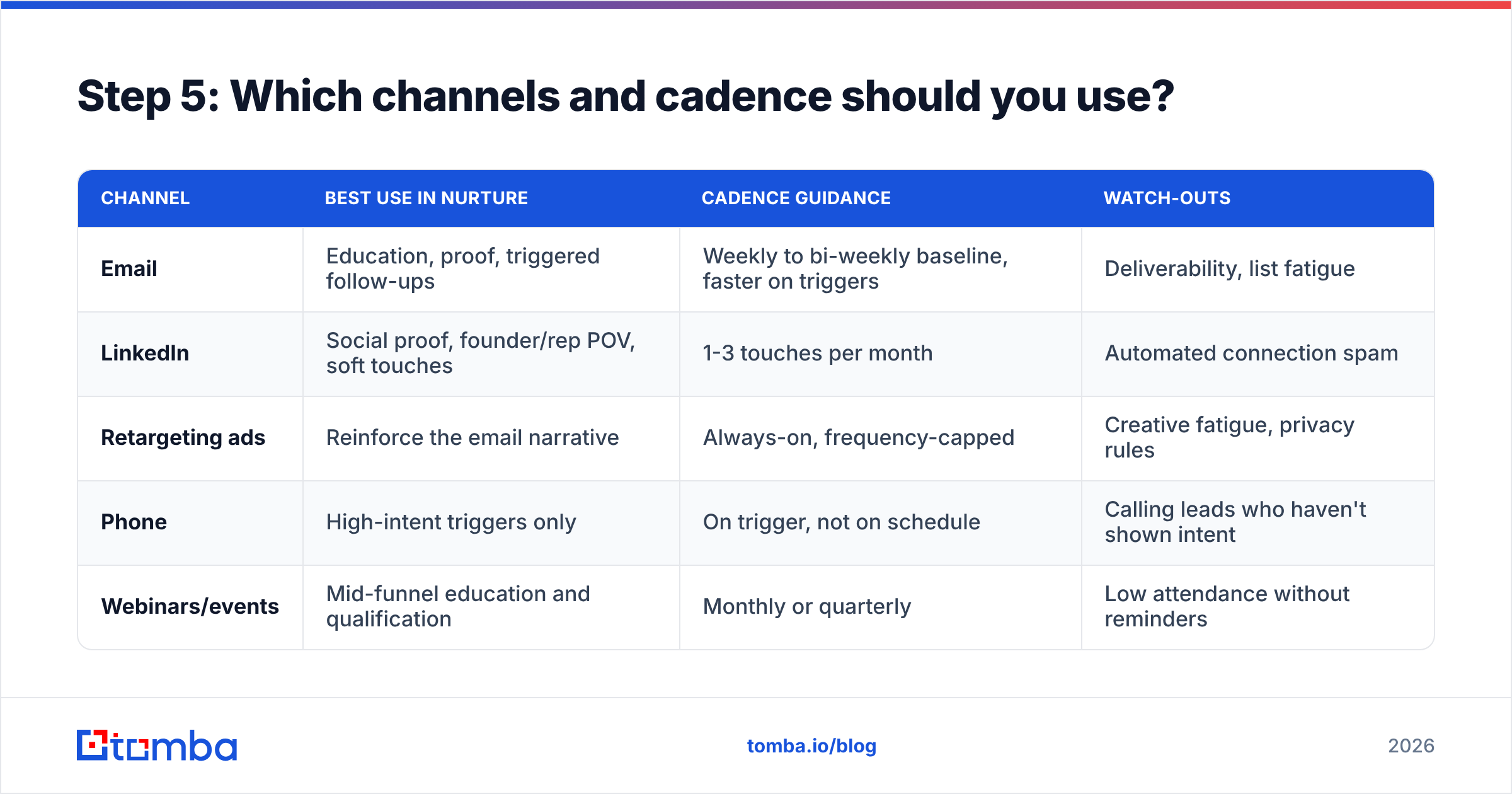
Email is the backbone of most nurture programs, but email-only nurture tends to go stale. Layer in other channels so the lead sees a consistent story in more than one place.
| Channel | Best use in nurture | Cadence guidance | Watch-outs |
|---|---|---|---|
| Education, proof, triggered follow-ups | Weekly to bi-weekly baseline, faster on triggers | Deliverability, list fatigue | |
| Social proof, founder/rep POV, soft touches | 1-3 touches per month | Automated connection spam | |
| Retargeting ads | Reinforce the email narrative | Always-on, frequency-capped | Creative fatigue, privacy rules |
| Phone | High-intent triggers only | On trigger, not on schedule | Calling leads who haven't shown intent |
| Webinars/events | Mid-funnel education and qualification | Monthly or quarterly | Low attendance without reminders |
Let triggers override the calendar. A baseline cadence keeps you top of mind. Triggers are where the conversions happen: a pricing page visit, a second visit from the same account, a job change, or a reply that says "check back in Q3." Build branches for these instead of letting everyone march through the same drip.
If you're comparing platforms to run all of this, G2's marketing automation category is a reasonable place to shortlist tools by company size and review volume.
Step 6: How do you score leads and hand them off to sales?#
Lead scoring turns "seems interested" into a number both teams can act on. Keep the model simple enough to explain in one sentence.
A practical two-part score:
- Fit score (0-50): role seniority, company size, industry match, tech-stack match. This comes mostly from enrichment.
- Engagement score (0-50): pricing page visits, demo-page views, webinar attendance, email replies, and repeat visits from the same account. Opens alone should count for little, since privacy features in mail clients inflate them.
Set a threshold, say 65, for MQL status, and require at least a minimum fit score so a very engaged student doesn't end up in a rep's queue.
Then write the hand-off SLA:
- Sales accepts or rejects each MQL within an agreed window, for example one business day.
- Rejected leads go back into nurture with a reason code, not into a black hole.
- Accepted leads leave marketing nurture automatically so they don't get a newsletter in the middle of a live deal.
That last point matters more than it looks. Few things damage credibility faster than a prospect getting a "Getting started with our category" email the day after a pricing call.
Step 7: How do you measure and improve a nurture program?#
Opens and clicks are diagnostic metrics. They aren't outcomes. Track what the business actually cares about:
- Stage conversion rates: Lead → MQL, MQL → SQL, SQL → Opportunity.
- Velocity: median days spent in each stage.
- Nurture-sourced and nurture-influenced pipeline: opportunities where nurture touches happened before sales acceptance.
- Response rate on reply-oriented emails, which says more about fit than click rate does.
- List health: bounce rate, unsubscribe rate, and the share of the list with no engagement in 90+ days.

Prune on a schedule. Contacts with no engagement for 90-180 days should get a short re-engagement sequence ("still relevant?"). If they don't respond, suppress them. A smaller, engaged list gets better inbox placement and gives you more honest metrics.
Then run one test at a time: a new first email, a shorter sequence, a different trigger threshold. Change one variable per test so you know what caused the result.
What does a sample lead nurturing sequence look like?#
Here's a behaviour-driven example for a mid-market lead who downloaded a guide:
- Day 0: Deliver the asset plus one related resource. No ask.
- Day 3: Short email with a single insight or benchmark relevant to their industry segment.
- Day 8: Case study from a similar-sized company in their vertical.
- Trigger (any time): Pricing page visit → rep gets an alert, and the lead gets a plain-text note from the rep offering a specific resource (not a generic demo link).
- Day 15: Comparison or "how to evaluate" content.
- Day 25: Invitation to a webinar or a short product walkthrough video.
- Day 40: Direct, low-pressure check-in: "Is this on your roadmap this quarter, later, or not at all?" Each answer routes to a different branch.
- No engagement by day 60: Move to a monthly low-frequency track. After 180 days of silence, re-engage once, then suppress.
The day-40 question does a lot of work. It lets leads self-select into the right cadence, and "not this quarter" is useful data, not a rejection.
Is lead nurturing different for outbound leads?#
Yes. Inbound leads raised their hand. Outbound leads didn't, so the nurture has to earn attention first.
For outbound-sourced contacts:
- Keep sequences shorter and more personal, usually four to six touches, before moving non-responders to a light-touch track.
- Reference a specific trigger (hiring, funding, a tech change) instead of generic content.
- Be stricter about verification, because outbound lists tend to have higher bounce risk than form fills.
- Respect local consent rules. What's acceptable B2B outreach varies by country, so check with your legal team before you add cold-sourced contacts to marketing flows.
Once an outbound prospect engages, they can move into the same stage model as inbound leads, which keeps reporting consistent.
What's the bottom line on lead nurturing strategy?#
A good lead nurturing strategy works more like a system than a campaign. Define the stages, keep the data clean and enriched, segment by fit and intent, match content to the buyer's actual question, let behaviour set the cadence, agree on a scoring and hand-off rule, and prune on a schedule.
The part teams skip most often is data. Every other step assumes the email reaches a real person who still works at the company you think they do. Get that right and the rest gets much easier.
If you're rebuilding your nurture lists or turning personal-email signups into reachable work contacts, Tomba Email Finder finds professional email addresses by name, domain, or company, and each result comes with a verification status, so your nurture program starts on clean data. There's a free tier with 25 searches a month to test it against your own ICP, and paid plans start at $49/mo.
Related guides#
// get started
Find, verify and enrich your first contacts today
Start on the free plan with 25 searches a month, then scale when your team is ready.
Free plan · No credit card required · GDPR & CCPA
Get the Tomba newsletter
Product and data updates
// about the author