Lead Onion Pricing, Reviews, Pros and Cons: 2026 Honest Breakdown
Lead Onion sells premium B2B intent data from roughly $500/mo with no free trial. Here's what the tiers include, what G2 reviewers praise and complain about, and when a cheaper contact-data stack does the job.
TL;DR
- Lead Onion is a B2B intent data platform, not a plain email finder. You pay to learn which accounts are researching topics you sell into, then you reveal contacts at those accounts.
- Third-party directories list the published tiers at about Starter $500/mo, Growth $1,750/mo, Scale $3,000/mo, and custom Enterprise. Overage contact reveals run about $0.20 each. There's no free plan or self-serve trial.
- G2 reviewers (around 4.3/5) like the intent depth, the Research Quadrant buying-stage view, and hands-on support. The common complaints are onboarding complexity, occasional contact-reveal glitches, and limited niche segmentation.
- It's worth the money if you have a defined ICP, an SDR team that acts on signals within days, and budget above $6,000 a year. It isn't worth it if what you actually need is verified email addresses.
- If contact data is your bottleneck, an email finder like Tomba ($49/mo Starter, free tier available) covers that part for a small fraction of the cost. You can also pair it with Lead Onion.
What is Lead Onion, and what are you actually paying for?#
Lead Onion describes itself as a "premium intent platform." Its job is to tell your sales and marketing teams which companies are actively researching a problem you solve, before those companies fill in a form or reply to an email.
To do that, it combines several intent sources: topic-level research activity across the web, social engagement signals, and website-level behaviour. It then scores and classifies each account. The product's signature feature is the Research Quadrant, which places each in-market account into one of four buying-journey phases (Initial, Interested, Active, In-Depth). Once an account looks hot, you use contact reveals to pull the relevant decision-makers at that company.
So a Lead Onion invoice pays for three separate things:
- Intent triggers: the number of intent-qualified companies the platform surfaces for your chosen topics each month.
- Contact reveals: credits to unlock people and their contact details at those companies.
- Seats: the number of users who can log in and work the signals.
This matters when you compare prices. A $49 email finder and a $500 intent platform aren't the same category, even though both will eventually give you an email address. Lead Onion's value comes from timing (who is in-market now). An email finder's value comes from reachability (can you get a verified address for this person).
How much does Lead Onion cost in 2026?#
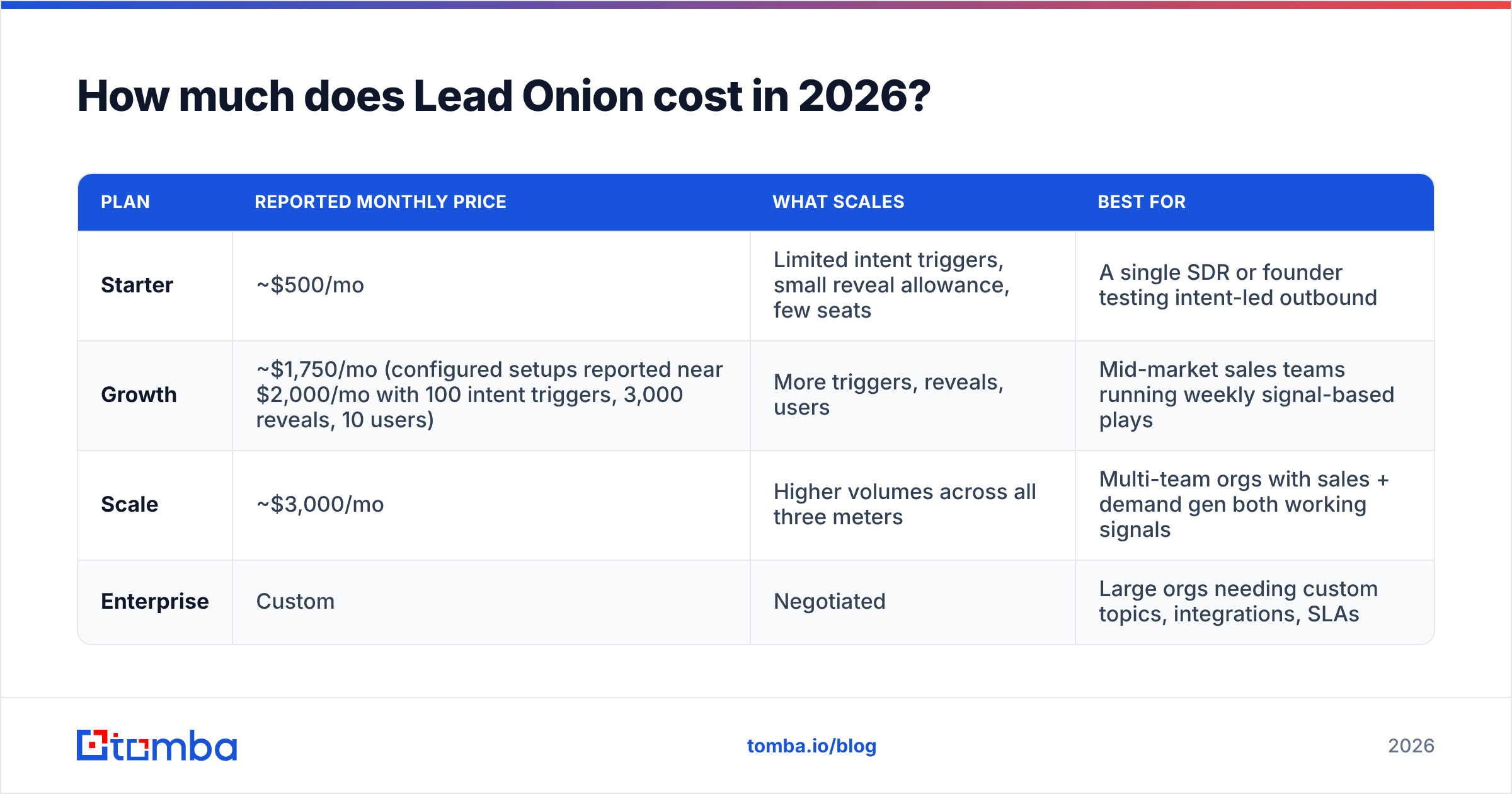
Lead Onion publishes pricing on its official pricing page, but the numbers change often and aggregators quote different figures. The table below uses the tiers most consistently reported by third-party directories in 2026. Treat them as ballpark figures and get a written quote before you budget.
| Plan | Reported monthly price | What scales | Best for |
|---|---|---|---|
| Starter | ~$500/mo | Limited intent triggers, small reveal allowance, few seats | A single SDR or founder testing intent-led outbound |
| Growth | ~$1,750/mo (configured setups reported near $2,000/mo with 100 intent triggers, 3,000 reveals, 10 users) | More triggers, reveals, users | Mid-market sales teams running weekly signal-based plays |
| Scale | ~$3,000/mo | Higher volumes across all three meters | Multi-team orgs with sales + demand gen both working signals |
| Enterprise | Custom | Negotiated | Large orgs needing custom topics, integrations, SLAs |
Reported add-on costs:
- Extra contact reveals: about $0.20 per contact (roughly $200 per 1,000)
- Extra intent triggers: about $10 each
- Extra users: about $50 per seat
All tiers reportedly include multi-source intent, Research Quadrant classification, and account-level insights. The difference between tiers is volume, not feature access. That makes pricing fairly easy to model once you know how many in-market accounts and contacts you need each month.
What does Lead Onion really cost per year?#
Here's the annualised math, using the reported list prices and no discounts:
- Starter: ~$6,000/year
- Growth: ~$21,000–$24,000/year
- Scale: ~$36,000/year
Overages come on top. On Growth, a team that burns through its 3,000 included reveals and needs another 2,000 a month adds about $400/month, or $4,800/year. Two extra SDR seats add $1,200/year. Most Growth customers will realistically spend $25,000+ annually once usage settles.
What are the hidden costs of Lead Onion?#
The subscription line is only part of what you'll spend. Budget for these before signing:
- No free trial. You can't validate signal quality on your own ICP before paying. Ask for a pilot or a sample list of in-market accounts in your category during the sales process.
- Contact reveal overages. Intent is only useful if you can reach people. Teams that underestimate reveals end up paying $0.20 per contact past their quota, and those costs add up quickly with multi-threaded outreach (3–5 contacts per account).
- Verification isn't the same as revealing. A revealed email still needs to be deliverable. If you're sending cold email, you should still run addresses through an email verifier before they go into a sequence, especially on catch-all domains.
- Onboarding time. Several G2 reviewers call setup "hectic" for reps. Choosing topics, defining ICP filters, and wiring the tool into your CRM takes real RevOps hours. Price that time in.
- Sequencer and CRM stack. Lead Onion tells you who and when. You still need a CRM and an outreach tool to act on it, and those have their own licences.
What do Lead Onion reviews say?#
Lead Onion holds roughly 4.3 out of 5 on G2. The review count is modest compared with category giants, so read it as directional rather than definitive. Reviews on TrustRadius follow similar themes.
What reviewers consistently praise:
- Depth of intent in one place. Users like seeing social, topic, and website intent together instead of stitching three vendors into a spreadsheet.
- Fast, usable prioritisation. Sorting accounts by intent level and buying stage helps SDRs decide who to call first on Monday morning.
- Customer success. This comes up repeatedly: regular check-ins, responsive support, and help tuning topics.
- Shipping pace. Reviewers mention frequent updates and new features.
What reviewers push back on:
- Onboarding complexity. Getting a sales team comfortable with intent concepts and the interface takes effort.
- Occasional reveal glitches. Some users report contacts that won't reveal. They also say support fixes these quickly.
- Segmentation for niche markets. Teams selling into narrow verticals want more advanced filters than the platform currently offers.
What stands out is what isn't in the complaints: few reviewers say the intent signals are wrong. The friction is operational (setup, workflow, edge cases) rather than about the core data. That's a good sign for an intent vendor, because signal accuracy is where most of them lose credibility.
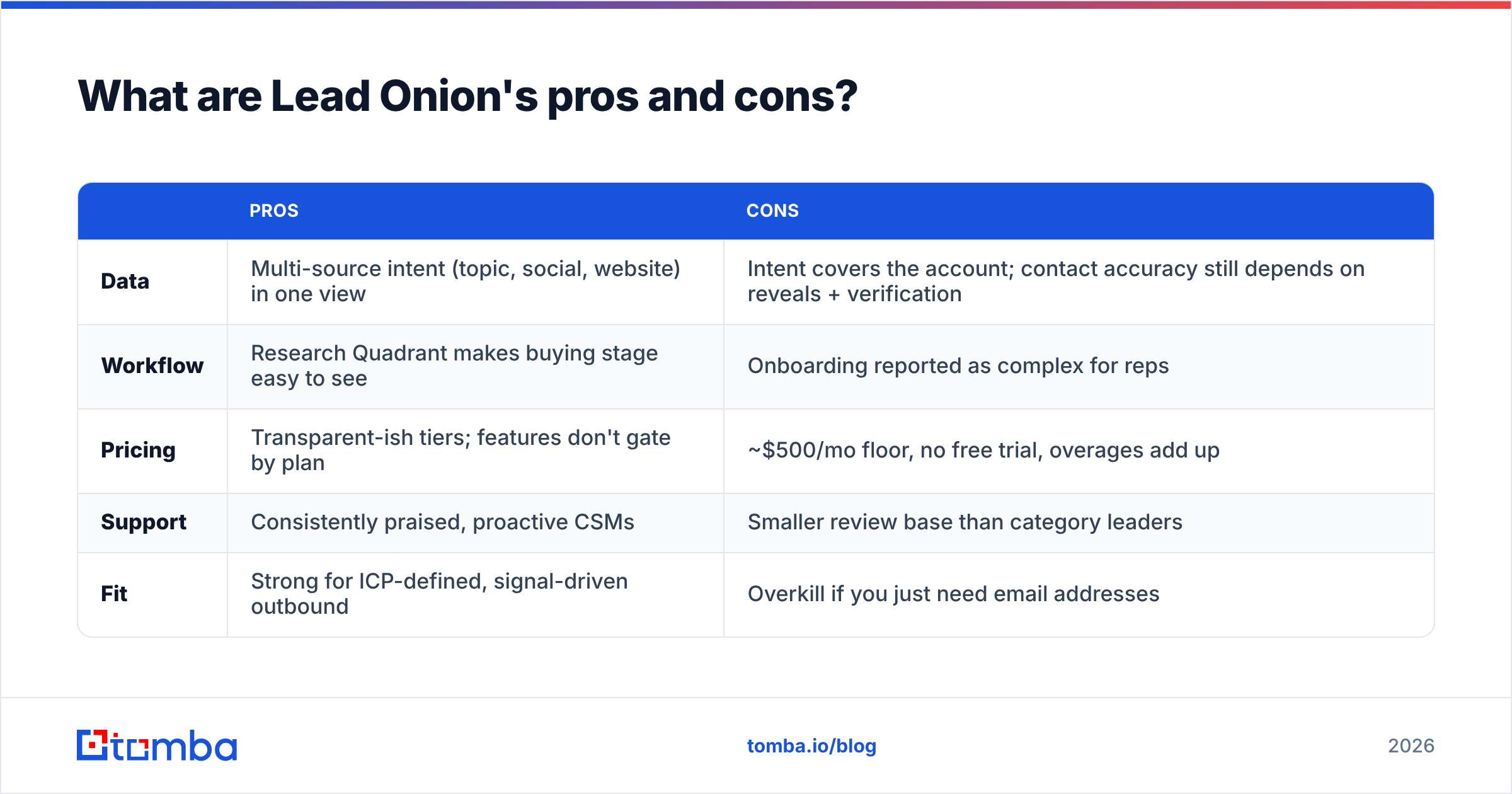
What are Lead Onion's pros and cons?#
| Pros | Cons | |
|---|---|---|
| Data | Multi-source intent (topic, social, website) in one view | Intent covers the account; contact accuracy still depends on reveals + verification |
| Workflow | Research Quadrant makes buying stage easy to see | Onboarding reported as complex for reps |
| Pricing | Transparent-ish tiers; features don't gate by plan | ~$500/mo floor, no free trial, overages add up |
| Support | Consistently praised, proactive CSMs | Smaller review base than category leaders |
| Fit | Strong for ICP-defined, signal-driven outbound | Overkill if you just need email addresses |
Who should (and shouldn't) pay for Lead Onion?#
Intent data works like a weather forecast for your pipeline. It tells you where rain is likely, but you still need an umbrella and someone who walks outside. The tool only pays off if your team acts on it.
Lead Onion is a good fit if you:
- Sell a considered B2B product with an ACV high enough that one extra closed deal a quarter covers the subscription
- Have a clear ICP and topics buyers research before purchasing
- Run an SDR or BDR team that can work fresh signals within 24–72 hours
- Already have a CRM and sequencer in place and want better targeting, not more tools
Lead Onion is a poor fit if you:
- Are pre-product-market-fit and still figuring out who buys
- Need high volumes of verified emails more than you need timing signals
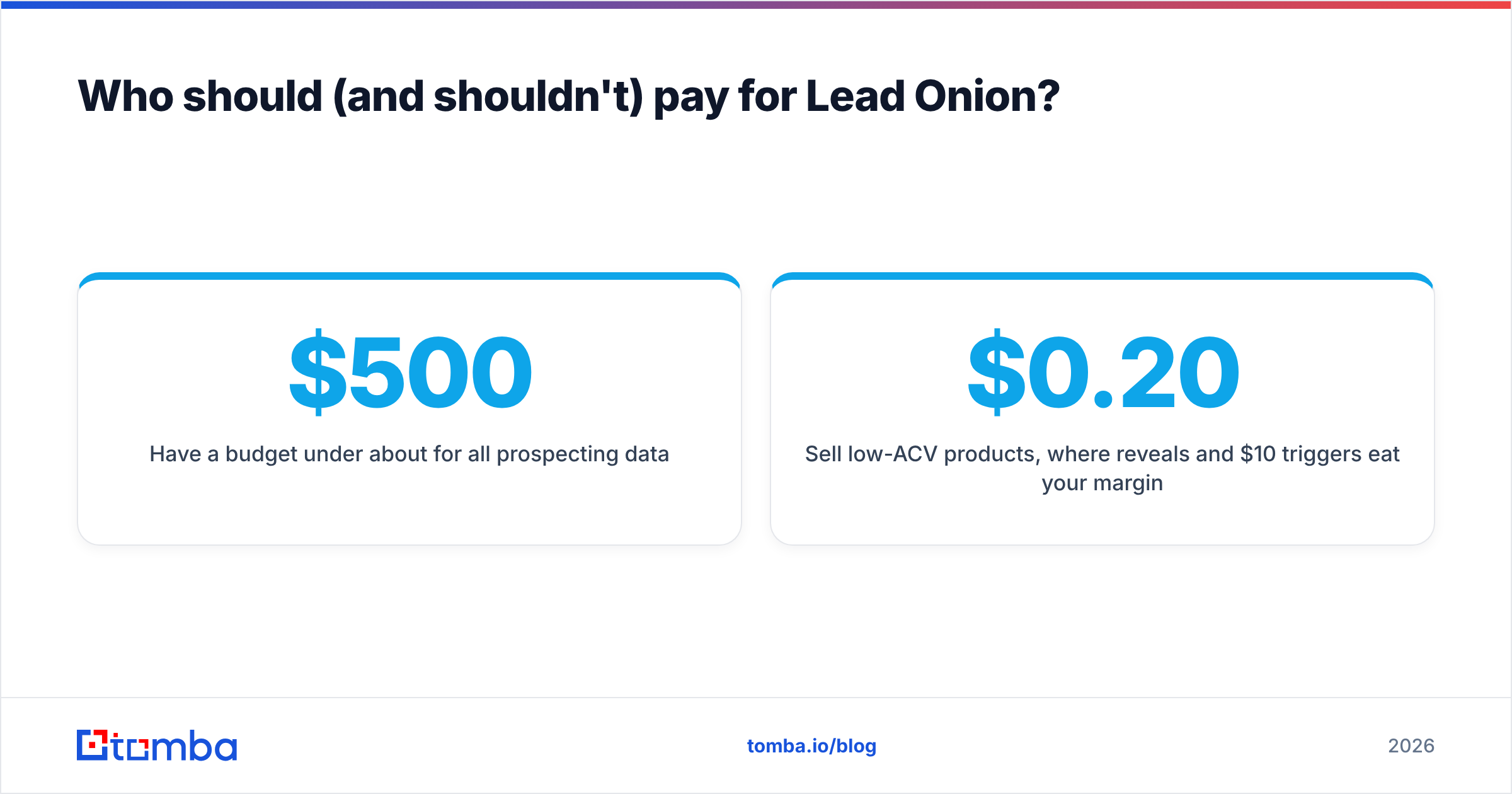
- Have a budget under about $500/month for all prospecting data
- Sell low-ACV products, where $0.20 reveals and $10 triggers eat your margin
How does Lead Onion compare with alternatives?#
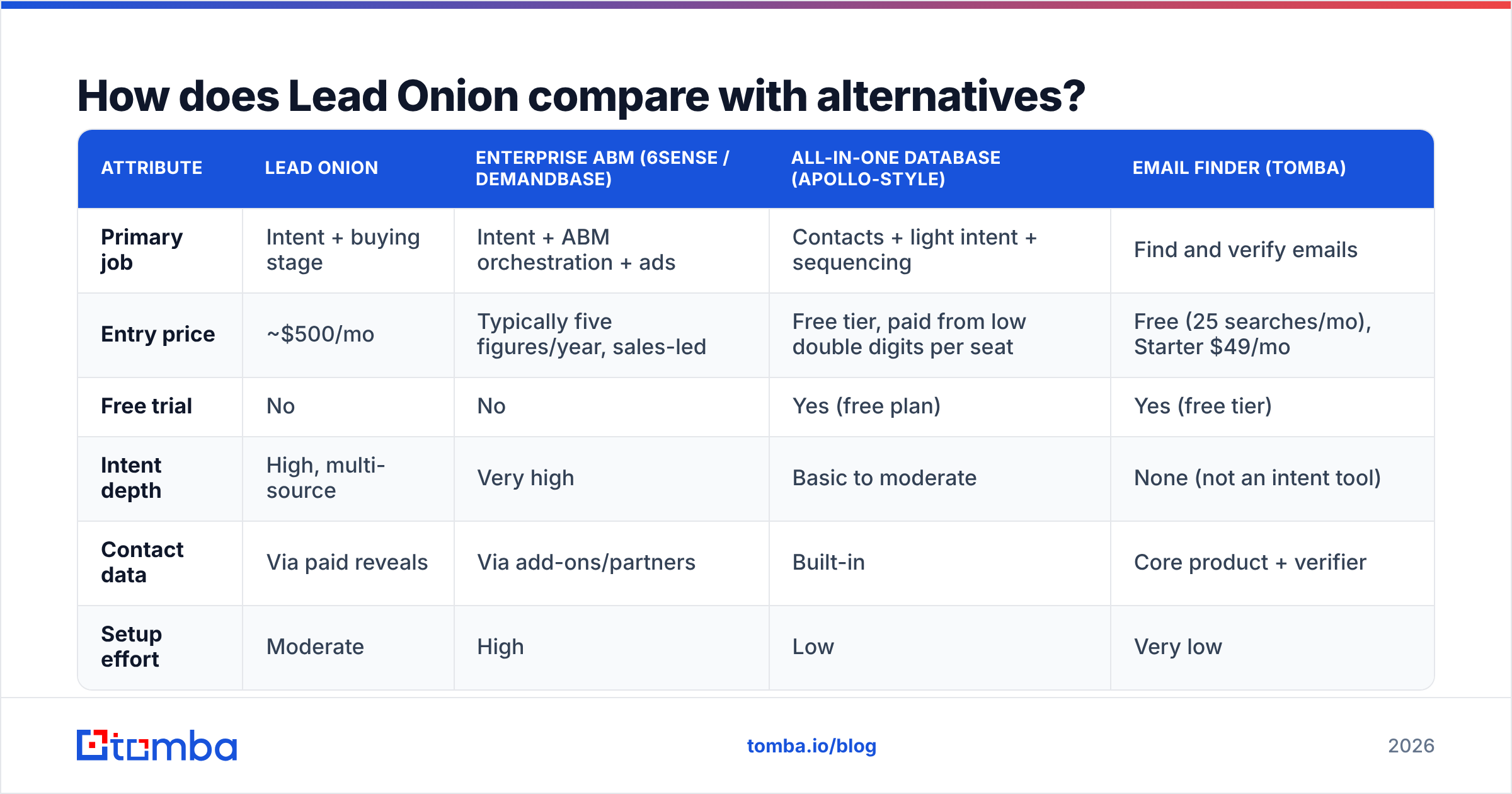
Lead Onion competes in two directions. Upmarket, it sits alongside intent and ABM platforms such as 6sense, Demandbase, and Bombora-powered tools. Downmarket, buyers often compare it with all-in-one databases like Apollo or UpLead, which bundle lighter intent with contact data. Sales teams that only need contacts often skip intent entirely and use an email finder.
| Attribute | Lead Onion | Enterprise ABM (6sense / Demandbase) | All-in-one database (Apollo-style) | Email finder (Tomba) |
|---|---|---|---|---|
| Primary job | Intent + buying stage | Intent + ABM orchestration + ads | Contacts + light intent + sequencing | Find and verify emails |
| Entry price | ~$500/mo | Typically five figures/year, sales-led | Free tier, paid from low double digits per seat | Free (25 searches/mo), Starter $49/mo |
| Free trial | No | No | Yes (free plan) | Yes (free tier) |
| Intent depth | High, multi-source | Very high | Basic to moderate | None (not an intent tool) |
| Contact data | Via paid reveals | Via add-ons/partners | Built-in | Core product + verifier |
| Setup effort | Moderate | High | Low | Very low |
If you're weighing the ABM tier, our 6sense alternative breakdown covers what you give up by going lighter.
Many teams end up running a combination: Lead Onion (or another intent source) to decide which accounts to target this week, and a dedicated email finder plus verifier to reach the right people at those accounts without spending reveal credits on every contact.
Can you cut Lead Onion costs without losing the intent signal?#
Yes. Contact reveals are the part of the bill that grows fastest, so that's where to optimise.
- Buy the tier for triggers, not reveals. Size your plan around the number of in-market accounts your team can realistically work. Don't size it around contacts.
- Reveal one champion, find the rest elsewhere. Use a Lead Onion reveal for the key decision-maker. Then find additional stakeholders at that domain with a domain-based email finder, which costs far less per contact.
- Verify before you send. Bounces hurt sender reputation no matter where the data came from. Run every list through verification before it hits your sequencer.
- Enrich instead of re-revealing. If a contact is already in your CRM, data enrichment can fill in missing fields without using another intent-platform credit.
- Negotiate annual terms. Intent vendors usually discount annual prepay and can bundle extra reveals. Ask during the pilot conversation.
With this setup, a Growth-tier team can often stay within its included 3,000 reveals and avoid most overages. That typically saves a few thousand dollars a year.
Is Lead Onion worth it in 2026?#
It depends on what's limiting your pipeline right now.
If your reps spend their days emailing accounts that aren't buying, Lead Onion addresses that problem directly. Reviewers credit its multi-source intent and buying-stage view with better prioritisation, and its support team gets consistent praise. At about $500–$3,000/month it's cheaper than the enterprise ABM suites, though far from cheap.
If your problem is that you can't reach the right people, because you're short on verified emails or your bounce rate is creeping up, intent data won't solve it. You'll pay premium prices for timing and still be stuck on reachability.
A useful test: write down the ten accounts you'd most like to close this quarter. If you already know who they are but can't reach the buyers, you need contact data first. If you don't know which accounts are in-market, intent data is the right investment.
How can Tomba fit alongside (or instead of) Lead Onion?#
Whether you go all-in on intent or start with the basics, you need verified contact data to act on it. Tomba Email Finder finds professional email addresses by name, domain, or company, and the email verifier checks them before they go into a sequence. You can start on the free tier with 25 searches a month, and paid Tomba plans begin at $49/mo. That's enough to test whether better contact coverage moves your reply rate before you commit $6,000+ a year to intent data. If you already run Lead Onion, use Tomba to multi-thread into hot accounts without paying for every extra reveal.
Related guides#
// get started
Find, verify and enrich your first contacts today
Start on the free plan with 25 searches a month, then scale when your team is ready.
Free plan · No credit card required · GDPR & CCPA
Get the Tomba newsletter
Product and data updates
// about the author