Lead Prioritization: How to Rank Leads So Reps Work the Right Ones
Your reps have more leads than hours. This guide compares five lead prioritization models, shows how to build a simple fit-plus-intent matrix, and covers the data problems that quietly break every scoring system.
TL;DR
- Lead prioritization means ranking leads so your reps spend their limited hours on the leads most likely to close, instead of the newest or loudest ones.
- The most dependable model for most B2B teams is a two-axis matrix: fit (does this account match your ICP?) crossed with intent (are they showing buying signals right now?).
- Points-based lead scoring works once you have enough closed-won history to calibrate it. Predictive scoring needs even more. Don't adopt either before your data can support it.
- Most prioritization systems break on data, not on logic. Missing job titles, bounced emails and unknown company sizes push good leads to the bottom of the queue.
- Speed still matters. A well-ranked lead that waits two days for a reply has usually cooled off.
What is lead prioritization?#
Lead prioritization is the process of deciding which leads a sales team works first, second, and not at all. It turns a flat list of names into an ordered queue based on how likely each lead is to buy and how much revenue they're likely to bring.
It overlaps with lead scoring, but they aren't the same thing. Lead scoring is one method: you assign points to attributes and behaviours. Lead prioritization is the wider discipline. It includes scoring, routing rules, SLA timers, tiering, and the judgement calls your reps make at 9 a.m. on a Monday.
Without explicit prioritization, the queue gets sorted by accident. Common defaults:
- Recency. The newest lead gets worked first, even when it's a student downloading an ebook.
- Volume. Whoever shouts loudest gets the attention: the lead who emailed three times, or the one with a famous logo.
- Rep preference. Reps chase deals they enjoy or already understand and skip everything else.
All three look productive and all three leak pipeline. A written prioritization model takes that decision out of individual habit and makes it repeatable.
Why does lead prioritization matter more in 2026?#
Two things changed. Inbound volume went up because AI-assisted content and gated assets produce a lot of low-intent form fills. Outbound got harder because inbox providers now enforce stricter bulk-sender rules. The result is more leads, less rep capacity per lead, and a higher cost for every wasted touch.
Response speed matters as much as it ever did. A widely cited Harvard Business Review study on online sales leads found that firms contacting a lead within an hour were about seven times as likely to qualify it as firms that waited longer. The study is old, but the principle still applies: prioritization only helps if the top of the queue gets worked quickly. A perfectly ranked list that sits untouched for two days is no better than a random one.

What are the main lead prioritization models?#
There are five models you'll see in practice. They aren't mutually exclusive. Most mature teams layer two or three of them together.
- ICP fit tiering. Sort accounts into Tier 1/2/3 using firmographics such as industry, headcount, revenue, geography and tech stack. It's simple and fast, and it works even with no historical data.
- Qualification frameworks (BANT, MEDDIC, CHAMP). Reps rank leads after discovery, based on budget, authority, need and timing. It's accurate, but it only applies after a conversation has happened.
- Points-based lead scoring. Assign points for attributes (VP title +15) and behaviours (pricing page visit +20), and subtract points for negatives (personal Gmail address −10). This is the standard in marketing automation platforms.
- Predictive scoring. A machine-learning model trained on your closed-won and closed-lost deals outputs a probability. It's powerful, but it needs clean historical data at volume.
- Fit x intent matrix. Two independent scores placed on a 2x2 or 3x3 grid. The quadrant decides the action: call now, nurture, sequence, or disqualify.
How do these models compare?#
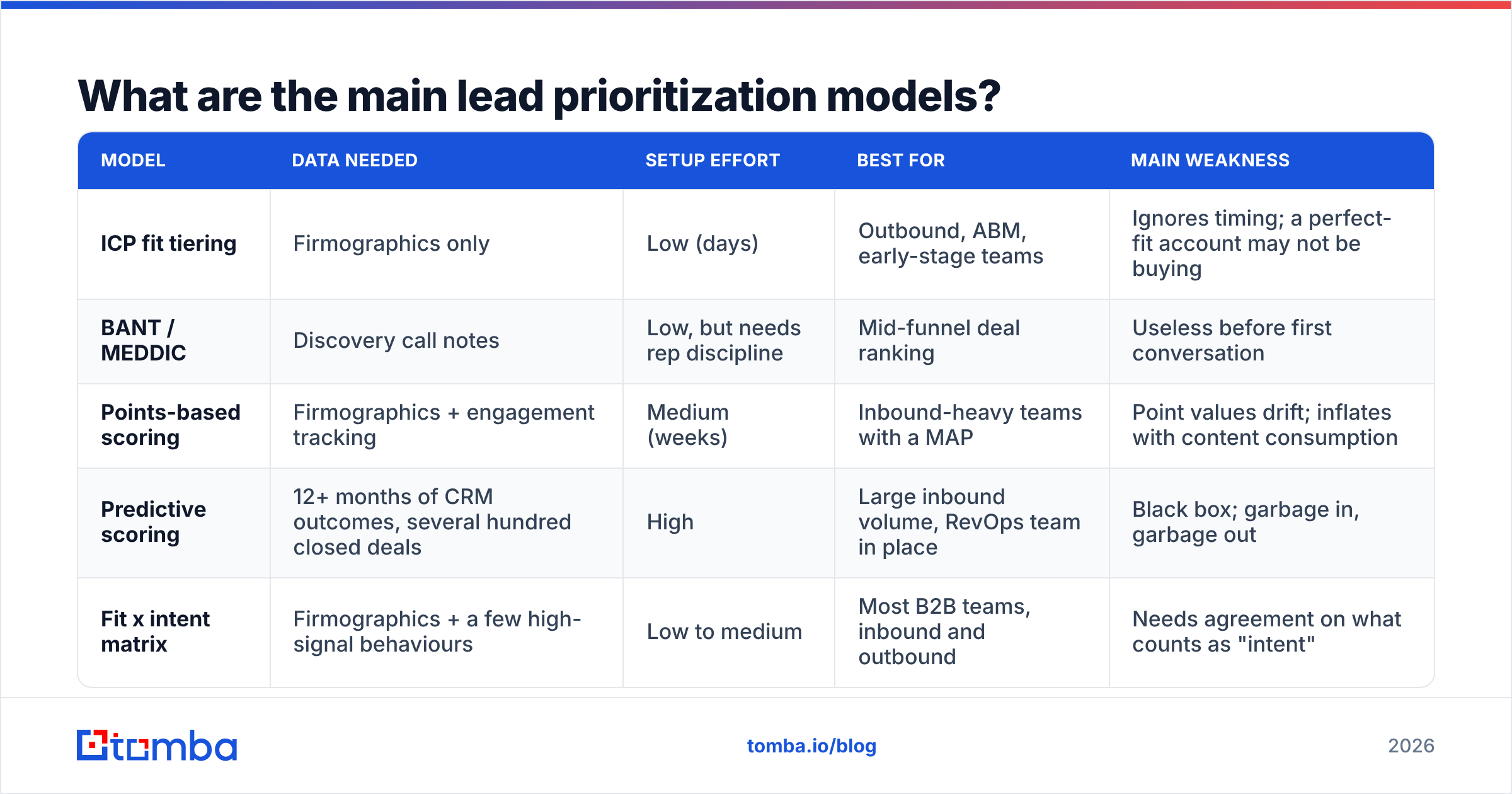
| Model | Data needed | Setup effort | Best for | Main weakness |
|---|---|---|---|---|
| ICP fit tiering | Firmographics only | Low (days) | Outbound, ABM, early-stage teams | Ignores timing; a perfect-fit account may not be buying |
| BANT / MEDDIC | Discovery call notes | Low, but needs rep discipline | Mid-funnel deal ranking | Useless before first conversation |
| Points-based scoring | Firmographics + engagement tracking | Medium (weeks) | Inbound-heavy teams with a MAP | Point values drift; inflates with content consumption |
| Predictive scoring | 12+ months of CRM outcomes, several hundred closed deals | High | Large inbound volume, RevOps team in place | Black box; garbage in, garbage out |
| Fit x intent matrix | Firmographics + a few high-signal behaviours | Low to medium | Most B2B teams, inbound and outbound | Needs agreement on what counts as "intent" |
If you're unsure, start with the fit x intent matrix. It's the easiest model to explain to reps, it holds up when your data is thin, and it grows naturally into points-based scoring later.
How do you build a fit x intent prioritization matrix?#
Think of it like an emergency room triage desk. The nurse doesn't assess every patient on a single scale. They ask two questions: how serious is this, and how urgent is it? A serious, urgent case goes straight in. A serious but stable case waits a little. Minor and stable goes to the back. Your leads work the same way.
Step 1: Define fit#
Fit is about who the lead is. Pick four to six attributes that separate your best customers from the rest. Look at your last 50 closed-won deals rather than your aspirations. Typical fit attributes:
- Industry or vertical
- Company headcount band
- Buyer's seniority and department
- Region or language
- A technology they use, such as a specific CRM or ecommerce platform
Score each lead A (strong fit), B (partial) or C (poor fit). Keep it coarse. Ten-point scales create false precision.
Step 2: Define intent#
Intent is about what the lead is doing right now. Only count signals that correlate with buying, not with curiosity:
- High intent: demo request, pricing page visited twice in a week, reply to outbound asking about cost, free-trial signup with a work email, a return visit from a known target account
- Medium intent: webinar attendance, comparison page visit, multiple people from the same account engaging
- Low intent: single blog visit, newsletter signup, gated ebook download
Score each lead Hot, Warm or Cold.
Step 3: Map quadrants to actions#
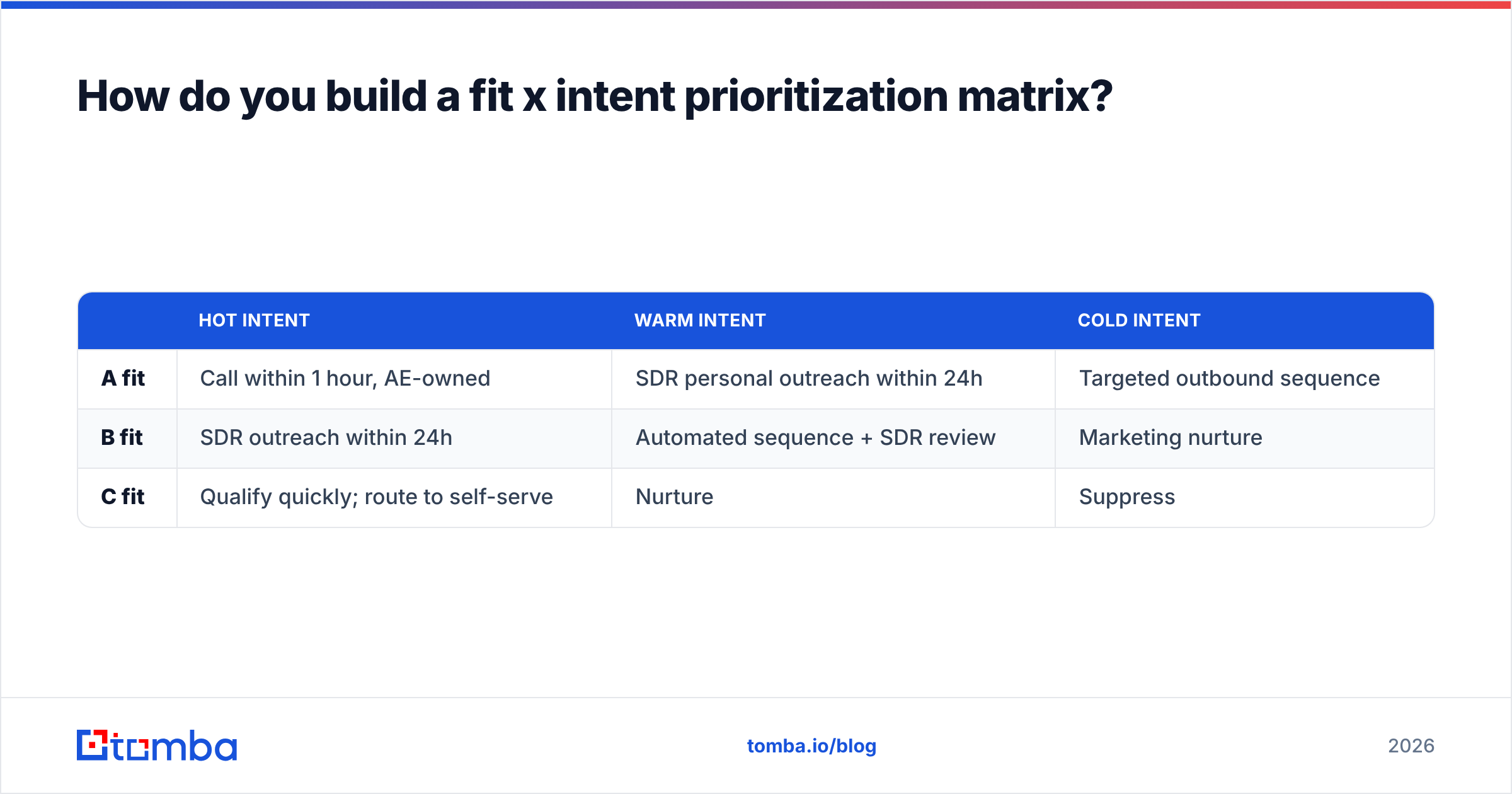
| Hot intent | Warm intent | Cold intent | |
|---|---|---|---|
| A fit | Call within 1 hour, AE-owned | SDR personal outreach within 24h | Targeted outbound sequence |
| B fit | SDR outreach within 24h | Automated sequence + SDR review | Marketing nurture |
| C fit | Qualify quickly; route to self-serve | Nurture | Suppress |
This table is your whole prioritization policy on one page. Put it in your CRM as routing rules and in your sales playbook as the SLA.
Step 4: Review monthly#
Pull every closed-won deal from the last 90 days and check which cell it started in. If a lot of wins came from B-fit/Warm, your fit definition is too narrow. If A-fit/Hot leads keep stalling, your intent signals are probably measuring curiosity rather than buying.
Is points-based lead scoring better than a matrix?#
Not automatically. Points-based scoring is a matrix with more resolution, and that extra resolution only helps if your data can support it.
Points scoring runs into three common problems:
- Score inflation. A student who reads 30 blog posts ends up outscoring a VP who visited pricing once. Fix it by capping content-engagement points and adding decay, for example −25% after 30 days of inactivity.
- Collapsing two dimensions into one. A lead with a score of 60 could be a perfect-fit account showing no activity or a terrible-fit account clicking on everything. Those need completely different actions. Many teams solve this by keeping separate fit and engagement scores. Several marketing automation platforms, including HubSpot, support this.
- Nobody recalibrates. Point values set at launch are rarely revisited. After 12 months they reflect how the team guessed a year ago, not what's actually closing now.
Move from a matrix to points scoring when you have enough closed deals to test whether each point value predicts outcomes, and someone in RevOps who owns the model. Before then, the matrix will serve you better.
When does predictive lead scoring make sense?#
Predictive scoring, like the built-in models in Salesforce Einstein or dedicated tools, looks at your historical wins and losses and learns which combination of attributes predicts a close. When it works, it catches patterns humans miss.
It needs three things most teams don't have:
- Volume. Several hundred closed outcomes at minimum, and ideally more.
- Consistent fields. If half your CRM records have no industry or headcount, the model learns from gaps rather than from the data.
- A stable ICP. If you changed pricing or moved upmarket six months ago, your history describes a business you no longer run.
If you're missing any of the three, predictive scoring will give you confident-looking numbers that aren't reliable. The fit x intent matrix is less impressive to present, but you can trust it.
Why do lead prioritization systems fail?#
Usually because of data quality. The scoring logic is fine, but the inputs are empty or wrong.
Here's what that looks like in practice:
- Blank fit fields. A form captures name and email, nothing else. The lead has no company size, industry or title, so it defaults to C-fit and sinks, even if it's a Head of Sales at an ideal account.
- Personal or role emails. "info@" and Gmail addresses can't be matched to an account, so fit can't be scored at all.
- Invalid emails. Leads with typo-riddled or dead addresses get routed, sequenced and counted in pipeline reports. Every one of them is wasted rep time and a potential hit to your sender reputation.
- Anonymous intent. Most of the buying signal on your site comes from visitors who never fill out a form. If you only score known leads, you're prioritizing on a fraction of the real demand.
The fixes are operational, not strategic:
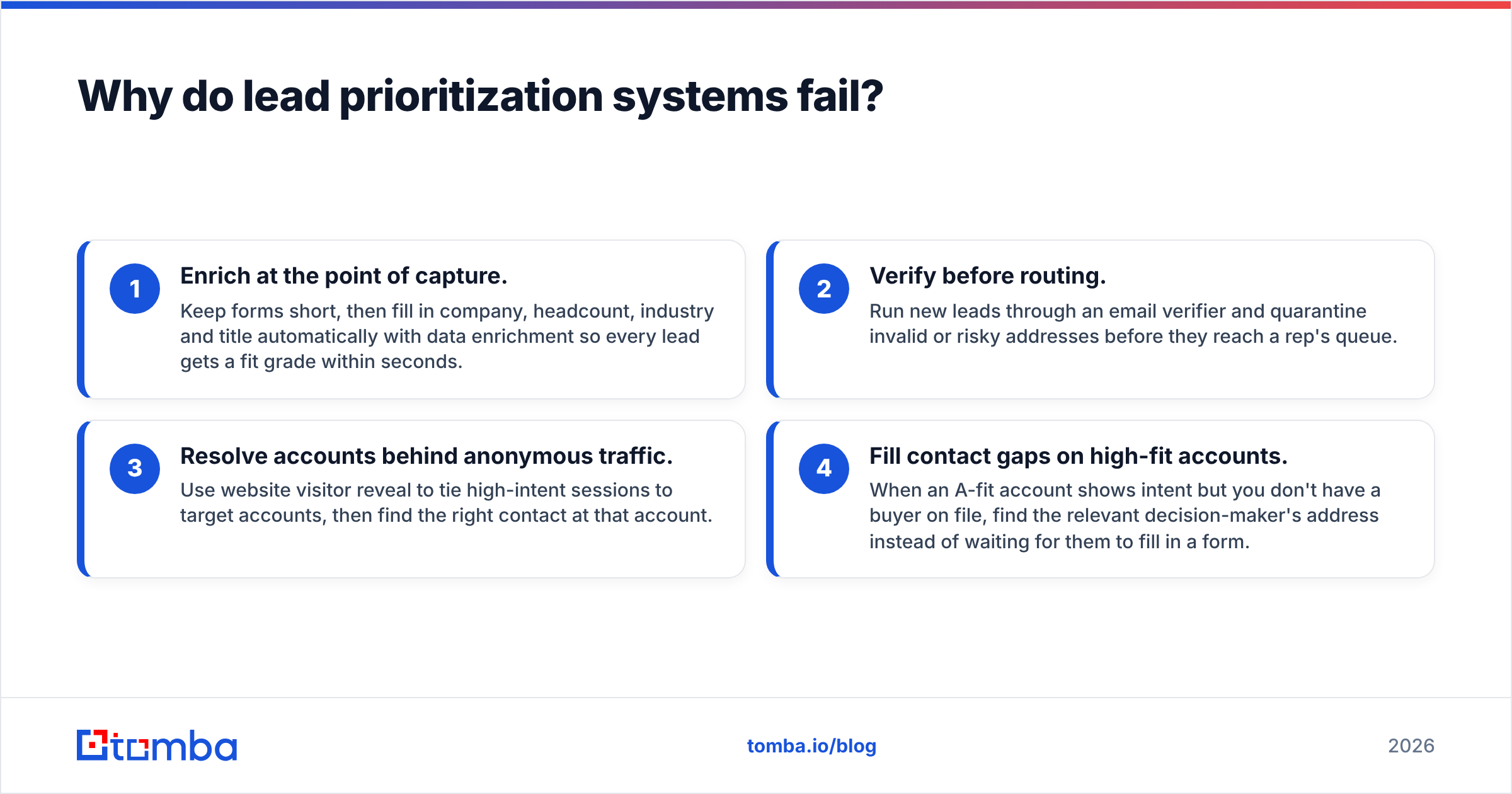
- Enrich at the point of capture. Keep forms short, then fill in company, headcount, industry and title automatically with data enrichment so every lead gets a fit grade within seconds.
- Verify before routing. Run new leads through an email verifier and quarantine invalid or risky addresses before they reach a rep's queue.
- Resolve accounts behind anonymous traffic. Use website visitor reveal to tie high-intent sessions to target accounts, then find the right contact at that account.
- Fill contact gaps on high-fit accounts. When an A-fit account shows intent but you don't have a buyer on file, find the relevant decision-maker's address instead of waiting for them to fill in a form.
A basic model running on complete, verified data will beat a sophisticated model running on half-empty records.

How should MQLs fit into lead prioritization?#
The traditional marketing qualified lead threshold ("hit 50 points and you're an MQL") is a lead prioritization model with only one cut-off. It's better than nothing, but it causes the arguments sales and marketing teams know well: marketing counts MQLs, sales ignores them, and neither side trusts the number.
A more useful approach:
- Replace the single MQL threshold with matrix cells. "A-fit/Hot" and "B-fit/Hot" become the handoff criteria, and everything else stays with marketing.
- Measure conversion by cell, not by total MQL volume. If A-fit/Hot converts to opportunity at 30% and B-fit/Warm at 4%, you know where to invest.
- Give sales a reject reason field. When a rep disqualifies a prioritized lead, capture why: wrong person, no budget, bad data, student. That feedback is the fastest way to recalibrate.
What does a good lead prioritization workflow look like day to day?#
Here's how a realistic morning looks for an SDR on a team that has this set up:
- Open the queue sorted by matrix cell, then by time since last signal. A-fit/Hot leads from the last 24 hours are at the top.
- Work every A-fit/Hot lead before anything else. Call first, then send a personal email, then connect on LinkedIn.
- Review B-fit/Hot and A-fit/Warm leads. Personalize the first touch for these and let the sequence handle follow-ups.
- Leave the rest to automation. C-fit leads and cold leads go to nurture or self-serve. Reps don't touch them manually.
- Log disqualification reasons. Every lead that turns out to be a poor match gets a reason code, which goes into the monthly review.
The goal is that no rep ever has to ask "who should I call next?" The system answers that question, and reps put their judgement into the conversation itself.
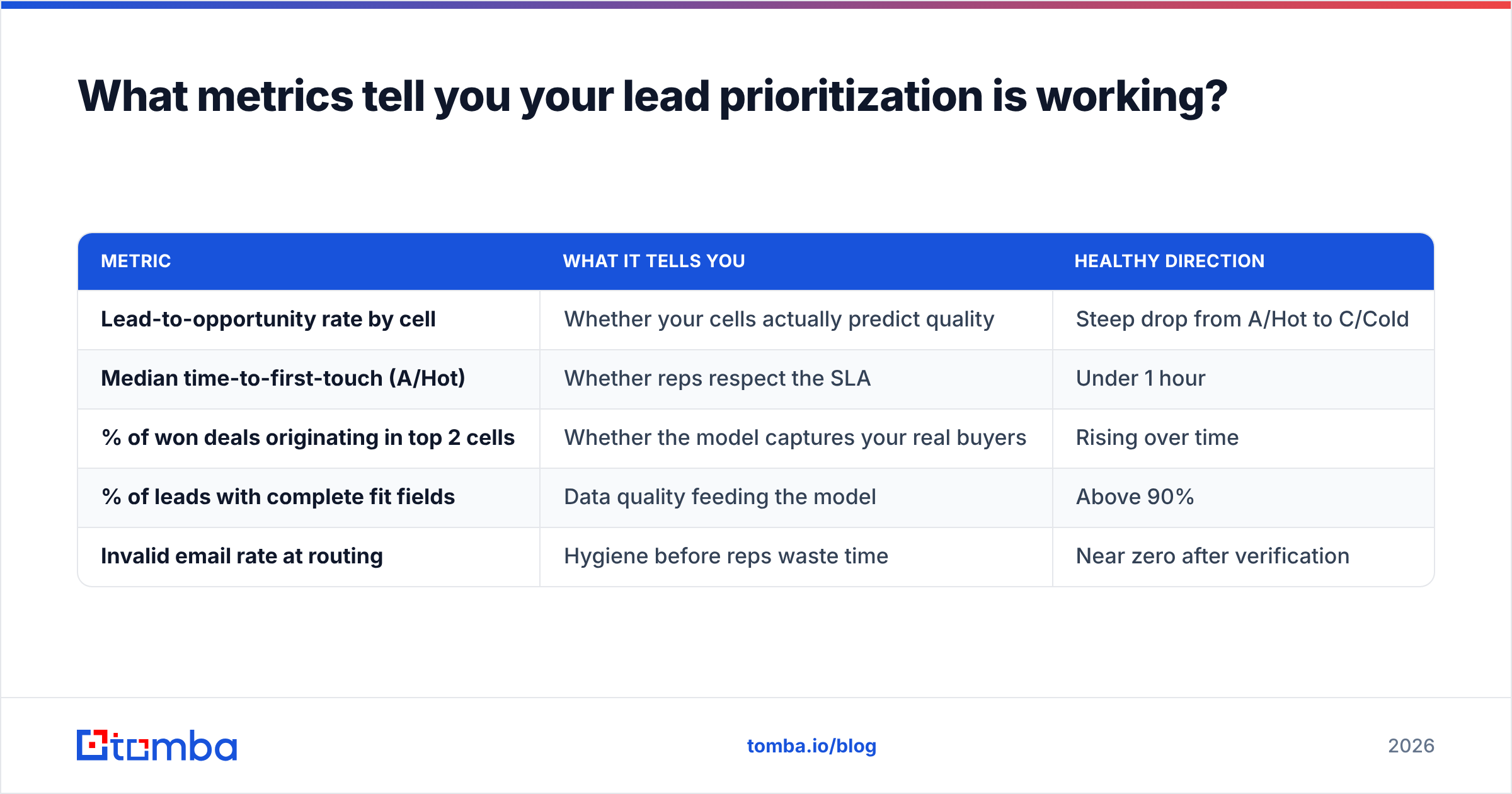
What metrics tell you your lead prioritization is working?#
Track these monthly, split by matrix cell:
| Metric | What it tells you | Healthy direction |
|---|---|---|
| Lead-to-opportunity rate by cell | Whether your cells actually predict quality | Steep drop from A/Hot to C/Cold |
| Median time-to-first-touch (A/Hot) | Whether reps respect the SLA | Under 1 hour |
| % of won deals originating in top 2 cells | Whether the model captures your real buyers | Rising over time |
| % of leads with complete fit fields | Data quality feeding the model | Above 90% |
| Invalid email rate at routing | Hygiene before reps waste time | Near zero after verification |
If conversion looks flat across cells, your model isn't doing anything useful: it's ranking leads without separating good from bad. Go back to your closed-won list and redefine fit.
Final take: which approach should you choose?#
For most B2B teams in 2026, the answer is less sophisticated than vendors suggest:
- Under ~300 closed deals of history: a fit x intent matrix, enforced with routing rules and response SLAs.
- Solid history plus a RevOps owner: a points-based model with separate fit and engagement scores and decay.
- High volume, clean CRM, stable ICP: consider layering predictive scoring on top, but keep the matrix as the explainable backup.
Whichever model you pick, the most common failure is the same: leads arrive with missing fields or invalid emails and end up misranked. Fix the data first.
If your fit scoring keeps stalling because high-value accounts come in without a reachable decision-maker, Tomba Email Finder fills that gap. Search by name, company or domain to find the verified professional email of the buyer you actually want, so your A-fit accounts get worked by a rep instead of sitting at the bottom of the queue. You can start on the free plan with 25 searches a month, and paid plans begin at $49/mo.
Related guides#
// get started
Find, verify and enrich your first contacts today
Start on the free plan with 25 searches a month, then scale when your team is ready.
Free plan · No credit card required · GDPR & CCPA
// about the author