Lead Prioritization in B2B: A 2026 Framework That Actually Works
Your reps have 400 leads and time for 40. B2B lead prioritization decides which 40, and most teams get it wrong because the data is bad, not because the model is. Here's a four-tier framework you can run this week.
TL;DR
- B2B lead prioritization means ranking leads so your reps work first on the ones most likely to close. It isn't the same as lead scoring, which is only one input.
- Rank on three layers in this order: fit (should they buy?), intent (are they buying now?), and reachability (can you actually contact the decision-maker?).
- Most prioritization models break because of the data behind them: bad emails, missing titles, stale firmographics. The weighting is rarely the real problem.
- A four-tier system (A/B/C/D) with clear SLAs beats a 100-point score that nobody trusts.
- Before you put a lead in your top tier, confirm the contact data. A "hot" lead with an email that bounces can't be worked.
What is B2B lead prioritization?#
B2B lead prioritization is how you decide which leads get a salesperson's time first, which ones go into automated nurture, and which ones get dropped. Your reps have a fixed number of hours, and this is how you spend them.
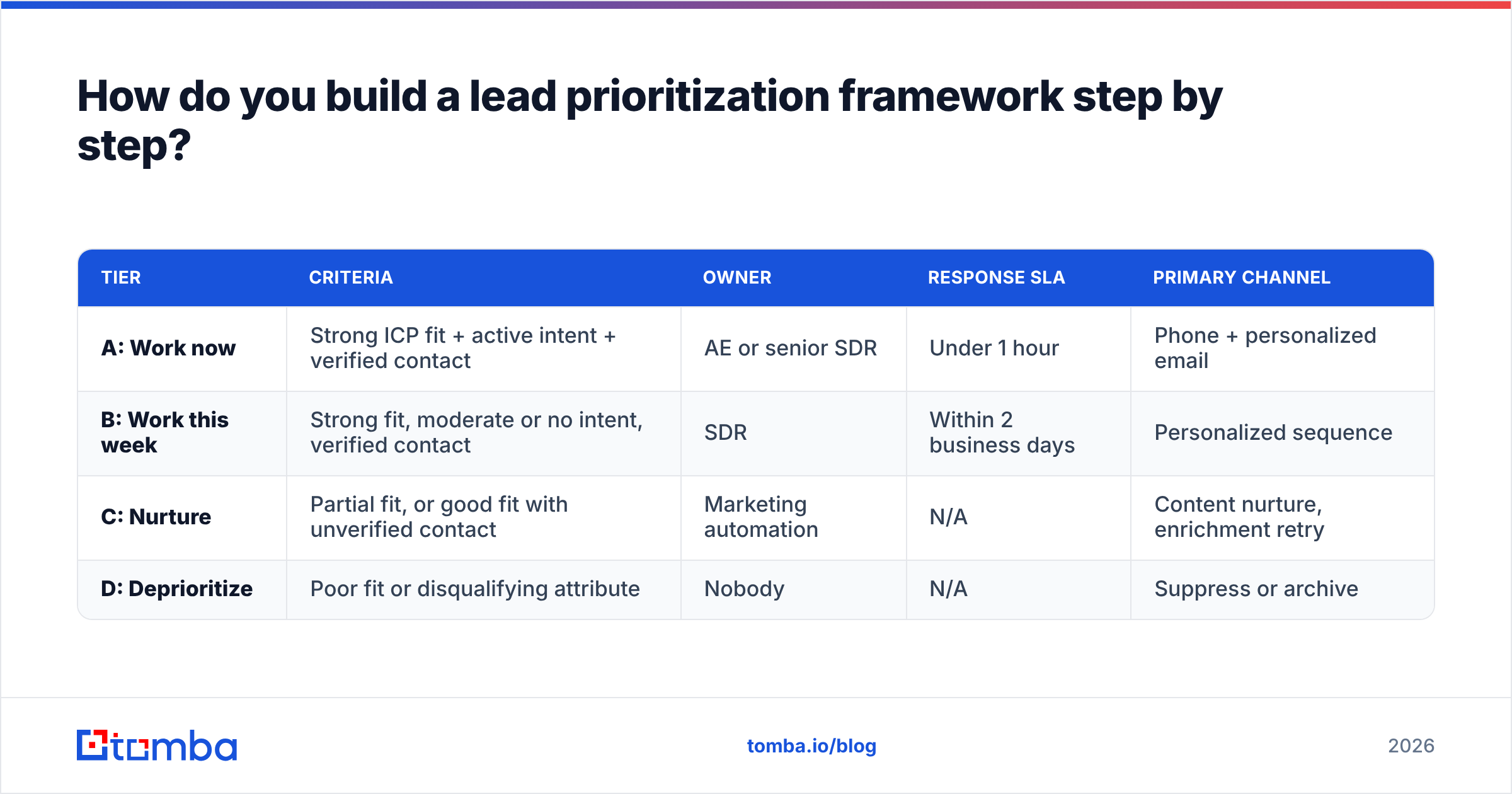
Think of a hospital emergency room. Triage nurses don't treat patients in order of arrival. They sort by severity, likelihood of a good outcome, and what resources are free. Lead prioritization does the same job for your pipeline. The difference is that most sales teams still work leads in arrival order ("first in, first out") or in whatever order the CRM view happens to sort by.
People often mix up prioritization and lead scoring. Scoring gives a number to one lead. Prioritization is the full operating system around that number: the tiers, the routing rules, the response-time SLAs, and the feedback loop that tells you whether the scores predicted anything.
Why does lead prioritization matter more in 2026?#
There are three reasons, and they add up.
- Lead volume keeps going up while rep headcount doesn't. AI-assisted content, gated assets, and product-led signups have made it cheap to generate leads. Reps haven't gotten any cheaper. The gap between leads you have and leads you can work gets wider every quarter.
- Buying committees are larger. Enterprise deals now pull in finance, security, IT, and procurement next to the champion. A lead is no longer one person. It's a way into an account, and you have to rank accounts as well as contacts.
- Inbox providers punish sloppy outreach. Google and Yahoo's bulk-sender requirements mean that emailing unverified, low-fit contacts in volume costs you more than a wasted rep hour. It damages your sender reputation for every other campaign as well.
Put the three together and the cost of getting prioritization wrong grows. You lose the good leads to slow follow-up, and you burn your domain on the bad ones.
What are the core signals for prioritizing B2B leads?#
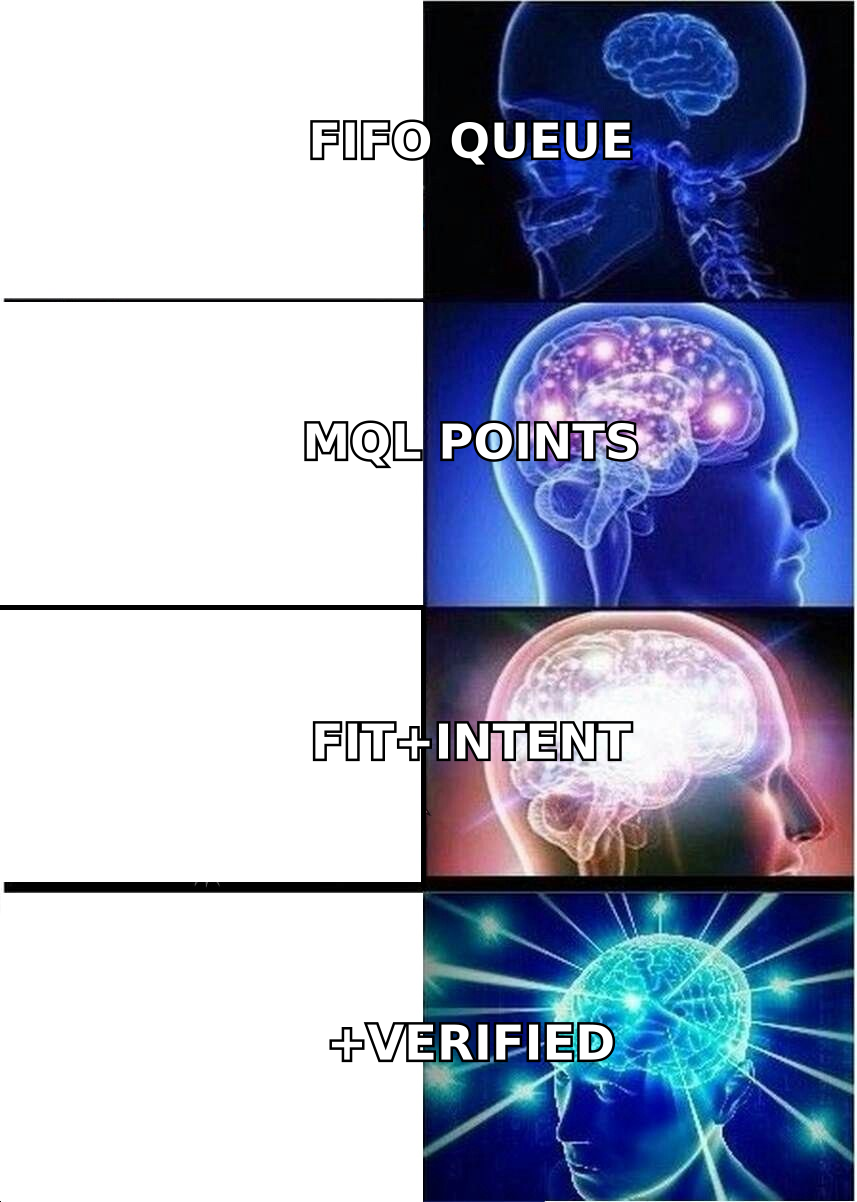
Every workable model uses the same three layers. The weights differ by company, but the order stays the same: check fit first, intent second, and reachability last, as a gate.
| Signal layer | What it answers | Example data points | Where it usually comes from | Common failure |
|---|---|---|---|---|
| Fit | Should this account ever buy from us? | Industry, headcount, revenue band, tech stack, geography | Enrichment providers, firmographic databases | Stale headcount; wrong industry codes |
| Persona | Is this person someone who can buy or influence? | Job title, seniority, department | Form fills, LinkedIn, enrichment | Titles like "Manager" with no department |
| Intent | Are they in-market right now? | Pricing page visits, demo requests, third-party intent topics, hiring signals | Web analytics, intent vendors, job boards | Treating one blog visit as intent |
| Engagement | Are they responding to us? | Email replies, meeting attendance, product usage | CRM, sequencer, product analytics | Counting opens (unreliable since Apple MPP) |
| Reachability | Can we actually contact the decision-maker? | Verified email, direct dial, valid LinkedIn profile | Email finder + verifier, phone finder | Scoring leads you can't contact |
The last row is where most models fall short. A lead can match your ICP perfectly and show strong intent, but if the only email you have is info@company.com, or a personal address that bounces, it doesn't belong in Tier A. It belongs in an enrichment queue.
How do you build a lead prioritization framework step by step?#
Here is the process that holds up in real RevOps teams. It deliberately avoids anything that needs a data science team.
- Define the ICP from closed-won deals, not opinions. Pull your last 12–24 months of closed-won and closed-lost opportunities. Look at industry, headcount, tech stack, and the title of the first contact. You want the traits that separate winners from losers, not the traits your VP likes to imagine.
- Pick 5–8 fit attributes and 3–5 intent signals. More than that and the model gets noisy and nobody can explain why a lead scored 73. Every attribute should come with a one-sentence reason.
- Add reachability as a gate, not a score. A lead can't enter Tier A or B without a verified business email or a validated direct dial. Leads that miss the gate go to data enrichment first and don't reach the rep until they pass.
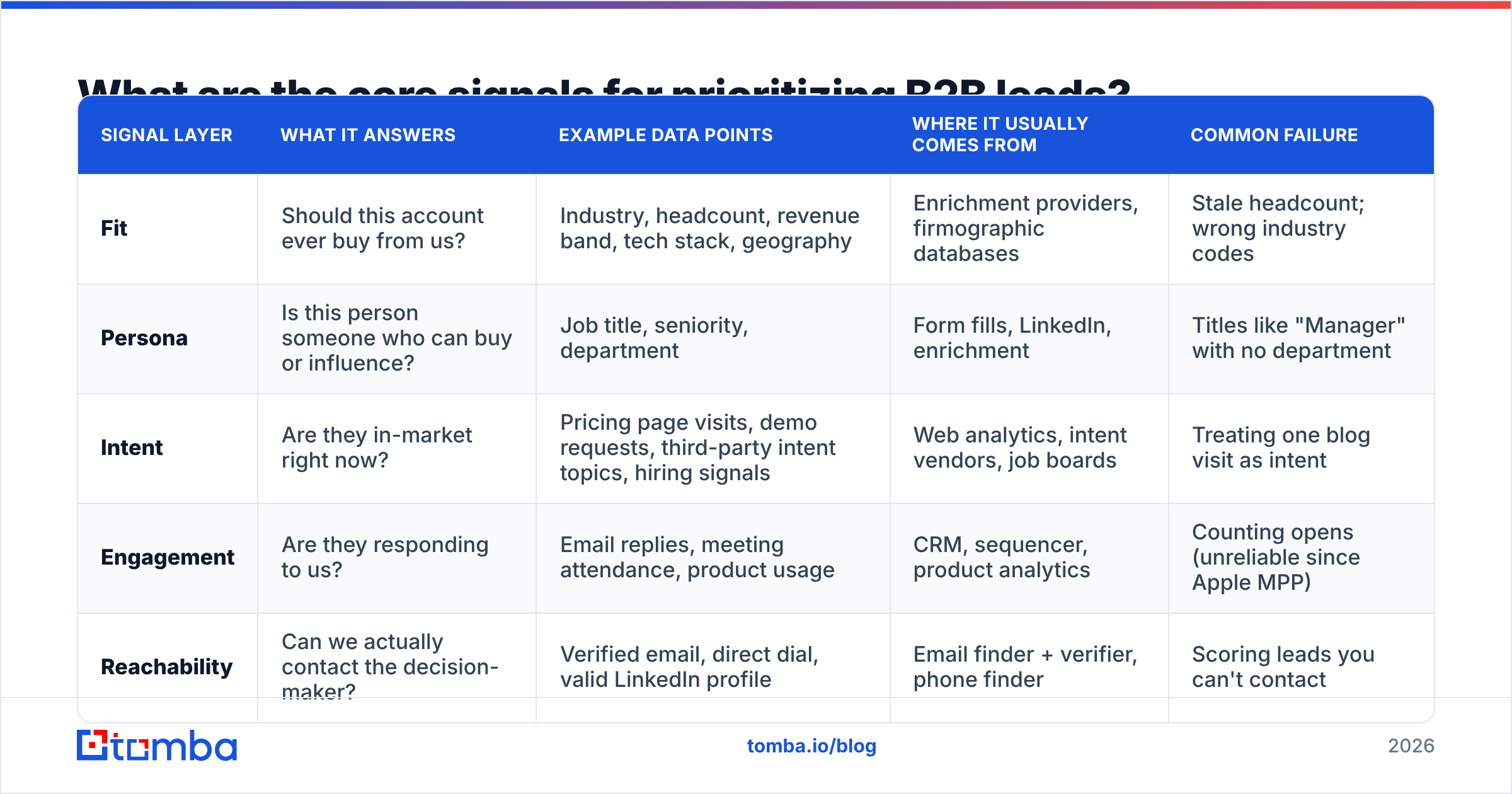
- Collapse scores into four tiers. Reps act on tiers. They ignore three-digit numbers. Map score ranges to A/B/C/D and attach an SLA and an owner to each tier.
- Route automatically. Put the routing in your CRM (HubSpot, Salesforce, Pipedrive) so Tier A leads land in a rep's queue with an alert and Tier C leads go into nurture without anyone touching them.
- Review conversion by tier every month. If Tier B converts better than Tier A, your model is wrong. Change the weights and don't argue with the data.
What should the four tiers look like?#
| Tier | Criteria | Owner | Response SLA | Primary channel |
|---|---|---|---|---|
| A: Work now | Strong ICP fit + active intent + verified contact | AE or senior SDR | Under 1 hour | Phone + personalized email |
| B: Work this week | Strong fit, moderate or no intent, verified contact | SDR | Within 2 business days | Personalized sequence |
| C: Nurture | Partial fit, or good fit with unverified contact | Marketing automation | N/A | Content nurture, enrichment retry |
| D: Deprioritize | Poor fit or disqualifying attribute | Nobody | N/A | Suppress or archive |
Tier C does two jobs. It holds partial-fit leads that marketing should keep warm, and it holds good-fit leads whose contact data needs repair. Keep those two groups apart in your CRM with a sub-status. Otherwise great accounts sit in nurture forever just because nobody went and found the right email.
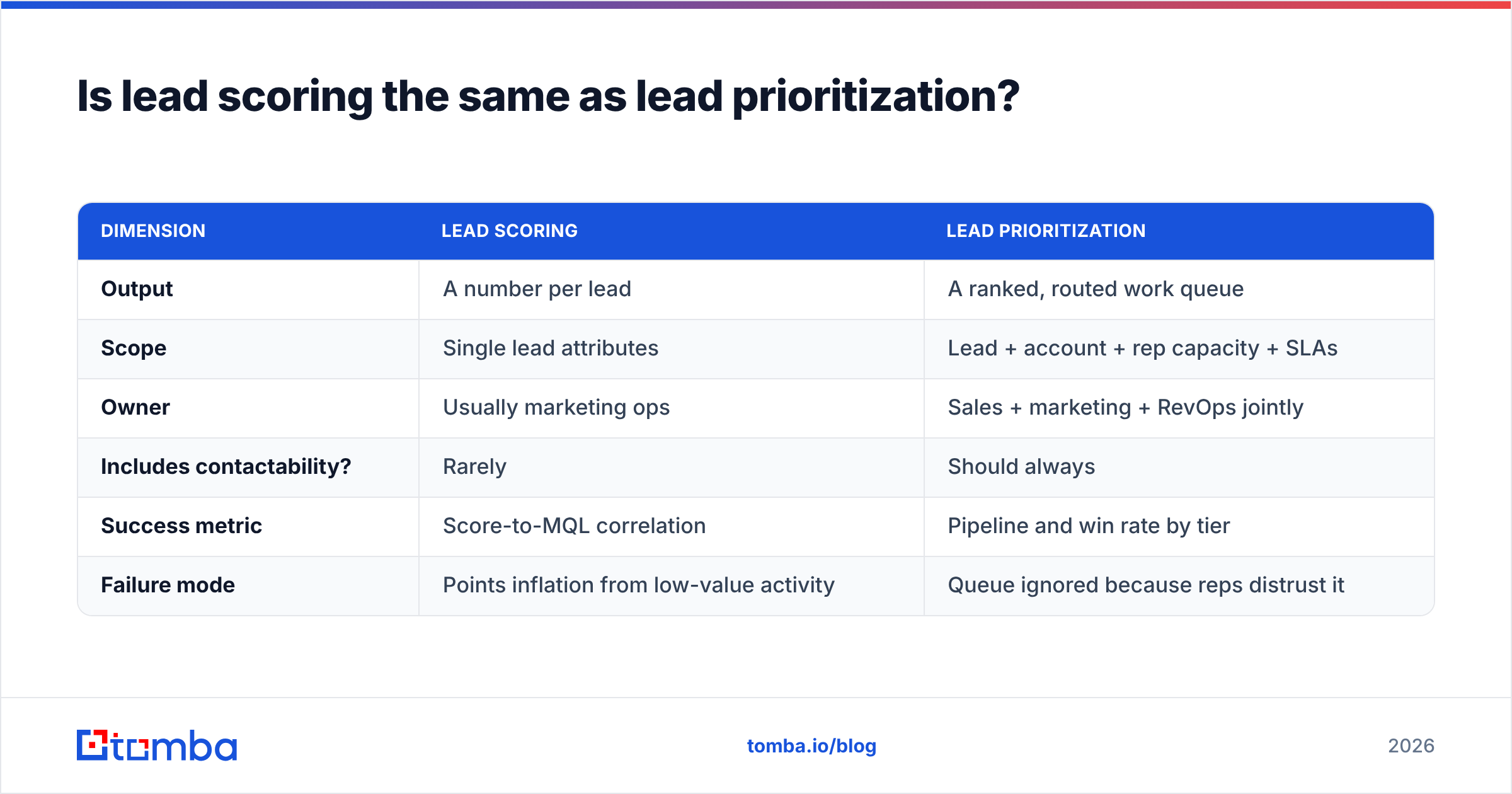
Is lead scoring the same as lead prioritization?#
No, and treating them as the same thing causes a lot of the frustration sales teams have with scoring.
| Dimension | Lead scoring | Lead prioritization |
|---|---|---|
| Output | A number per lead | A ranked, routed work queue |
| Scope | Single lead attributes | Lead + account + rep capacity + SLAs |
| Owner | Usually marketing ops | Sales + marketing + RevOps jointly |
| Includes contactability? | Rarely | Should always |
| Success metric | Score-to-MQL correlation | Pipeline and win rate by tier |
| Failure mode | Points inflation from low-value activity | Queue ignored because reps distrust it |
Scoring feeds into prioritization. Prioritization is what decides what your reps actually do at 9 a.m. on Monday.
What are the most common B2B lead prioritization models?#
You'll see four patterns in the wild. Most mature teams end up with a hybrid.
Rules-based point scoring. "+10 for VP title, +15 for pricing page visit, −20 for student email." It's transparent and quick to set up. It also drifts: points pile up from low-value activity, and six months later everyone is a 90.
ICP-fit tiering (account-first). Sort accounts into tiers by firmographic fit before looking at any behavior. This is popular with ABM teams. It stays stable and is easy to explain, but it's slow to react to a sudden spike in intent.
Predictive / ML scoring. Tools built into platforms like Salesforce Einstein or HubSpot's predictive scoring train on your historical conversions. They can work well once you have a few hundred closed-won deals. With thin data, they confidently predict noise. Analyst firms such as Forrester have warned for years that predictive models are only as good as the CRM hygiene underneath them.
Signal-based prioritization. Rank by recent trigger events: funding rounds, leadership hires, tech-stack changes, job postings. It works very well for outbound timing. It's weaker when used alone, because a trigger at a poor-fit account is still a poor-fit account.
The practical hybrid looks like this: ICP tiering sets the ceiling, signals and engagement set the urgency, and reachability decides whether a rep sees the lead at all.
Why do most lead prioritization models fail?#
When a scoring model underperforms, teams usually tweak the weights. Usually the weights aren't the issue. Look here first.
- Incomplete records. When 30–40% of your leads have no job title or company size, the model defaults them to the middle of the distribution. A lot of Tier B turns out to be "we don't know" in disguise.
- Invalid contact data. A lead with a bounced email still has a high score in most CRMs. Reps work it, bounce, and learn to distrust the queue. Running every new lead through an email verifier before it's scored removes that whole class of false positives.
- Engagement signals that aren't real. Since Apple Mail Privacy Protection, email opens are mostly machine-generated. Scoring on opens rewards leads whose email client prefetches images.
- No closed-loop feedback. If nobody checks conversion by tier, the model never gets better. It just ages.
- Too many tiers or too much precision. A score of 67 against 71 means nothing to a rep. Four tiers with clear actions will beat a precise number nobody uses.

How does contact data quality change your priority list?#
Here's a concrete scenario. You run a model across 1,000 inbound and outbound leads and 150 land in Tier A. Before routing, you run a verification and enrichment pass:
- Some of those 150 have emails that bounce, or sit on catch-all domains that can't be confirmed.
- Some have personal addresses from gated-content forms and no business contact at all.
- Some are the wrong person, a coordinator who downloaded a whitepaper at an account where the real buyer is two levels up.
Every one of those is a lead a rep would have spent 15–20 minutes researching before finding out it can't be worked. Fix it upstream and Tier A shrinks, but the rep's hit rate on it goes up a lot.
This is also where account-level prioritization pays off. When a Tier A account's inbound contact isn't the buyer, use domain search to see who else at the company is reachable, then work the actual decision-maker alongside the original lead. Several B2B data providers support this multi-threading workflow, including Tomba, Apollo, and list-focused vendors such as BookYourData. Choose based on coverage in your target regions and how the tool fits your stack. There isn't a single right answer.
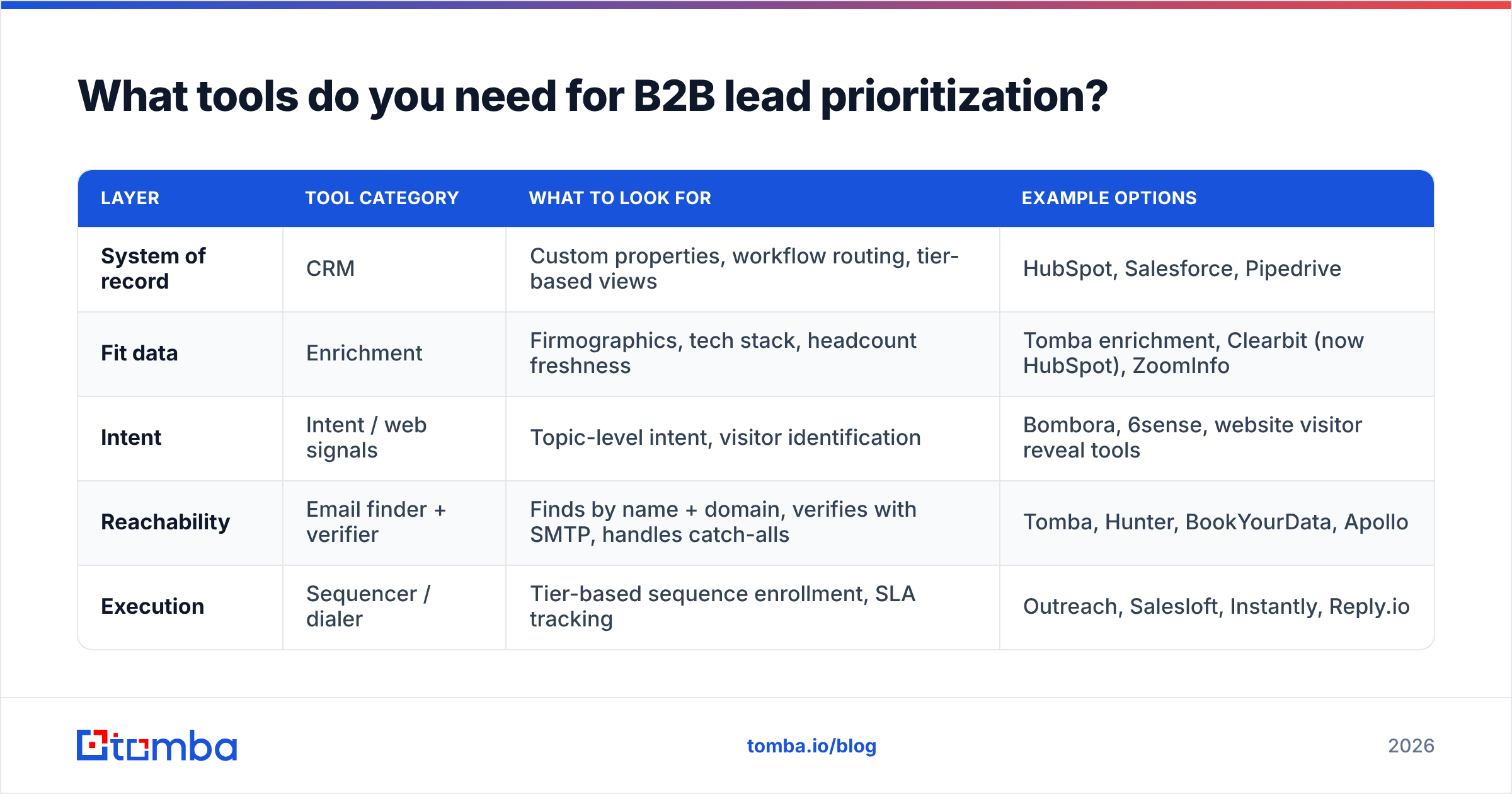
What tools do you need for B2B lead prioritization?#
You don't need a big stack. You need one tool for each layer.
| Layer | Tool category | What to look for | Example options |
|---|---|---|---|
| System of record | CRM | Custom properties, workflow routing, tier-based views | HubSpot, Salesforce, Pipedrive |
| Fit data | Enrichment | Firmographics, tech stack, headcount freshness | Tomba enrichment, Clearbit (now HubSpot), ZoomInfo |
| Intent | Intent / web signals | Topic-level intent, visitor identification | Bombora, 6sense, website visitor reveal tools |
| Reachability | Email finder + verifier | Finds by name + domain, verifies with SMTP, handles catch-alls | Tomba, Hunter, BookYourData, Apollo |
| Execution | Sequencer / dialer | Tier-based sequence enrollment, SLA tracking | Outreach, Salesloft, Instantly, Reply.io |
If your team is small, the CRM plus one data provider that does both enrichment and verification covers most of this. You can add intent data once your fit-based tiers are converting predictably. Adding intent to a broken fit model only makes the noise louder.
How do you measure whether your prioritization is working?#
Track these metrics monthly, broken out by tier:
- Lead-to-meeting rate by tier. Tier A should convert well above Tier B. If the two are close, your criteria aren't separating anything.
- Speed-to-lead against SLA. The percentage of Tier A leads touched within the SLA. A great model that reps ignore is still a failed model.
- Bounce rate on first touch. This should be close to zero for Tiers A and B, because the reachability gate should catch invalid contacts before anyone emails them.
- Pipeline and win rate by original tier. This is the real test. Follow opportunities back to the tier the lead started in. Meetings are an early signal. Revenue is what counts.
- Tier drift. The share of leads in each tier over time. If Tier A creeps from 10% to 35%, your points are inflating.
FAQ#
How many leads should be in Tier A?#
Size Tier A to what your reps can actually handle, not to a fixed percentage. If each SDR can give real attention to 15 new Tier A leads a week, set your threshold so Tier A produces about that many per rep. Tighten it when the queue overflows.
Should inbound and outbound leads use the same prioritization model?#
Use the same fit layer and different intent layers. Inbound leads bring first-party intent, like a form fill or a pricing page visit. Outbound leads depend on third-party signals and triggers. Keep one ICP definition so both motions compete for rep time on equal terms.
How often should I recalibrate lead scoring weights?#
Review conversion by tier every month and change weights every quarter. Recalibrate right away after a major ICP change, a new product line, or a new market.
Can small teams do lead prioritization without predictive tools?#
Yes. A rules-based fit model, a reachability gate, and four tiers in your CRM will outperform a predictive model trained on thin data. Predictive scoring starts earning its cost once you have a few hundred closed-won deals to train on.
Where should you start this week?#
Pull your current Tier A list, or your top 100 leads by score if you don't have tiers yet, and run one check: how many have a verified business email for someone who can actually buy? The answer usually tells you more about your prioritization problem than any change to the weights would.
If that check finds gaps, the Tomba Email Finder is a practical first fix. You enter a name and company domain, and it returns a professional email address with a confidence score, so good-fit leads move out of the "unreachable" bucket and into your reps' queues. It works in bulk, connects to HubSpot, Salesforce, and Pipedrive, and the free tier includes 25 searches a month, enough to test it against your own Tier A list before you commit to anything.
Related guides#
// get started
Find, verify and enrich your first contacts today
Start on the free plan with 25 searches a month, then scale when your team is ready.
Free plan · No credit card required · GDPR & CCPA
Get the Tomba newsletter
Product and data updates
// about the author