Lead Prioritization Software in 2026: 7 Tools Compared
Your reps have more leads than hours. Here's how lead prioritization software ranks them, which seven tools are worth a look in 2026, and why data quality matters more than the scoring model.
TL;DR
- Lead prioritization software ranks your leads by fit (do they match your ICP?), intent (are they researching a purchase?) and engagement (are they responding to you?), so reps work the best accounts first.
- For most teams the right choice is the CRM you already pay for. HubSpot and Salesforce both include predictive scoring on their higher tiers. Standalone tools like MadKudu and 6sense make sense once you have volume and a RevOps owner.
- A scoring model can only work with the data it gets. Missing emails, stale job titles and bounced addresses will skew rankings more than which algorithm you picked.
- Start with a simple rules-based model and 3-5 signals. Move to predictive scoring once you have a few hundred closed-won deals it can learn from.
- Whatever you buy, make sure the top-ranked leads have verified contact data. A high score is worthless if the rep can't reach the person.
What is lead prioritization software?#
Lead prioritization software looks at every lead in your pipeline and tells your team which ones to work first. It does this by assigning a score, a tier (A/B/C), or a ranked queue based on signals such as company size, industry, job title, website visits, email engagement and third-party buying intent.
People often use "prioritization" and "lead scoring" as if they mean the same thing, but they don't. Lead scoring is the math: it assigns points or runs a model. Prioritization is what happens next: the score becomes a routing rule, a task queue, or an alert that tells an SDR "call this person today." Good software handles both. Weaker tools produce a number in a CRM field that nobody looks at.
A typical setup has three layers:
- Data layer. Firmographics, contact details, product usage, and web and email engagement.
- Scoring layer. Rules ("VP title = +20") or a machine-learning model trained on your past wins.
- Action layer. Routing, sequences, Slack alerts and rep task lists ordered by score.
Most failed rollouts break at the first layer. We'll return to that.
Why do sales teams need lead prioritization in 2026?#
Inbound volume keeps rising, AI-written outbound has flooded inboxes, and SDR headcount mostly hasn't grown. Without a way to rank leads, reps choose on instinct: the recognizable logo, the most recent form fill, or whoever replied last. That means high-fit, high-intent buyers sit in the queue for days.
Prioritization fixes three concrete problems:
- Speed-to-lead on the right leads. Answering every lead in five minutes isn't realistic. Answering the top 10% in five minutes is.
- Clean handoffs between marketing and sales. A shared score gives you an agreed definition of a marketing qualified lead instead of a monthly argument about it.
- Rep focus. Reps stop spending Tuesday afternoon on students and competitors who downloaded an ebook.
How does lead prioritization software actually score leads?#
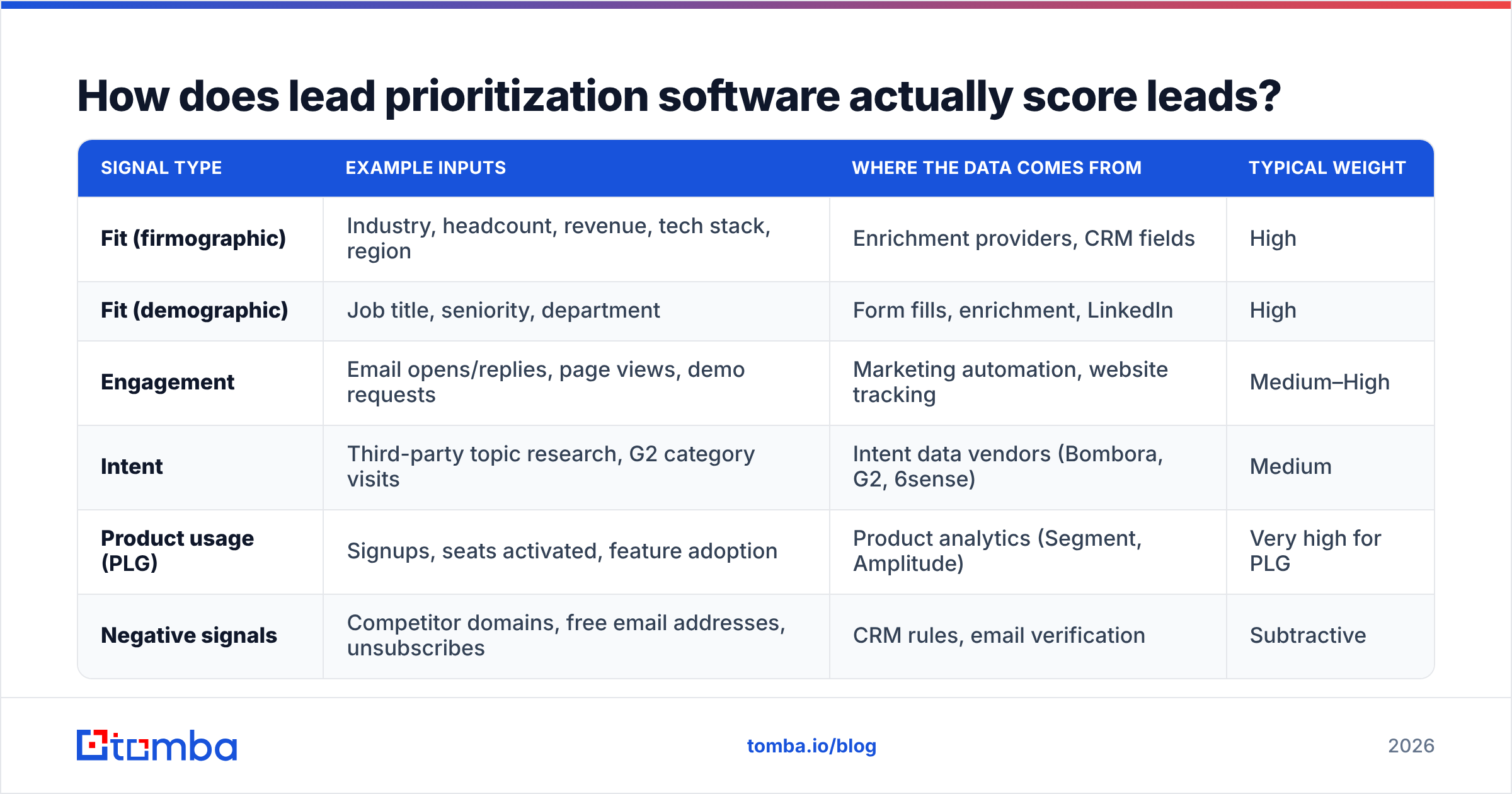
Nearly every tool uses a mix of the four signal types below. The differences come down to how much each type is weighted and where the data comes from.
| Signal type | Example inputs | Where the data comes from | Typical weight |
|---|---|---|---|
| Fit (firmographic) | Industry, headcount, revenue, tech stack, region | Enrichment providers, CRM fields | High |
| Fit (demographic) | Job title, seniority, department | Form fills, enrichment, LinkedIn | High |
| Engagement | Email opens/replies, page views, demo requests | Marketing automation, website tracking | Medium–High |
| Intent | Third-party topic research, G2 category visits | Intent data vendors (Bombora, G2, 6sense) | Medium |
| Product usage (PLG) | Signups, seats activated, feature adoption | Product analytics (Segment, Amplitude) | Very high for PLG |
| Negative signals | Competitor domains, free email addresses, unsubscribes | CRM rules, email verification | Subtractive |
Rules-based scoring is a points table you write yourself. It's transparent and quick to set up, but it drifts as your market changes, and someone has to maintain it.
Predictive scoring trains a model on your closed-won and closed-lost history and finds patterns you'd miss by hand. It usually needs a meaningful volume of historical conversions to be reliable. With too little data, the model learns noise and presents it with confidence.
Account-level scoring combines signals from everyone at a company. That matters in B2B because buying committees rarely come down to one person.
What are the best lead prioritization software tools in 2026?#
These seven tools cover the main approaches: CRM-native, standalone predictive, intent-led ABM, and all-in-one prospecting platforms. Pricing changes often and many vendors quote custom deals, so check each vendor's pricing page before you budget.
1. HubSpot Sales Hub (Predictive Lead Scoring)#
HubSpot includes manual lead scoring on paid tiers and adds AI-driven predictive scoring on the top tiers. The score sits next to contact records, drives workflows, and feeds rep task queues. If you already use HubSpot's marketing tools, engagement data flows in without extra setup.
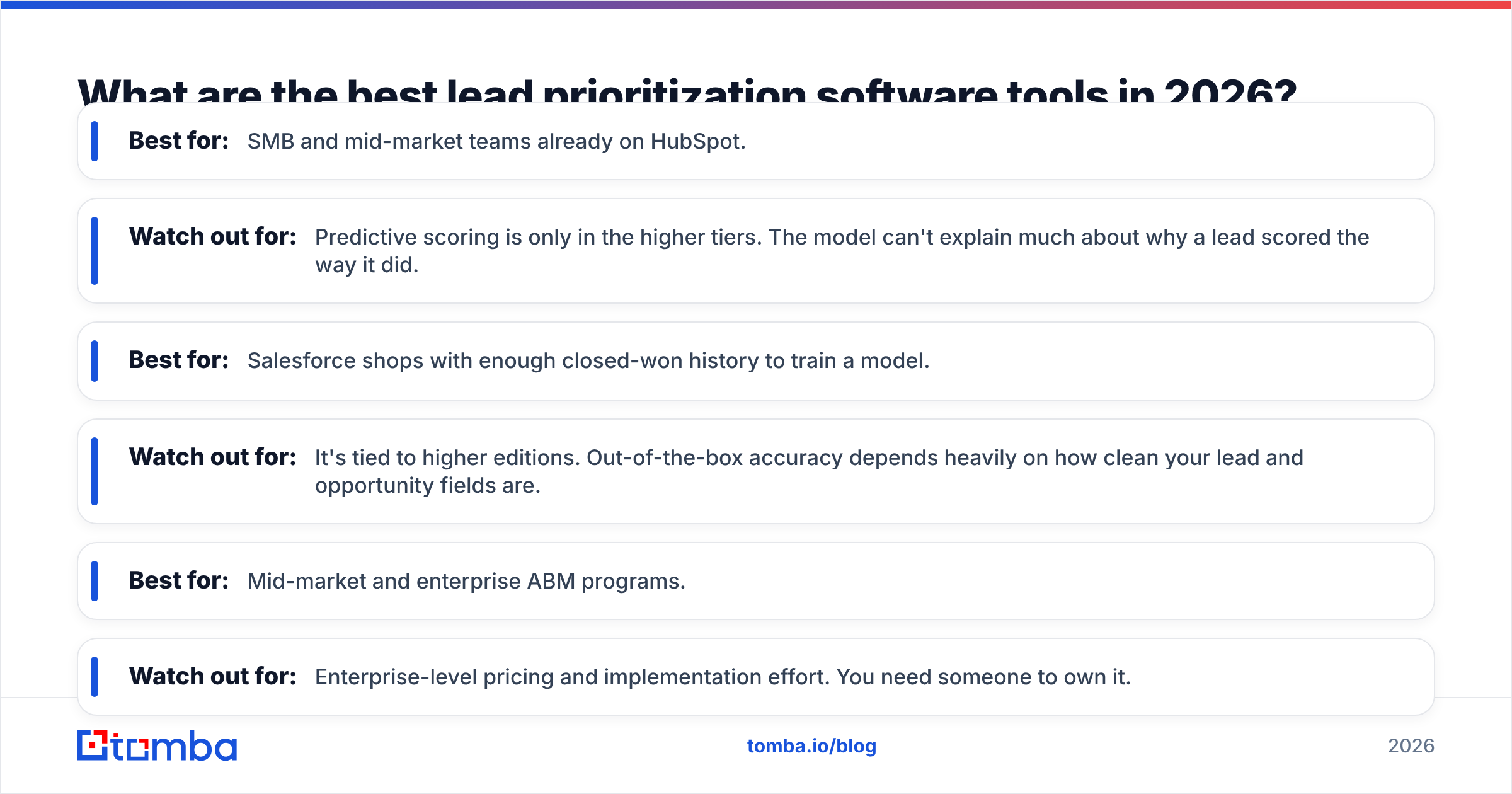
- Best for: SMB and mid-market teams already on HubSpot.
- Watch out for: Predictive scoring is only in the higher tiers. The model can't explain much about why a lead scored the way it did.
2. Salesforce Sales Cloud (Einstein Lead Scoring)#
Einstein Lead Scoring builds a model from your Salesforce history and shows the top factors behind each score. That transparency helps when reps push back ("why is this a 90?"). It runs inside Sales Cloud, so routing and assignment rules can act on the score immediately.
- Best for: Salesforce shops with enough closed-won history to train a model.
- Watch out for: It's tied to higher editions. Out-of-the-box accuracy depends heavily on how clean your lead and opportunity fields are.
3. 6sense#
6sense is an account-based platform built around intent data. It identifies anonymous accounts researching your category, predicts buying stage, and prioritizes accounts rather than individual leads. Its main strength is surfacing demand you didn't know existed.
- Best for: Mid-market and enterprise ABM programs.
- Watch out for: Enterprise-level pricing and implementation effort. You need someone to own it.
4. MadKudu#
MadKudu is a standalone predictive scoring tool that has been especially popular with product-led SaaS companies. It combines fit, behavior and product usage into one score, pushes it into your CRM, and lets RevOps adjust the model.
- Best for: PLG companies with a steady flow of self-serve signups.
- Watch out for: Custom pricing. It's overkill for teams processing a few hundred leads a month.
5. Apollo.io#
Apollo combines a contact database, sequencing and lead scoring. Because the scoring sits next to the data and the outreach, a solo founder or small SDR team can go from scored list to live sequence in one tool.
- Best for: Small outbound teams that want everything in one place.
- Watch out for: Scoring is simpler than dedicated tools. Check contact data accuracy on your own segment before relying on it.
6. Breadcrumbs#
Breadcrumbs focuses on "co-dynamic" scoring: separate fit and activity scores that combine into a matrix (A1, B2, and so on). It's easy for reps to read, and the no-code model builder suits teams without a data scientist.
- Best for: Teams moving from spreadsheet scoring to something structured.
- Watch out for: It depends on integrations for data, so enrichment gaps show up directly in the scores.
7. Pipedrive (AI Sales Assistant + LeadBooster)#
Pipedrive's built-in AI assistant flags deals and leads that need attention, and its add-ons handle lead capture. It isn't a heavy scoring engine, but for a small team it's often enough to stop important leads from slipping.
- Best for: Small sales teams and agencies on Pipedrive.
- Watch out for: Limited modeling depth. You'll outgrow it once volume goes up.
How do these lead prioritization tools compare?#
| Tool | Scoring approach | Intent data | Best fit | Pricing model | Main trade-off |
|---|---|---|---|---|---|
| HubSpot Sales Hub | Rules + predictive (top tiers) | Limited native | SMB / mid-market on HubSpot | Per seat, tiered | Predictive locked to higher tiers |
| Salesforce Einstein | Predictive, explainable factors | Via add-ons | Salesforce orgs with history | Per user, edition-based | Needs clean historical data |
| 6sense | Account-level, intent-led | Yes, core feature | Enterprise ABM | Custom (annual) | Cost and setup effort |
| MadKudu | Predictive fit + behavior + usage | Via integrations | PLG SaaS | Custom | Overkill at low volume |
| Apollo.io | Rules-based, built into prospecting | Basic | Small outbound teams | Per seat, free tier | Lighter scoring depth |
| Breadcrumbs | Fit × activity matrix | Via integrations | Teams outgrowing spreadsheets | Tiered | Depends on data inputs |
| Pipedrive | AI suggestions, light scoring | No | Small teams on Pipedrive | Per seat + add-ons | Limited modeling |
User reviews on G2's lead scoring category are useful for checking implementation effort and support quality, since those are the things that decide whether a scoring tool gets used after the first quarter.
Is predictive lead scoring better than rules-based scoring?#
Only when you have the data to support it. Here's a practical way to decide:
- Fewer than roughly 200 closed-won deals, or a new ICP: Use rules-based scoring. Write down 5-8 signals, weight them by gut and sales feedback, and review them monthly.
- Several hundred wins and stable ICP: Try predictive scoring alongside your rules for one quarter. Compare which score better predicted the deals that actually closed.
- PLG motion with product telemetry: Predictive usually wins quickly, because usage signals are strong and plentiful.
- Enterprise ABM with long cycles: Account-level intent scoring often beats contact-level scoring, because the "lead" isn't one person.
The common mistake is buying predictive scoring to avoid deciding what a good lead looks like. The model will pick up whatever bias your historical data has. If reps only worked big logos, the model will learn that big logos convert.

Why does data quality make or break lead prioritization?#
Every scoring model runs on fields such as title, company size, industry, and a reachable email. When those fields are empty or wrong, three things go wrong:
- Fit scores collapse. A VP of Sales with a blank title field scores like an intern. Your best leads end up in the C tier.
- Engagement scores lie. If 15% of your emails bounce, those leads show zero engagement and get deprioritized, when the real problem is a bad address, not a lack of interest.
- Reps lose trust. After a rep calls three "A" leads and hits a dead number, a wrong person and a bounced email, they stop using the score. Getting that trust back takes much longer than setting up the tool.
The fix happens before scoring:
- Enrich on entry. Run new leads through data enrichment so title, seniority, company size and industry are filled in before the model sees them.
- Verify emails before they count. Invalid and catch-all addresses should be flagged, not scored as "unengaged."
- Fill gaps for high-fit accounts. If an account scores well but you have only one contact, find the rest of the buying committee before handing it to a rep.
- Sync to the CRM automatically. Manual CSV imports go stale within weeks. Use native connectors like a HubSpot integration so enrichment and scoring stay current.
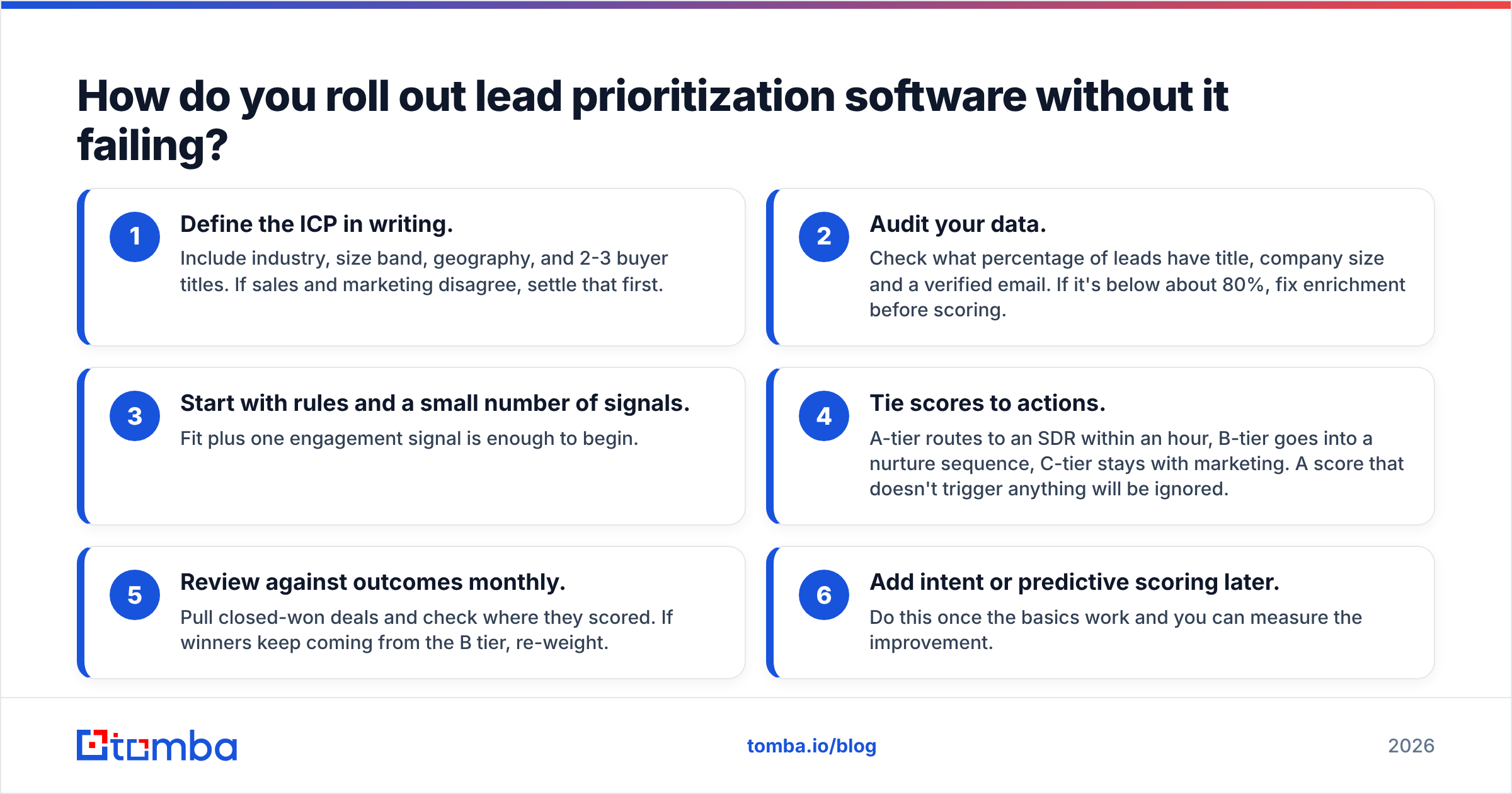
How do you roll out lead prioritization software without it failing?#
Most rollouts fail because of adoption, not technology. This sequence works for teams of 5 to 50 reps:
- Define the ICP in writing. Include industry, size band, geography, and 2-3 buyer titles. If sales and marketing disagree, settle that first.
- Audit your data. Check what percentage of leads have title, company size and a verified email. If it's below about 80%, fix enrichment before scoring.
- Start with rules and a small number of signals. Fit plus one engagement signal is enough to begin.
- Tie scores to actions. A-tier routes to an SDR within an hour, B-tier goes into a nurture sequence, C-tier stays with marketing. A score that doesn't trigger anything will be ignored.
- Review against outcomes monthly. Pull closed-won deals and check where they scored. If winners keep coming from the B tier, re-weight.
- Add intent or predictive scoring later. Do this once the basics work and you can measure the improvement.
If you're choosing a CRM at the same time, Salesforce's overview of lead management explains how scoring connects to routing and assignment. Read it with a vendor's bias in mind.
Which lead prioritization software should you choose?#
Base the decision on your stack and your volume, not on feature lists:
- Already on HubSpot or Salesforce: Use the native scoring first. It's the cheapest option with the fewest integration problems.
- PLG SaaS with product data: Look at MadKudu or a similar tool that takes usage signals as input.
- Enterprise ABM: 6sense or another intent-led platform, as long as you have budget and someone to run it.
- Small outbound team: Apollo or Pipedrive's built-in features will cover you until volume makes a dedicated tool worthwhile.
- Moving off spreadsheets: Breadcrumbs offers a readable fit-and-activity model without data-science overhead.
Whatever you choose, budget for the data layer as well. A $0 scoring feature built on complete, verified data will outperform a six-figure platform that's scoring blank fields.
How do you make sure your top-scored leads are reachable?#
A lead prioritization tool tells you who to contact. It doesn't guarantee you can reach them. That's where Tomba Email Finder fits: once your model marks an account as A-tier, Tomba finds verified professional emails for the decision-makers there by name, domain or company, and flags risky addresses before they damage your engagement scores. It works with HubSpot, Salesforce and Pipedrive, has a free tier of 25 searches a month for testing, and paid plans start at $49/mo. Run your top 50 scored accounts through it this week and see how many of your "best" leads you can actually contact.
Related guides#
// get started
Find, verify and enrich your first contacts today
Start on the free plan with 25 searches a month, then scale when your team is ready.
Free plan · No credit card required · GDPR & CCPA
// about the author