Lead Qualification in 2026: Frameworks, Scoring and Real Examples
Most pipelines don't have a lead problem. They have a qualification problem. Here's how to compare BANT, MEDDIC, CHAMP and GPCTBA/C&I, build a scoring model, and stop giving demo slots to leads that will never buy.
TL;DR
- Lead qualification decides whether a prospect is worth a rep's time. You check fit (can they buy?) and intent (do they want to buy now?) before anyone books a demo.
- BANT still works for simple, transactional deals. MEDDIC or MEDDPICC fits complex enterprise sales. CHAMP and GPCTBA/C&I sit in between and put the buyer's problem first.
- A good process has two layers. Automated scoring handles volume, and a human conversation confirms the leads that pass.
- Bad data breaks qualification before it starts. If the email bounces or the job title is two years out of date, no framework will save the lead.
- Keep it simple. Pick one framework, set 5 to 8 scoring criteria, agree on MQL and SQL definitions with marketing, and review conversion rates every quarter.
What is lead qualification?#
Lead qualification is how you decide whether a contact or account is likely to become a paying customer and deserves active sales effort. It works like a filter between lead generation and the sales pipeline.
Picture a hospital triage nurse. Not everyone in the waiting room needs the surgeon right away. Some need a prescription, some need to come back next week, and a few need attention now. Qualification does the same job for your pipeline, so your most expensive resource (an account executive's calendar) goes to the leads most likely to close.
In practice, qualification answers two questions:
- Fit: Does this company and person match your ideal customer profile (ICP)? Think industry, headcount, tech stack, geography, and whether the contact has buying authority.
- Intent and timing: Do they have a problem you solve, and are they trying to solve it now?
A lead that passes on fit but fails on timing goes into nurture. A lead that shows intent but fails on fit, like a student downloading your whitepaper, gets disqualified. You only want leads that pass both checks in front of a rep.
Most teams track this with lifecycle stages in their CRM: subscriber, lead, marketing qualified lead (MQL), sales qualified lead (SQL), opportunity. If you want the broader context of where qualification fits, the lead generation overview on Wikipedia covers the upstream half of the funnel.
Why does lead qualification matter so much in 2026?#
Qualification matters because generating leads has become cheap and a rep's time hasn't. Intent data, AI SDRs, and cheap enrichment let almost any team fill a CRM with thousands of contacts in an afternoon. Nobody has made the number of good conversations a rep can have per week any bigger.
Skipping qualification costs you in three ways:
- Wasted demo slots. A 45-minute discovery call with a company that has no budget is a lost slot you could have given a real buyer.
- Forecast damage. Unqualified opportunities sit in the pipeline for months and inflate coverage ratios. Leadership plans hiring on numbers that were never real.
- Sender reputation damage. Blasting unverified, unqualified lists gets you bounces and spam complaints, and those hurt deliverability for every future campaign.

The fix isn't more leads. You need a clear, repeatable way to say "yes," "not yet," or "no" to each one.
What are the main lead qualification frameworks?#
There are five frameworks worth knowing. Each one is a checklist of questions a rep works through, either in discovery or before it.
- BANT (Budget, Authority, Need, Timeline). IBM created it in the 1960s and it's still the most widely taught. It's quick and simple, and it works best when the deal is transactional and the buyer already knows what they want.
- MEDDIC / MEDDPICC (Metrics, Economic buyer, Decision criteria, Decision process, Identify pain, Champion, plus Paper process and Competition). This is the enterprise standard. It maps the whole buying committee and the internal approval path, which matters when a deal has 6 to 10 stakeholders.
- CHAMP (Challenges, Authority, Money, Prioritization). A reworked BANT that starts with the buyer's problem instead of their budget. That makes the first conversation feel less like an interrogation.
- GPCTBA/C&I (Goals, Plans, Challenges, Timeline, Budget, Authority, Negative Consequences, Positive Implications). HubSpot's inbound-era framework. It's detailed and consultative, and it works well for mid-market solution selling.
- ANUM (Authority, Need, Urgency, Money). Similar to BANT but puts authority first. It's useful when you sell into organizations where reaching the right person is the hardest step.
How do the frameworks compare side by side?#
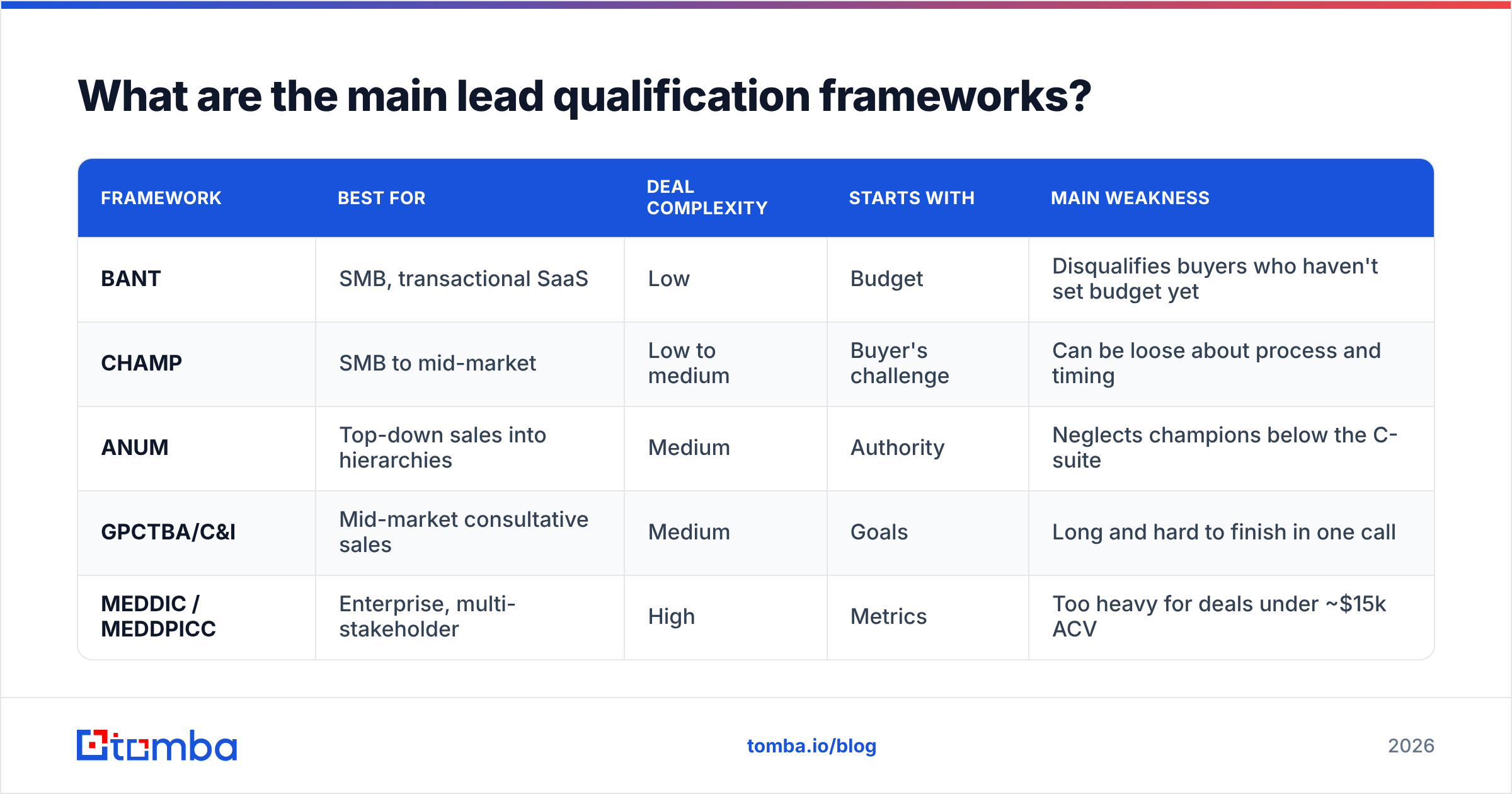
| Framework | Best for | Deal complexity | Starts with | Main weakness |
|---|---|---|---|---|
| BANT | SMB, transactional SaaS | Low | Budget | Disqualifies buyers who haven't set budget yet |
| CHAMP | SMB to mid-market | Low to medium | Buyer's challenge | Can be loose about process and timing |
| ANUM | Top-down sales into hierarchies | Medium | Authority | Neglects champions below the C-suite |
| GPCTBA/C&I | Mid-market consultative sales | Medium | Goals | Long and hard to finish in one call |
| MEDDIC / MEDDPICC | Enterprise, multi-stakeholder | High | Metrics | Too heavy for deals under ~$15k ACV |
A simple rule of thumb: match the framework to your sales cycle length. If deals close in under 30 days, BANT or CHAMP is enough. If they take 3 to 9 months and involve procurement, you need MEDDPICC-style rigor or your forecast will slip.
Is BANT still relevant, or is MEDDIC better?#
BANT is still relevant, but only for the right deal size. MEDDIC isn't "better." It solves a different problem.
BANT's biggest flaw is the budget question. Many modern buyers don't have a budget line for your category until you've shown them the problem is worth solving. If a rep disqualifies every lead that says "we haven't budgeted for this," the pipeline loses real opportunities. That's why CHAMP moved "money" later in the conversation and put the challenge first.
MEDDIC's flaw is the opposite: it's expensive to run. Mapping an economic buyer, a champion, and a paper process for a $3,000/year self-serve deal is overkill, and reps will quietly stop filling in the fields.
Many teams now use a hybrid:
- Marketing and SDRs qualify with a light BANT or CHAMP pass (4 questions, one call or a form).
- Account executives take accepted SQLs into a MEDDPICC-style discovery for anything above a set deal-size threshold.
This splits the work between the people who handle volume and the people who handle depth, and it keeps your CRM fields consistent across stages.
How does lead scoring fit into qualification?#
Lead scoring is the automated first half of qualification. It assigns points based on fit and behavior so only leads above a threshold reach a human. Frameworks like BANT are the conversational second half.
Most CRMs support this natively. HubSpot's CRM and Salesforce both let you build rule-based or predictive scores. The math is simple. What makes a model useful is picking the right signals and weighting them honestly.
What does a practical lead scoring model look like?#
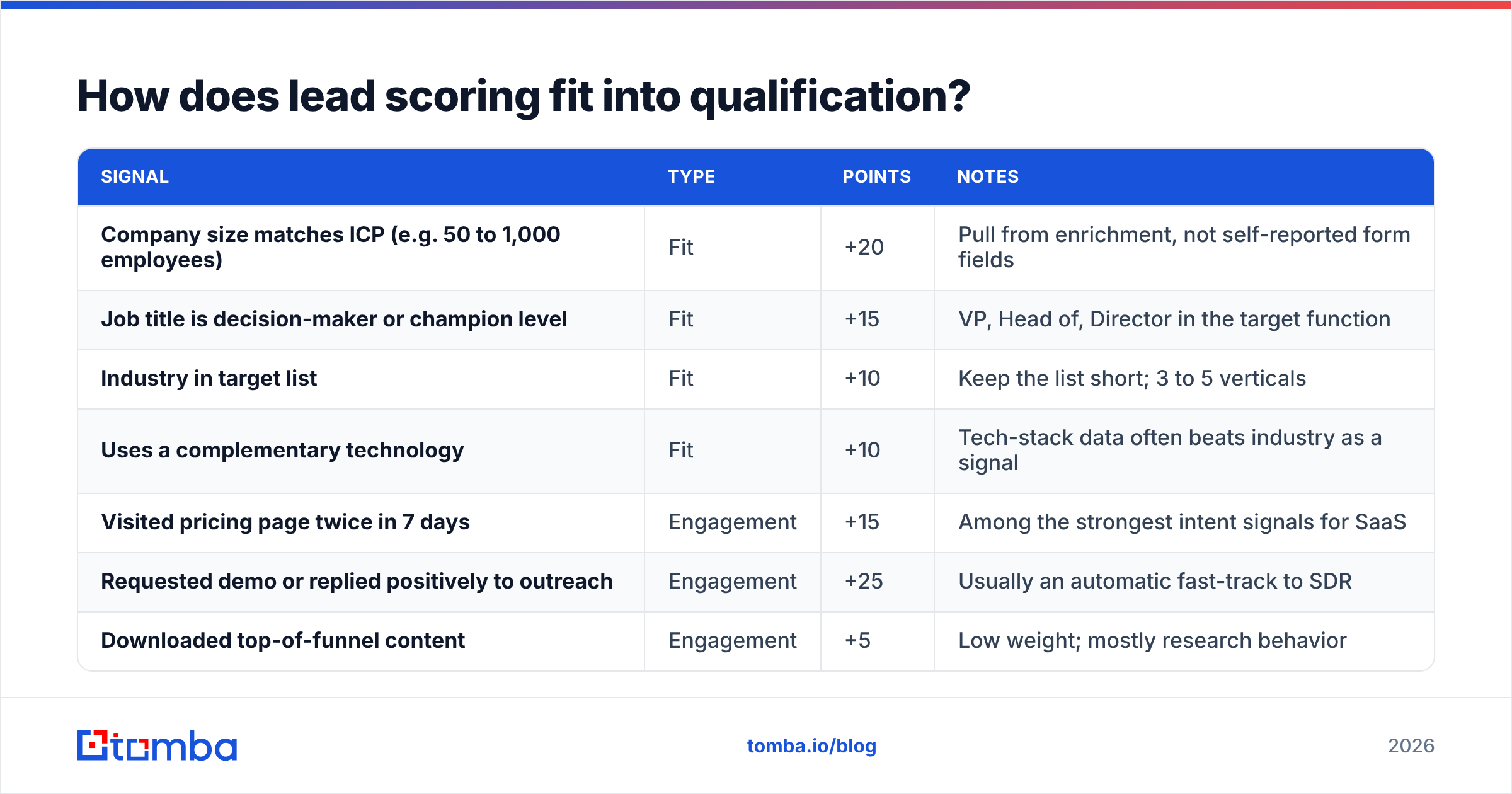
Here's a starter template you can adapt. It separates fit (who they are) from engagement (what they've done), because a perfect-fit account that has never engaged is a prospecting target, not an MQL.
| Signal | Type | Points | Notes |
|---|---|---|---|
| Company size matches ICP (e.g. 50 to 1,000 employees) | Fit | +20 | Pull from enrichment, not self-reported form fields |
| Job title is decision-maker or champion level | Fit | +15 | VP, Head of, Director in the target function |
| Industry in target list | Fit | +10 | Keep the list short; 3 to 5 verticals |
| Uses a complementary technology | Fit | +10 | Tech-stack data often beats industry as a signal |
| Visited pricing page twice in 7 days | Engagement | +15 | Among the strongest intent signals for SaaS |
| Requested demo or replied positively to outreach | Engagement | +25 | Usually an automatic fast-track to SDR |
| Downloaded top-of-funnel content | Engagement | +5 | Low weight; mostly research behavior |
| Personal email domain (gmail, yahoo) | Negative | -15 | Common among students, job seekers, competitors |
| Email bounces or fails verification | Negative | -30 | Not reachable, so not qualified |
| Competitor or existing customer domain | Negative | Disqualify | Route to the right team instead |
Set the MQL threshold, for example 50 points, and then test it against closed-won deals from the last two quarters. If half of your won customers would have scored below 50, your weights are off.
One common mistake is scoring engagement heavily and fit lightly. That rewards curious people over likely buyers. A student who reads twelve blog posts shouldn't outscore a VP of Sales at a 400-person target account who visited the pricing page once.
Why does data quality make or break lead qualification?#
Every scoring rule and framework question depends on the data underneath it. If the data is wrong, the qualification decision is wrong too, and nobody notices until a rep burns an hour on it.
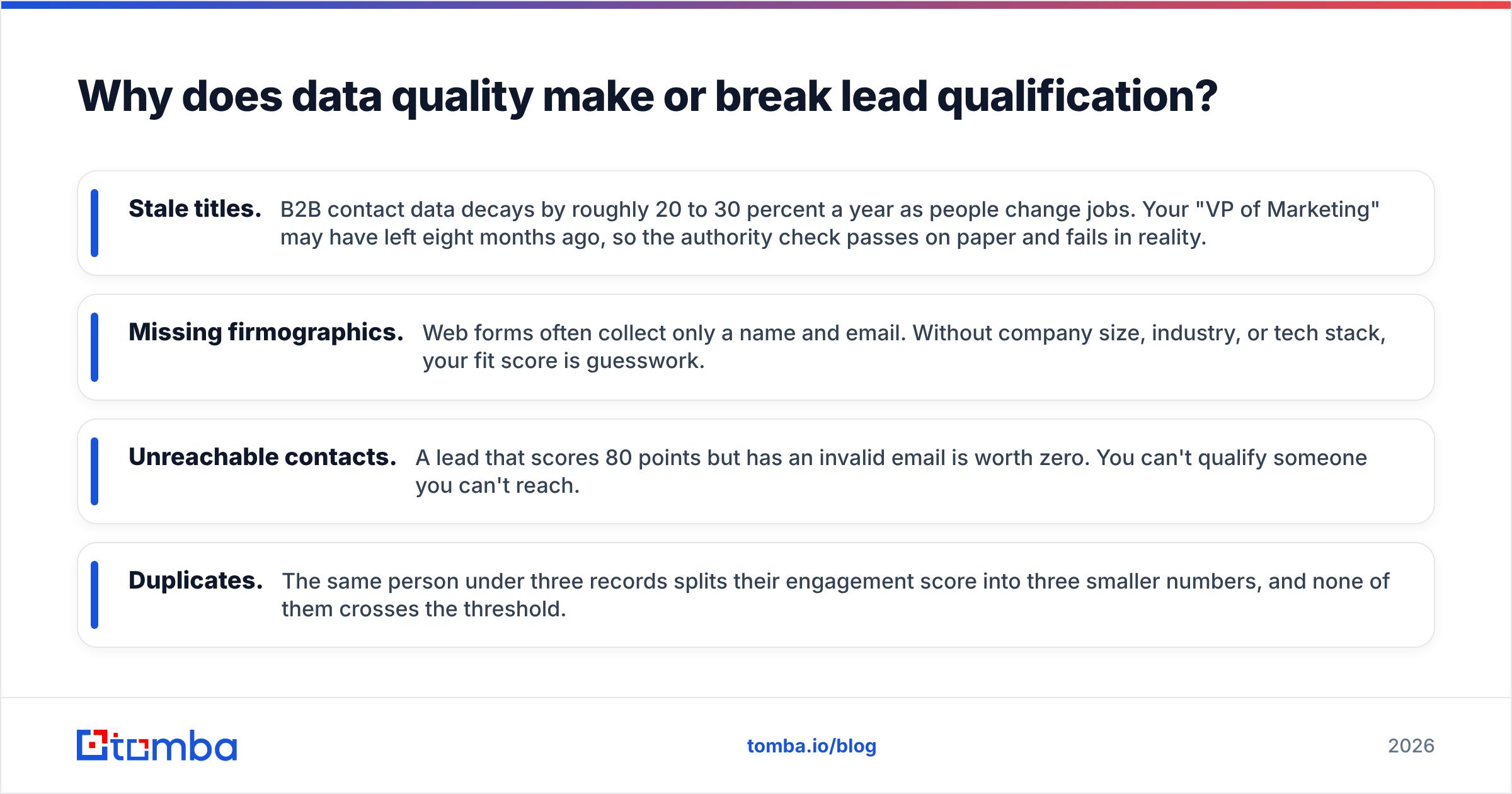
The usual failures:
- Stale titles. B2B contact data decays by roughly 20 to 30 percent a year as people change jobs. Your "VP of Marketing" may have left eight months ago, so the authority check passes on paper and fails in reality.
- Missing firmographics. Web forms often collect only a name and email. Without company size, industry, or tech stack, your fit score is guesswork.
- Unreachable contacts. A lead that scores 80 points but has an invalid email is worth zero. You can't qualify someone you can't reach.
- Duplicates. The same person under three records splits their engagement score into three smaller numbers, and none of them crosses the threshold.
That's why the stronger qualification workflows run enrichment and verification before scoring, not after. You enrich the lead with firmographic and role data, and you verify the email so reachability is confirmed. Then the scoring model has clean inputs to work with.
A few questions to ask whichever data provider you use (Tomba, BookYourData, Apollo, ZoomInfo, or a CRM-native option):
| Question | Why it matters for qualification |
|---|---|
| How often are records refreshed? | Stale titles break authority checks |
| Is email verification real-time or cached? | Cached results can be months old |
| How are catch-all domains handled? | Many enterprise domains accept everything, so "valid" can mislead |
| Can enrichment run automatically on CRM create? | Manual enrichment gets skipped under pressure |
| Is company-level data (headcount, tech) included? | Fit scoring needs firmographics, not just contacts |
Tomba's data enrichment fills in role, company, and social data from a single email or domain. It's a reasonable fit if your inbound forms collect little and you need fit data before the score calculates. BookYourData is a solid peer to evaluate, especially if you prefer building pre-filtered lists by industry and title before outreach. Pick whichever matches how your leads enter the funnel.
How do you build a lead qualification process step by step?#
Here's a process a small RevOps team can set up in about two weeks.
- Write down your ICP in one page. List industry, headcount range, geography, the 2 to 3 job titles that buy, and 2 to 3 disqualifiers. Base it on your best 20 customers, not your aspirations.
- Agree on MQL and SQL definitions with marketing and sales in writing. For example: "MQL = score ≥ 50 with at least 25 fit points. SQL = MQL plus a confirmed need and a conversation scheduled within 30 days." If the two teams disagree on these definitions, pipeline reviews turn into arguments.
- Automate enrichment and verification at lead creation. Every new record should be enriched and have its email verified before the score runs. Most CRMs can trigger this through a native integration or Zapier/Make.
- Build the scoring model with negative scoring. Include the disqualifiers from the table above. Negative points matter as much as positive ones.
- Pick one conversational framework for SDRs. BANT or CHAMP for most teams. Turn it into 4 to 6 required CRM fields so the qualification is recorded, not just remembered.
- Set an SLA. Hot leads (demo requests, pricing-page repeats) get a response within 5 to 15 minutes during business hours. Speed-to-lead still has a large effect on connect rates.
- Define the "not yet" path. Leads that fit but aren't ready go into a nurture sequence with a re-score trigger. They shouldn't sit forgotten in a rep's queue.
- Review monthly, recalibrate quarterly. Track MQL-to-SQL rate, SQL-to-opportunity rate, and win rate by lead source and score band. Change the weights based on what actually closed.
What are the most common lead qualification mistakes?#
You can avoid most of these with some discipline. They show up in almost every pipeline audit.
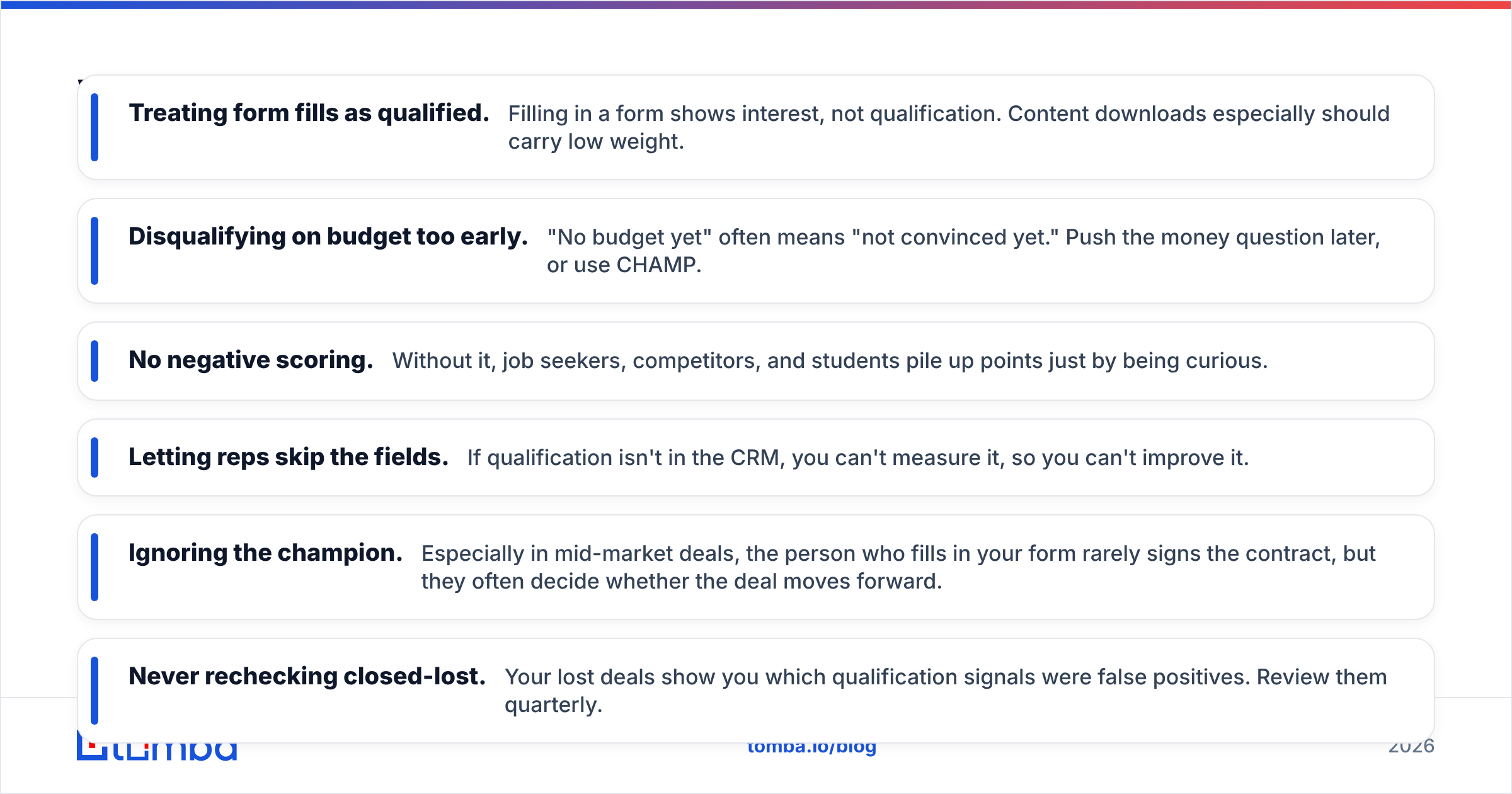
- Treating form fills as qualified. Filling in a form shows interest, not qualification. Content downloads especially should carry low weight.
- Disqualifying on budget too early. "No budget yet" often means "not convinced yet." Push the money question later, or use CHAMP.
- No negative scoring. Without it, job seekers, competitors, and students pile up points just by being curious.
- Letting reps skip the fields. If qualification isn't in the CRM, you can't measure it, so you can't improve it.
- Ignoring the champion. Especially in mid-market deals, the person who fills in your form rarely signs the contract, but they often decide whether the deal moves forward.
- Never rechecking closed-lost. Your lost deals show you which qualification signals were false positives. Review them quarterly.
- Qualifying on unverified data. A beautifully scored lead with a bounced email or an outdated title is still a bad lead.
Gartner's research on B2B buying behavior keeps finding that buyers spend only a small share of their journey talking to vendors. So the conversations you do get with prospects are scarce. Spend them on leads you've actually qualified.
How do you know your lead qualification is working?#
Track four numbers and compare them over time, not against industry averages:
- MQL-to-SQL conversion rate. If it's below roughly 15 to 20 percent, marketing's threshold is probably too loose. If it's above 50 percent, you may be qualifying too strictly and leaving pipeline on the table.
- SQL-to-opportunity rate. A drop usually means SDRs are passing leads without confirming need.
- Average sales cycle by score band. High-score leads should close faster. If they don't, your scoring model is measuring the wrong things.
- Win rate by source. It shows which channels bring leads that are actually qualified, not just lots of them.
If all four improve over two quarters, your process works. If only lead volume goes up, you've built a bigger funnel, not a better one.
Where should you start?#
Start with data, then add the framework. The conversational layer (BANT, CHAMP, MEDDPICC) only works if the lead in front of the rep is real, reachable, and at a company that fits. That groundwork is the enrichment and verification step, and it's the easiest one to automate.
If your qualification keeps stalling because contacts are missing, emails bounce, or you can't identify the actual decision-maker at a target account, Tomba Email Finder is a practical first fix. Search by name and company or by domain to find the verified professional address of the buyer your framework says you need, whether that's the economic buyer, the champion, or the VP your scoring model rewards. You can start on the free plan with 25 searches a month and check the fit against your own ICP before you commit to a paid tier.
Related guides#
// get started
Find, verify and enrich your first contacts today
Start on the free plan with 25 searches a month, then scale when your team is ready.
Free plan · No credit card required · GDPR & CCPA
// about the author